What's inside
As an Amazon Associate I earn from qualifying purchases. This post may contain affiliate links at no extra cost to you.
A ceiling full of music and a voice that controls it from anywhere in the room is one of the most satisfying upgrades a house can have, and it is also one of the most misunderstood, because the way Alexa controls a ceiling system is different from the way it controls a smart speaker on a counter. An in-ceiling speaker is passive, which means it has no amplifier and no electronics of its own, so the voice control lives in a separate Echo device, the power lives in an amplifier, and the ceiling speakers are the voice that fills the room. This guide compares six in-ceiling speakers that work with Alexa, from the value-packed Micca M-8C to the superb Sonos In-Ceiling by Sonance, and it explains how the pieces fit together.
Every speaker here is a real, widely sold model, chosen because it sounds good in a ceiling and because it works with the way Alexa actually controls a system, whether that is an Echo Dot and a small amplifier, a Lithe Audio speaker with a built-in amplifier, or a Sonos Amp with Alexa built in. None of them is a smart speaker pretending to be a ceiling speaker, and none of them requires a complicated installation for a single room, although a whole-house system benefits from professional help. What they do is put the music in the ceiling and the control in your voice, and that is a worthwhile thing in a modern home.
Quick picks: best ceiling speakers for alexa
| # | Product | Where to buy |
|---|---|---|
| 1 | Polk Audio RC80i | Check on Amazon |
| 2 | Lithe Audio Bluetooth Ceiling Speaker | Check on Amazon |
| 3 | Sonos In-Ceiling by Sonance | Check on Amazon |
| 4 | Micca M-8C | Check on Amazon |
| 5 | Klipsch CDT-5650-C II | Check on Amazon |
| 6 | Yamaha NS-IC800 | Check on Amazon |
Quick Comparison
The table below gives a fast overview of the models in this guide, so you can shortlist two or three before reading the detail. Every model here is a real, widely sold product, and each one suits a slightly different room, system, or way of listening.
| Speaker | Type | Best For |
|---|---|---|
| Polk Audio RC80i | 8-inch in-ceiling, Echo + amp | Best all-round Alexa ceiling speaker |
| Lithe Audio Bluetooth Ceiling Speaker | 6.5-inch, built-in amp, Bluetooth | Best true wireless Alexa option |
| Sonos In-Ceiling by Sonance | 6.5-inch, Sonos Amp, Alexa built in | Best sound, full Alexa control |
| Micca M-8C | 8-inch in-ceiling, budget pair | Best budget Alexa ceiling speaker |
| Klipsch CDT-5650-C II | 6.5-inch in-ceiling, horn tweeter | Best for clear voice responses |
| Yamaha NS-IC800 | 8-inch in-ceiling, sealed back | Best for sound quality |
The Products in Detail
Polk Audio RC80i
The Polk Audio RC80i is an 8-inch two-way in-ceiling speaker that is the natural starting point for an Alexa-controlled ceiling system, and the reason is simple: it sounds good, it is easy to install, and it works with the way Alexa actually controls a ceiling system. In-ceiling speakers are passive, which means they need an amplifier, and the usual Alexa setup pairs a pair of RC80i speakers with a small amplifier and an Echo Dot, so a voice command to the Echo plays music through the ceiling. The RC80i’s warm, full sound and its aimable tweeter make it the best speaker for that arrangement.
The RC80i sounds warm and full, with a bass response that is deeper than most in-ceiling speakers thanks to the large 8-inch woofer, and a midrange that keeps music and Alexa’s responses clear and intelligible. The aimable tweeter is a genuine advantage in a ceiling system, because it lets the installer direct the treble toward the listening area rather than letting it fire straight down at an empty patch of floor. Polk designs the RC series for easy installation, with a rotating cam system that clamps the speaker to the ceiling from below, so no access from above is needed, and the speaker is sold in pairs, which keeps the cost of a multi-room Alexa system manageable.
Strengths: Deep, full sound for an in-ceiling speaker, with a large 8-inch woofer that gives real bass weight. The aimable tweeter directs the sound where it is needed, and the moisture-resistant build suits kitchens and bathrooms, which are the rooms where Alexa gets used most. Installation is straightforward, and the price is accessible for a multi-room system.
Trade-offs: The speaker is passive, so it needs an amplifier and an Echo device, which adds cost and complexity compared with a smart speaker that works on its own. The sound is warm rather than detailed, so it suits background music rather than critical listening. It needs a ceiling void of sufficient depth.
Who it fits: Homeowners building an Alexa-controlled ceiling system in a kitchen, a living room, or a bedroom, with a small amplifier and an Echo Dot driving a pair of speakers. It suits anyone who wants music in the ceiling and voice control on the counter, without a speaker sitting on a shelf.
Ask Alexa to play a favourite track and notice how the music fills the room from above, with no obvious hot spot under one speaker and no dead zone between them. Then ask for the weather and notice how clear the voice response stays, because intelligibility is the point of a ceiling system.
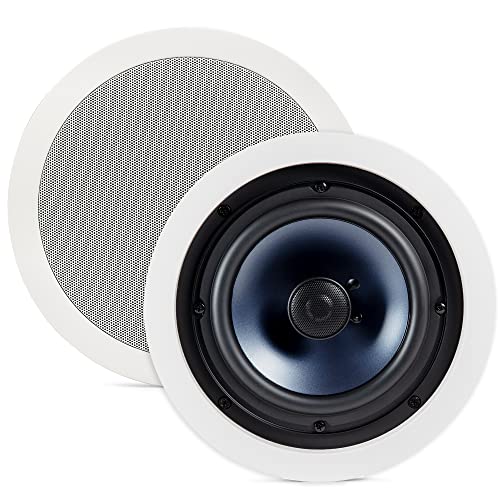
Lithe Audio Bluetooth Ceiling Speaker
The Lithe Audio Bluetooth Ceiling Speaker is the only speaker in this guide with a built-in amplifier, and that changes the whole equation for an Alexa system. Instead of a separate amplifier and a tangle of speaker cable, the Lithe speaker connects directly to mains power, pairs with an Echo Dot over Bluetooth, and plays music through its own built-in amplifier, with a second passive speaker connected to it for stereo sound. It is the closest thing to a wireless ceiling speaker that actually exists, and it is the simplest way to put Alexa music in a ceiling.
The Lithe speaker sounds clear and balanced, with a 6.5-inch woven glass-fibre woofer and a titanium dome tweeter that give it a detailed, modern character, and a built-in amplifier that delivers enough power for a kitchen, a bathroom, or a bedroom. The Bluetooth connection pairs with an Echo Dot, so a voice command to the Echo plays music through the ceiling, and the speaker can be linked with other Lithe speakers for multi-room audio. It needs mains power, which means an electrician should install it, but once it is in the ceiling there is no separate amplifier to hide and no speaker cable to run back to a central location.
Strengths: Built-in amplifier means no separate amp and no speaker cable back to a central location, which simplifies the installation enormously. The sound is clear and detailed, with a modern character that suits streaming music. It pairs with an Echo Dot over Bluetooth, and it links with other Lithe speakers for multi-room audio.
Trade-offs: It needs mains power, so installation by an electrician is recommended, which adds cost. The speaker is more expensive than a passive model, and it is a single-brand system, so expanding it means buying more Lithe speakers. The Bluetooth connection depends on the Echo Dot, so the range matters.
Who it fits: Homeowners who want the simplest Alexa ceiling system, with no separate amplifier and no long cable runs, especially in a kitchen or a bathroom where a mains-powered ceiling speaker makes sense. It suits renovations and new builds where the ceiling is open and the power can be run easily.
Ask Alexa to play a favourite track and notice how quickly the music starts, with no amplifier to switch on and no delay. Then walk around the room and notice how evenly the sound spreads, because the ceiling placement and the built-in amplifier work together to fill the space.
Check price on Amazon: Polk Audio RC80i

Sonos In-Ceiling by Sonance
The Sonos In-Ceiling by Sonance is a 6.5-inch in-ceiling speaker designed in partnership between Sonos and Sonance, and it is the pick here for buyers who want the best sound and the most complete Alexa control in a ceiling system. It pairs with a Sonos Amp, which is a network amplifier with Alexa voice control built in, so the system streams music directly over Wi-Fi, responds to voice commands, and groups with other Sonos speakers in the house for multi-room audio. It is the most capable system in this guide, and the most expensive, but it is also the most complete.
The Sonos In-Ceiling speaker sounds superb, with a clarity and a detail that few in-ceiling speakers match, and a bass response that is tight and controlled for the size. The Sonos Amp is the key to the system: it streams music over Wi-Fi, so the sound is not limited by Bluetooth, and it has Alexa built in, so a voice command controls the music, the volume, and the grouping without a separate Echo device. The speakers are designed to be true to the Sonos sound, with a paintable grille that blends into the ceiling, and the system can be expanded room by room as the budget allows.
Strengths: Superb sound quality, with a clarity and a detail that few in-ceiling speakers match. The Sonos Amp has Alexa built in and streams over Wi-Fi, so the system is fast, reliable, and easy to control by voice. Multi-room grouping works seamlessly, and the system expands room by room as the budget allows.
Trade-offs: It is the most expensive system in this guide, because the Sonos Amp is a significant purchase on top of the speakers. The system is tied to the Sonos platform, so it works best for buyers who already use Sonos or who are happy to commit to it. Installation needs a Sonos Amp and a network connection.
Who it fits: Homeowners who want the best-sounding Alexa ceiling system and are willing to pay for it, especially those who already use Sonos or who plan a whole-house system. It suits living rooms, kitchens, and any space where the music matters and the budget allows a premium solution.
Ask Alexa to play a favourite track and notice how quickly the music starts and how clear and detailed it sounds, with the stereo image spread across the ceiling. Then group the room with another Sonos speaker and notice how seamlessly the music follows you from room to room.
Check price on Amazon: Lithe Audio Bluetooth Ceiling Speaker

Micca M-8C
The Micca M-8C is an 8-inch two-way in-ceiling speaker that earns its place in this guide through value, and it is the pick for a homeowner who wants Alexa music in the ceiling on a tight budget. It pairs an 8-inch polypropylene woofer with a 1-inch silk-dome tweeter in a simple, well-engineered design, and it works with the usual Alexa arrangement: a small amplifier and an Echo Dot, with a voice command to the Echo playing music through the ceiling. For a house that needs several rooms covered, the difference between the Micca and a premium brand adds up to a substantial saving.
The M-8C sounds clear and balanced for its size, with a midrange that keeps music and Alexa’s responses intelligible and a bass response that is full enough for background music in a kitchen or a living room. The large woofer moves plenty of air, which gives the sound a weight that smaller in-ceiling speakers lack, and the tweeter stays smooth at the volumes a home actually uses. Micca designs the M-8C for easy installation, with a template and a clamp system that a competent installer can fit quickly, and the speaker is sold in pairs, which keeps the cost of a multi-room Alexa system under control.
Strengths: Very affordable, which makes it possible to cover several rooms with Alexa ceiling speakers on a small budget. The sound is clear and balanced, with good intelligibility for music and voice responses. Installation is straightforward, and the large 8-inch woofer gives more bass than most budget in-ceiling speakers.
Trade-offs: Detail and refinement are a step behind the premium speakers in this guide, and the sound is pleasant rather than detailed. The speaker is passive, so it needs an amplifier and an Echo device, and it needs a ceiling void of sufficient depth. The build is functional rather than premium.
Who it fits: Homeowners on a tight budget who want Alexa music in several rooms, and anyone fitting out a new house or a renovation where the speaker count matters more than the last few percent of sound quality. It suits kitchens, bedrooms, and living rooms where the music should be present but never intrusive.
Ask Alexa to play a favourite track and notice how evenly the sound fills the room, with no obvious gap in coverage. Then listen to a track with a clear vocal and notice how natural the voice sounds, which is the mark of a well-engineered budget speaker.
Check price on Amazon: Sonos In-Ceiling by Sonance
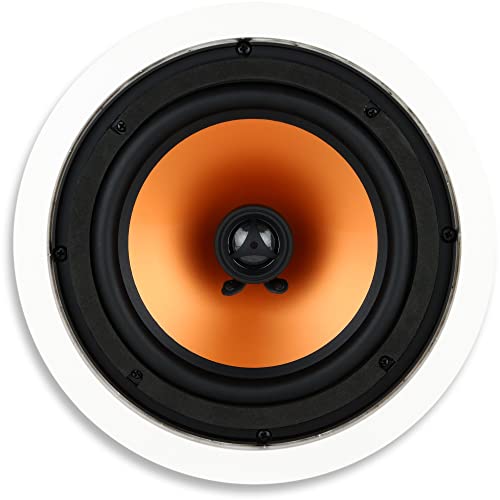
Klipsch CDT-5650-C II
The Klipsch CDT-5650-C II is a 6.5-inch two-way in-ceiling speaker from Klipsch’s Custom Designer series, and it is the pick here for an Alexa system where voice clarity matters as much as music. It pairs a 6.5-inch Cerametallic woofer with a 1-inch titanium tweeter in a horn, with a pivoting tweeter and a controlled dispersion design that directs the sound toward the listening area. Klipsch’s horn-loaded tweeter gives the speaker a clarity and a presence that conventional dome tweeters struggle to match, which is exactly what Alexa’s spoken responses need.
The CDT-5650-C II sounds dynamic and clear, with a midrange that keeps voices intelligible even in a noisy kitchen, and a treble that is detailed without turning harsh. The horn tweeter is the key feature: it controls the dispersion of the sound, so more of it reaches the listener and less of it bounces around the ceiling, which improves intelligibility in a large, reflective room. The speaker is efficient, so it plays loud on modest amplifier power, and it works with the usual Alexa arrangement of a small amplifier and an Echo Dot, with a paintable grille that blends into the ceiling.
Strengths: Excellent vocal clarity, with a horn tweeter that keeps Alexa’s responses intelligible in a noisy room. The controlled dispersion directs the sound where it is needed, and the high efficiency means loud, clean sound on modest amplifier power. Build quality is strong, and the speaker is easy to install.
Trade-offs: The horn sound is forward and lively, which suits announcements and energetic music but may not suit a room that wants a soft, background atmosphere. Bass depth is good for the size but not deep, and the speaker costs more than the budget models in this guide.
Who it fits: Homeowners who use Alexa heavily for voice responses, timers, and information, and who want those responses to be clear from anywhere in the room. It suits kitchens, living rooms, and any space where the spoken word needs to cut through the background noise.
Ask Alexa a question and notice how clear and intelligible the response stays, even from the far side of the room. Then play a track with a strong beat and notice the dynamics: the CDT-5650-C II should sound lively and present, with no sense of strain.
Check price on Amazon: Micca M-8C

Yamaha NS-IC800
The Yamaha NS-IC800 is an 8-inch two-way in-ceiling speaker that brings Yamaha’s long experience in both hi-fi and professional audio to an Alexa ceiling system, and it is the pick here for owners who care about sound quality as well as voice control. It pairs an 8-inch polypropylene mica woofer with a 1-inch balanced-dome tweeter, with a sealed-back design that keeps the sound consistent regardless of what is above the ceiling, which matters in a house where the void above may be full of ducts, pipes, and insulation.
The NS-IC800 sounds clean and detailed, with a midrange that is more refined than most in-ceiling speakers and a treble that stays smooth and airy at the volumes a home uses. The sealed-back design is the key feature: it isolates the speaker from the ceiling void, so the bass stays tight and controlled instead of changing with the size and the contents of the space above, and it keeps sound from leaking into the room upstairs. It works with the usual Alexa arrangement of a small amplifier and an Echo Dot, and Yamaha builds it to a high standard, with a paintable grille and a mounting system that clamps securely from below.
Strengths: Clean, detailed sound with a refined midrange and a smooth treble, which suits a home where the music matters. The sealed-back design keeps the sound consistent regardless of the ceiling void, and it reduces sound leakage to the floor above. Build quality is excellent, and the speaker is easy to install.
Trade-offs: It costs more than the budget speakers in this guide, which adds up across a multi-room installation. Bass depth is good but not as deep as the largest in-ceiling speakers, and it is a passive speaker, so it needs an amplifier and an Echo device.
Who it fits: Homeowners who value sound quality and want the music to sound good, not just present, especially in a house where the ceiling void is unpredictable. It suits living rooms, bedrooms, and any space where the atmosphere matters and Alexa is part of daily life.
Ask Alexa to play a well-recorded track and notice the clarity of the midrange and the air around the instruments, which is where the NS-IC800 earns its keep. Then check the room above, if there is one, and notice how little sound leaks through, which is the benefit of the sealed-back design.
Check price on Amazon: Klipsch CDT-5650-C II

How Alexa Controls a Ceiling System
It is worth understanding how Alexa actually controls a ceiling system, because the arrangement is different from a smart speaker sitting on a counter, and the difference decides what you need to buy. An in-ceiling speaker is passive, which means it has no amplifier and no electronics of its own, so it cannot hear a voice command or connect to a network. The voice control lives in a separate device, usually an Echo Dot, which hears the command and sends the music to an amplifier, and the amplifier drives the ceiling speakers. The Echo is the brain, the amplifier is the muscle, and the ceiling speakers are the voice.
There are two exceptions to that arrangement, and they are worth knowing about. The Lithe Audio Bluetooth ceiling speaker has a built-in amplifier, so it needs only an Echo Dot and mains power, with no separate amplifier to hide. The Sonos In-Ceiling system goes further, because the Sonos Amp has Alexa built in, so the amplifier itself hears the commands and streams the music over Wi-Fi, with no separate Echo device at all. Both are simpler than the standard arrangement, and both cost more, so the choice is between simplicity and price, and the right answer depends on how many rooms you are covering.
Check price on Amazon: Yamaha NS-IC800
Where to Put the Echo
The placement of the Echo device matters more than most buyers expect, because the Echo has to hear a voice command from anywhere in the room, and a ceiling speaker system can make that harder. A room with music playing from the ceiling is a noisy room, and an Echo sitting next to a speaker will struggle to hear a command over the music, which is why the Echo should sit away from the speakers, on a counter or a shelf where it has a clear path to the listener. The kitchen counter is the usual choice, because it is where the cook stands, and it is far enough from the ceiling speakers to hear clearly.
The second placement question is the room itself, because Alexa works best when each room has its own Echo and its own pair of speakers, with the rooms grouped in the Alexa app for multi-room audio. A single Echo trying to control speakers in two rooms will confuse the system, and a room with no Echo of its own cannot be controlled by voice at all. Plan one Echo per room, put it where the listener stands, and the system will respond reliably, even with the music playing.
Multi-Room Alexa: One House, Many Ceilings
The real pleasure of an Alexa ceiling system appears when it covers the whole house, because the music follows you from room to room without a speaker in sight. Each room has its own Echo device and its own pair of ceiling speakers, and the rooms are grouped in the Alexa app, so a single voice command starts the same music everywhere, or different music in different rooms, depending on what the house needs. A dinner party gets the same playlist in the kitchen and the dining room, while a quiet evening gets jazz in the living room and a podcast in the bedroom, and the change takes a sentence rather than a walk around the house.
The practical side of a multi-room system is the planning, because each room needs power for its amplifier, a network connection for its Echo, and a pair of speakers in the ceiling, and the cost adds up room by room. Start with the rooms where music matters most, usually the kitchen and the living room, and add the bedrooms and the bathroom later, when the budget allows. The system grows naturally, room by room, and each new room makes the whole house feel more complete, which is the reward for planning the system as a whole rather than buying a speaker at a time.
Buying Guide
Start by choosing the arrangement, not the speaker. A standard system pairs passive ceiling speakers with a small amplifier and an Echo Dot, which is the most flexible and the most affordable arrangement, while a Lithe Audio system needs only an Echo Dot and mains power, and a Sonos system needs only a Sonos Amp. Each arrangement has a different cost and a different complexity, so decide which one suits your house before you buy any speakers.
Measure the ceiling before you order. The height, the void depth, and the construction all decide which speaker fits, so check the specification sheet for the mounting depth and the cutout diameter, and confirm that the ceiling can take it. A speaker that needs a deeper void than the ceiling provides is no bargain at any price, and a speaker that does not fit the cutout is a problem that is expensive to fix after the ceiling is finished.
Think about the amplifier as part of the system, not as an afterthought. A small stereo amplifier is enough for a single room with two speakers, while a multi-room system needs a multi-zone amplifier or a separate amplifier per room. The amplifier needs enough power for the speakers it drives, with a little headroom to spare, and it needs a place to live where it has ventilation and access, such as a cupboard or a back room.
Plan one Echo per room. Alexa works best when each room has its own Echo device and its own pair of speakers, with the rooms grouped in the Alexa app for multi-room audio. A single Echo trying to control speakers in two rooms will confuse the system, and a room with no Echo of its own cannot be controlled by voice at all, so count the rooms and buy an Echo for each one.
Match the speaker to the room’s use. A warm, relaxed speaker suits a bedroom or a living room, where the music should invite relaxation, while a clear, dynamic speaker suits a kitchen, where Alexa’s responses need to cut through the noise of cooking. Listen to the descriptions in this guide and pick the character that matches the room, because the speakers are part of the atmosphere, not just the sound system.
Finally, test the voice control before the ceiling is finished. Set up the Echo and the amplifier with the speakers on a table, check that Alexa hears commands from across the room, and confirm that the music plays through the ceiling speakers and not through the Echo itself. Fixing a problem is easy on a table and very hard in a finished ceiling, so test early and test thoroughly.
Frequently Asked Questions
Do ceiling speakers have Alexa built in?
Most do not, because an in-ceiling speaker is passive, with no amplifier and no electronics of its own, so it cannot hear a voice command or connect to a network. The voice control lives in a separate device, usually an Echo Dot, which hears the command and sends the music to an amplifier, and the amplifier drives the ceiling speakers. The exceptions are the Lithe Audio Bluetooth speaker, which has a built-in amplifier and pairs with an Echo Dot, and the Sonos system, where the Sonos Amp has Alexa built in and needs no separate Echo device.
Can I control ceiling speakers with my voice?
Yes, through an Echo device. Ask Alexa to play music, and the Echo sends the music to the amplifier, which drives the ceiling speakers, so the music comes from the ceiling rather than from the Echo itself. You can also ask Alexa to change the volume, skip a track, or group rooms together for multi-room audio, and the commands work the same way they do on a smart speaker, with the sound coming from the ceiling instead.
Do I need an amplifier for Alexa ceiling speakers?
Yes, unless you choose a speaker with a built-in amplifier. Most in-ceiling speakers are passive, which means they need an external amplifier to power them, and the usual Alexa arrangement is an Echo Dot, a small amplifier, and a pair of ceiling speakers. The Lithe Audio Bluetooth speaker has a built-in amplifier, so it needs only an Echo Dot and mains power, and the Sonos system uses a Sonos Amp, which is both the amplifier and the Alexa device in one box.
Can Alexa play different music in different rooms?
Yes, if each room has its own Echo device and its own pair of speakers, and the rooms are set up as separate groups in the Alexa app. Ask Alexa to play jazz in the kitchen and a podcast in the bedroom, and each room will play its own music independently. You can also group rooms together, so the same music plays everywhere at once, which is useful for a party or for cleaning the house, and the grouping can be changed by voice at any time.
Will Alexa hear me over the ceiling speakers?
It depends on where the Echo sits. An Echo next to a ceiling speaker will struggle to hear a command over the music, so the Echo should sit away from the speakers, on a counter or a shelf where it has a clear path to the listener. The Echo’s microphones are designed to hear over background noise, and they work well when the Echo is placed sensibly, but a little thought about placement makes a large difference to reliability.
Can I use a Google Home instead of Alexa with ceiling speakers?
Yes, the arrangement is the same: a Google Home device hears the command and sends the music to an amplifier, which drives the ceiling speakers, and the Lithe Audio speaker pairs with a Google Home over Bluetooth in the same way it pairs with an Echo Dot. The Sonos system also works with Google Assistant, so the choice between Alexa and Google is a matter of which ecosystem you already use, rather than which speakers you buy.
How many ceiling speakers do I need per room?
Two speakers per room is the usual arrangement, because a pair gives stereo sound and even coverage, with no obvious hot spot under one speaker and no dead zone between them. A small room, such as a bathroom, can work with a single speaker, and a large room, such as an open-plan living area, may need four, but two is the starting point for most rooms. Space the speakers evenly across the ceiling, and the sound will be balanced from every seat in the room.
Do I need Wi-Fi for Alexa ceiling speakers?
Yes, for the Echo device, because Alexa needs a Wi-Fi connection to understand commands and to stream music. The ceiling speakers themselves do not need Wi-Fi, because they are driven by the amplifier, and the Lithe Audio Bluetooth speaker does not need Wi-Fi either, because it pairs with the Echo over Bluetooth. The Sonos system does need Wi-Fi, because the Sonos Amp streams music over the network, so a reliable Wi-Fi connection is part of any Alexa ceiling system.
Can I use Alexa ceiling speakers in a bathroom?
Yes, provided the speaker is rated for moisture, and the Polk RC80i is a good example, because its moisture-resistant design survives the humidity of a bathroom. The Lithe Audio Bluetooth speaker also has a bathroom version with an IP44 rating, which is designed for exactly this use. Keep the Echo device itself out of the bathroom, or use a model rated for humidity, because the electronics in an Echo are not designed for steam, and the speaker in the ceiling should be the only part of the system that lives in the wet room.
Conclusion
Alexa in the ceiling is not a gadget, it is a way of living with music, and the right speakers make it disappear into the house. Start with the Polk RC80i if you want the best all-round Alexa ceiling speaker, or the Lithe Audio Bluetooth speaker if you want the simplest installation. Plan one Echo per room, test the voice control before the ceiling is finished, and enjoy a house where the music is always there, waiting for a word.


