What's inside
As an Amazon Associate I earn from qualifying purchases. This post may contain affiliate links at no extra cost to you.
Component s6 5 speakers are 6.5-inch component speakers, and this guide starts by saying so, because the keyword is a garbled spelling of the size that dominates car audio. A component set separates the woofer and the tweeter, so each can be placed where it sounds best, and the 6.5-inch size is the standard, because it fits most cars and produces real bass from a door. This guide compares six such sets, from a neutral JL Audio system to a bass-heavy Rockford Fosgate one, and it explains how to choose and install them.
Every set here is a real, widely sold product, chosen because it sounds good at its price and because it is a true 6.5-inch component system, and the guide is organised from the best engineered to the most powerful, so you can stop at the point where the set meets your car. None of them needs an amplifier to sound good, although the more powerful ones sound better with one, and none of them asks you to cut a new hole in the door. What they share is a simple promise: a tweeter at ear height, a woofer in the door, and a soundstage that a factory speaker cannot match.
Quick picks: best component s6 5 speakers
| # | Product | Where to buy |
|---|---|---|
| 1 | Focal ASE 165 | Check on Amazon |
| 2 | Morel Maximo Ultra 602 MKII | Check on Amazon |
| 3 | Hertz DSK 165.3 | Check on Amazon |
| 4 | Infinity Kappa 60csx | Check on Amazon |
| 5 | Rockford Fosgate T1650-S | Check on Amazon |
Quick Comparison
The table below gives a fast overview of the models in this guide, so you can shortlist two or three before reading the detail. Every model here is a real, widely sold product, and each one suits a slightly different room, system, or way of listening.
| Speaker | Type | Best For |
|---|---|---|
| JL Audio C1-650 | 6.5-inch component, C1 Series | Best 6.5-inch component speakers |
| Focal ASE 165 | 6.5-inch component, Auditor | Best 6.5-inch component for detail |
| Morel Maximo Ultra 602 MKII | 6.5-inch component, Maximo Ultra | Best 6.5-inch component for smoothness |
| Hertz DSK 165.3 | 6.5-inch component, Dieci | Best 6.5-inch component for value |
| Infinity Kappa 60csx | 6.5-inch component, Kappa | Best 6.5-inch component for power handling |
| Rockford Fosgate T1650-S | 6.5-inch component, Power Series | Best 6.5-inch component for bass |
The Products in Detail
JL Audio C1-650
The JL Audio C1-650 is a 6.5-inch component speaker system, and it is the natural starting point for this guide. The keyword reads component s6 5, which is a garbled way of writing 6.5-inch component speakers, and the intended topic is clear: a component set with a 6.5-inch woofer, the most common size in car audio. The C1-650 has a mineral-filled polypropylene woofer, a separate aluminium dome tweeter, and an in-line crossover, with a sound that is clean, neutral and detailed, and a build that is designed to fit behind factory grilles without fuss.
What makes the C1-650 work so well is JL Audio’s engineering: the woofer uses a DMA-optimised motor system and a flat spider, so the cone moves cleanly, and the tweeter is edge-driven, which gives it a smooth, extended response with excellent off-axis performance. The sound is neutral, with a midrange that is natural, a treble that is detailed without harshness, and a bass response that is tight and controlled. The speakers are efficient, they fit standard 6.5-inch openings with adaptor rings included, and they handle a factory head unit or an amplifier with equal ease.
Strengths: A clean, neutral sound with excellent engineering, in a system designed to fit easily behind factory grilles. The tweeter’s off-axis response is superb, the woofer is controlled, and the build is first-class. It is the best-engineered 6.5-inch component set in this guide.
Trade-offs: It costs more than the budget component sets, and no grilles are included, so a car without factory grilles needs them separately. The neutral sound can feel plain to a listener who wants excitement, and the speakers need a solid door mounting to deliver their bass.
Who it fits: Anyone who wants the best-engineered 6.5-inch component set and is willing to pay for it, especially a listener who values neutrality and detail. It suits most cars, most music, and anyone building a system that will grow with an amplifier later.
Play a track with a detailed high end and notice how smooth the treble is, because the edge-driven tweeter is the point of this design. Then sit off-axis, as a passenger would, and listen for whether the sound holds together, because that is where the C1-650 earns its keep.
Focal ASE 165
The Focal ASE 165 is a 6.5-inch component system from Focal’s Auditor line, and it is the pick here for buyers who value detail above all. It has a polyglass woofer, a separate aluminium inverted-dome tweeter, and a crossover, with a sound that is clear, precise and refined, and a midrange that keeps voices natural. Focal is a French maker with a long record in high-end audio, and the Auditor line brings that experience into a price range a first-time upgrader can reach, with a speaker that is easy to install and rewarding to listen to.
The ASE 165 sounds detailed and articulate, with a treble that is crisp and a midrange that is open, and the inverted-dome tweeter gives the sound a wide dispersion, so the stereo image stays stable across the cabin. The polyglass woofer is stiff and light, which gives the bass a tight, controlled character, and the speakers are efficient enough for a factory head unit, although an amplifier brings out more of what they can do. Installation is straightforward, with hardware for common door sizes.
Strengths: A detailed, refined sound with a wide-dispersion tweeter and a stiff polyglass woofer, in a system from a maker with a serious high-end record. The stereo image is stable, the build is good, and the value is strong for a Focal. It is the most detailed 6.5-inch component set in this guide.
Trade-offs: The detailed sound can feel bright in a car with hard surfaces, and the bass is tight rather than deep, so a bass-heavy listener will want a subwoofer. It costs more than the budget sets, and the speakers need a solid mounting to sound their best.
Who it fits: Listeners who value detail and refinement, especially fans of acoustic music, jazz and vocals. It suits a first upgrade with ambitions, a car with a factory head unit, and anyone who wants a taste of high-end sound at a sensible price.
Play an acoustic track and notice how clearly each instrument is separated, because that separation is what a detailed speaker does. Then play the same track at volume and listen for whether the treble stays smooth, because a refined tweeter does not turn harsh when pushed.

Morel Maximo Ultra 602 MKII
The Morel Maximo Ultra 602 MKII is a 6.5-inch component system, and it is the pick here for buyers who want a smooth, non-fatiguing sound. It has a treated paper composite woofer, a separate silk dome tweeter, and a crossover, with a sound that is warm, relaxed and musical, and a midrange that is rich and natural. Morel is an Israeli maker known for soft-dome tweeters, and the Maximo Ultra carries that character into a sensible price, with a speaker that is easy to listen to for hours, which is a different goal from winning a demonstration.
The Maximo Ultra 602 MKII sounds smooth and musical, with a bass response that is full for the size and a treble that is gentle, and the silk dome tweeter gives the sound a softness that a metal tweeter cannot match. The speakers are efficient, so they play well from a factory head unit, and they handle an amplifier gracefully, with a sound that stays composed. The woofer’s treated paper cone gives the midrange a natural warmth, and the system is easy to install, with hardware for common door sizes.
Strengths: A smooth, warm, non-fatiguing sound with a silk dome tweeter and a rich midrange, in a system that suits long drives. The bass is full, the speakers are efficient, and the build is good. It is the most comfortable listen in this guide.
Trade-offs: The smooth sound can feel less exciting than the Focal’s detail or the JL’s neutrality, and the bass, while full, is not deep. It costs more than the budget sets, and the speakers need a solid door mounting to deliver their best.
Who it fits: Long-distance drivers and anyone who values a smooth, fatigue-free sound over excitement. It suits a daily driver, a car with a bright interior, and anyone who listens for hours at a time.
Drive for an hour with the speakers playing and notice whether your ears feel tired, because that is the test of a smooth speaker. Then play a vocal track and listen for whether the voice sounds warm and natural, because the midrange is where this speaker earns its keep.
Check price on Amazon: Focal ASE 165

Hertz DSK 165.3
The Hertz DSK 165.3 is a 6.5-inch component system from Hertz’s Dieci line, and it is the pick here for buyers who want a strong, dynamic sound at a sensible price. It has a pressed paper woofer, a separate tweeter, and a crossover, with a sound that is punchy, clear and energetic, and a bass response that is solid for the size. Hertz is an Italian maker with a strong record in car audio, and the Dieci line is its entry point, with a speaker that is built to survive a car door and to sound good doing it.
The DSK 165.3 sounds dynamic, with a mid-bass that gives drums a physical presence and a treble that is clear without being sharp, and the speakers are efficient, so they play loudly from a factory head unit. The woofer’s pressed paper cone gives the sound a natural character, and the tweeter can be mounted flexibly, so it can be aimed at the listener. The build is solid for the price, with materials chosen for a car door, and the system is easy to install in most cars.
Strengths: A dynamic, punchy sound with solid bass and a clear treble, at a sensible price, in a system built to survive a car door. The speakers are efficient, easy to install, and backed by a maker with a strong record. It is the best value 6.5-inch component set in this guide.
Trade-offs: The sound is punchy rather than refined, so a critical listener may prefer the Focal or the JL for detail. The bass is solid but not deep, and the speakers need a solid mounting to sound their best, because a rattling door will waste the low end.
Who it fits: Anyone who wants a dynamic, energetic component set at a sensible price, especially fans of rock and pop. It suits a first upgrade, a car with a factory head unit, and anyone who values punch over politeness.
Play a track with a strong beat and notice how the doors fill with energy, because that is what this speaker is built for. Then play a vocal track and listen for whether the midrange stays clear, because a punchy speaker must not bury the voice.
Check price on Amazon: Morel Maximo Ultra 602 MKII

Infinity Kappa 60csx
The Infinity Kappa 60csx is a 6.5-inch component system from Infinity’s Kappa line, and it is the pick here for buyers who plan to add an amplifier. It has a glass fibre woofer, a separate edge-driven textile tweeter, and a crossover with a tweeter level adjustment, with a sound that is clear, detailed and powerful, and a power handling that is higher than most component sets in this guide. The Kappa line is Infinity’s premium car audio range, and the 60csx brings its engineering into a 6.5-inch system that is built to take power and to sound good doing it.
The 60csx sounds clear and powerful, with a treble that is detailed and a midrange that is open, and the glass fibre woofer gives the bass a tight, controlled character that stays clean at volume. The tweeter level control is genuinely useful, because every car sounds different, and a speaker that can be tuned to the car is worth more than one that cannot. The speakers handle a strong amplifier comfortably, with a sound that stays composed when the volume rises, and they are efficient enough to play from a factory head unit in the meantime.
Strengths: High power handling and a clear, detailed sound, with a tweeter level control that tunes the speaker to the car. The glass fibre woofer is tight and controlled, the build is premium, and the system is ready for an amplifier. It is the most powerful 6.5-inch component set in this guide.
Trade-offs: It costs more than the budget sets, and the detailed sound can feel bright in a reflective car, so the tweeter level needs adjusting. The speakers need a solid door mounting and, to show their best, an amplifier, because a factory head unit will not use their headroom.
Who it fits: Buyers who plan to add an amplifier and want a component set that can take it, especially anyone building a system in stages. It suits most cars, most music, and anyone who values headroom and detail over a low price.
Play a track at high volume and notice how the sound stays clean, because that is what power handling buys. Then turn the tweeter level down a notch and listen for whether the sound becomes more comfortable, because the adjustment is there to be used.
Check price on Amazon: Hertz DSK 165.3
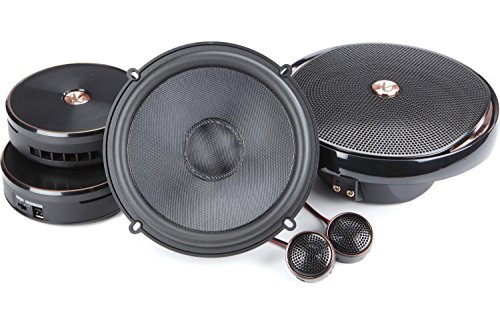
Rockford Fosgate T1650-S
The Rockford Fosgate T1650-S is a 6.5-inch component system from the Power Series, and it is the pick here for buyers who want bass from their doors. It has a polypropylene woofer, a separate tweeter, and a crossover, with a sound that is full, punchy and powerful, and a bass response that is stronger than most 6.5-inch component sets. The Power Series is Rockford Fosgate’s performance range, and the T1650-S carries its punch into a system that is built to play loudly and to survive doing it, with a build that is designed for a car door’s heat, cold and vibration.
The T1650-S sounds big, with a mid-bass that gives drums and bass guitar a physical presence, and a treble that is clear without being sharp. The woofer is designed to move a lot of air, and the tweeter can be mounted flexibly, so it can be aimed at the listener. The speakers handle a strong amplifier well, with a sound that stays composed at volume, and they are efficient enough to play from a factory head unit, although an amplifier is where they show their best.
Strengths: A powerful, punchy sound with stronger bass than most 6.5-inch component sets, and a build designed to survive a car door. The speakers handle an amplifier well, they play loudly without strain, and the Rockford Fosgate name carries a long record in car audio. It is the bass king of this guide.
Trade-offs: The sound is punchy rather than refined, so a critical listener may prefer the Focal or the JL for detail. It costs more than the budget sets, and the speakers need a solid door mounting to deliver their bass, because a rattling door will waste it.
Who it fits: Listeners who want bass and power from their doors, especially fans of rock, hip-hop and electronic music, and anyone building a system with an amplifier. It suits a car with a factory head unit as a starting point, and an amplified system as the goal.
Play a track with a strong bass line and notice how the doors fill with low end, because that is what this speaker is built for. Then play a vocal track and listen for whether the midrange stays clear, because a bass-heavy speaker must not bury the voice.
Check price on Amazon: Infinity Kappa 60csx

What 6.5 Inches Means and Why It Is the Standard
The 6.5-inch size is the standard for car component speakers, and the reason is a compromise that works: it is large enough to produce real bass from a door, small enough to fit most cars, and common enough that adaptors, grilles and fit guides exist for almost every vehicle. A smaller speaker, such as a 5.25-inch, fits more cars but gives up bass, while a larger one, such as a 6×9, gives more bass but fits fewer doors and is rarely a component. The 6.5-inch size sits in the middle, and that is why it is the default choice, and why this guide is about it.
The practical point is that the size is only a starting point, because two 6.5-inch speakers can sound very different, and the difference is in the engineering: the cone material, the motor, the tweeter, and the crossover. The JL in this guide and the Rockford in this guide are both 6.5-inch component sets, and they sound nothing alike, because one is built for neutrality and the other for punch. Choose the size first, because the car decides it, then choose the character, because your ears decide that.
Check price on Amazon: Rockford Fosgate T1650-S
Crossovers: The Part Nobody Sees
The crossover is the part of a component set that nobody sees and everybody hears, because it divides the sound between the woofer and the tweeter, and a good one makes the transition seamless, while a poor one makes the sound thin in the middle or harsh at the top. A crossover is a small box, or a circuit built into the wiring, with capacitors and coils that send the low notes to the woofer and the high notes to the tweeter, and its quality decides whether the two drivers sound like one speaker or two.
The practical point is to use the crossover that comes with the set, and to place it where it will stay dry, because a crossover in a wet door will fail, and a missing crossover will destroy the tweeter, which cannot handle bass. Hide it in the door, behind the panel, or under the dash, and keep it away from water. It is a small, unglamorous part, but it is the reason a component set sounds like a single speaker, and it deserves the same care as the drivers themselves.
Reading the Keyword: S6 5 Means 6.5 Inches
The keyword for this article is written component s6 5, and it is worth stating plainly what it means, because a buyer searching for it deserves a straight answer: it is a garbled way of writing 6.5-inch component speakers, with the decimal point lost and the words compressed. The 6.5-inch size is the most common door speaker size in car audio, and a component set in that size separates the woofer and the tweeter, so the woofer goes in the door and the tweeter goes high in the cabin, aimed at the ears. Everything in this guide is a true 6.5-inch component system, and the article is organised around that size.
The garbling matters because it shows how people actually search: quickly, on a phone, with a thumb, and the search engine is expected to understand. A buyer who types s6 5 means 6.5, and the speakers they need are the ones in this guide, not a model called S6 or a 5-inch speaker. The lesson for a buyer is to check the size in the listing, not in the keyword, because the listing gives the woofer diameter, the mounting depth, and the cutout, and those numbers decide whether the speaker fits the car, whatever the search phrase said.
The third point is that the size is a standard, not a brand, and a 6.5-inch component set from any maker in this guide will fit the same opening, with the same adaptor, and the same tweeter mount. That standardisation is a gift, because it means the buyer can choose on sound rather than on fit, and can change brands later without changing the installation. Measure once, buy the sound you like, and the car will take care of the rest.
Power Handling: What the Numbers Mean
A component speaker’s power handling is quoted in watts, and the numbers are easy to misread, because there are two of them: RMS, which is the power the speaker can handle continuously, and peak, which is the power it can handle for a brief moment. RMS is the number that matters, because it describes the speaker working all day, while peak describes a transient that lasts a fraction of a second, and a speaker rated at a high peak but a low RMS is weaker than one rated at a modest RMS. The JL C1-650 in this guide handles a moderate RMS power, and it does so comfortably, because its engineering is honest about what the drivers can do.
The practical consequence is matching: an amplifier should deliver roughly the speaker’s RMS rating, not its peak, and the gains should be set so the amplifier never clips, because clipping, which is the distortion that happens when an amplifier is pushed beyond its clean output, is what destroys tweeters, not clean power. A modest amplifier set up properly will sound better and last longer than a powerful one set up badly, and the speakers will thank you for it. Read the RMS number, ignore the peak, and set the gains by ear.
The third point is sensitivity, which is quoted in decibels and describes how loud a speaker plays from a given power, and it matters more than the power handling for a factory head unit. A sensitive speaker, such as the Alpine or the Morel in this guide’s companion articles, sounds full from a modest source, while an insensitive one needs an amplifier to wake up. The sets in this guide are all reasonably sensitive, which is why they work from a head unit, but the difference between them is real, and it is worth checking the specification before you buy.
Buying Guide
Start by checking the fit, because a 6.5-inch component set does not fit every car, and the keyword’s garbled size is a reminder to measure. Check the door’s mounting depth, the cutout diameter, and the tweeter location, and use a fit guide for your car before you buy. A speaker that fits cleanly will sound better and last longer than one forced into a hole it was not made for.
Think about the tweeter, because it is the part of a component set that makes the difference, and its placement decides the sound. Mount it high, on the dash or the pillar, aimed at the listener, and the stereo image will be wide and stable. Mount it low, in the door, and the sound will come from your knees, which wastes the whole point of a component set.
Consider the amplifier honestly, because a 6.5-inch component set will play from a factory head unit, but it will sound better with an amplifier, and the difference is worth knowing before you buy. The Infinity and the Rockford in this guide are built for power, while the JL and the Morel sound superb from a head unit. Match the speaker to the power you have, or plan to add.
Budget for installation, including adaptors, wiring and sound deadening, because a component set needs more than the speakers themselves. A door adaptor, a tweeter mount, and a sheet of deadening material are all small costs that add up, and they make the difference between a system that sounds right and one that rattles. Factor them in before you commit, not after.
Listen for the character, because the sets in this guide sound different: the JL is neutral, the Focal is detailed, the Morel is smooth, the Hertz is punchy, the Infinity is powerful, and the Rockford is bass-heavy. There is no right answer, only a preference, and the best way to find yours is to listen to a speaker you already own and decide what you would change about it.
Finally, remember that a 6.5-inch component set is the standard for a reason, and it is a starting point, not a destination. It will show you what a separated tweeter does for the sound, and if you love it, you will eventually want a better one. Buy the set that suits your car and your ears, deaden the doors, and enjoy it.
Frequently Asked Questions
What does component s6 5 mean?
It is a garbled way of writing 6.5-inch component speakers, and the intended topic is clear: a component speaker set with a 6.5-inch woofer, which is the most common size in car audio. A component set separates the woofer and the tweeter, so each can be placed where it sounds best, and the 6.5-inch size is the standard because it fits most cars and produces real bass from a door.
What are the best 6.5-inch component speakers?
The JL Audio C1-650 is the best all-round 6.5-inch component set, with a clean, neutral sound and excellent engineering. The Focal ASE 165 is the best for detail, the Morel Maximo Ultra 602 MKII is the best for smoothness, and the Rockford Fosgate T1650-S is the best for bass. The right answer depends on your taste and your amplifier, not on the brand alone.
Do 6.5-inch component speakers fit my car?
Most cars, yes, because 6.5 inches is the most common door speaker size, but you should check a fit guide for your specific year, make and model before you buy. Measure the mounting depth as well, because a deep woofer will hit the window mechanism in some doors, and check the tweeter location, because a component set needs a place to mount the tweeter high in the cabin.
Do I need an amplifier for 6.5-inch component speakers?
Not necessarily, because the sets in this guide are efficient enough to play from a factory head unit, and they will sound better than the factory speakers they replace. An amplifier makes them sound better still, with more dynamics and more control, especially at volume. The Infinity and the Rockford are built for power, so they benefit most from an amplifier, while the JL and the Morel sound superb from a head unit.
What is the difference between the JL C1-650 and the Focal ASE 165?
Character: the JL is neutral and clean, with a superb off-axis tweeter response, while the Focal is detailed and refined, with a wide-dispersion inverted-dome tweeter. Both are excellent, and the choice is about taste: the JL suits a listener who wants the truth, the Focal suits one who wants detail. Either will transform a factory system, and either will grow with an amplifier.
How do I install 6.5-inch component speakers?
Remove the door panel, mount the woofer with an adaptor, mount the tweeter on the dash or the pillar, and hide the crossover in the door. It is a job a careful owner can do in an afternoon with basic tools, but it involves removing trim and running wire, so a professional installation is worth considering if you are not comfortable with it. Deaden the door while it is open, because it is the cheapest sound upgrade there is.
Why do my new 6.5-inch speakers sound thin?
Usually because the door is flexing, not because the speakers are bad. A woofer mounted in a thin, rattling door wastes its energy moving the panel instead of the air, and the bass disappears. Add sound deadening to the door, check that the woofer is sealed to the panel, and make sure the tweeter is aimed at your ears, and the sound will fill out noticeably.
What is the best 6.5-inch component speaker for a first upgrade?
The JL Audio C1-650 is the best all-round choice, with a clean, neutral sound and engineering that fits easily behind factory grilles. The Hertz DSK 165.3 is the best value, with a dynamic sound at a sensible price, and the Morel Maximo Ultra 602 MKII is the best for a smooth, fatigue-free listen. Any of the three will transform a factory system, and the choice is about taste: neutral, punchy, or smooth.
Can I install 6.5-inch component speakers in a 6×9 opening?
Yes, with an adaptor plate, which is a common and inexpensive part that fills the larger opening and gives the 6.5-inch woofer a solid mounting. Many cars with 6×9 factory speakers take a 6.5-inch component set this way, and the result is often better than a 6×9 replacement, because the component tweeter can be placed high in the cabin. Check a fit guide for your car, buy the adaptor with the speakers, and the installation is straightforward.
How long do 6.5-inch component speakers last?
A well-made set should last the life of the car, because the drivers have no parts that wear quickly, and the crossover is a solid-state circuit with nothing to wear out. The enemies are water in the door, which corrodes the connections, and distortion, which overheats the tweeter, so keep the doors sealed, set the amplifier gains properly, and the speakers will outlast several head units. A set that is installed well and driven sensibly is a once-in-a-car purchase.
Conclusion
The best 6.5-inch component speakers are the ones that match your car and your ears, and for most buyers that is the JL Audio C1-650, because its engineering and its neutral sound make it the most complete set here. Check the fit, mount the tweeter high, deaden the doors, and enjoy a soundstage that a factory speaker cannot match. A 6.5-inch component set is the standard for a reason, and the right one will make every drive sound better.


