Our Top Picks


What's inside
- What stepping up actually buys: crystal, movement, case, bracelet
- Three styles that organise the tier: dress, field, and diver
- Quartz and mechanical at the same tier: an honest comparison
- Size and thickness, fitted to the wrist you actually have
- Where the money should go, and where it can be saved
- The long cost of owning one, described without figures
- Buying new, buying elsewhere, and the warranty questions to ask
- Dial, hands, and legibility: the interface you read a hundred times a day
- Bezels, crowns, and the moving parts you touch
- Straps in depth: the cheapest way to own two watches
- Accuracy in daily life, and setting a fair expectation
- One watch or a small rotation: deciding the shape of ownership
- Reading a listing in order, from the first photograph to the last line
- Mistakes this tier invites, and how to decline them
- Check prices on Amazon
- A closing checklist, organised by the day you will actually live
As an Amazon Associate I earn from qualifying purchases. This post may contain affiliate links at no extra cost to you.
As an Amazon Associate we earn from qualifying purchases. With that stated, the honest starting point for this guide is that mid range is the least well-defined phrase in watch buying, and also the most useful one once it is defined by construction rather than by a number. This article will not print a price, a price band, or a threshold figure anywhere, because figures date, currencies differ, and a number would tell you less than the materials and finishing you can inspect for yourself. Mid range, as the term is used here, names the tier where a watch stops being built down to a cost on every component and starts being built up to a standard on the components that matter: the crystal, the movement, the case finishing, the bracelet, and the seals that keep weather out.
Below that tier, compromises are structural. Crystals are chosen for cheapness rather than clarity or endurance, cases are polished in ways that blur their lines within a year of knocks, bracelets are folded and rattling assemblies, and movements are selected because they are available rather than because they serve well. Above the mid range, money increasingly buys hand-finishing, precious materials, brand heritage, and rarity, all real pleasures, but pleasures with diminishing effect on how a watch keeps time, survives a decade, or feels on the wrist at eight in the morning. The mid range is where durability and daily satisfaction are bought most efficiently, and understanding exactly what changes at this tier is the whole skill this guide tries to teach.
Read what follows as a set of inspections rather than a set of recommendations. Any specific model will come and go, colours will rotate, and a reference that suits one reader’s work will be wrong for another’s. What does not change is how to tell a sapphire crystal from a coated mineral one in a listing, how to judge whether a case’s brushing and polishing were done with intent, how a solid-link bracelet differs in the hand from a folded one, and how to weigh a quartz movement’s indifference against a mechanical movement’s charm when both sit at the same tier. Learn those judgements and the mid range stops being a fog and becomes a workshop you can walk through with your eyes open.
What stepping up actually buys: crystal, movement, case, bracelet
The crystal is the most legible upgrade. At lower tiers the window over the dial is commonly mineral glass or an acrylic chosen for cost, and both record daily life faithfully: mineral picks up fine scratches from grit and knocks, acrylic scuffs if you look at it sternly, though it can be polished back. A mid range watch is expected to carry sapphire, which shrugs off the contacts that mark lesser crystals and keeps the dial looking new long after the case has earned its own patina. The better listings at this tier also treat the sapphire properly, with anti-reflective coating where it reduces glare rather than adding a coloured sheen, and with a shape, flat, boxed, or gently domed, chosen to suit the design rather than whatever was cheapest that quarter.
The movement improves in two directions at once. Accuracy tolerances tighten or, in quartz, the calibre gains features that matter: a seconds hand that lands on its markers, an end-of-life warning that stutters the hand before the battery dies at an awkward moment, a calendar that handles month lengths with less intervention. In mechanical form, the mid range brings calibres with better regulation from the factory, smoother winding action, more assured date changes, and reserves that better survive a day or two off the wrist. None of this is magic. It is the compound interest of better components, better adjustment, and quality control that rejects the marginal example instead of shipping it.
Case finishing is where the tier announces itself to anyone who handles watches side by side. A mid range case holds distinct surfaces: brushing that runs in one disciplined direction, polished bevels that catch light along an unbroken line, lugs whose shapes survive the finishing process instead of being rounded into anonymity by it. The case back seats properly, the crown threads or turns with a machined smoothness, and the bezel, where fitted, rotates or sits with a precision that feels engineered rather than approximate. These are not decorations. They are evidence of time spent on machining and inspection, and time is precisely what lower tiers cannot afford to spend on each unit.
The bracelet completes the quartet, and it may be the upgrade felt most often. Solid links replace folded ones, and the difference is audible before it is visible: a solid bracelet does not jingle, it settles. End links fit the case rather than approximating it. The clasp is likelier to be milled, to carry several micro-adjustment positions, and to close with the kind of damped certainty that makes a watch feel like one object rather than a head on a chain. Readers arriving from connected watches, including those comparing against best affordable smartwatches, often remark that this solidity is the first thing that surprises them, because a watch’s weight, properly distributed through a good bracelet, reads as quality rather than burden.
- Sapphire crystal, correctly coated, instead of mineral or acrylic.
- A movement with tighter tolerances, better regulation, or fuller features.
- Case surfaces that keep separate finishes and crisp edges after polishing.
- Solid bracelet links, fitted end links, and a clasp with real adjustment.
- Seals, crowns, and case backs assembled to a stated, testable standard.
Three styles that organise the tier: dress, field, and diver
Nearly every mid range watch belongs, loosely, to one of three families, and naming the family first prevents the commonest buying error, which is purchasing a handsome watch for a life it was never designed to live. The families overlap at their edges and borrow each other’s details constantly, but their centres of gravity differ, and so do the compromises each one asks its owner to accept.
A dress watch is built for proportion and restraint. Its case tends to be slimmer, because it must slide under a cuff without argument, and its dial favours clarity and finish over instrumentation: applied indices, a restrained handset, perhaps a small seconds register or a date handled so discreetly that it does not interrupt the dial’s calm. Water resistance is modest and that is an honest limitation, not a flaw to be excused; this is not the watch for a pool, and its leather strap agrees. What the dress style returns for those limits is elegance that ages slowly. Fashions in dial colour come and go, but a well-proportioned dress watch in a moderate size looks as correct in a decade as it does on delivery day, and its mid range premium is spent exactly where the eye rests: dial furniture, case lines, and the fineness of the hands.
A field watch descends from military specification, and its virtues are legibility and toughness in ordinary clothing. The dial is a model of information design: bold numerals or indices, strong contrast, luminous material where the dark requires it, and nothing decorative competing with the time. Cases are usually brushed to kill reflections, sized moderately so the watch takes knocks without presenting a large target, and paired with fabric or leather straps that suit its working character. The trade-offs are a certain plainness under formal dress and, often, a specification that prizes robustness over refinement in the movement and finishing. For a buyer whose days involve children, dogs, tools, travel, or weather, the field watch is frequently the most honest mid range purchase of all, because its money is spent on surviving the buyer’s actual routine.
The diver is the most technically dressed of the three. A rotating bezel for timing immersion or, in daily life, parking meters and pasta; serious water resistance built on screw-down crowns and tested seals; luminous plots generous enough to read at a glance in murk; a bracelet or rubber strap that fits over a sleeve or a wetsuit with an extension. The costs of that equipment are thickness and presence. A diver stands taller on the wrist, weighs more, and can fight a tight cuff with genuine determination. It is also, for many owners, the most charismatic of the families, and the one whose mid range step-up is easiest to verify, because bezel action, crown threading, and seal integrity can all be assessed with the hands. Buy one because you love its competence and will tolerate its bulk, not because its dial rating flatters a depth your life will never visit.
Hybrids complicate the tidy scheme in useful ways. A field-leaning watch with a rotating bezel, a slim diver that behaves under a cuff, a dress watch with a screw-down crown and a sportier dial: these crossbreeds often serve real lives better than purist designs. Judge them by the same inspections as their parents. Ask which family’s compromises the hybrid has kept and which it has escaped, and be suspicious only when a design claims every virtue at once, since in watchmaking, as elsewhere, a claim to have abolished trade-offs usually means the trade-offs have been hidden rather than solved.
Quartz and mechanical at the same tier: an honest comparison
At mid range the quartz-versus-mechanical question becomes genuinely interesting, because both sides are now well made. A mid range quartz watch is not a disposable ticking token; it is a precision instrument in a finished case, and its owner can expect timekeeping that a mechanical piece cannot approach, a slimmer profile because no rotor needs clearance, and a watch that is ready after a fortnight in a drawer. Better quartz calibres add their own refinements: high-accuracy variants regulated to drift only slightly across a year, solar charging that removes battery changes from the calendar for long stretches, radio or satellite correction in some lines, and seconds hands aligned with a care that cheaper quartz rarely manages.
The mechanical offering at the same tier sells a different bundle. Its timekeeping is worse by every stopwatch measure and its ownership demands more: winding or wearing to keep it alive, setting after it stops, periodic servicing across its life. What it returns is mechanical integrity, an object whose operation can be understood, maintained, and handed on, with a moving seconds hand whose sweep is a visible consequence of a balance spring breathing several times a second. For many mid range buyers this is not nostalgia but a preference for repairable things in a sealed-unit world. The honest framing is that neither choice is the serious one and the other a toy. They are two engineering philosophies at the same standard of execution, and the right answer is the one whose maintenance rhythm fits the owner’s temperament.
Consider the household reality behind the choice. A quartz watch suits the person who rotates several watches, who travels across time zones and wants a grab-and-go instrument, or who simply does not want another small ritual in the day. A mechanical watch suits the person who wears one watch most days, enjoys the setting and winding as a morning punctuation, and values that a competent watchmaker decades from now can keep it alive. Readers weighing a household where connected pieces already cover alarms, timers, and notifications, a situation surveyed in guides such as best analog smartwatches, often find the mechanical’s narrow job description refreshing: it tells the time, beautifully, and asks to be looked after in return.
Thickness and size interact with the choice in ways listings understate. A quartz calibre’s slimness lets a designer produce a genuinely thin dress watch at this tier, the kind that disappears under a cuff and is forgotten until consulted. An automatic movement imposes a floor under case height, and a mid range mechanical dress watch will usually be a little thicker than its quartz sibling in the same catalogue. Neither fact should decide alone, but a buyer with slim wrists and formal habits should weigh it, just as a buyer who prizes a display case back and a decorated rotor should accept the height that makes the exhibition possible.
Size and thickness, fitted to the wrist you actually have
The mid range tempts buyers toward presence, because the watches are handsome and the cases feel substantial in the hand. Resist judging size in the hand at all. A watch is worn, not held, and the measurements that predict comfort are the lug-to-lug span against the flat of your wrist, the total thickness against your cuffs and sleeves, and the case diameter only as a rough guide to dial legibility and visual balance. A broad diameter with short, curved lugs can wear smaller than a nominally narrower watch whose long, straight lugs reach past the wrist’s edges and make the whole piece perch.
Measure before ordering, especially from a seller you cannot visit. A soft tape gives wrist circumference; a ruler laid across the wrist’s top gives the flat span that lug-to-lug must respect. Then read the listing for all three dimensions, and be wary of any mid range seller who publishes diameter alone, because at this tier full dimensions are a basic courtesy. Photographs on a model’s wrist help only when the wrist size is stated, a detail good retailers and reviewers include and careless ones omit.
Thickness deserves a cuff test in the imagination. A slim dress piece slides away; a tall diver or a chunky field case announces itself to every sleeve and can catch on door frames and desk edges in proportion to its height. Case shape mediates the number: curved sides and a domed crystal can make a thick watch wear friendlier than a slab-sided thinner one, and a case back that sits into the wrist lowers the perceived height. Weight follows similar logic. A mid range steel watch on a steel bracelet is a substantial object, and its comfort depends on the bracelet distributing that weight evenly, which is another reason the solid-link, well-articulated bracelet discussed earlier matters more than its appearance in photographs.
Women and men with smaller wrists should treat the tier’s growing number of moderate sizes as the headline development it is. For years, mid range mechanical variety concentrated in larger cases, and smaller wrists were offered quartz or nothing. That has changed, and a buyer today can reasonably insist on proportions that fit rather than compromising with an oversized case and a strap on its last hole. The related guidance gathered under best affordable women s smartwatches makes a parallel point for connected watches: fit is not a secondary preference to be traded against features, because a watch that does not sit right is not worn, and an unworn watch has no features at all.
Where the money should go, and where it can be saved
A mid range budget, described qualitatively, is large enough to matter and small enough to require choices. Spend first on the movement’s quality and regulation, because it governs every day of the watch’s life and cannot be upgraded later. A watch is its calibre in a way it is not its strap; movements are effectively permanent, while almost everything external can be changed. Spend second on the crystal, sapphire properly treated, because it protects the dial’s appearance for the whole ownership and likewise cannot be sensibly retrofitted. Spend third on the bracelet if you are a bracelet wearer, since its links, end pieces, and clasp are in contact with your skin all day and its quality is felt hourly.
Case finishing sits close behind those three, with a nuance: pay for clean, durable finishing rather than for elaborate finishing. Crisp brushing, honest polishing, and well-kept edges will look right for decades. Intricate multi-stage decoration at this tier can be charming, but it is also where a maker under pressure cuts unseen corners, and a simpler case executed completely is the better buy. Dial furniture follows the same rule. Applied indices and fine hands repay their cost daily; novelty dial materials should be bought because you love them, not because a listing presents them as inherently superior.
Savings, then, are available in respectable places. A strap is the easiest: a watch bought on its bracelet can wear a modest, well-made aftermarket strap for variety, and a watch bought on a strap can be upgraded later when the original wears, spreading cost across the ownership instead of concentrating it at purchase. Packaging is another: an elaborate box is a pleasure for a week and a storage problem for a decade, and no buyer should choose one watch over another for its carton. Complications are the third place to economise with a clear conscience. A chronograph, a moonphase, or an alarm is worth its cost when it will be used and enjoyed; bought as specification padding, each adds servicing complexity and dial clutter in exchange for functions a phone performs without being wound.
- Prioritise movement quality and factory regulation above all else.
- Insist on sapphire; it defends the dial for the watch’s whole life.
- Pay for the bracelet if bracelets are how you actually wear watches.
- Prefer complete, simple case finishing over elaborate but thin decoration.
- Save on straps, packaging, and complications you will not use.
The long cost of owning one, described without figures
Ownership costs at this tier are real, predictable, and best understood as rhythms rather than bills. A quartz watch asks for a battery at intervals measured in years, a trivially small job that should still be done with a gasket check and, for a watch that swims, a pressure check, because opening a case back disturbs the seal that the rating depends on. Solar quartz stretches that rhythm dramatically, substituting light for cell changes, though its rechargeable cell also ages eventually and its watch still benefits from seal attention. The expensive quartz mistake is neglect after a battery dies: a cell left exhausted for a long period can leak and damage the movement, turning the cheapest service in watchmaking into the costliest by procrastination.
A mechanical watch asks for servicing on a longer cycle: cleaning, lubrication, regulation, and gasket renewal performed by a watchmaker, with the interval guided by the maker’s advice and by symptoms such as a shrinking reserve, a rate that wanders, or a crown that winds with new roughness. Between services it asks for nothing but wearing and the occasional correction. The mid range virtue here is predictability. Calibres common at this tier are serviced everywhere, parts are stocked, and estimates can be obtained in advance, so the cost arrives as planned maintenance on a durable object rather than as a surprise. Budget for it in spirit from the day of purchase and it never feels like a defect being charged for.
Straps and bracelets consume themselves slowly and visibly. Leather darkens, cracks at the holes, and eventually asks to be replaced; that is its nature, accelerated by water and sweat, slowed by rotating two straps and keeping leather away from swimming entirely. Rubber endures water happily and ages by stiffening. Fabric frays and fades with a certain charm. A steel bracelet outlasts them all but accumulates stretch in its pins and scratches on its clasp, most of which a service can tidy. Spring bars, the small sprung pins holding strap to case, are cheap insurance: replacing them when a strap is changed removes the commonest cause of a watch falling from a wrist.
Set against these rhythms is the cost profile of the connected alternative, where the device is typically replaced whole when its battery fades or its software support ends. Buyers who keep a household of devices, a landscape mapped in guides like best android smartwatches fitness, will recognise the contrast immediately. A mid range conventional watch spreads its cost across decades of small, comprehensible maintenance, and can be kept in service by independent craftspeople rather than by a manufacturer’s continuing goodwill. For many buyers that, more than any dial or calibre, is the tier’s deepest argument.
Buying new, buying elsewhere, and the warranty questions to ask
Buying new from an authorised source remains the straightforward route at this tier, and its advantages are concrete rather than ceremonial. The warranty is unambiguous and starts with you. The watch’s history is a blank page: no prior owner’s knocks, no unknown service, no battery changed with a case knife in a kitchen. Sizing help, strap swaps at purchase, and a returns window if the proportions disappoint on your own wrist all have real value that is easy to underrate until one of them is needed. For a first mid range purchase especially, that supported beginning is worth choosing deliberately.
Other channels exist and can serve an informed buyer well, provided the same inspections are applied with extra rigour. A pre-owned watch from a reputable dealer should come with a stated condition, a service history where known, a dealer’s own warranty, and a returns policy that allows inspection at home. A watch sold privately demands more of the buyer: verify the reference against its papers, examine the case for polishing that has softened its lines, ask when it was last serviced and by whom, and treat a missing box as a minor matter while treating missing provenance for a recent, valuable model as a question worth pressing. In every channel, the movement’s behaviour on arrival, its rate, its winding feel, its date change, is evidence that should be checked inside the returns window rather than admired past it.
Warranty literacy prevents most disappointments. Read what is covered and for how long, what is excluded, and where the watch must go. Water damage is commonly excluded unless the watch is a rated diver used within its specification, and even then crowns left unsecured void the protection in spirit and usually in letter. Accidental damage, magnetism, and wear items such as straps sit outside most warranties everywhere. Servicing by an unauthorised hand during the warranty period can complicate a claim, which is an argument for routing early faults through the seller however inconvenient the postage feels. None of this is fine print designed to trap you; it is the boundary of a promise, and a buyer who knows the boundary rarely has cause to argue about it.
Authenticity deserves one calm paragraph. The mid range is less plagued by sophisticated imitation than the luxury tiers, but paperwork, serial consistency, and purchase history still matter, particularly for popular models bought outside authorised channels. A price of record that seems to have escaped the gravity every other seller obeys is information, and the information is rarely that you alone have found the generous exception. Buy the seller’s reputation with the same care as the watch, keep every document together, and your future self, servicing, gifting, or selling, will be grateful for the folder.
Dial, hands, and legibility: the interface you read a hundred times a day
A watch has one interface, and it is read in glances, in poor light, at arm’s length, while moving. Legibility is therefore not a styling preference but the product itself, and the mid range earns its keep here through contrast, proportion, and restraint. A dial whose hands stand clearly against its surface, whose indices are sized in a hierarchy that puts the hours first, and whose markings stop before the dial becomes a spreadsheet will be read faster and with fewer errors than a busier design at any tier. Test a candidate in your imagination at three moments: waking in a dim room, checking the time mid-sentence in a meeting without appearing to, and glancing while driving or cycling, where the reading must happen inside a fraction of a second.
Hand design carries more of that burden than dial decoration does. Hands should differ enough in length and shape that hour and minute cannot be confused at an angle, reach close to the tracks they point at, and carry luminous fill in proportion to the indices if night reading matters to you. A seconds hand with a visible counterweight and a tip that reaches the outer track turns a watch into a small instrument; a stubby one turns the same dial into jewellery. Neither is wrong, but a buyer should know which they are purchasing, because the difference is felt every day and cannot be altered later.
Dial finishing at this tier rewards close looking. A sunburst surface that changes character as the wrist turns, a matte dial that stays legible by refusing reflections, a lacquer with real depth, a textured pattern that is fine rather than coarse: each is achievable in the mid range, and each should be judged in varied light rather than under a seller’s spotlights. Printing quality is the tell of tells. Letters and numerals should be crisp at magnification, evenly inked, and aligned to their tracks. Sloppy printing on an otherwise ambitious dial is the watchmaking equivalent of a misspelled sign over a good shop, and it predicts other unseen economies.
The date window, that small daily convenience, separates careful design from catalogue assembly. A window positioned where it does not amputate an index, a disc whose colour respects the dial, numerals in a typeface that belongs to the same family as the dial’s own, and a change that completes crisply around midnight rather than wandering through the small hours: these details are all available at mid range, and their absence on a particular model is a legitimate reason to choose its rival. Buyers who do not need a date at all gain a cleaner dial and one less setting chore after short months, a trade worth considering honestly rather than defaulting to the fuller specification.
Bezels, crowns, and the moving parts you touch
Where a mid range watch has a rotating bezel, its action is a complete quality audit in one gesture. The rotation should be firm without stiffness, indexed without play, and aligned so its marker meets the dial’s top index exactly rather than near enough. A bezel that drifts off alignment or rocks under a fingertip is announcing tolerances that will be present elsewhere too. Insert material follows the familiar trade: ceramic for scratch resistance and colour depth, aluminium for a softer, more traditional ageing, steel for a monochrome tool character. What matters at this tier is that the choice is deliberate and the execution clean, with numerals and markers filled or engraved crisply.
The crown is the other daily touchpoint, and it is judged by grip, action, and honesty of engineering. A crown sized to be operated by real fingers, with knurling or fluting that works when hands are cold, winding that feels smooth and mechanical rather than gritty or vague, and, where fitted, threads that engage without cross-threading anxiety: these are mid range expectations, and a watch that meets them feels trustworthy in a way specifications cannot convey. Pushers on a chronograph deserve the same examination, with a start action that is positive and a reset that returns the hands to zero without a shudder or a miss.
Case backs divide into the exhibition and the solid, and the choice is more practical than romantic. A display back shows a mechanical movement’s working beauty and, at this tier, often a decorated rotor that is pleasant to own. It can add thickness and it replaces engraved steel with a crystal that must also be sealed. A solid back permits slimmer construction, carries engraving well, and suits a watch whose movement is handsome but not decorated for show. Quartz watches gain little from display backs. Let the movement’s finish and your own habits decide, and do not pay a premium in thickness for a view you will take twice a year.
Straps in depth: the cheapest way to own two watches
If the bracelet is a mid range watch’s skeleton, its straps are its wardrobe, and understanding them multiplies the value of the whole purchase. Leather remains the dress default, and its quality is legible: a strap that is supple from the first day, evenly stitched, edged cleanly, and lined in something that tolerates skin and summer will age into character, while a stiff, plasticky strap makes even a fine watch feel borrowed. Keep leather away from water without exception. Its enemy is not rain on a walk but immersion and repeated soaking, which no quality of hide survives gracefully.
Rubber and silicone serve the wet and the active. Good rubber is flexible, matte, resistant to sunscreen and salt, and fitted with a buckle or deployant that matches the watch’s ambition; poor material stiffens, shines, and cracks at the holes. Fabric straps, woven or canvas, bring the field character and washability that leather lacks, at the cost of slower drying and a more casual register. Metal mesh deserves its own mention for warm climates and swelling wrists, since its fine adjustability solves the between-holes problem that defeats leather in summer.
The enabling details are lug width and spring bars. A standard lug width opens a world of replacements at every quality level, while quick-release bars turn a strap change into a thirty-second decision made at the door. Build a small rotation deliberately: the bracelet for most days, leather for formal ones, rubber or fabric for holidays and weather. Two straps transform one mid range watch into coverage for nearly a whole life, which is a more intelligent use of money than a second watch bought to fill a gap a strap would have closed. Store the strap not in use flat and dry, keep its spring bars with it, and the system stays ready.
Accuracy in daily life, and setting a fair expectation
Expectations about accuracy cause more needless dissatisfaction at this tier than any defect does, because buyers import phone standards into a mechanical world or, conversely, accept quartz performance that a good calibre should beat. A mid range quartz watch should be effectively beyond daily concern: set it, and its drift across a month should be a curiosity rather than a correction. If a quartz piece gains or loses in a way you can notice week to week, something is wrong, most often a battery nearing its end or a movement asking for attention, and the warranty or a watchmaker should hear about it promptly.
A mid range mechanical watch should be judged against its own stated range and against consistency, which matters more than the headline figure. A watch that gains the same small amount each day is well regulated and can be trimmed by resting position or a watchmaker’s adjustment into excellent practical accuracy. A watch whose rate swings unpredictably with position or temperature is telling a less happy story even if its average looks fine. Owners help themselves by observing a new watch for a fortnight before judging it: note the rate against a phone clock every few days, wear it as you normally will, and only then decide whether it sits inside its promise. That small diary converts arguments into facts if a seller needs persuading.
Time zones and calendars add practical wrinkles worth planning around. A traveller who crosses zones often should value a movement or quartz system that lets the hour hand move independently, sparing the minutes and the date a full reset at every border. Everyone with a calendar watch should know its short-month behaviour and build the small correction into the rhythm of the first morning of certain months. These are not flaws to be forgiven; they are the known mechanics of the class, and a mid range purchase made with them understood will satisfy in direct proportion to that understanding.
One watch or a small rotation: deciding the shape of ownership
The last strategic question is whether the mid range watch will live alone or in company. As a sole watch it should be the most versatile object you can find: a style between families, a size that suits your wrist in every company, water resistance that covers your real life with margin, and a bracelet-plus-strap pairing that dresses it up and down. Versatility sounds like a compromise and, chosen well, is instead a discipline that produces the most-worn, best-loved watches. The one-watch buyer should be ruthless about the dominant-day test and permissive about everything else.
In a rotation, specialisation becomes affordable. A dress piece can be slimmer and more delicate because a field watch takes the weekends; a diver can be as tall as its engineering wants because it need not fight a cuff daily. Rotation also spreads wear across straps and movements, though it does not pause the ageing of lubricants or batteries, a fact owners of several quartz pieces learn when two batteries expire in the same month. Keep a simple note of service and battery dates for each piece, and a rotation stays a pleasure rather than becoming a small fleet with unknown maintenance.
Either way, buy in an order that respects use. The watch for your dominant day comes first, however unglamorous that sounds at the moment of purchase. The specialist, the indulgence, the dial colour that serves no strategy at all comes later, when the foundation is worn daily and its gaps are known from experience rather than imagined from listings. Mid range money spent in that order builds a collection that looks, within a few years, remarkably like wisdom.
Reading a listing in order, from the first photograph to the last line
Most buyers read a watch listing backwards, starting with the hero photograph and ending, if they get there, with the dimensions and terms. Reverse that habit and the mid range becomes far easier to judge. Start with the specification block, because it contains the claims that can be verified: case dimensions in full, crystal material, movement reference, water resistance, bracelet or strap material, and lug width. A listing that leads with lifestyle copy and buries or omits those facts is asking to be judged as advertising rather than as an instrument, and it should be.
Next, examine the photographs as evidence rather than as atmosphere. Look for a side profile, because it reveals thickness, case shape, and how the crystal sits. Look for the clasp, open and closed, and for the case back. Look for a wrist shot with the wrist size stated, and for a dial photograph taken straight on, where hand alignment, printing, and date framing can actually be assessed. Macro images are welcome, but they flatter finishing by isolating it; a watch must also cohere at arm’s length, which is the distance at which its owner will live with it.
Then read the movement paragraph with a pencil in mind. The calibre should be named, not paraphrased, and its stated accuracy, reserve, or battery arrangement should match what that calibre’s maker publishes. Where a brand claims regulation, special adjustment, or an upgraded component, it should say what was done and to what standard. Vague elevation, phrases about precision heritage or master craftsmanship with no reference attached, is not information. At this tier, genuine makers compete on specifics, and specifics are what allow a buyer to compare two watches honestly instead of comparing two moods.
Finish with the commercial terms, which are part of the product. Returns window and conditions, warranty duration and route, shipping arrangements, and what happens if the watch arrives running outside its stated range: a seller confident in the tier will state all of it plainly. Note also what is offered after the sale, spare links, strap availability, and a service route you can name. A mid range watch is a decade-long relationship with an object and, at a distance, with its maker or seller. The listing’s last lines tell you how that relationship will be conducted when something needs attention, which is precisely when it matters.
Mistakes this tier invites, and how to decline them
The first mistake is buying diameter as a personality. A large case can feel like value in the hand and like a costume on the wrist, and the mid range is full of handsome watches whose proportions exceed their buyers’ wrists because the test was a photograph rather than a measurement. The second mistake is the mirror image: choosing a watch so discreet that its dial cannot be read in the conditions of your life. Both errors are prevented by the same unglamorous act, measuring the wrist and reading the lug-to-lug figure before emotion is allowed a vote.
The third mistake is paying for a specification you will never use while starving one you will use daily. A depth rating far beyond any water you will meet, bought at the cost of a thinner case and a better bracelet, is a poor trade for a desk-based owner. A chronograph complication bought for its dial symmetry, while the crystal is downgraded and the clasp left crude, repeats the error in another direction. List your daily interactions with a watch, telling time at a glance, feeling the clasp twice a day, sliding a cuff over the case, and fund those interactions first. Specifications that serve a photograph rather than a Tuesday can wait for a later, more specialised purchase.
The fourth mistake is neglecting the unphotogenic consumables. A buyer who spends the whole allocation on the watch head and nothing on a second strap, spare spring bars, or the first service in spirit has bought an incomplete system. The fifth is its cousin: keeping no records. Receipts, warranty documents, service notes, and even a note of when a battery was changed turn future maintenance from archaeology into administration, and they materially help any later sale or gift. A simple envelope or folder, started on the day of purchase, is the cheapest upgrade in this entire guide.
The last mistake is rushing. Mid range watches are produced in real quantities, return to stock, and appear across several reputable sellers. A countdown, a dwindling-stock banner, or a limited label should never be allowed to skip the dimensional check, the movement check, or the terms. If a particular piece sells out while you are verifying it, that is information about its popularity, not a catastrophe for your wrist, and the tier is deep enough that an equal or better fit for your life exists. Patience is not the enemy of pleasure here. It is the mechanism by which a purchase stays pleasurable after the first week, when the watch must earn its place by comfort, legibility, and reliability rather than by novelty.
Check prices on Amazon
Live listings for the shortlist in this guide are pulled from Amazon below, so prices and availability are always current at the moment you look.

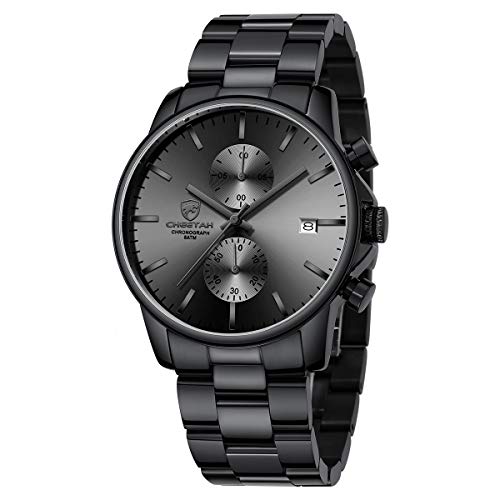
GOLDEN HOUR Men's Watches with Stainless Steel and Metal Casual Waterproof Chronograph Quartz Watch, Auto Date in Grey Hands


A closing checklist, organised by the day you will actually live
Begin the checklist with your dominant day rather than your most glamorous one. Write down, honestly, what the watch must survive and accompany: a desk and a commute, a workshop, a pool twice a week, a uniform, a cuff that cannot negotiate. That single paragraph eliminates whole families more reliably than any specification comparison. A dress watch bought for a life of site visits will be babied and resented; a diver bought for an office life will spend its days fighting sleeves it was never meant to meet. Match the family to the routine first, and let taste choose within the family.
Then run the physical checks in order. Dimensions against your measured wrist, lug-to-lug first. Crystal confirmed as sapphire, with its coating and shape understood. Movement identified by name, with its accuracy range, reserve or battery arrangement, and service story clear enough to repeat to a watchmaker. Bracelet or strap assessed as you will actually wear it, including clasp adjustment and the availability of spare links or a second strap. Water resistance translated into your real habits, with the crown type noted and no optimism added. Each check is a minute’s work, and together they are the difference between a watch chosen and a watch guessed at.
- Dominant day defined first; style family chosen to match it.
- Lug-to-lug, thickness, and diameter checked against a measured wrist.
- Sapphire crystal confirmed, along with coating and shape.
- Movement named, with accuracy, reserve, and servicing route understood.
- Bracelet and clasp adjustment assessed; spare links kept safe.
- Water resistance matched honestly to swimming, showering, and rain.
- Warranty terms, returns window, and seller reputation read before payment.
- Long-term rhythm accepted: batteries or servicing, straps, and seals.
Finally, apply the pause that every considered purchase deserves. A mid range watch is not an emergency, and the right one will still be right after a night’s sleep and a second reading of its dimensions. Imagine it in a year: the strap softened, the clasp carrying the fine scratches of real use, the dial as familiar as a face. If that imagined watch pleases you more than the gleaming one in the listing, the tier has done its work and so have you. Buy it, wear it daily, maintain it on its rhythm, and let it become the unremarkable, indispensable kind of object that good tools become.
One more consideration belongs in the checklist even though no specification sheet will ever print it: how the watch will feel in the second year, when its novelty has fully worn off and only its qualities remain. By then the bracelet’s comfort is a fact rather than a hope, the crystal either carries the scratches of its material or it does not, the movement has settled into a known rhythm of accuracy and care, and the dial is read with the unconscious fluency that only a legible design permits. Choosing for that second year, rather than for the unboxing, is the single habit that unites every sound decision in this guide. It favours fit over fashion, construction over complication, and a seller who will still answer in that second year over one who was merely quickest to take payment in the first week. A buyer who keeps that horizon in view will find that the mid range, approached patiently, rarely disappoints, because its best watches were designed by people working to exactly the same horizon.
It is also worth deciding, before the watch arrives, where it will be serviced and who will change its straps, batteries, or seals when the time comes. A local watchmaker you have spoken to, a seller whose service desk answered a question promptly, or a maker with a clear postal route for repairs all turn future maintenance from a search conducted under pressure into an appointment already understood. That small piece of preparation, done while the purchase is still theoretical, is the difference between an owner who maintains a watch on schedule and one who postpones until a small need becomes a large one.
When the checklist is done and the watch is on your wrist, the mid range reveals its quiet thesis: enough quality to forget about the object and remember only the time it gave you, year after unhurried year.