What's inside
- Key Takeaways
- Quick Picks
- How Did We Approach a Category That Barely Exists?
- Why Does One Subwoofer Leave Some Seats Starved?
- Where Should Two Subwoofers Go, Exactly?
- How Do the Build Slots Compare?
- What Mistakes Ruin Dual-Subwoofer Systems?
- How Do You Gain-Match Two Subwoofers Before Calibrating?
- Does the Second Subwoofer Help Music, or Only Films?
- When Should You Not Build a 5.2 System?
- Can You Predict Your Room’s Problem Frequencies Before Buying Anything?
- What About Cables, Wireless Kits and Hum With Two Subwoofers?
- In What Order Should You Buy the Build If the Budget Arrives in Stages?
- Which Crossover Settings Suit a Dual-Subwoofer Build?
- What Does the Second Subwoofer Do for Gaming and Sport?
- How Can a Phone App Verify That the Pair Is Working?
- Final Recommendation
- Frequently Asked Questions
- Related Guides
As an Amazon Associate I earn from qualifying purchases. This post may contain affiliate links at no extra cost to you.
widgetverdict.com is reader-supported. When you buy through links on our site, we may earn an affiliate commission.
Honest sourcing, stated up front: only one product in this entire guide carries a purchase link — the SVS Prime Tower pair, which serves as the front speakers of the reference build described below. That is not an oversight or a shortage of effort. It is the subject of the article. Complete, boxed 5.2 speaker systems barely exist as retail products, so the remaining five picks are the components of a self-assembled build, covered in prose: a receiver with two subwoofer outputs, a matched pair of subwoofers, a centre channel, a surround pair, and the calibration approach that ties them together. Anyone who shows you a tidy shelf of boxed “5.2 systems” to choose from is selling you 5.1 systems with a second subwoofer added at the till, which is, in the end, exactly what we recommend — we just refuse to pretend a factory packed it that way, or that the second subwoofer’s contribution can be judged from a photograph of a box.
Search for the best 5 2 surround sound speakers and the results pages will happily imply a category: rows of systems, rankings, badges. Look closer and a pattern emerges — nearly every result is a 5.1 system photographed next to an extra subwoofer, or a receiver bundle whose “.2” refers to its outputs rather than to anything in the box. The truth is structural. Speaker makers package what retailers can shelve, and a matched five-speaker set with one subwoofer is a tidy carton; adding a second subwoofer doubles the bulkiest item, doubles the placement questions, and serves a need — smoother bass across several seats — that most casual buyers have never been told they have. So the industry leaves 5.2 to the people who assemble systems from components, which is to say, to you, with this guide as the assembly instructions.
And the need is real. The second subwoofer is not about louder bass, and it is certainly not about twice the bass. It is about evenness. A single subwoofer in a real room excites the room’s standing waves in a pattern fixed by its position: some seats sit in peaks where bass booms, others in nulls where it vanishes, and no equaliser can fill a true null because pouring more power into a cancellation just makes the cancellation deeper somewhere else. A second subwoofer, placed at a different point in the room, excites a different pattern; the two patterns interleave, peaks soften, nulls fill in, and every seat hears something closer to what the mix intended. That is the entire case for 5.2, and it is a strong one for any room with more than one serious seat — which is to say, for nearly every room where films are watched with other people rather than alone, and where the worst seat in the house is currently occupied by someone you like.
Key Takeaways
- Boxed 5.2 systems are essentially a fiction: the format is a configuration you assemble — five speakers, two subwoofers, and a receiver with dual subwoofer outputs.
- The second subwoofer buys evenness across seats, not volume; two modest subs placed apart outperform one large sub in one corner for multi-seat rooms.
- Matched subwoofers are strongly preferred, because level, phase and equalisation behave predictably when both units respond identically.
- The receiver matters more here than in 5.1: look for two subwoofer outputs and, ideally, independent level and delay for each — that is what the “.2” should mean.
- The SVS Prime Tower pair is this guide’s one linked component, chosen as front speakers for the reference build; everything else is a prose-only component slot with buying criteria.
- Placement and calibration decide the result: two subs placed thoughtlessly in the same corner deliver almost none of the benefit.
Quick Picks
| Build slot | Badge | What it is and why |
|---|---|---|
| SVS Prime Tower (Pair) | Linked front speakers | Full-range towers anchoring the reference build, from a maker whose subwoofers define the dual-sub approach. |
| A receiver with true dual subwoofer outputs | Prose-only component | The “.2” lives here: two outputs, ideally with independent level and delay per sub. |
| A matched pair of powered subwoofers | Prose-only component | Two identical subs, placed apart, are the actual product this keyword is shopping for. |
| A voice-matched centre channel | Prose-only component | Dialogue anchor chosen from the same family as the front towers. |
| A compact surround pair | Prose-only component | Smaller speakers for the sides, where output demands are modest. |
| Calibration: measurement microphone and patience | Prose-only method | The step that turns two subwoofers from a purchase into an improvement. |
How Did We Approach a Category That Barely Exists?
By refusing to fake it. The normal machinery of a buying guide — six boxed products, six links — does not survive contact with this keyword, and forcing it would have meant presenting 5.1 bundles as 5.2 systems, which is the precise dishonesty the search results already commit. Instead we structured the guide around the build that experienced installers actually assemble: capable front speakers, a matched centre, modest surrounds, two identical subwoofers placed apart, and a receiver whose subwoofer section is genuinely dual rather than a single output split by a cheap Y-cable. One component, the front towers, carries a verified link because it sits in our checked pool; the rest are specified by criteria, with the reasoning exposed so you can shop them anywhere.
We also set the guide a test it must pass: everything claimed for the second subwoofer had to be explainable in terms of room acoustics a reader can verify at home with a phone app and a test tone, not in terms of audiophile weather. Where the evidence is genuinely two-sided — for instance, whether two smaller subs beat one larger sub at the same total cost — we say so and give the deciding factor, which is seating: one seat favours the single larger sub, several seats favour the pair.
Why Does One Subwoofer Leave Some Seats Starved?
Rooms are resonant boxes. Below a few hundred hertz, sound stops behaving like rays bouncing around and starts behaving like pressure patterns set by the room’s dimensions — standing waves with fixed addresses. A subwoofer in a corner energises those patterns strongly and predictably: along some lines in the room the waves reinforce and bass piles up; along others they cancel and bass thins to a rumour. Move your head half a metre during a film’s low rumble and you can cross from one zone into another. This is not a defect of cheap subwoofers; it is geometry, and it happens with excellent ones too. Equalisation can trim the peaks, which helps the boomy seats, but it cannot rescue the nulls, because a null is the room subtracting the sound as fast as the subwoofer adds it.
A second subwoofer at a different location writes a second, different pattern over the first. Where one pattern dips, the other often does not, so the combined result across the seating area is flatter — not perfect, but dramatically more consistent. The benefits compound: with two subs sharing the work, each one runs at lower excursion for the same total output, which means less distortion and more headroom, and the bass seems to come from the room itself rather than from a box you can point at. Those three gains — consistency, headroom, invisibility — are the honest product being sold under the “5.2” label.
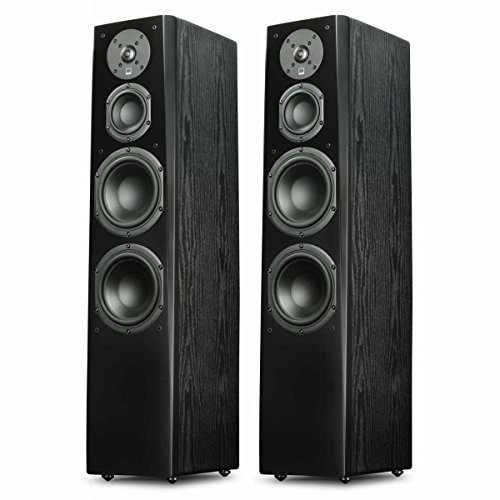
SVS Prime Tower (Pair) — The linked front speakers of the build
Every build needs an anchor, and this one is anchored by a pair of floor-standing towers from SVS — a company that made its reputation on subwoofers before it made speakers, which is a fitting pedigree for a 5.2 guide. The Prime Tower is a three-way design with twin woofers, a dedicated midrange driver and an aluminium dome tweeter in a cabinet that is substantial without being furniture-dominating. In the reference build it does two jobs at once. As a front pair it carries film scores and stereo music with a scale that satellite speakers cannot approach, so the system never sounds like effects wrapped around a hole. And because the towers reproduce a healthy amount of midbass themselves, the crossover to the subwoofer pair can sit at a civilised point where the subs handle only the region they are built for, which keeps bass clean and keeps the subwoofers unlocalisable.
Honesty about the arrangement matters, so let us be explicit: this is a component in a build we are specifying, not half of a boxed 5.2 system, and SVS sells it as a stereo pair. Buyers who want smaller fronts can substitute good bookshelf speakers from the same family and lose little in a subwoofer-assisted system, since the dual subs carry the bottom. What the towers buy over bookshelves is output headroom and midbass authority in larger rooms, plus freedom from stands. They are the one element of this guide you can click through and buy today with our verification behind the listing; treat them as the build’s foundation and choose the remaining components to their standard.
- Role: front left and right channels of the 5.2 build
- Design: three-way floor-standing tower, sold as a pair
- Drivers: twin woofers, dedicated midrange, aluminium dome tweeter
- System fit: designed by a subwoofer specialist to blend with powered subs
- Status: linked — the guide’s single verified component listing
Strengths
- Full-range scale means the front soundstage never feels like satellites waiting for the sub.
- Voicing and finish match the same maker’s centre and surround options for a coherent set.
- Enough sensitivity and headroom for larger rooms where small speakers strain.
Trade-offs
- Towers need floor space and breathing room from the front wall.
- They are the premium line in this build’s budget; bookshelf fronts cost less.
- Buying them alone completes nothing — the rest of the build still awaits.
Best for: builders of the reference system who want front speakers that will never be the weak link. Not suited for: small rooms or satellite-scale budgets, where bookshelf fronts serve better.
The Receiver With True Dual Subwoofer Outputs — Prose-only component
If the “.2” lives anywhere, it lives in the receiver’s subwoofer section, and the market’s vocabulary here is slippery enough to deserve a paragraph of suspicion. Some receivers print two subwoofer sockets on the back that are internally one output split in two — both subs receive identical signal, level and delay. That arrangement still delivers most of the dual-sub benefit, because the acoustic advantage comes from placement, not from separate signals. Better receivers go further and treat the two outputs independently, measuring and setting level and distance for each sub separately during calibration, which corrects the common case where one sub sits near the seats and the other across the room. The best implementations add per-sub equalisation. When you shop this component — and it is a component, chosen by criteria rather than by a link from us — read the manual’s subwoofer pages, not the badge on the carton, and confirm which of those three tiers you are buying.
Beyond the subwoofer section, the receiver needs the ordinary virtues in dual-sub strength: enough channels for five speakers with headroom to spare, room-correction software that actually measures the bass region rather than ignoring everything below a few hundred hertz, and bass management that lets you set one sensible crossover for the speaker set. A receiver that gets these things right makes two subwoofers behave like one invisible source of low frequency. A receiver that gets them wrong leaves you with two boxes booming in counterpoint, which is worse than one — the dual-sub idea fails at the setup stage more often than at the shopping stage, and the receiver is where that battle is won.
- Role: decoding, amplification and bass management for the whole build
- Must-have: two subwoofer outputs; independent level and delay preferred
- Calibration: room correction that measures and adjusts the bass region
- Bass management: flexible crossover settings per speaker group
- Status: prose-only — shop by manual, not by badge
Strengths
- Independent dual-sub calibration solves unequal sub distances automatically.
- Good bass management keeps towers and subs blended at one crossover.
- A receiver bought to this standard serves future speaker upgrades too.
Trade-offs
- True independent dual-sub processing sits in mid-tier receivers and above.
- Marketing labels blur the difference between split outputs and real dual processing.
- Setup menus reward patience; the automatic routine still needs verifying by ear.
Best for: every 5.2 builder — this is the component the format is named after. Not suited for: buyers hoping a Y-splitter on a basic receiver is the same thing; it is a compromise, not an equivalent.
A Matched Pair of Powered Subwoofers — Prose-only component
Here is the purchase the keyword is really about, and the criteria are clearer than the market makes them sound. Buy two of the same subwoofer. Identical units respond identically to the receiver’s settings, so one calibration pass describes both, their output sums predictably, and neither unit becomes the system’s ceiling. Size them for the room rather than for the brochure: in small and medium rooms, a pair of compact sealed subs will reach deeper into evenness than a single large ported unit, while genuinely large rooms may justify a pair of bigger ported models for sheer output. Sealed designs generally start and stop with a tidiness that flatters music and smaller spaces; ported designs trade a little of that tidiness for output and extension per unit of money. Either philosophy works in a pair — what fails is mixing philosophies, sizes and brands in the hope that variety averages out. It does not; it multiplies the variables your calibration must chase.
Set the pair’s budget with the same honesty. Two subwoofers at a moderate level each outperform one subwoofer at the combined price in any room with more than one seat, and roughly match it even for a single seat once placement freedom is counted. What the pair cannot do is rescue a room where both units end up side by side for tidiness — placed together, two subs behave acoustically like one slightly larger sub, and the evenness that justified the purchase evaporates. If your room truly permits only one subwoofer location, spend the whole sub budget on one better unit and skip the 5.2 idea without regret; the format’s virtue is entirely in the separation.
- Role: the two “.2” channels — low-frequency foundation, twice placed
- Rule one: identical models, bought as a pair
- Rule two: placed apart — opposing walls or separated front positions
- Design choice: sealed for tidiness, ported for output per cost
- Status: prose-only — chosen by room size and placement options
Strengths
- Even bass across all seats instead of one sweet spot and several deserts.
- Shared workload lowers distortion and raises headroom for both units.
- Placement flexibility lets each sub sit where it behaves best.
Trade-offs
- Two cabinets to place, wire and explain to the household.
- Total cost exceeds a single entry-level sub, though not a single premium one.
- Requires calibration effort to realise the benefit at all.
Best for: rooms with a sofa’s worth of listeners who all deserve the same bass. Not suited for: single-seat rooms or rooms with only one viable subwoofer position.
A Voice-Matched Centre Channel — Prose-only component
The centre speaker in a dual-sub build has an easier life than in a satellite system — the subwoofer pair carries everything low, and the front towers set the tonal standard — but it remains the speaker your ears judge most critically, because it speaks. The governing rule is family resemblance: a centre from the same speaker line as the front towers shares tweeter design and voicing targets, so a voice panning from tower to centre to tower keeps one accent on its journey across the screen. Cross-brand centres can work, and calibration narrows the gap, but the pan test exposes mismatches instantly and forever. Size the centre generously within its family; the common error is economising here because the speaker looks like a supporting part, when in programme terms it is the lead.
Placement discipline from ordinary 5.1 applies unchanged: at the screen, at ear height as nearly as furniture allows, angled toward the listeners, and forward on its shelf so the sound leaves the cabinet behind. In a dual-sub system there is one extra temptation to resist — do not let the centre’s crossover drift unusually low to make it sound weightier on its own. Its weight in the blend comes from the subwoofers; a centre crossed too low starts producing directional bass that pulls effects toward the screen and muddies the evenness the second sub was bought to create.
- Role: dialogue and screen-anchored effects
- Rule: same family and tweeter design as the front towers
- Placement: screen-centred, ear height, angled to the seats
- Crossover: same disciplined setting as the rest of the set
- Status: prose-only — matched to whichever fronts you choose
Strengths
- A matched centre makes dialogue pans seamless across the front stage.
- Dual subs free it from bass duties, so clarity is its only assignment.
- Family lines offer several sizes, letting the room decide.
Trade-offs
- Large centres demand real estate under or above the screen.
- Staying in-family narrows bargain hunting across brands.
- Its quality ceiling is set by the family you chose for the towers.
Best for: completing the front stage of the reference build with SVS’s own matching centre. Not suited for: mixing into an unrelated existing front pair without a careful audition.
A Compact Surround Pair — Prose-only component
Surround speakers in a 5.2 build have the most forgiving job description in the system: ambience, effects, the occasional dramatic flyover, and almost no deep bass, because the dual subwoofers own the bottom of the spectrum everywhere in the room. That forgiveness is a budget opportunity. Compact bookshelf speakers or dedicated surround designs from the front speakers’ wider family do the work admirably, and the money saved here is better spent on the second subwoofer or the receiver’s calibration tier — the two places this format actually lives or dies. Matching the family still helps, since surround pans to the front stage do occur, but the ear is far less forensic about ambience than about voices, and a near relation serves perfectly well.
Placement, again, outranks pedigree. Surrounds belong at the sides of the main seating, slightly above seated ear height, aimed across the listening area rather than into the nearest listener’s ear; in narrow rooms, a little extra height buys the distance that prevents one speaker from dominating its nearest seat. Wall mounting is normal and expected at this position, so choose models whose brackets and keyhole fittings suit your walls, and plan the cable route before the speakers arrive. In a dual-sub room there is a subtle bonus: because bass is even everywhere, surrounds crossed over at a sensible point blend into a soundfield with no weak quadrant, and effects that circle the room keep their weight all the way around.
- Role: side ambience and effects for the seating area
- Size: compact bookshelf or dedicated surround designs
- Placement: beside the seats, above ear height, aimed across
- Budget logic: the savings here fund the second subwoofer
- Status: prose-only — near relations of the front family suffice
Strengths
- Modest demands make this the cheapest slot in the build to fill well.
- Compact cabinets mount where towers and big bookshelves cannot.
- Even dual-sub bass keeps circling effects consistent in weight.
Trade-offs
- Undersized surrounds can still be outplayed by strong fronts at high volume.
- Side-wall placement is not negotiable in most rooms; furniture may fight it.
- Dedicated bipole-style designs suit film but divide opinion for music.
Best for: finishing the build without overspending where ears are forgiving. Not suited for: multichannel-music devotees, who should match the fronts fully.
Calibration: Measurement, Placement Trials and Patience — Prose-only method
The final pick is not a product, and including it as one is this guide’s way of insisting that 5.2 is a result, not a receipt. The method runs in three passes. First, placement: put one subwoofer in the classic front corner, the second at a genuinely different address — the opposite rear corner, or midway along a side or rear wall — and connect both with their gain knobs set identically at a moderate level. Second, measurement: run the receiver’s calibration with its microphone at the main seat, then at the other seats if the software supports multiple positions, because dual-sub calibration earns its keep by averaging the room rather than perfecting one chair. Third, verification by ear and, if you are inclined, by a phone measurement app playing slow test sweeps: walk the seating row during a bass-heavy scene and listen for the seat-to-seat sameness you bought. Boomy seats mean a peak survived — trim the overall sub level or nudge the nearer sub’s position. A thin seat means a null persists — move the second sub a half-metre and remeasure.
Expect one iteration, occasionally two. What you should not do is calibrate once with both subs stacked in the same corner because the cables reached, declare the format a scam, and return one unit: the format’s entire physics depends on separation. Nor should the two subs run at wildly different gains to compensate for one being nearer — level differences are the receiver’s calibration job, set after placement, with the subs themselves matched. Treat this method as a pick with the same status as the hardware, because in every dual-sub room we know of, it is the difference between owning two subwoofers and hearing what two subwoofers are for.
- Role: converts dual-sub hardware into dual-sub results
- Pass one: separated placement, matched sub gain settings
- Pass two: receiver calibration across the seating positions
- Pass three: seat-by-seat verification with familiar bass-heavy scenes
- Status: prose-only — a method, deliberately listed as a pick
Strengths
- Costs nothing beyond time and unlocks the format’s real benefit.
- Multi-position measurement serves every seat rather than one.
- Small placement nudges fix problems no purchase can.
Trade-offs
- Demands an evening of methodical work rather than instant gratification.
- Some rooms need two iterations before the bass evens out.
- Requires household tolerance for test tones at odd hours.
Best for: every builder of this system, without exception. Not suited for: anyone expecting the second subwoofer to calibrate itself.
Where Should Two Subwoofers Go, Exactly?
Three layouts account for most successful rooms. The first places the subs at the midpoints of the front and rear walls — the classic arrangement in seating studies, and the most even for a row of seats. The second uses opposing front corners, easier with furniture and still far better than one corner alone. The third, for awkward rooms, puts one sub near the front stage and the second near the seating itself, where its proximity fills the nulls the distant sub leaves at the chairs. What all three share is distance between the units and a refusal to cluster them. Symmetry helps calibration behave, but perfect symmetry is not required; the receiver’s per-sub distance settings exist precisely to forgive asymmetric rooms. Experiment within reason: subwoofers are heavy, but moving one is cheaper than any other upgrade in this guide, and the crawl test — ears at seat height, walking the walls during a bass sweep — remains the most honest measurement instrument in home audio. One refinement for the dual-sub case: run the crawl with the first subwoofer already in its chosen home and switched off, placing the second where the sweep sounds smoothest while the first stays silent; then switch the first on and listen from the seats rather than the floor, because the pair’s combined behaviour at the chairs — not either unit’s solo behaviour along a wall — is the quantity you are actually buying.
How Do the Build Slots Compare?
| Slot | Linked? | What decides quality | Budget priority |
|---|---|---|---|
| SVS Prime Tower pair (fronts) | Yes | Scale, voicing, headroom | High |
| Dual-output receiver | No | Independent sub calibration, bass management | High |
| Matched subwoofer pair | No | Identical response, separated placement | Highest |
| Centre channel | No | Family match with the fronts | Medium |
| Surround pair | No | Placement and adequate output | Lowest |
| Calibration method | No | Measurement across all seats | Free, mandatory |
The priority column is the guide in miniature. If money runs short, protect the subwoofer pair and the receiver’s calibration tier, economise on surrounds, and consider bookshelf fronts. If money runs long, the towers and a larger matched centre repay it. The one false economy is deleting the second subwoofer to afford grander speakers elsewhere — that converts the build back into the 5.1 system this keyword was trying to escape.
What Mistakes Ruin Dual-Subwoofer Systems?
Clustering both subs in one corner for tidiness is the classic, already confessed. Running mismatched subwoofers — one sealed, one ported, different sizes — is the second, because calibration ends up serving two different instruments with one set of instructions. Third is gain anarchy: setting each sub’s own volume knob by feel until the pair is unbalanced, then asking the receiver to fix a problem created upstream; match the knobs, then calibrate. Fourth is crossing the speakers over too low in a bid for “full-range” pride, which drags directional bass back into the room and wastes the evenness. Fifth is judging the result from one seat — usually the one the single sub already served well — and concluding nothing changed, while the corner seats quietly went from desert to oasis. Walk the row before you judge.
How Do You Gain-Match Two Subwoofers Before Calibrating?
The receiver’s calibration can only polish what it is handed, and the handover it handles worst is two subwoofers arriving at wildly different levels. Gain-matching prevents that, and it takes ten minutes with nothing more exotic than a phone running a sound-level app. Place the phone at the main seat, play the receiver’s subwoofer test noise or a low test tone at a fixed receiver volume, and measure each subwoofer alone — the other switched off — adjusting its rear gain knob until both produce the same reading at the seat. They will not need identical knob positions, because their distances and room positions differ, and that is fine: identical output at the seat is the goal, not identical knobs. Only then switch both on together and run the full calibration, which now starts from balance instead of chasing it.
Phase deserves the same calm treatment. Most powered subwoofers offer a phase control or a polarity switch, and the receiver’s distance settings do most of this work digitally by delaying the nearer sub. Leave physical phase controls at their zero or normal setting unless the calibration result sounds hollow at the crossover region — that hollowness, a strange thinness in upper bass during the test scenes, is the signature of the subs fighting the main speakers at the handover frequency. If it appears, adjust one control at a time, remeasure, and trust the sweep more than the knob’s label. Methodical beats clever here: change one variable, listen, write down what you did, and keep the notes with the receiver manual for the day furniture moves and the ritual begins again.
Does the Second Subwoofer Help Music, or Only Films?
Music benefits, though the benefit wears different clothes. A film mix uses bass as event — impacts, rumbles, the architecture of tension — while a music recording uses it as foundation: kick drum, bass guitar, the lower body of a piano. With one subwoofer, that foundation’s evenness depends on where you sit, and listeners at the edges of a sofa hear a bass line with notes missing, some pitches strong and others oddly absent as the standing-wave pattern picks its favourites. Two subwoofers flatten that pattern for music exactly as they do for films, so the bass line keeps its shape across the seating. Stereo listening through the towers alone remains a legitimate purist option in this build — the Prime Towers are full-range speakers, not satellites — but for most rooms the crossed-over, dual-sub arrangement is the more honest reproduction of what the recording contains, because it is the arrangement whose response you have actually measured and corrected.
There is one musical caveat worth stating. Systems assembled mainly for cinema sometimes run their subwoofers a few decibels hot for effect, a taste choice that flatters explosions and flatters nothing else. If the build serves music half the week, calibrate to level, verify with recordings whose bass you know intimately, and let films be slightly less theatrical rather than letting music be permanently exaggerated. The evenness you bought works at any level; the level itself is a preference, and preferences should be set on the material you love most.
When Should You Not Build a 5.2 System?
Three situations argue against it, and a guide that hides them is selling rather than advising. The first is the single-seat room: a dedicated chair in a small media room can be served superbly by one well-placed subwoofer and careful calibration aimed at that chair, and the second sub’s money buys more joy elsewhere — better front speakers, acoustic treatment, a larger screen. The second is the room that cannot separate the subs: an alcove layout where every subwoofer position clusters at the front wall within a metre of each other offers nowhere for a second pattern to form, and clustered subs, as established, are one sub wearing a spare. The third is a household at the very start of its surround journey with a fixed total budget, where splitting funds across a second subwoofer would force compromises in the receiver and front speakers that every listener hears every minute, to buy an improvement some seats enjoy some of the time. Sequence matters: get a good 5.1 foundation first, live with it, learn your room’s bad seats by experience — and then, if those seats matter, you will know exactly what the second subwoofer is for, which is the moment this guide was written for.
Can You Predict Your Room’s Problem Frequencies Before Buying Anything?
Roughly, yes, and the arithmetic is friendly. A room’s strongest standing waves form at frequencies whose wavelengths fit its dimensions — the simplest being the wave that fits exactly between two opposite walls. For a room five metres long, that first length mode sits in the region of the mid-thirties in hertz, with siblings at double and triple that frequency, and parallel calculations apply to the width and the height. You do not need precision here; you need the insight that your room has a small set of problem frequencies determined by its shape, that every subwoofer placed in it will excite them according to its position, and that seating placed at a wall — where pressure peaks live — hears the most exaggerated version. This is why moving the sofa even half a metre off the rear wall sometimes improves bass more than any equipment change, and why the second subwoofer, exciting the same modes from a different address, smooths what no single position can. Free room-mode calculators online will draw your room’s pattern from three measurements; spending ten minutes with one before the subwoofers arrive turns placement from folklore into a plan, and turns the calibration evening from an exploration into a confirmation.
What About Cables, Wireless Kits and Hum With Two Subwoofers?
Two subwoofers double the low-level cabling, and with it the chances of the system’s most annoying gremlin: mains hum arriving through a ground loop when the two subs plug into different wall circuits. The symptoms are unmistakable — a steady low hum from one or both subs that changes when other equipment switches on. The cures, in order of preference, are to power both subs from the same circuit where possible, to keep signal cables away from long parallel runs with mains leads, and to use the receiver’s balanced or well-shielded outputs where offered. Wireless subwoofer kits exist and work respectably for the second sub in particular, whose cable run is usually the long and awkward one; the small latency they add is absorbed by the receiver’s distance calibration, which is one more reason that calibration tier matters. What wireless cannot fix is a subwoofer placed where the room hates it — the signal path was never the hard part of this format. Plan cable routes when you plan positions, drill nothing until the crawl test has voted, and remember that a subwoofer’s power cable needs a socket as surely as its signal needs a source: rooms have ended dual-sub ambitions at the discovery that the rear wall has no free outlet, a problem an electrician solves more cheaply before the carpet goes down than after.
In What Order Should You Buy the Build If the Budget Arrives in Stages?
Few households fund a whole system in one afternoon, and 5.2 assembles gracefully in stages if the order is chosen with the end in mind. Stage one is the receiver with genuine dual-subwoofer management and the front pair — the SVS towers of this build, or their bookshelf relatives — run as a high-quality stereo or 3.1 system with a single subwoofer. That stage already transforms television and music, and it locks in the two decisions that are expensive to reverse: the receiver’s calibration tier and the speaker family’s voice. Stage two adds the centre channel and surrounds, completing the 5.1 layout and letting you learn your room’s bass geography seat by seat, because that knowledge is the specification for stage three. Stage three is the second, identical subwoofer, bought while the first is still in production — a practical argument for choosing a current, popular subwoofer model at stage one rather than an obscure bargain that may vanish from catalogues before its twin is needed.
Two staging errors deserve warning. Buying the second subwoofer early, before the surrounds exist, spends money on the subtlest layer of the experience while dialogue still comes from television speakers. And buying a first subwoofer so large and expensive that its identical twin will never be affordable quietly cancels the entire 5.2 plan; if the staged route is yours, size the first sub as one of a pair from the beginning. The staged builder’s reward is that every stage is auditioned in the real room, so the final system is not a guess but a sequence of verified improvements — and the day the second subwoofer arrives, you will already know exactly which seat it was bought for.
Which Crossover Settings Suit a Dual-Subwoofer Build?
The crossover is where speakers hand bass to subwoofers, and in a dual-sub system the setting carries extra weight because the subs are deliberately unlocalisable: cross too high and voices acquire a chestiness that seems to come from everywhere and nowhere, cross too low and the small speakers strain at material the subs could have carried effortlessly. For the build specified here, a single uniform crossover in the familiar eighty-hertz region suits the towers, centre and surrounds alike, because the towers’ own bass ability is a bonus rather than an assignment — letting them run deeper in a surround mix rarely helps and often reintroduces the seat-to-seat variation the second subwoofer was bought to remove, since now the front wall joins the bass argument with its own pattern. Stereo music is the one place to experiment: some listeners prefer the towers running full-range for two-channel material with the subs assisting only at the very bottom, and a receiver with separate music and cinema profiles lets both preferences coexist. Whatever you settle on, settle it after placement and calibration, in that order — crossover choices made before the subs are positioned are guesses dressed as settings, and the room, as this entire guide has argued, always gets the final vote.
What Does the Second Subwoofer Do for Gaming and Sport?
Games turn out to be an unexpectedly strong argument for the pair. Modern game audio is mixed like cinema — engines, weather, distant artillery and footsteps all live partly in the bass — but the player, unlike the film viewer, moves the camera, which moves the listener’s relationship to every sound source constantly. In a single-sub room, that movement keeps crossing the standing-wave pattern’s borders, so the same virtual engine swells and thins as you turn, an artifact players often blame on the game. Two subwoofers steady the foundation under that motion, and the low end becomes a reliable spatial cue rather than a lottery. Sport broadcasts benefit more quietly: crowd noise is a broad wash with genuine low-frequency content, and even bass makes a living room feel like the same stadium from every seat on the sofa, which is, after all, the social point of watching together. Neither case requires new equipment beyond the build already specified — they are dividends of the same placement and calibration work, noticed on the nights when the cinema is dark and the console or the match is on instead.
How Can a Phone App Verify That the Pair Is Working?
You do not need laboratory instruments to confirm the improvement, because the improvement is large and lives at frequencies a phone handles adequately for comparison purposes. Download any spectrum analyser or sound-level app, play a slow sine sweep from a test-tone source through the system at a modest level, and record the level at each seat with only the first subwoofer running; then repeat with both. The single-sub trace will swing widely as the sweep crosses your room’s modes — the phone’s numbers will leap and sag by margins you can also plainly hear. The dual-sub trace should sag less and recover faster, and the seat-to-seat traces should resemble each other more closely. Perfection is not on offer and is not the claim; resemblance between seats is. Keep the sweeps short and the volume neighbourly, since sustained low tones at level are hard on both subwoofers and relationships, and write the before-and-after numbers in the receiver manual. They are the receipt that this configuration, assembled from components and patience, does the thing the boxed category only advertises.
Final Recommendation
Build it, do not buy it — that is the whole truth of this keyword. Take the SVS Prime Tower pair as the front foundation if your room and budget allow, match a centre from the same family, keep the surrounds modest, insist on a receiver whose two subwoofer outputs are more than a split socket, and buy two identical subwoofers that you are genuinely willing to place in different parts of the room. Then spend the evening the calibration method asks for. What you will own is not a product with a badge but a room where the bass is the same in every seat, where explosions arrive as weather rather than as a box clearing its throat in the corner. Of every upgrade in home cinema, that evenness is the one guests notice without knowing why the room feels expensive — and it starts the moment you stop shopping for a 5.2 box and start placing a second subwoofer where the first one’s nulls live.
Frequently Asked Questions
Is 5.2 just a 5.1 system with an extra subwoofer?
In hardware terms, yes — and that is precisely the point this guide exists to make. The difference is configuration and intent: the same five speakers, a receiver that manages two subwoofers properly, and a second sub placed to fix the first one’s room problems. The label describes the arrangement, not a separate species of product.
Do the two subwoofers play different signals?
Usually not in any meaningful way. Film mixes carry one low-frequency effects channel plus the bass redirected from the small speakers, and both subwoofers reproduce that combined bass. The benefit comes from two locations exciting the room differently, not from stereo bass — which, at these frequencies, human hearing cannot localise anyway.
Can I add a second subwoofer to my existing 5.1 system later?
Yes, and it is one of the best upgrade paths in home audio. Match your existing subwoofer with an identical unit if it is still available, check whether your receiver offers one or two subwoofer outputs, and budget an evening for placement and recalibration. A single-output receiver can still drive two subs through a splitter, with the calibration caveats described in the receiver section above.
Are two smaller subwoofers better than one bigger one?
For several seats, generally yes: evenness beats depth you can only hear from one chair. For a single dedicated seat, one larger subwoofer placed optimally for that chair can match or beat a pair, and costs less in cabling and floor space. Count your real seats, not your theoretical ones, and let that decide.
Where should the second subwoofer go if the room is small?
Small rooms have stronger, not weaker, standing-wave problems, so the second sub still earns its place. Try the wall opposite the first sub, or beside the seating, and keep both units’ levels modest — in a small room the pair’s job is smoothing, and neither unit needs to work hard to do it.
Will two subwoofers annoy the neighbours twice as much?
Usually the opposite. Because each subwoofer works less hard for the same in-room result, and because calibration trims the peaks that carry through walls, a well-set dual-sub system often transmits less stray energy than a single subwoofer being driven into boom to satisfy the worst seat. Total output is a choice made at the volume control in both cases; evenness is what the second unit adds, and evenness is not the part neighbours hear through the floor.
Can I mix one new subwoofer with my older, different one?
You can, and many people start there, but treat it as a trial rather than the destination. The receiver will calibrate to the pair’s combined behaviour, the weaker unit will set the system’s limits, and their different low-frequency roll-offs make the blend harder to even out. If the experiment convinces you of the format — and it usually does — replace the older unit with a twin of the newer one and recalibrate; that is the configuration every section of this guide assumes.
Can I run two subwoofers from a receiver with only one subwoofer output?
Yes, with a simple RCA Y-splitter, and many dual-sub systems start exactly there. The limit is calibration rather than wiring: both subwoofers receive the same signal and the same correction, so the receiver treats the pair as one combined unit. That arrangement works well when the two are identical models placed in a rough symmetry, and it is the honest stepping stone toward a receiver with independent dual outputs when the budget allows the upgrade.
Related Guides
Keep reading with our complete 5.1 channel speaker guide for the single-sub systems this build grows from, floor-standing tower speakers compared if the front pair is your next decision, and our guide to best 5 1 ceiling speakers for rooms that cannot take floor-standing speakers at all. There is also our guide to best 6 5 component speakers for the other system most households upgrade next, the car, since a second project has a way of starting the week the first one is finally calibrated.



[…] with our companion reading: the dual-subwoofer surround build explained, floor-standing speakers for larger rooms, and best 5 1 ceiling speakers. You may also find our […]