What's inside
- Key Takeaways
- Quick Picks
- How We Chose These Picks
- What Does “Marine Grade” Actually Have to Mean?
- Why Does Sensitivity Matter More on a Boat Than Anywhere Else?
- How Many Pairs Does Your Boat Actually Need?
- What About Wakeboard Towers and T-Tops?
- How Should You Set Up the Head Unit for Open Water?
- How Do the Six Compare Side by Side?
- Where Should Marine Speakers Be Mounted?
- How Do You Wire and Protect a No-Amp Marine System?
- How Should You Care for Marine Speakers Season to Season?
- Does Your Boat Type Change the Answer?
- A Note on Volume, Neighbours and the Water
- What Are the Most Common Mistakes When Buying Marine Speakers?
- What Does a Season of Ownership Actually Look Like?
- What If One Side Goes Quiet Mid-Season?
- What Should You Know Before Replacing Factory Boat Speakers?
- Lighting Ecosystems: How Do the Two Approaches Differ?
- Should a No-Amp Boat Add a Subwoofer?
- Fresh Water Is Kinder, but Not Kind
- Final Recommendation
- Frequently Asked Questions
- Related Guides
As an Amazon Associate I earn from qualifying purchases. This post may contain affiliate links at no extra cost to you.
widgetverdict.com is reader-supported. When you buy through links on our site, we may earn an affiliate commission.
Where to buy: All six picks below carry checked Amazon listings, and each name in the Quick Picks table links to its product page. Note the colour and grille variants before ordering — several of these models are sold in white and black versions under near-identical names, and the LED-equipped Kicker is a distinct model from the standard KM65, not a trim option.
The best 6.5 marine speakers that run without an amp solve a very specific boating problem: a boat is the worst listening room ever built — open air, wind, engine noise, water slapping the hull — and most boats power their speakers from a head unit alone, because an amplifier means wiring, current draw and one more thing for salt air to eat. So the brief for this guide is double. The speaker must be efficient enough to sound full and clear on head-unit power alone, over real on-water noise. And it must be genuinely marine: sealed against spray, built from materials that ultraviolet light and salt do not quietly destroy, with grilles and hardware that will not be orange with rust by the second season.
Plenty of speakers are sold as marine on the strength of a white cone and a hopeful product page. The six below come from the ranges that boat builders actually fit — Kicker’s KM line, Rockford Fosgate’s M1 and M2 Color Optix families, Skar’s marine range and JL Audio’s M3 series — and each pick is assessed against the no-amplifier brief first and the marine brief second, because a waterproof speaker you cannot hear over the engine is deck furniture, and a loud speaker that dies in a season is worse. If you do plan an amplifier later, several picks here will happily grow into it; the guide flags which ones reward power and which are already giving everything a head unit can ask for.
Key Takeaways
- Without an amplifier, sensitivity is destiny: efficient speakers make head-unit power sound like a system, and inefficient ones sound like a suggestion.
- True marine construction means sealed motors, UV-stable cones and surrounds, corrosion-resistant terminals and grilles — not merely a white finish.
- The Kicker KM65 is the default answer for most boats: efficient, genuinely weatherproof and sold with both charcoal and white grilles in the box.
- Rockford’s M1 and M2 add the Color Optix lighting ecosystem; the M2 is the step up for larger, louder boats. The JL Audio M3 is the refinement pick, and the Skar SK65M the value pick.
- Mounting location matters as much as the speaker: a well-placed pair near ear level beats a premium pair buried low in a cockpit sole.
Quick Picks
| Pick | Badge | Why it earns its place |
|---|---|---|
| Kicker KM65 | Best overall without an amp | Efficient, sealed and proven across a decade of factory boat installs. |
| Kicker KM65 LED | Best with lighting | The KM65 recipe plus LED illumination for evening cockpit ambience. |
| Rockford Fosgate M1-65 | Best value in Color Optix | The entry to Rockford’s marine line with lighting-ready design and honest efficiency. |
| Rockford Fosgate M2-65B | Best for bigger boats | More motor, more output and a black sport-grille look for larger cockpits. |
| Skar Audio SK65M | Best budget marine pair | Real marine construction and generous output at the price of a tank of fuel. |
| JL Audio M3-650X | Best sound quality | The refinement pick — smooth, controlled and built to JL’s marine standard. |
How We Chose These Picks
Efficiency came first, because the no-amplifier constraint is absolute: a marine head unit delivers modest continuous power per channel, and on open water that power fights wind, engine and hull noise for your attention. We favoured speakers whose sensitivity and voicing produce clarity at the moderate outputs a head unit sustains — presence in the vocal band matters more underway than deep bass, which the open air steals anyway. Speakers that only wake up on amplifier power were excluded however good their marine credentials, because this guide’s promise is in its title.
Marine construction was audited as a checklist rather than a vibe. Sealed motor structures keep driven spray out of the voice-coil gap. Cones and surrounds must be UV-stable synthetics — treated paper and foam need not apply. Terminals should be sealed or corrosion-resistant, grilles should be moulded polymer or properly coated, and mounting hardware should be stainless. Every pick here clears that bar by design and by service history; the differences between them are output, refinement, lighting and price, not survival.
Finally, we weighted ecosystem and fit. Boats use standard 6.5-inch cutouts across decades of models, so all six install in the holes most cockpits already have. Lighting ecosystems — Rockford’s Color Optix, Kicker’s LED grilles — were treated as legitimate deciding features rather than gimmicks, because evening use is half of recreational boating and a speaker that lights the cockpit is doing two jobs. Where a model is sold in colour variants, the listing named is the one described.
What Does “Marine Grade” Actually Have to Mean?
A boat subjects speakers to three enemies a car never combines: ultraviolet radiation all day, every day the cover is off; water delivered as spray, washdown and driven rain, often salty; and vibration from hull and engine transmitted through thin fibreglass panels that flex. Marine grade, honestly used, means the design answers all three. UV-stable cone and surround materials that will not chalk, crack or stiffen across seasons. A sealed or shielded motor so spray that passes the grille does not reach the coil. Drainage thinking — the speaker should shed water, not cup it. Corrosion-proof terminals and hardware. And a grille that is part of the protection, not a decoration clipped over a car speaker.
The honest test is time. Any speaker sounds fine in its first month on a boat. The marine ranges in this guide have the service history — years of factory fitment by boat builders who warranty the result — that separates construction from marketing. When you compare alternatives outside this list, look for the sealed motor and the materials list, and be suspicious of any “marine” speaker whose manufacturer will not say what the cone and surround are made of.
Why Does Sensitivity Matter More on a Boat Than Anywhere Else?
On the water, your listening level is set by the noise floor, and the noise floor is high: wind across an open cockpit, an outboard at cruise, water against the hull. Music must clear that floor to be music rather than murmur, and without an amplifier the only way to clear it is efficiency — sound produced per watt. A few decibels of sensitivity difference between two speakers is equivalent to doubling or halving your head unit’s power, which is why the efficient Kicker and Skar designs punch so far above their price in this application, and why a refined but thirstier speaker can disappoint underway while delighting at the dock.
Voicing interacts with the noise too. The band that carries intelligibility — vocals, the melody line — is the band that survives wind best when the speaker presents it cleanly and slightly forward. Deep bass, by contrast, is a dockside pleasure: underway, the open air gives it nowhere to build. Choose for underway clarity first and enjoy the dockside fullness as the bonus it is, rather than buying a bass-heavy speaker whose best trick only works tied up.

Kicker KM65 — Best overall without an amp
The KM65 is the speaker the marine industry itself chose: it has been factory-fitted across countless production boats because it solves the whole problem at once. The motor is completely sealed, the cone is a UV-treated polypropylene with a Santoprene rubber surround — a pairing chosen for exactly the sun-and-spray life a cockpit delivers — and the terminals are sealed against the moisture that creeps into every boat eventually. Kicker ships both charcoal and white grilles in the box, which sounds trivial until you have priced a second grille set or tried to match a cockpit’s colour scheme from a catalogue photograph.
On head-unit power it is the benchmark of this guide. Its efficiency turns a marine stereo’s modest output into underway-usable volume with the vocal band presented clearly, and its balance stays composed when the volume goes up against the wind — no shouting treble, no collapsing middle. It is not the last word in refinement; the JL is smoother, and the M2 plays bigger. But as the single purchase that makes a boat’s stereo genuinely good with no amplifier, no drama and a decade of service history behind it, the KM65 is where this list starts and, for most boats, where it can honestly end.
- Design: gloss-white 6.5-inch marine coaxial, pair
- Tweeter: 3/4-inch dome
- Construction: sealed motor, UV-treated cone, Santoprene surround
- Grilles: charcoal and white both included
- Impedance: 4 ohm
Strengths
- The complete no-amp package — efficiency, sealing and service history in one box.
- Both grille colours included; cockpit matching costs nothing extra.
- Balance holds together at underway volume, where lesser speakers turn ragged.
Trade-offs
- Refinement trails the JL M3 — smoothness was traded for efficiency and price.
- No lighting; the LED sibling is a separate model and purchase.
- Its popularity means counterfeits and grey listings exist — buy the exact model from a reputable seller.
Best for: the majority of boats running head-unit power, from centre consoles to cruisers. Not suited for: buyers who want cockpit lighting included, or outright sound-quality builds with amplifiers.

Kicker KM65 LED — Best with lighting
Take everything above and add light. The KM65 LED carries the same sealed construction, the same efficient coaxial design and the same pair of grille colours, with LED illumination built into the speaker that can be wired to a simple switch or to a lighting controller for colour control. The use case is not frivolous: a cockpit at anchor after dark is a social space, and speakers are already mounted in exactly the positions — high, spread, wired — that lighting wants. Combining the two jobs in one fitting saves a second set of holes in the fibreglass, which every boat owner understands is a real saving.
The costs are wiring and a little complexity. The LEDs need their own power run and switching beyond the speaker wire, and full colour control wants a controller module, which is another box to mount somewhere dry. Sound is the KM65’s sound — which is to say, the no-amp benchmark — so the decision is honestly about whether your evenings on the water justify the extra install hour. For boats that anchor out, entertain at the dock or run at dusk, they usually do. For a fishing machine that lives at dawn and sleeps in a lift, save the money and buy the standard model.
- Design: 6.5-inch marine coaxial with built-in LED lighting, pair
- Tweeter: 3/4-inch dome
- Construction: sealed motor, UV-treated cone, Santoprene surround
- Lighting: LED, controller-compatible for colour effects
- Impedance: 4 ohm
Strengths
- Full KM65 performance plus cockpit lighting from the same fitting.
- Evening ambience without cutting additional holes for separate lights.
- Both grille colours included, as with the standard model.
Trade-offs
- LED wiring and switching add install time; colour control needs a controller.
- You pay for the light whether or not your boating uses evenings.
- One more electrical system for salt air to test — keep connections sealed and accessible.
Best for: boats that live social evenings — anchor-outs, dock parties, dusk cruises. Not suited for: purely utilitarian boats, or owners who want the simplest possible wiring.

Rockford Fosgate M1-65 — Best value in Color Optix
Rockford’s M1 series is the entry floor of a serious marine line, and the M1-65 in white brings the company’s Color Optix lighting platform down to a first-upgrade price. The construction follows the marine checklist properly — a sealed, element-ready design with a UV-stable cone and an integrated crossover that keeps the wiring a head unit can drive simple — and the voicing is tuned for the open air: clear, present and efficient enough to be genuinely satisfying without an amplifier, which is not true of every speaker wearing this badge’s bigger siblings’ reputations.
The Color Optix system is the strategic reason to choose it. The speakers are lighting-ready, designed to connect with Rockford’s controller and app ecosystem, so a boat can start with sound today and add full colour lighting control later without replacing the speakers. That upgrade path, plus the option of the M2 above it in the same visual family for a second zone, makes the M1 the planner’s pick. On pure sound-per-money the Kicker argues back hard, and the M1’s white-only listing here will not suit every cockpit — check the range’s colour options when ordering. But as the entry ticket to a coherent marine audio-and-lighting system, it has no rival on this list.
- Design: Color Optix ready 6.5-inch marine coaxial, pair
- Colour: white (this listing)
- Construction: element-ready sealed design, UV-stable materials
- Crossover: integrated, head-unit friendly
- Impedance: 4 ohm class
Strengths
- Lighting-ready from day one — add the Color Optix controller when budget allows.
- Efficient enough to honour this guide’s no-amplifier brief honestly.
- Part of a family — M2 zone upgrades match visually and tonally.
Trade-offs
- Full lighting requires the separate controller; out of the box the ecosystem is potential, not light.
- White finish only on this listing — dark cockpits should check the black variant.
- Sound-per-money is matched by the Kicker; you are paying partly for the platform.
Best for: owners building toward a lit, multi-zone Rockford system in stages. Not suited for: one-and-done buyers who will never add the controller.
Rockford Fosgate M2-65B — Best for bigger boats
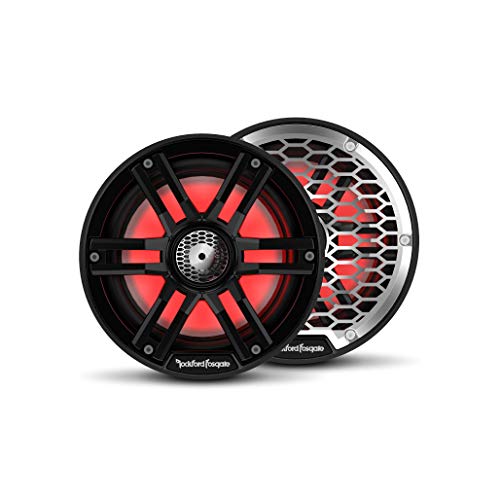
The M2-65B, in black with its sport and stainless grille options, is the M1’s bigger brother in every sense: more motor, more cone control, more output, and a design brief aimed at larger cockpits where a pair of speakers must cover more air and more passengers. It remains Color Optix ready, and it remains usable on head-unit power — that was a condition of entry to this guide — but honesty requires the nuance: the M2 is the pick here that most clearly rewards an amplifier when one eventually arrives. On the head unit it is strong; on real power it is the biggest sound on this list, with a low-end solidity the others do not attempt.
Choose it by boat size and by trajectory. A centre console or cruiser with a wide cockpit, seating spread across zones, and a probable amplifier in next season’s budget is exactly its home. A small open boat will never use its headroom and should save the difference. The black finish and sport grille styling suit the darker, more technical cockpits of fishing and performance boats where the M1’s white looks lost. Fit is standard 6.5-inch, but check the mounting depth — the bigger motor asks for a little more room behind the panel than its siblings do.
- Design: Color Optix ready 6.5-inch marine coaxial, pair
- Colour: black, with sport and stainless grille options
- Construction: element-ready sealed design, larger motor than M1
- Power character: works on head-unit power, scales best with an amplifier
- Impedance: 4 ohm class
Strengths
- Biggest output and low-end authority here — covers large cockpits properly.
- Grows into an amplifier better than any other pick on this list.
- Black sport styling suits fishing and performance-boat cockpits.
Trade-offs
- On head-unit power alone, part of what you paid for stays asleep.
- Deeper motor — verify clearance behind the mounting panel.
- Premium pricing within this list, before any controller costs.
Best for: larger boats, wide cockpits and owners with an amplifier on the horizon. Not suited for: small boats, tight mounting depth, or strict one-purchase budgets.

Skar Audio SK65M — Best budget marine pair
Skar’s SK65M in white does for marine audio what the brand does everywhere: takes the essential specification, builds it properly, and prices it where the big names’ entry models used to live. The essentials are genuinely present — a marine-sealed design with a UV-resistant cone, a rubber surround, and output figures that translate into real underway volume on head-unit power, because Skar voices its speakers generously in the bands that matter on open water. A boat that needs four speakers — cockpit plus bow, say — can be fitted out with SK65Ms for what a pair of the premium picks cost, and on the water that coverage often beats two better speakers in the wrong places.
The compromises are refinement and ecosystem. There is no lighting platform, the finish and grille detailing are workmanlike rather than yacht-grade, and at the top of its range the sound is enthusiastic rather than polished — the JL shows what the extra money buys, every time, at the dock. Underway, at cruise, with the wind up, those differences narrow to nearly nothing, which is the SK65M’s whole argument. For working boats, fishing machines, pontoons and any hull where audio is a pleasure rather than a project, it is the rational spend.
- Format: 6.5-inch marine coaxial, pair
- Colour: white (a black variant exists in the range)
- Construction: marine-sealed design, UV-resistant cone, rubber surround
- Power character: generous output on head-unit power
- Impedance: 4 ohm class
Strengths
- Real marine construction and real volume at the lowest price here.
- Four-speaker coverage for premium-pair money — placement beats pedigree on water.
- Voicing suits open-air listening: present, clear, unfussy.
Trade-offs
- No lighting ecosystem and plainer finishing details.
- Refinement at high volume trails the Kicker and clearly trails the JL.
- Brand support and dealer network are thinner than the marine majors’.
Best for: budget-conscious boats, multi-zone coverage and working hulls. Not suited for: buyers building a lit, single-brand system, or dockside critical listeners.

JL Audio M3-650X — Best sound quality
JL Audio’s M3-650X, in gloss white with the classic grille, is what this category sounds like when refinement is the design brief. The silk dome tweeter is the giveaway: where most marine coaxials use a hard dome voiced to cut through noise, JL tunes for smoothness, and at anchor or at the dock the difference is not subtle — voices are natural, cymbals have texture instead of splash, and long evenings of music do not fatigue. The construction is everything the badge implies: a properly engineered marine driver with a long service record in premium factory installs, built to be serviced by a real dealer network.
It earns its place in a no-amplifier guide honestly — it is efficient enough to satisfy on head-unit power, and many owners will never ask more of it. But it is fair to say its margin over the Kicker lives at moderate volumes and in quiet anchorages; at cruise, wind and engine compress the differences, and the M3’s premium buys less. Buy it because your boating includes the quiet hours and your ear notices tweeter quality, and it will repay you every evening. Buy it for a loud centre console that lives at full throttle and the Kicker or M2 will serve the actual use better for less.
- Format: 6.5-inch marine coaxial, pair
- Colour: gloss white, classic grille (this listing)
- Tweeter: silk dome — the refinement choice in this class
- Construction: JL marine engineering, dealer-supported range
- Impedance: 4 ohm class
Strengths
- Smoothest, most natural sound here — the dockside and anchorage champion.
- Build quality and dealer support set the class standard.
- Satisfying on head-unit power, with headroom to grow if an amplifier joins.
Trade-offs
- The premium is real, and underway noise erases much of its advantage.
- No integrated lighting ecosystem of its own.
- Gloss white classic styling will not suit every cockpit’s look.
Best for: sound-quality-first owners whose boating includes quiet hours at anchor. Not suited for: loud, fast boats where refinement cannot be heard, or lighting-led builds.
How Many Pairs Does Your Boat Actually Need?
Zone planning beats speaker collecting. A single pair, well placed at the helm and main seating, covers most boats under about twenty-five feet honestly — the cockpit is one acoustic space, open to the sky, and two good speakers fill it. The case for a second pair is geography: a bow seating area separated from the cockpit by a windshield, a flybridge, or a cabin that people actually occupy. Each of those is its own listening space and deserves its own pair, ideally on its own zone control so the helm can run quietly while the bow socialises. The SK65M’s pricing makes that second zone painless; the Rockford family’s matching M1 and M2 models make it coherent.
What rarely works is scattering single speakers or adding a second pair to the same space to make it louder. In an open cockpit, more speakers in one space mostly means more sound escaping to the sky and more wiring for salt to test. Loudness underway comes from efficiency and placement, not count. Spend the second pair’s money on the second space, or do not spend it — and if the boat truly needs volume beyond what an efficient pair gives the helm, that is the amplifier conversation arriving on schedule, with the M2 and M3 as its natural partners.
What About Wakeboard Towers and T-Tops?
Tower speakers are a different product wearing a similar diameter: they are built to project sound behind the boat to a rider, in enclosures, with output as the entire brief. Nothing in this guide is that product, and no cockpit coaxial should be asked to do that job — pointing a pair of KM65s at the sky will entertain the rider faintly and the marina greatly. If your boating includes towing sports seriously, budget the tower as its own line with its own amplification; it almost always needs an amplifier, which is another reason it lives outside this guide’s no-amp premise. The cockpit picks here remain the right answer for the people in the boat, which is most of the people, most of the time.
How Should You Set Up the Head Unit for Open Water?
Start flat and resist the loudness button. Marine head units ship with the same showroom tricks as car units — boosted lows, boosted highs — tuned to impress in a quiet shop. Underway, the wind removes the top and the open air removes the bottom, so a modest treble lift can be legitimate at cruise; set it underway, at cruise, not at the dock, or you will build a tune for a room that does not exist when the boat moves. Keep the fader honest between zones, and if your unit offers a volume limiter or a second zone level, set the bow zone for its listeners rather than mirroring the helm.
Bluetooth and phone sources deserve one caution: their own volume and EQ stack on top of the head unit’s, and a phone at maximum with its bass booster on will clip a clean system into sounding broken. Set the phone near full but not at the last step, turn its sound effects off, and let the head unit do the shaping. Half the “my new speakers distort” reports on boats are a phone setting wearing a disguise.
How Do the Six Compare Side by Side?
| Model | Efficiency on head unit | Lighting | Character | Best habitat |
|---|---|---|---|---|
| Kicker KM65 | Excellent | None | Balanced, proven | Most boats |
| Kicker KM65 LED | Excellent | Built-in LED | Balanced plus ambience | Evening boats |
| Rockford M1-65 | Very good | Color Optix ready | Clear, staged growth | System builders |
| Rockford M2-65B | Good, scales with amp | Color Optix ready | Biggest output | Large cockpits |
| Skar SK65M | Very good | None | Enthusiastic value | Budget multi-zone |
| JL Audio M3-650X | Good | None | Smoothest sound | Quiet anchorages |
The pattern to notice is that “best” on a boat is a question about your hours. Underway hours favour efficiency — Kicker and Skar. Evening hours favour light — the LED Kicker or the Rockford platform. Quiet hours favour refinement — the JL. Large-cockpit hours favour output — the M2. Match the speaker to the hours you actually spend, and every pick here is the right one for somebody.
Where Should Marine Speakers Be Mounted?
Placement on a boat follows one rule: sound goes where ears are, at the height ears live. Speakers mounted low in a cockpit sole fire at ankles and are muffled by legs, coolers and life; the same speakers at seat-back or gunwale height, angled toward the seating, sound twice as expensive. Before cutting anything, hold the speaker in candidate positions with a helper playing music at cruise volume and listen from the helm and the passenger seats — the helm is the position that matters underway, and it is often the worst served by factory locations chosen for easy fibreglass access rather than acoustics.
Respect the structure while you chase the sound. Do not cut into cored fibreglass without sealing the core edges against water intrusion, keep speakers clear of compass deviation zones at the helm, and never mount where a speaker’s magnet sits against wiring looms or fuel-system components. Behind the panel, leave a drip loop in the wiring and use sealed, adhesive-lined heat-shrink connections — the marine environment finds every bare crimp, and it finds them in the second season, at the furthest point from the dock.
How Do You Wire and Protect a No-Amp Marine System?
Use tinned marine-grade speaker wire, sized generously for the run, because ordinary copper wire corrodes from the inside out in salt air — the green creeping failure that makes a speaker fade over a season and baffles owners who test everything except the cable. Every connection gets adhesive-lined heat shrink or a sealed connector; every penetration gets sealant; every run gets supported so it cannot chafe against a bulkhead edge. The head unit’s own protection matters too: a splash cover or a mounting position out of direct spray extends its life more than any feature on its box.
Electrically, keep the plan simple, which is the no-amplifier philosophy applied to wiring. One pair per head-unit channel, impedance as the manufacturer expects, no creative series-parallel experiments to run six speakers from four channels — head units protect themselves by shutting down, usually at the best part of the evening. If the boat genuinely needs more zones than the head unit has channels, that is the honest signal that a small marine amplifier belongs in the plan after all, and picks like the M2 and M3 will be waiting for it.
How Should You Care for Marine Speakers Season to Season?
Rinse salt off with fresh water when you wash the boat — gently, as a rinse, not a pressure-washer blast into the cone. Inspect the surrounds and grilles each spring for UV chalking or cracking, and check the terminals and connections for the first green hints of corrosion while the boat is out of the water and everything is easy to reach. A cover over the cockpit does more for speaker life than any product you can apply to the speakers themselves; UV is cumulative, and shade is the only true sunscreen. In winter storage, the speakers ask nothing special — it is the connections and the head unit that benefit from a dry boat and a battery maintained rather than abandoned.
When a marine speaker does fade, diagnose before replacing: swap the quiet speaker’s wiring with the good side’s at the head unit. If the fault follows the wire, it was corrosion in a connection, not the driver — the most common marine audio failure by a wide margin, and the cheapest to fix. Drivers in this guide are built to outlast several head units; the wiring is the perishable part, and it deserves the suspicion first.
Does Your Boat Type Change the Answer?
Centre consoles live loud: open layout, outboard noise, an owner who fishes at dawn and cruises at noon. Efficiency and durability outrank everything, which is the KM65’s home turf, with the SK65M as the value route to covering a bow zone as well. The helm position matters most — get the pair where the driver hears them at cruise, not where the factory found easy fibreglass. Pontoons are the opposite acoustic problem: quiet, social, spread out across a deck where one pair at the helm leaves the front loungers in a different world. Two pairs — the Skar makes this affordable, the M1 makes it upgradeable — with zone control is the pontoon answer, and refinement at conversational volume argues for the JL at the main seating if the budget stretches to one premium pair.
Cruisers and sailboats add the cabin, which is a genuine indoor room and the one place on any boat where dockside refinement is heard underway too, at anchor and in harbour. A cruiser plan often pairs the efficient cockpit speakers with the smoother choice below deck, and sailboats add a power-budget conscience: without an amplifier, a frugal head unit and efficient speakers keep the stereo’s draw trivial against house batteries, which is one more reason the no-amp brief suits sailing particularly well. Runabouts and bowriders split the difference — social like pontoons, faster like consoles — and usually land on the KM65 or M1 with the second zone added when the bow proves popular.
A Note on Volume, Neighbours and the Water
Sound carries across water with an efficiency that surprises every new boat owner, and an efficient speaker system — the kind this guide exists to recommend — carries further than most. The etiquette is simple and worth stating in a guide that teaches people to hear their music clearly at cruise: anchorages and marinas are shared quiet, and the same clarity that serves your cockpit at moderate level serves the whole cove at high level. The good news hidden in this list is that clarity and loudness are not the same purchase. A well-placed, efficient pair sounds full to its own listeners at levels a poorly placed system must double to match — which means the considerate setup and the satisfying setup are, for once, the same setup.
What Are the Most Common Mistakes When Buying Marine Speakers?
Buying car speakers in white is the first and worst — a season of UV and spray will collect the debt. The second is ignoring efficiency and then blaming the head unit for a quiet system. The third is mounting low because the fibreglass was easy there, and spending the next five years listening to your own ankles. The fourth is bare crimp connections, which are scheduled failures, not connections.
Fifth is over-speaker-ing a small boat: a 19-foot open boat needs one good pair near the helm, not four speakers competing with the wind from four corners. Sixth is forgetting the variants — ordering the white model for a black cockpit, or the non-LED Kicker while picturing the lit one — because marine ranges reuse names across colours and features more than any other category in this series. Read the exact listing title before the checkout button, every time.
What Does a Season of Ownership Actually Look Like?
The first month is honeymoon: everything in this guide sounds dramatically better than the chalked factory speakers it replaced, and the temptation is to declare the project finished. The wiser move is a short shakedown list. After the first few outings, re-check every mounting screw — fibreglass and vibration negotiate, and screws that were snug on the trailer loosen on the water. After the first washdown, look behind one accessible speaker and confirm your connections are dry and your drip loops are doing their job. After the first evening run, decide whether the lighting question — the LED Kicker, the Color Optix controller — is a real desire or was a showroom one; both answers are respectable, and the speakers were chosen so either can be acted on later.
By mid-season the system’s real character has declared itself: whether the helm position is properly served at cruise, whether the bow zone balance suits its passengers, whether the head unit’s settings survived contact with guests. Adjust once, properly, at cruise, and then leave the tune alone. Marine audio rewards the owner who sets it and boats, over the owner who tweaks it at every anchorage — the water is the point, and every pick here was chosen to disappear into it.
What If One Side Goes Quiet Mid-Season?
Work the fault in the order the sea creates them. First, connections: a corroded or shaken-loose terminal at the speaker or head unit accounts for most silent sides, and it costs nothing but access to check. Second, the wire run itself, especially anywhere it passes a bulkhead or shares a chase with anything that moves. Third, the head unit’s balance and zone settings, which guests adjust with confidence and owners forget with equal confidence. Only after those three should the driver itself be suspected — and the test is simple: swap the silent speaker onto the working side’s wire. If it sings, the driver was never the problem. The sealed construction that defines this list means genuine driver failures are the rarest item on the page, which is, in the end, the whole argument for buying marine speakers from marine ranges.
What Should You Know Before Replacing Factory Boat Speakers?
Production boats were built to a price, and their speakers are usually the first place it shows: unsealed car-type drivers behind marine-looking grilles, wired with whatever was on the production line’s shelf. Replacing them with anything in this guide is a genuine upgrade, but go in with a surveyor’s eye. The factory cutouts are standard 6.5-inch on the great majority of boats, yet the mounting depth behind them varies with hull design, and the wiring you inherit may be plain copper already years into its corrosion — budget the wire replacement into the job if the old cable shows any green at the stripped ends, because new speakers on dying wire will fade exactly like the old ones did and take the blame for it.
Also expect the factory positions to be mediocre, chosen for the builder’s convenience. You are not obliged to honour them. Filling the old holes and cutting new ones at ear height is more work and some fibreglass courage, but on a boat you keep, it is the difference between a speaker upgrade and a sound upgrade. If you do relocate, seal the old cutouts properly — an unsealed hole in a cockpit liner is a water path into places water should never meet. And keep the old grilles if they are sound: factory grilles sometimes match a cockpit’s mouldings in ways no new grille will, and several drivers here can live behind them if the sound passes cleanly, though the speakers’ own grilles are the safer acoustic bet.
Lighting Ecosystems: How Do the Two Approaches Differ?
Kicker and Rockford sell light two different ways, and the difference decides which suits your boat. The KM65 LED builds the light into the speaker and asks only for power and a switch for basic illumination — the shortest path from box to glow, ideal when the lighting is a feature of the speakers rather than a system of its own. Rockford’s Color Optix treats lighting as a platform: the M1 and M2 are ready to light, and the controller and app arrive as the system’s brain, coordinating colour across every connected speaker and light on the boat. The platform path costs more in parts and planning and returns a boat whose entire evening lighting behaves as one instrument.
Choose by ambition, honestly assessed. A single pair and a quiet cove: the Kicker’s built-in approach, finished in an afternoon. A multi-zone boat whose owner enjoys the evening as much as the day: the Rockford platform, staged across seasons if the budget prefers. What neither path forgives is casual wiring — every lighting circuit is another set of connections for salt air to audit, so the sealed-joint discipline of the wiring section applies to the pretty lights exactly as it applies to the sound.
Should a No-Amp Boat Add a Subwoofer?
Not on head-unit power — a subwoofer is an amplifier product by definition, and the moment one joins the system, this guide’s premise has been honourably retired and a marine amplifier should be specified with it. Until then, know what you are and are not missing. Underway, a subwoofer’s contribution is largely stolen by open air and engine noise; at anchor it is real and pleasurable, which is why the boats that add subs are the boats that live at anchor in the evenings. If that is your boating, the M2 and M3 above were chosen partly as the speakers that will keep up when that day comes. If your hours are underway hours, an efficient pair at ear height remains the whole answer, and the subwoofer money is better spent on fuel.
Fresh Water Is Kinder, but Not Kind
Lake and river boaters sometimes ask whether the full marine specification is necessary away from the sea. The honest answer is that fresh water removes the salt — the most aggressive corrosive — and keeps everything else: the UV, the spray, the washdowns, the vibration and the freeze-thaw of northern storage. Every pick here is specified for the harder ocean case and will simply live longer in the kinder one, which makes the freshwater version of this decision easier, not different. The one adjustment worth making is in maintenance expectations: connections still corrode, just more slowly, so the spring inspection stays on the calendar even if the rinse can be more relaxed. Buy the same speakers, keep the same wiring discipline, and enjoy the longer intervals the lake grants you.
Final Recommendation
For most boats, buy the Kicker KM65 and spend your remaining effort on placement and sealed connections; it is the complete answer to this guide’s question. Add the LED version if your boating runs into the evenings, choose the Rockford M1 if a lit multi-zone system is the plan and the M2 if the cockpit is large or an amplifier is coming, take the Skar when coverage per money is the priority, and take the JL when the quiet hours at anchor are the hours you boat for. Any of the six, mounted at ear height on tinned wire with sealed joints, will still be singing seasons after a lesser speaker has gone chalky and silent.
Frequently Asked Questions
Can a head unit really drive marine speakers loud enough?
Yes, with efficient speakers — that is the entire premise of this list. The KM65 class of design was engineered for exactly that pairing. What a head unit cannot do is rescue an inefficient speaker, so the sensitivity of the pick matters more than any claim on the head unit’s box.
Are these speakers waterproof enough for an open boat?
They are built for spray, washdown and driven rain in exposed cockpits — the normal marine environment. They are not built for submersion, and no cockpit speaker is. Mount them so water sheds rather than pools, keep connections sealed, and rinse salt off with the boat wash.
Do I need special wire for a boat?
Yes — tinned marine-grade wire. Plain copper corrodes internally in salt air and is the leading cause of marine speakers fading after a season or two. The wire costs a little more and outlasts the alternative by years.
White or black speakers — does it matter beyond looks?
Mostly looks, with one practical note: white finishes show less salt residue and suit light cockpits; black suits the darker fishing and performance layouts and hides scuffs. Several picks here offer both — order the variant deliberately, because the listings are separate.
Will adding an amplifier later be worthwhile?
For the M2 and M3, clearly yes — both scale with power. For the efficient Kicker and Skar designs, an amplifier adds headroom and control but is not necessary; they were chosen because they complete the job without one. Decide by the pick, not by habit.
How long should marine speakers last?
From the ranges in this guide, expect many seasons — the sealed construction and UV-stable materials are designed for exactly that horizon, and factory-fit service histories run to a decade and beyond. The usual life-limiters are not the drivers but their connections and any non-marine wiring inherited from the original install, which is why this guide keeps returning to tinned wire and sealed joints.
Can I mix brands between zones?
You can, and on boats it is often sensible — an efficient pair at the helm and a smoother pair in the cabin serve different rooms. Keep each zone internally matched as a pair, set levels per zone, and accept a slight tonal difference between spaces that are never heard simultaneously from one seat. Within one space, matched pairs always win.
Can I run four speakers from a four-channel head unit?
Yes — that is the standard no-amplifier layout, one speaker per channel, and every pick here is a standard 4-ohm load that marine head units are built to drive. Resist running six speakers by doubling up channels in parallel; the combined load drops below what most head units tolerate, and their protection circuits will end evenings early. Four channels, four speakers, zones set by the fader — that is the honest ceiling of head-unit power, and with efficient speakers it is a generous one.
What volume should I expect at cruise?
With the efficient picks here — the Kickers above all — expect clear, full music at cruise in a typical open boat without the head unit straining at its maximum. If you find yourself at the volume control’s last steps routinely, the answer is placement first, then the amplifier conversation, never a louder claim on a product page. A system that cruises at two-thirds volume has headroom for the loud chorus; one that cruises at maximum has distortion for it.
Do covers and enclosures behind the speaker help?
A simple foam or plastic baffle behind a cockpit speaker can help in two ways: it shields the motor and connections from direct spray that enters through vents or panel gaps, and it slightly firms up the low end by giving the cone a more defined space to work against. It is an accessory, not a substitute for a sealed marine driver — but on exposed bulkhead mounts it is a sensible few pounds spent alongside any pick in this guide.
Related Guides
Best 6.5 Speakers for Harley-Davidson Touring Fairings · Best 6.5 Speakers for Truck Cabs and Crew Doors · Best 6.75 Car Speakers for Oversized Factory Holes


