What's inside
As an Amazon Associate I earn from qualifying purchases. This post may contain affiliate links at no extra cost to you.
Some speakers are built for quiet evenings and careful listening. Others are built to fill a room, to make a party feel like a party, and to play loud without losing their composure. This guide is about the second kind. Loud is not just about volume: it is about dynamics, headroom, and the ability to stay clean and exciting when the music demands it. A speaker that sounds fine at moderate volume can fall apart when pushed, compressing the peaks, hardening the treble, and losing the bass that gives music its weight. The speakers on this list are chosen because they do not do that. They are efficient, well-built, and capable of playing at genuinely high levels while keeping their character intact.
Before the shortlist, it is worth being honest about what loud means in a real room. Volume is measured in decibels, and every increase of ten decibels sounds roughly twice as loud, which means the difference between a comfortable listening level and a party level is larger than most people realise. A speaker’s sensitivity, the volume it produces from a given amount of amplifier power, matters enormously here, because a sensitive speaker will play louder with the same amplifier, and it will do so with less strain. Power handling matters too, but it is often misunderstood: a speaker rated for high power is not necessarily a loud speaker, and a sensitive speaker driven by a modest amplifier will often play louder and cleaner than an insensitive speaker driven by a powerful one. The relationship between sensitivity, power, and room size determines how loud a system can actually go, and the speakers on this list are chosen with that relationship in mind.
It is also worth saying plainly that loud listening carries a responsibility. Hearing damage is real, cumulative, and irreversible, and the speakers on this list are capable of producing levels that can harm your hearing if used carelessly for extended periods. Enjoy the dynamics and the headroom, but take breaks, keep the volume at a level where you can still hear the detail in the music, and be considerate of neighbours and housemates. A speaker that can play loud is a tool, not a challenge, and the best use of its capability is the headroom it gives you at normal volume, where the music stays effortless and unstrained, rather than the maximum volume it can reach.
Room size matters as much as the speaker. A large, open-plan living room needs more output than a small bedroom, and a speaker that is plenty loud in one will sound restrained in the other. The speakers on this list are all capable of filling a medium to large room, but the most efficient models, particularly the Klipsch and the JBL, have a clear advantage in larger spaces. Placement matters too: a speaker on a stand, away from the wall, with a little space to breathe, will play louder and cleaner than the same speaker crammed onto a shelf, and a subwoofer will take the deepest bass off the bookshelf speakers, letting them play louder in the midrange and treble where the music lives.
Quick picks: best bookshelf speakers for loud volume
| # | Product | Where to buy |
|---|---|---|
| 1 | Klipsch RP-600M | Check on Amazon |
| 2 | JBL L52 Classic | Check on Amazon |
| 3 | SVS Ultra Bookshelf | Check on Amazon |
| 4 | Polk Audio ES20 | Check on Amazon |
| 5 | ELAC Uni-Fi 2.0 UB52 | Check on Amazon |
At a Glance: The Six Speakers Compared
| Speaker | Character | Best for | Watch out for |
|---|---|---|---|
| Klipsch RP-600M | Efficient, dynamic, exciting | Maximum output, modest amps | Forward in bright rooms |
| JBL L52 Classic | Punchy, retro, lively | Rock and pop at volume | Distinctive looks divide opinion |
| SVS Ultra Bookshelf | Powerful, detailed, composed | Clean loudness, big rooms | Needs a capable amplifier |
| Polk Audio ES20 | Balanced, smooth, easy | All-round loud listening | Large cabinet |
| ELAC Uni-Fi 2.0 UB52 | Detailed, coherent, refined | Loud and detailed together | Less efficient, needs power |
| Wharfedale Diamond 12.2 | Warm, musical, full | Loud without fatigue | Likes space behind it |
What Makes a Speaker Play Loud and Stay Clean
Sensitivity is the first and most important factor, and it is the specification most worth understanding. A speaker’s sensitivity tells you how much sound it produces from a standard amount of amplifier power, and a difference of three decibels means the more sensitive speaker needs only half the power to play at the same volume. In practical terms, a speaker with high sensitivity will play louder with any amplifier, it will stay cleaner at high volume because the amplifier is working less hard, and it will be more forgiving of a modest amplifier. The Klipsch RP-600M is the most sensitive speaker on this list by a clear margin, which is why it is the first recommendation for anyone who wants maximum volume from a modest system.
Driver size and cabinet volume are the second factor. A larger woofer moves more air, which is what produces bass and physical impact, and a larger cabinet gives the driver room to work. The six-and-a-half-inch woofers on the Klipsch, the SVS, the Polk, and the Wharfedale all move substantially more air than the smaller drivers on compact speakers, and that is why they sound bigger and fuller at high volume. The cabinet matters too: a well-braced cabinet stays rigid when the drivers are working hard, while a flimsy cabinet will resonate and colour the sound, particularly at high volume. All six speakers on this list have solid, well-braced cabinets, which is one of the reasons they stay composed when pushed.
Power handling and thermal management are the third factor, and they are often misunderstood. A speaker’s power rating tells you how much power it can accept without damage, but it does not tell you how loud it will play, and a speaker with a high power rating but low sensitivity may still play quietly. What matters for loud listening is the combination: a sensitive speaker with a robust driver and a well-designed crossover will play loud, stay clean, and last for years, while a speaker that is pushed beyond its limits will compress, distort, and eventually fail. The speakers on this list are all designed to be played loud, with robust drivers, well-designed crossovers, and cabinets that can handle the energy, and that is why they are on this list rather than more delicate designs.

1. Klipsch RP-600M
The Klipsch RP-600M is the loudest speaker on this list, and it is not a close contest. A one-inch titanium dome tweeter in a Tractrix horn, paired with a six-and-a-half-inch spun-copper Cerametallic woofer, it is one of the most efficient bookshelf speakers available at any level, and it converts amplifier power into sound with an effectiveness that its rivals cannot match. It is the speaker for anyone who wants maximum volume from a modest system, and it is the first recommendation for a large room, a party, or a home theater where dynamics matter.
Strengths. Efficiency is the headline, and it changes everything. The RP-600M plays louder with less power than almost anything else here, which means a modest amplifier will drive it to satisfying levels, a capable amplifier will drive it to levels that fill a large room, and the amplifier is never working hard enough to strain. Dynamics are the second strength: drums hit with real impact, the leading edge of a guitar sounds immediate and physical, and the speaker stays composed at volumes where softer designs start to compress and lose their character. Dialogue in films is exceptionally clear, because the horn-loaded tweeter gives voices a presence that cuts through a busy mix. The build quality is excellent, with the distinctive copper woofer, a solid, well-braced cabinet, and a design that looks as good as it sounds. The bass is tight and punchy, and while it does not reach the depths of a subwoofer, it has more weight and authority than most bookshelf speakers, which means the RP-600M sounds full even without one.
Trade-offs. The same liveliness that makes the RP-600M exciting can make it sound forward in a bright, reflective room with hard floors and bare walls. If your room is lively, add a rug, curtains, or soft furnishings, or aim the speakers slightly off-axis, and the sound will smooth out considerably. The horn character is a matter of taste, and listeners who prefer a soft, warm sound may find it a little direct at first, although many listeners come to love its immediacy and energy. The bass is punchy rather than deep, so listeners who want real low-end weight for electronic music will want a subwoofer, although that is true of every bookshelf speaker on this list.
Who it fits. This is the speaker for volume, energy, and excitement. Rock, pop, hip-hop, film soundtracks, and anything where dynamics and impact matter will sound more alive through the RP-600M than through most of its rivals. It is also the best choice on this list if your amplifier is modest or your room is large, because its efficiency means you get more volume and more life out of every watt, and it is the speaker most likely to satisfy a listener who wants a system that can handle a party as well as a quiet evening.
Check price on Amazon: Klipsch RP-600M
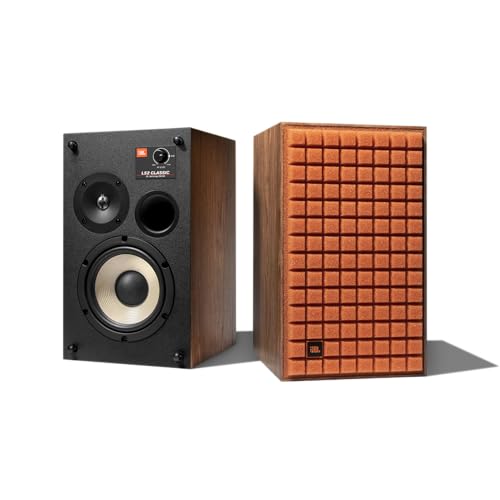
2. JBL L52 Classic
The JBL L52 Classic is a modern speaker with a retro soul, inspired by the company’s classic designs from the nineteen-seventies, and it brings a sense of fun and punch to loud listening that is hard to find elsewhere. A three-quarter-inch titanium dome tweeter in a waveguide, paired with a five-and-a-quarter-inch white-cone woofer, it is a compact speaker with a big personality, and it is at its best when the volume goes up and the music gets energetic.
Strengths. Punch and presence are the L52 Classic’s strengths. It has a lively, forward character that makes rock, pop, and soul sound immediate and engaging, with drums that hit hard and vocals that sit clearly in the mix. The waveguide gives the treble a controlled dispersion that keeps the sound consistent across a wide listening area, which is useful in a living room where people sit in different positions. The speaker is efficient enough to play loud with a modest amplifier, and it stays composed at high volume, with a bass that is tight and punchy rather than boomy. The build quality is excellent, with a solid cabinet and the distinctive retro styling, including the white woofer cone and the classic JBL badge, that makes it a conversation piece as well as a speaker.
Trade-offs. The retro styling divides opinion, and listeners who prefer a discreet, modern look may find it a little conspicuous, although many will love it precisely for that reason. The bass is punchy rather than deep, so a subwoofer will help with the lowest octaves, particularly for electronic music and film soundtracks. The speaker’s forward character means it can sound a little direct in a bright room, so a rug or curtains will help, and it benefits from a little space behind the cabinet to sound its best.
Who it fits. This is the speaker for the listener who wants music to feel like an event. Classic rock, soul, funk, and pop all sound superb through the L52 Classic, and it is the best choice on this list for a living room where music is a shared, social activity rather than a solitary pursuit. It is also a good choice for a listener who loves the look and the heritage of classic JBL designs and wants a modern speaker that honours them.
Check price on Amazon: JBL L52 Classic

3. SVS Ultra Bookshelf
The SVS Ultra Bookshelf is the most powerful and composed speaker on this list, and it is the one that stays cleanest at the highest volumes. A one-inch aluminum dome tweeter and a six-and-a-half-inch glass-fiber woofer, in a cabinet designed with the company’s most advanced crossover, it is a speaker that was engineered to handle power and to deliver detail at any volume, and it is a favourite among listeners who want loud without compromise.
Strengths. Composure at volume is the Ultra Bookshelf’s defining quality. Where other speakers start to harden and compress as the volume rises, the Ultra stays clean, detailed, and balanced, with a treble that remains smooth and a bass that stays tight and controlled. The sound is neutral and honest, which means it sounds good with every genre, and the level of detail is exceptional, with cymbals, strings, and room ambience rendered clearly even at high volume. The build quality is superb, with a solid, heavily braced cabinet, a beautiful finish, and a sense of solidity that inspires confidence. The speaker is also an excellent match for an SVS subwoofer, which is a combination many listeners choose deliberately for a complete system.
Trade-offs. The Ultra Bookshelf is the most demanding speaker on this list in terms of amplification, and it benefits from a capable amplifier with real headroom, particularly in a large room. It is also the most expensive speaker here, although its performance justifies the cost for listeners who want the best. The neutral character means it will not flatter a poor recording, and listeners who prefer a warm, forgiving sound may find it a little honest, although its composure at volume is a virtue that outweighs that for most listeners.
Who it fits. This is the speaker for the listener who wants loud and clean together. If you play music loud and you care about detail, if you want a speaker that never strains and never hardens, and if you have an amplifier capable of driving it properly, the Ultra Bookshelf is the pick. It is also the best choice for a large room, where its power and composure are most apparent.
Check price on Amazon: SVS Ultra Bookshelf

4. Polk Audio ES20
Polk’s Signature Elite range is built around the idea that a speaker should be easy to live with, and the ES20 is the bookshelf model that brings that philosophy to loud listening. A one-inch Terylene dome tweeter and a six-and-a-half-inch mica-reinforced polypropylene woofer, in a cabinet with Polk’s Power Port, it is a balanced, smooth, and forgiving speaker that plays loud without ever becoming harsh, and it is one of the most popular choices for a living-room system that needs to do everything well.
Strengths. Balance at volume is the ES20’s strength. It does not have the raw efficiency of the Klipsch or the outright power of the SVS, but it plays loud with a smoothness and composure that makes long, loud sessions enjoyable rather than fatiguing. Dialogue is clear, which makes it a strong choice for a system that doubles as a TV setup, and the Power Port genuinely helps the bass stay clean when the volume rises, reducing the chuffing noise that can plague ported speakers at high levels. The speaker is easy to drive, easy to place, and easy to match with a center speaker from the same range, which makes building a complete system straightforward. The cabinet is well-made, the finish is attractive, and the overall impression is of a speaker designed to be used every day at real-world volumes.
Trade-offs. The ES20 does not have a single dramatic strength to set it apart, and listeners who want maximum excitement may find it a little safe compared with the Klipsch or the JBL. It is a relatively large bookshelf speaker, so check the dimensions against your space. The treble is smooth rather than extended, which is a virtue for long sessions but means it will not deliver the last degree of air that a more analytical design might. Like every bookshelf speaker, it needs a subwoofer for the deepest bass.
Who it fits. This is the all-rounder of the group and the safest recommendation for a living room where the volume goes up and down. If you listen to a bit of everything, watch films as often as you listen to music, and want a speaker that plays loud without ever becoming tiring, the ES20 is the pick. It is also an excellent choice for a family system, where different people have different tastes and the speaker needs to please everyone at any volume.
Check price on Amazon: Polk Audio ES20

5. ELAC Uni-Fi 2.0 UB52
The ELAC Uni-Fi 2.0 UB52 is the most technically ambitious speaker on this list, and it brings a level of coherence and detail to loud listening that is rare at any level. A three-way design with a one-inch soft dome tweeter, a four-inch aluminum midrange, and a five-and-a-quarter-inch aluminum woofer, all arranged concentrically, it is a speaker that was designed to sound like a single point source, and the result is a sound that is detailed, coherent, and remarkably composed at high volume.
Strengths. Coherence and detail are the UB52’s strengths. The concentric driver arrangement means the sound radiates from a single point, which gives the speaker a stable, precise stereo image and a sense of timing that makes music feel effortless and natural. The three-way design means each driver handles only the frequencies it is best at, which reduces distortion and lets the speaker stay clean at high volume. The treble is detailed and extended, the midrange is clear and natural, and the bass is tight and well-defined. The build quality is excellent, with a solid cabinet and a clean, understated design, and the speaker is a genuine step up in sophistication from the two-way designs that dominate this list.
Trade-offs. The UB52 is the least efficient speaker on this list, and it needs a capable amplifier with real power to sound its best, particularly at high volume. With a modest amplifier in a large room it can sound restrained, so pair it with an amplifier that has headroom. The speaker is also honest about poor recordings, which is a virtue, but it means a bad source will sound bad. The design is understated, which some listeners will love and others will find plain, although in a listening room that hardly matters.
Who it fits. This is the speaker for the listener who wants loud and detailed together. If you play music loud and you care about hearing everything in the recording, if you want a speaker that stays coherent and composed when the volume rises, and if you have an amplifier capable of driving it, the UB52 is the pick. It is also the best choice for a listener who is building a system around a good amplifier and wants a speaker that will reward it.
Check price on Amazon: ELAC Uni-Fi 2.0 UB52
6. Wharfedale Diamond 12.2
Wharfedale has been making the Diamond range for decades, and the 12.2 is the larger bookshelf model that brings the range’s musical character to loud listening. A one-inch textile dome tweeter and a six-and-a-half-inch Klarity polypropylene woofer, in a cabinet designed to reduce resonance, it is a warm, musical, and full-sounding speaker that plays loud without ever becoming fatiguing, and it is the most enjoyable speaker on this list for long, loud sessions.
Strengths. Musicality at volume is the 12.2’s strength. Voices sound rich and natural, instruments have body and tone, and the speaker has a rhythmic ease that makes it hard to stop listening, even when the volume is high. The bass is fuller than the compact cabinet suggests, with a weight and warmth that makes music feel physical, and the overall balance is warm without being muddy. The speaker is forgiving of modest electronics and imperfect recordings, and it is easy to place, sounding good on stands, on a shelf, or on a desk. The build quality is excellent, with a clean finish and a solid, resonance-controlled cabinet, and the speaker looks as good as it sounds.
Trade-offs. The 12.2 is not the most detailed speaker on this list, and listeners who want forensic detail may prefer the SVS or the ELAC. The rear port means it needs a little space behind the cabinet to sound its best, so avoid pushing it hard against a wall. Like the ELAC, it benefits from an amplifier with a little headroom rather than the smallest amp you can find, and in a very large room it can sound a little restrained at the highest volumes, although in a medium room it is superb.
Who it fits. This is the speaker for the listener who wants loud without fatigue. If your taste runs to vocals, jazz, folk, and classic rock, and you want a speaker that makes every record sound good at any volume, the 12.2 is the pick. It is also a fine choice for a living room where listening is relaxed and extended, and where the speaker needs to sound good for hours rather than minutes.
Buying Guide: Amplifier, Room, and Subwoofer for Loud Listening
Start with the amplifier, because loud listening asks more of it than quiet listening does. A sensitive speaker like the Klipsch will play loud with almost any amplifier, but a less sensitive speaker like the ELAC Uni-Fi or the SVS Ultra needs an amplifier with real power and headroom to sound its best at high volume. As a rule, buy the most capable amplifier you can afford, because an amplifier that is never strained will always sound better than one that is working at its limits, and the difference is most apparent at high volume, where a strained amplifier will harden the treble and compress the dynamics. Keep the amplifier ventilated, keep the cables tidy, and do not stack anything on top of it, because heat is the enemy of clean power.
Next, consider the room. A large, open-plan living room needs more output than a small bedroom, and a speaker that is plenty loud in one will sound restrained in the other. Hard floors, bare walls, and glass doors reflect sound and make a room sound lively, which can make a forward speaker like the Klipsch sound aggressive, while a heavily damped room with thick carpet and upholstered furniture absorbs sound and can make a warm speaker like the Wharfedale sound dull. A rug, curtains, and a few soft furnishings will tame a lively room, and they cost far less than a speaker upgrade. Placement matters too: a speaker on a stand, away from the wall, with a little space to breathe, will play louder and cleaner than the same speaker crammed onto a shelf.
Think about the subwoofer honestly. No bookshelf speaker produces the deep bass that gives music its physical weight, and a subwoofer will take the deepest bass off the bookshelf speakers, letting them play louder in the midrange and treble where the music lives. A subwoofer is not just about more bass: it is about letting the main speakers do less work, which means they stay cleaner at high volume. Set the crossover so the subwoofer handles the deepest bass, set the volume so the bass blends with the speakers rather than dominating them, and place the subwoofer where it sounds smoothest, which is often not in the corner. A well-integrated subwoofer should be felt rather than heard as a separate source.
Finally, protect your hearing. The speakers on this list are capable of producing levels that can cause permanent damage if used carelessly, and the damage is cumulative and irreversible. Take breaks, keep the volume at a level where you can still hear the detail in the music, and be honest with yourself about how loud you are actually listening. A sound level meter app on your phone will give you a rough idea, and if you are regularly listening above the level where you need to raise your voice to be heard, you are listening too loud. The best use of a loud-capable speaker is the headroom it gives you at normal volume, where the music stays effortless and unstrained, rather than the maximum volume it can reach.
Frequently Asked Questions
What makes a speaker good for loud volume?
Three things: sensitivity, driver size, and cabinet design. A sensitive speaker produces more sound from the same amplifier power, a larger woofer moves more air, and a well-braced cabinet stays rigid when the drivers are working hard. The speakers on this list combine all three, which is why they stay clean and exciting at high volume while other speakers compress and harden.
Will a more powerful amplifier make my speakers play louder?
Yes, up to a point, but sensitivity matters more. Doubling the amplifier power only adds three decibels, which is a small increase, while a speaker with three decibels higher sensitivity will play the same volume with half the power. The best approach is to choose a sensitive speaker and pair it with a capable amplifier that has headroom, so neither component is ever strained.
Can loud listening damage my speakers?
Yes, if the amplifier is driven into distortion, which is more likely with a modest amplifier pushed to its limits than with a powerful one used sensibly. Distortion is what damages tweeters, not clean power. The safest approach is to use an amplifier with enough headroom for your room and your speakers, and to turn the volume down if the sound starts to harden or distort, which is the speaker telling you it has had enough.
Do I need a subwoofer for loud listening?
Not necessarily, but it helps. A subwoofer takes the deepest bass off the bookshelf speakers, which lets them play louder and cleaner in the midrange and treble, and it adds the physical weight that makes loud music feel powerful. If you listen to a lot of bass-heavy music or watch films with deep sound effects, a subwoofer is a worthwhile upgrade, and it is one you can add later when the budget allows.
Are these speakers good for parties?
Yes, particularly the Klipsch RP-600M, the JBL L52 Classic, and the Polk ES20, which are efficient, dynamic, and capable of filling a room without strain. Place them on stands, give them some space, keep the volume at a level where the sound stays clean, and they will handle a party easily. A subwoofer will help, and it is worth keeping the volume sensible late in the evening for the sake of your neighbours and your hearing.
How loud is too loud?
If you need to raise your voice to be heard over the music, you are listening at a level that can cause hearing damage over time. Take regular breaks, keep the volume at a level where you can still hear the detail in the music, and use a sound level app on your phone to get a rough idea of your listening level. The goal is to enjoy the dynamics and the headroom, not to test the limits of your hearing.
Does speaker placement affect how loud a speaker sounds?
Yes, significantly. A speaker placed near a wall gains bass reinforcement, which can make it sound louder and fuller, although too close to the wall can make the bass boomy. A speaker on a stand at ear height will sound clearer and more direct than the same speaker on a low shelf, because the tweeter is aimed at your ears rather than at your knees. Symmetry matters too: if one speaker is in a corner and the other is in open space, the sound will be uneven, and the system will never sound as loud or as balanced as it should. Small changes in placement are free, and they often make more difference than a more powerful amplifier.
Should I worry about my neighbours when playing music loud?
Yes, and a little consideration goes a long way. Bass travels through walls and floors far more effectively than treble, so a subwoofer is usually the main source of complaints, while bookshelf speakers on isolation pads are much less intrusive. Keep the volume sensible in the evening, use headphones late at night, and talk to your neighbours about what times work for everyone. A good relationship with the people next door is worth more than any speaker, and it is easier to maintain when you show consideration before there is a problem.
Conclusion
Loud is not just about volume: it is about dynamics, headroom, and the ability to stay clean and exciting when the music demands it, and the six speakers in this guide deliver exactly that. The Klipsch RP-600M is the most efficient and the most exciting, the JBL L52 Classic is the most fun, the SVS Ultra Bookshelf is the most composed at high volume, the Polk ES20 is the most balanced, the ELAC Uni-Fi 2.0 UB52 is the most detailed and coherent, and the Wharfedale Diamond 12.2 is the most musical and the least fatiguing. Choose the character that matches your room, your music, and your amplifier, give the speakers a proper stand and a little space, add a subwoofer when the budget allows, and you will have a system that plays loud without ever losing its composure. That is the real achievement of a good loud-capable speaker: not that it can be turned up, but that it sounds effortless at every volume you actually use.
Whatever you choose, remember that the best loud speaker is not the one that plays the loudest, but the one that makes you want to keep listening. Dynamics, clarity, and composure matter more than raw volume, and a speaker that sounds effortless at the levels you actually use will bring you more pleasure over the years than one that simply goes louder. Choose well, set it up carefully, and enjoy the music.


