What's inside
- Key Takeaways
- Quick Picks
- How We Chose These Picks
- Comparison
- Which Capture Size Does a Classroom Actually Need?
- How Should a Teacher Set Up a Document Camera for Hybrid Lessons?
- What Makes Pupils Actually Watch the Screen?
- How Do You Run a Whole Lesson Through the Camera Without Losing the Room?
- What Should a School Check Before Buying for Several Rooms?
- How Long Should a Classroom Camera Last, and What Keeps It Alive?
- Common Mistakes
- What Is the Sensible First Week With a New Camera?
- Final Recommendation
- Frequently Asked Questions
- Related Guides
As an Amazon Associate I earn from qualifying purchases. This post may contain affiliate links at no extra cost to you.
widgetverdict.com is reader-supported. When you buy through links on our site, we may earn an affiliate commission.
A document camera earns its keep in the ninety seconds after a pupil asks a question nobody planned for. The textbook diagram is too small, the worked example on the board went wrong halfway down, and thirty faces are waiting while the teacher reaches for something that can put a real object, a real page, a real half-finished piece of work on the big screen right now. The best classroom document cameras are bought for exactly that moment, and judged by how little friction stands between the question and the image. A camera that needs a driver hunt, a settings menu and a prayer will be used twice and then quietly abandoned in a cupboard. A camera that wakes up, focuses and shows the page will be used every single day.
Six cameras are compared here, and they divide along lines a teacher will feel within a week. Two come from INSWAN, two sit at different points of IPEVO’s range, one carries Elmo’s long classroom heritage, and one is a THUSTAR unit that doubles as a webcam. All six connect over USB, which is the classroom reality: the camera plugs into the machine that already drives the board or the projector. Beyond that shared connection, the differences that matter are capture area — whether the camera can frame a full A3 spread or only a single page — focus behaviour, whether a microphone is built in for the pupils joining from home, and whether a lamp is built into the head for the classroom whose blinds never quite close properly.
One discipline governs every claim below. Each camera is described only by what its own listing title states: sensor size in megapixels, capture size where given, focus type where given, microphone and light where given, and the operating systems named. Where a title says nothing about a feature a teacher might assume — zoom, recording, a lamp — the review says so in plain words and the specification list marks it as not stated, rather than letting a plausible guess harden into a promise. Prices and star ratings appear nowhere, because neither survives contact with a school year.
Key Takeaways
- Every pick here is a USB document camera, so the buying decision is really about capture area, focus, microphone and light — not about connection exoticism.
- The INSWAN INS-2 is the large-format outlier: its title states 4K, 13MP and A3 capture with dual auto-focus, aimed squarely at big classrooms and large documents.
- The Elmo OX-1 states the widest classroom feature set on paper: 1080p Full HD, one-push auto focus, 8x digital zoom, A3 capture area, a built-in microphone and a foldable body.
- Microphones are stated on five of the six titles, which matters for hybrid lessons where the camera is also the room’s ear.
- The IPEVO V4K and the OKIOLABS OKIOCAM T-4K both state 8MP sensors without stating a lamp or microphone, so their reviews treat them as image-first cameras for rooms that already have light and audio solved.
- Chromebook compatibility is stated across the whole group, reflecting how much classroom computing now runs on school-issued Chrome devices.
Quick Picks
| Pick | Badge | Why it earns its place |
|---|---|---|
| IPEVO V4K | The established classroom default | An 8MP USB camera pitched at live demo, web conferencing, distance learning and remote teaching across Mac, Windows and Chromebook. |
| INSWAN INS-1 | Light and microphone included | An 8MP camera whose title adds a built-in LED light and microphone plus auto focus — the hybrid lesson kit in one head. |
| INSWAN INS-2 | Big-room, big-page pick | 4K, 13MP and A3 capture with dual auto-focus, stated for large documents, artworks and big classrooms. |
| Elmo OX-1 | Fullest stated feature list | 1080p Full HD, 8MP CMOS, built-in microphone, one-push auto focus, 8x digital zoom, A3 capture and a foldable body. |
| OKIOLABS OKIOCAM T-4K | Teacher-and-calling crossover | An 8MP USB camera framed for teachers, online teaching and video calling across Mac, PC and Chromebook. |
| THUSTAR 8MP Document Camera & Webcam | Dual-role camera with lighting | 4K document camera and webcam with dual microphones, A3-size capture, three-level LED lights, image invert and a folding design. |
How We Chose These Picks
Classroom use has a rhythm that product photography never shows. The camera is set up at the start of the day, often by a teacher carrying three other things. It is used in bursts — a page here, a pupil’s book there, a lump of rock, a leaf, a maths manipulative — and between bursts it must get out of the way of the lesson rather than become the lesson. At the end of the day it may be unplugged, moved to another room, or handed to a colleague whose laptop runs a different operating system entirely. Selection followed that rhythm. USB connection was the entry requirement, because the classroom computer, whatever it is, has a USB port. Stated compatibility across Mac, Windows and Chromebook mattered because school fleets are mixed and nobody chooses the camera and the laptop in the same purchase.
Capture area was the second filter. A camera that frames only a single sheet forces the teacher to choose which half of a textbook spread the class sees; a camera whose title states A3 capture can show the whole spread, the whole artwork, the whole map. Two picks here state A3 capture and one states A3-size framing, and their reviews treat that as the headline it is. Focus behaviour came third: auto focus, in one-push or dual forms, is what lets a teacher swap objects quickly without a focusing ritual in front of an audience of children whose attention is a perishable good.
Audio and light completed the picture because the modern classroom is hybrid more often than schools admit. A pupil isolating at home, a class joining another class across town, a lesson recorded for revision — all of them need the camera’s scene to be heard as well as seen, and a stated built-in microphone removes one more cable and one more device from the desk. A stated LED light answers the classroom with a bright window on one side and a gloomy corner where the camera lives. Picks whose titles state neither are not condemned for it; their reviews simply place them in rooms where light and sound are already handled by other means, which describes plenty of well-equipped classrooms honestly.
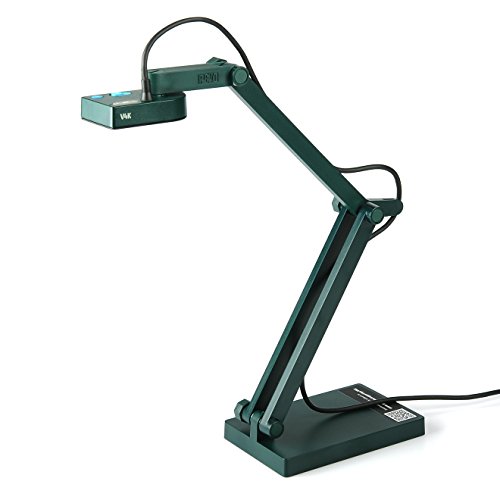
IPEVO V4K — The established classroom default
The V4K’s title reads like a summary of the last several years of teaching: an ultra high definition 8MP USB document camera, compatible with Mac OS, Windows and Chromebook, for live demo, web conferencing, distance learning and remote teaching. Notice the order of concerns. The sensor is stated first — 8MP is the resolution foundation everything else stands on — and then the listing spends its remaining words on where the camera works and what it is for, rather than on a thicket of secondary features. That restraint is itself information. This is a camera sold on being the dependable visualiser at the centre of a lesson, in whatever mixture of in-room and remote teaching the week happens to contain.
For the classroom teacher, the practical meaning of that positioning is breadth. Live demo covers the core job: the page, the object, the worked example under the lens. Web conferencing and distance learning extend the same image to pupils who are not in the room, through the same USB connection to the same computer, with no second device to manage. A department buying cameras for several rooms values that breadth because it standardises the experience — a teacher walking into any room in the corridor meets the same camera behaving the same way, and the small stock of shared know-how (“plug it in, open the viewer, share the window”) transfers without translation.
What the title does not state should shape where this camera is deployed. No microphone is mentioned, so a hybrid lesson’s audio must come from the computer’s own microphone or a separate room microphone — workable, and common, but a decision to make deliberately rather than discover during a call. No built-in light is mentioned, so the camera belongs in rooms with decent, even lighting, or under a teacher who keeps a desk lamp nearby for gloomy afternoons. No capture size is stated, so a teacher whose daily material is A3 artwork should verify the framing with the manufacturer documentation before building a scheme of work around it. None of these silences diminishes the camera’s core case; they define the room it suits.
- Sensor stated: 8MP, ultra high definition
- Connection stated: USB
- Compatibility stated: Mac OS, Windows, Chromebook
- Uses stated: Live demo, web conferencing, distance learning, remote teaching
- Built-in microphone: Not stated in the listing title — verify with the manufacturer documentation
- Capture area: Not stated in the listing title — verify with the manufacturer documentation
Strengths
- The stated use list covers the full modern teaching mixture — in-room demonstration and remote lessons — in one device.
- Compatibility across all three classroom operating systems suits mixed school fleets and shared departmental cameras.
- An 8MP sensor gives the image enough foundation for a large classroom display without the title overreaching into unlisted extras.
Trade-offs
- Audio for hybrid lessons must come from elsewhere, since no microphone is stated.
- No lamp is stated, so dim rooms and winter afternoons need the room’s own lighting to carry the image.
- Teachers working daily with A3 material cannot confirm the capture area from the title alone.
Best for: departments standardising one camera across several classrooms with mixed computers and a blend of in-person and remote teaching. Not suited for: a hybrid classroom with no other microphone, where the unstated audio becomes the lesson’s weak point.
See the current V4K listing on Amazon here: check price on Amazon.

INSWAN INS-1 — Light and microphone included
The INS-1’s title solves, in one breath, the two problems that make teachers abandon document cameras: darkness and silence. It is an 8MP USB document camera and webcam with a built-in LED light, a built-in microphone and auto focus, plug and play, compatible with Windows, Mac and Chromebook, for distance learning, live demo and online teaching. Each stated item removes a separate piece of classroom friction. The LED light means the page under the lens is lit by the camera itself rather than by whatever the room offers. The microphone means the teacher’s explanation travels with the image to the pupils at home. Auto focus means the swap from a flat page to a chunky object does not trigger a focusing pause in front of the class.
Plug and play deserves its own sentence, because in a school it is not a convenience but a survival trait. Classroom computers are locked down, shared and frequently rebuilt; a camera that needs administrator-installed drivers will spend its life waiting for the IT technician’s next visit. A plug-and-play camera that a teacher can carry to a different room, plug into a different machine and use within the minute is a camera that actually gets used, and the INS-1’s title leads its compatibility list with exactly that promise. The white finish is a smaller detail with a real effect: in a bright primary classroom the camera reads as furniture rather than equipment, and younger pupils treat it with correspondingly less fascination.
The honest limits are about scale rather than quality. No capture area is stated, so the teacher whose work is dominated by large artwork or double-page spreads should confirm framing against the manufacturer documentation before committing. No zoom figure is stated, so close inspection of tiny objects — the details of a coin, the legs of an insect — is not a claim this review makes for it. Within the ordinary run of lessons, though, pages, books, worksheets and tabletop objects are the material, and for that material the INS-1’s stated kit — light, microphone, auto focus, plug and play — is precisely the kit that decides whether the camera is used daily or decoratively.
- Sensor stated: 8MP
- Light stated: Built-in LED
- Microphone stated: Built-in mic
- Focus stated: Auto focus
- Setup stated: Plug & play
- Compatibility stated: Windows, Mac, Chromebook
- Capture area: Not stated in the listing title — verify with the manufacturer documentation
Strengths
- Built-in light and microphone make it a complete hybrid-lesson station without extra desk equipment.
- Plug-and-play setup suits locked-down, shared school computers and teachers who move rooms.
- Auto focus keeps object swaps quick in front of an audience with limited patience.
Trade-offs
- Capture area is unstated, so large-format work needs verification before purchase.
- No zoom is stated, limiting claims about extreme close-up demonstration.
- Its completeness is aimed at ordinary lesson material; specialist large-classroom projection is the next pick’s territory.
Best for: a teacher running hybrid lessons from a single desk who wants light, sound and image handled by one plug-and-play device. Not suited for: an art teacher whose daily material is A3, until the capture area is confirmed from the documentation.
Look at the INS-1’s present Amazon listing: check price on Amazon.

INSWAN INS-2 — Big-room, big-page pick
Some classrooms are simply large, and the INS-2 is the pick whose title was written for them. It states UHD 4K resolution and a 13MP sensor — the highest figures in this group — then adds a built-in LED light, a microphone, A3 capture, dual auto-focus and plug-and-play connection for Mac, Windows and Chromebook, and it names its territory without embarrassment: large documents, artworks, big classrooms. That closing phrase is the review’s anchor. A camera for a big classroom is not about vanity resolution; it is about the pupil in the back row reading the small print on the projected page, and about a teacher at the front not having to choose which third of an artwork the class gets to see.
A3 capture changes the choreography of a lesson. A textbook spread sits under the camera whole. A pupil’s A3 artwork is shown entire rather than panned across in apologetic sections. A map, a newspaper page, a science poster — the large artefacts of school life fit the frame, and the teacher’s hands stay free for pointing, annotating and teaching instead of repositioning. Dual auto-focus, as stated, speaks to the same choreography: focus that keeps up when the material changes from a flat sheet to a three-dimensional object and back, several times a lesson, without the teacher breaking eye contact with the room to manage the machine.
The supporting cast matters too. The built-in LED and microphone repeat the INS-1’s hybrid completeness at a larger scale, so the big room’s lessons can still reach the pupil at home with lit images and audible explanation. Plug and play keeps the setup story simple despite the bigger specification. The cautions are the honest counterparts of its strengths: a teacher in a small room with ordinary A4 material is buying capture area and resolution headroom that the timetable may never call on, and no zoom figure is stated, so the science teacher wanting extreme close-ups should read the specialist guide linked at the end of this article before deciding this camera covers that job too.
- Sensor stated: 13MP, UHD 4K
- Capture stated: A3 capture
- Focus stated: Dual auto-focus
- Light stated: Built-in LED
- Microphone stated: Built-in mic
- Setup stated: Plug & play
- Compatibility stated: Mac, Windows, Chromebook
Strengths
- A3 capture shows whole spreads, artworks and maps without panning or cropping the lesson’s material.
- The 13MP 4K specification serves the back row of a genuinely large classroom.
- Light, microphone and dual auto-focus keep the big specification usable in everyday hybrid teaching.
Trade-offs
- Small rooms with A4-only material will rarely use the capture area they are paying attention to here.
- No zoom figure is stated, so dedicated close-up science work is not covered by the title’s claims.
- Its larger ambition makes it the pick to deploy deliberately, in the rooms that need it, rather than as a blanket standard.
Best for: large classrooms, art and design rooms, and any teacher whose material regularly arrives as A3 documents or artwork. Not suited for: a small seminar room where a single-page camera already fills the screen comfortably.
Review the INS-2 listing on Amazon before ordering: check price on Amazon.

Elmo OX-1 — Fullest stated feature list
Elmo’s name carries weight in classrooms for a reason, and the OX-1’s title shows the company writing a specification with a teacher looking over its shoulder. Model 1433, a visual presenter with 1080p Full HD over USB, an 8MP CMOS sensor, a built-in microphone, one-push auto focus, 8x digital zoom, an A3 capture area and a foldable body, in white. Count the classroom problems answered in that single sentence: image clarity for the big screen, audio for the remote pupil, focus at the press of a control rather than a menu dive, magnification for the small object, room for the large page, and a body that folds when the lesson ends and the desk must become a desk again.
One-push auto focus is worth dwelling on, because focus is where demonstrations go to die. A teacher holding a fossil in one hand and a marker in the other cannot perform a focusing ritual; a single push that brings the object sharp is the difference between showing the fossil and describing it while the class watches a blur. The 8x digital zoom extends the same logic to detail — the title states it plainly as digital zoom, and this review repeats it in those terms: magnification handled electronically, suited to enlarging print, patterns and the middle-distance details of objects, rather than a claim about optical reach. The A3 capture area completes a rare combination in this group: large framing and stated magnification in the same camera.
The foldable body is the quiet feature that decides where the camera lives. A visual presenter that folds travels — between classrooms, between school and the teacher’s home during remote-teaching weeks, into a cupboard that could never hold a rigid arm. Combined with the built-in microphone, the OX-1 presents itself as the self-contained unit of the group: image, sound, focus, zoom, big capture and portability, each stated in the title rather than hoped for. The single silence of note is a lamp — no light is mentioned — so the gloomiest rooms should plan their lighting as they would for the V4K. For most classrooms, though, this is the most complete single answer on the page.
- Output stated: 1080p Full HD, USB
- Sensor stated: 8MP CMOS
- Microphone stated: Built-in microphone
- Focus stated: One-push auto focus
- Zoom stated: 8x digital zoom
- Capture stated: A3 capture area
- Body stated: Foldable
- Built-in light: Not stated in the listing title — verify with the manufacturer documentation
Strengths
- The only pick stating zoom, A3 capture, microphone and foldable body together.
- One-push auto focus fits the hands-full reality of live demonstration.
- Foldability makes it the easiest camera here to share between rooms or carry home.
Trade-offs
- No built-in light is stated, so very dim rooms lean on ambient lighting.
- The zoom is digital, as the title states — enlargement, not optical reach.
- Its 1080p output sits below the INS-2’s stated 4K for the largest projection jobs.
Best for: a teacher who demonstrates objects as much as pages and wants focus, zoom, microphone and A3 framing in one folding unit. Not suited for: a permanently dark classroom with no other light source, where a stated built-in lamp matters more.
Check the OX-1’s current Amazon listing: check price on Amazon.

OKIOLABS OKIOCAM T-4K — Teacher-and-calling crossover
The OKIOCAM T-4K’s title speaks to a slightly different working life: an 8MP USB document camera for teachers and classroom, online teaching and video calling, for Mac, PC and Chromebook. The phrase video calling is the tell. This camera is positioned where the document camera’s world overlaps the webcam’s — the teacher who spends part of the day showing pages to a room and part of it on calls with parents, tutors, remote pupils or colleagues, and who would rather do both through one camera that already points at the desk. The T-4K name carries a 4K suggestion, and the honest reading is the one this review sticks to: the listing title states an 8MP sensor, and states the name; any resolution claim beyond the stated sensor figure belongs to the manufacturer documentation, not to this page.
In the classroom itself, the stated recipe is the familiar core — USB connection, 8MP imaging, compatibility across the three school platforms — and its value is the absence of surprises. A teacher moving between a Mac at home, a PC at school and a Chromebook in the library meets the same camera in each place. For departments equipping staff who teach partly from home, that cross-platform sameness is a purchasing argument in its own right, because support questions collapse to a single set of answers regardless of whose machine is involved.
The silences in this title are the longest in the group, and the review respects them by placing the camera carefully. No microphone is stated, no light, no capture area, no focus type. A buyer should therefore picture the T-4K in a room where audio comes from a headset or the computer, where lighting is decent, and where the material is ordinary pages and objects — the mainstream of teaching — rather than in the specialist corners the other picks were built for. Judged on that mainstream, its case is straightforwardness: an 8MP camera from a brand that builds for education, comfortable in a lesson and on a call, asking nothing exotic of the computer it meets.
- Sensor stated: 8MP
- Connection stated: USB
- Compatibility stated: Mac, PC, Chromebook
- Uses stated: Teachers and classroom, online teaching, video calling
- Built-in microphone: Not stated in the listing title — verify with the manufacturer documentation
- Capture area: Not stated in the listing title — verify with the manufacturer documentation
- Focus type: Not stated in the listing title — verify with the manufacturer documentation
Strengths
- Positioned explicitly for both classroom teaching and video calling, suiting staff who split the day between room and screen.
- Three-platform compatibility matches the mixed machines teachers actually own and are issued.
- An education-focused brand’s 8MP core covers the ordinary run of pages and objects without complication.
Trade-offs
- Audio, light, capture area and focus are all unstated, so the room must supply what the title does not promise.
- Hybrid lessons need a separate microphone plan from the first day.
- Large-format and close-up specialists will find their answers in other picks in this guide.
Best for: teachers whose week mixes classroom lessons, online teaching and video calls across different computers. Not suited for: classrooms where A3 capture or a built-in microphone must be confirmed before purchase.
See how the T-4K is listed on Amazon at the moment: check price on Amazon.
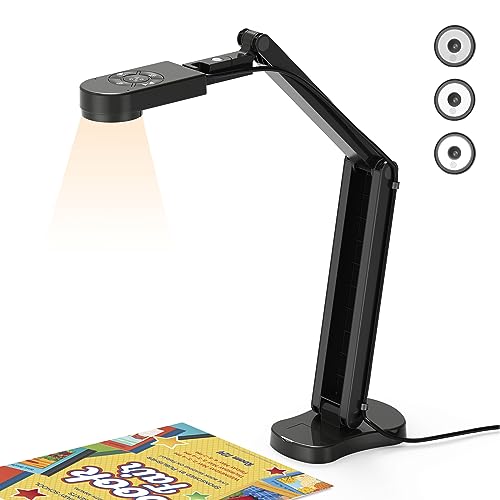
THUSTAR 8MP Document Camera & Webcam — Dual-role camera with lighting
THUSTAR’s title is the most theatrical of the six, and underneath the energy sits a genuinely practical combination: an 8MP document camera and webcam in 4K, with dual microphones, USB connection, A3-size visualiser framing, three-level LED lights, an image invert function and a folding design, for live demo and distance education across Windows, macOS and Chrome OS. Dual microphones are the stated audio step up in this group — two microphones suggest a camera listening for a voice that moves around a desk, the teacher who talks while turning pages, fetching objects and writing, rather than sitting still in front of a single mic. For distance education, where the remote pupil’s whole experience is this camera’s picture and sound, that attention to audio is well spent.
The lighting deserves equal attention. Three levels of LED light, as stated, give the teacher a response to the three lighting conditions of a school day: the bright morning that needs no help, the overcast afternoon that needs some, and the dark winter last period that needs all of it. Adjustable light also tames glare on glossy textbook pages, the quiet enemy of document cameras, where a fixed bright lamp can bounce a white stripe across exactly the paragraph the class needs to read. The image invert function answers a smaller but real annoyance — material that arrives upside down, a page fed from the far side of the desk, an object whose label reads correctly only one way — by correcting orientation in the camera rather than in a software menu.
A3-size framing puts this camera in the large-material conversation alongside the INS-2 and the OX-1, and the folding design puts it in the portability conversation with the OX-1. The cautions are about focus and role. No focus type is stated, so the speed of refocusing between objects cannot be claimed from the title. And a dual-role camera asks its owner to actually use both roles; a teacher who never makes video calls is carrying webcam versatility they will not exercise, though the document camera half loses nothing by it. For the distance-education teacher lighting a desk at home, this is a thoughtfully assembled package.
- Sensor stated: 8MP, with 4K stated for the camera/webcam
- Microphones stated: Dual microphones
- Capture stated: A3-size
- Light stated: 3-level LED lights
- Functions stated: Image invert function
- Body stated: Fold design
- Compatibility stated: Windows, macOS, Chrome OS
- Focus type: Not stated in the listing title — verify with the manufacturer documentation
Strengths
- Dual microphones and three-level lighting serve the remote pupil’s experience directly.
- A3-size framing handles spreads and larger work without repositioning the material.
- Image invert and a folding body add everyday convenience for desk-based distance teaching.
Trade-offs
- Focus behaviour is unstated, so rapid object-swapping performance rests on the documentation.
- Its webcam half is wasted on teachers whose work never involves calls.
- The feature list is broad rather than deep in any single specialism such as zoom.
Best for: distance-education and hybrid teachers working from a desk who want dual microphones, adjustable light and A3-size framing together. Not suited for: a demonstration-heavy science room that needs a stated zoom figure before it buys.
Look over THUSTAR’s current Amazon listing: check price on Amazon.
Comparison
| Camera | Sensor stated | Capture stated | Microphone | Light | Defining trait |
|---|---|---|---|---|---|
| IPEVO V4K | 8MP | Not stated in title | Not stated in title | Not stated in title | Cross-platform classroom standard |
| INSWAN INS-1 | 8MP | Not stated in title | Built-in mic | Built-in LED | Plug-and-play hybrid completeness |
| INSWAN INS-2 | 13MP, 4K | A3 | Built-in mic | Built-in LED | Large documents and big classrooms |
| Elmo OX-1 | 8MP CMOS, 1080p | A3 area | Built-in microphone | Not stated in title | 8x digital zoom, one-push focus, foldable |
| OKIOLABS OKIOCAM T-4K | 8MP | Not stated in title | Not stated in title | Not stated in title | Classroom and video-calling crossover |
| THUSTAR 8MP | 8MP, 4K | A3-size | Dual microphones | 3-level LED | Dual-role camera/webcam with invert |
Sort the table by the constraint of your room. A big room or A3 material narrows the field to the INS-2, the OX-1 and the THUSTAR. A hybrid timetable with no other microphone narrows it to the four cameras stating one — INS-1, INS-2, OX-1 and THUSTAR. A gloomy room narrows it to the three stating a light. A teacher who demonstrates small objects should note that only the OX-1 states a zoom figure at all. The V4K and the T-4K wait at the simpler end for rooms where light, sound and framing are already solved by the space itself.
Which Capture Size Does a Classroom Actually Need?
Think in terms of the largest thing you show every week, not the largest thing you own. For most teachers that is a textbook spread or an A4 worksheet with annotations in the margin, and honesty about that answer saves money and desk space. A4 material shown whole, with the teacher’s handwriting legible at the back, is the daily requirement; A3 enters when artwork, maps, newspapers, posters or double-page spreads become weekly rather than occasional. Art, design, geography and primary classrooms live at A3 more than they admit, because children’s work is big. Secondary classrooms working from textbooks live at the spread, which is A3 in landscape whether the timetable calls it that or not.
Height is the hidden half of capture size. A camera frames a larger area by sitting higher above the page, and a taller stance brings its own classroom physics: more wobble when the desk is knocked, a longer shadow from the teacher’s hand, a bigger silhouette against the board. The three picks stating A3 framing have each settled that geometry in their own design, but the teacher’s part is placement — a stable desk corner, out of the traffic line of pupils fetching books, where the camera can live at its working height all day instead of being assembled and struck like stage scenery.
Finally, match capture ambitions to the display. A 4K camera feeding an elderly projector shows the projector’s limits, not the camera’s. The INS-2’s stated resolution earns its keep on a modern panel or a large interactive display; on a small, dim projector, the OX-1’s focus, zoom and framing may serve the room better. Buy the chain, not the link: camera, computer and screen are one instrument, and the weakest part of it sets what the class actually sees.
How Should a Teacher Set Up a Document Camera for Hybrid Lessons?
Begin with the unglamorous test: join a call from a second device, as a pupil would, and watch your own lesson for two minutes. That single rehearsal reveals what the class at home experiences — whether the page is legible, whether your voice arrives clearly when you turn away, whether the window light behind the desk turns the page into a mirror. Cameras with stated microphones, like the INS-1, INS-2, OX-1 and THUSTAR here, simplify the audio half of that rehearsal; cameras without a stated microphone make the rehearsal more important, because the computer’s microphone and its distance from your mouth become the lesson’s sound system.
Position the camera before the lesson, at the height your largest regular material needs, and mark the desk position with a small piece of tape if the camera shares the desk with other work. Teachers who rebuild the camera’s position daily lose the first minutes of lessons to framing; teachers who keep a settled position develop the presenter’s instinct for placing material inside the frame without looking. Keep a plain dark mat or sheet of card under the camera’s field: it gives pages a consistent background, calms auto-exposure behaviour on white paper, and makes objects — a shell, a circuit, a handful of coins — read clearly against a surface that is not the desk’s own busy grain.
Lighting discipline completes the setup. Face the camera’s scene away from windows where possible, so daylight falls on the page rather than into the lens. Where a stated LED light exists, learn its levels on a glossy page before the class does, and find the setting that lifts the print without bouncing a glare stripe across it. Where no light is stated, a small desk lamp placed to the side, angled across the page rather than down at it, does the same job. Two minutes of this preparation, done once and repeated by habit, is the entire difference between a camera the class trusts and one they squint at.
What Makes Pupils Actually Watch the Screen?
Movement, briefly and purposefully. A document camera image that never changes becomes wallpaper within minutes, however sharp it is. The teachers who hold a room with one of these cameras work the material: a finger tracking the line being read, a pen annotating the worked example live, an object rotated slowly so its far side becomes a small event. Auto focus — stated on the INS-1, in dual form on the INS-2, as one-push on the OX-1 — is the technical ally of that style, because it forgives the constant small changes of distance as hands and objects move through the frame.
The second attention tool is the reveal. Cover part of the page and uncover it line by line; place the pupil’s book under the camera only after the class has attempted the problem themselves, so the screen becomes the answer rather than the wallpaper behind the question. Document cameras reward this pedagogy because the material is real — a genuine pupil’s genuine half-right working carries a credibility that a prepared slide never matches, and classes lean in for it. Choose a camera that starts quickly and focuses forgivingly, and the reveal stays a teaching move instead of a technical interlude.
Sound is the third tool, and the least discussed. In a hybrid lesson the remote pupils’ attention hangs entirely on the audio; a stated built-in microphone close to the action keeps the teacher’s running commentary attached to the image it describes. In a room-only lesson, the same microphone habit matters when lessons are recorded for revision or for absent pupils. Either way, the camera’s microphone — or its absence, and the substitute you arrange for it — belongs in the purchase decision, not in the first week’s improvisation.
How Do You Run a Whole Lesson Through the Camera Without Losing the Room?
Plan the camera’s appearances the way you plan board work: few, deliberate and signposted. A lesson that lives entirely under the camera flattens into a single visual register, and pupils stop distinguishing the important image from the incidental one. The stronger pattern alternates — the camera for the worked example, the artefact, the pupil’s book; the board or the class discussion for everything else — so each return to the screen carries a small charge of event. Tell the class what they are about to see and why before the image changes. “Watch what happens to the denominator” turns a page into an argument; an unexplained page is just a page.
Keep a presenter’s station beside the camera: the next objects queued in order, a blank sheet for covering and revealing, a pen that writes boldly enough to survive projection, and a scrap page for the annotation you did not plan. Teachers improvise these things mid-lesson when the station is missing, and improvisation costs the room’s attention in instalments. With the station ready, the camera work disappears into the teaching, which is the highest compliment a classroom tool can earn. The cameras in this guide that state auto focus and built-in light support exactly this invisibility, because they forgive the unscripted object and the dimming afternoon without asking the teacher to stop and administer them.
End camera segments cleanly. Freeze or clear the image when the discussion moves on, rather than leaving a page glowing behind a conversation that has left it. Pupils read a lingering image as an instruction to keep looking at it, and the teacher ends up competing with their own visual aid. A blank screen, or the camera turned briefly to the class itself where the setup allows it, closes the segment the way a closed book closes a reading. These are small stagecraft habits, but a document camera is a stage in miniature, and its lessons succeed on stagecraft as much as on specifications.
What Should a School Check Before Buying for Several Rooms?
Start with the displays, room by room. Note each screen’s size, age and inputs, and be honest about which rooms make small print legible at the back today. A camera purchase that ignores a failing projector buys sharp images nobody can see; sometimes the right split of a fixed budget is fewer cameras and one replaced display. Then check the computers: their operating systems, their spare USB ports, and whether peripheral policies on managed machines will accept a plug-and-play camera without an administrator’s visit. Every title in this guide states broad compatibility, but the school’s own device policy is the document that decides what actually happens on the first morning.
Next, audit the material and the timetable. Which rooms teach from A3 artwork or double-page spreads weekly? Which run hybrid lessons with pupils at home? Which teachers demonstrate objects — in science, design, food, primary classrooms — rather than pages? The answers map directly onto the stated features compared in this guide: A3 capture for the large-material rooms, stated microphones for the hybrid rooms, the OX-1’s stated zoom and one-push focus for the demonstration rooms, straightforward plug-and-play cameras for the rest. A purchase order written from that audit equips each room for its real week instead of giving every room the same compromise.
Finally, plan the unglamorous logistics. Decide where each camera lives overnight, who owns the spare cable, and how a teacher reports a fault. Label cameras to rooms but let them travel when a failure demands it, which argues for standardising on one or two models across the school rather than six. Run one training session that is really a practice session — cameras out, material under them, colleagues teaching each other for ten minutes — because the skill that matters is presenter’s stagecraft, and it is learned by doing, not by watching a demonstration about a demonstration.
How Long Should a Classroom Camera Last, and What Keeps It Alive?
A document camera has few moving ambitions: an arm that holds its position, a head that focuses, a cable that flexes every time the unit is moved. Its lifespan is decided less by electronics than by handling. The camera that lives settled on one desk, plugged in once and adjusted gently, will outlast the camera that is packed, carried and re-plugged daily — which is why the foldable picks in this guide earn their design: a body built to fold absorbs the travelling life properly, while a rigid camera forced into a bag absorbs it as damage. Schools buying for peripatetic staff should read the folding guide linked below as part of this decision, not as an afterthought.
Cables are the quiet casualty. The USB lead is tugged, trapped under book stacks and wound too tightly around arms, and it fails long before the camera does. A spare cable in the room — the right length, routed so pupils’ feet never find it — converts the commonest camera failure from a lost lesson into a thirty-second swap. Dust is the second casualty, settling on the lens through terms of chalk-free but hardly dust-free classroom air; a soft cloth kept with the camera, and a monthly wipe built into the classroom’s tidying rhythm, keeps the image from slowly greying while everyone blames the projector.
Software habits matter more than software itself. Keep one known-good viewing application on each classroom machine, resist the accumulation of duplicate camera apps installed by successive teachers, and write the working setup — which app, which input, which screen setting — on a card taped near the desk. When a substitute teacher or a colleague covering a lesson can get a picture in under a minute from that card, the camera has become infrastructure. Infrastructure is the goal: a tool so reliably present that lessons are planned around it without a thought for whether it will work, which is the point at which the purchase has fully repaid itself.
Common Mistakes
Judging the camera by the screen in the shop photograph. Listing images show the camera’s view filling a display in a darkened room; the classroom test is your display, your lighting, your largest material. Buy against the stated capture area and sensor, then rehearse in the real room during the first week while returns are still simple.
Forgetting the audio until the first hybrid lesson. A camera without a stated microphone is a fine camera — paired with a plan. The plan made in advance is a headset, a room microphone or the computer’s own array tested from teaching distance. The plan improvised mid-call is an apology, and classes remember it.
Parking the camera in the wrong light. A document camera facing a window spends its life fighting glare and exposure swings as clouds move. Ten minutes spent choosing the desk position — light falling on the page, not into the lens — outperforms any specification upgrade bought later.
Treating focus as a detail. Demonstrations live or die on the seconds between placing an object and the class seeing it clearly. Stated auto focus, in any of its forms here, is not a luxury feature; it is the feature that keeps thirty pupils’ attention attached to the object rather than to the teacher’s struggle with the machine.
Buying capture area for material you never show. A3 framing is genuinely valuable to the art teacher and the textbook-spread teacher, and genuinely wasted on the worksheet teacher whose largest artefact is a single sheet. Audit a fortnight of your own material before letting capture size lead the decision.
What Is the Sensible First Week With a New Camera?
Teach with it daily, briefly, even when the lesson could manage without it. Short, low-stakes appearances — a page here, an object there — build the presenter’s habits and the class’s expectations while the cost of a fumble is still trivial. By the second week the camera stops being an event, and by the first time a pupil’s question genuinely needs it, the ninety-second moment described at the start of this guide will already feel routine. That routine, not any single specification, is what the purchase was for.
Final Recommendation
For the large classroom or the large page, the INSWAN INS-2 is the clearest answer here: 13MP, 4K, A3 capture, dual auto-focus, light and microphone, all stated, all aimed at exactly that room. For the demonstrating teacher, the Elmo OX-1 assembles the most complete stated toolkit — one-push focus, 8x digital zoom, A3 area, microphone, folding body — and folds away when the desk is needed. For distance teaching from a desk, the THUSTAR’s dual microphones and three-level light serve the remote pupil best. The INS-1 remains the plug-and-play hybrid all-rounder for ordinary rooms, while the V4K and the OKIOCAM T-4K suit schools standardising a simple 8MP camera across mixed computers where light and audio are already arranged. Choose by the room you actually teach in, and any of the six will be used daily rather than admired briefly.
Frequently Asked Questions
Do these cameras work with school Chromebooks?
Chromebook compatibility is stated in every title in this guide — Mac, Windows and Chromebook for the V4K, INS-1, INS-2, OX-1’s USB classroom peers and the THUSTAR’s Chrome OS listing alike. School-managed Chromebooks can still restrict peripherals, so test the camera on an actual school device during setup week rather than assuming the fleet will accept it.
Can a document camera replace a webcam for remote teaching?
For desk-based teaching, largely yes: the camera shows the page and the teacher’s hands, which is what remote pupils need, and the THUSTAR states the dual role outright as document camera and webcam. What a document camera does not frame is the teacher’s face at eye level, so staff who present face-to-camera for long stretches may keep a separate webcam for those sessions.
How much resolution does a classroom display need?
Enough that small print survives the journey to the back row. The 8MP cameras here cover ordinary pages on ordinary displays; the INS-2’s stated 13MP and 4K serve larger screens and larger rooms. The display itself is half the equation — a modest camera on a bright modern panel outperforms a flagship camera on a dying projector.
Is a built-in light worth having?
In rooms with even, generous lighting, it is a reserve you rarely touch. In rooms with one bright window, old fittings or winter-afternoon lessons, a stated LED — the INS-1’s, the INS-2’s, the THUSTAR’s three-level version — turns marginal images into legible ones and tames glossy-page glare when angled well.
What should a department buy when equipping ten rooms?
Standardise where rooms are alike, because shared know-how and interchangeable cameras are worth more than marginal specification differences. Where rooms genuinely differ — the art block against the seminar rooms — split the order: A3-capable cameras where the material is large, simpler plug-and-play cameras where it is not.
Can pupils use the camera themselves?
Yes, and they should: showing their own work under the camera is one of the device’s best classroom uses. Auto focus forgives inexpert placement, and a settled camera position with a marked frame lets a pupil place a book correctly in seconds. Reserve the setup, cables and settings for adults, and let pupils own the presenting.
Related Guides
Teachers whose demonstrations centre on specimens, dissections and small components should read our companion guide to document cameras chosen for science teaching, where optical zoom and macro focus take over the argument. Colleagues equipping a classroom on a tight departmental budget will find the value end of this category examined in our roundup of lower-cost document cameras for teachers. And for staff who carry their camera between rooms all week, our guide to folding document cameras compares the bodies that collapse for the journey.


