What's inside
- Where to Buy
- Key Takeaways
- Quick Picks
- How We Chose These Picks
- Comparison
- How to Choose a Fire TV
- Is a Built-In Fire TV Better Than a Fire TV Stick?
- What Does the Ambient Experience Actually Do All Day?
- Which Fire TV Should a Console Gamer Choose?
- How Does Fire TV Handle Live Television Without Cable?
- Common Mistakes
- Final Recommendation
- Frequently Asked Questions
- Related Guides
As an Amazon Associate I earn from qualifying purchases. This post may contain affiliate links at no extra cost to you.
[SITE_DOMAIN] is reader-supported. When you buy through links on our site, we may earn an affiliate commission.
Where to Buy
Six televisions with Fire TV built into the set — not a stick in sight — are compared below, and each linked name opens its Amazon page. The value pair leads: the INSIGNIA 43-inch Class F50 Series covers the smaller-room brief, and its listing is the place to confirm its voice remote details. Its larger sibling, the INSIGNIA 55-inch Class F50 Series, carries the same formula to a main-room size. Amazon’s own range begins with the Amazon Ember 55-inch 4-Series, whose page describes its Ambient Experience and HDR10+ support. The step up, the Amazon Ember 55-inch QLED Series, adds Dolby Vision to the recipe, as its listing sets out. Gamers should open the Amazon Ember 55-inch Mini-LED Series for its 144Hz gaming mode and Dolby Vision IQ. Finally, the TOSHIBA 43-inch Class M450 Series brings QLED colour to the smaller size on Fire TV, detailed on its own page.
The best fire tvs share one trait before any panel is discussed: the platform is inside the television. Fire TV built in means one remote, one power button, Alexa on the set itself and a home screen that owns the whole display from the first second — a materially different appliance from a television with a streaming stick borrowed into an HDMI port. The six sets here all work that way, and they divide along the lines Fire TV buyers actually face: Amazon’s own Ember range in three ascending tiers, Insignia’s F50 value pair in two sizes, and a Toshiba that brings QLED to the smaller screen. Choosing well is mostly a matter of knowing which tier your room and your evenings justify.
Amazon’s Ember line is the range’s spine, and its three 55-inch tiers are cleanly separated by their titles. The 4-Series is the platform reference: 4K Ultra HD, HDR10+, a fast processor, Dolby Audio and the Ambient Experience that turns the idle screen into photos and glanceable information. The QLED Series keeps the size and adds quantum-dot colour with Dolby Vision alongside Dolby Audio and a quad-core processor. The Mini-LED Series tops the line with QLED plus Mini-LED backlighting, Dolby Vision IQ and a 144Hz gaming mode — the tier for dark rooms and consoles. Around that spine, Insignia’s F50 pair covers the value brief in 43 and 55 inches with voice remotes and live TV without cable, and Toshiba’s M450 answers the buyer who wants QLED colour at 43 inches.
Voice is the platform’s daily texture, and it deserves a sentence of its own. Every pick here carries an Alexa voice remote or Alexa built into its proposition, so finding a show, dimming the household’s lights or asking for the weather happens from the sofa without a menu expedition. Households already running Echo devices will feel these sets behave like large members of the same family. Households new to Alexa should still shop the panel first — the reviews below do — because a television outlives any assistant’s novelty, and the right way to use this guide is to let the room, the light and the gaming habit choose the tier, then let Alexa be the bonus it is.
Key Takeaways
- All six picks are televisions with Fire TV built in; no streaming sticks or boxes appear in this guide.
- Amazon’s Ember 55-inch line climbs three tiers: 4-Series with HDR10+, QLED Series with Dolby Vision, Mini-LED Series with Dolby Vision IQ and a 144Hz gaming mode.
- Insignia’s F50 pair covers the value brief at 43 and 55 inches, both with Alexa voice remotes and live TV without cable.
- Toshiba’s M450 is the smaller-room QLED option, bringing quantum-dot colour to a 43-inch Fire TV.
- Ambient Experience on the Ember 4-Series and Mini-LED gives the idle screen a photo-and-widget second life.
- Every pick is Alexa-led, so Echo households get the deepest integration from any of the six.
Quick Picks
| Pick | Badge | Why it makes the cut |
|---|---|---|
| INSIGNIA 43-inch Class F50 Series | Smaller-room value | 4K UHD Fire TV with an Alexa voice remote and live TV without cable, at the range’s entry tier. |
| INSIGNIA 55-inch Class F50 Series | Main-room value | The F50 formula at 55 inches, for the living room that wants Fire TV without tier-climbing. |
| Amazon Ember 55-inch 4-Series | Platform reference | 4K with HDR10+, Dolby Audio, a fast processor and Ambient Experience on Amazon’s own hardware. |
| Amazon Ember 55-inch QLED Series | Colour step-up | QLED colour with Dolby Vision and a quad-core processor over the 4-Series base. |
| Amazon Ember 55-inch Mini-LED Series | Dark-room and gaming tier | Mini-LED backlighting, Dolby Vision IQ and a 144Hz gaming mode at the top of the Ember line. |
| TOSHIBA 43-inch Class M450 Series | Small-room QLED | QLED 4K colour at 43 inches with an Alexa voice remote, for bedrooms and dens that want more than LED. |
How We Chose These Picks
The categorical filter came first: televisions with Fire TV built in, verified as TV listings through the site’s product pool. Streaming sticks, streaming boxes and ordinary televisions that merely work with a Fire TV device were excluded, because the keyword promises the integrated appliance and the integrated appliance is what the one-remote, Alexa-on-the-set experience actually is. Within that filter, candidates needed their headline features stated in their listing titles, so that every claim in the reviews below can be traced to the manufacturer’s own words for that model.
The six were chosen to reproduce the shape of the real Fire TV market. Amazon’s own Ember range takes three places because its three tiers are the decision most buyers actually make, and collapsing them into one entry would hide the guide’s most useful comparison. Insignia takes two because its F50 pair is the value reference of the platform and because the 43-versus-55 fork is the first question a value buyer answers. Toshiba takes the sixth place because it alone answers a real gap in Amazon’s own line: QLED colour at 43 inches, for the smaller room that refuses to accept a plain LED panel as its lot.
Claims discipline followed the titles throughout. The Mini-LED’s 144Hz figure is described as its gaming mode, in the title’s own terms, not converted into a general panel claim. Ambient Experience is credited to the two Ember sets whose titles name it. Dolby Vision appears only where a title prints it — the Ember QLED and Mini-LED — and the 4-Series is described with its stated HDR10+ instead, because borrowing a flagship format down the range is how buying guides mislead. Where a title is silent, the spec boxes say so in the standard form.

INSIGNIA 43-inch Class F50 Series — Smaller-room value
Insignia’s F50 in its 43-inch form is the Fire TV value proposition at its most concentrated: an LED 4K UHD panel, a voice remote with Alexa, and the platform’s pitch of streaming live TV without cable, in the size that bedrooms, kitchens, dens and student rooms actually absorb. Nothing in the listing reaches for a flagship claim, and that restraint is the product. This is the set a household buys when the room needs a proper television — integrated platform, voice control, full 4K resolution — and the budget has other places to be.
The room’s life defines its virtues. In a bedroom, the voice remote ends the nightly excavation of menus from under a duvet; in a kitchen, Alexa answers timers and finds the news while hands are occupied; in a student room, the whole streaming world arrives through one remote that a housemate cannot really misplace the function of. Live TV without cable matters in these rooms more than in the main room, because second screens are where channel-surfing survives — the morning news, the background match, the local channel left running. The F50’s listing speaks directly to that life.
Resolution is the point sceptics raise at this tier, and the listing answers it: 4K UHD at 43 inches is sharp at every distance these rooms impose, from a desk chair to a bed. What the value tier does not claim is quantum-dot colour, Dolby Vision or a gaming mode, and the reviews below hold those upgrades in plain sight — the Toshiba M450 at this same size for QLED colour, the Ember tiers at 55 inches for the formats. A household whose room is smaller and whose viewing is streamed series, news and sport will not feel the absences nightly; a viewer who watches cinema attentively in the dark should climb. For the straightforward smaller-room brief, read the F50 43 listing and spend the savings on the mount and the room.
Insignia’s identity is part of the value story and worth stating plainly. As a house-brand line sold in volume, the F50’s proposition is distribution and price discipline rather than panel prestige, and its sets furnish more second rooms than any flagship ever will. Households that understand that bargain — and it is a real bargain when the room’s needs are as described — buy this tier with their eyes open and are rarely disappointed by it.
Guests and grandparents complete the case. A spare room with an F50 in it explains itself: press the voice button, say the programme, watch. No household accounts to untangle beyond the host’s own setup, no second remote, no input hunt. The television that a visitor can operate unaided is a small hospitality, and at this size and tier it costs the host very little to provide.
Ownership costs beyond the set itself are refreshingly few at this tier, which is part of its design. A basic mount or a stand on existing furniture, a pair of spare batteries for the remote across the years, and the household’s existing subscriptions are the whole supporting cast. There is no soundbar the room demands, no gaming provision to feed, no ambient schedule to curate. For the rooms this set serves — the ones where television is a utility woven into mornings and evenings rather than an event — that absence of overhead is precisely the specification that matters, and the F50’s listing, to its credit, never pretends otherwise.
- Screen size: 43-inch class
- Panel and resolution: LED, 4K UHD
- Remote and voice: Voice Remote with Alexa
- Content: Stream live TV without cable per listing
- Platform: Smart Fire TV
- Series: F50 Series
Strengths
- The complete integrated Fire TV experience at the range’s value tier.
- 4K UHD resolution stays sharp at bedroom and desk distances.
- Voice remote and live TV suit second rooms and guest rooms perfectly.
Trade-offs
- Plain LED panel without the QLED colour of the Toshiba at this size.
- No Dolby Vision or gaming mode is stated in the title.
- Too small to anchor a main living room’s seating distance.
Best for: bedrooms, kitchens and guest rooms needing an integrated Fire TV at a value tier.
Not suited for: a main room with seating far enough back that a 43-inch picture cannot fill the view.

INSIGNIA 55-inch Class F50 Series — Main-room value
The 55-inch F50 takes the same value formula to the main room: an LED 4K UHD panel with Fire TV inside, an Alexa voice remote, and a listing — model NS-55F501NA26 — that states the essentials and stops. Its role in this guide is to mark the floor of the 55-inch Fire TV market, the point from which every upgrade in the Ember range must justify itself. That is a more useful role than it sounds, because a floor set honestly described lets a buyer see exactly what each higher tier’s premium purchases.
What the floor includes is the complete platform life: the full Fire TV home screen, Alexa voice control, the free and live content bench, and 4K resolution across a main-room canvas. For a household whose viewing is streamed series, sport and family film nights in a normally lit room, that is not a stripped experience — it is the experience, on a plainer panel. The households that should climb are the ones whose rooms or habits expose panel differences nightly: the dark-room film viewer, the console gamer, the colour enthusiast. The reviews below name those climbs precisely so this set’s buyers can check themselves against them and, in many cases, stay.
The comparison that matters most is internal. Against its own 43-inch sibling, the 55 buys main-room scale for the seating distances living rooms impose. Against the Ember 4-Series directly above it, it concedes Amazon’s own hardware polish, the stated HDR10+ and the Ambient Experience. Neither concession is hidden, and the day’s pricing — which a buyer should check on the F50 55 listing against the Ember’s — decides how much those concessions are worth in a given household’s money. Value tiers exist to be priced against their betters, and this one bears the comparison calmly.
There is also a multi-room arithmetic in the F50 55’s favour. A household equipping a main room and a rental property, or a living room and a holiday home, can standardise on one interface and one remote language at a tier that makes duplication painless. Platform consistency across addresses is a real convenience — the same household habits work in both places — and value lines are how that consistency becomes affordable.
Finally, the F50 55 is the honest answer for the buyer replacing a failed main set in a hurry. It can be chosen in an evening, understood in an hour and lived with for years, and for the household whose priority is that the television simply work by the weekend, its plain specification is a feature rather than an apology.
The F50 55 also deserves a word about light. A plain LED panel in a normally lit living room is in its element: the room’s own brightness forgives the panel’s simpler contrast, and streamed content — which is mastered for ordinary screens far more than for flagship ones — looks as its makers expected. The tier’s limits appear when the room goes dark and the film goes darker, which is why this guide keeps pointing that specific household upward. Buyers should be honest about which room they actually have at 8 p.m., because the F50 and the Ember QLED are answers to two different versions of that room.
- Screen size: 55-inch class
- Panel and resolution: LED, 4K UHD
- Remote and voice: Alexa Voice Remote
- Platform: Smart Fire TV
- Model: NS-55F501NA26
- Ambient Experience: Not stated in the listing title — verify with the manufacturer documentation
Strengths
- The full integrated Fire TV experience at the 55-inch value floor.
- Main-room scale with 4K resolution for everyday streamed viewing.
- A plain, quickly understood specification for hurried replacements.
Trade-offs
- LED panel without QLED colour, Dolby Vision or Mini-LED dimming.
- No Ambient Experience is stated, unlike the Ember sets above it.
- Dark-room film viewers will feel the panel tier nightly.
Best for: a main room wanting integrated Fire TV at the value floor, with normally lit everyday viewing.
Not suited for: darkened-room cinema viewing, where the Ember QLED and Mini-LED tiers justify their premiums.

Amazon Ember 55-inch 4-Series — Platform reference
Amazon’s own 4-Series is the Fire TV platform’s reference hardware, the set the experience is designed around: a 55-inch 4K Ultra HD panel with HDR10+, a fast processor, Dolby Audio, an Alexa Remote and the Ambient Experience. That last feature is the line’s signature. Borrowed from the philosophy of Amazon’s smart displays, it turns the idle television into a surface for photos, artwork and glanceable widgets — weather, calendar, the time — so the largest screen in the room earns its wall during the hours it is not showing anything. In a living room, that idle life is most of the set’s existence, and the 4-Series is the only value-adjacent pick here that addresses it.
The television beneath the ambient layer is the platform mainstream done properly. HDR10+ gives streamed content dynamic tone mapping from the services that support it; Dolby Audio keeps dialogue respectable at living-room volumes; the fast processor claim addresses the unglamorous virtue that decides whether a platform feels pleasant — how quickly the set wakes, searches and loads. Alexa+ show-finding shortens the distance between sitting down and watching, and the free and live TV bench gives the set a channel life beyond subscriptions. None of these is a flagship specification, and together they describe a set with no weak hour in its day.
Position it against its neighbours and its tier becomes exact. It concedes QLED colour and Dolby Vision to the Ember QLED above it, and Mini-LED dimming to the tier above that; it takes from the Insignia below it the platform’s own hardware polish, the stated HDR10+ and the ambient layer. A household that watches in normal light, streams widely and likes the idea of its wall doing something between programmes is describing this set. A household that watches films in darkness should keep climbing. Buyers in the first group should read the Ember 4-Series listing for its ambient and processor details and buy the tier their room describes.
The 4-Series also suits the household joining Fire TV for the first time and wanting the canonical version of it. Third-party sets interpret the platform; Amazon’s own hardware defines it, receives its updates as the reference and integrates Alexa at the depth the platform’s makers intend. First-time platform buyers routinely underestimate how much that reference quality matters across a decade of evenings, and the 4-Series is priced to make choosing it easy.
One caution belongs to the ambient feature, and it is a household rather than a technical one: a screen that glows with photographs at dusk is a pleasure, and the same screen glowing at 3 a.m. is a nuisance. The ambient schedule and brightness need setting with the room’s sleep in mind, in any room where people rest. Configured once, with that care, the feature is the 4-Series’ gift; left at defaults in a bedroom-adjacent open-plan space, it can argue with the household’s nights.
The 4-Series’ processor claim connects to a habit worth forming with any platform set: keep the home screen curated. Fire TV rewards a household that pins its handful of real services and lets the rest recede, and the set’s responsiveness makes that curation feel instant rather than administrative. Five minutes of arranging on the first evening pays out across thousands of subsequent ones, in a room where the television is reached for in short, frequent sessions — the news, the weather, one episode — as often as in long ones. Reference hardware deserves a reference setup, and the 4-Series makes it easy to give it one.
- Screen size: 55-inch
- Panel and resolution: 4K Ultra HD
- HDR: HDR10+
- Idle display: Ambient Experience
- Audio: Dolby Audio
- Remote and voice: Alexa Remote, Alexa+ show-finding
- Content: Free and live TV per listing
- Model: Newest model
Strengths
- Ambient Experience gives the idle main-room screen a useful second life.
- Amazon’s reference hardware runs Fire TV as the platform intends.
- HDR10+ and Dolby Audio cover the everyday format bases.
Trade-offs
- No QLED colour or Dolby Vision, which the next Ember tier adds.
- Ambient features need scheduling care in rooms where people sleep nearby.
- No gaming mode is stated in its title for console households.
Best for: a normally lit main room joining Fire TV through Amazon’s own reference set, with an idle wall to put to work.
Not suited for: dark-room film viewers who need Dolby Vision, which begins one tier up in the Ember QLED.
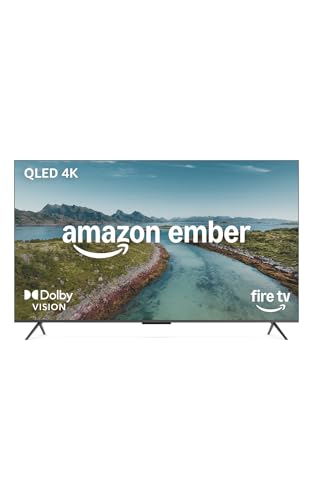
Amazon Ember 55-inch QLED Series — Colour step-up
The Ember QLED exists to answer the 4-Series’ one pictorial concession. Quantum-dot colour widens the palette the panel can show — richer reds and greens, more convincing skin, pitches and sunsets with depth in them — and the tier adds Dolby Vision beside the carried-over HDR10+, so streamed cinema gets both the colour range and the scene-by-scene tone mapping the format offers. Dolby Audio and a quad-core processor complete a specification that reads as the 4-Series with its picture ceiling lifted, which is exactly what a step-up tier should be.
Who feels the step? The viewer who watches attentively in a dimmed room, where colour volume and tone mapping are the picture. Nature documentary, prestige drama and film are the content that spends QLED’s range, and a household whose evenings are built from them will see the tier’s value nightly rather than occasionally. The normally lit, channel-and-series household, by contrast, may find the 4-Series’ picture already sufficient and its ambient layer the more lived-with feature — note that the QLED’s title does not name the Ambient Experience, so buyers for whom the idle wall matters should verify its provision on the listing rather than assume the tiers share every feature.
That last point generalises into the guide’s most useful habit: tiers trade, they do not simply accumulate. The QLED buys colour and Vision; a buyer should confirm what else the tier carries before assuming the whole 4-Series list travels upward. Read in that disciplined way, the QLED’s identity is clear — it is the film-colour tier of Amazon’s own range, for the household that has decided its evenings justify a richer palette and does not need the Mini-LED’s dimming or the gaming mode above it. Colour-first buyers should open the Ember QLED listing and weigh its Dolby Vision claim against their film habits.
The quad-core processor deserves its unglamorous sentence. Platform televisions live or die by responsiveness across years of app updates, and processing headroom is the specification that decides whether a set feels brisk in year five or merely in week one. A tier that names its processor class is telling the buyer something about its intended lifespan, and households that keep televisions long should listen.
There is a room the QLED suits particularly: the living room that doubles as the household’s cinema because it is the room that can be darkened. Blinds drawn, lamps low, a film chosen with intent — that room exposes panel colour more than any other pattern of use, and it is where the step from the 4-Series stops being a specification and becomes the evening itself.
There is a colour argument specific to sport that the QLED quietly wins, and sports households weighing this tier against the 4-Series should hear it. Kits, pitches and skin tones under floodlights are colour information before they are entertainment, and a wider palette renders them with a clarity that reads as sharpness even though it is saturation and separation doing the work. The household whose dimmed room hosts both film nights and the big match gets the QLED’s value twice, from the two kinds of evening it splits its life between.
- Screen size: 55-inch
- Panel and resolution: QLED, 4K Ultra HD
- HDR: HDR10+, Dolby Vision
- Audio: Dolby Audio
- Processor: Quad-core processor
- Voice: Alexa+ show-finding per listing
- Model: Newest model
Strengths
- QLED colour widens the palette for film, documentary and drama.
- Dolby Vision joins HDR10+ for scene-by-scene tone mapping.
- Quad-core processing gives the platform long-run responsiveness.
Trade-offs
- No Mini-LED dimming, so the top Ember tier holds the contrast lead.
- Ambient Experience is not named in its title; verify before relying on it.
- No gaming mode is stated for console-led households.
Best for: a dimmed living room whose evenings are film and prestige drama, wanting QLED colour and Dolby Vision.
Not suited for: rooms needing Mini-LED local dimming for the darkest scenes, which only the Ember Mini-LED offers here.

Amazon Ember 55-inch Mini-LED Series — Dark-room and gaming tier
The Mini-LED Series is where Amazon’s own range stops being a platform showcase and becomes a picture contender. Mini-LED backlighting behind a QLED 4K panel gives the set local control over brightness — bright highlights and genuinely dark shadows in the same frame — and Dolby Vision IQ adapts the picture to the room’s light as it does so. Add the Ambient Experience from the 4-Series and a 144Hz gaming mode, and the tier describes a set aimed simultaneously at the film household and the gaming household, which is a combination the rest of this guide does not attempt.
Take the film half first. Local dimming is the technology that decides night scenes, and night scenes are where mid-tier panels confess their limits: the glow around a streetlight, the grey of a supposedly black sky. A Mini-LED array attacks exactly that confession, zone by zone, and Vision IQ’s light-aware adaptation keeps the result right as the room moves from dusk to dark. For the household that watches cinema the way it was meant to be watched — lights low, attention up — this is the Ember tier that competes with the wider market’s film sets rather than merely with its own siblings.
Then the gaming half, stated in the title’s own terms: a 144Hz gaming mode. Console and PC players sharing the main screen get a provision the other five picks do not claim, on the same set that handles the family’s film nights and idle-wall hours. A household with one main screen and two demanding uses — cinema and fast games — is precisely the household this tier was designed for, and it should weigh the Mini-LED against buying two lesser compromises. If that dual life is yours, the Ember Mini-LED listing is the one to read in full, gaming mode and Vision IQ details included.
The tier’s honesty check is the usual one: none of this matters to the normally lit, series-and-news household, which will use the dimming rarely and the gaming mode never, and which the 4-Series serves at a lower tier without apology. Premium tiers earn their place by matching specific lives, and the Mini-LED’s life — dark films, fast games, one main screen — is specific indeed. Buyers outside it should climb back down the range with confidence rather than up it with hope.
Longevity closes the case. A top tier bought correctly is the set a household keeps longest, because it has no obvious successor itch: the panel handles the dark scenes, the gaming mode handles the console’s ambitions, and the platform is Amazon’s own reference. The Mini-LED’s buyers are buying the absence of a next purchase, and priced against two avoided upgrades, the tier’s premium often reads differently than it does on a specification table.
Installation of the Mini-LED deserves the planning its tier implies. A 55-inch set bought for dark-room performance should be placed where the room’s darkness is real — away from the doorway’s spill, at the seated eye line, with the gaming console’s cables routed before the unit goes on its stand or mount. Premium panels punish casual placement more than value ones do, because their virtues are exactly the ones poor placement hides. Households willing to spend that half hour get the set they paid for; the tier rewards the care visibly.
- Screen size: 55-inch
- Panel and resolution: QLED Mini-LED, 4K UHD
- HDR: Dolby Vision IQ
- Gaming: 144Hz gaming mode
- Idle display: Ambient Experience
- Voice: Alexa+ show-finding per listing
- Model: Newest model
Strengths
- Mini-LED local dimming gives night scenes genuine depth and control.
- Dolby Vision IQ adapts tone mapping to the room’s light.
- A 144Hz gaming mode serves consoles on the same screen as film nights.
Trade-offs
- Its premium is wasted on normally lit, non-gaming households.
- One size only; smaller rooms must take the Toshiba or Insignia route.
- Ambient scheduling still needs care where people sleep nearby.
Best for: a single-main-screen household splitting its evenings between dark-room cinema and fast console gaming.
Not suited for: bright, casual viewing rooms, where the 4-Series covers the same platform life at a lower tier.
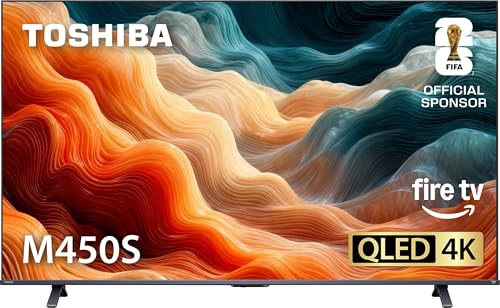
TOSHIBA 43-inch Class M450 Series — Small-room QLED
Toshiba’s M450 answers the question the Insignia F50 43 leaves open: what if the smaller room wants colour? Its listing states a QLED 4K UHD panel at 43 inches with Fire TV and a voice remote with Alexa, streaming live TV without cable — the value formula’s shape, with the panel upgraded to quantum-dot colour. For the bedroom or den whose owner watches film attentively at close range, that upgrade is not a luxury; at 43 inches viewed from a bed or a desk chair, colour richness is the picture quality the viewer actually sits near enough to judge.
The M450’s competitive set is small and specific. Against the F50 43, it trades the value floor for the QLED panel, and the buyer is choosing between money and colour with no other variable moving. Against the Ember range, it offers the colour story at a size Amazon’s own line does not sell in this guide — every Ember here is 55 inches — so the small-room colour buyer has exactly one address, and it is this one. Toshiba’s long television lineage sits behind the badge, and the REGZA heritage of the brand’s picture tuning is the context its buyers are purchasing into, even though this listing keeps its claims to the panel, the platform and the remote.
Rooms that suit it multiply once the size-and-colour combination is understood. The main bedroom of a film-loving household, where the second screen gets serious use. The home office that becomes a private cinema after hours. The small flat whose only screen must be a good one, because there is no larger room for a better set to live in. Each of those rooms asks for the best panel that fits its wall, and the M450 is the Fire TV answer to that ask at 43 inches. Small-room buyers who care about colour should read the M450 listing before settling for any plain LED set.
What the title does not claim should be noted with the usual discipline: no Dolby Vision, no gaming mode and no ambient feature are stated, so none are promised here. The M450’s case rests on its panel at its size, and it is strong enough to rest there. Anyone needing those formats must climb to the 55-inch Ember tiers and accept the larger canvas, which in a small room may be no favour at all.
There is a final, practical charm to a well-specified small set: it is the easiest television in the house to live around. One person can mount it, move it and re-home it; it fits the spare room, the student flat and the kitchen wall across its life; and because its panel is genuinely good, none of those rooms feels like a demotion. The M450 is built to be that set for Fire TV households.
The M450 also reframes what a second television can be in a household that cares about pictures. The traditional second set is a demotion — the old panel exiled to the bedroom — and its picture quietly taxes every viewing in that room for years. A household that instead buys a small set deliberately, with a QLED panel chosen for the room, finds the bedroom screen competing with the main room’s for the household’s best viewing. That inversion is the M450’s real proposition, and it is why a 43-inch set can be a considered purchase rather than a leftover.
- Screen size: 43-inch class
- Panel and resolution: QLED, 4K UHD
- Remote and voice: Voice Remote with Alexa
- Content: Stream live TV without cable per listing
- Platform: Smart Fire TV
- Series: M450 Series
Strengths
- QLED colour at 43 inches, the only small-room colour upgrade here.
- Full Fire TV integration with an Alexa voice remote.
- Close-range rooms sit near enough to actually judge its richer panel.
Trade-offs
- No Dolby Vision or gaming mode is stated in the title.
- Too small for a main room with long seating distances.
- Its colour premium only pays where viewers sit close and watch attentively.
Best for: a bedroom, den or small flat whose only or second screen must have genuine QLED colour at 43 inches.
Not suited for: a main living room, where its 43-inch canvas cannot serve seating beyond a short distance.
Comparison
| Pick | Size | Panel | HDR as stated | Signature extra |
|---|---|---|---|---|
| Insignia F50 43 | 43-inch | LED 4K | Not stated in the listing title | Alexa voice remote, live TV without cable |
| Insignia F50 55 | 55-inch | LED 4K | Not stated in the listing title | Main-room value floor |
| Ember 4-Series 55 | 55-inch | 4K UHD | HDR10+ | Ambient Experience, fast processor |
| Ember QLED 55 | 55-inch | QLED 4K | HDR10+, Dolby Vision | Quad-core processor, QLED colour |
| Ember Mini-LED 55 | 55-inch | QLED Mini-LED 4K | Dolby Vision IQ | 144Hz gaming mode, Ambient Experience |
| Toshiba M450 43 | 43-inch | QLED 4K | Not stated in the listing title | QLED colour at the smaller size |
How to Choose a Fire TV
Start with the room’s size, because it halves the field instantly: 43-inch rooms choose between the Insignia F50’s value and the Toshiba M450’s QLED colour, while main rooms choose among the F50 55 and the three Ember tiers. Then let the room’s light and the household’s evenings climb the tiers. Normally lit, everyday viewing is honestly served by the value sets and the 4-Series. Dimmed film viewing justifies the Ember QLED’s colour and Dolby Vision. Dark-room cinema plus console gaming is the Mini-LED’s exact brief, and no lesser tier should be stretched to cover it.
Close with the platform questions. An Echo household gains the most from any of the six and should weight Alexa’s depth accordingly; a household new to voice assistants should buy the panel and treat the voice layer as a bonus it can adopt at its own pace. And check the idle wall: if the screen will sit in a room it dominates, the Ambient Experience on the 4-Series and Mini-LED is a lived feature, not a garnish, and it deserves a line in the decision.
A last piece of choosing discipline: decide the sound plan with the television, not after it. None of the six titles here headlines an audio system beyond the Ember line’s Dolby Audio, so a room that needs more — a large open-plan space, a household that watches with the volume of a gathering — should budget its soundbar or speaker answer alongside the set rather than discovering the gap at the first family film night. The television is the visible half of a viewing installation; the other half is audible, and it is cheaper to plan both together.
Is a Built-In Fire TV Better Than a Fire TV Stick?
For a television being bought today, yes — the integrated set is one appliance with one remote, one power state and Alexa resident in the television itself, while a stick is a guest in another set’s house, with an input to find and a second interface governing volume and picture. The stick keeps two honest advantages: it can move between screens, and it can be replaced cheaply when the platform generation turns. Those advantages suit travellers, renters and spare rooms with a serviceable panel already hanging. But the buyer in this guide is choosing a television, and choosing one with the platform inside removes a layer of friction from every evening of the set’s life. All six picks were verified as integrated televisions for exactly that reason.
What Does the Ambient Experience Actually Do All Day?
It gives the television a daytime job. Instead of a black rectangle, the idle Ember shows photographs, artwork or glanceable widgets — the time, the weather, a calendar — at a brightness pitched for a room rather than a cinema. In practice, households use it as a large family photo frame that occasionally becomes a television, and in open-plan rooms that second life changes how the wall feels for the twenty hours a day nobody is watching. The discipline it asks in return is scheduling: brightness and hours set with the household’s sleep in mind, especially where the screen shares space with rest. Configured once, it is the feature owners mention most; left unconfigured, it is the feature most likely to be switched off, which would be a waste of the tier that includes it.
Which Fire TV Should a Console Gamer Choose?
The Ember Mini-LED, and the reasoning is stated rather than speculative: it is the only pick whose title claims a gaming provision, a 144Hz gaming mode, and it pairs that claim with the Mini-LED panel whose contrast serves games as well as films. The other five sets will all display a console perfectly happily through their inputs — casual and family play asks nothing more — but they make no gaming claims in their listings, and this guide does not make claims on their behalf. A household whose gaming is competitive or fast-twitch should buy the tier that prints its gaming intent; a household whose gaming is occasional can let the room and the film habit choose instead.
How Does Fire TV Handle Live Television Without Cable?
The platform’s live proposition, named in the Insignia and Toshiba listings as streaming live TV without cable, gathers free and ad-supported channels, news and the household’s live-capable apps into the same guide-shaped experience a cable viewer recognises. For second rooms especially, that bench is the difference between a television that gets used for the morning news and one that only wakes for deliberate streaming. It will not replicate a full cable package, and households should not buy it expecting one; what it does is give every room in the house a channel-surfing life at no additional subscription, which for kitchens, bedrooms and guest rooms is most of what live television was ever for.
The main room uses the same bench differently — as the background layer beneath the subscription life, the channel left running during the day, the local news at breakfast. Buyers weighing the tiers should count that ordinary usage honestly, because a set’s live and free bench is touched daily while its flagship formats are touched weekly, and daily features deserve their share of the decision even in a guide organised by panels.
Common Mistakes
Confusing the tiers’ contents is the Ember range’s characteristic trap. Features do not automatically travel upward: the QLED’s title does not name the Ambient Experience its cheaper sibling headlines, and the value sets claim none of the formats above them. Buyers who shop by the range’s reputation rather than the individual listing’s words end up owning a set missing the one feature they pictured. Read the chosen model’s own title and listing the way these reviews do, and let it — not the badge — close the sale.
Buying a stick’s logic in a television purchase is the second error. Shoppers who frame the decision as platform-versus-platform end up comparing dongles against panels and choosing neither well. This guide’s six are televisions; their panels, sizes and rooms are the decision, with Fire TV as the shared constant. Households that keep that framing choose quickly and regret rarely.
The third error is sizing by habit rather than by room. A household replacing a 55-inch set buys another 55-inch set for a room that has since filled with furniture, or squeezes a 43 into a main room because the old set was that size in a smaller flat. Measure the wall and the seating, and let the current room — not the previous address — pick between this guide’s two sizes.
Second-hand and hand-me-down life is the final quiet virtue of the value and mid tiers here. A Fire TV set passed to a student, a relative or a holiday let carries its platform manners with it, signs into a new household cleanly and asks nothing exotic of its next owner. Sets bought at sensible tiers for real rooms tend to live two or three household lives, and the ones specified honestly — neither gilded nor starved — are the ones that survive each move still earning their wall.
Final Recommendation
Most main rooms should land on the Ember 4-Series: Amazon’s reference hardware, HDR10+, the Ambient Experience and no wasted tier. Film households in dimmable rooms step to the Ember QLED for its colour and Dolby Vision; film-and-gaming households sharing one screen take the Mini-LED and stop. Value-led main rooms take the Insignia F50 55 without apology, smaller rooms take the F50 43 for value or the Toshiba M450 for colour, and every one of those choices is defensible because each is matched to a room rather than a ranking.
The platform will feel familiar within an evening whichever set you choose — that is Fire TV’s promise, and all six keep it. What separates a satisfying purchase from a restless one is the panel around that familiarity and the tier matched to the room’s light and the household’s evenings. Buy those correctly, and the voice remote becomes what it should be: a pleasant detail on a television that was chosen well.
One household pattern ties the whole range together and is worth naming before the verdicts: the Fire TV home is usually an Alexa home, and in an Alexa home the television stops being an appliance that is operated and becomes a surface that is asked. Ask for the programme, ask for the lights, ask for tomorrow’s weather over the credits. Every set in this guide participates in that pattern, from the value pair to the Mini-LED, which is why the platform decision outranks the panel decision for such households — and why this guide can separate its six picks by room and tier with confidence that the daily experience will feel continuous across all of them.
Frequently Asked Questions
Are these televisions, or do I need a Fire TV Stick as well?
They are televisions with Fire TV built into the set. No stick or box is needed; the platform, the Alexa remote and the home screen all belong to the television itself.
What separates the three Ember 55-inch tiers?
Panel and formats. The 4-Series offers 4K with HDR10+ and the Ambient Experience; the QLED Series adds quantum-dot colour and Dolby Vision; the Mini-LED Series adds local dimming, Dolby Vision IQ and a 144Hz gaming mode.
Which Fire TV is best for a bedroom?
One of the 43-inch sets: the Insignia F50 for value, or the Toshiba M450 if the bedroom’s screen gets attentive film viewing and deserves QLED colour at close range.
Does the Insignia F50 include Alexa?
Yes — both F50 sizes list an Alexa voice remote, and the platform’s live TV without cable is part of their pitch for second rooms and main rooms alike.
Which pick should I choose for gaming?
The Ember Mini-LED, the only set here whose title states a gaming provision — a 144Hz gaming mode — alongside its Mini-LED panel and Dolby Vision IQ.
Is the Ambient Experience worth paying for?
If the screen dominates a room it sits idle in, yes: it turns dead wall hours into a photo and information display. In a room where the set is rarely idle or rarely seen, the feature matters less and the panel tiers should decide.
Renters and frequent movers form the last audience worth addressing directly, because integrated platform televisions suit their lives in a way component systems do not. One box, one remote, no stick to lose in a move and no console of streaming hardware to rewire at each address: the set arrives, joins the Wi-Fi, signs in and is a household again by the first evening. Every tier in this guide preserves that simplicity, which is why the range can be recommended across such different budgets without the advice changing shape — choose the size the current room needs, the tier its light justifies, and carry both decisions to the next address unchanged.
Related Guides
Households comparing platforms before committing should read our guide to Roku TVs, the calm-interface alternative. And if the main room’s evenings are cinema first, the smart TVs for movies round-up ranks panels by their film credentials across platforms.


