What's inside
- Key Takeaways
- Quick Picks
- How These Picks Were Chosen
- The Six Headsets in Detail
- Comparison Table
- Which Cockpit Are You Actually Flying?
- How to Choose an Airline Pilot Headset?
- Panel Plugs, Impedance and Other Unglamorous Deciders
- Hearing Health Across a Flying Career
- Crew Communication: The Half of the Headset You Transmit
- Common Mistakes
- Frequently Asked Questions
- Building the Rest of the Flight Bag Around the Headset
- What a Full Roster Month Does to a Headset Decision
- Try Before You Commit: A Sensible Test Protocol
- Final Recommendation
- Related Guides
As an Amazon Associate I earn from qualifying purchases. This post may contain affiliate links at no extra cost to you.
widgetverdict.com is reader-supported. When you buy through links on our site, we may earn an affiliate commission.
Where to buy: all six picks below link to their Amazon listings; start with the David Clark H10-13.4 if you want the passive benchmark, or the Bose A30 if active reduction tops your list. Prices move, so confirm the current figure on the listing itself.
The best headsets for airline pilots have to survive two judges at once: the flight deck, where noise, wiring and intercom discipline are unforgiving, and the roster, which may ask for four sectors before lunch. A headset that wins on one and fails the other ends up in the locker. This guide ranks six headsets across the full professional spread — passive legends, adjustable ANR flagships, an in-ear jet specialist, a hybrid electronic design and two honest training-grade options that working pilots still buy as spares and starters.
Notice what this guide does not do: it does not hand every pick Bluetooth and call it progress. Airline flying is a wired profession at the panel, and the dual plug remains the connection that simply works when the aircraft powers up. Wireless features earn praise here only where they serve the EFB, the phone call to operations or the walk-around — never as a substitute for the cable that carries the clearance.
Key Takeaways
- Passive headsets like the H10-13.4 never need batteries, and their protection depends entirely on ear seal fit.
- Adjustable ANR on the Bose A30 lets a pilot trade isolation against cockpit awareness by phase of flight.
- The Proflight Series 2 suits quieter jet flight decks, where in-ear comfort beats maximum isolation.
- Hybrid electronic cancelling on the DC ONE-X keeps a passive headset working underneath the electronics.
- Training-grade picks from ASA and KORE state their reduction figures plainly and cost little enough to serve as spares.
- Panel wiring decides compatibility first; check plug type against your fleet before falling for any feature list.
Quick Picks
| Pick | Badge | Why it earns its place |
|---|---|---|
| David Clark H10-13.4 Aviation Headset | The passive benchmark | A passive design with a decades-long service record, no batteries to manage and a reputation for surviving flight bags, hangar floors and daily line flying. |
| Bose A30 Bluetooth Aviation Headset | The ANR flagship | Adjustable active noise reduction, a noise cancelling microphone and Bluetooth in a lightweight frame, wired to the panel through a dual plug cable. |
| Bose Proflight Series 2 Aviation Headset | The in-ear jet specialist | An in-ear format built for quieter jet flight decks, with Bluetooth connectivity and a dual plug cable, trading big earcups for a barely-there fit. |
| David Clark DC ONE-X ENC Headset | The hybrid electronic step-up | Electronic noise cancelling from the David Clark stable, for pilots who want active help without leaving a brand their mechanics already trust. |
| ASA AirClassics HS-1A | The honest training workhorse | A stated 23 dB of noise reduction, a noise-cancelling microphone and stereo or mono switching at a training-school price point. |
| KORE P1 Aviation Headset | The student-budget starter | Passive reduction rated at 24dB NRR, acoustic ear cups, GA dual plugs and a headset bag in the box, aimed squarely at student pilots. |
Reading the table vertically tells the story of a career. The KORE and ASA picks serve the training years, the David Clark passive serves everyone forever as the spare that cannot fail, and the Bose and ONE-X picks serve the line years where comfort compounds across thousands of hours. Our wider comparisons in Best Noise-Cancelling Aviation Headsets dig into the active-versus-passive argument in more depth.
How These Picks Were Chosen
Selection started with the panel, not the brochure. Every pick had to connect to real aircraft audio systems without exotic adaptors, because a headset that needs a dongle hunt before pushback has already failed. Dual plug compatibility across general aviation and much of the airline fleet was the baseline, and any design whose listing could not support a professional use case was left out regardless of consumer popularity.
Noise strategy came second, and we deliberately kept all three philosophies in the guide. Passive, active and hybrid electronic designs each win in a different cockpit, and a guide that only praised one approach would mislead pilots whose flying differs from the reviewer’s. Where a listing states a reduction figure — the ASA at 23 dB, the KORE at 24dB NRR — we report it as the manufacturer’s own number and remind you that seal fit governs the real result.
Comfort evidence was weighed the way rosters apply it: cumulatively. A headset is not worn for a review afternoon but for a career of early reports and late finishes, so weight, clamp and heat all counted heavily. Finally, we favoured manufacturers with aviation service cultures — the kind that sell replacement seals and repair their own products — because professional kit is maintained, not discarded.
The Six Headsets in Detail

David Clark H10-13.4 Aviation Headset
Some headsets earn their place through features, and some earn it through sheer survival. The H10-13.4 belongs firmly in the second camp. It is a passive headset, which means every decibel of protection comes from the seal of its ear cups and the mass of its construction rather than from electronics. On a piston flight deck that approach has a particular honesty: there is nothing to switch on, nothing to charge, and nothing to fail quietly halfway across a long sector while you wonder why the world suddenly got louder.
For airline pilots, the honest use case is narrower than the legend suggests, and this guide will not pretend otherwise. A pilot moving between a piston trainer, a turboprop and occasional general aviation flying will find the H10-13.4 completely at home. On a modern jet flight deck, where ambient noise is lower and the working day is longer, its weight and clamping pressure become the story instead. Plenty of professional pilots keep one as a personal spare, a jumpseat companion or the headset they lend without anxiety, because a passive David Clark shrugs off treatment that would end a delicate electronic model.
Fit deserves a paragraph of its own. The headset sits over the ear with a firm seal, and that seal is the entire noise strategy, so glasses arms, thick hair and worn ear seals all change the result. Replacing tired seals restores performance cheaply, which is part of the ownership appeal: this is a headset maintained with parts, not replaced with a new purchase. If your flying mixes training fleets and older airframes with standard dual plugs, the H10-13.4 remains the reference point against which every passive rival is judged.
Consider also how the headset behaves on the ground, because professional flying includes plenty of it. During walk-arounds it rides around the neck or stays in the cockpit, during delays it sits on the glareshield baking in sun through the windshield, and during turnarounds it gets knocked by seat belts and chart holders. A passive design tolerates this rough choreography without complaint. There is no battery door to crack, no control module to crush under a flight bag, and no pairing state to puzzle over when the headset is borrowed by a colleague whose own kit has failed. Dispatchers of small fleets quietly love equipment like this, because the headset that is always ready is the one that never generates a phone call. For a personal purchase the same logic applies at smaller scale: the H10-13.4 asks for nothing except a place in the bag, and repays that small hospitality with decades of indifference to neglect.
Strengths
- No batteries, no electronics, nothing to fail mid-sector
- Passive seal keeps working on any airframe with dual plugs
- Deep parts support makes worn seals and cushions replaceable
Trade-offs
- Weight and clamp grow tiring across very long duty days
- No Bluetooth, so phone and tablet audio stay separate
- Passive-only protection asks more of the ear seal fit
| Noise strategy | Passive, through ear seal and cup design |
|---|---|
| Connection | Listing title does not specify the plug layout — confirm the exact configuration with David Clark documentation before ordering |
| Electronics | None; no battery required |
| Microphone | Details are not spelled out in the listing title — check the manufacturer documentation |
Best for: pilots splitting time between training fleets and line flying who want one passive headset that simply never quits.
Not suited for: long-haul jet rosters where low weight and active reduction matter more than mechanical simplicity.
Ownership costs stay refreshingly boring with this one, so open the listing, confirm the plug configuration matches your fleet, then compare today’s Amazon price before you commit.

Bose A30 Bluetooth Aviation Headset
The A30 is the headset most airline pilots picture when someone says active noise reduction done properly. Bose built it around three ideas that matter on a flight deck: adjustable ANR so the pilot can trade isolation against awareness, a noise cancelling microphone so controllers hear the voice rather than the cockpit, and Bluetooth so a phone, tablet or electronic flight bag can join the conversation without another cable crossing the glareshield. The listing describes a lightweight, comfortable design, and on long sectors that word lightweight stops being marketing and starts being physiology.
The dual plug configuration in this listing suits the panel connections found across much of the airline and corporate fleet, which keeps the A30 simple to move between airframes. Adjustable ANR deserves emphasis because fixed systems force a single compromise. In a loud climb you may want maximum reduction; during a quiet cruise with a colleague talking beside you, a gentler setting keeps the flight deck feeling human rather than submerged. That ability to tune the silence is what separates a flagship from a merely expensive headset.
Bluetooth behaviour is the detail to interrogate before buying. Airline operating rules differ on personal device audio, and company policy always outranks headset capability. Used within those rules, the connection is ideal for EFB audio cues and for the phone call to operations that somehow always happens during boarding. The microphone’s noise cancelling earns its keep in exactly those moments, holding your voice forward while the APU and air conditioning argue in the background. If you fly long days and your neck files complaints by the third sector, the A30 is the pick engineered around your complaint.
The A30 also deserves credit for how it handles the unglamorous middle of a duty: the cruise. At altitude the workload dips, conversation with the other pilot matters, and a headset that seals you into a private silent world can feel oddly isolating across a four-hour sector. The adjustable reduction lets you open that world back up without removing the headset, keeping the intercom present while the airframe hum recedes to a background texture. Small ergonomic decisions compound here — controls placed where a gloved or busy hand can find them, a microphone boom that holds its position through turbulence and meal trays, ear cushions that spread pressure rather than concentrating it behind the jaw. Pilots upgrading from older active models usually notice these refinements before they notice the electronics, because the electronics simply get out of the way. That is the flagship bargain: money spent on making eight hours feel like three.
Strengths
- Adjustable ANR lets the pilot tune isolation to the phase of flight
- Noise cancelling microphone keeps transmissions clean in loud cockpits
- Bluetooth joins EFB and phone audio without extra cabling
Trade-offs
- Flagship pricing demands a long career to amortise
- Bluetooth use still bound by your operator’s device policy
- Battery management becomes part of the pre-flight routine
| Noise strategy | Adjustable active noise reduction |
|---|---|
| Microphone | Noise cancelling, per the listing title |
| Wireless | Bluetooth |
| Connection | Dual plug, per the listing title |
Best for: line pilots flying long sectors who want tunable ANR, Bluetooth EFB audio and a frame that stays comfortable to the last landing.
Not suited for: flight decks where company policy forbids personal Bluetooth audio entirely, wasting the feature you paid most for.
If tunable silence sounds like the upgrade your roster deserves, follow the A30 listing, double-check the dual plug variant, then see what Amazon is asking today.
Bose Proflight Series 2 Aviation Headset
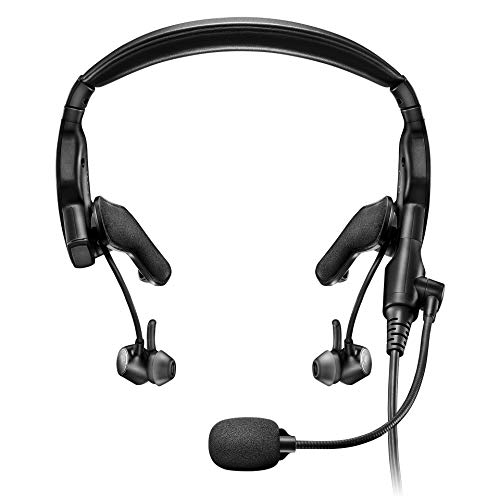
The Proflight Series 2 breaks the visual rule of aviation headsets. Instead of cups over the ears, it places small earbuds in them, which changes everything about how a long day feels. Pilots in quieter jet flight decks often find over-ear headsets are solving a noise problem their aircraft does not really have, while creating a comfort problem it definitely does: pressure on the skull, heat around the ears and conflict with sunglasses across a ten-hour duty. The Proflight answers with an in-ear design that weighs almost nothing on the head and disappears under a hat or headset band.
Bluetooth connectivity and a dual plug cable keep it professionally wired where it counts. The panel connection stays physical, as flight deck audio should, while Bluetooth handles the secondary stream. In an Airbus or business jet environment, where the ambient level is moderate and conversation with the other pilot matters, the in-ear approach preserves a natural sense of the room. You hear the cockpit rather than a processed reconstruction of it, which many jet pilots prefer on principle.
The cautions are equally specific. In-ear fit is personal in a way earcups are not: tip size, insertion depth and ear shape decide both comfort and isolation, and a poor fit cannot be fixed by turning anything up. Piston and turboprop pilots should look elsewhere in this guide, because an in-ear design leans on a quieter starting environment. Shared or pooled headsets are also a poor match, since earbuds are inherently personal kit. Bought by the right pilot, though — a jet pilot with long sectors and a hatred of head clamp — the Proflight is less a compromise than a category of its own.
There is a social dimension to the Proflight that rarely appears in spec sheets. Flight decks run on conversation, and a headset that leaves the ears physically open changes the texture of crew interaction. Side conversations, the purser’s quiet word at the door, the engineer leaning in during a turnaround — all arrive naturally rather than through a microphone feed. Many jet pilots describe the experience as working in the room instead of inside a device, and for two-crew operations built on shared awareness that quality has operational value beyond comfort. The trade is discipline about fit: carry the tip sizes, seat the buds properly at the start of the duty, and treat the seal check like a checklist item rather than a hope. Pilots who adopt that small ritual tend to become evangelists; pilots who skip it tend to blame the headset for a problem that lives in the fitting.
Strengths
- In-ear format removes clamp pressure and heat on long jet sectors
- Bluetooth connectivity with a physical dual plug panel cable
- Natural cockpit awareness suits two-crew jet operations
Trade-offs
- Fit depends entirely on ear tip size and personal ear shape
- Not the tool for loud piston or turboprop flight decks
- Earbud format makes it unsuitable as shared pool equipment
| Form factor | In-ear, per the Series 2 design |
|---|---|
| Wireless | Bluetooth connectivity |
| Connection | Dual plug cable, per the listing title |
| Colour | Black, per the listing title |
Best for: jet pilots on long sectors whose flight decks are quiet enough that comfort, not maximum isolation, is the real problem.
Not suited for: piston training fleets, where ambient noise overwhelms what an in-ear design is built to handle.
Jet pilots curious about losing the earcups should open the Proflight listing, study the fit guidance carefully, then weigh the current Amazon listing price before deciding.

David Clark DC ONE-X ENC Headset
The DC ONE-X occupies the most interesting middle ground in this line-up: a David Clark headset with electronic noise cancelling. The brand’s identity was built on passive toughness, so an ENC model from the same house speaks to a particular buyer — the pilot who trusts the green headband lineage but flies enough noisy sectors to want active assistance. Electronic cancelling attacks the low, droning frequencies that passive seals handle worst, which is precisely the band where piston and turboprop fatigue accumulates.
For airline pilots, the ONE-X makes sense in mixed flying lives. A pilot whose day job is a jet but who instructs, ferries or flies pistons at weekends gets one headset that behaves respectably in both worlds, from a manufacturer whose service network aviation already knows. Electronic systems also change the failure conversation in a healthy way: when the electronics rest, a well-sealed headset still works as a passive unit, so a flat battery degrades the experience rather than ending it. Confirm the exact behaviour in the manufacturer documentation, but that layered design philosophy is the correct one for working pilots.
What the listing title does not do is shout about Bluetooth or extra connectivity, and this guide will not invent any. Treat the ONE-X as a focused tool: electronic noise cancelling, David Clark build, professional intent. Pilots who need phone integration should look at the Bose picks here; pilots who want active help with minimal lifestyle features will find the restraint refreshing. It is the headset for the pilot who reads the spec sheet twice and the marketing never.
Where the ONE-X quietly scores is in the psychology of trust. Airline pilots are conservative about flight deck equipment for good reason: the kit has to work on the worst day, not the best one. A manufacturer whose passive headsets already populate thousands of flight bags brings an existing relationship to an electronic product, including mechanics who know the brand, parts channels that already exist and colleagues who can lend a cable or a cushion at an outstation. That ecosystem rarely appears in comparison charts, yet it decides real purchases. The electronic cancelling itself addresses the frequency band where long turboprop and piston sectors do their damage, the low drone that leaves ears ringing in the crew room. If your career mixes fleets and your loyalties were formed in the passive era, the ONE-X reads less like a gadget and more like a continuation.
Strengths
- Electronic noise cancelling targets low-frequency drone directly
- David Clark build and service culture behind an active design
- Layered protection still leaves a sealed passive headset underneath
Trade-offs
- Listing title names no Bluetooth, so device audio needs another route
- Active electronics add batteries to the pre-flight checklist
- Less feature-rich than flagship rivals at a similar intent
| Noise strategy | Electronic noise cancelling (ENC) |
|---|---|
| Brand lineage | David Clark aviation line |
| Wireless | The listing title is silent on wireless — verify current details in the manufacturer documentation |
| Microphone | Not described in the listing title — confirm the specification with David Clark documentation |
Best for: pilots loyal to David Clark build quality who want electronic cancelling for mixed piston and professional flying.
Not suited for: pilots who rank Bluetooth phone and tablet integration above every other feature.
Brand loyalists ready for active help can open the ONE-X listing, confirm the remaining specifications against the documentation, then review the Amazon listing price.

ASA AirClassics HS-1A
The ASA AirClassics HS-1A is the headset flight schools buy by the shelf, and its listing tells you why in plain numbers: 23 dB of noise reduction, a noise-cancelling microphone and stereo or mono switching. ASA built its name on training materials, and the HS-1A applies the same philosophy to hardware — cover the syllabus, survive the students, keep the invoice sane. For an airline pilot, its natural roles are the spare in the flight bag, the headset for the hour-building side job, or the first headset bought on the road to the right seat.
Stereo and mono switching sounds minor until you meet an aircraft whose panel wiring disagrees with your headset. Training fleets are museums of every wiring decision ever made, and a switch that adapts the headset to the aeroplane saves the crackling one-ear ride that ruins a lesson. The noise-cancelling microphone matters for the same unglamorous reason: instructors talk constantly, often over a tired engine at full climb power, and clarity on the intercom is a teaching tool, not a luxury.
Set expectations with care. A stated 23 dB figure describes passive reduction under test conditions, and real protection still lives or dies on ear seal fit. The HS-1A will not pamper a pilot through a long-haul roster, and it is not pretending to. What it offers is honest, replaceable, school-proof utility. Airlines are full of captains whose first thousand hours were logged under an ASA headset, and that lineage of abuse survived is its own specification.
Schools evaluate the HS-1A through a lens private buyers can learn from: cost per flying hour. A training headset gets dropped, sat on, left in a hot cockpit and adjusted by a hundred different heads, so purchase price is only the opening bid. What matters is whether the unit survives the syllabus, whether parts and replacements are painless, and whether a student can be understood on frequency from their very first taxi call. The HS-1A’s specification reads like a direct answer to those questions, from the stated reduction figure to the microphone chosen for clarity over an engine at climb power. Airline pilots buying a spare should apply the same arithmetic. The headset that rides in the bag as insurance does not need flagship refinement; it needs to work after a year of neglect, on whatever airframe the day produces, with wiring quirks it can adapt to through that stereo and mono switch.
Strengths
- Stated 23 dB noise reduction with a noise-cancelling microphone
- Stereo and mono switching adapts to mixed training fleets
- Training-school pricing makes it a painless spare or starter
Trade-offs
- Passive design only, so loud decks stay comparatively loud
- Comfort tuning for multi-hour line flying is limited
- Fewer refinements than the flagship picks in this guide
| Noise reduction | 23 dB, per the listing title |
|---|---|
| Microphone | Noise-cancelling |
| Audio modes | Stereo and mono |
| Intended use | General aviation and training, per the listing title |
Best for: cadets, instructors and line pilots needing a tough spare that shrugs off training-fleet wiring quirks.
Not suited for: long-haul rosters where active reduction and low clamp force define whether a headset gets worn.
Schools and spares-buyers alike should open the HS-1A listing, confirm the fleet plug standard, then review the Amazon listing price.

KORE P1 Aviation Headset
The KORE P1 speaks directly to the student pilot, and its listing is admirably specific about it: 24dB NRR passive noise reduction, a noise cancelling microphone, mono audio, acoustic ear cups, GA dual plugs and a headset bag included. That is a complete starter kit described in one breath. For the airline pilot reading this guide, the P1’s relevance is as the gift, the recommendation or the school-fleet purchase — the headset you suggest when a new student asks what to buy before their third lesson.
Passive reduction rated at 24dB NRR sets a clear expectation. The figure comes from a recognised rating method, and like every passive number it depends on the seal the acoustic ear cups achieve on the individual head. Mono audio is the honest compromise at this level: intercom and radio traffic arrive clearly, and the money saved goes into the microphone and the cups rather than stereo wiring a trainer will never use. The included bag matters more than it sounds, because student headsets live in cars, lockers and the bottom of kit bags, and protection between lessons is what separates a two-year headset from a two-month one.
Dual plugs for general aviation panels mean the P1 plugs into the training fleet without adaptors or arguments. Its ceiling is equally clear: a pilot progressing to long commercial days will outgrow mono audio and passive-only protection, and should budget this as the first headset rather than the last. Judged on its own brief — protect a student’s hearing, carry their voice clearly, survive the course — the P1 covers every line.
Parents and partners buying the P1 for a new student should understand what the rating on the box promises and what it does not. The 24dB NRR figure describes performance under laboratory fitting, and a hurried student yanking the headset on in a noisy apron wind will get less. Teach the seal as part of the lesson: cups centred over the ears, headband adjusted so the pressure is even, glasses threaded carefully if worn. With that thirty-second habit the P1 delivers protection in the range its rating suggests, which matters because training aircraft are loud in exactly the frequency bands that tire young ears fastest. The mono limitation even carries a hidden benefit for beginners — there is less to configure, less to misroute, and the instructor’s voice arrives in both ears through the intercom regardless. Simple, rated, bagged and plugged for the fleet: as a first purchase brief, that is complete.
Strengths
- Rated 24dB NRR passive reduction aimed at training aircraft
- Noise cancelling microphone keeps student transmissions readable
- GA dual plugs and an included bag complete the starter kit
Trade-offs
- Mono audio only, where most rivals here offer stereo
- Passive-only protection in loud trainers still depends on seal
- Working airline pilots will outgrow it as a primary headset
| Noise reduction | 24dB NRR passive, per the listing title |
|---|---|
| Microphone | Noise cancelling |
| Audio | Mono |
| Connection | GA dual plugs; headset bag included |
Best for: student pilots and the instructors recommending them a first headset with rated protection and fleet-ready plugs.
Not suited for: line flying as a primary headset, where stereo audio and active reduction are the working standard.
Students comparing first headsets can open the P1 listing, note the included bag and plug type, then review the Amazon listing price.
Comparison Table
Read across a row for the ownership story and down a column for the philosophy. The table sticks to what each listing itself supports, so empty glamour features simply do not appear.
| Headset | Noise strategy | Connection | Wireless | Natural home |
|---|---|---|---|---|
| David Clark H10-13.4 | Passive seal | Confirm plug layout in documentation | None | Mixed fleets, spare duty |
| Bose A30 | Adjustable ANR | Dual plug | Bluetooth | Long line sectors |
| Bose Proflight Series 2 | In-ear isolation | Dual plug cable | Bluetooth | Quieter jet decks |
| David Clark DC ONE-X | Electronic cancelling | Confirm in documentation | Not stated in listing | Noisy mixed flying |
| ASA AirClassics HS-1A | Passive, 23 dB stated | Training fleet standard | None | Schools and spares |
| KORE P1 | Passive, 24dB NRR | GA dual plugs | None | Student pilots |
Which Cockpit Are You Actually Flying?
The most expensive mistake in this category is buying for the aircraft you admire rather than the one on your roster. Jet flight decks at cruise are moderate environments where conversation, comfort and clarity dominate; piston trainers are loud, vibrating classrooms where raw reduction and durability dominate. Turboprops sit between, with low-frequency drone that rewards electronic cancelling. Write down your real week — airframes, sector lengths, report times — before reading a single feature list.
Then match the philosophy. Loud and varied flying points to the A30 or the ONE-X. Quiet jet work points to the Proflight. Mixed and unpredictable flying, where the headset may ride in a bag between a jet and a Cessna, points to the H10-13.4 or the training picks. Pilots who also handle office calls on layovers sometimes cross-shop desk gear like Best Wireless Headsets for Landlines, but keep the flight bag and the desk as separate budgets with separate tools.
How to Choose an Airline Pilot Headset?
Start with the plug. Confirm what your fleet’s panels accept and whether your flying is single-airframe or mixed, because an adaptor carried forever is a tax on every sector. Next, decide your noise philosophy honestly using the section above, and only then compare microphones. A noise cancelling microphone is not a luxury in a loud cockpit; it is the difference between a controller reading you first time and the readback loop that frays a busy frequency.
Weight and clamp deserve a test longer than a shop visit. If a retailer or colleague lets you wear a headset for a full ground-school day, take the offer, because hour four reveals what minute four hides. Check the ownership trail too: replacement ear seals, available repairs, warranty handling in your country. Finally, set the battery habit before the headset arrives — active models belong in the same checklist rhythm as your torch and your licence, charged or carrying spares, every single report.
Panel Plugs, Impedance and Other Unglamorous Deciders
Beneath every glamorous feature sits an electrical reality: aircraft audio panels were built across decades, and headsets must speak to all of them. Dual plugs remain the lingua franca, which is why so many picks here carry them. Where a listing leaves the configuration unstated, treat the manufacturer documentation as part of the purchase, not an afterthought, and confirm before the return window becomes your test programme.
Microphone type matters to the panel as well, and mismatches show up as weak or distorted transmissions that pilots often blame on the radio. If your operation runs older airframes alongside new ones, a headset with flexible audio modes — the ASA’s stereo and mono switching is the budget example — smooths over differences that would otherwise demand two headsets. None of this appears in lifestyle photography, and all of it decides whether a headset works on your fleet.
Hearing Health Across a Flying Career
Pilots think about hearing in the wrong tense. The damage that ends careers rarely arrives as a single loud event; it accumulates as thousands of hours of moderate exposure that never quite hurt. Flight decks that measure as acceptable for a single sector become a different proposition across a thirty-year career of four-sector days, which is why headset choice belongs in the same conversation as sunscreen and sleep hygiene. The headset is the one piece of protective equipment a pilot controls personally, and its real specification is not the laboratory figure but the protection delivered on your head, on your fleet, in your ninety-fifth percentile week.
Active and electronic designs earn their price in this frame by attacking the low frequencies that passive seals leak. That rumble band is where turboprops and pistons concentrate their energy, and it is also the band most associated with the drained feeling pilots describe after long noisy duties. Reducing it does not merely protect hearing in the audiogram sense; it lowers the total load the brain carries, so the pilot who steps off the aircraft is sharper for the drive home and the family evening. Passive designs counter with a different health argument: protection that never depends on a battery is protection that is always present, including the day the charger stayed in another hotel room.
Fit checks deserve the same discipline as a walk-around. Before the first departure of the day, seat the cups, check the seal with a hand cupped over each ear, and confirm the microphone position while the cockpit is still quiet enough to judge honestly. Glasses wearers should thread frames over the seal rather than under it where the design allows, and a pilot whose headset suddenly seems louder than last month should suspect tired seals before suspecting their ears. Replacement cushions are cheap hearing protection; a career of small leaks is not.
Crew Communication: The Half of the Headset You Transmit
Every headset in this guide is judged twice by the outside world: once by what its wearer hears and once by what everyone else hears from its wearer. Controllers form instant impressions of professionalism from transmission quality, and a noise cancelling microphone that holds the voice steady over cockpit roar shortens exchanges, reduces readback errors and lowers the temperature of busy frequencies. When a listing names a noise cancelling microphone — as the Bose A30, the ASA and the KORE listings all do — that phrase is doing operational work, not decorating a box.
Boom discipline completes the system. A microphone positioned at the corner of the mouth, close enough to favour voice over ambience, transforms even modest electronics. Pilots who drape the boom loosely and then complain about clarity are misusing a precision instrument, and instructors do students a lasting favour by teaching placement in the first lesson. The intercom adds a second audience: your colleague hears your breathing, your sighs and your muttered checklist responses through the same channel, so a headset that keeps sidetone natural and breathing noise low is a courtesy as much as a tool.
Airlines standardise fleets of headsets partly for this reason. When every crew member’s audio behaves predictably, training simplifies, spare pooling works and the operation stops troubleshooting individual quirks at the gate. Private buyers can borrow the principle at individual scale: pick the microphone behaviour you can live with daily, because your voice is the part of the headset the rest of the aviation system actually experiences.
Common Mistakes
The first mistake is buying maximum noise reduction for a quiet flight deck and then fighting the pressure sensation and isolation for years. Match the tool to the measured environment, not the brochure hierarchy. The second is ignoring the microphone: pilots obsess over what they hear and forget that their job is half transmission, so a weak microphone undermines the entire purchase.
Third, pilots buy for a single airframe and then change fleets, stranding a headset whose plug or profile no longer fits the new office. Flexible connections and honest resale value protect against roster roulette. Fourth, active headsets get bought and their batteries get forgotten, usually discovered at the worst moment of a loud departure. Fifth, glasses wearers skip the seal test, then blame the headset for a leak their frames created. Break the seal, lose the protection — every philosophy in this guide obeys that law.
Frequently Asked Questions
Do airline pilots really need ANR?
On loud airframes and long rosters, active reduction meaningfully cuts the fatigue that accumulates across a duty, which is why the A30 and ONE-X lead so many professional bags. On quieter jet decks, pilots often prefer the lighter touch of the Proflight or a good passive seal. Need follows the noise you actually sit in, measured across your real roster.
Can one headset cover both training and airline flying?
Yes, with the right expectations. The H10-13.4 has done exactly that for generations of pilots, and the ONE-X stretches the same idea with electronic help. What changes between the worlds is comfort demand and ambient level, so a shared headset should be the flexible, durable kind rather than a specialist like the in-ear Proflight.
Why do these headsets still use cables?
Because panel audio must never depend on pairing, battery state or interference luck. The cable is the certified path; Bluetooth, where fitted, serves secondary devices only. Pilots comparing wireless office gear in Best Microsoft Teams Headsets will find the opposite priority, which is correct for a desk and wrong for a flight deck.
How long should a professional headset last?
With replaceable seals, available parts and sane storage, a quality aviation headset should serve for many years and often decades in the passive case. Longevity comes from maintenance culture — seals refreshed, cables treated kindly, the bag used — more than from any single purchase decision.
Is a stated dB figure enough to compare two headsets?
No. Figures come from different methods — the KORE quotes an NRR rating, the ASA a plain reduction number — and neither predicts your seal on your head. Treat stated figures as orientation, then judge fit and philosophy. A slightly lower figure with a perfect seal beats a heroic figure leaking around a glasses arm.
Building the Rest of the Flight Bag Around the Headset
A headset never travels alone, and the pilots who stay comfortable are the ones who treat the bag as a system. Spare ear seals belong beside the headset because a torn cushion discovered at an outstation cannot be fixed by optimism. A short adaptor for the odd panel, a cloth for lenses and cushions, and — for active models — the battery solution chosen once and never renegotiated at 4 a.m. These are boring objects that decide whether the expensive object performs.
Storage habits matter as much as accessories. Headsets die in bags more often than in cockpits, crushed under laptops or cooked in parked cars. The bag included with the KORE P1 acknowledges this reality at the student end of the market, and flagship owners should show the same respect with a proper case. Coil cables loosely, keep microphones parked in their rests, and the headset that cost real money will still be earning it when the airframe outside has been retired and replaced twice.
What a Full Roster Month Does to a Headset Decision
Judge a headset across a month, not a demo. Week one of a busy roster brings the early reports, when the headset goes on in a dark cockpit and the seal is set by feel. Week two brings the long day with the delayed final sector, when clamp pressure that seemed trivial in the shop begins to negotiate with your temples. Week three brings weather, diversions and the sector where everything happens at once, and the microphone either holds your voice together or adds one more repetition to a frequency that has no patience left. By week four the headset has stopped being equipment and become part of the uniform, which is precisely when its small virtues and small vices have both compounded into your real opinion.
Passive designs win this long test through absence. There is no charge state to wonder about at the third hotel of a trip, no control module swinging against the seat harness, no firmware personality. The H10-13.4 and the two training picks simply present the same face every day, and crews value that predictability more than feature lists suggest. The cost shows up in the body instead: weight carried by the headband and pressure carried by the jaw accumulate, and pilots who fly the longest days feel the invoice first. Rotating to fresh ear seals on a schedule, rather than waiting for visible decay, keeps a passive headset performing like its younger self.
Active designs win the same month through relief. The A30’s adjustable reduction reshapes the acoustic texture of every sector, and the ONE-X brings similar mercy to noisier fleets, so the pilot arrives at the hotel with more left in the tank. The price is a small liturgy of care: batteries checked, spares carried, cables inspected where they flex. Pilots who already run a disciplined bag — torch charged, documents ordered, EFB synced — absorb that liturgy without noticing. Pilots who prefer their equipment invisible should be honest about it before spending flagship money, because an active headset with a flat battery is just a heavier passive one.
The Proflight writes its own month. Jet crews report that the in-ear format changes how the duty feels socially as much as physically: conversations flow, the headset vanishes during the cruise, and the end-of-day skull ache that over-ear users accept as normal simply never arrives. The counterweight is hygiene and fit discipline — tips are personal, spares must be carried, and a lost tip at an outstation is a genuine problem rather than an annoyance. Fleets solve this with personal issue; individuals solve it with a small pouch and a habit.
Underneath all four stories sits the same truth: the roster is the reviewer. Spec sheets rank features, but a month of early starts ranks comfort, reliability and microphone manners in that order, and any pick in this guide that matches your fleet and your habits will out-perform a theoretically superior headset that fights either one.
Try Before You Commit: A Sensible Test Protocol
If you can borrow a headset before buying, borrow it for a whole day rather than a circuit. Wear it through a ground-school session or a long simulator detail, because simulators reproduce the duty length without the scenery and expose comfort problems honestly. Note three things at the end: where pressure gathered, whether your ears feel tired in a way you can describe, and how your voice sounded to the person beside you when you deliberately spoke at working volume against background noise from a fan or an open door.
Then test the logistics, which matter as much as the sound. Pack the headset into your actual flight bag and take it out ten times. Coil and uncoil the cable. Find the controls without looking. If any step requires a table, a mirror or a second pair of hands, imagine it at an outstation in rain with a departure slot approaching. Headsets that pass the day test and the bag test rarely disappoint in service, whatever their philosophy, because professional satisfaction is built from exactly these repetitions.
One last filter belongs in every test: the opinion of the person who will hear you most. Ask a colleague, an instructor or a family member on a call to judge your voice blind, once with your current headset and once with the candidate, both times against the same background noise. Listeners are ruthless in the useful way — they notice muffling, distance and strain that wearers forgive. A headset that wins the blind voice test, survives the bag test and stays comfortable to the end of a long day has passed every examination that matters, and the remaining decision is simply which philosophy you want to live with for the next decade of flying.
Final Recommendation
For most airline pilots buying one headset to build a career on, the Bose A30 is the recommendation: adjustable ANR, a serious microphone, Bluetooth for the EFB and a frame that respects a long roster. Jet pilots who prize lightness above isolation should choose the Proflight Series 2 instead, and pilots whose flying stays gloriously mixed should keep the H10-13.4’s passive honesty at the centre of the bag, with the ASA or KORE as the spare that lends without worry. The ONE-X remains the connoisseur’s middle path for David Clark loyalists who fly noisy metal.
Choose by cockpit, maintain by habit, and the headset disappears into the flying — which is the highest praise professional kit can earn, because a pilot thinking about their headset is a pilot not thinking about the approach.
Related Guides
- Best Noise-Cancelling Aviation Headsets
- Best Wireless Headsets for Landlines
- Best Microsoft Teams Headsets