What's inside
- Key Takeaways
- Quick Picks
- How These Picks Were Chosen
- The Six Headsets in Detail
- Comparison Table
- Which Radio Do You Actually Mean?
- Channel Discipline: Sounding Professional on Any Radio
- Spares, Batteries and the Kit Room
- Reading a Headset Title Like a Professional Buyer
- Common Mistakes
- Frequently Asked Questions
- Final Recommendation
- Related Guides
As an Amazon Associate I earn from qualifying purchases. This post may contain affiliate links at no extra cost to you.
widgetverdict.com is reader-supported. When you buy through links on our site, we may earn an affiliate commission.
Where to buy: the broadcast end of this roundup starts with the Rugged Radios H41 Behind-the-Head Headset for two-way radio work — but readers equipping a studio should read the Sennheiser and Audio-Technica reviews below first, because this category contains two different industries sharing one word.
The best headsets for radio split into two families that rarely meet, and an honest guide must separate them before recommending anything. In the first family, radio means broadcasting: the headset a presenter, commentator or producer wears in a studio or at an outside broadcast, with earpieces for the programme feed and a boom microphone carrying their voice to air. In the second family, radio means two-way radio: the headset that connects a pit crew, a warehouse team, a security detail or a film set to handheld radios and intercoms, where the voice goes to colleagues rather than to an audience. The six picks divide three-and-three across that line — two true broadcast headsets and one professional intercom on the studio side of the building, three radio headsets on the field side — and each review states plainly which family it belongs to, because a broadcast headset cannot plug into a walkie-talkie and a radio earpiece cannot carry a programme.
What unites the families is the working pattern: a voice that must be understood the first time, in noise, over hours, by people who cannot ask for a repeat. Broadcast adds its own demand — the microphone is the product, judged by listeners — while two-way radio adds environmental demands: hearing protection ratings, push-to-talk discipline, connector compatibility with specific radio models. The reviews weight those demands differently per family, and the comparison table keeps the families visibly separate so no reader mistakes a field headset for a studio instrument.
Connector compatibility is the field family’s version of the ecosystem question. Two-way radio headsets terminate in plugs matched to radio brands and pin arrangements; the Retevis and HELETUL picks below name the radio families they serve, and the Rugged H41 offers both a 3.5mm audio jack and a universal 5-pin port. A headset bought for the wrong radio is exactly as useful as a broadcast headset bought for a fishing trip, so the reviews lead with fitment wherever fitment is the product.
Key Takeaways
- This category is two industries: broadcast headsets for studios, and headsets for two-way radios in the field.
- The Sennheiser HMD 26 and Audio-Technica BPHS2C are the true broadcast instruments here.
- The Eartec UL2S is a wireless full-duplex intercom for two-person production crews, up to 1000ft stated range.
- The Rugged H41 adds a 24dB noise reduction rating for hearing protection in loud environments.
- The Retevis and HELETUL picks live or die by radio-model compatibility — check the named models before ordering.
- Nothing here is interchangeable across the two families; buy for the radio you actually mean.
Quick Picks
| Pick | Badge | Why it earns its place |
|---|---|---|
| Rugged Radios H41 Behind-the-Head Headset | The protected field workhorse | A behind-the-head racing and industrial headset with 24dB NRR, dynamic noise-canceling mic, clear hear speakers, volume control and both 3.5mm and universal 5-pin connections. |
| Eartec UL2S UltraLITE HD Intercom (2-Person) | The wireless crew link | A two-person full-duplex wireless intercom system, single-ear, DECT interference-free, with a stated range up to 1000ft for team communication. |
| Sennheiser HMD 26 Broadcast Headset | The studio standard-bearer | A dual-ear, supra-aural, closed-back broadcast headset from the house whose microphones define radio studios. |
| Audio-Technica BPHS2C Broadcast Stereo Headset | The commentator’s condenser | A broadcast stereo headset with a cardioid condenser boom microphone, built for on-air voice work. |
| Retevis EHK012 Two Way Radio Headset (2 Pack) | The fleet two-pack | Two radio headsets with mic, noise reduction and volume adjust, compatible with named Retevis models and Baofeng and Pxton radios. |
| HELETUL Single-Sided Two Way Radio Headset | The big-earmuff PTT pick | A single-sided over-ear headset with boom mic and push-to-talk earpiece for Baofeng, Retevis, Kenwood and other 2-pin radios. |
How These Picks Were Chosen
The selection began by refusing the category error: we did not rank broadcast headsets against radio earpieces on one ladder, because they answer different briefs. Instead the roundup was built as two shortlists of three, each judged on its own family’s terms. For the broadcast side, the criteria were the ones producers actually apply — microphone character where the title states it, earpiece architecture for programme monitoring, and the manufacturer’s standing in professional audio. For the field side, the criteria were fitment breadth, hearing protection where rated, and the wearing style’s suitability for long shifts in loud places.
Evidence discipline follows the same split. Broadcast titles are often terse — the HMD 26’s title is a single descriptive line — and this guide does not inflate them with borrowed specifications from a manufacturer’s wider catalogue; where the title is silent about the microphone’s pattern or the cable’s termination, the spec box records the silence and directs the reader to the documentation that governs a studio purchase. Field titles are chattier, naming radio models and protection ratings, and those named facts are used fully — a compatibility list in a title is the most useful sentence in this entire category.
We also considered the second-hand and institutional realities of both families, because radio equipment circulates. Broadcast headsets pass between stations and freelancers; a freelancer who owns the standard headset walks into any studio already equipped, which is a career argument for the Sennheiser and Audio-Technica class of tool. Field headsets circulate inside organisations; a volunteer group’s cupboard of mixed radios and headsets, accumulated across a decade of donations and grants, is the natural habitat of the broad-compatibility picks. A guide that ignored how this equipment is actually owned would recommend a tidier world than the one its readers inhabit.
One absence should be acknowledged: there is no consumer USB headset here, no podcasting kit, no gaming model in a radio costume. A reader building a home studio has neighbouring guides for that shelf, linked at the end. This page is for the two professional meanings of its keyword, served straight.
The Six Headsets in Detail

Rugged Radios H41 Behind-the-Head Headset
The H41 comes from motorsport and industry, and it wears that origin proudly: a behind-the-head headset with a 24dB noise reduction rating, a dynamic noise-canceling microphone, clear hear speakers, a volume control, a 3.5mm audio jack and a universal 5-pin port. Rugged Radios equips racing pits and industrial crews, environments where the radio is a safety tool and the noise is a physical presence. The behind-the-head band is the format’s signature — it leaves the crown free for a cap or helmet strap, stays put through physical work, and carries the ear cups where they can do their protective work.
The 24dB NRR figure is the headline and should be read as the product’s centre of gravity. A rated reduction at that level serves genuinely loud work — pit lanes, plant floors, shooting ranges, agricultural machinery — where the headset is hearing protection first and a radio accessory second. The dynamic noise-canceling microphone complements the rating: dynamic capsules in this service are chosen for their indifference to abuse and their focus on the voice at close range, which is what a crew chief needs to hear over an engine. The volume control on the headset completes the safety loop, letting the wearer govern the radio’s level without reaching for the radio itself.
Dual connection paths widen the H41’s working life. The universal 5-pin port speaks to the racing and industrial radio world the brand serves, while the 3.5mm jack admits ordinary audio sources — a scanner, a phone, a second feed. For a crew that runs mixed equipment, that flexibility means the headset migrates between roles instead of being retired by a radio change. It is the most self-sufficient field pick in this roundup, and the one whose specification most completely answers its environment.
Strengths
- 24dB NRR hearing protection built into a working radio headset.
- Dynamic noise-canceling microphone tuned for voice over machinery and engines.
- Both 3.5mm and universal 5-pin connections, with on-headset volume control.
Trade-offs
- Behind-the-head industrial design is overbuilt for quiet indoor radio work.
- Full ear coverage isolates the wearer, which some team roles cannot afford.
- Its radio connections serve the field world; it is not a studio broadcast tool.
| Wearing style | Behind-the-head |
|---|---|
| Hearing protection | 24dB NRR |
| Microphone | Dynamic noise-canceling |
| Connections | 3.5mm audio jack and universal 5-pin port |
| Controls | Volume control on the headset |
The clear hear speakers named in the title deserve a sentence, because they express the design’s balancing act: protection that deafens its wearer to the radio defeats the purpose, so the speakers are voiced to keep speech intelligible at protected levels. Crews evaluating the H41 should test exactly that balance — radio traffic readable at a working volume while the environment stays at its rated distance — because that balance, not any single figure, is what a shift of use will judge.
Shift-length thinking separates this headset from lighter rivals. Hearing protection that pinches at hour two gets lifted at hour three, and a lifted headset protects nothing; the behind-the-head band distributes its hold differently from a conventional top band, which many physical workers find sustainable across a full shift of bending, lifting and looking up. Crews trialling the H41 should judge it at the end of a real shift rather than the start, because its virtues — protection that stays on, a radio that stays readable — compound over hours exactly as its weight does, and the honest verdict lives at the finish line it was named for.
Best for: a racing, industrial or range crew whose radios must work inside genuine noise, with hearing protection as part of the tool. Not suited for: a quiet studio or office radio role, where its protection and bulk solve problems that do not exist. Crew chiefs can check the H41 listing to match its ports against their radio fleet.

Eartec UL2S UltraLITE HD Intercom (2-Person)
The UL2S is a complete wireless intercom for two: a full-duplex headset system running on DECT, described as interference-free, single-ear in design, with a stated range of up to 1000 feet, built for team communication among crews. Eartec’s UltraLITE concept puts the radio in the headset itself — no beltpack, no cable to a transceiver — so a two-person team gains a permanent open conversation: the camera operator and the director, the rigger and the ground hand, the producer and the floor manager at an outside broadcast. In radio terms this is the production intercom, the tool that makes live events cohere.
Full duplex is the phrase that matters. Like a telephone rather than a walkie-talkie, both parties can speak and hear simultaneously, interrupt, warn and confirm in real time. For production work — a live shot being framed, a cue approaching, a load being landed — that simultaneity is the difference between coordination and commentary. The DECT basis is the second phrase that matters: DECT operation gives the system its interference-free character in crowded RF environments, the stadiums and conference centres where every crew’s radios compete for air.
The single-ear design is a deliberate production choice. A floor manager must hear the venue as well as the intercom; a camera operator must hear the director and the room. One open ear serves both, at the cost of immersion nobody on a crew needs. The stated 1000ft range should be read as open-condition headroom in the usual way — buildings will tax it — but as headroom it is generous for venues, sidelines and warehouse floors alike.
Strengths
- Full-duplex wireless conversation for two, with no beltpacks or cables.
- DECT-based, interference-free positioning for crowded RF venues.
- Stated range up to 1000ft gives venues and sidelines comfortable headroom.
Trade-offs
- A two-person system; larger crews need Eartec’s bigger configurations, not this box.
- Single-ear listening is a production choice that music or monitoring uses will not want.
- It is an intercom, not a broadcast microphone — the voice serves the crew, not the audience.
| System | Wireless intercom headsets, 2-person |
|---|---|
| Conversation type | Full duplex |
| Technology | DECT, interference-free positioning |
| Stated range | Up to 1000ft (manufacturer figure) |
| Design | Single ear |
Production buyers should note the growth question before falling for the format: a two-person system is a complete answer for a two-person crew and a cul-de-sac for a growing one. Eartec’s wider family exists for expansion, and the time to confirm the path from two users to four is before the first purchase, while the architecture is still a choice. For the stable pair — the wedding videography duo, the two-hander theatre crew, the broadcast team of reporter and engineer — the UL2S’s self-contained simplicity is precisely the point.
The beltpack-free design changes the working day in small ways that add up. There is no cable to snag on a lighting stand, no pack to sit on in the followspot chair, no connector to work loose during a load-in. The headset is the system, worn and forgotten, and for crews whose hands carry the show — literally, in the riggers’ case — that absence of apparatus is a safety feature as much as a convenience. Battery discipline remains: a two-headset system lives on a two-unit charging habit at the day’s end, and crews that build the habit into their pack-down checklist will never open a case to a silent headset.
Best for: a two-person production crew needing a permanent, hands-free, full-duplex link at events and venues. Not suited for: a crew of four or more, or a presenter needing an on-air microphone. Production pairs can review the UL2S listing to confirm the system’s contents and expansion options.
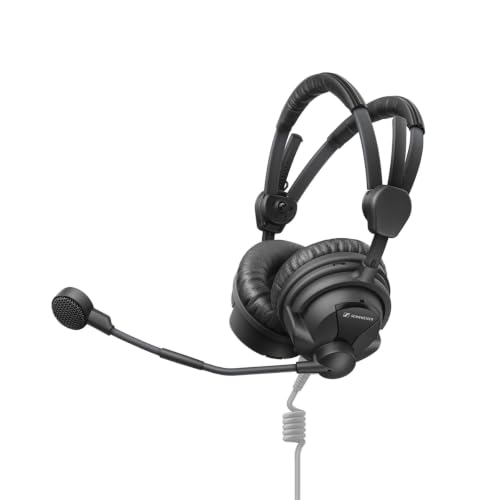
Sennheiser HMD 26 Broadcast Headset
The HMD 26 is the genuine studio article: a dual-ear, supra-aural, closed-back broadcast headset from Sennheiser, a house whose microphones have defined radio sound for generations. The title is terse because the product’s audience does not need it explained — broadcast engineers know the HMD pattern: earpieces that deliver the programme and talkback, a boom microphone that carries the presenter’s voice, a closed-back design that keeps the studio’s sound where it belongs. This is the headset of commentary positions, news booths and outside broadcasts, and its presence anchors the broadcast half of this roundup.
Each element of the short title carries weight. Dual-ear matters because a presenter monitoring a programme feed needs both ears on it, unlike the single-ear production world. Supra-aural — sitting on the ear rather than around it — keeps the headset compact and quick to don between items, the rhythm of a broadcast day. Closed-back construction limits spill both ways: the microphone hears less of the earpiece feed, and the studio hears less of the presenter’s monitoring. For a device whose entire purpose is the clean separation of one voice from everything else, that architecture is the specification.
The honest caveat is what the title leaves for the documentation: cable termination and microphone specifics are not stated here, and broadcast headsets are famously ordered in variants matched to the desk or commentary unit they serve. A studio purchase of an HMD-class headset is always a compatibility conversation with the existing infrastructure — which connector, which wiring, which impedance world — and this guide directs that conversation to Sennheiser’s documentation and the full listing, where it belongs, rather than guessing at variants.
Strengths
- A purpose-built broadcast headset from professional audio’s defining house.
- Dual-ear, closed-back design serves programme monitoring and spill control.
- Supra-aural format suits the don-and-doff rhythm of studio and commentary work.
Trade-offs
- Variant and termination details are not stated in the title — a documentation-led purchase.
- A professional instrument priced and specced for studios, not home recording corners.
- It serves broadcast infrastructure, not two-way radios or computers directly.
| Type | Broadcast headset |
|---|---|
| Earpieces | Dual-ear, supra-aural, closed-back |
| Microphone detail | The boom microphone’s pattern and the cable termination are not stated in the listing title; Sennheiser’s documentation specifies the variants |
| Intended setting | Studio and outside broadcast |
| Connection | Confirm the exact termination against your desk or commentary unit before ordering |
There is a reason broadcasters standardise on headsets like this and keep them for years: the presenter’s voice is the station’s signature, and consistency of microphone is consistency of signature. A station that voices its news, sport and continuity through one headset model sounds like itself on every shift and every outside broadcast. That institutional logic — boring, cumulative, decisive — is the HMD 26’s real market, and individual buyers stepping into commentary work inherit it when they choose the same tool the institutions use.
Outside broadcasts test this class of headset in ways a studio never does: wind at a pitch-side position, rain threatening a racetrack commentary point, a crowd’s roar arriving from every side at once. The closed-back, dual-ear architecture is the design’s answer — the presenter’s monitoring stays theirs, the programme stays intelligible, and the microphone’s job stays singular. Stations that work OBs heavily should still treat any broadcast headset as part of a weather system, with covers and spares planned, because the finest headset in this roundup is electronics worn outdoors and deserves the same respect as the camera beside it.
Best for: a studio, commentary position or outside broadcast unit standardising on a professional broadcast headset. Not suited for: a home podcaster seeking a USB plug-and-play device, or any two-way radio application. Broadcast buyers can open the HMD 26 listing and match its variant to their desk before committing.

Audio-Technica BPHS2C Broadcast Stereo Headset
The BPHS2C is Audio-Technica’s answer to the same broadcast brief, with its distinguishing fact stated in the title: a cardioid condenser boom microphone in a broadcast stereo headset. Where the category often defaults to dynamic capsules, a condenser brings sensitivity and detail — the texture of a commentator’s voice, the room’s edge kept at bay by the cardioid pattern’s directionality. Audio-Technica builds this headset for the broadcast stereo world: two ears on the programme, one carefully aimed capsule on the voice.
Cardioid is the pattern word to understand. A cardioid capsule favours sound arriving from its front — the wearer’s mouth, at boom’s end — and discounts sound from the sides and rear, which in a commentary box means the crowd, the co-commentator and the venue PA all sit lower in the mix than the voice they surround. For sports and event broadcasting, where the environment is the story but the voice must own it, that directional discipline is the product. Condenser sensitivity adds the second half: quiet asides and excited peaks both register with detail, given a desk that supplies the capsule’s power and an engineer who sets gain for the peaks.
The stereo earpiece side completes the commentator’s working picture. Broadcast feeds are produced in stereo — programme, effects, talkback panned and layered — and a stereo headset lets the presenter inhabit that feed as the audience hears it. Audio-Technica’s broadcast line serves exactly this professional niche, and the BPHS2C’s black, understated build suits the commentary box’s other requirement: the headset will be on camera, and it should look like equipment rather than costume.
Strengths
- Cardioid condenser boom captures vocal detail while discounting the surrounding venue.
- Broadcast stereo earpieces match the produced feed presenters must monitor.
- Purpose-built for commentary and on-air voice work by a professional audio house.
Trade-offs
- Condenser capsules need appropriate desk power and gain care — not a casual plug-in.
- Cable and termination details are not stated in the title; verify against your infrastructure.
- A specialist broadcast instrument, priced for the profession rather than the hobby.
| Type | Broadcast stereo headset |
|---|---|
| Microphone | Cardioid condenser boom microphone |
| Colour | Black |
| Termination | Not specified in the listing title; Audio-Technica’s documentation carries the connection details to match |
| Intended setting | Commentary and broadcast voice work |
Choosing between this and the Sennheiser above is the broadcast buyer’s real decision, and it turns on house infrastructure and microphone taste. Desks already voiced for condenser commentary, engineers who prefer the detail, presenters whose delivery lives in quiet registers — all lean BPHS2C. The honest method is the studio trial: both headsets on the actual desk, the actual presenter reading the actual script, judged on the recording rather than the reputation. Professional audio is full of these paired standards, and the correct answer is the one your chain already speaks.
Voice casting is the final, human layer of the choice. A condenser cardioid rewards a presenter with a controlled, close-miked technique — the sports commentator who rides the boom’s distance instinctively, the arts presenter whose quiet register is the programme’s signature. It is less forgiving of the presenter who turns away to watch a monitor mid-sentence, because directionality is a contract: stay in the capsule’s favour and it stays in yours. Engineers know their presenters; the BPHS2C is the headset for the ones whose technique can hold up its end of that contract, and it pays them back in presence every single broadcast.
Best for: a commentator or broadcast voice whose desk supports a condenser capsule and whose venue demands cardioid discipline. Not suited for: a two-way radio user, or a home recordist wanting USB simplicity. Commentary teams can look at the BPHS2C listing to confirm termination against their commentary units.

Retevis EHK012 Two Way Radio Headset (2 Pack)
The EHK012 is the fleet purchase of the field family: two two-way radio headsets with microphones, noise reduction and volume adjust, compatible with a named list of radios — Retevis RT22, RT21, RT68 and H777, Baofeng BF-888S, BF-F8HP and AR-5RM, and the Pxton PX-777S. That compatibility list is the review’s headline, because in this family the list is the product: a headset that fits the radios a team already owns is useful, and one that does not is a paperweight with ear cushions. The named models cover the most common budget fleet radios in event, warehouse, hospitality and volunteer service, which is precisely where two-packs sell.
Noise reduction and volume adjust are the working features. Radio headsets live in environments that swing — a quiet corridor, a loud loading bay — and a wearer-side volume control lets each team member govern their own ear without touching the radio’s settings mid-task. Noise reduction at the microphone keeps the team’s channel cleaner, which matters more than outsiders expect: on a shared channel, every headset’s background becomes everybody’s listening burden, and a fleet of noise-reducing headsets raises the whole network’s intelligibility.
The two-pack format reflects how these headsets are actually consumed: in multiples, by teams, with spares. Nobody equips a security shift with one headset. Retevis sells into that fleet reality across its radio range, and the EHK012’s value is its fit inside an existing Retevis-and-Baofeng world. The reciprocal warning is absolute: a team running radios outside the named families must verify connector compatibility on the full listing before ordering, because two-way radio plugs are a landscape of near-misses.
Strengths
- Named compatibility with the common Retevis, Baofeng and Pxton fleet radios.
- Noise reduction and per-wearer volume adjust serve shared-channel discipline.
- A two-pack matched to how teams actually buy and spare headsets.
Trade-offs
- Compatibility is bounded by the named models — other radios are a verify-first gamble.
- Fleet-grade adequacy is the design point, not broadcast or hi-fi performance.
- Two headsets serve a pair; larger teams must multiply packs and track spares.
| Quantity | 2 headsets |
|---|---|
| Named compatibility | Retevis RT22, RT21, RT68, H777; Baofeng BF-888S, BF-F8HP, AR-5RM; Pxton PX-777S |
| Features | Noise reduction, volume adjust |
| Type | Two-way radio headset with mic |
| Connector detail | Pin arrangement is defined by the named radio families; if your model is unlisted, confirm the plug on the full listing before ordering |
A fleet habit worth copying from professional users: label each headset to its radio, and store them as pairs. Radio headsets drift apart from their radios in shared kit rooms, and the morning of an event is the wrong time to discover that the box holds four headsets and three incompatible plugs. The EHK012’s two-pack discipline — matched units, bought together — is the beginning of that order, and teams that keep it will find their radio checks measured in seconds rather than expeditions.
Event-day arithmetic shows why the two-pack is sized as it is. A small event team — gate, stage, car park, control — runs four to eight radios, and headsets are bought to that count plus the day’s inevitable casualty: the dropped unit, the cable closed in a van door. Two-packs let a buyer reach the working count in round numbers and keep the float in the same model, which keeps every plug identical and every wearer’s controls familiar. Standardisation at this humble level is what separates a radio check that takes one minute from one that takes twenty, and on event morning that difference is the whole ballgame.
Best for: a team running the named Retevis or Baofeng radios that needs matched headsets with spares logic built in. Not suited for: a team whose radios fall outside the named list without verification, or a studio seeking a broadcast microphone. Team buyers can check the EHK012 listing against their exact radio models.

HELETUL Single-Sided Two Way Radio Headset
The HELETUL headset is the single-sided, big-earmuff entry in the field family: an over-ear, single-sided headphone with a boom microphone and push-to-talk earpiece, built for Baofeng, Retevis, Kenwood, Arcshell and other 2-pin radios, with a long model list — UV5R, BF-888S, H-777S, RT21, RT22, AR-6 among them — in its title. The 2-pin connector family it serves is the most widespread in budget and mid-range handheld radio, so this headset’s compatibility tent is broad, and its single-sided design answers the field worker’s standing need: one ear on the radio, one ear on the world.
Push-to-talk is the discipline this design serves. Unlike the Eartec’s open duplex conversation, two-way radio is a turn-taking medium: press, speak, release, listen. A PTT button integrated at the earpiece puts that discipline under the wearer’s hand without a dangling inline switch to hunt for, and the boom mic keeps the voice’s distance constant through the turn. For security, event and warehouse work — short messages, high clarity, hands returning to the task — that is the correct ergonomics, refined by decades of radio practice.
The big earmuff is the comfort and isolation statement. A generous single muff cushions a long shift and gives the radio’s audio a quieter pocket to live in, while the open side preserves the wearer’s awareness of vehicles, alarms and colleagues. The balance is role-dependent — a spotter who must hear the environment clearly may prefer a lighter earpiece — but for the radio-heavy roles, where the channel carries the shift’s instructions, the muff’s focus is the point.
Strengths
- Broad 2-pin compatibility across Baofeng, Retevis, Kenwood, Arcshell and named models.
- PTT earpiece design puts push-to-talk at the wearer’s hand with a boom mic.
- Big single earmuff cushions long shifts while the open ear keeps situational awareness.
Trade-offs
- Single-sided listening will not serve monitoring or music uses.
- 2-pin compatibility still demands a model check — near-matching plugs exist.
- A working tool’s finish and features, not a broadcast instrument.
| Type | Single-sided two-way radio headset, over-ear |
|---|---|
| Microphone | Boom mic with PTT earpiece |
| Compatibility | 2-pin radios: Baofeng, Retevis, Kenwood, Arcshell; UV5R, BF-888S, H-777S, RT21, RT22, AR-6 named |
| Wearing note | Big earmuff on the radio ear |
| Noise features | No electronic noise-cancellation claim appears in the listing title; judge it as a passive, fit-based design unless the full listing states otherwise |
The HELETUL and the Retevis pack above are cousins, and choosing between them is a fleet question: the Retevis two-pack standardises a team on matched units from the radio maker’s own accessory line, while the HELETUL’s broad 2-pin reach suits mixed fleets assembled over years from several brands. Mixed fleets are the norm in volunteer and event work, which is why a compatibility-led pick like this one earns its place — it meets the kit room as it is, not as a purchasing department wishes it were.
Long-shift comfort on a single-sided design has its own physics: all the muff’s pressure and all the band’s work happen on one side, so the fit check that matters is at hour four, not minute four. Wearers should set the band so the muff seals without clamping, and alternate the headset’s resting position during quiet periods rather than wearing it clamped through breaks. Supervisors issuing single-sided headsets across a team should expect a week of individual adjustment before the format settles — after which the open-ear awareness becomes the feature the team refuses to surrender, because a crew that can hear its environment works like a crew with its eyes up.
Best for: a field worker or mixed-fleet team on 2-pin radios needing PTT discipline and one open ear. Not suited for: a broadcaster, a duplex intercom user, or a radio outside the 2-pin families. Mixed-fleet buyers can view the HELETUL listing and match their radio model against its list.
Comparison Table
| Headset | Family | Connects to | Voice path | Defining fact |
|---|---|---|---|---|
| Rugged Radios H41 | Two-way field | Radios via 5-pin, audio via 3.5mm | Dynamic noise-canceling mic | 24dB NRR protection |
| Eartec UL2S | Production intercom | Its own second headset | Full-duplex conversation | DECT, stated 1000ft range |
| Sennheiser HMD 26 | Broadcast | Studio desk / commentary unit | Broadcast boom microphone | Dual-ear closed-back design |
| Audio-Technica BPHS2C | Broadcast | Studio desk / commentary unit | Cardioid condenser boom | Condenser detail, cardioid focus |
| Retevis EHK012 | Two-way field | Named Retevis/Baofeng/Pxton radios | Noise-reduction mic | Two-pack fleet purchase |
| HELETUL Single-Sided | Two-way field | 2-pin radio families | Boom mic, PTT earpiece | Big earmuff, one open ear |
Which Radio Do You Actually Mean?
Say the quiet part first: if your radio is a programme that listeners hear, you are in the broadcast half, and the choice narrows to the Sennheiser and the Audio-Technica, decided by your desk’s infrastructure and your engineer’s microphone taste. If your radio is a production conversation, the Eartec’s duplex intercom is the tool — or the field headsets, if your conversation must ride on handheld radios you already own. If your radio is a working channel for a team in noise, the field three divide by environment: the H41 where hearing protection is rated and required, the Retevis pack where a matched fleet is being equipped, the HELETUL where a mixed 2-pin fleet needs one broad answer.
Budget reasoning also splits by family, and conflating the two produces bad purchases in both directions. A broadcast headset is a capital instrument: it will voice a station for years, its cost amortises across thousands of programmes, and skimping on it taxes every one of them. A field headset is closer to a consumable with a long life: bought in multiples, exposed to weather and drops, replaced without ceremony. Spending broadcast money on field units bankrupts the fleet budget; spending field money on the broadcast position bankrupts the sound. The six picks sit at honest points on their own family’s scale, and the reviews judge them there — a field headset is not criticised for lacking a condenser’s sheen, nor a broadcast headset for lacking a protection rating.
Compatibility homework differs by family and neither half may skip it. Broadcast buyers verify termination and variant against the desk. Field buyers verify the plug against the radio model, in writing, from the title’s list or the full listing — never from a plug’s photograph, because this category’s connectors are a family of lookalikes. The five minutes of verification is the least expensive safeguard in professional audio, and the returns process is its expensive alternative.
The word radio reaches beyond this page’s two families, and neighbouring shelves cover its other lives: the pulpit’s wireless microphones live in Best Headsets for Pastors, the youngest listeners are served by Best Headsets for Children, and the desk-based meeting world that borrowed radio’s discipline is gathered in Best Zoom Headsets.
Channel Discipline: Sounding Professional on Any Radio
Equipment is half of radio; the other half is conduct, and it is learnable in an afternoon. On two-way channels: listen before transmitting, keep messages short and structured, say the recipient’s name first and your own last, and spell the critical words — addresses, numbers, names — rather than trusting a noisy channel with them. On an intercom, remember the channel is open: the duplex link that makes the Eartec so useful also broadcasts the unguarded aside, so crews adopt a running awareness that the mic is always live. On air, the discipline is the presenter’s: consistent distance from the boom, levels set for the loudest laugh, and the humility to let the engineer engineer.
There is a corollary for the broadcast side, where listening is literally the job: a presenter monitoring their own programme through a headset hears the broadcast as the audience’s reference point, and any colouration the earpieces add becomes part of how they pitch, pace and level their own voice. Engineers who voice a chain through a chosen headset are not indulging a preference; they are calibrating the feedback loop the presenter works inside, which is one more reason the broadcast picks in this guide are treated as instruments rather than accessories.
Listening is the under-taught half of the discipline. On a busy channel the skill is extraction — hearing your call sign inside cross-talk, catching the one changed word in a routine message, noticing the transmission that did not happen when it should have. Good headsets serve that skill directly: a clear, undistorted earpiece at a moderate level fatigues the listener less across a shift, and a fatigued listener misses the message that mattered. Supervisors evaluating headsets for a channel-heavy team should test comprehension, not just comfort — read a list of similar-sounding words over the actual radios in the actual noise, and let the headsets be judged by what the wearers correctly repeat back.
These habits are why identical equipment sounds professional in one organisation and chaotic in another. A team buying its first fleet headsets should budget the training hour alongside the hardware — a single session on message structure and PTT timing will improve the channel more than the next model up the range would. Radio, in both its families, rewards the disciplined far beyond the merely well-equipped.
Spares, Batteries and the Kit Room
Professional radio, in both families, is a logistics discipline wearing an audio costume. Broadcast headsets live in a world of spare cables, spare ear pads and a second headset on the shelf, because a commentary position cannot be cancelled for a failed boom. Field fleets live in a world of charged radios, labelled headsets and a float of replacements, because an event cannot pause for a plug. The organisations that sound effortless on air and on channel are the ones whose kit rooms are boring: everything labelled, everything paired, everything charged on a rota somebody owns by name.
Charging and power deserve their own line in the rota, because the two families fail differently. The Eartec headsets carry their radios in the earpieces themselves, so a flat headset is a silent crew member with no workaround at the venue; the field headsets are passive, but the radios beneath them live and die by their battery packs; the broadcast headsets ask nothing, being wired to the desk, which is one more reason studios forgive them their cables. A kit room that tracks which devices hold a charge, and charges them on schedule rather than on suspicion, has eliminated the single most common cause of radio failure in both families before it can happen.
Buyers scaling from one headset to a working system should copy that boredom deliberately. Purchase the spare at the same time as the primary, while the model and variant are certain. Keep a one-page compatibility card in the kit room — which headset serves which radio, which termination serves which desk — because memory is not a storage medium and staff change. And schedule the unglamorous inspections: ear pads, cable strain reliefs, connector pins, battery health. Radio equipment rarely fails dramatically; it degrades politely, in crackles and intermittencies, and the inspection rota is what catches politeness before it becomes a silence at the wrong moment.
Reading a Headset Title Like a Professional Buyer
The six titles in this roundup teach a transferable skill: how much truth a listing title can be made to carry. At one extreme, the Retevis title spends its words on a compatibility list — unglamorous, and worth more than any adjective on the page, because it lets a buyer verify fitment without leaving the search results. At the other extreme, the HMD 26’s title is a single line of architecture, adequate only because its audience holds the rest of the knowledge professionally. Between them, the H41’s title itemises protection, microphone and ports like a specification in miniature, while the Eartec’s compresses an entire system — duplex, technology, range, crew size — into one breath.
The buyer’s rule that follows is simple: reward titles that state checkable facts, and interrogate titles that spend their length on atmosphere. A checkable fact can be verified against your desk, your radio or your venue before money moves; an atmosphere word cannot be verified at all. Every judgement in this guide was built by applying that rule pick by pick, which is why some reviews lean confidently on their titles and others carefully route the reader to documentation. It is a rule worth keeping for the next purchase, in this category and every other where a title is the first specification a buyer meets.
The same rule disciplines the questions a buyer asks a seller. Instead of asking whether a headset is good — a question with no checkable answer — ask which radios its plug serves, which desk termination its cable carries, what its protection rating measures and what its stated range assumed about the terrain. Sellers answer factual questions factually, and the answers either match your infrastructure or they do not. A purchase made on verified matches almost never comes back; a purchase made on enthusiasm comes back with the return label already half-expected, and both families of radio deserve better arithmetic than that, every working day of the year, in every venue where the show, the shift, the race or the service depends on being understood the first time.
Common Mistakes
- Buying across the families. A broadcast headset will not serve a walkie-talkie fleet, and a radio earpiece will not carry a programme. Decide which radio you mean first.
- Trusting a plug’s photograph. Two-way radio connectors are lookalikes. Verify the model list in words before ordering.
- Treating intercom range as indoor truth. The Eartec’s stated figure is open-condition headroom; buildings spend it quickly.
- Ordering a broadcast headset without its variant homework. Termination and wiring must match the desk; the documentation, not the headline, governs.
- Skipping hearing protection arithmetic. In rated-noise environments the NRR is the product. Do not trade it away for a lighter headset.
- Running an open intercom like a private line. Duplex channels are always live; crews that forget it eventually broadcast the wrong sentence.
One last cross-family observation for the reader equipping a whole organisation: the same building often needs both families at once. The community station has presenters in broadcast headsets, a producer on a duplex intercom and a outside-broadcast crew on handheld radios with field headsets — three purchases, three budgets, one Saturday. Buying them as one undifferentiated “headset order” is how the wrong tools arrive in the wrong hands; buying them as three small, deliberate decisions, each with its own compatibility homework, is how a station ends up sounding like a station. This page’s two shortlists are designed to be used exactly that way.
Frequently Asked Questions
Can a broadcast headset be used for podcasting at home?
Only with the right chain behind it. Broadcast headsets are built for studio desks and commentary units, with terminations and capsule power requirements to match; a home USB interface may need adapters and gain care. Home recordists are usually better served by a USB headset or a dedicated microphone, and the broadcast picks here should be bought by readers who mean broadcast.
What does full duplex actually change for a production crew?
It removes turn-taking. Both parties can speak and hear at once, so warnings interrupt, confirmations land instantly and conversation flows at natural speed. For cue-driven work — cameras, rigging, live events — that simultaneity is the entire value, and it is why intercoms and push-to-talk radios are different tools rather than rivals.
How do I know if a radio headset fits my handheld radio?
Match the radio’s exact model against the headset’s stated compatibility list, as the Retevis and HELETUL titles provide. If your model is unlisted, treat compatibility as unproven and confirm the pin arrangement with the seller or documentation before ordering — visual similarity between plugs is not evidence.
Is the 24dB NRR on the H41 enough for a pit lane?
A 24dB rating is substantial hearing protection of the class used in loud industrial and motorsport settings, and it is the wearer’s employer’s safety assessment — considering exposure level and duration — that ultimately governs sufficiency. What can be said here is that the H41 is designed and rated for exactly those environments, unlike unrated headsets that merely cover the ears.
Why do broadcast headsets cost so much more than radio headsets?
Because they are different instruments bought on different logic. A broadcast headset is a microphone first — its capsule and build serve an audience of listeners, it is made in professional volumes, and it is expected to voice a station for years. A field radio headset is an accessory to a radio, bought in multiples and treated as hard-wearing kit. Comparing their prices directly is comparing a camera with a camera strap.
Can the Eartec system grow beyond two people later?
The UL2S as listed is a two-person system. Eartec’s wider family offers larger configurations, and buyers who suspect growth should confirm the expansion path on the full listing before the first purchase, because intercom architectures do not always scale by simply adding headsets.
Final Recommendation
Name your radio, then buy its headset. Broadcasters: the HMD 26 for the standard studio chain, the BPHS2C where a cardioid condenser suits the desk and the voice — and trial both on your own infrastructure if the budget allows the comparison. Production pairs: the UL2S, for the open duplex channel that makes two people work like four. Field teams: the H41 where noise is a rated hazard, the Retevis two-pack where a named fleet needs matched units, the HELETUL where a mixed 2-pin fleet needs one broad, comfortable answer. Verify the connector, train the channel discipline, and the voice — whether it is carrying a programme to a city or a warning across a pit lane — will arrive the first time, clearly, which is the only promise radio has ever really made — in the studio, on the channel and everywhere a voice has to matter the moment it is spoken, with no second take and no apology tour afterwards.
Related Guides
More voices, more guides: Best Headsets for Children for the youngest audience, Best Headsets for Pastors for wireless microphones in worship, and Best Zoom Headsets for the meeting-room descendants of radio discipline.


