What's inside
- Key Takeaways
- Quick Picks
- How These Picks Were Chosen
- The Six Headsets in Detail
- Comparison Table
- How Loud Is Too Loud? A Parent’s Working Guide
- Fit, Sharing and the Sibling Economy
- Building Listening Habits That Outlast the Headphones
- Common Mistakes
- Frequently Asked Questions
- Final Recommendation
- Related Guides
As an Amazon Associate I earn from qualifying purchases. This post may contain affiliate links at no extra cost to you.
widgetverdict.com is reader-supported. When you buy through links on our site, we may earn an affiliate commission.
Where to buy: the safest wired starting point for most families is the iClever HS19 Kids Headphones with Cord, an over-ear 3.5mm headset with a microphone and foldable design — the other five picks below divide between wired and wireless, with the volume-limit details stated pick by pick.
The best headsets for children are governed by one duty that adult audio never carries: protecting hearing that has to last a lifetime. Children’s ears are not small adult ears, their listening is often unsupervised, and the volume that an adult would find merely loud can, repeated daily across a childhood, do quiet cumulative harm. That is why this category exists as its own shelf rather than as a size option on adult headsets: volume limiting is its founding idea, joined by fit for smaller heads, durability against a child’s honest roughness, and designs a child will actually agree to wear. Every pick here is a children’s product from a maker who builds for children — not a shrunken afterthought — and the reviews treat the volume question first wherever a title lets us.
Reading those titles carefully matters, because the category’s language varies in precision. One pick states its limit as a number — the Belkin SoundForm Mini’s 85dB volume limit, printed in its title. Others claim volume limiting or a named safe-sound technology without a figure in the title: JBL’s Junior 320 is described as volume-limited, EarFun’s K1 and LilGadgets’ Connect+ Pro claim volume limiting in words, and iClever’s two picks carry its SafeSound Tech branding. This guide reports each claim at the strength its title gives it — number where a number is stated, words where only words are stated — and never upgrades a word into a number on a parent’s behalf. Where a limit matters to your decision, the figure to trust is the one the maker prints, and we point to it exactly.
The second sorting fact is the cable. Four picks are wired on 3.5mm, which cannot run flat, cannot be left behind as easily as an earbud, and plugs into the school and travel devices children actually use. Two are wireless with wired fallback — the iClever BTH12 with an AUX cable and a stated 85 hours of playtime, the Belkin with a 3.5mm AUX option alongside its wireless mode — which suits older children whose listening has outgrown the cord’s radius. The reviews keep the two groups’ trade-offs explicit, because the right answer for a four-year-old on a tablet and a ten-year-old on a school laptop are different answers wearing similar colours.
Key Takeaways
- Volume limiting is this category’s founding duty; only the Belkin states its limit as a figure — 85dB — in its title.
- Other picks claim volume limiting or SafeSound technology in words; this guide reports each claim at its stated strength.
- Four picks are wired 3.5mm designs for school and travel devices; two are wireless with a wired fallback cable.
- SharePort designs from EarFun and LilGadgets let two children listen from one device without a splitter.
- Foldable designs dominate because children’s headphones live in bags, not on stands.
- Built-in microphones serve classes and calls, not just listening — every pick here carries one.
Quick Picks
| Pick | Badge | Why it earns its place |
|---|---|---|
| iClever HS19 Kids Headphones with Cord | The wired all-rounder | Over-ear wired headphones with SafeSound Tech, an HD mic, stereo sound and a foldable 3.5mm design for iPad, computer and travel. |
| JBL Junior 320 Kids Headphones | The big-brand school pick | Wired, volume-limited JBL headphones in purple with a built-in mic, foldable design, 3.5mm jack and customisable stickers. |
| EarFun K1 Kids Headphones Wired with Mic | The sharing specialist | Volume-limit wired headphones with a SharePort for a second listener, stereo sound and a foldable build for school and tablet use. |
| iClever BTH12 Kids Bluetooth Headphones | The long-playtime wireless | Bluetooth over-ear headphones with a stated 85 hours of playtime, LED lights, SafeSound Tech, USB-C charging and an AUX cable fallback. |
| Belkin SoundForm Mini Kids Headphones | The stated-number limiter | Wireless and wired headphones with a stated 85dB volume limit, 30 hours of playtime, built-in mic, USB-C and 3.5mm AUX. |
| LilGadgets Connect+ Pro Kids Headphones | The classroom veteran | Wired volume-limiting over-ear headphones with a microphone, SharePort technology and SoftTouch padding, built for school. |
How These Picks Were Chosen
The filter was childhood itself: a product qualified only if it was designed for children — sized for smaller heads, built for school and travel abuse, and carrying a microphone, since the modern child’s headphone serves class calls and family video chats as much as music. Adult headsets in bright colours were excluded, as were novelty designs whose titles promise character licensing instead of audio engineering. Within the filter, we weighed the evidence titles can honestly carry: the volume claim and its precision, the connection and its fallbacks, sharing features, foldability, and the devices each title names — iPads, Kindles, school laptops and classroom fleets all appear, and each names a different child’s actual day.
The volume-claim discipline described in the introduction was applied as a hard editorial rule during selection, not just in the writing. Products whose marketing implies protection without any limiting claim in the title did not make this list, and no pick’s claim is paraphrased into a stronger one anywhere in this guide. Parents deserve the maker’s own words at the maker’s own strength, because the difference between a stated 85dB limit and an unquantified safe-sound badge is a real difference in what has been promised — even though both may describe responsible products.
Age labelling was read sceptically throughout. Several titles in this category reach for the word toddler, and a headset genuinely suited to a two-year-old — in fit, in weight, in the simplicity of its demands — is a narrower thing than a headset a seven-year-old thrives in. Where a title claims the youngest ages, the review notes the claim and assigns the real test to the first supervised fittings, because no title can measure a particular small head. Parents of the very youngest listeners should buy with returns in mind and treat fit, not features, as the deciding examination.
We also kept the household’s second child in view. Sharing features, wired indestructibility and hand-me-down durability recur across these picks because children’s headphones are rarely bought into a vacuum: they are bought into sibling economies, classroom sets and car-seat logistics. The reviews judge each pick partly as an object in that economy, which is why a sticker sheet and a SharePort earn analytical attention here that they would never receive in an adult roundup.
The Six Headsets in Detail
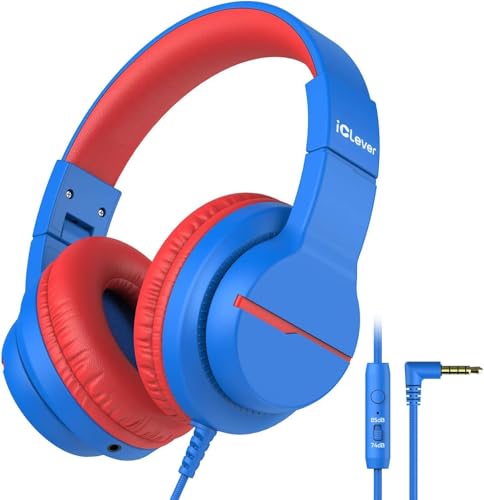
iClever HS19 Kids Headphones with Cord
The HS19 is iClever’s wired cornerstone: over-ear kids’ headphones with a cord, carrying the brand’s SafeSound Tech, an HD microphone, stereo sound and a foldable design on a 3.5mm connection, positioned for iPad, computer and travel. iClever builds children’s audio as its main business rather than a sideline, and the HS19 reads like the reference design for the category — every feature a parent lists on the way to the shop is present, in a wired format that asks nothing of batteries or Bluetooth menus. For a first headset for a school-age child, this is the shape of the safe default.
SafeSound Tech is iClever’s name for its volume-protection approach, and the honest treatment is to report it as the brand presents it: a technology claim in the title, without a decibel figure stated there. Parents comparing across this page should register the difference between that and Belkin’s printed 85dB — not as a verdict on either product, but as a difference in what has been specified. A parent who wants the number should buy the number; a parent content with a specialist maker’s branded system, in a wired headset whose volume a supervising adult can also govern at the device, has a coherent choice here.
The HD microphone and foldable over-ear build complete the school-day picture. The mic serves the class call and the grandparent video chat with a clarity claim the brand is willing to print; the fold serves the backpack, the car door pocket and the classroom bin. Over-ear cups on a child’s head also carry a supervision benefit parents underrate: a child wearing visible, full-size headphones is a child whose listening state the room can see, unlike an earbud disappearing into an ear under hair.
Strengths
- A specialist children’s maker’s reference design: wired, foldable, over-ear, with an HD mic.
- SafeSound Tech volume protection from a brand built entirely around children’s audio.
- 3.5mm connection serves iPads, computers and travel devices without adapters or charging.
Trade-offs
- No decibel figure for the volume protection is stated in the listing title.
- Wired only — no wireless mode for the older child’s wider roaming.
- A cord is a tangle and snag management task for the youngest wearers.
| Connection | 3.5mm wired |
|---|---|
| Design | Over-ear, foldable |
| Volume approach | SafeSound Tech (brand’s named technology; no dB figure in the title) |
| Microphone | HD mic |
| Named devices | iPad, computer, travel use |
Durability expectations should be set by the wired reality the HS19 shares with its wired siblings: the cable and its two ends are the wear points, and a child taught to unplug by the plug rather than the cord, and to fold the headset rather than stuff it, will get years from the design. iClever’s specialisation shows in the category’s small mercies — a headset bought for a six-year-old should still fit, work and be wanted at eight, and the HS19’s adjustability and inoffensive design are aimed at exactly that span.
One more parental consideration favours the wired default at this age: repairability of routine. When a wired headset falls silent, the fault tree has three branches — the plug, the device’s socket, the cable — and a parent can walk it in a minute at the kitchen table. When a wireless headset falls silent the tree grows pairing, battery, software and range branches, several of which require the child to wait while an adult investigates. For a first headset, whose job includes teaching the child that technology is manageable, the short fault tree is a curriculum in itself.
Best for: a school-age child’s first headset, for tablet, computer and class use in a wired, charge-free format. Not suited for: a parent who requires a printed decibel limit as the purchase condition, where the Belkin below states its number openly. Families can check the HS19 listing for its full specification and colour range.

JBL Junior 320 Kids Headphones
The Junior 320 brings a famous audio name into the nursery: JBL’s wired kids’ headphones, described as volume-limited, finished in purple, with a built-in microphone, a foldable design, a 3.5mm jack, a comfortable fit and customisable stickers, designed for school and travel. JBL’s presence matters for a specific kind of buyer — the parent who trusts an established audio house’s tuning and wants the child’s first headphones to sound genuinely good within their limit, rather than merely safe. The Junior line is that house’s dedicated children’s range, and the 320 is its current wired expression.
The volume-limited description is stated in words in the title, and — following this guide’s rule — we report it in words. JBL’s children’s line is built around limited output as a design premise, and the parent who wants the precise figure should find it in the full listing’s specifications, where JBL publishes its numbers, rather than in a paraphrase here. What the title does establish is intent and architecture: this is a limited design from a major maker, not an adult headphone with the volume left to chance and a cartoon on the box.
The stickers are not a triviality, and treating them as one misunderstands the category. A child’s willingness to wear hearing protection is the protection’s first component — the finest limiter in the world guards nothing on a headset left in the drawer — and customisation is how a mass-produced object becomes a particular child’s possession. JBL, to its credit, designs for that psychology openly. The foldable build and school-and-travel positioning complete a pick aimed at the real logistics of childhood rather than an idealised version of them.
Strengths
- A major audio house’s dedicated children’s design, volume-limited and school-ready.
- Built-in mic and foldable 3.5mm build serve classes, calls and travel.
- Customisable stickers make the headset the child’s own — a genuine compliance feature.
Trade-offs
- The volume limit is described in words in the title, without a printed figure there.
- Purple will not be every child’s choice; check the listing for other finishes.
- Wired only, with the cord management that implies for younger children.
| Connection | 3.5mm wired |
|---|---|
| Design | Foldable, comfortable fit, purple |
| Volume approach | Volume-limited (described in the title; figure in the full listing’s specifications) |
| Microphone | Built-in mic |
| Extras | Customisable stickers included in the concept |
Sound quality deserves one fair paragraph in a children’s guide, because parents sometimes assume safety and quality trade against each other. A volume limit caps loudness; it does not cap clarity, balance or the simple pleasure of a favourite song sounding like itself. A house with JBL’s tuning heritage designing inside a limit is precisely the combination that gives a child both — and a child who enjoys the sound asks for the headphones, which closes the compliance loop the stickers began.
The school-and-travel positioning also implies a set of small survivals worth naming: the headset will be sat on in a car seat, dropped on a platform, worn in rain between a station and a school gate. A foldable design from a major maker is engineered against that statistical life rather than a display shelf, and the comfortable-fit claim in the title is part of the same realism — a child crossing a city twice a day wears the headset longer than a child crossing a hallway, and the Junior 320 is dressed for the longer wear.
Best for: a school-age child whose family values a major maker’s tuning and a volume-limited design for school and travel. Not suited for: a purchase that requires the limit’s figure printed in the title itself, or a child who has outgrown wired listening. Parents can view the Junior 320 listing to read its published volume specification.

EarFun K1 Kids Headphones Wired with Mic
The K1 is the diplomat of this roundup: wired kids’ headphones with a microphone and a stated volume limit, stereo sound, a foldable build — and a SharePort, the small socket that lets a second pair of headphones plug into the first, so two children can listen to one tablet together. EarFun positions it across school, toddler, tablet, iPad and Kindle use, in a black and red finish. The SharePort is the headline because it solves a real and constant problem of family life — one device, two children, a long journey — without a splitter, a second screen or an argument.
Sharing changes the social physics of children’s audio. The paired film on a train, the audiobook two siblings follow together, the language app a parent hears alongside the child — all of these are listening as a shared activity rather than a solitary seal, and parents who worry, rightly, about headphones as isolation devices should note which picks are built to be shared. The K1’s volume limit applies its protection to that shared listening as well, and its foldable wired design keeps the whole arrangement free of charging and pairing ceremonies that shared devices make miserable.
The toddler mention in its positioning deserves a careful reading: EarFun names toddler use among its contexts, and the volume limit supports that, but fit is the governing question at the youngest ages — a headset must sit securely and lightly on a very small head, and parents of toddlers should treat the first supervised fittings as the real specification test. For the school-age child who is this guide’s centre of gravity, the K1’s combination of limit, sharing and stereo wired simplicity is one of the most complete on the page.
Strengths
- SharePort lets a second child listen from the same device — no splitter, no second screen.
- Volume limit stated in the title, with stereo sound and a microphone for classes.
- Foldable wired design suits school, tablet and travel without batteries.
Trade-offs
- The limit’s decibel figure is not printed in the title; the full listing carries the number.
- Sharing means the second child’s headphones draw on the same volume setting.
- Black-red finish is a single stated colourway in the title.
| Connection | Wired, with SharePort for a second listener |
|---|---|
| Volume approach | Volume limit (figure in the full listing) |
| Design | Foldable headset, stereo sound |
| Microphone | Built-in mic |
| Named uses | School, toddler, tablet, iPad, Kindle |
The Kindle mention is a small sign of honest positioning: children’s listening is heavily book-shaped — stories, read-alongs, library apps — and a headset named for reading devices understands its audience’s day better than one marketed only for video. EarFun’s K1, in other words, is designed for the quiet hours as much as the loud ones, and its wired patience — no battery to die at chapter nine — suits the audiobook’s long, calm arc.
There is a classroom version of the sharing story that teachers will recognise: paired reading and paired listening are standard practice in primary education, and they usually depend on a splitter that lives in a drawer nobody can find. A headset with the sharing socket built in removes the drawer from the pedagogy. Two students, one tablet, one story — the arrangement just works, at a volume the limit governs for both. Schools buying classroom sets should weigh that built-in pairing heavily; it converts a two-pupil activity from a logistics exercise into a default.
Best for: siblings who share devices and journeys, and a child whose listening mixes school, stories and tablet time. Not suited for: a parent who wants the volume figure stated in the title, or a child ready for wireless freedom. Sharing households can look at the K1 listing for its full volume specification.
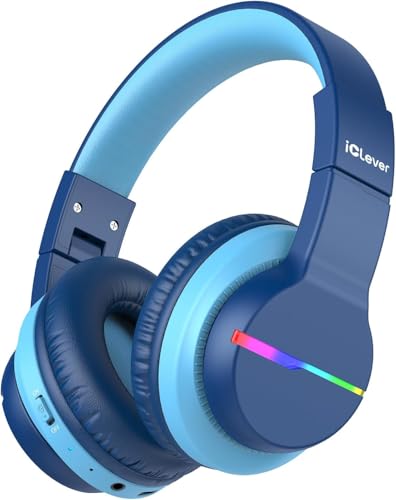
iClever BTH12 Kids Bluetooth Headphones
The BTH12 is the wireless step-up in iClever’s children’s line: Bluetooth over-ear headphones with a stated 85 hours of playtime, LED lights, SafeSound Tech, USB-C charging, an included AUX cable and a built-in microphone. The playtime figure is the headline a parent feels first — eighty-five hours is not a week of listening, it is most of a school term, and it converts the wireless headset’s standing weakness, the flat battery at the wrong moment, into a rare and schedulable event. The AUX cable is the second half of the same insurance: when the battery or the Bluetooth fails the moment, the cable restores the headset to wired duty instantly.
SafeSound Tech appears here as in the HS19 — iClever’s named volume-protection system, reported at the strength the title gives it. On a wireless headset the protection question carries an extra wrinkle parents should understand: the limiting must hold across both the wireless and wired paths, and a specialist children’s maker designing both paths is the reassurance available from the title. The LED lights, meanwhile, are the BTH12’s sticker-equivalent — the delight feature that makes the headset wanted — and on a wireless model they carry a small battery cost the enormous playtime absorbs without argument.
Wireless freedom suits the older child whose world has widened: moving around the house with an audiobook, practising an instrument along to a track, taking a call from a tablet in another room. It suits travel differently too — no cord to catch on armrests — though aeroplane entertainment systems still speak 3.5mm, which is where the AUX cable earns its place in the case. The BTH12, read whole, is a headset designed for the transition years between the wired toddler shelf and the teenager’s own devices.
Strengths
- A stated 85 hours of playtime makes charging a rare, schedulable event.
- Wireless freedom with an AUX cable fallback for flat batteries and seatback screens.
- SafeSound Tech, USB-C charging and a built-in mic from a children’s specialist.
Trade-offs
- No decibel figure for the volume protection is stated in the title.
- LED lights will not suit every school’s classroom rules.
- Wireless means a battery that ages and a pairing step younger children cannot manage alone.
| Connection | Bluetooth wireless, AUX cable included |
|---|---|
| Playtime | 85 hours stated |
| Charging | USB-C |
| Volume approach | SafeSound Tech (named technology; no dB figure in the title) |
| Extras | LED lights, built-in mic, over-ear design |
Parents should plan the wireless transition as a small ceremony rather than a purchase: the child learns the charging cable’s home, the pairing routine on the family’s tablet, and the rule that the AUX cable lives in the case. A child who can run those three routines owns a genuinely more capable tool; a child handed wireless freedom without them owns a headset that is flat, unpaired or lost at the exact moment of the school call. The BTH12’s huge playtime forgives a great deal of routine-learning, which is part of its design intelligence.
Travelling families should note how the BTH12’s numbers interact: a stated 85 hours means the headset can cross an ocean, survive the holiday and fly home on its original charge, which removes the charging cable from the packing list’s critical section and the flat-battery negotiation from the departure lounge. The lights that delight at home can be a consideration in a darkened cabin, and parents should discover the light behaviour at home rather than at altitude — a small rehearsal that, like all the rituals in this guide, converts a potential friction into a known quantity before it matters.
Best for: an older child ready for wireless listening across home and travel, whose family wants a specialist’s volume system and a wired fallback. Not suited for: a young child’s first headset, where the wired HS19’s simplicity governs better. Transition-age families can examine the BTH12 listing for colours and full details.
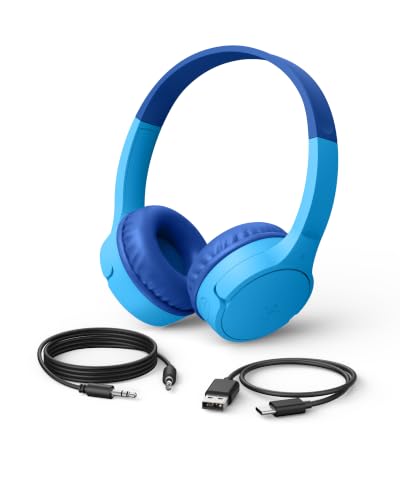
Belkin SoundForm Mini Kids Headphones
The SoundForm Mini is the pick for the parent who reads specifications: wireless and wired kids’ headphones with a stated 85dB volume limit printed in the title, 30 hours of playtime, a built-in microphone, USB-C charging and a 3.5mm AUX connection, positioned for school, classroom, travel, laptop and tablet. Belkin is an accessories house of long standing, and this title is written the way its audience likes — the protective figure first, in numbers, with the dual-mode connection and the school contexts all stated. In a category of branded assurances, the printed number is a form of respect for the buyer.
The 85dB figure deserves context a parent can use. Eighty-five decibels is the ceiling most commonly adopted for children’s listening products, chosen because sustained listening at or below it is the level hearing guidance treats as safe for extended periods. Belkin stating it in the title means the limit can be compared, filed and relied on in a way word-only claims cannot — a school writing a device policy, for instance, can cite the figure. The trade is playtime: 30 hours is ample for a school week and a holiday journey, but it is a third of the iClever’s stated figure, so the charging habit must be a weekly rhythm rather than a termly one.
Dual-mode operation is the Mini’s second strength. Wireless for the home and the walk to school, wired for the classroom device that has no Bluetooth, the aeroplane seatback and the flat-battery afternoon — the headset declines to choose between the two childhoods its wearer lives. Belkin’s school and classroom positioning, alongside laptop and tablet, shows the same dual citizenship. For a child whose day crosses institutional and personal devices, that flexibility is not a feature list; it is the difference between one headset and two.
Strengths
- The volume limit is stated as a figure — 85dB — in the title itself.
- Wireless and wired modes cover home, classroom, travel and seatback screens.
- 30 hours of playtime, USB-C charging and a built-in mic for classes and calls.
Trade-offs
- Thirty hours is generous but far below the BTH12’s stated playtime — charging is a weekly habit.
- A plainer design without the lights or stickers younger children are courted with elsewhere.
- Wireless pairing remains an adult-assisted step for younger wearers.
| Connection | Wireless and wired (3.5mm AUX) |
|---|---|
| Volume limit | 85dB, stated in the title |
| Playtime | 30 hours stated |
| Charging | USB-C |
| Named uses | School, classroom, travel, laptop, tablet |
The classroom positioning is worth a school buyer’s attention. A headset that works wired on the school’s devices and wireless on the child’s own, with a citable volume limit, fits both the institution’s policy document and the family’s shelf — a rare overlap. Schools standardising personal-device programmes and parents equipping one child are, for once, shopping for the same object, and the SoundForm Mini is the pick on this page most plainly designed to be that object.
There is a policy trend quietly favouring this pick: schools and districts increasingly write device standards for the personal equipment children bring — acceptable connections, charging standards, volume limits — and a product whose title already speaks that language slots into such documents without a translation exercise. Parents buying ahead of a school transition may find the SoundForm Mini is the headset the school’s own guidance describes, which settles arguments before they start and makes the child’s equipment unremarkable in the best institutional sense.
Best for: a parent or school that wants the volume limit as a printed figure and a headset that serves wired classrooms and wireless homes alike. Not suited for: a family wanting the longest possible playtime between charges, where the BTH12’s stated figure leads. Specification-first buyers can check the SoundForm Mini listing for fit and colour details.

LilGadgets Connect+ Pro Kids Headphones
The Connect+ Pro is the classroom veteran: wired, volume-limiting over-ear headphones with a microphone, SharePort technology and SoftTouch padding, built by LilGadgets for school use. LilGadgets is another children’s specialist, and the Connect+ line has been a fixture of school and family buying for years — the kind of product whose longevity in the catalogue is itself evidence, since children’s products that fail in the field do not get reordered by schools. The Pro designation and the padding claim speak to its positioning: the comfortable, shareable, wired standard for a child’s school day.
SharePort appears here as it did on the EarFun K1, and the repetition is instructive: daisy-chaining a second listener from one device is a feature the children’s category has converged on because classrooms and siblings demand it. A teacher pairing two students on one tablet, a parent sharing an audiobook on a flight — the port serves both without a splitter’s extra cost and tangle. SoftTouch padding addresses the other classroom constant, duration: reading periods and testing sessions run long, and a child’s tolerance for a headset is set by its padding more than its electronics.
The volume-limiting claim is stated in words in the title — LilGadgets’ line is built on the premise — and this guide reports it in words, directing figure-seekers to the maker’s published specifications. What the title establishes beyond argument is the design’s centre of gravity: wired reliability, sharing, comfort and school intent, from a specialist, in a product line with years of classroom service behind it. For many families that accumulation of fit-for-purpose is worth more than any single specification on this page.
Strengths
- A specialist’s school-proven design with volume limiting as its premise.
- SharePort technology for paired listening in class and travel.
- SoftTouch padding and over-ear build for long reading and testing sessions.
Trade-offs
- The limit’s figure is not printed in the title; the maker’s specifications carry it.
- Wired only — no wireless mode as the child grows.
- A utilitarian school aesthetic beside the lights and stickers of rivals.
| Connection | Wired, with SharePort |
|---|---|
| Volume approach | Volume limiting (figure in the maker’s published specifications) |
| Design | Over-ear, SoftTouch padding |
| Microphone | Headset microphone included |
| Named use | School |
The hand-me-down test is where veterans like this one quietly win. A Connect+ Pro bought for a seven-year-old’s school bag is, three years later, the younger sibling’s first headset — the padding worn companionable, the cable proven, the fit still adjustable across the family’s head sizes. Children’s products are rarely granted that second life, because most are styled too precisely for one age or built too lightly for two childhoods. A design that survives the sibling transfer has halved its cost per child without a single coupon, which is the kind of arithmetic parents actually run.
Teachers’ cupboards tell this product’s story better than any review can: the Connect+ design is the one that appears in classrooms in multiples, labelled with room numbers, surviving cohort after cohort. That installed base creates its own support economy — every teacher knows its fit, every school office knows its reorder path — and a family buying the same model borrows that institutional knowledge for free. In a category full of launches, there is a particular confidence in buying the headset that a thousand classrooms have already stress-tested on your behalf.
Best for: a school-age child needing a comfortable, shareable, wired headset for school days and paired listening. Not suited for: a child ready to leave wires behind, or a buyer who needs the limit’s figure in the title. School-first families can review the Connect+ Pro listing for its published specifications and colours.
Comparison Table
| Headphones | Connection | Volume claim as titled | Sharing | Signature extra |
|---|---|---|---|---|
| iClever HS19 | 3.5mm wired | SafeSound Tech | Not stated | HD mic, foldable |
| JBL Junior 320 | 3.5mm wired | Volume-limited | Not stated | Customisable stickers |
| EarFun K1 | Wired | Volume limit | SharePort | Stereo, foldable |
| iClever BTH12 | Bluetooth + AUX | SafeSound Tech | Not stated | 85H playtime, LED lights |
| Belkin SoundForm Mini | Wireless + 3.5mm AUX | 85dB limit, stated figure | Not stated | 30H playtime, dual mode |
| LilGadgets Connect+ Pro | Wired | Volume limiting | SharePort | SoftTouch padding |
How Loud Is Too Loud? A Parent’s Working Guide
Start with the principle rather than a number: children’s listening should be limited at the device or the headset, because a child’s own volume judgement is not a safety system. The picks divide by how that limiting is evidenced. The Belkin states 85dB in its title — the figure most often cited in children’s audio guidance — and is the natural choice when a number is required for peace of mind or a school policy. The other five claim limiting or a named safe-sound technology in words; those claims come from specialist makers whose product lines are built on the premise, and the full listings carry their published figures for the parent who wants to verify before buying. What no parent should do is buy an ordinary adult headset and rely on reminding a child to keep it down — the reminder loses to the chorus every time.
Context volume is the trap that catches careful families. A headset’s limit is set against a quiet room, but children listen in cars, trains and cafés, where the environment invites the level up to cover the noise — and a limited headset in a loud place tempts its wearer to press it tighter, lean in and strain, while the un-limited adult headset beside it simply gets louder. The correct responses are environmental: save the listening for the quieter legs of the journey, use the travel time for the shared and spoken entertainments too, and never treat a volume limit as a licence for unlimited hours in loud places. The limit governs the ceiling; the family still governs the day.
Duration is the second half of hearing care, and it belongs to household routine rather than hardware. Even at limited volumes, listening should come in sessions with breaks, and a child who must shout to be heard over their own headphones — or who cannot hear a parent at normal speaking distance — is listening too loud or through a poor fit, whatever the specification says. Teach the simple test: if the room can hear the music clearly from the earpieces at arm’s length, the level deserves a check. Hardware limits, session habits and that one observable test together form a complete system; any one of them alone is a hope.
The rest of the family’s audio shelf obeys different rules, and the neighbouring guides keep them separate: the pulpit’s professional microphones live in Best Headsets for Pastors, the desk worker’s single-ear tools in Best Mono Wired Headsets, and the play-focused branch of this very category in Best Gaming Headsets For Children.
Fit, Sharing and the Sibling Economy
Travel compresses every one of these questions into a single journey, which is why travel keeps appearing in the titles. The travel headset must fold into a bag already full of the child’s other necessities, survive the seat pocket and the dropped-under-the-seat retrieval, work with the seatback screen and the family tablet alike, and hold its volume discipline in the noisiest listening environment of a child’s year. Parents equipping for a long journey should rehearse the full kit at home — headset, cable, device, a downloaded film — because the departure lounge is the worst classroom in the world for a first fitting.
Fit is the silent specification of children’s audio. A headset sized for an adult slips on a child, and a slipping headset gets its volume raised to compensate for the leak — quietly defeating the limit the parent bought it for. Every pick here is child-sized by design, but parents should still run the fitting ritual: headband adjusted so the cups sit centred and sealed without clamping, the child able to shake their head gently without the headset migrating, and a conversation test at normal volume to confirm the child can hear the room’s important sounds — a parent’s voice, a smoke alarm’s chirp — at the level the household expects. That last point is a safety feature no title can print.
Hygiene belongs in the fit conversation for any headset that will be shared, loaned or inherited. Ear cushions should be wiped between children as a matter of routine, and a headset that has served a child through an ear infection should be cleaned properly before it descends to a sibling. The wired designs here, with their wipeable surfaces and absence of electronics in the cups, tolerate that regime gracefully. Schools running shared sets institutionalise the same wiping between users; families can copy the institution with a cloth kept where the headsets live.
Sharing, finally, is an economy as much as a feature. SharePort models let one device serve two children today; durable wired models let one purchase serve two children across years; and the wireless models serve the eldest child’s independence while the wired ones descend the sibling line. A family that buys with that cascade in mind — wireless for the eldest, wired veterans flowing downward, one SharePort set for the shared tablet — spends less across a childhood than a family buying reactively, and owns fewer, better-loved objects. The six picks map onto that cascade almost in age order, which is the market’s quiet summary of how children actually grow through audio.
Building Listening Habits That Outlast the Headphones
The headset a child wears at seven is temporary; the habits formed inside it are not. Families should treat the first headset as a teaching instrument for a lifetime of listening: volume set by the hardware’s limit rather than by appetite, sessions broken by natural pauses, the room kept audible at the levels the household agrees, and the equipment cared for as a possession rather than consumed as a disposable. A child who learns those four habits on a volume-limited headset carries them into the earbud years, the gaming years and the workplace years, when no parent and no product will be limiting anything on their behalf.
None of this requires the household to become solemn about a pair of headphones. The point of the rituals is the opposite: a few minutes of structure at the start purchases years of unthinking ease afterwards, in which the headset is simply there, charged or corded, fitted and trusted, and the family’s attention is free for the stories, lessons and songs the whole apparatus exists to deliver.
Schools can borrow the same staircase. A classroom that issues wired, limited headsets in the early years and permits personal wireless devices later is teaching the identical progression at institutional scale, and the consistency between home and school expectations is what turns a rule into a norm a child stops testing. Parents choosing from this page for a school-age child are therefore not merely buying audio equipment; they are casting a vote for the listening culture their child will consider normal, and the six designs here all vote the same way.
Practical rituals make the habits stick. Keep the headset in one home — a hook, a case, a named drawer — so its care is a routine rather than a search. Let the child do the plugging, folding and packing from the first week, at whatever speed small hands manage, because ownership practised is ownership felt. And mark the upgrades as the milestones they are: the move from wired to wireless, earned by demonstrated care of the wired set, teaches more about technology’s terms than any lecture. The six picks in this guide are, among their other virtues, six well-sized steps on that staircase.
Common Mistakes
- Buying adult headphones and policing the volume by reminder. Limiting must live in the hardware; a child’s enthusiasm will defeat a household rule daily.
- Treating every volume claim as identical. A stated 85dB figure and a branded safe-sound claim are different strengths of promise. Read each at its own strength.
- Ignoring fit as a safety feature. A loose, leaking fit invites the volume up. Child-sized design and a proper fitting ritual protect the limit’s work.
- Giving a young child a wireless headset first. Pairing, charging and loss are adult logistics; the wired picks exist because the youngest listeners need none of them.
- Forgetting the aeroplane. Seatback entertainment speaks 3.5mm. A wireless pick without its AUX cable packed is a silent flight.
- Skipping the room-awareness test. A child should still hear a parent’s normal voice and the home’s alarms; check it at home before the headset becomes routine.
Grandparents and gift-buyers deserve a closing word in this section, because children’s headphones are a classic relative’s purchase and a classic source of well-meant error. The rules for the gift-buyer are the guide in miniature: buy from the children’s shelf rather than the adult one, prefer wired for the under-eights, match the household’s devices before matching the child’s favourite colour, and include the receipt without embarrassment. A volume-limited headset given with its paperwork intact is a genuinely protective gift; a powerful adult headset given for its impressive box is a problem the parents must then manage daily, wrapped in gratitude they have to perform.
Frequently Asked Questions
What volume limit should I look for in children’s headphones?
The figure most commonly adopted for children’s products is 85dB, and it is the limit one pick here — the Belkin SoundForm Mini — states in its title. Other picks claim volume limiting or a named safe-sound technology in words, with figures in their full listings. Buy the evidence standard you are comfortable with, and never rely on a child’s own volume discipline instead of a limit.
Are wireless headphones safe and practical for young children?
The volume question on the wireless picks here is handled by the same limiting approaches as the wired ones. The practical questions are separate: pairing, charging and the loss of a more expensive object. For younger children the wired picks remove all three; wireless earns its place with older children who can run the routines, and both wireless picks here include a cable fallback for the days the routines fail.
What is a SharePort, and do we need one?
A SharePort is a socket on the headphones into which a second pair plugs, so two children hear one device together. Families with siblings close in age, shared tablets or long paired journeys will use it weekly; a single child with their own device may never use it at all. It is a household-shape question, not a quality question.
Can these headphones be used for school testing and classes?
Yes — the wired picks especially are built and positioned for school, with microphones for participation and 3.5mm plugs for school devices. The Belkin’s classroom positioning and stated limit also suit school policies. Check any specific school requirement, such as a no-lights rule that would sideline the BTH12’s LEDs, before the first term morning.
At what age should a child move from wired to wireless headphones?
When the child can run the routines: charge the headset without being reminded, pair it to the family tablet, and keep track of it outside the house. For most children that readiness arrives somewhere in the later primary years, and the honest test is the wired headset’s history — a child whose wired set is intact, housed and working after a year has demonstrated exactly the care a wireless set requires.
How long will a pair of children’s headphones realistically last?
The electronics rarely set the limit; cables, hinges and outgrown fits do. A wired pick treated with basic cable discipline commonly serves one child for years and descends to a sibling, while wireless models add battery ageing to the ledger across a similar span. Buy for the child and the likely heir, not for a single school year.
Final Recommendation
Let the evidence standard and the child’s age decide together. The parent who wants the limit as a printed figure has one clear address: the Belkin SoundForm Mini, with its stated 85dB, dual modes and school manners. The parent content with a specialist’s named system should choose by logistics — the HS19 as the wired first headset, the Junior 320 for JBL’s tuning and a child’s stickered pride, the K1 or Connect+ Pro where sharing rules the household, and the BTH12 when an older child’s world has outgrown the cord and an 85-hour battery can carry the term. Fit whichever you choose with care, teach the cable and charging rituals once, and the headset will do the quiet, essential work this category exists for: a child’s favourite sounds, at a level their ears can enjoy for the rest of a very long listening life — through every device, decade and decibel still to come, with the habits these first headphones taught them standing guard long after the headphones themselves have been outgrown, handed down and finally retired with honours.
Related Guides
For the rest of the family’s ears: Best Headsets for Pastors for the pulpit’s very different microphones, Best Mono Wired Headsets for the working parent’s desk, and Best Gaming Headsets For Children for the play side of this category.


