What's inside
- Key Takeaways
- Quick Picks
- How We Chose These Picks
- Comparison
- What Time Should an Outdoor Film Actually Start?
- Which Surface Makes a Garden Screen?
- How Do You Handle Sound, Power and Dew Outdoors?
- How Do You Run a Garden Film Night That People Remember?
- What Should You Do When the Weather Turns Mid-Season?
- Which Projector Suits Camping Rather Than a Garden?
- How Much Should You Spend on the Screen and Extras?
- Do Outdoor Projectors Work for Sport and Gaming Outside?
- How Do You Keep an Outdoor Projector Bright Across Seasons?
- What Does a Season of Outdoor Cinema Actually Cost to Run?
- How Should Seating and Distance Work in a Garden?
- What Changes After Your First Season?
- Common Mistakes
- Final Recommendation
- Frequently Asked Questions
- Related Guides
As an Amazon Associate I earn from qualifying purchases. This post may contain affiliate links at no extra cost to you.
widgetverdict.com is reader-supported. When you buy through links on our site, we may earn an affiliate commission.
The best home projectors for outdoor movies are judged by a clock no indoor guide uses: dusk. An outdoor screen competes with a fading sky, a neighbour’s porch light and the last of the daylight bouncing off the house, and the winning projector is the one whose picture arrives at full confidence the moment the film should start — not an hour later, in full dark, when the children have gone inside. The six picks below divide by how they meet that moment. Nebula’s Mars 3 and Capsule 3 Laser carry their own batteries into the garden. The Cosmos 4K SE brings the highest stated portable brightness here. Epson’s CO-FH02, CO-W01 and EF12 plug in and answer with 3,000-lumen-class light and 3LCD colour. Every one of them was chosen for evenings outside, and every review states plainly what that evening demands in return.
Behind every pick sits an Amazon listing matched by exact model name — the two Epson Flex models and the three Nebula models are easy to confuse at a glance, so check the full name on the listing against the review you read. Outdoor models swing in price with the seasons for obvious reasons; where money matters to a comparison we say check price on Amazon rather than printing a figure that a summer promotion will falsify. None of these projectors is weatherproof, whatever their outdoor marketing implies — outdoor-capable means bright enough and portable enough for a dry evening, and the reviews keep that distinction visible.
One framing point before the rankings: brightness figures below arrive in different units — ANSI lumens on the Nebulas, Epson’s colour-and-white lumens on the Flex models and the EF12 — and the honest comparison is by class and by evening, not by digit. A battery projector’s number must also survive its own battery: output and endurance trade against each other in every portable design.
Key Takeaways
- The Mars 3 is the backyard flagship: a stated 1,000 ANSI lumens, a 5-hour battery and AI-powered image adjustment built for outdoor setup.
- The Cosmos 4K SE is the brightness leader among the portables at a stated 1,800 ANSI lumens, with Google TV and a 200-inch maximum image.
- The Capsule 3 Laser is the pocket option — 2.5 hours unplugged, certified Netflix, and a body that travels in a bag’s corner.
- Epson’s CO-FH02 answers with 3,000 lumens of matched colour and white brightness plus Android TV, for gardens with a socket in reach.
- The CO-W01 matches that 3,000-lumen figure and stretches to a stated 300-inch display for the biggest garden ambitions.
- The EF12 brings the best sound outdoors — Yamaha-tuned audio and 1,000 lumens of laser 3LCD light for patios and campsite shelters with power.
Quick Picks
| Pick | Badge | Why it makes the cut |
|---|---|---|
| NEBULA Mars 3 | Backyard flagship | 5-hour battery, 1,000 ANSI lumens and image intelligence aimed at outdoor setup. |
| NEBULA Cosmos 4K SE | Portable brightness leader | 1,800 ANSI lumens and 4K in a portable Google TV design. |
| NEBULA Capsule 3 Laser | Pocket garden cinema | Laser light and 2.5 hours unplugged in the smallest body here. |
| Epson EpiqVision Flex CO-FH02 | Bright plugged option | 3,000 lumens of 3LCD colour with Android TV streaming inside. |
| Epson EpiqVision Flex CO-W01 | Big-image value | 3,000 lumens and a stated 300-inch ceiling for large garden screens. |
| Epson EpiqVision Mini EF12 | Best sound outdoors | Yamaha-tuned audio with laser 3LCD light for powered patios. |
How We Chose These Picks
Outdoor projection is a logistics problem wearing a picture problem’s clothes, so selection weighed the whole evening: how the projector gets outside, what powers it, how it finds its picture on an imperfect wall or screen, what it sounds like over garden ambience, and how it comes back in when the dew arrives. Models that were merely indoor projectors with optimistic marketing were cut. What survived had to earn the word “outdoor” in at least one concrete way — battery endurance, portable brightness, setup intelligence or a form built to be carried.
Battery honesty shaped the portable rankings. The Mars 3’s stated 5 hours covers a long film plus the pre-show cartoon with margin; the Capsule’s 2.5 hours covers one feature and demands programme discipline. Those are the manufacturers’ own figures, printed here as stated, and the reviews discuss what they mean in evenings rather than in brochures. For the plugged Epsons, the equivalent honesty is brightness: matched colour and white figures that describe what a saturated image — a football pitch, an animated film — actually looks like at dusk.
Sound was scored outdoors, not in a quiet room. A garden has no walls to help a small speaker; dialogue must carry across a lawn against birdsong, traffic murmur and conversation. Models with a genuine audio story — the EF12’s Yamaha tuning, the Nebulas’ Dolby Digital support — earned marks that indoor guides would spend elsewhere. Bluetooth routes to a portable speaker counted as the universal upgrade path, and every pick here offers either that or enough built-in voice to hold a family audience.
Finally, we required the streaming question to be answerable in the garden. Wi-Fi range from a house router is a real constraint outdoors, so built-in platforms matter more here than in any other guide: five of the six picks stream for themselves, and the sixth, the CO-W01, is reviewed frankly as the HDMI-led option for owners who will bring a stick, a laptop or a console outside with it.

NEBULA Mars 3 — Backyard flagship
The Mars 3 is the projector in this guide that was designed outdoors and merely tolerates the indoors, and the design intent shows in every choice. The stated figures: 1,000 ANSI lumens, a battery rated at 5 hours, an image up to 200 inches, Android TV inside, and AI-powered image adjustment that handles the focus and geometry chores a garden setup throws at it — uneven ground, an improvised screen, a projector placed where the furniture allows rather than where a manual would wish. Nebula lists backyard, camping, office and business use; the backyard is plainly the home turf.
The battery is the argument in one number. Five hours is not “a film, if it is short” — it is the trailers, the film, the interval conversation with the picture still glowing, and the highlight reel afterwards, with the extension lead never leaving the shed. That margin changes the host’s evening from battery anxiety to hospitality. Paired with genuinely portable brightness — 1,000 ANSI lumens is a serious figure for a battery machine, enough to start the film at dusk rather than at dark — the Mars 3 delivers the outdoor cinema ritual in its most relaxed form.
Where it concedes: it is the largest commitment among the battery picks, it is not the pocketable Capsule, and 200 inches is a headline to treat with the usual suspicion — the picture will look its best well inside that ceiling, especially early in the evening. It is also, like everything here, a dry-weather instrument. But for the household whose garden becomes a cinema every fortnight all summer, this is the machine the rest of the guide is compared against, and the comparison is not close.
Owners should plan the screen pairing with the same seriousness: a proper outdoor screen or a smooth pale wall rewards the Mars 3’s light far more than a wrinkled sheet, and its setup intelligence cannot rescue a surface that moves in the breeze. Give it a still evening and a decent wall, and it gives you the neighbourhood’s film night.
The camping case deserves its own sentence, because Nebula names it and the design supports it: a battery this size turns a tent-side sheet or a camper van’s flank into a cinema, and the AI image adjustment earns its keep precisely where no surface is level and no wall is true. Families who camp twice a summer will find the Mars 3 working harder across a year than any indoor projector they own — garden on Fridays, campsite on holidays, and the spare room’s wall for the rainy weekends between.
- Brightness: 1,000 ANSI lumens
- Battery: 5 hours, per listing title
- Max image: 200 inches, per listing title
- Platform: Android TV
- Setup: AI-powered image adjustment
- Positioning: backyard, camping, office and business use
Strengths
- 5-hour battery removes endurance anxiety from film night
- Serious portable brightness for a battery design
- Image intelligence forgives improvised garden setups
Trade-offs
- Largest and most committed of the battery picks
- 200-inch headline exceeds the size where it looks best
- Dry evenings only — no weatherproofing claimed
Best for: households hosting regular garden film nights who want one machine to own the ritual.
Not suited for: travellers counting grams, who should take the Capsule 3 Laser’s measure instead.

NEBULA Cosmos 4K SE — Portable brightness leader
The Cosmos 4K SE answers the outdoor brightness question with the largest portable number in this guide: a stated 1,800 ANSI lumens, feeding a 4K picture sized up to 200 inches, in a portable body running Google TV. Nebula’s listing names its NebulaMaster image engine and HybridBeam light technology — the manufacturer’s own terms for its processing and light design — and positions the machine across gaming, home and office as well as the garden. For outdoor use, the translation is simple: this is the pick that starts the film earliest in the evening and holds the largest image with confidence.
Resolution earns a paragraph outdoors because garden seating sits far back. At the distances a lawn imposes, 4K’s extra detail is not about pixel-peeping; it is about the picture staying composed and text — subtitles, scores, game interfaces — staying legible on a big image viewed from a deckchair. The Cosmos pairs that with Google TV’s current platform and certified app behaviour, so the streaming side of the evening needs no workarounds in a garden where troubleshooting by torchlight is nobody’s plan.
The honest gap in its listing is battery: no endurance figure is stated in the title, so plan this as a powered portable — a machine that travels between rooms and gardens and plugs in where it lands, with an extension lead as part of its outdoor kit. Buyers who need true unplugged freedom should take the Mars 3 or the Capsule. Buyers whose garden has power, and whose problem is light rather than sockets, will find the Cosmos the strongest answer here.
It also doubles indoors better than most outdoor picks: 4K, bright, platform-complete, a genuine second screen for a spare room between garden duties. Outdoor specialists often live narrow lives; this one moonlights convincingly, which softens its premium into something closer to two projectors’ worth of service.
Gaming, named in its positioning, is the sleeper feature for garden households with teenagers: a console carried outside, a 4K picture on the house wall, and a summer evening that competes with every indoor screen in the street. The Cosmos does not publish a lag figure in its title, so competitive players should treat it as a casual-gaming machine — but for the garden’s actual gaming diet of party titles and sports games, brightness and size are the specifications that matter, and it leads the portable field in both.
- Resolution: 4K
- Brightness: 1,800 ANSI lumens
- Max image: 200 inches, per listing title
- Platform: Google TV
- Image engine: NebulaMaster, HybridBeam, per listing title
- Battery figure: Not stated in listing title
Strengths
- Highest stated brightness among the portable picks
- 4K detail holds up at garden distances and sizes
- Current Google TV platform with proper app behaviour
Trade-offs
- No battery figure stated — plan on mains power outdoors
- Premium positioning among the Nebula models
- 200-inch ceiling is a headline, not a recommendation
Best for: powered gardens and patios wanting the earliest start and the biggest confident picture.
Not suited for: socket-free camping or allotment cinema, where the battery picks rule.
NEBULA Capsule 3 Laser — Pocket garden cinema
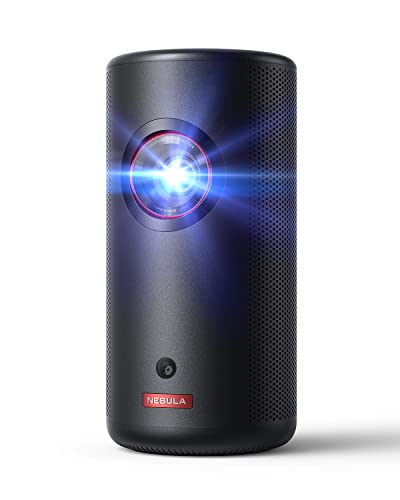
The Capsule 3 Laser is the outdoor pick for people whose outdoors is not their own garden. A laser light source, Google TV with Netflix certification, Dolby Digital sound and a 2.5-hour battery, in a can-sized body rated for images up to 120 inches: this is the projector that goes in the bag for the holiday cottage, the campsite, the friend’s barbecue, the festival weekend. Its outdoor claim rests on portability rather than power, and on dry evenings in dark places it is completely convincing.
The battery arithmetic defines its evenings: one feature film, chosen well, at a sensible size. Within that discipline it is liberating — no socket hunt, no cable across a lawn, no host’s permission needed to rearrange their furniture around an extension lead. The laser source suits the travelling life, holding its output across seasons of occasional use without a lamp’s ageing clock running between trips.
Brightness honesty, as in our mini guide where this model also appears: the listing title states no lumens figure, and none is invented here. The class context governs expectations — full dusk or darkness, moderate image sizes, audiences gathered near. A campsite at midnight is its cathedral; a garden at seven on a June evening is its purgatory. Plan the programme for the light you will have at the halfway point of the film, not the light at the barbecue, and the Capsule will not disappoint.
Between this and the Mars 3, the decision is luggage versus lawn. The Mars owns a fixed garden with authority; the Capsule owns everywhere else, by fitting in the bag that was already going. Households with both a garden ritual and a travelling life occasionally buy both, and this guide cannot call that irrational.
One more honest note belongs to the Capsule’s sound: Dolby Digital decoding means the audio stream arrives intact, but a can-sized speaker in an open garden is still a can-sized speaker. For two people on a blanket it is plenty; for eight in deckchairs, pair a Bluetooth speaker and place it near the screen. The Capsule’s genius is that it makes that pairing optional for its natural audiences rather than mandatory — the solo traveller and the couple need nothing else at all.
- Battery: 2.5 hours built in, per listing title
- Light source: laser
- Max image: 120 inches, per listing title
- Platform: Google TV, Netflix-certified
- Audio: Dolby Digital sound
- Brightness figure: Not stated in listing title
Strengths
- The only truly pocketable outdoor cinema here
- Certified Netflix and Google TV travel with it
- Laser light suits years of intermittent adventures
Trade-offs
- 2.5 hours is one film, not a double bill
- Needs real darkness; early-evening gardens defeat it
- Small image ceiling beside the 200-inch models
Best for: campers, travellers and guests who bring the cinema with them.
Not suited for: hosts running a fixed garden cinema for a crowd — the Mars 3’s stamina serves that scale.

Epson EpiqVision Flex CO-FH02 — Bright plugged option
The CO-FH02 is Epson’s answer to a specific outdoor truth: many gardens have power, and what they lack is light. This Full HD smart streaming projector states 3,000 lumens of both colour and white brightness from its 3-chip 3LCD engine — a figure in a different league from the battery models, with the matched colour output that keeps an animated film saturated and a football pitch green at dusk. Android TV is built in, with Wi-Fi and Bluetooth, so the garden setup is a projector, a power lead and a wall.
That brightness buys the evening’s most valuable commodity: time. A 3,000-lumen image can start while the sky still holds light, which means the film fits before younger children’s bedtimes and the barbecue does not have to end in darkness for the cinema to begin. For family gardens, that earlier start is worth more than any resolution figure, and it is why a plugged Epson can outrank a battery Nebula for hosts whose audience includes seven-year-olds.
The 3LCD design brings its indoor virtues outside: no rainbow artefacts for sensitive viewers, and colour that holds together in bright scenes. Portability is honest — this is a carry-it-out machine, not a pocket one, and it returns indoors when the evening ends, because no weatherproofing is claimed and dew is a projector’s quiet enemy. Treat it as the garden’s guest, not its resident.
Against its Flex sibling below, the CO-FH02 is the streaming-complete choice: platform inside, Bluetooth for a portable speaker, Full HD stated in its name. Households choosing between them are really choosing whether the projector or their existing kit provides the brains, and for outdoor simplicity, brains inside the box usually win.
Classrooms and village halls are this model’s weekday disguise, and worth a mention for buyers whose projector must justify itself beyond summer: 3,000 matched lumens and built-in streaming make the CO-FH02 a presentation-capable machine in any dimmable room, and its portable Flex design was plainly built to be carried between venues. A projector that earns money or goodwill five days a week and hosts film night on the sixth is a different value proposition from a pure leisure machine, and community-minded buyers should weigh that double life.
- Resolution: Full HD 1080p
- Brightness: 3,000 lumens colour and white
- Technology: 3-chip 3LCD
- Platform: Android TV, Wi-Fi and Bluetooth
- Positioning: portable home theatre, per listing title
- Battery: none — mains powered
Strengths
- Brightness that starts the film at dusk, not dark
- Matched colour output keeps bright scenes saturated
- Streaming and Bluetooth built in for a one-box garden setup
Trade-offs
- Needs a socket and an extension lead outdoors
- Carry-out size, not a travel pocket machine
- Must come indoors nightly; no weather resistance claimed
Best for: family gardens with power in reach and audiences that include early bedtimes.
Not suited for: unplugged camping, where its brightness cannot follow you.

Epson EpiqVision Flex CO-W01 — Big-image value
The CO-W01 shares its sibling’s headline light — a stated 3,000 lumens of colour and white brightness from a 3-chip 3LCD engine — and adds the guide’s largest stated image ceiling: up to 300 inches. That number should be read as the outer edge of possibility for a community-scale evening — the village hall wall, the school fundraiser, the very large garden with a very large audience — rather than a domestic recommendation, because even 3,000 honest lumens spread across 300 inches make a picture for dark conditions and forgiving content. At the 100-to-150-inch sizes real gardens use, the same light is generous.
What the listing does not state matters here, and the guide will state the absences plainly: no resolution figure appears in the title, and no smart platform is named — the connections given are an HDMI port and a built-in speaker. So the CO-W01 is the traditionalist’s outdoor machine: a bright, portable light engine that expects a source — a streaming stick, a laptop, a console — to arrive with it. Households with a spare stick in a drawer will feel no lack; households buying their first projector should budget the source into the plan.
Its constituency is the big-occasion host: the family that screens the final on the largest wall available, the community group whose film night outgrew the living room, the school or club that needs a portable bright box several times a year. For those buyers, resolution subtlety matters less than presence, and presence is what 3,000 matched lumens on a big surface deliver after dark.
Daily-driver buyers should look at the CO-FH02 instead — the streaming and Full HD naming make it the more complete household machine — while the CO-W01 waits, unbothered, for the evenings that are too big for it. A guide that ranked only by completeness would miss why this model exists; outdoor life includes occasions, and occasions have their own logic.
Setup discipline scales with the occasion, and the CO-W01 rewards the host who rehearses: a test run the afternoon before, the source and its cables labelled, the image sized to the surface while daylight still allows judgement. Big-surface projection forgives little once two hundred people are seated, and this machine’s simplicity — one HDMI, one speaker, honest light — is precisely what a volunteer-run event needs. There is a reason the workhorse end of this guide looks plain; plain is what survives contact with a crowd.
- Brightness: 3,000 lumens colour and white
- Technology: 3-chip 3LCD
- Max image: 300 inches, per listing title
- Connections: HDMI port, built-in speaker
- Resolution: Not stated in listing title
- Smart platform: Not stated in listing title
Strengths
- Guide-leading stated image ceiling for big occasions
- Same honest 3,000-lumen matched colour as its sibling
- Simple, source-led design with nothing extraneous to configure
Trade-offs
- No resolution or platform stated in the title — verify before buying for those needs
- Needs a source device outdoors; nothing streams by itself
- 300-inch images demand darkness and forgiving content
Best for: big-occasion hosts — finals, fundraisers and community film nights on very large surfaces.
Not suited for: first-time buyers expecting a self-contained streamer for the bedroom wall.

Epson EpiqVision Mini EF12 — Best sound outdoors
The EF12 appears in this guide for the reason outdoor evenings fail most often after brightness: sound. A garden swallows a small speaker — no walls to reflect it, a lawn of ambience to compete with — and the EF12’s Yamaha-tuned audio is the strongest built-in answer in this list, with dialogue clarity that carries across a patio. Its laser 3LCD engine states 1,000 lumens of colour and white brightness, Full HD resolution, HDR support and Android TV streaming, with Bluetooth for the households that will still add a portable speaker for the biggest nights.
Its outdoor habitat is the powered, civilised kind: the patio with a socket, the campsite pitch with an electric hook-up, the holiday home’s terrace. In those settings the EF12’s completeness shines — one cube, one lead, streaming and sound solved — and its laser light holds steady across a season of evenings in a way lamp portables cannot promise. Family gaming is part of Epson’s own positioning for the model, which suits the garden’s second shift after the film: consoles on the big wall while the night is still warm.
The limits are the mini class’s limits, unchanged by the setting: 1,000 lumens wants dusk deepening toward dark, image sizes should stay in the moderate band, and there is no battery, so the socket defines the venue. It will not host the field-scale occasions the CO-W01 exists for. It will host the loveliest small evenings in this guide — six people, a patio, a film everyone can hear as clearly as they can see.
Buyers torn between the EF12 and the Mars 3 are choosing between sound-and-light polish with a cable, and battery freedom with setup intelligence. Both are honourable outdoor philosophies. The household that already owns a good Bluetooth speaker should lean Mars; the household that owns none should lean EF12 and let Yamaha carry the night.
There is a temperament the EF12 suits outdoors that the brighter Flex models do not: the quiet evening. A poetry-paced film, a concert recording, a documentary under stars — content where the audience listens as much as watches — plays to this machine’s strengths exactly. Outdoor cinema culture tends to photograph the big loud nights, but its repeat customers come back for the small attentive ones, and the EF12 is the small attentive night’s projector.
- Resolution: Full HD 1080p
- Brightness: 1,000 lumens colour and white
- Light source: laser, 3LCD
- Audio: sound by Yamaha, Bluetooth
- Platform: Android TV
- Battery: none — mains powered
Strengths
- Best built-in audio here — the garden’s hardest problem solved
- Laser consistency across a whole season of evenings
- Complete one-box streaming with Bluetooth speaker escape route
Trade-offs
- Mains power ties it to patios and hook-ups
- 1,000 lumens starts later in the evening than the Flex models
- Moderate image sizes only; not a big-occasion machine
Best for: patios, terraces and powered pitches where the audience must hear every line.
Not suited for: socket-free fields or crowds beyond a family’s reach.
Comparison
| Pick | Stated brightness | Battery | Platform | Max image in title | Outdoor character |
|---|---|---|---|---|---|
| NEBULA Mars 3 | 1,000 ANSI lumens | 5 hours | Android TV | 200 inches | Backyard flagship |
| NEBULA Cosmos 4K SE | 1,800 ANSI lumens | Not stated in listing title | Google TV | 200 inches | Bright 4K portable |
| NEBULA Capsule 3 Laser | Not stated in listing title | 2.5 hours | Google TV | 120 inches | Pocket traveller |
| Epson CO-FH02 | 3,000 lumens | None — mains | Android TV | Not stated in listing title | Bright family garden |
| Epson CO-W01 | 3,000 lumens | None — mains | Not stated in listing title | 300 inches | Big occasions |
| Epson EF12 | 1,000 lumens | None — mains | Android TV | Not stated in listing title | Patio polish |
What Time Should an Outdoor Film Actually Start?
Later than the invitation says, and the projector you own decides how much later. The governing concept is civil dusk — the period when the sky’s remaining light stops competing with a screen. A 3,000-lumen Epson can open the show as dusk begins, especially with bright content: sport, animation, a concert film. A 1,000-lumen-class machine wants the deeper part of dusk. The Capsule wants near-dark. Hosts should programme backwards from those facts: barbecue in daylight, gathering at sunset, film at your projector’s hour — and put the start time on the invitation, so nobody’s evening is spent squinting at a grey rectangle waiting for the sky to cooperate.
Season rewrites the schedule monthly. Midsummer pushes even the brightest pick’s start toward nine in northern latitudes; autumn’s early dark is the outdoor cinema’s golden season, which is why so many households discover this hobby in September. Buy the projector whose brightness matches the evenings you will actually host, in the months you will actually host them.
Which Surface Makes a Garden Screen?
The hierarchy is stable: a smooth pale house wall first for convenience, a proper outdoor screen first for quality, and everything else after. A wall’s virtues are that it exists, does not flap, and costs nothing; its vices are texture, colour and the window someone forgot. A dedicated screen — ideally a matte white surface that can be tensioned — repays regular hosts within a few evenings, because a flat, still surface is worth visible brightness: wrinkles and breeze movement scatter the light you paid for. The classic sheet works when it is pulled genuinely taut and weighted, and fails charmingly otherwise.
Size the surface to the projector’s honest band, not its headline ceiling. The Mars 3 and Cosmos quote 200 inches and the CO-W01 300, but every machine here looks its best well inside its maximum — the garden sweet spot for this guide is roughly 100 to 150 inches, large enough to feel like an event, small enough that dusk light stays punchy and the audience’s necks stay comfortable.
How Do You Handle Sound, Power and Dew Outdoors?
Sound first: place the projector near the audience, not near the screen, when its own speakers are the system — a garden inverts the cinema’s geometry because the machine sits with the viewers. For crowds beyond a family, add a Bluetooth speaker near the screen so voices come from the faces. Power second: battery models get charged the day before, not the hour before; plugged models get a proper outdoor-rated extension, run once and taped or routed where feet will not find it in the dark. Dew last, and it is the one hosts forget: as the temperature falls, moisture settles on everything, including lenses and vents. Bring the projector in when the film ends — not after the conversation, not in the morning — and let it warm to room temperature before its next use. Outdoor projectors die of being left out far more often than of being used.
How Do You Run a Garden Film Night That People Remember?
The remembered evenings share a choreography. The screen and seating go out in daylight, when alignment is easy and the audience is hypothetical. The projector is tested at dusk with a trailer, not at showtime with the feature — focus, size, volume and the Wi-Fi’s temper all confirmed while fixes are still free. Food and blankets are settled before the film, because a garden audience that is warm and fed forgives a modest picture and remembers a generous host; the reverse audience forgives nothing.
Programme for the light curve: something bright and welcoming as dusk deepens — the match highlights, the cartoon, the concert — and the feature once the sky has fully committed. Keep the total running time inside the battery’s honesty or the children’s stamina, whichever ends first. And end the night by bringing the machine in before the conversation migrates indoors; the host who builds that habit keeps the same projector for many summers.
Children deserve a planning line of their own: for family nights, the film is the second act. Games, food and the novelty of being outside after dark are the first, and the projector’s job is to crown an evening that was already working. Hosts who understand that sequence stop chasing cinema specifications and start choosing machines — like the early-starting CO-FH02 — that fit the family’s real timetable.
What Should You Do When the Weather Turns Mid-Season?
Have the indoor plan rehearsed before it is needed. Every pick in this guide works indoors without apology — the Nebulas become spare-room screens, the Epsons become living-room machines, the EF12 returns to the bedroom it may have come from — so a rained-off film night is a relocation, not a cancellation, provided the host has a wall and five minutes. The households that love outdoor cinema longest are the ones that refuse to let a forecast own the evening.
Storage through the off-season matters as much: clean, dry, charged where a battery is involved, and kept somewhere it will be found in April rather than discovered in a damp shed in June. A projector stored kindly in October is the one that starts the next season at full brightness, on the first warm evening, without a shopping trip in between.
Which Projector Suits Camping Rather Than a Garden?
Camping strips the question to weight, power and darkness. The Capsule 3 Laser wins the first two and the campsite provides the third free: no light pollution, a sky that commits to dark early away from town, and audiences of two to six who sit close. Its 2.5 hours map neatly onto one film under stars, and its laser light will be doing the same job on the tenth trip as the first. The Mars 3 is the basecamp upgrade — heavier, brighter, longer-running — for groups who drive to their pitch and stay a week, where its 5 hours and 1,000 ANSI lumens serve a nightly programme rather than a single feature.
The plugged Epsons enter camping only where the pitch provides electricity, and on hook-up sites the CO-FH02’s brightness makes it the family tent’s television with absurd ease. But a projector that needs a socket is furniture for a serviced pitch, not equipment for the wild — choose by the camping you actually do, not the camping in the brochure, and the battery question answers itself.
How Much Should You Spend on the Screen and Extras?
Less than the internet suggests, in a deliberate order. First the power: a quality outdoor extension lead for the plugged models, bought once, ends more evenings’ improvisation than any other accessory. Second the surface: a wall is free, a tensioned portable screen is the one upgrade whose effect every guest will see, and it should be bought at the size your projector’s honest band supports. Third the sound: a portable Bluetooth speaker the household already owns usually suffices; buy one only when the audience regularly outgrows the projector’s own voice.
Resist the rest until a season proves the need. Outdoor cinema’s pleasure is partly its improvisation — blankets, deckchairs, a wall that was never meant to be a screen — and over-equipping the ritual can price the spontaneity out of it. The projector is the purchase; everything else is hospitality, and hospitality was never mainly about equipment.
Do Outdoor Projectors Work for Sport and Gaming Outside?
Sport may be outdoor projection’s most natural content: it is bright, colourful, watched socially and scheduled by broadcasters into exactly the dusk hours a garden screen loves. A cup final on a 130-inch wall with twenty neighbours is the experience that sells this entire category, and the picks divide by crowd size — the CO-W01 and Cosmos for the big gathering, the Mars 3 for the family version, the EF12 where commentary clarity matters. HLG-capable broadcast feeds and bright scenes forgive the fading light that a moody film would suffer under, so sport can start earlier than cinema on the same machine.
Gaming outdoors is the sleepover and barbecue variant: party games, racing titles, a console under the stars. None of these listings publishes an input lag figure, so competitive play belongs indoors on the dedicated gaming guide’s machines — but for the garden’s actual gaming diet, responsiveness is adequate across this list and the limiting factor is light, not lag. A console, a wall and a warm night remain one of the great underpriced evenings in entertainment, and any pick here can host it.
How Do You Keep an Outdoor Projector Bright Across Seasons?
Brightness outdoors is a system, not a specification, and the system’s weakest part is usually housekeeping. A lens filmed with dust and pollen — the garden’s constant fallout — can tax a picture more than the difference between two models in this guide. A soft blower after each outing, a cap or cover in storage, and a filter checked monthly through the season keep the machine at its stated self. Battery models add their own discipline: store them part-charged, cycle them occasionally through the winter, and never let a summer’s projector sit empty and forgotten until June.
The surface ages too. A wall that grows algae or a screen stored damp will quietly dim every evening projected onto it, and owners blame the lamp that never existed. Clean the screen as the manufacturer allows, store it dry, and repaint the chosen wall when it greys. Outdoor cinema rewards the households that treat the whole arrangement — machine, surface, power, sound — as one instrument to be kept in tune, and it punishes, gently and visibly, the ones that treat the projector as the whole story.
What Does a Season of Outdoor Cinema Actually Cost to Run?
Less than any other form of hosted entertainment, once the projector exists. The electricity for an evening is pennies; the plugged models sip, the battery models were charged from the same wall. There are no lamp replacements lurking in the laser picks, and even the lamp-free designs here ask only for cleaning and kind storage. The real seasonal costs are hospitality’s — chairs, blankets, drinks, the occasional screen upgrade — and they are the costs of having people over, not of projecting at them.
Amortised honestly, a garden projector that hosts a dozen evenings a summer reaches a cost per evening that no cinema trip, streaming rental bundle or hired event screen can approach by its second season. That arithmetic is the quiet engine of the hobby’s growth: the first summer feels like a purchase, the second feels like infrastructure, and by the third the neighbours are asking when the season opens. Buy the machine your garden’s power and light call for, keep it kindly, and the seasons will do the rest of the persuading.
How Should Seating and Distance Work in a Garden?
Garden seating obeys the same optics as a living room with worse furniture. The audience should sit inside the cone where the picture is bright and the sound is present — for most of these machines, a band beginning a couple of metres from the screen and ending where the image still fills a comfortable field of view. Deckchairs and blankets forgive a range of distances; the mistake is scattering seating by social accident, with the keenest viewers at the back squinting and the front row close enough to count pixels on the 1080p models.
Sound sets the second boundary. A projector’s own speakers serve a gathered group within a few metres; beyond that, a Bluetooth speaker near the screen restores the geometry of voices coming from faces. Plan the speaker’s position with the seating, not after it, and run the volume test from the furthest chair before the audience arrives. Gardens reward hosts who rehearse the edges — the back row, the side seat, the kitchen doorway — because guests occupy edges without announcing themselves, and their evening is the one your setup actually delivered.
What Changes After Your First Season?
Standards rise, pleasantly. The sheet becomes a screen, because the household now knows the ritual is permanent. The start time gets printed on invitations, because the host has learned the sky’s timetable for their own garden. A speaker finds a permanent home near the screen position. And the projector choice itself gets rejudged with experienced eyes — some households discover they are battery people who bought a plugged machine, or brightness people who bought a traveller, and the second purchase corrects the first with a precision no guide could have supplied in advance.
That is why this guide ranks by evening rather than by specification: the machine that fits your evenings survives the first season’s education, while the machine that merely won a comparison table becomes the lesson. Choose the pick whose compromises you will not notice — the socket you do not mind reaching, the battery you do not mind planning around, the start time your family keeps — and the second season will feel like a tradition rather than a hobby.
Common Mistakes
Starting the film too early is the signature outdoor error — a washed-out first act teaches the audience the evening was oversold, and no projector recovers a first impression. Second comes the wrinkled sheet: a surface that moves turns brightness into shimmer, and the projector gets blamed for the laundry. Third: forgetting that Wi-Fi weakens through exterior walls, then troubleshooting the stream instead of pre-downloading the film or moving the router’s luck with a mesh node near the garden door.
Fourth: leaving the projector out overnight “because it is an outdoor model”. Outdoor describes the use, not the storage; dew, frost and the occasional fox are not covered by any marketing department. Fifth: sizing the image to the headline maximum and seating grandparents at a distance where faces dissolve. Sixth: neglecting the neighbours — a garden cinema is a shared acoustic event, and a volume check plus a finishing time keeps the hobby welcome on the street for next summer too.
Seventh: buying on the headline image size. A 300-inch ceiling sounds like ambition and behaves like a trap, because the audience ends up seated too far from a picture the light cannot fill with conviction. The hosts whose evenings get remembered size the image to the light and seat everyone close enough to feel gathered. Eighth: treating the first night as the test. The first night is the rehearsal — the test is the fourth, when the routine is smooth, the surface is chosen and the projector has become the garden’s habit rather than its novelty.
Final Recommendation
Match the machine to the garden’s power and the evening’s hour. Socket-free hosts should build around the Mars 3, whose battery and brightness make it the only pick here that owns an entire unplugged ritual; travellers take the Capsule 3 Laser and its pocketable freedom. Powered gardens should choose by start time: the CO-FH02 for family evenings that must begin at dusk, the Cosmos 4K SE for the brightest, sharpest powered picture, the CO-W01 for occasions that outgrow the family, and the EF12 where hearing every whispered line matters most. Outdoor cinema is the most forgiving and the most magical form of projection — a wall, a dusk, a gathered crowd — and every pick here can deliver it, provided its particular bargain with power and light matches yours.
Buy it before the season, not during it. Outdoor projectors are at their most available and most sensibly priced outside the summer rush, and a machine bought in spring gets its rehearsals — the wall chosen, the lead routed, the Wi-Fi tested — before the first audience arrives. The garden cinema that feels effortless in July was usually prepared in April by someone who understood that the projector is only half the show; the other half is a host who has already made every mistake in private.
Frequently Asked Questions
Can I leave an outdoor projector outside permanently?
No. None of the models in this guide claims weatherproofing, and dew alone will shorten any projector’s life, quietly and cumulatively, in a way no warranty conversation will rescue. Outdoor projectors are carried out for the evening and carried in after it, every time, without exception; treat permanent installation as a job for a weather-sealed enclosure and professional advice, not for these machines.
How bright does an outdoor projector need to be?
It depends on your start time. For films beginning in full darkness, the 1,000-lumen class serves moderate images well. For dusk starts and family-friendly hours, the 3,000-lumen Epsons change what is possible. Brightness outdoors buys time more than it buys size — decide which you need. As a working translation: every step up in honest brightness moves your viable start earlier by a visible margin on a clear evening, and for families that margin is measured in children’s bedtimes, which is to say in whether the event happens at all. That is why the plugged Epsons, with no battery to boast of, can be the most practical outdoor projectors in this guide for the households with the youngest audiences.
Will garden Wi-Fi reach the projector?
Usually, at garden distances from a typical router, but exterior walls weaken the signal considerably — a stream that never stutters in the living room can buffer at the bottom of the garden, especially once a house full of guests adds their phones to the same network. Test the exact spot before film night, pre-download where the platform allows it, and treat a mesh node near the garden door as the permanent fix for a regular outdoor cinema.
Battery or plugged — which is better for a garden?
Battery wins on freedom and loses on light and stamina; plugged wins on brightness and loses the socket hunt. A garden with a reachable socket and young children often suits the plugged Epsons’ early starts; a garden without power, or a travelling life, belongs to the Mars 3 and the Capsule. There is also a hybrid worth knowing: several households run a battery model as the main machine and keep a long outdoor extension lead as the insurance policy for the nights that run long, which buys most of the freedom and most of the stamina in a single purchase.
Can an outdoor projector double as my indoor projector?
Every pick here can, and the brighter Epsons and the Cosmos 4K SE make genuinely good indoor machines — which matters for the machine’s value across the fifty weeks it is not in the garden. The battery models become travel and spare-room projectors; the EF12 returns to bedroom duty where its sound belongs. Buyers should still choose by the outdoor brief first, because a projector optimised for a dark cinema room may lack the brightness or the battery the garden demands, while the reverse compromise costs little indoors.
What screen size should I plan for?
Between 100 and 150 inches for most gardens and most of these machines — big enough for an event, modest enough for dusk light to stay strong. The headline ceilings in the listings describe possibility in darkness, not a target for a June evening. If your garden regularly gathers more than a dozen viewers, size the image to the back row’s comfort rather than the wall’s capacity, and consider the brightest model your power arrangement allows — crowds forgive many things, but a picture the back row cannot read is not one of them.
Related Guides
If the garden evenings convince you the house deserves the same treatment indoors, our home gaming projectors with low input lag selection covers the console side of big-screen life. The pocket end of this guide is explored further in the affordable mini projectors sized for small rooms round-up, where the Capsule and EF12 appear in their indoor roles. And households ready to retire the lamp entirely should read the home laser projectors for lamp-free movie rooms guide before the next upgrade.


