What's inside
- Key Takeaways
- Quick Picks
- How We Chose These Picks
- Comparison
- How Small Is Too Small for a Soundbar?
- Branded or Budget: What Does the Difference Buy?
- How Do You Place a Compact Bar for Its Best Sound?
- Which Compact Bar Suits a Bedroom?
- What About Compact Bars for PC and Gaming Setups?
- How Long Should a Compact Bar Last?
- Can a Compact Bar Serve a Kitchen or Dining Room?
- Common Mistakes
- Final Recommendation
- Frequently Asked Questions
- Related Guides
As an Amazon Associate I earn from qualifying purchases. This post may contain affiliate links at no extra cost to you.
widgetverdict.com is reader-supported. When you buy through links on our site, we may earn an affiliate commission.
The best compact soundbars for tv exist because of a measurement most living rooms fail: the gap between a television’s feet, the depth of a bedroom dresser, the shelf under a kitchen wall cabinet. Full-width bars assume a media unit and a main lounge; compact bars assume the rooms the rest of the house actually contains — the bedroom where the screen sits on a chest of drawers, the study corner, the caravan, the small flat where the television shares a sideboard with everything else the owner possesses. This guide gathers six of them, from an 11.7-inch budget bar that fits where no soundbar has fitted before to a premium Bose compact, and judges each by the small-room virtues that matter: clarity at close range, manners at low volume, and a footprint that asks nothing of the furniture.
Honesty about the class’s two tribes comes first. Two picks carry famous badges — Amazon’s Fire TV Soundbar and the Bose TV Speaker — with the ecosystems, tuning pedigree and support networks that follow a major brand. The other four are budget brands, named plainly as such: Saiyin, LARKSOUND, ULTIMEA and RIOWOIS, makers whose compact bars compete on size, connection lists and price rather than on heritage. That is not a dismissal; it is a positioning. Budget compact bars have become genuinely capable for second rooms and small screens, and their listings state their sizes, inputs and power figures with a directness the premium brands sometimes avoid. But a buyer deserves to know which tribe they are buying from, because warranty culture, app polish and longevity differ between them, and this guide keeps the distinction visible in every review.
Size claims are quoted only where a listing prints them. The Saiyin is 11.7 inches because its title says so; the LARKSOUND and the ULTIMEA are 16 inches; the RIOWOIS is 17 inches. The Fire TV Soundbar and the Bose state no width in their titles, so their reviews call them compact — as their makers position them — without inventing a measurement. In a category where an inch decides whether a bar fits between a television’s feet, that discipline is not pedantry; it is the difference between a guide and a guess.
What compact bars cannot do should be said once, clearly, before the reviews: none will fill a large lounge with cinema bass, and none pretends to in its listing. What they can do — transform the intelligibility and body of a small television’s sound at the distances small rooms impose — they do completely, and for the second screens of the house that transformation is the whole requirement.
There is also a demographic truth under this category that the flagship guides rarely meet: most televisions in most homes are not the main television. They are the bedroom set, the kitchen set, the set in the room a teenager has colonised — screens watched daily by people who never chose them and never complain about them formally, but who lean toward the screen and reach for subtitles all the same. Compact bars exist for those viewers, and a guide that takes them seriously is taking the majority of the house’s viewing seriously.
Key Takeaways
- Six compact bars span two tribes: the branded pair — Fire TV Soundbar and Bose TV Speaker — and four budget brands positioned honestly as such.
- Sizes per listing: Saiyin at 11.7 inches, LARKSOUND and ULTIMEA at 16 inches, RIOWOIS at 17 inches.
- The ULTIMEA Poseidon M20 Pro is the only pick with a 2.1ch built-in subwoofer layout, at 16 inches with app control.
- LARKSOUND’s mini bar lists the fullest connection set of the budget four: HDMI ARC, Optical, AUX, USB and Bluetooth 5.0, plus a Night Mode.
- The Bose TV Speaker is the premium compact: HDMI-ARC in its listing, Bluetooth and an included remote.
- The Fire TV Soundbar pairs DTS Virtual:X and Dolby Audio with Amazon’s platform for small Fire TV rooms.
Quick Picks
| Pick | Badge | Why it makes the cut |
|---|---|---|
| Amazon Fire TV Soundbar | Fire TV compact | 2.0 speaker with DTS Virtual:X and Dolby Audio, plus Bluetooth, sized for small Fire TV rooms. |
| Bose TV Speaker | Premium compact | HDMI-ARC and Bluetooth in a compact all-in-one with included remote — the clarity benchmark of the class. |
| Saiyin 11.7-inch Sound Bar | Smallest budget bar | An 11.7-inch bar with Bluetooth 5.3, Optical and Auxiliary inputs and a 48W peak power figure. |
| LARKSOUND Small Sound Bar | 16-inch mini, full inputs | 60W compact bar with 4 EQ modes, Night Mode, HDMI ARC, Optical, AUX, USB and Bluetooth 5.0. |
| ULTIMEA Poseidon M20 Pro | 16-inch with built-in sub | 2.1ch with built-in subwoofer, app control, 132W peak figure and wall-mount option at 16 inches. |
| RIOWOIS 17″ Sound Bar | 17-inch wall-mountable | Bass Reflex Port design, Fire TV remote compatibility, Optical/AUX/Bluetooth 5.3 and wall mounting. |
How We Chose These Picks
Compactness was the entry ticket, verified against each listing’s own positioning and, where printed, its dimensions. Beyond size, the six were chosen to span the class’s real variety: two branded bars for households set on an ecosystem and a pedigree, and four budget bars that divide the territory by their stated strengths — the Saiyin by sheer smallness, the LARKSOUND by its connection list and night mode, the ULTIMEA by its built-in subwoofer and app, the RIOWOIS by its wall-mountable 17-inch frame and Fire TV remote compatibility. A guide that listed only the famous two would abandon the rooms budget compacts were invented for; a guide that listed only budget bars would hide the class’s quality ceiling.
Claims discipline follows the now-familiar rule: sizes, inputs and power figures appear only where a listing prints them, in the listing’s own terms. The budget bars’ peak power figures — 48W for the Saiyin, 60W for the LARKSOUND, 132W peak for the ULTIMEA — are quoted as the peak numbers they declare themselves to be, never converted into a league table and never lent to the branded pair, whose listings print no such figures. Connection lists are likewise kept per model: the LARKSOUND’s five named inputs belong to the LARKSOUND alone.
Small-room criteria governed the judgements. At a metre or two of viewing distance, dialogue clarity outweighs width, low-volume balance outweighs peak output, and a bar that fits the furniture outweighs a bar that outperforms it from the floor. Night manners — the LARKSOUND’s Night Mode, every bar’s behaviour at whisper volumes — were treated as first-class features, because compact bars live disproportionately in bedrooms, flats and shared houses where the hour is always somebody’s bedtime.
Budget positioning is stated in each review without euphemism and without condescension. These are inexpensive products from value brands, and the reviews say what that buys — remarkable size-to-sound ratios, honest input lists — and what it does not promise: flagship tuning, decade-long platform support, or bass that troubles the neighbours. Readers deserve the positioning straight, and the budget four deserve to be judged inside it rather than against the Bose’s price.
One more selection note: remotes and control cultures were counted as features, not accessories. The Bose’s included remote, the RIOWOIS’s Fire TV remote compatibility and the ULTIMEA’s app control each describe a different theory of how a small room’s bar should be run, and households feel that choice daily. A bar whose control fights the household’s habits will be resented at any sound quality, so the reviews name the control story of every pick explicitly.

Amazon Fire TV Soundbar — Fire TV compact
Amazon’s compact entry is the platform bar in miniature: a 2.0 speaker soundbar with DTS Virtual:X and Dolby Audio, and Bluetooth connectivity, built to sit under the smaller televisions of Fire TV households. DTS Virtual:X is its processing signature — a virtualisation system that widens and lifts a stereo bar’s presentation, giving streamed films a sense of space beyond the cabinet’s width — while Dolby Audio covers the everyday decoding that broadcast and streaming actually send. The combination is aimed squarely at the second-screen rooms where Fire TV sticks and televisions already run the household’s viewing.
The compact brief suits it. A 2.0 bar asks for one connection and one power point, fits the stands and dressers of bedrooms and dens, and improves the two things small televisions do worst — dialogue body and overall fullness — without importing a subwoofer the room has no corner for. Bluetooth gives it the room’s music shift from a phone, completing the second-screen pattern: the bar that the television needed becomes the speaker the room uses.
Against the Bose beside it, the division is ecosystem and emphasis. The Bose brings its listing’s named HDMI-ARC connection, an included remote and a dialogue-first pedigree at a premium brand’s price; the Amazon bar brings its platform nativeness and virtual-surround processing at the platform’s own value positioning — check price on Amazon, because the gap between the branded pair is the substance of choosing between them. Fire TV households will feel the Amazon bar’s home-turf neatness daily; households of other platforms should compare on sound and connections alone, where the contest is honest and close.
Its ceilings are the class’s own: stereo architecture, cabinet-bound bass, and height that is virtualised rather than physical. None of that is a failure in a bedroom at two metres. It is the correct specification for the room, delivered by the platform the room already runs — which is why this bar, rather than a larger one, is the Fire TV household’s compact answer.
Guest rooms and children’s rooms extend its case. A bar that speaks the same platform language as the television above it presents one interface to learn, one remote culture to absorb, and no orphaned features a visitor cannot find. Compact bars succeed socially as much as sonically, and the platform-native pick starts with the social advantage built in.
There is a quiet upgrade logic to starting here, too. A household that learns from this bar that it values width, or bass, or a centre channel, has bought that knowledge at the compact tier’s gentle prices, and the bar itself retires gracefully to a bedroom when the main room graduates. Few technology purchases offer so soft a landing for being outgrown, and second-screen bars are rehomed more happily than almost any other device in the house.
- Channels: 2.0 speaker per listing
- Processing: DTS Virtual:X per listing
- Decoding: Dolby Audio per listing
- Streaming: Bluetooth connectivity
- Line: Fire TV Soundbar
- Size: compact — width not stated in listing title
Strengths
- Platform-native compact for Fire TV households and second screens.
- DTS Virtual:X widens film sound beyond the cabinet’s width.
- Bluetooth covers the room’s everyday music duty.
Trade-offs
- Stereo architecture with cabinet-bound bass.
- Its ecosystem neatness favours Amazon households over others.
- Height is virtualised processing, not physical speakers.
Best for: Fire TV bedrooms, dens and second screens wanting a native compact upgrade.
Not suited for: main lounges and bass-led film nights.

Bose TV Speaker — Premium compact
The Bose is this class’s quality benchmark, and its listing states the formula without ornament: a soundbar for TV with Bluetooth and HDMI-ARC connectivity, an all-in-one compact design, an included remote control, in black. Every phrase earns its place. All-in-one compact is the physical brief — one small cabinet, nothing else to place. HDMI-ARC is the ownership brief — one cable, the television’s remote governing volume, the bar waking and sleeping with the screen. The included remote is the household brief — a dedicated controller for the bar’s own settings that anyone can operate. It is the compact bar reduced to its essentials and then executed at a premium standard.
Sound follows the maker’s priorities: dialogue forward, balance over spectacle. In compact rooms that priority order is not a preference but a description of the content — news, drama, sport and streamed series at close range and family volume. The Bose’s clarity at those volumes is what its premium buys, along with a tuning maturity that keeps long listening fatigue-free. Bluetooth handles music from the phone with the same tidiness, making the bar the room’s speaker in the hours the television is dark.
Price honesty belongs in a premium compact’s review. The Bose will cost more than every budget bar in this guide, several times over in some comparisons, and the buyer should know precisely what the multiple purchases: connection certainty, tuning pedigree, an included remote, brand support, and a product with nothing in it that can age badly — no app dependency, no account, no platform to be discontinued. Households that keep equipment for a decade will find that list worth the money; households furnishing a room for a year should take the budget four seriously instead.
Its limits are printed by omission and accepted by its buyers: no Atmos is claimed, no subwoofer extends the bass, and no streaming suite beyond Bluetooth is offered. The Bose is not a small version of a flagship; it is a finished answer to the small room’s actual question, and its continued presence as the class’s reference point suggests the question has not changed.
Second televisions in quality-conscious homes are its heartland — the bedroom of a household that buys once, the study of a listener who notices tuning, the parents’ lounge where clarity is a kindness. Compact bars are often bought as afterthoughts; the Bose is the one bought as a decision, and it rewards being chosen deliberately.
It also makes the class’s best gift for anyone who has suffered a relative’s television. The installation is one ARC cable, the operation is the television’s own remote, and the improvement is audible before the kettle boils — a combination that survives being set up by the giver in someone else’s house, under time pressure, without the manual. Premium pricing buys many things; in the Bose’s case, the most valuable may be that it never generates a support phone call.
- Type: all-in-one compact soundbar for TV
- Connections: Bluetooth and HDMI-ARC per listing
- Remote: included remote control
- Format claims: no Atmos claimed in listing
- Cabinet: compact, single unit
- Colour: Black
Strengths
- The class’s clarity benchmark, with dialogue-forward premium tuning.
- HDMI-ARC one-cable life plus an included remote.
- Nothing app- or account-dependent, so it cannot age badly.
Trade-offs
- Premium pricing against capable budget rivals a fraction of its cost.
- No Atmos, subwoofer or streaming suite beyond Bluetooth.
- Compact-cabinet bass, by deliberate design.
Best for: quality-first small rooms and second TVs in households that buy once.
Not suited for: budget furnishing projects, where the budget four answer better.
Saiyin 11.7-inch Sound Bar — Smallest budget bar
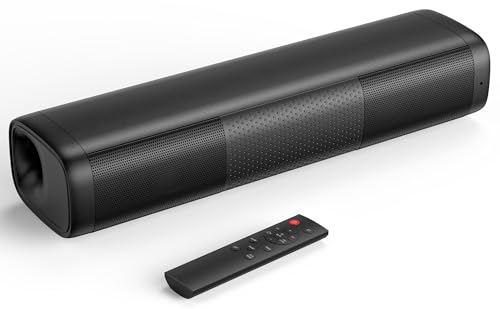
Eleven point seven inches. The Saiyin’s listing leads with the smallest number in this guide, and the number is the product: an 11.7-inch sound bar for smart TV, PC and gaming, with Bluetooth 5.3, Optical and Auxiliary inputs, a 48W peak power figure, and power by AC adapter. A bar under a foot wide fits the places soundbars have never fitted — beneath a monitor on a crowded desk, on a caravan shelf, under a kitchen cabinet’s television, in a dorm room where the furniture is measured in centimetres of clearance. Saiyin is a budget brand and this review positions it as one; within that positioning, the Saiyin’s proposition is coherent and, for its rooms, close to unbeatable.
The input list suits its multi-screen brief. Bluetooth 5.3 pairs it to phones and televisions wirelessly, Optical serves the television directly, and the Auxiliary input welcomes the PC and the older devices its desk-and-gaming pitch names. A compact bar that can migrate between a monitor at noon and a television at night earns its keep twice, and the Saiyin’s connection set is chosen for exactly that migrant life. The 48W figure is quoted as its listing states it — a peak power number for a very small system, to be read as scale rather than as a promise.
Expectations must be set by physics and by tier, and this guide sets them plainly. An 11.7-inch cabinet produces clarity and presence at desk and bedside distances; it does not produce room-filling bass, cinematic width or the tuning refinement of the branded pair. What it produces, for rooms and screens that would otherwise keep their feeble built-in speakers, is a transformation out of all proportion to its size and price — check price on Amazon, because its value case is written in how little it asks.
The AC adapter power supply is a small, practical detail worth honouring: the bar runs from a compact adapter rather than demanding a figure-eight lead or a spare socket brick of its own design, which suits the power-strip realities of desks and small rooms. Details like that are where budget products either respect their rooms or fight them, and the Saiyin respects its rooms consistently.
Buy it for the screen nothing else fits. The monitor on the study desk, the small television in the box room, the caravan’s entertainment corner — the Saiyin exists for the gaps in the house where sound was previously surrendered, and it fills them with a competence that makes its budget badge a footnote rather than a warning.
Camper vans and boats deserve their sentence in its defence, because those are rooms where every centimetre and every watt is audited. A bar under a foot wide that runs from a compact adapter and serves a small screen’s films, sport and music answers a brief that the branded world barely acknowledges. The Saiyin’s natural habitat includes wheels and hulls, and in those habitats its compromises stop being compromises at all — they are simply the correct size of sound.
- Size: 11.7-inch per listing
- Inputs: Bluetooth 5.3, Optical, Auxiliary per listing
- Output: 48W peak power per listing
- Power: AC adapter per listing
- Brief: smart TV, PC, gaming per listing
- Brand tier: budget brand, positioned as such
Strengths
- The smallest bar in the guide — fits desks, shelves and caravans.
- Three input routes cover TV, PC and phone without adapters.
- Budget pricing makes it a low-risk first soundbar for small screens.
Trade-offs
- Tiny-cabinet physics cap bass and width absolutely.
- Budget-brand support and longevity expectations apply.
- No HDMI ARC is named among its listed inputs.
Best for: desks, dorms, caravans and the smallest televisions in the house.
Not suited for: lounges of any size, or listeners expecting branded refinement.

LARKSOUND Small Sound Bar — 16-inch mini, full inputs
The LARKSOUND’s listing is the budget class at its most forthcoming: a small sound bar for TV, PC and gaming, 16 inches, a mini TV speaker with a 60W figure, 4 EQ modes, a Night Mode, and five named inputs — HDMI ARC, Optical, AUX, USB and Bluetooth 5.0. That input list is the fullest in this guide at any price, and it changes the bar’s nature: this is a compact that refuses to make its owner choose a connection religion. The television takes ARC, the PC takes USB or AUX, the phone takes Bluetooth, the older device takes Optical — the LARKSOUND simply meets each screen where it lives.
Night Mode is its second distinction, and in compact-bar territory it might be the first. Small bars serve bedrooms, flats and shared houses, where the evening’s second half is watched at volumes negotiated with sleepers. A mode that compresses the dynamic swings — taming the explosion, lifting the whisper — lets a film remain followable at those volumes instead of turning into a remote-riding exercise. Paired with 4 EQ modes for the room’s other moods, the LARKSOUND’s sound-shaping suite is the most complete among the budget four, and it addresses the hours compact bars actually work.
LARKSOUND is a budget brand, positioned here as plainly as the Saiyin, and the positioning carries the usual honest corollaries: expect competent execution and remarkable feature density for the money — check price on Amazon to feel the density-per-pound for yourself — rather than the branded pair’s tuning pedigree or support infrastructure. The 60W figure is the listing’s own and is read as the scale of a 16-inch system, not as a challenge to larger bars.
Sixteen inches is a considered size: wide enough to separate stereo honestly at bedside and desk distances, narrow enough for the stands of the small televisions it names. In a bedroom, that width under a modest screen looks proportionate in a way a metre bar never can, and proportion is a real component of whether equipment gets kept or quietly returned.
For the household whose small room contains several screens and several generations of device, the LARKSOUND is the budget four’s natural shortlist-topper: every input present, a night mode for the hours that matter, and a footprint that fits the furniture as found.
Shift workers and anyone whose leisure runs against the household’s clock will understand the Night Mode’s value instantly. Their viewing happens at 3 p.m. behind blackout curtains or at 4 a.m. before a commute, always at volumes negotiated with sleepers in the next room. A bar that keeps dialogue intact at those volumes is not a luxury for that life; it is the difference between watching properly and watching with subtitles and guilt. The LARKSOUND is the only pick in this guide that names the feature, and it names it for them.
- Size: 16 inch per listing
- Output: 60W per listing
- Inputs: HDMI ARC, Optical, AUX, USB, Bluetooth 5.0 per listing
- Sound modes: 4 EQ modes, Night Mode per listing
- Brief: TV, PC and gaming per listing
- Brand tier: budget brand, positioned as such
Strengths
- Five named inputs — the fullest connection list in this guide.
- Night Mode serves bedrooms and shared houses directly.
- Four EQ modes give a small bar unusual sound-shaping range.
Trade-offs
- Budget-brand tuning and support expectations apply.
- 16-inch stereo width and bass remain compact-class.
- No app control or streaming platform is offered.
Best for: multi-device small rooms, bedrooms and night-time viewing households.
Not suited for: listeners who prioritise branded tuning over features.

ULTIMEA Poseidon M20 Pro — 16-inch with built-in sub
The ULTIMEA asks the question the rest of the budget class avoids: how much system can fit inside sixteen inches? Its listing answers with a 2.1ch soundbar with a built-in subwoofer, app control, a 132W peak power figure, Bluetooth 5.4, Optical and AUX inputs and a wall-mount option, under the name Poseidon M20 Pro. The 2.1ch architecture is the headline — a dedicated low-end channel inside the cabinet gives this compact a bass foundation its stereo rivals cannot match — and app control at this tier and size is a genuine rarity, bringing phone-based adjustment to a class that usually stops at a bundled remote.
ULTIMEA is a budget brand with home-theatre ambitions, and the review positions it exactly there: this is the value tier’s attempt at a real system in miniature, and judged inside that ambition it is impressively complete. The peak power figure is quoted as the listing’s own peak number, the built-in subwoofer’s contribution is real but cabinet-bound — a foundation, not a floor-shaking — and the wall-mount option acknowledges the small room’s other truth, which is that the stand is often already full.
App control deserves its paragraph because it changes who the bar serves. Phone-first households — younger renters, students, anyone whose remote is already lost — can run volume, modes and inputs from the device that is always in hand, and the bar joins the household’s digital habits instead of fighting them. Bluetooth 5.4 is the current generation of the standard, a small future-proofing the budget tier rarely bothers with.
Against the LARKSOUND at the same 16 inches, the choice is architecture versus inputs: ULTIMEA’s built-in subwoofer and app against LARKSOUND’s five-input welcome and Night Mode. Rooms that watch films and feel the missing bass should take the ULTIMEA; rooms juggling devices and bedtimes should take the LARKSOUND. Against the branded pair, the ULTIMEA’s case is specification per pound — check price on Amazon — with the budget-brand corollaries on support and longevity accepted openly.
Wall mounting may be its sleeper virtue. A 16-inch 2.1 system floated beneath a wall-mounted television gives a small room a genuinely finished entertainment wall — no stand space consumed, no subwoofer box on the floor — and few products at any price in the compact class assemble that picture as completely.
Small flats with a film habit are its defining constituency. The open-plan studio where the bed, the desk and the sofa share one room needs sound that scales from a whispered morning podcast to a Friday film without a second device, and a 2.1 compact with app control covers that whole range from the phone already in the resident’s hand. The M20 Pro reads like it was specified by someone who lives in forty square metres, and that is a compliment few soundbars at any price have earned.
- Channels: 2.1ch with built-in subwoofer per listing
- Size: 16 inches per listing
- Output: 132W peak power per listing
- Control: app control per listing
- Inputs: Bluetooth 5.4, Optical, AUX per listing
- Mounting: wall mount option per listing
Strengths
- A built-in subwoofer gives 16 inches a real bass foundation.
- App control is rare at this size and tier.
- Wall-mount option suits stands that are already full.
Trade-offs
- Built-in bass remains cabinet-bound despite the 2.1 layout.
- No HDMI ARC is named among its listed inputs.
- Budget-brand support and longevity expectations apply.
Best for: small film rooms, renters and phone-first households wanting bass in miniature.
Not suited for: ARC one-cable purists and branded-support seekers.

RIOWOIS 17″ Sound Bar — 17-inch wall-mountable
The RIOWOIS closes the budget four with the largest footprint of the set — a 17-inch sound bar whose listing names a Bass Reflex Port design, compatibility with the Fire TV remote, Optical, AUX and Bluetooth 5.3 inputs, a compact wall-mountable design, and a home-theater surround sound positioning for TV. Seventeen inches buys the budget class’s widest stereo canvas, and the Bass Reflex Port is the engineering detail to note: a ported cabinet extracts more low-end presence from a small enclosure than a sealed one, giving this bar a fuller bottom than its dimensions suggest — within, always, the honest limits of a compact cabinet.
Fire TV remote compatibility is its household masterstroke. In the enormous population of rooms running Amazon’s platform, a budget bar that answers to the remote already in the hand removes the compact class’s commonest friction — the second, flimsy remote that gets lost by the second week. RIOWOIS is a budget brand and is positioned as one throughout this guide; within that tier, designing for the remote the household already owns is a more useful feature than another EQ preset.
Wall-mountable compactness completes the picture. The 17-inch frame floats beneath a mounted television without consuming stand depth, and its input trio — Optical for the television, AUX for the legacy device, Bluetooth 5.3 for the phone — covers the small room’s realistic sources without pretending to the LARKSOUND’s five-way welcome. The surround positioning in its listing is read as the bar’s widening presentation rather than as physical surround, the same honesty this guide applies to every processed claim.
Against its budget siblings, the RIOWOIS is the screen-focused one: the widest of the four, ported for fullness, aimed at the television rather than the desk. PC-and-gaming households will prefer the Saiyin’s or LARKSOUND’s briefs; television-first small rooms, especially Fire TV ones, will find the RIOWOIS the most precisely aimed budget bar in the guide.
Its ceilings are the class’s ceilings — compact bass, front-only presentation, budget-brand support — and its price, which readers should check on Amazon, is the context that makes those ceilings acceptable. A 17-inch bar that mounts, answers the Fire remote and fills a small room’s evenings is a complete product inside its positioning, and it is judged here as one.
Teenagers’ rooms make an unexpectedly strong case for it. The television there is usually wall-mounted or perched, the platform is usually Fire TV, the content is games and streamed series at hours that test the house’s patience, and the budget is usually negotiated. A 17-inch bar that mounts under the screen, answers the existing remote and costs what a budget bar should is not a shortlist candidate for that room — it is close to a specification of it.
- Size: 17-inch per listing
- Design: Bass Reflex Port, compact, wall-mountable per listing
- Remote: compatible with Fire TV remote per listing
- Inputs: Optical, AUX, Bluetooth 5.3 per listing
- Positioning: home theater surround sound for TV per listing
- Brand tier: budget brand, positioned as such
Strengths
- The budget four’s widest canvas, with a ported cabinet for fullness.
- Fire TV remote compatibility removes the second-remote problem.
- Wall-mountable design suits mounted televisions and full stands.
Trade-offs
- No HDMI ARC or USB is named among its listed inputs.
- Surround is a front presentation, not physical rear speakers.
- Budget-brand support and longevity expectations apply.
Best for: Fire TV small rooms and wall-mounted televisions on a budget.
Not suited for: multi-input desks, which the LARKSOUND serves better.
Comparison
| Pick | Size per listing | Layout | Inputs named | Signature feature |
|---|---|---|---|---|
| Fire TV Soundbar | Not stated in listing title | 2.0 | Bluetooth | DTS Virtual:X, Dolby Audio |
| Bose TV Speaker | Not stated in listing title | All-in-one compact | HDMI-ARC, Bluetooth | Included remote, premium tuning |
| Saiyin | 11.7-inch | Compact bar | Bluetooth 5.3, Optical, AUX | Smallest footprint, 48W peak |
| LARKSOUND | 16 inch | Compact bar | HDMI ARC, Optical, AUX, USB, Bluetooth 5.0 | Night Mode, 4 EQ modes, 60W |
| ULTIMEA M20 Pro | 16 inches | 2.1ch, built-in sub | Bluetooth 5.4, Optical, AUX | App control, 132W peak, wall mount |
| RIOWOIS | 17-inch | Compact bar | Optical, AUX, Bluetooth 5.3 | Bass Reflex Port, Fire TV remote |
How Small Is Too Small for a Soundbar?
Physics sets a floor, and this guide’s smallest pick stands near it honestly. Below roughly a foot of cabinet, a bar can still transform dialogue — speech lives in the midrange, where small drivers are competent — but it surrenders any claim on bass body or stereo width. The Saiyin’s 11.7 inches should therefore be bought as a clarity device for desks and tiny screens, where it excels, and never as a lounge system in miniature. The 16- and 17-inch bars occupy the class’s sweet spot: enough width for honest stereo at close range, enough cabinet for a present low end, and footprints the furniture of small rooms can actually absorb.
Viewing distance arbitrates the rest. Compact bars are engineered for the one-to-three-metre world of bedrooms, studies and small lounges, where their output is generous and their width fills the listener’s field. Carry any of them into a five-metre open-plan space and the same bar will sound lost — not because it failed, but because it was carried out of its country. Match the bar’s size to the room’s, and the compact class stops looking like a compromise and starts looking like correct engineering.
Branded or Budget: What Does the Difference Buy?
The honest ledger has two columns. The branded pair buy tuning pedigree, connection certainty, included remotes of real quality, support networks that answer, and products engineered to serve a decade without platform decay. The budget four buy specification density — inputs, modes, app control, a built-in subwoofer — at prices that make a bar a furnishing decision rather than an investment, with support and longevity expectations set accordingly. Neither column is a trick. A household furnishing three small rooms for the price of one Bose is making a rational allocation; a household buying one bedroom bar for ten years is making the opposite one, equally rational.
The failure mode is mixing the columns up: expecting a budget bar to be supported like a Bose, or dismissing a budget bar’s genuine input list because its badge is unfamiliar. Read each pick inside its positioning — as this guide has written them — and both tribes reward their buyers. The compact class is where the budget brands’ progress is most real, because small rooms forgive small cabinets everything except dishonesty.
How Do You Place a Compact Bar for Its Best Sound?
Front edge of the furniture, centred on the screen, nothing in front of it — the universal rules shrink gracefully to compact scale. A small bar pushed to the back of a deep shelf loses its top end into the shelf above; a bar at the edge speaks into the room. Wall-mounted picks should sit a hand’s breadth below the screen, close enough that voices stay married to faces. Desk bars like the Saiyin belong under the monitor’s centre, angled up at the listener if the design allows, because at desk distance a few degrees of aim are audible.
Then set the television’s audio output to the bar, silence the set’s own speakers, and judge the result with the room’s real content at the room’s real volume — a drama scene, not a demo clip. Compact bars reveal their quality in dialogue at ordinary levels, and a two-minute check with the evening’s actual programme tells a household more than an afternoon of test tones.
Cable dressing matters at this scale more than pride admits. A compact bar’s charm is its near-invisibility, and a nest of slack leads behind a small television undoes it; route the single connection and the power lead together, keep them behind the screen’s silhouette, and the installation reads as part of the furniture. Small rooms show everything, which is precisely why the compact class exists — finish the job the size started.
Which Compact Bar Suits a Bedroom?
Bedrooms impose the class’s defining conditions: close distance, low volumes, a sleeping partner’s diplomacy, and furniture that predates the television. Night manners lead the shortlist — the LARKSOUND’s Night Mode exists for exactly this room — followed by wake-with-the-television simplicity, where the Bose’s ARC behaviour and the Fire TV bar’s platform nativeness shine. Bass should be present but contained, which argues for the ULTIMEA’s built-in subwoofer trimmed sensibly, or for the stereo bars whose cabinets cannot overdo it.
The dresser test completes the decision: measure the surface the bar will actually occupy, between the television’s feet or in front of them, and let the tape measure eliminate the bars that do not fit before taste eliminates the rest. In bedrooms, the best compact bar is reliably the best-fitting one, because a bar that fits gets kept, placed correctly and used nightly — the whole point of the purchase.
What About Compact Bars for PC and Gaming Setups?
Two of the budget picks name the desk in their own briefs — the Saiyin and the LARKSOUND both list PC and gaming alongside TV — and the desk is a genuinely different acoustic country. Distances shrink to under a metre, volumes drop, and the listener sits on the bar’s axis rather than in a room’s field, which flatters small drivers enormously. A compact bar under a monitor delivers a stereo image and a dialogue clarity that desktop speakers at the same money rarely match, and it frees the desk of a second pair of boxes in the bargain.
The input lists decide the desk contest. USB and AUX welcome the PC without adapters, Bluetooth takes the phone’s music when work ends, and the television inputs remain for the evening migration to the screen. Households running one bar between a monitor by day and a television by night — a pattern student and studio-flat life imposes constantly — should shortlist the five-input LARKSOUND and the three-input Saiyin first, and let the desk’s width choose between them.
How Long Should a Compact Bar Last?
The branded pair set the horizon: a bar with a standard connection, no app dependency and no account can serve through several televisions, and the Bose’s design assumes exactly that life. The budget four should be bought with a shorter, more cheerful horizon in mind — years of daily service in a room that may itself be temporary, at a price that makes replacement a shrug rather than a project. Neither horizon is a failure; they are different contracts, and the buyer’s only job is to sign the one their room is actually offering.
Care is minimal and identical across the class: keep the bar’s drivers unobstructed, dust it when the television is dusted, and avoid cooking it behind a cabinet door where heat gathers. Compact bars die of obstruction and neglect far more often than of electronics, which is another way of saying their longevity is largely in their owners’ hands — a reassuring property in a disposable age.
Can a Compact Bar Serve a Kitchen or Dining Room?
Kitchens are the compact class’s secret stronghold. The television there is small, the viewing is intermittent and standing, the soundtrack is news, sport and cookery programmes competing with extraction fans and conversation, and the available surface is a worktop’s edge or a wall bracket. Dialogue clarity at a few metres, in noise, is the entire brief — and it is the brief compact bars were born to. A bar that lifts a presenter’s voice cleanly over a running tap has done more for that room than any flagship’s height channel could.
Placement in kitchens rewards the wall-mountable picks, the RIOWOIS and ULTIMEA, because worktop space is the scarcest resource in the room and steam is unkind to electronics left beside the hob. Mount the bar high, near the screen it serves, keep it clear of the cooking zone’s worst of the grease, and the kitchen gains the house’s most-used second speaker — the one that plays the radio at breakfast and the match during Sunday lunch without ever being the room’s project.
Common Mistakes
Buying a compact bar for a main lounge is the class’s founding mismatch. These six are engineered for small rooms and close distances; set one under a large screen in an open-plan space and its honest limitations will be billed as failures. The wider soundbar guides exist for that room, and a buyer does a compact bar no favour by auditioning it outside its country.
Comparing peak power figures across the budget listings is the second error, and this guide has quoted each figure in its own terms precisely to prevent it. A 132W peak claim and a 48W peak claim describe different systems measured by their makers’ own conventions; the numbers that compare honestly are the printed sizes, the input lists and the architectures — 2.0 against 2.1, 11.7 inches against 17.
Assuming the branded pair must be better at everything wastes the budget four’s real virtues: no Bose or Amazon bar in this guide offers five inputs, a night mode, app control or a built-in subwoofer at these sizes. Conversely, expecting budget support, tuning and longevity to match the Bose’s decade-proof simplicity mistakes the ledger’s columns. Finally, forgetting the tape measure — the compact class exists because of centimetres, and a bar that does not fit between the television’s feet has failed before it has played a note.
One quieter error deserves the final word: placing a compact bar and then leaving the television’s own speakers switched on beside it. The two sources smear dialogue into a hollow double image that owners blame on the bar, when the fix is a single settings change — the television’s audio output belongs to the bar alone. Every pick in this guide assumes that one-minute courtesy, and every one of them sounds twice as good for it.
Final Recommendation
Fit first, then tribe, then features. Measure the space and let the sizes sort the field: the Saiyin’s 11.7 inches for desks and the tiniest screens, the 16-inch pair for the standard small room, the RIOWOIS’s 17 inches where the stand allows the budget class’s widest canvas, and the branded compacts where their cabinets suit the furniture. Within the fitting set, choose the tribe by horizon — the Bose for a decade of clarity, the Fire TV bar for platform nativeness, the budget four for specification per pound spent today — and the feature by the room’s habit: LARKSOUND’s Night Mode for bedtime viewing, ULTIMEA’s built-in subwoofer for small-room films, RIOWOIS’s Fire remote harmony for Amazon households.
Compact bars are the soundbar idea at its most democratic: better television sound fitted to the rooms people actually live in, at sizes and prices that ask nothing heroic of anyone. Choose the one that fits your furniture and your evenings, and the smallest screen in the house will stop sounding like the smallest — which was the entire ambition from the first inch.
A parting thought for households furnishing several small rooms at once: consistency is an underrated kindness. Two or three bars of the same model across the bedrooms means one remote culture, one set of habits, and no room whose sound is the household’s apology. The budget four make that consistency affordable, and the branded pair make it durable — either way, a house whose every screen sounds cared-for feels different to live in, and the difference starts at eleven point seven inches.
Frequently Asked Questions
Will a compact soundbar improve a small TV’s dialogue?
Yes — that is the class’s core competence. Every pick here places dedicated drivers at the centre of the screen at close range, which is where dialogue clarity is won. The Bose is the tuning benchmark, but even the 11.7-inch Saiyin transforms speech intelligibility over built-in television speakers at desk and bedside distances. The improvement is usually audible within the first sentence of the evening news, which is why compact bars so rarely get returned once they are plugged in.
Which compact bar has the most bass?
The ULTIMEA Poseidon M20 Pro, by architecture: its 2.1ch layout includes a built-in subwoofer, which none of the other five matches. Its bass remains cabinet-bound — a foundation for small rooms, not a substitute for a separate subwoofer system in a lounge. The RIOWOIS’s ported cabinet is the clear runner-up for fullness among the stereo bars, which is worth knowing for rooms that want body without a 2.1 layout.
Are budget soundbar brands worth buying?
Positioned honestly, yes. Saiyin, LARKSOUND, ULTIMEA and RIOWOIS compete on size, inputs and features at budget prices, and their listings state their claims plainly. Expect capable small-room sound and remarkable feature density; set support and longevity expectations at the tier, and the value case is strong. The rooms these bars serve — second screens, rentals, student houses — are also the rooms where a bar’s working life is most likely to be interrupted by a move, which makes the budget contract easier to sign with a clear conscience.
Which pick connects to everything?
The LARKSOUND, whose listing names HDMI ARC, Optical, AUX, USB and Bluetooth 5.0 — five routes covering televisions, PCs, phones and legacy devices. It is the natural choice for a small room with several screens of different generations.
Do compact bars work for gaming?
At desk and bedroom scale, very well — the Saiyin and LARKSOUND both name PC and gaming in their briefs. Close-range play rewards clarity and contained bass, which is the compact class’s home ground. Dedicated gaming rooms with large screens belong in the wider soundbar guides. Players sharing a room should also note that compact bars keep directional cues legible at low volumes, which matters in the evening sessions when a headset would isolate them from the household around them entirely.
Should I wall-mount a compact bar?
Where the design offers it — the ULTIMEA and RIOWOIS name wall mounting — it is often the small room’s best placement, freeing the stand entirely and aligning the bar with a mounted screen. Keep it close beneath the television so voices stay attached to faces.
Which compact bar is best for an elderly relative’s TV?
The Bose TV Speaker, for its one-cable ARC behaviour, included remote and dialogue clarity — the combination most likely to be installed once and used without assistance. Among the budget bars, the RIOWOIS’s Fire TV remote compatibility is the kindest feature, since it adds no new remote to learn.
Can one compact bar move between rooms?
Easily, and the smallest picks are built for it. The Saiyin’s adapter power and three inputs let it migrate between desk, bedroom and caravan in minutes. Compact bars are the most rehomed audio products in the house, which is one more reason to buy the size the smallest destination room dictates.
Related Guides
Readers speccing a workstation corner instead of a TV corner will find the best affordable laptops for AutoCAD guide a practical companion on entry mobile workstations. The analytical counterpart, best affordable laptops for data analytics, ranks laptops by RAM and storage for data work. And screen quality takes centre stage in the best affordable laptops for photography roundup, where the displays are chosen for editing rather than for viewing.


