What's inside
- Key Takeaways
- Quick Picks
- How We Chose These Picks
- Comparison Table
- Optical, intelligent and digital zoom: how can you tell them apart on any listing?
- Why does a longer zoom demand stabilization and steady technique?
- How does sensor size trade against zoom length in a travel camera?
- What does a lens range in millimetres tell you that a zoom multiplier hides?
- How do you shoot sharp pictures at the long end of a superzoom?
- How should you care for a retracting zoom lens?
- How do you photograph birds with a superzoom without disturbing them?
- What happens to image quality at the far end of an extreme zoom?
- How should a traveller choose between the ZS300 and a slim superzoom?
- Why do manufacturers advertise intelligent and digital zoom at all?
- How do you set up a superzoom for a day at the zoo or safari park?
- What is the realistic ceiling of a bridge superzoom, and when should you step beyond it?
- How do you photograph the moon with a superzoom?
- How do you keep a superzoom steady on a boat, train or moving vehicle?
- What subjects suit a 20x slim zoom better than a 125x bridge camera?
- How do you clean and store a bridge camera between expeditions?
- How does atmospheric haze limit long-zoom photography, and how do you beat it?
- What should a superzoom owner pack for a dedicated wildlife weekend?
- How do you evaluate a used superzoom before buying?
- When is a travel zoom’s 15x honestly better than a superzoom’s 125x?
- Common Mistakes
- Final Recommendation
- Frequently Asked Questions
- Related Guides
As an Amazon Associate I earn from qualifying purchases. This post may contain affiliate links at no extra cost to you.
widgetverdict.com is reader-supported. When you buy through links on our site, we may earn an affiliate commission.
The entire argument for the best digital point and shoot optical zoom cameras fits in one sentence: a lens that physically magnifies the scene captures detail a phone’s digital crop throws away. Everything in this guide hangs on the word optical, and one listing below tests it directly — a Panasonic whose title advertises 40x Intelligent Zoom, a marketing figure that is not optical zoom and is never treated as such in these pages.
At the extremes sit two very different machines. Nikon’s COOLPIX P1100 offers a staggering 125x optical zoom in a bridge body the size of a small DSLR — a fact stated plainly in its review, because calling it pocketable would be a lie. Panasonic’s LUMIX ZS300 takes the opposite route: a 1-inch sensor with a 15x optical zoom in a travel body. Between them sit three slim Sony and Panasonic compacts of earlier generations.
Ranking these cameras is therefore an exercise in matching reach to honesty. How far the lens truly goes, what kind of zoom the number describes, how large the sensor behind it is, and whether the body fits the pocket or demands a bag — those four questions, answered per pick from the listing titles themselves, structure everything that follows.
Key Takeaways
- Only zoom labelled optical describes real lens magnification; the Lumix ZS25’s 40x Intelligent Zoom is a digital enhancement figure and is not counted as optical reach here.
- The Nikon P1100’s 125x optical zoom is genuine and enormous — and the camera is bridge-sized, comparable to a small DSLR, not a pocket compact.
- Panasonic’s ZS300 pairs a 1-inch sensor with 15x optical zoom covering 24-360mm, the quality-first formula in this set.
- Sony’s WX300 states a clear 20x optical image stabilized zoom, the most legible specification among the slim picks.
- The FZ80D bundle’s 20-1200mm lens range describes serious reach in a larger compact body, sold here with a 64GB card.
Quick Picks
| Pick | Badge | Why it made the cut |
|---|---|---|
| Nikon COOLPIX P1100 | Extreme 125x bridge superzoom bundle | The P1100 with 125x optical zoom, image stabilization, 16MP and 4K Ultra HD video, bundled with a Deco Gear bag, 64GB card and accessories kit. |
| Sony Cyber-shot HX80 | Slim high-zoom Cyber-shot | Sony’s DSCHX80/B high zoom point and shoot camera in black — a slim Cyber-shot whose listing emphasises compact high-zoom design. |
| Panasonic Lumix ZS25 | The intelligent-zoom lesson, in camera form | The 16.1 MP Lumix DMC-ZS25K advertising 40x Intelligent Zoom — included so its marketing figure can be translated honestly. |
| Panasonic Lumix ZS300 | 1-inch sensor travel zoom | The ZS300 with a 20.1MP 1-inch sensor, 15x optical zoom covering 24-360mm and 4K video — the quality-first travel zoom formula. |
| Sony Cyber-shot WX300 | 20x slim zoom in white | The DSC-WX300/W with 18 MP, 20x optical image stabilized zoom and a 3-inch LCD, in white — the legibly specified slim Sony. |
| Panasonic LUMIX FZ80D Bundle | 20-1200mm long-range bundle | The FZ80D, described by its 20 to 1200mm lens range, bundled with a 64GB Extreme Pro SDXC card as a two-item package. |
How We Chose These Picks
Picks were assembled to teach the category while stocking it: the extreme bridge zoom, the 1-inch travel zoom, two slim high-zoom compacts from Sony’s Cyber-shot line, one older Panasonic whose marketing language needs translating, and a long-range Panasonic bundle. Each represents a real buying route, including the cautionary one.
Specifications are quoted only where a listing title states them. The Sony HX80’s title calls it a high zoom camera without printing a figure, so its review prints none — an older model’s reputation is not a licence to invent numbers. That restraint is deliberate: a guide about honest zoom claims must first be honest itself.

Nikon COOLPIX P1100 — Extreme 125x bridge superzoom bundle
Begin with the size, because the size is the story nobody should discover at delivery: the P1100 is a bridge camera built like a small DSLR, with a deep grip and a lens barrel that announces itself. It does not slip into a pocket, a clutch or a jacket’s inside pouch. It travels in its own bag — helpfully, this bundle includes a Deco Gear photography bag — and it is carried deliberately, like the instrument it is.
What that bulk buys is the most extreme optical zoom in this guide by an absurd margin: 125x, with image stabilization fighting the shake that such magnification amplifies, 16MP stills and 4K Ultra HD video. At full reach, distant wildlife fills the frame in a way no other pick here approaches. Birders, moon photographers and distant-shore watchers are its people; everyone else should admire it and buy something smaller.
- Body: Nikon COOLPIX P1100 superzoom
- Zoom: 125x optical zoom with image stabilization, as listed
- Sensor: 16MP, as listed
- Video: 4K Ultra HD video, as listed
- Connectivity: Wi-Fi
- Bundle: Deco Gear bag, 64GB card and accessories kit — bridge body, not pocketable
Strengths
- 125x optical reach is in a class of its own in this guide
- Stabilization is essential at this magnification and it is included
- Bundle supplies the bag this large body genuinely requires
Trade-offs
- Bridge dimensions rule out pocket carry entirely
- Small sensor behind extreme zoom limits low-light quality
- At full zoom, atmospheric haze and shake challenge every frame
Best for: a birder or moon watcher who wants maximum optical reach in one fixed-lens instrument and accepts carrying a bag.
Pocket carry is impossible with this bridge body: its extreme zoom lens demands a bag and deliberate carrying, not a jacket pocket between sights.

Sony Cyber-shot HX80 — Slim high-zoom Cyber-shot
The HX80 represents the slim superzoom idea at its most pocket-friendly: a Cyber-shot body that keeps the silhouette of an ordinary compact while packing a high zoom lens, as its listing describes it. For travellers burned by bulky bridge cameras, that silhouette is the entire appeal — reach that rides in a jacket pocket and deploys in seconds.
Its listing title is unusually terse, stating the high zoom positioning without printing a zoom figure, sensor size or video specification, so this review follows suit and invents none of them. What can be said from the model and line is that the HX80 belongs to Sony’s travel-zoom generation that made pocketable reach mainstream. Buyers should confirm the detailed specification on the listing page itself before paying, a habit this guide recommends for every tersely-titled model.
- Model: Sony DSC-HX80/B (Cyber-shot HX80)
- Positioning: High zoom point and shoot camera, as listed
- Colour: Black
- Zoom figure: Not stated in the listing title — verify on the listing
- Sensor: Not stated in the listing title
- Configuration: Camera listing
Strengths
- Slim body keeps long-zoom capability genuinely portable
- Cyber-shot travel-zoom lineage is well understood by owners
- Black finish and compact shape suit discreet street use
Trade-offs
- Listing title omits the detailed specifications buyers need
- An earlier-generation model beside the ZS300 here
- No bundle extras are included to offset accessory costs
Best for: a traveller who prizes a slim pocket silhouette and will verify the full specification on the listing before ordering.
Headline figures run thin on this listing: the ZS300 and WX300 listings state far more, so specification-by-specification comparison starts at a disadvantage here.

Panasonic Lumix ZS25 — The intelligent-zoom lesson, in camera form
This camera earns its place as a teaching example. Its title advertises 40x Intelligent Zoom, and intelligent zoom is not optical zoom: it is a processing enhancement that extends reach by cropping and refining the image digitally, beyond what the lens itself delivers. Printing 40x as this camera’s optical figure would be false, so this guide does not do it — the ZS25’s lens reach is more modest than the headline suggests, and its 16.1 megapixel sensor records what the processing gives it.
Judged without the marketing, the ZS25 is an older, slim Panasonic travel compact of its era: pocketable, simple and adequate for daylight holiday photography. Its value today depends entirely on a price that reflects both its age and its true optical specification. Buyers who learn to interrogate zoom language from this example will shop every other listing in this guide more safely.
- Model: Panasonic Lumix DMC-ZS25K
- Sensor: 16.1 MP, as listed
- Headline figure: 40x Intelligent Zoom — digital enhancement, NOT optical zoom
- Optical zoom: Not stated as a separate figure in the listing title
- Colour: Black
- Era: Older travel compact generation
Strengths
- Slim, simple travel compact for undemanding daylight use
- A clear example for learning how zoom marketing works
- Can make sense at a genuinely low legacy price
Trade-offs
- The 40x figure must not be compared with optical zoom figures
- Older generation in every respect beside the ZS300
- Specification detail in the listing is thin
Best for: a bargain hunter who understands the intelligent-zoom distinction and prices this camera as the modest older compact it is.
True optical reach stops short of the headline: its 40x figure is intelligent zoom, so optical comparison belongs against stated lens ranges instead.
Panasonic Lumix ZS300 — 1-inch sensor travel zoom
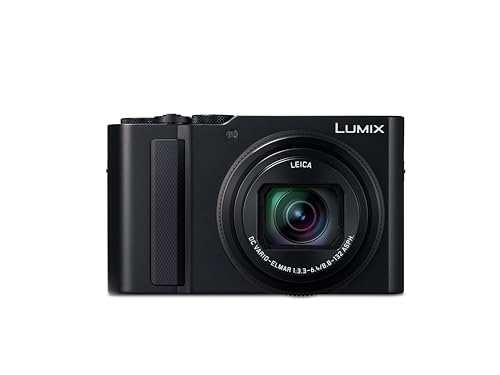
If one camera here represents the grown-up answer to the zoom question, it is the ZS300. Panasonic pairs a 20.1MP 1-inch sensor — large for a travel compact — with a 15x optical zoom whose 24-360mm range is printed in the listing, so the buyer knows the wide and telephoto ends exactly. That range covers landscapes at 24mm through portraits and distant details at 360mm, while the bigger sensor keeps quality standing when light fades.
4K video completes a specification with no marketing fog: every headline figure is a real, comparable number. The trade is reach — 15x sounds modest beside 125x — yet 360mm equivalent frames most travel subjects honestly, and it does so on a sensor several times the size of the superzooms’. For photographers, this is the pick whose images will bear enlarging.
- Model: Panasonic LUMIX ZS300 compact travel camera
- Sensor: 20.1MP 1-inch sensor, as listed
- Zoom: 15x optical zoom, 24-360mm, as listed
- Video: 4K video, as listed
- Positioning: Compact travel zoom
- Configuration: Camera listing
Strengths
- 1-inch sensor delivers the best image quality foundation here
- Zoom range printed in millimetres, not just a multiplier
- 4K video matches its stills ambition
Trade-offs
- 15x reach is far short of the bridge superzooms’ extremes
- Premium travel-zoom pricing beside the slim Sonys
- Serious capability invites spending on cases and spare batteries
Best for: a travelling photographer who values image quality across a genuinely useful 24-360mm range.
Not suited for: a distant-wildlife specialist, for whom even 360mm will crop cruelly and the P1100 exists.

Sony Cyber-shot WX300 — 20x slim zoom in white
The WX300’s listing is a small model of honest specification: 18 megapixels, a 20x optical zoom with image stabilization stated in plain words, and a 3-inch LCD. No intelligent multipliers, no vague high-zoom language. A buyer can compare that 20x optical figure directly against every other optical figure in this guide and know the comparison is fair.
The camera itself is an earlier-generation slim Cyber-shot in a white finish that stands out in a sea of black compacts. Twenty-times reach in a pocket body covers holiday stages, distant architecture and candid telephoto work, with stabilization keeping the long end usable. Age shows in its generation’s video and connectivity expectations, yet as a straightforward optical-zoom compact at a legacy-era price, its proposition remains coherent.
- Model: Sony DSC-WX300/W (Cyber-shot WX300)
- Sensor: 18 MP, as listed
- Zoom: 20x optical image stabilized zoom, as listed
- Display: 3-inch LCD
- Colour: White
- Era: Earlier Cyber-shot generation
Strengths
- 20x optical zoom stated plainly and comparable across this guide
- Stabilization supports the telephoto end in handheld use
- Slim body keeps the reach pocketable
Trade-offs
- Earlier generation, with period video and connectivity
- White finish shows travel wear more visibly than black
- No bundle items are included
Best for: a holiday shooter who wants honest 20x optical reach in a slim, distinctive white body.
Not suited for: 4K-led video work, because this generation predates the ZS300’s 4K specification and cannot close that gap in use.

Panasonic LUMIX FZ80D Bundle — 20-1200mm long-range bundle
The FZ80D expresses its reach in the most informative way a listing can: as a lens range, 20 to 1200mm. That enormous span — wide enough for interiors at one end, telescope territory at the other — defines a bridge-style compact for photographers who chase distant subjects but stop short of the P1100’s extremity and bulk. It remains a substantial camera rather than a pocket one, and its buyers should picture a neck strap, not a trouser pocket.
This listing bundles the camera with a 64GB Extreme Pro SDXC UHS-I card, a sensibly fast card for a camera that will shoot bursts at distant, moving subjects. The two-item bundle keeps the proposition clean: camera, capable card, nothing decorative. For the reach-per-package brief, it sits between the slim compacts and the Nikon flagship of zoom, and it knows it.
- Model: Panasonic LUMIX FZ80D
- Lens range: 20 to 1200mm, as listed
- Bundle: 64GB Extreme Pro SDXC UHS-I memory card (2 items)
- Positioning: Zoom lens point and shoot bundle, per the listing
- Colour: Black
- Form: Bridge-style compact — strap carry, not pocket carry
Strengths
- Lens range stated in millimetres across an enormous span
- Quality fast card included for burst shooting
- Less extreme bulk than the P1100 while keeping serious reach
Trade-offs
- Still a bridge-style body that will not pocket
- Sensor and video detail are not expanded in the bundle title
- Two-item bundle means case and extras remain separate purchases
Best for: a distant-subject shooter who wants 1200mm-class reach with a fast card included and less bulk than the P1100.
Not suited for: a minimalist traveller packing one small bag, whose camera must vanish into a pocket between sights.
Comparison Table
| Pick | Badge | Headline fact from its listing |
|---|---|---|
| Nikon COOLPIX P1100 | Extreme 125x bridge superzoom bundle | Nikon COOLPIX P1100 Superzoom Digital Camera |
| Sony Cyber-shot HX80 | Slim high-zoom Cyber-shot | Sony DSCHX80/B High Zoom Point & Shoot Camera (Black) |
| Panasonic Lumix ZS25 | The intelligent-zoom lesson, in camera form | Panasonic Lumix DMC-ZS25K 16.1 MP Compact Digital Camera with 40x Intelligent Zoom (Black) |
| Panasonic Lumix ZS300 | 1-inch sensor travel zoom | Panasonic LUMIX ZS300 Compact Travel Camera, 1-Inch Sensor, 15x Zoom, 4K |
| Sony Cyber-shot WX300 | 20x slim zoom in white | Sony DSC-WX300/W 18 MP Digital Camera with 20x Optical Image Stabilized Zoom and 3-Inch LCD (White) |
| Panasonic LUMIX FZ80D Bundle | 20-1200mm long-range bundle | Panasonic LUMIX FZ80D 20 to 1200mm Compact Camera Bundle (Black) |
Optical, intelligent and digital zoom: how can you tell them apart on any listing?
Optical zoom moves lens elements to magnify the image before it reaches the sensor, so detail is genuinely resolved. When a listing in this guide says 12x, 15x, 20x or 125x optical, that figure describes the lens and can be compared directly with any other optical figure. This is the only zoom type that justifies buying a camera over a phone.
Intelligent zoom — the ZS25’s advertised 40x — extends reach by processing: cropping the sensor’s output and refining the result with software. It can look respectable at modest extensions, but it manufactures reach from existing pixels rather than gathering more scene detail. Manufacturers use it because the number is larger than the lens’s own, and listings rarely volunteer the lens’s separate optical figure beside it.
Digital zoom is the crudest form, a straight crop enlarged to fill the frame, identical in effect to cropping a photograph afterwards. The shopping rule survives every branding variation: find the word optical, take that number, and treat every other multiplier on the page as decoration until proven otherwise.
Why does a longer zoom demand stabilization and steady technique?
Magnification amplifies everything, including the photographer’s tremor. At 20x, a heartbeat moves the frame noticeably; at the P1100’s 125x, breathing becomes weather. Image stabilization — named in the Nikon and Sony listings here — counteracts small movements, and it is the difference between a usable long-zoom camera and a frustrating one.
Technique multiplies stabilization’s effect. Bracing elbows against the body, leaning on a wall or fence, exhaling before pressing the shutter and using a two-second timer on a rested camera all rescue frames that no stabilizer saves alone. At extreme reach, a monopod or beanbag transforms results more than any setting.
Light is the third partner: long zooms need fast shutter speeds to freeze both shake and subject, and fast speeds demand bright conditions or higher sensitivity settings. Superzooms are daylight instruments by physics, whatever their brochures imply, and planning subjects around good light is part of owning one happily.
How does sensor size trade against zoom length in a travel camera?
A pocket body holds a fixed volume, and designers spend it on either lens or sensor. The ZS300 spends it on a 1-inch sensor and accepts a 15x lens; the slim superzooms spend it on longer lenses over smaller sensors; the P1100 escapes the trade by abandoning pocket size altogether and growing to bridge dimensions.
The photographic consequences are predictable. Bigger sensors win in dim light and in background blur. Longer lenses win whenever the subject cannot be approached — wildlife, stages, distant architecture. Neither victory helps the other’s photographs, which is why this guide asks buyers to diagnose their own missed shots before choosing.
A useful test: scroll your last holiday’s photographs and count the failures. Images ruined by distance argue for zoom; images ruined by grain and blur argue for sensor. The majority verdict, honestly counted, is the most reliable buying advice in this entire category.
What does a lens range in millimetres tell you that a zoom multiplier hides?
A multiplier alone — 15x, 20x — says how much a lens magnifies from its own wide end, but not where that range sits. The ZS300’s listing prints 24-360mm, revealing a genuinely wide starting point for landscapes and interiors as well as its telephoto end. Two cameras can both claim 20x while covering completely different real ranges.
Wide ends matter more than buyers expect. Travel photography constantly needs to fit a square, a cathedral or a family group into the frame from close quarters, and a lens starting at 24mm does it where one starting at 28mm forces a backward walk into traffic. The FZ80D’s printed 20-1200mm range promises an even wider start alongside its extreme reach.
When a listing gives both figures, trust the millimetres for planning and use the multiplier only for quick comparison. When it gives neither — as with the tersest title in this guide — treat the omission itself as information and verify the specification before money moves.
How do you shoot sharp pictures at the long end of a superzoom?
Set the camera up for the distance before the moment arrives: zoom to the expected framing, let the stabilization settle for a breath, and half-press to focus while the subject is still approaching its mark. Superzoom lenses focus and zoom more slowly than prime lenses, and pre-empting that delay is the working photographer’s main skill with this class.
Support is the second skill. Rest the camera or your elbows on anything stable — a railing, a daypack on a wall, a companion’s shoulder with permission. At extreme magnification, even stabilized handheld shots vary wildly in sharpness, while a rested camera produces consistent results that reward the small effort.
Shoot short bursts at moving distant subjects and select later. Professionals with extreme zooms expect a keeper rate, not perfection per frame, and they budget card space accordingly — one reason the bundled 64GB cards in this guide are sensibly sized.
How should you care for a retracting zoom lens?
The extending barrels of compact zooms are their most fragile feature. Never force a lens that hesitates, never wipe grit across its glass with dry cloth, and keep the camera cased in sandy or dusty environments. A blower removes loose particles safely; a soft brush handles the barrel’s crevices where grit migrates toward the mechanism.
Battery discipline protects lenses too: a camera that loses power mid-extension can leave its lens stranded, and repeated hard power cuts strain the mechanism. Charge before long outings and switch off before pocketing, letting the lens retract fully under its own power.
Store the camera lens-retracted in a dry place, and operate the zoom through its range every few weeks during quiet periods. Mechanisms that travel regularly rarely seize, and a fault discovered at home costs a repair bill rather than a ruined trip.
How do you photograph birds with a superzoom without disturbing them?
Bird photography with a superzoom is an exercise in ethics enforced by optics. The long lens exists so the photographer does not have to approach, and the working rule is absolute: if the bird changes its behaviour because of you, you are too close, whatever the lens can technically frame. Set up at a respectful distance from feeders, nests and roosts, let the birds resume their routines around your stillness, and let the 125x or 60x reach close the remaining gap on the sensor rather than with your feet.
Technically, the discipline is preparation. Pre-focus on the perch or feeder port the birds favour, compose wider than the final crop to allow for sudden movement, and use the fastest shutter speed the light permits, because small birds move in increments that blur at speeds a portrait would forgive. Bright mornings are the superzoom’s natural studio: they feed the small sensor the light it needs while the birds are most active, an alignment of the subject’s schedule and the equipment’s physics.
The keeper rate will humble beginners, and that is normal across all of bird photography, not a verdict on the camera. Professionals delete the majority of frames from any session. What the superzoom changes is access: species that once required a hide, a fortune in glass and a season of patience can now be recorded, identified and enjoyed from a garden chair, which is a democratic shift in a once-exclusive pursuit.
What happens to image quality at the far end of an extreme zoom?
Three enemies gather at maximum magnification, and naming them turns disappointment into technique. The first is atmosphere itself: hundreds of metres of air carry heat shimmer, dust and moisture that soften any lens, however expensive, which is why distant subjects photograph crisper in the cool of morning than over sun-baked ground at noon. No camera in this guide escapes that physics, and the photographer who schedules around it gains more than any upgrade could deliver.
The second enemy is shake, amplified in direct proportion to magnification. Stabilization — named in the Nikon and FZ80D listings here — fights it bravely, but at the longest settings a rested camera, a braced posture or a support separates sharp files from hopeful ones. The third enemy is the small sensor’s struggle as the lens reaches its slowest apertures at full extension: shutter speeds fall, sensitivity rises, and fine detail trades against noise in proportions the photographer can influence but never abolish.
Managed together, these enemies leave a wide working envelope. Bright light, morning air, solid support and subjects at sensible distances produce superzoom files that print beautifully at family sizes and identify any bird in the field guide. Demanding dusk miracles at maximum reach produces the murky results that give the class its unfair reputation — unfair because the misuse, not the instrument, failed.
How should a traveller choose between the ZS300 and a slim superzoom?
The decision is a referendum on your own archive. Open your last trip’s photographs and sort them by the light they were taken in. If the majority live in bright exteriors — viewpoints, harbours, old towns at noon — the slim superzoom’s longer reach serves the photography you demonstrably do, and its sensor penalty rarely appears. If evenings, interiors and restaurants fill the album, the ZS300’s 1-inch sensor is buying quality in exactly the frames you treasure most.
Carry style casts the second vote. The ZS300’s formula still pockets, but it is a photographer’s pocket camera, carried with intent; the slim Sonys in this guide vanish more completely and suit travellers who photograph opportunistically between other activities. Weight differences at this scale sound trivial in a specification table and become decisive on the twentieth kilometre of a walking day, a truth every travel photographer learns exactly once.
Budget casts the third vote, and it should be counted in total system terms: case, spare battery, cards and the bag a bridge body demands. The ZS300’s premium buys the sensor; the superzoom’s saving buys the accessories that make its reach usable. Either allocation is rational. The irrational purchase is the one made without the archive referendum, by a traveller shopping for the photographer they imagine being rather than the one their photographs prove they are.
Why do manufacturers advertise intelligent and digital zoom at all?
Because shelf comparison rewards the largest number, and lens engineering is expensive while processing claims are cheap. A compact with a modest lens can advertise a formidable reach figure by counting the crop its software performs, and beside a rival honestly stating a smaller optical figure, the dishonest number wins the hurried shopper. The practice persists because it works on exactly the buyers least equipped to detect it, which is why guides like this one treat zoom translation as consumer protection rather than pedantry.
The technology itself is not fraudulent in moderation. Intelligent zoom’s processing can produce presentable results at modest extensions, and for a snapshot destined for a phone screen, the difference from true optical reach may never be visible. The offence is in the comparison the number invites — placing a processed 40x beside a lens’s 20x optical as though they were the same currency. They are not, and the exchange rate worsens with every step of extension.
Regulation and reviewer pressure have improved labelling in some markets, and the better listings in this guide state their optical figures cleanly in millimetres or plain multipliers. The shopper’s defence remains the oldest one: find the word optical, note its number, and let every other multiplier on the page pass by as advertising weather. A camera bought on its lens’s true figure never disappoints on that score.
How do you set up a superzoom for a day at the zoo or safari park?
Preparation begins the night before: charge the battery fully, format a capacious card in the camera, and clean the front element, because a day’s shooting through enclosure glass and mesh will add enough optical obstacles without a smeared lens contributing. Set the camera’s stabilization on, choose its largest fine-quality file setting, and decide in advance that digital zoom extensions stay off — the day’s framing will be done by the lens or not at all.
In the field, work with the enclosures rather than against them. Position the lens close to mesh and shoot through a single opening, letting the shallow depth of the long lens blur the barrier into invisibility; at glass, angle the lens to dodge reflections and shade it with a hand. Shoot in the morning when animals are active and the light is kind to small sensors, and rest the camera on rails and posts whenever the subject pauses — zoo architecture is a forest of free tripods.
Pace the battery and the card across the day rather than spending both by lunch. Review sparingly, delete nothing in haste on a small screen, and keep the camera cased between enclosures against dust and knocks. The superzoom’s gift at a zoo is the portrait no phone in the crowd can take — the tiger’s face from the public path — and a methodical day harvests a dozen of them.
What is the realistic ceiling of a bridge superzoom, and when should you step beyond it?
The ceiling is defined by light and motion. A bridge superzoom in bright conditions, shooting perched birds, distant architecture and moonlit landscapes from support, operates far above its reputation. Move the subject into shade, add speed — a bird in flight, a player at dusk — and the small sensor and slow long lens reach their physical limits together: focus hunts, shutter speeds sag, and the files record the struggle honestly. No settings menu repeals that boundary.
Stepping beyond it means accepting the interchangeable-lens world’s costs: a larger sensor body, a telephoto lens whose price alone can exceed the entire bridge camera, and a bag that announces a photographer’s intent. What that money buys is real — focusing that tracks flight, files that survive dusk, prints that hold at exhibition sizes. Photographers whose subjects live at the boundary should pay it without resentment, because equipment matched to the work is never the expensive option in the long run.
Most superzoom owners, though, discover their subjects live comfortably inside the ceiling, and the bridge camera serves them for years at a fraction of the system’s cost and weight. The mature decision is to let your own attempted photographs, not a forum’s hierarchy, announce when the ceiling has been reached. Until that announcement arrives in your own archive, the superzoom is not a compromise. It is the correct tool.
How do you photograph the moon with a superzoom?
The moon is the superzoom’s parlour trick and its finest advertisement, because a subject that defeats every phone becomes a detailed disc at 125x or even 60x optical reach. The technique is mostly stillness: the camera rested or tripod-mounted, stabilization settled, a self-timer or remote release so the pressing of the button does not smear the frame, and focus allowed to lock on the bright limb where contrast lives. Expose for the moon itself, not the night around it — the disc is sunlit rock, far brighter than intuition suggests, and automatic metering that averages the black sky will bleach it featureless.
Choose the night with the same care as the settings. A moon a few days from full shows its craters in raking light along the terminator, where a full moon’s flat glare hides them; clear, still air after a cold front steadies the atmosphere that otherwise boils the detail away. Shoot a sequence across the evening as the moon climbs, because the atmosphere thins with altitude and the last frames are usually the sharpest of the night.
The resulting photograph — craters, maria, the works, from a camera carried in one bag — converts more sceptics to the superzoom cause than any review paragraph. It is also a standing lesson in the class’s physics: a static, bright, distant subject is exactly what extreme optical zoom exists for, and no other instrument at this size and price performs the trick at all.
How do you keep a superzoom steady on a boat, train or moving vehicle?
Moving platforms add their vibration to your own, and the technique is to decouple from both. Never rest the camera or your elbows on the vehicle’s structure, which transmits engine vibration directly into the lens; instead, hold the camera free with elbows tucked into your body, letting your torso act as the suspension the vehicle refuses to provide. On boats, time exposures to the swell’s pause at the top of each rise, when the deck momentarily stops accelerating and the horizon steadies.
Settings follow the motion. Favour the fastest shutter speed the light allows, accept higher sensitivity as the price of stillness, and shoot in short bursts from which the sharpest frame — the one that coincided with a calm instant — can be selected at leisure. Stabilization stays on and earns its keep doubly here, but it corrects your tremor, not the sea’s, so the burst is the real insurance policy.
Compositionally, embrace what the platform offers: the coastline unrolling, seabirds pacing the ship, harbour approaches at telephoto compression. Superzooms earn their passage on boats and scenic trains precisely because the subjects are distant, the light is usually generous, and the alternative — a phone pressed to a vibrating window — produces the smears every traveller recognises. The rested-on-body, burst-at-the-pause method turns those journeys into some of the best shooting of the trip.
What subjects suit a 20x slim zoom better than a 125x bridge camera?
Most of them, on most days — which is why the slim zoom outsells its extreme cousin. The 20x class, represented here by Sony’s WX300 with its plainly stated optical figure, covers the working photographer’s real distances: the far side of a square, the detail on a cathedral, the performer on a civic stage, the candid portrait across a garden. At those ranges the atmosphere is thin, the light is usually adequate, and the slim body’s instant readiness beats the bridge camera’s deliberation every time.
The bridge superzoom’s extra reach serves a specialist minority of frames: the bird, the moon, the ship at the horizon, the shy animal. Photographers whose albums contain those subjects weekly should pay the size tax gladly. Photographers whose albums contain them yearly are carrying a bag daily for a dozen annual frames, and the arithmetic of that trade, honestly totalled, usually favours the pocket camera plus patience.
This is the zoom category’s central maturity: matching reach to evidence rather than to appetite. The largest number is the easiest to sell and the least often needed, and the photographer who audits a year’s photographs for their actual focal distances buys correctly the first time. Twenty times, it turns out, is where most of photography lives — a fact the slim zoom’s designers understood and its marketing, to its credit, never needed to exaggerate.
How do you clean and store a bridge camera between expeditions?
Bridge cameras live episodic lives — intense weeks of travel separated by months of cupboard — and storage is where their longevity is decided. Clean before storing, never after discovering: blow dust from the barrel’s seams, wipe the front element with a breath and a soft cloth, and cycle the zoom through its full range a final time so it rests retracted and relaxed. Store the battery separately at partial charge, because a pack forgotten inside a camera for a year can swell or die in ways that damage the compartment it was trusted to.
The storage place matters as much as the ritual. A dry interior shelf beats the garage’s humidity and the attic’s heat everywhere on Earth, and a simple sealed box with a rechargeable dehumidifier pack serves owners in tropical climates better than any gadget. Keep the strap attached and the case closed against the household dust that migrates, over months, into every zoom mechanism ever built.
Wake the camera monthly for five minutes: power on, zoom through the range, fire a few frames, top the battery if it has sagged. Mechanisms and batteries both reward this small exercise, and the habit guarantees the camera is expedition-ready when the opportunity is sudden — which, for the subjects bridge cameras exist to photograph, it usually is.
How does atmospheric haze limit long-zoom photography, and how do you beat it?
Haze is the long zoom’s invisible tax. Every metre of air between lens and subject carries moisture, dust and heat turbulence that scatter light and soften contrast, and at superzoom distances the metres number in the hundreds. The effect is worst over sun-heated ground, water at midday and cities in summer — which is to say, over most of the subjects tourists point long lenses at — and it is routinely misdiagnosed as a faulty lens by owners who test their new camera across a noon valley.
The countermeasures are scheduling and geometry. Shoot distant subjects in the first hours after dawn, when the air is cool, still and washed by the night; after rain, when the dust has been knocked out of it; and in winter, when humidity falls. Shorten the air path whenever the subject allows — elevation helps, because looking slightly down through still air beats looking level through a kilometre of shimmer — and accept that some famous views are morning subjects that no equipment will rescue at noon.
Post-processing can restore contrast to a hazed frame but cannot restore detail the air dissolved, which is why the fieldcraft matters more than the software. Photographers who internalise the haze rules stop blaming their superzooms and start planning around the atmosphere like sailors around weather — and their long-zoom files improve more in a month than any lens upgrade could achieve in a year.
What should a superzoom owner pack for a dedicated wildlife weekend?
The kit is short and deliberate: the camera, two charged batteries, two capacious cards, a monopod or beanbag, a blower and cloth, and clothing that lets you sit still in the morning’s cold without fidgeting the hide into uselessness. The monopod earns its place by the second hour, because even a stabilized superzoom at full reach punishes handheld technique across a long session, and the beanbag turns any fence, car window or hide ledge into a studio-grade support.
Food, water and patience outrank every accessory after that. Wildlife sessions are won by the photographer who is still present, comfortable and quiet when the subject finally performs, and lost by the one whose hunger or cold announced itself at the decisive moment. A flask and a sandwich are photographic equipment in the only sense that matters by hour three.
Leave the second-guessing at home. One camera, one lens that cannot be changed, a method rehearsed — the superzoom’s fixed-lens simplicity becomes a discipline that interchangeable-lens owners, forever swapping and wondering, sometimes envy. The weekend’s success is measured in encounters witnessed as much as frames kept, and the photographer equipped lightly enough to stay all day usually wins both counts.
How do you evaluate a used superzoom before buying?
The zoom mechanism is the whole inspection. Cycle it slowly through its full range several times, listening for grit and watching for hesitation or uneven travel; extend it fully and check the barrel for wobble beyond the model’s normal tolerance. Photograph a detailed distant subject at maximum reach and a plain sky at a small aperture, then examine both files enlarged: the first exposes decentering and fungus, the second maps the sensor’s dust and any dead patches storage may have caused.
Electronics follow: stabilization should visibly settle the view at long zoom, autofocus should lock decisively in good light, and every dial and button should answer. Check the battery against a full charge’s honest endurance, because a tired pack on a power-hungry superzoom can halve a day’s shooting, and price a replacement into any offer. Cosmetic wear on a bridge body is forgivable; a scratched front element is not, since it sits in every photograph the camera will ever take.
Buy from sellers who can describe the camera’s life — where it travelled, how it was stored — because superzooms age by environment more than by use. A garden birder’s pampered P-series and a beach rental’s survivor may share a model name and nothing else. The inspection ritual takes fifteen minutes and is the entire difference between the used market’s bargains and its warnings.
When is a travel zoom’s 15x honestly better than a superzoom’s 125x?
When the photographs are the point rather than the reach. The ZS300’s 15x optical zoom rides on a 1-inch sensor, so every frame across that range carries detail, dynamic range and low-light ability the small-sensor superzooms cannot approach at any setting. For the traveller whose album mixes dawn harbours, museum interiors, family evenings and the occasional distant tower, that uniform quality across a useful range outweighs a spectacular reach reserved for a handful of frames.
The comparison sharpens at print size. Superzoom files at maximum reach serve identification and sharing beautifully and large prints reluctantly; the travel zoom’s files enlarge with confidence, because the sensor gathered the information the print demands. Photographers who print — and this guide keeps insisting they are the ones equipment should serve — feel the difference on the wall, where it cannot be argued away.
None of this demotes the superzoom, whose subjects simply live elsewhere. It locates each instrument honestly: the bridge camera is a telescope that photographs, the travel zoom is a camera that reaches. Buy the one whose sentence describes your photography, and the numbers — fifteen, one hundred and twenty-five — stop competing and start informing.
Common Mistakes
Comparing an intelligent-zoom figure against optical figures
Placing the ZS25’s 40x Intelligent Zoom beside the WX300’s 20x optical and concluding the Panasonic reaches twice as far is the exact error its marketing invites. One number describes processing, the other a lens. Compare optical with optical only, and ask what a listing is hiding when it will not state an optical figure.
Expecting a bridge superzoom to behave like a pocket camera
The P1100’s 125x lens requires a bridge body, a bag and deliberate carrying. Buyers who order it imagining a large pocket compact return it or abandon it at home. Respect the category: bridge cameras are instruments you plan to carry, and their photographs reward exactly that commitment.
Judging superzooms by their performance at dusk
Extreme zooms over small sensors are daylight tools. Evaluating one by its murky evening output, then rejecting the whole class, misreads the physics every owner works within. Schedule distant-subject photography for good light and these cameras shine; demand night miracles and only a large sensor will do.
Zooming fully when stepping closer would work better
Beginners stretch to maximum zoom from wherever they stand, inheriting shake, haze and flat light. Walking closer — when the subject allows — improves every variable at once: less magnification needed, better light angles, stronger composition. The zoom is for subjects you cannot approach, not a substitute for legs.
Final Recommendation
The zoom category sorts itself once its language is translated. For genuine, extreme optical reach and the willingness to carry for it, the P1100 stands alone. For reach balanced with the best sensor in the set, the ZS300 is the photographer’s choice. The slim Sonys serve travellers who want honest optical figures in pocket bodies, the FZ80D bundle stretches to 1200mm with a fast card included, and the ZS25 remains in this guide as the standing reminder to read zoom claims twice.
Apply that reading habit beyond these six listings and the category becomes safe territory: optical figures compared with optical figures, millimetre ranges trusted over multipliers, and body size matched to how you actually travel. A camera chosen that way delivers the one thing this class exists for — the distant photograph your phone could not take.
Before ordering, run one final check that costs nothing: stand where you will actually use the camera, look at your most distant regular subject, and ask whether the reach you are buying serves that view or a fantasy one. The honest answer, matched to the right pick above, is the whole purchase.
Frequently Asked Questions
Is 125x zoom on the Nikon P1100 really optical?
Yes — the listing states 125x optical zoom with image stabilization, and that figure describes the lens. The consequences are physical rather than magical: a bridge body the size of a small DSLR, a need for stabilization and steady technique, and daylight as the natural working condition. The reach is genuine, and so is the bulk that enables it.
What is intelligent zoom, in plain language?
It is a processing extension that crops and refines the image to simulate more reach than the lens provides, as advertised on the Lumix ZS25 at 40x. Results can be usable, but the figure must never be compared with optical zoom numbers or printed as one. This guide treats the ZS25’s 40x strictly as a marketing figure and ranks the camera on its other merits.
Which pick has the best image quality?
The Panasonic ZS300, because its 20.1MP 1-inch sensor is the largest in this set while still offering a useful 15x optical zoom across 24-360mm. The superzooms reach further on smaller sensors. Quality and reach trade against each other throughout this category, and the ZS300 is the quality-led end of that exchange.
Why does the Sony HX80 review avoid quoting a zoom figure?
Because its listing title does not print one, calling the camera a high zoom model without a number. Inventing a figure from the model’s reputation would break the rule this guide applies to every pick: only title-stated facts become specifications. Buyers should confirm the full specification on the listing page before purchasing.
Can a superzoom replace a DSLR with a telephoto lens?
For daylight distant subjects at modest print sizes, it can come surprisingly close, and it does so in one fixed package with no lens changes. An interchangeable-lens system with a quality telephoto still wins on sensor size, focusing speed and low light. The superzoom’s victory is convenience and total reach per package, honestly bounded.
Related Guides
Keep exploring with the pocket camera guide where body size is the entry ticket, then compare our APS-C mirrorless picks for photographers outgrowing compacts, and finish with the portable monitor guide for reviewing shots on a bigger screen.



[…] exploring with the optical zoom guide that separates lens reach from marketing, then compare our pocketability-tested compact camera picks, and finish with the APS-C mirrorless […]