What's inside
- Key Takeaways
- Quick Picks
- How We Chose These Picks
- How Does PS5 3D Audio Change What a Headset Needs to Do?
- Wired Through the Controller or Wireless Through a Dongle?
- How Do the Six PS5 Headsets Compare Directly?
- How Do You Get the Best From Party Chat on PS5?
- What Should Glasses Wearers and Long-Session Players Look For?
- How Do You Share One Headset Between a PS5 and a PC?
- How Does the PS5’s Catalogue Shape the Comfort You Need?
- What Does a Good PS5 Microphone Actually Sound Like to Your Party?
- How Should You Set Up 3D Audio and Chat Balance on the Console?
- When Is a Second, Wired Headset the Smartest PS5 Purchase?
- How Long Will a PS5 Headset Last, and What Ages First?
- How Do You Trial a PS5 Headset Properly in the First Week?
- What Changes When the PS5 Is in a Bedroom Rather Than a Living Room?
- What Mistakes Do PS5 Headset Buyers Keep Making?
- Final Recommendation
- Frequently Asked Questions
- Related Guides
As an Amazon Associate I earn from qualifying purchases. This post may contain affiliate links at no extra cost to you.
widgetverdict.com is reader-supported. When you buy through links on our site, we may earn an affiliate commission.
Where to buy: Amazon carries every headset in this guide, spanning Sony’s own first-party wireless headset, three wireless all-rounders from the big gaming brands, and two wired designs that plug into the DualSense controller and simply work.
The best gaming headsets ps5 buyers can choose from start with an advantage no other console offers: the platform holder makes one itself, the audio system — Tempest 3D AudioTech — is built into the console, and the controller in your hands carries a 3.5mm jack that turns any wired headset into a PS5 headset in one second. That abundance creates the category’s only real problem, which is choosing where on the wired-to-wireless, value-to-flagship spectrum your evenings actually live.
This guide maps that spectrum with six picks. At one end sits Sony’s own Pulse wireless headset in Midnight Black, the first-party answer. The middle belongs to the multiplatform wireless generation — SteelSeries’ Arctis Nova 5, Turtle Beach’s Stealth 600 and Logitech’s G733 — headsets that serve a PS5 first and a PC, Switch or phone second. At the other end, the HyperX Cloud III and Razer BlackShark V2 X make the wired case: no batteries, no pairing, controller-jack simplicity, and comfort engineered to be forgotten.
Every pick is judged on the PS5 specifics that generic headset reviews skip: how it handles the console’s 3D audio, whether its microphone survives a party chat’s judgement, how its wireless dongle behaves in the console’s front ports, and whether it stays comfortable through the long single-player sessions this console’s catalogue specialises in. If your PS5 shares a desk with a PC, the reviews flag exactly which picks make that journey daily and which make it grudgingly. None of the six requires anything beyond the console, a controller and a chair to deliver its best — the extras are preferences, and the guide treats them that way.
Key Takeaways
- Sony’s Pulse is the first-party wireless route, designed around the PS5’s own 3D audio system.
- The Arctis Nova 5 is the battery champion of the wireless group at 60 hours, with 2.4GHz and Bluetooth modes.
- The Stealth 600 pushes battery further still — 80 hours — with memory foam and a flip-to-mute mic.
- The G733 is the style-and-comfort wireless pick, with a suspension headband and Blue VO!CE microphone.
- The Cloud III and BlackShark V2 X prove the wired case: DualSense-jack simplicity and nothing to charge.
- Multiplatform players should buy the wireless trio or the Cloud III; PS5-only players can let fit decide.
Quick Picks
| Pick | Badge | Why it earns its place |
|---|---|---|
| PlayStation Pulse Wireless Headset | Best first-party PS5 headset | Sony’s own wireless design in Midnight Black, built to sit at the centre of the PlayStation ecosystem. |
| SteelSeries Arctis Nova 5 | Best wireless all-rounder | 60 hours of battery, 2.4GHz or Bluetooth at a switch, and a ClearCast Gen2.X mic across PS5, PC and Switch. |
| Turtle Beach Stealth 600 | Best battery life on PS5 | An 80-hour battery, 50mm drivers and memory foam in a white multiplatform wireless design. |
| Logitech G733 Lightspeed | Best comfort and style | A suspension headband that floats the weight away, Blue VO!CE mic clarity and Lightspeed wireless. |
| HyperX Cloud III | Best wired headset | Memory foam, a durable frame and three connection cables for PS5, PC and Xbox with a notably clear 10mm mic. |
| Razer BlackShark V2 X | Best wired value for PlayStation | 50mm drivers, a cardioid mic and noise-isolating cups in a lightweight wired PlayStation design. |
How We Chose These Picks
We started with the console’s two audio doors: the DualSense controller’s 3.5mm jack and the USB ports that host wireless dongles. A credible PS5 shortlist must serve both, because the platform’s players divide by them — sofa players who refuse cables, desk players who refuse charging, and the large middle who will accept either for the right headset. Two wired and four wireless picks reflect that real distribution rather than an editor’s preference.
The first-party question came second. Sony’s Pulse belongs in any honest PS5 guide because it is the headset the platform’s own audio team designed around the console’s 3D audio, and because some buyers want the ecosystem answer with no further research. It is judged here by the same standards as the third-party picks — comfort, microphone, battery discipline — rather than waved through on the badge.
Multiplatform reach was the third filter, applied asymmetrically on purpose. Most PS5 households contain a second machine, so four of the six picks travel — to PC, to Switch, in the Cloud III’s case even to Xbox. The two that lean hardest into PlayStation, the Pulse and the BlackShark V2 X PlayStation edition, earn their places by serving the console itself best, which is a legitimate specialisation this guide respects.
Finally, comfort was weighted for the PS5’s actual catalogue: long, cinematic, single-player games played in multi-hour sittings. Memory foam appears on three picks, a suspension headband on another, and every review reports the wearing experience across an evening rather than across a demonstration. On this console, the headset that disappears wins.
How Does PS5 3D Audio Change What a Headset Needs to Do?
The PS5 renders its Tempest 3D audio in the console, not in the headset, and that architectural fact simplifies buying enormously: any stereo headset connected to the console — by controller jack, USB or a licensed wireless link — can carry the 3D-processed signal. You do not need a headset that advertises its own surround processing to hear a PS5 game in three dimensions; you need a headset with clean stereo imaging, because the console is doing the spatial work and the headset’s job is to deliver it faithfully.
That shifts the buying criteria in a healthy direction. Driver quality, channel balance and a soundstage that does not collapse everything into the centre of the skull matter more than virtual-surround badges. The wired Cloud III and BlackShark V2 X, neither of which processes anything, deliver the console’s 3D audio exactly as rendered — one reason the wired case on PS5 is stronger than on platforms where the headset must do the spatial work itself.
Set the console’s 3D audio profile up properly whichever pick you buy: the PS5 offers adjustable ear-height profiles, and five minutes spent choosing the one that places sounds correctly for your ears improves every headset in this guide more than an upgrade would. The technology is in the console; the headset is the window, and windows should be clean rather than clever.
Wired Through the Controller or Wireless Through a Dongle?
The DualSense jack is the PS5’s quiet gift to headset buyers. Plug in and everything works — game audio, party chat, the console’s 3D processing — with the controller itself as the only battery in the chain, and it is a battery you already charge. Wired headsets are also the lightest option and the cheapest route to genuine quality, which is why the Cloud III and BlackShark V2 X hold their places against wireless rivals costing considerably more in spirit.
The wireless case is the sofa. A dongle in the console’s USB port frees the player from the controller cable’s short leash — a cable that runs from your hands, which is exactly where a cable is most felt during play — and the modern wireless picks have closed the quality gap to the point where battery life, not fidelity, is the remaining argument. On the numbers in this guide that argument is nearly settled: 60 hours from the Arctis Nova 5 and 80 from the Stealth 600 mean charging is a monthly event, not a ritual.
The deciding question is your second machine. A desk where the PS5 shares space with a PC rewards the wireless all-rounders and the Cloud III’s cable trio; a console-only living room rewards whichever fits your head best. Latency, once the wireless objection, is a solved problem at 2.4GHz for this console’s catalogue — buy on comfort, battery and microphones instead.

PlayStation Pulse Wireless Headset — Best first-party PS5 headset
The Pulse is the headset Sony designed to be the PS5’s own voice, and its argument begins with belonging. It speaks the console’s design language — here in the Midnight Black finish that matches the black console covers and controller variants — pairs with the platform the way a first-party accessory should, and is tuned by the same organisation that built the console’s 3D audio system. For the player who wants the ecosystem answer, the one the platform holder intended, this is it, and no third-party pick can fully replicate that integration.
Wireless freedom is its working premise: no cable to the controller, no tether between the player’s hands and their ears. On the PS5 that freedom compounds, because the DualSense is already doing haptics and adaptive-trigger work that a dangling cable subtly fights. A first-party wireless headset also inherits the console’s update rhythm and settings surface, so the experience of owning it feels like owning part of the console rather than an accessory bolted onto it.
Its honest boundary is the mirror of its strength. The Pulse is a PlayStation-first product in a guide where four rivals pride themselves on travelling to PC and Switch; a player whose gaming life is genuinely multiplatform will extract more total value from the Arctis Nova 5 or the Stealth 600. The Pulse also asks the wireless tax — a battery to keep charged — that the wired pair below never will.
Judge it, then, as the specialist it is. For the PS5-centred household, and especially for the player who values the designed-as-one-system feeling that only first-party hardware gives, the Pulse in Midnight Black is the natural default — the headset the console would choose for itself.
There is a giftability to it that should not be underestimated in a guide read by people buying for others. A first-party headset is the one purchase in this category that cannot be wrong in the ways that embarrass: it will match the console, speak its language and arrive with the platform’s own assumptions built in. Third-party picks reward the buyer who knows the player’s habits; the Pulse rewards the buyer who knows only that the player loves the console — which, in December, is most buyers.
- Type: Wireless headset
- Maker: PlayStation (Sony), first-party
- Finish: Midnight Black
- Platform: PlayStation 5 centred
- Audio: Built around the console’s 3D audio
Strengths
- First-party integration with the console and its settings.
- Design language matches the black PS5 setup.
- Wireless freedom with no controller cable.
Trade-offs
- PlayStation-first focus beside multiplatform rivals.
- A battery to manage, like every wireless pick.
- Ecosystem polish matters less to PC-sharing desks.
Best for: PS5-centred players who want the platform’s own headset. Not suited for: players splitting their hours evenly across PC and Switch.

SteelSeries Arctis Nova 5 — Best wireless all-rounder
The Arctis Nova 5 is the headset for the desk where the PS5 is the biggest machine but not the only one. SteelSeries gives it neodymium magnetic drivers, a 60-hour battery, and two wireless modes — 2.4GHz for the console-and-PC work where latency matters, Bluetooth for the phone and the everyday — across a compatibility list that runs PC, PS5, PS4, Switch and mobile. It is the guide’s most complete traveller, and it travels without asking the owner to re-think anything at each border.
The microphone is the ClearCast Gen2.X, SteelSeries’ current generation of its retractable boom line, and it continues the family’s party-chat reputation: a voice that arrives clear and forward, from a boom that disappears into the earcup when the session turns single-player. That retractability is a small design decision with daily consequences — the Nova 5 looks and behaves like a pair of headphones when the mic is away, which is how a shared desk or a commute prefers its headsets.
Sixty hours of battery deserves its own sentence, because it changes the ownership rhythm from the category’s bad old days. Charged roughly monthly in ordinary play, the Nova 5 is simply always ready, and the psychological difference between a headset that might be flat and one that never is turns out to be most of what wireless ownership feels like. Against the Stealth 600’s 80 hours it concedes the endurance crown; against everything else here it wins the versatility argument outright.
Its compromises are matters of taste rather than function. The SteelSeries wearing style — ski-goggle-inspired tension rather than memory-foam plush — suits most heads and divides the rest, and black-plastic discretion will bore players who want their headset to look like an event. Try the fit if you can; buy it for the spec sheet with confidence regardless.
- Connection: 2.4GHz wireless or Bluetooth
- Drivers: Neodymium magnetic
- Battery: 60 hours
- Microphone: ClearCast Gen2.X
- Compatibility: PC, PS5, PS4, Switch, mobile
- Finish: Black
Strengths
- Two wireless modes cover consoles, PC and phone.
- 60-hour battery makes charging a monthly afterthought.
- Retractable mic keeps single-player sessions clean.
Trade-offs
- Fit style divides opinion more than foam designs.
- Stealth 600 outlasts it on battery.
- Understated looks for players wanting flair.
Best for: multiplatform players wanting one wireless headset for everything. Not suited for: players who know they dislike tension-band fits.

Turtle Beach Stealth 600 — Best battery life on PS5
Eighty hours. The Stealth 600’s headline is a battery figure that reframes what wireless ownership means: at a few hours of play an evening, a charge lasts the better part of a month, and the headset crosses from gadget-that-needs-feeding into furniture-that-works. For PS5 and PC — the platforms this multiplatform design names first — that endurance is the argument, and Turtle Beach backs it with 50mm drivers, memory foam cushions and Bluetooth alongside the primary wireless link.
The microphone continues the brand’s family pattern: a noise-cancelling flip-to-mute boom, silenced by swinging it up. In party chat the gesture is worth more than a button, because it is visible, unambiguous and performable mid-firefight without a glance. Memory foam, meanwhile, is the comfort choice for the PS5’s long single-player evenings — it moulds rather than presses, and it is the cushion material three of this guide’s picks converge on for good reason.
The white finish is a deliberate choice buyers should make with eyes open: it is the bright, clean look that suits a white-console setup and a tidy desk, and it will faithfully record every month of handling that a black headset forgives. Players whose PS5 lives in a family room with younger hands may prefer the Nova 5’s black discretion; players building the white setup will find this the only wireless pick here that completes the picture.
Against its wireless rivals the Stealth 600’s case is endurance plus cushions. It concedes the Nova 5’s retractable-mic elegance and the G733’s style, and wins the month between charges. For the player whose headset lives by the television and whose worst wireless memory is a flat battery on a Friday night, that is the trade that matters.
Turtle Beach’s long PlayStation history shows in the small print of ownership: this is a headset line refined across console generations for exactly this platform pairing, and its controls and fit assume a controller in the hands rather than a keyboard under them. Console-first design is a real thing, and players who live on the sofa rather than at a desk feel it in a hundred unlisted details.
- Connection: Wireless multiplatform plus Bluetooth
- Drivers: 50mm
- Battery: 80 hours, rechargeable
- Microphone: Noise-cancelling flip-to-mute
- Cushions: Memory foam
- Compatibility: PS5, PC, PS4 and more
- Finish: White
Strengths
- 80-hour battery, the longest in this guide.
- Flip-to-mute gesture is party-chat proof.
- Memory foam comfort for cinematic-length sessions.
Trade-offs
- White finish shows handling and travel honestly.
- Boom mic does not retract like the Nova 5’s.
- Endurance exceeds what light players will ever use.
Best for: heavy PS5 players who want charging to nearly disappear. Not suited for: tidy-finish sceptics in busy family rooms.

Logitech G733 Lightspeed — Best comfort and style
The G733 approaches the PS5 brief from the wearer’s side. Its suspension headband — a fabric strap that floats the frame’s weight across the head — is the most immediately noticeable comfort idea in this guide, the kind that makes a player put the headset on and say something about it within ten seconds. Logitech pairs it with Lightspeed wireless, PRO-G audio and a Blue VO!CE microphone, in a black design that has become a fixture of streaming desks as much as gaming ones.
Blue VO!CE deserves explanation, because it is the G733’s party-chat weapon: Logitech’s microphone processing, descended from the Blue microphone brand, applies real-time filtering to keep a voice broadcast-clean. In a PS5 party the difference registers as presence — the G733 wearer sounds like the person hosting the call. For players who stream from the console or simply care how they arrive in friends’ ears, that processing is a feature with daily returns.
Compatibility spans PC, PS5, PS4 and Switch, which makes the G733 a genuine all-rounder despite its style-first reputation. Its compromises are the style tax in reverse: the design language that delights its audience — the strap, the shape, the whole streaming-desk aesthetic — will read as costume to players who want their equipment invisible. It is also the wireless pick whose comfort story depends most on personal geometry; suspension bands suit most heads wonderfully and a few heads not at all.
Buy it for the wearing and the voice. Of the six picks here, the G733 is the one most likely to be described by its owner unprompted — the comfort compliment, the mic compliment — and in a category of competent black rectangles, personality backed by genuine engineering is a defensible reason to choose.
Its streaming-desk heritage has a practical PS5 consequence worth naming: this is the wireless pick most at home being seen. A player whose console sessions are also content — clips, streams, a camera in the corner of the room — is buying a headset that will appear in frame for years, and the G733 was designed by people who understood that the audience sees the headset more than the wearer does. Vanity is a specification when the camera is on.
- Connection: Lightspeed wireless
- Headband: Suspension design
- Microphone: Blue VO!CE
- Audio: PRO-G
- Compatibility: PC, PS5, PS4, Switch
- Finish: Black
Strengths
- Suspension headband comfort players notice immediately.
- Blue VO!CE processing for a broadcast-clean party voice.
- Cross-platform reach despite the style-first image.
Trade-offs
- Streaming-desk aesthetic is not for minimalists.
- Suspension fit depends on head geometry.
- Battery life trails the Stealth pair’s endurance race.
Best for: comfort-led players and console streamers who live in party chat. Not suited for: players who want equipment that disappears visually.
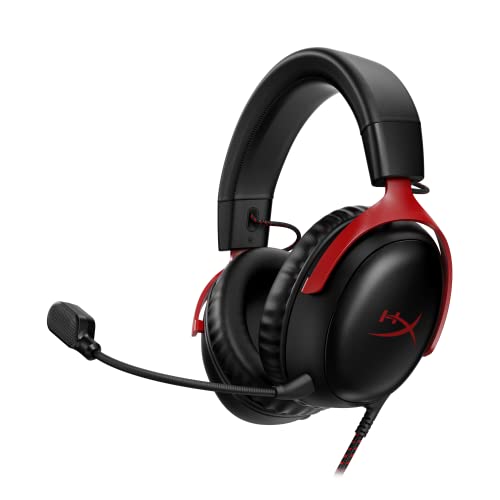
HyperX Cloud III — Best wired headset
The Cloud III is the wired argument at its most complete. HyperX built the Cloud line’s reputation on two things — memory foam comfort and frames that survive — and this generation adds the connection trio that makes it the guide’s most employable headset: USB-C, USB-A and 3.5mm cables covering PC, PS5, PS4 and even Xbox Series X|S. One headset, every machine in the house, no dongle, no battery, no negotiation. On the PS5 it lives in the DualSense jack; at the desk it takes USB; the headset does not care which day it is.
The microphone is a notably clear 10mm design — larger than the category’s typical capsule — and it shows in party chat, where Cloud owners have sounded like themselves for three generations of this line. Detachability keeps the headset civilised for music and travel. The durable frame, meanwhile, is the pick’s long game: this is the headset most likely in this guide to still be working, cushions aside, when the PS5’s successor is announced, because its failure points were engineered by a line that has been breaking and fixing them for a decade.
Wired limits apply in full. The cable reaches from the controller to your ears and no further, so the sofa-to-fridge journey happens in silence, and a desk shared with a PC means a cable swapped or a second headset eventually. Players who have tasted wireless freedom rarely return to the jack without resentment; players who have buried two wireless headsets’ batteries find the Cloud III’s simplicity reads as wisdom.
As the guide’s wired flagship its verdict is straightforward: if the cable does not frighten you, this is the most headset per decision here — the comfort, the microphone and the three-platform reach, with nothing to charge between you and the game. Generations of Cloud owners are not a marketing claim; they are the review.
- Connection: Wired USB-C, USB-A and 3.5mm
- Microphone: 10mm, ultra-clear
- Cushions: Memory foam
- Frame: Durable build
- Compatibility: PC, PS5, PS4, Xbox Series X|S
Strengths
- Three cables cover every platform in the house.
- Microphone clarity the line is famous for.
- Frame durability measured in console generations.
Trade-offs
- Controller cable ends the roaming conversation.
- No wireless mode at any price of adapter.
- Desk-and-console sharing means cable swapping.
Best for: wired loyalists and multiplatform homes wanting one durable headset. Not suited for: sofa players who roam mid-session.

Razer BlackShark V2 X — Best wired value for PlayStation
The BlackShark V2 X PlayStation edition closes the guide at the wired value end, and it earns the place on the strength of its fundamentals: 50mm drivers, a cardioid microphone, noise-isolating earcups and a lightweight frame, connected by the 3.5mm jack to the DualSense. Razer’s BlackShark line began as an esports design — the aviation-headset silhouette is a helicopter crew homage — and the V2 X distils that lineage into the simplest possible PlayStation purchase.
The cardioid microphone is the specification to understand. Cardioid capture favours sound from the front — your voice — over sound from behind the capsule, which in a living room means the television and the household are politely demoted in your party’s ears. Paired with noise-isolating cups that passively shut the room out of yours, the BlackShark gives a player in a busy house a two-way privacy that open designs cannot, at a wired price and with nothing to charge.
Its PlayStation branding sits alongside honest breadth: the listing covers PS5, Xbox Series X, PC and Switch through the same jack, so the value case compounds in multi-console homes. The compromises are the wired ones, plus a fit that runs snugger than the Cloud III’s — the isolation is partly clamp, and marathon sessions will introduce some players to their own ears by hour three.
For a first serious PS5 headset, or a second headset for the household’s other controller, the BlackShark V2 X is the pick that spends its money on drivers, microphone and isolation rather than on wireless electronics. Players building upward from pack-in earbuds will feel the upgrade in the first match, which is exactly what a value pick owes its buyer. It is also the easiest headset in this guide to lend, because there is nothing about it to explain.
- Connection: Wired 3.5mm jack
- Drivers: 50mm
- Microphone: Cardioid
- Cushions: Noise-isolating earcups
- Build: Lightweight
- Compatibility: PS5, Xbox Series X, PC, Switch
Strengths
- Cardioid mic demotes the room in party chat.
- Passive isolation suits busy living rooms.
- Jack breadth covers the whole console shelf.
Trade-offs
- Snug clamp can press across marathon sessions.
- Wired tether to the controller, as always.
- Fewer comfort luxuries than the Cloud III.
Best for: value-focused PlayStation players in lively households. Not suited for: players who know a firm clamp bothers them.
How Do the Six PS5 Headsets Compare Directly?
| Headset | Connection | Battery | Microphone | Also serves |
|---|---|---|---|---|
| PlayStation Pulse | Wireless | Rechargeable | Built-in first-party | PlayStation ecosystem |
| SteelSeries Arctis Nova 5 | 2.4GHz or Bluetooth | 60 hours | ClearCast Gen2.X | PC, PS4, Switch, mobile |
| Turtle Beach Stealth 600 | Wireless plus Bluetooth | 80 hours | Flip-to-mute, noise-cancelling | PC, PS4 |
| Logitech G733 | Lightspeed wireless | Rechargeable | Blue VO!CE | PC, PS4, Switch |
| HyperX Cloud III | Wired, three cables | None needed | 10mm detachable | PC, PS4, Xbox |
| Razer BlackShark V2 X | Wired 3.5mm | None needed | Cardioid | Xbox, PC, Switch |
How Do You Get the Best From Party Chat on PS5?
Party chat quality is decided by geometry before electronics. Whatever pick you own, position its microphone where the maker intended — boom near the corner of the mouth, not resting against a cheek — and run the console’s microphone level test honestly, speaking at match volume rather than library volume. A level set in silence will clip in excitement, and the player who sounds distorted in every firefight is usually a well-equipped player with a badly set gain.
Then use the platform’s own tools. The PS5’s party settings, the controller’s mute button — the orange-lit mercy every headset wearer should learn — and per-game voice balances exist so that the headset does not have to solve social problems with volume. Headsets with hardware mute gestures, the Stealth 600’s flip and the DualSense’s own button, earn their keep in the moment a doorbell, a child or a sneeze enters the call.
Finally, remember that your party hears your room as well as you. The BlackShark’s cardioid discipline and the Nova 5’s ClearCast tuning are technologies for a social fact: five people’s living rooms meet in a party chat, and the player whose room is quietest is the player everyone can hear. Choose and set up accordingly.
What Should Glasses Wearers and Long-Session Players Look For?
The PS5’s catalogue is a marathon catalogue, and its headset failures are comfort failures at hour three. Glasses wearers should look first at cushion material and clamp philosophy: memory foam, as on the Stealth 600 and Cloud III, moulds around frames instead of pressing them into the temples, and the G733’s suspension headband removes weight from the equation by carrying the headset from above rather than squeezing it on from the sides.
Heat is the second marathon variable. Sealed cups in a warm room accumulate it honestly, and the breaks a long game offers — cutscenes, loading, the kettle between chapters — should be used to lift the headset and let ears breathe. Players who know heat ends their sessions should weight the lighter, airier fits and accept the isolation trade, because a headset abandoned at hour two has no specifications at all.
The practical trial is unglamorous: wear the candidate for the length of your longest typical session, glasses on, in your warmest playing conditions, before the return window closes. Every pick in this guide can survive a shop’s five minutes; the ones worth keeping survive your Sunday.
How Do You Share One Headset Between a PS5 and a PC?
The shared desk is the normal desk now, and the six picks divide by how gracefully they commute. The wireless all-rounders commute best: the Nova 5’s 2.4GHz and Bluetooth pairing covers a console and a PC with a mode switch, the Stealth 600 names PS5 and PC in its first breath, and the G733’s Lightspeed link is a desk-native technology. Keep the dongle in the machine you use second-most and Bluetooth or the cable for the first, and the daily swap becomes a button rather than a re-pairing ceremony.
The Cloud III commutes by cable with a different kind of grace: USB for the PC, the DualSense jack for the console, and a frame durable enough to be unplugged twice a day for years. The Pulse and the BlackShark commute least willingly — the first by ecosystem loyalty, the second by being a jack-of-one-length — and both are better understood as the console’s own headset in a two-headset desk, a role many shared desks eventually settle into anyway.
Whichever pattern you choose, decide the headset’s home port and leave it there. Dongles and cables die by migration, in pockets and in the backs of drawers; a headset with a fixed home is a headset that is charged, findable and working when the session starts.
How Does the PS5’s Catalogue Shape the Comfort You Need?
Every console has a session shape, and the PS5’s is the long narrative evening: games built as ten-to-forty-hour stories, played in sittings that television would call double bills. That shape reorders headset priorities in a way spec sheets hide. Peak audio quality matters less than the absence of accumulating annoyances — the clamp that is fine at minute twenty and eloquent at hour three, the cushion that warms, the headband point that concentrates. The PS5 headset that wins is the one whose owner stops knowing they own it.
This is why three of the six picks spend their engineering on foam and weight distribution rather than on processing. Memory foam is not a luxury material in this context; it is the marathon material, because it distributes pressure across the whole contact patch instead of the two points a firmer cushion chooses. The G733’s suspension strap attacks the same problem from above. Even the BlackShark’s snugger isolation fit is a bet about its audience — shorter, competitive sessions where grip beats float.
Match the comfort technology to your session shape honestly. A player whose PS5 time is forty-minute competitive bursts can wear almost anything in this guide and should buy on microphone and price of admission. A player settling into a story game until midnight should buy on cushions first and read the rest of the review afterwards. The catalogue you actually play is the reviewer’s best proxy for the headset you actually need.
What Does a Good PS5 Microphone Actually Sound Like to Your Party?
Your party does not hear your headset’s specifications; they hear a voice that is either present or apologetic. Presence is built from three things: proximity, because a boom near the mouth captures the voice louder than the room; consistency, because a microphone that stays where it was put delivers the same voice in hour one and hour four; and processing, the modern layer — SteelSeries’ ClearCast tuning, Logitech’s Blue VO!CE, Turtle Beach’s noise cancelling — that pushes the room down and the consonants forward.
The test that reveals a microphone is the difficult room at the difficult hour: television on, household awake, a firefight adding its own commentary. The picks here were chosen because their microphones hold a voice together in that room — the Cloud III’s 10mm capsule by size and placement, the BlackShark’s cardioid pattern by geometry, the wireless trio by processing. A headset that sounds glorious in a silent study and dissolves at seven in the evening has failed the only examination party chat sets.
There is also a courtesy economy at work. The player whose voice is clear gets listened to, gets the callouts believed, gets invited back. Nobody in a party says this aloud, which is why microphone quality is the most under-bought feature in the category: its benefits arrive disguised as social ones, and its costs arrive disguised as being slightly ignored.
How Should You Set Up 3D Audio and Chat Balance on the Console?
Five minutes in the PS5’s settings pays for the whole headset. Begin with the 3D audio profile: the console plays test sounds at virtual heights, and the correct profile is the one where sounds meant to be level with your ears actually arrive there. Players skip this and then blame headsets for vague positioning that was never the headset’s fault. With the profile set, every pick in this guide images better, because the console is finally rendering for your ears rather than for an average stranger’s.
Chat balance is the second setting, and it should be set during a real party, not a menu. Bring game audio down until the quietest voice in your party sits clearly above the loudest effect, then leave it there for a week before judging. Most players run games too loud and voices too low for months because the defaults flatter spectacle; the corrected balance feels quiet for exactly one evening and then simply feels like being able to hear your friends.
Finally, assign the controller’s mute button to muscle memory. It is the fastest mute in the entire setup — faster than any boom flip — and the player who can silence themselves mid-sentence, mid-doorbell, mid-sneeze, is the player every party wants. Hardware gestures and console settings together are the system; the headset is one component of it, and treating it as the whole system is how good headsets get blamed for bad setups.
When Is a Second, Wired Headset the Smartest PS5 Purchase?
Households with one console and several players discover the arithmetic of the spare: a wired headset by the console, owned by nobody and used by everybody, ends more arguments than any flagship. The Cloud III and BlackShark exist at price-of-admission levels where buying one as the household headset — plus a personal wireless pick for the heaviest player — costs less than two wireless flagships and serves more evenings. Guests, siblings and the second controller all inherit a working headset with no pairing ceremony and no battery lottery.
The spare is also insurance with a perfect record. Wireless headsets fail socially before they fail electronically: flat on the night of the big release, left at a friend’s house, borrowed by a teenager whose room is a black hole for accessories. The wired headset in the drawer has never once been flat, lost or borrowed, because it is beneath everyone’s ambitions — right up to the evening it saves.
Buy the spare deliberately rather than apologetically. A Cloud III as the household headset is not a compromise purchase; it is the desk’s infrastructure, and infrastructure is allowed to be excellent. The PS5 supports the pattern natively — two controllers, two jacks, two players — and the households that equip for it stop negotiating about audio entirely.
How Long Will a PS5 Headset Last, and What Ages First?
The electronics in a modern headset are rarely the lifespan problem. Batteries are the wireless clock: a rechargeable cell cycled monthly, as the Nova 5 and Stealth 600’s endurance encourages, ages slowly and gracefully, while a small battery charged nightly in a lesser headset ages in dog years. This is the hidden longevity argument for the big-battery picks — their capacity is not only convenience, it is a slower calendar. Wired picks skip the clock entirely, which is why a Cloud III can plausibly outlive the console it was bought for.
Cushions are the universal consumable. Memory foam compresses over a year or two of evenings, coverings eventually crack, and a headset with tired cushions clamps wrong and sounds wrong while its drivers remain innocent. Treat cushions as a scheduled replacement on any pick you keep, and the headset’s second life begins. Cables and dongles are the accidental deaths — stepped on, vacuumed, migrated — and the defence is the fixed home this guide keeps recommending: a hook, a port, a drawer, always the same.
Buyers choosing between two finalists should ask which one’s aging they prefer to manage. The wireless picks ask for a battery’s slow fade in exchange for freedom; the wired picks ask for nothing but a cable’s care in exchange for a tether. Neither is the wrong answer, and both are longer-lived than the annual-upgrade rhythm the industry would prefer you adopted.
How Do You Trial a PS5 Headset Properly in the First Week?
Run the sessions your life actually contains. One long single-player evening tests comfort and heat. One party session tests the microphone in the only courtroom that matters — your friends’ ears, asked directly how you sound. One shared-desk day, if your PS5 has a PC neighbour, tests the commute between machines. And one ordinary weeknight tests the logistics: where the headset lives, whether it is charged, whether putting it on is a pleasure or a project.
Set the console up before judging anything: the 3D audio profile chosen for your ears, chat balance set in a live party, microphone level tested at match volume. A remarkable share of returned headsets were convicted by a default setting, and the trial’s first duty is to acquit the innocent. Only after the setup is honest does a remaining complaint belong to the headset itself.
If a complaint survives, let it point sideways within this guide. Too much clamp points from the BlackShark toward the foam picks; too much charging points from wireless toward the Cloud III; a voice your party criticises points toward the ClearCast, Blue VO!CE or 10mm microphones. The six were chosen as a system of mutual corrections, so a failed trial is a signpost rather than a dead end — provided the trial happens while returns are still easy.
What Changes When the PS5 Is in a Bedroom Rather Than a Living Room?
Room assignment quietly rewrites the shortlist. A bedroom PS5 is a late-night machine, and its headset is bought for other people’s sleep: isolation becomes a virtue in both directions, leakage a genuine fault, and the BlackShark’s noise-isolating cups or a foam-sealed wireless pick earn their keep by keeping a game inside one room. Volume discipline matters differently too — a headset at close range reaches cinematic loudness at settings a television never would, and the bedroom player should set their ceiling in daylight and honour it at midnight.
A living-room PS5 has the opposite physics: the room is shared, the television is communal, and the headset is often the peace treaty that lets one person play while others read, talk or watch something else on a second screen. Awareness-friendly fits gain value, the mute gesture becomes a social instrument, and a headset that can be put on and taken off forty times an evening without ceremony — the wired pair’s plug-and-play, the wireless trio’s always-on readiness — outranks the last degree of fidelity.
Neither room is the correct one; they are different products wearing one keyword. Name your room before you rank the six, and the ranking mostly performs itself — bedroom players drift toward isolation and endurance, living-room players toward convenience and gestures, and desk players toward the commuters. The guide’s order is a starting grid, not a verdict on your furniture.
What Mistakes Do PS5 Headset Buyers Keep Making?
The fashionable mistake is buying surround processing the console already performs, paying for a badge the PS5’s own 3D audio makes redundant. The second is ignoring the controller jack’s existence and buying wireless for a desk two feet from the console, where the Cloud III would have delivered more comfort per decision. The third is the mirror: buying wired for a sofa ten feet across the room, and meeting the cable’s opinion of that plan nightly.
Fourth, buyers skip the 3D audio profile setup and judge a headset on a spatial setting meant for someone else’s ears. Fifth, party players buy for game audio and discover the microphone in their first call — the feature their friends would have voted for. Finally, nobody trials comfort at session length. The PS5’s games are long; its headset regrets are correspondingly long, and they are almost all announced by hour three of day one, inside the return window, for anyone who bothers to run the test.
Final Recommendation
Let your desk decide. A PS5-only living room that wants the platform’s own answer should take the Pulse in Midnight Black and enjoy the designed-as-one feeling. A shared desk should take the Arctis Nova 5 for its two wireless modes and monthly charging, or the Stealth 600 if battery endurance outranks everything — 80 hours is a difficult number to argue with. The G733 is the comfort-and-voice pick, for players whose parties and streams make the microphone a headline.
And if the cable does not frighten you, the Cloud III remains the guide’s quiet masterpiece: every platform, a famous microphone, and a frame that will outlast the console generation, with the BlackShark V2 X as its value shadow for busier, louder rooms. The PS5 renders the space; these six deliver it — choose the one whose wearing you will forget, because on this console the game is supposed to be the thing you remember.
One last word on sequencing, because PS5 households often buy twice whether they plan to or not. The purchase that satisfies longest is usually the second-machine-aware one: the headset that also serves the PC, the Switch or the second controller, bought once, instead of the console-only pick bought in haste and supplemented within the year. Read the compatibility lines in the table above as a five-year forecast, not a specification — the desk you will have matters as much as the console you have.
Frequently Asked Questions
Do I need a headset with surround sound for PS5 3D audio?
No. The console renders its 3D audio itself and sends the processed stereo signal to whatever headset is connected, wired or wireless. A clean stereo headset — every pick in this guide — carries it faithfully. Spend on drivers, comfort and microphone rather than on processing the console has already done.
Does the DualSense controller jack reduce audio quality?
It is a fully capable route: the Cloud III and BlackShark V2 X deliver game audio and chat through it with nothing important lost, and it remains the zero-latency, zero-charging option. Wireless picks justify themselves on freedom and features, not on rescuing players from a broken wired experience.
Which headset is best if I also game on PC every day?
The Arctis Nova 5, for its dual wireless modes and 60-hour battery, with the Stealth 600 close behind on endurance and the Cloud III as the wired answer. All three name PC and PS5 in their core compatibility, which is the honest test of a shared-desk headset.
How long do the wireless batteries last in real play?
The Stealth 600 is rated at 80 hours and the Arctis Nova 5 at 60 — in ordinary evening play, both translate to charging roughly once a month. The Pulse and G733 carry rechargeable batteries sized for multi-session weeks. None of the wireless picks here makes charging a nightly ritual. One habit extends every one of them: charge on a schedule rather than at empty, because a battery topped up calmly ages more kindly than one repeatedly rescued from flat at midnight before a session.
Can one headset serve two players sharing a PS5?
One headset serves one pair of ears at a time, but the household pattern that works is a shared wired pick — the Cloud III or BlackShark — living by the console for whoever plays, plus personal wireless picks for the heaviest players. Wired headsets share gracefully because there is no pairing or battery state to argue about.
Which headset should I buy as a gift for a PS5 player?
The Pulse, if the player is PlayStation-only: first-party matching removes every compatibility doubt a gift buyer carries. If the player also games on PC or Switch, the Arctis Nova 5 is the safer generosity, because its compatibility list forgives the giver’s incomplete knowledge of the recipient’s desk.
Is the first-party Pulse worth it over third-party headsets?
For a PS5-centred player who values ecosystem integration and the platform’s own tuning, yes. For a multiplatform desk, the Nova 5 and Stealth 600 return more total value from the same purchase. The Pulse is a specialisation, and specialisations are worth it precisely when your play matches them.
Related Guides
Creators whose PS5 sessions turn into broadcasts should continue to best headsets for gaming and streaming, where the microphones take centre stage. The household’s other console is covered by best nintendo switch headsets, with picks sized for handheld and family play. And players who prefer their ears open to the room will find their shortlist in best open ear gaming headsets.


