What's inside
- Key Takeaways
- Quick Picks
- How We Chose These Picks
- What Does a Converter Charger Actually Do All Day?
- The Six Converters, Pick by Pick
- How Do the Six Compare Side by Side?
- How Do You Match Converter Amps to Your Battery Bank?
- What Should You Check Before Swapping a Converter?
- How Does a Converter Behave During Months of Plugged-In Storage?
- What Are the Signs That a Converter Is Failing?
- Why Do Two Identical Rigs Behave Differently on the Same Converter?
- What Mistakes Do RV Owners Make When Buying a Converter Charger?
- Final Recommendation
- Frequently Asked Questions
- Related Guides
As an Amazon Associate I earn from qualifying purchases. This post may contain affiliate links at no extra cost to you.
[widgetverdict.com] is reader-supported. When you buy through links on our site, we may earn an affiliate commission.
Where to buy: the six units below are sold through the linked listings, and each one is a piece of fixed RV hardware — a converter charger that bolts into the rig — rather than anything you clip on for an afternoon.
The best rv battery chargers are widely misunderstood before they are even bought, so this guide starts by correcting the picture. The devices below are not portable chargers. They are converter chargers: deck-mount units that live permanently inside the RV, wired between the shore-power inlet and the house battery bank, doing two jobs at once. When the rig is plugged in, they convert incoming AC power into the 12-volt DC that runs the lights, the water pump, the furnace fan and the slide-outs — and with whatever capacity remains, they charge the house batteries that must carry all of that when the plug comes out. Shopping for one as though it were a bigger version of a garage battery charger leads to the wrong questions. The right questions are about amperage against bank size, charging stages, and whether the unit understands the battery chemistry you actually own.
That last question has become the category’s fault line. The installed base of RVs runs on lead-acid house batteries — flooded, AGM or gel — while a steady stream of owners converts to lithium, whose charging voltages and absorption behaviour differ enough that a converter set up for lead-acid will chronically undercharge a lithium bank, and one carelessly adjusted can do worse. Two philosophies appear among the picks below. WFCO answers with Auto Detect, a patented system in its title that identifies lead-acid or lithium and adjusts its multi-stage charging accordingly. PowerMax answers with the opposite philosophy: an adjustable output the owner sets deliberately, including a stated 13-to-16.5-volt range on the 55-amp model. Neither philosophy is automatically superior; they suit different owners, and the picks below argue the case for each.
Amperage is the other decision, and it is a sizing decision rather than a bragging right. The six picks span 45 to 75 amps. A converter must feed the rig’s simultaneous 12-volt loads and still leave current to recharge the bank in reasonable time; too small a unit spends a plugged-in weekend merely keeping up, while an oversized unit bolted to a small bank charges at a rate the batteries did not ask for and the wiring may not have been built around. The sections after the picks walk through the matching arithmetic in plain terms, because the correct amp figure is a property of your rig, not of the product page.
Key Takeaways
- Every pick is a deck-mount converter charger installed permanently in the rig — it powers the 12V system from shore power while charging the house bank, and none of them is a portable clip-on charger.
- Outputs span 45A to 75A; the right figure depends on your battery bank’s size and your simultaneous 12V loads, not on buying the largest number available.
- Lithium support splits the field: WFCO’s Auto Detect identifies the chemistry itself, while the PowerMax units ask the owner to adjust the output deliberately.
- Charging stages are stated in the titles — three-stage on the PowerMax 55A, four-stage on both RecPro units, multi-stage on the WFCO and VEVOR.
- The RecPro pair offers the same four-stage design at 65A and 45A, making bank size the only real question between them.
- The VEVOR 55A matches the PowerMax 55LK’s output class and stated voltage range while declaring compatibility with both lithium and lead-acid.
Quick Picks
| Pick | Badge | Why it earns its place |
|---|---|---|
| PowerMax PM3-55LK 55A RV Converter Charger | The adjustable all-rounder | 55A deck-mount unit with three-stage smart charging and an adjustable 13–16.5V output the owner sets for lead-acid or lithium. |
| PowerMax PM3-75-SME 75A RV Converter Charger | The big-bank option | 75A of converter capacity with adjustable lithium setup, for large banks and heavy simultaneous 12V loads. |
| RecPro 65A RV Power Converter | The four-stage midsize | 65A converter and battery charger with four-stage charging, aimed at mid-to-large house banks. |
| RecPro 45A RV Power Converter | The four-stage compact-rig pick | The same four-stage RecPro design at 45A, sized for smaller banks and lighter 12V demand. |
| WFCO WF-9845-AD-CB 45A RV Converter | The self-detecting lithium answer | 45A deckmount converter whose patented Auto Detect technology recognises lead-acid or lithium and adjusts its multi-stage charging. |
| VEVOR 55A RV Power Converter | The value 55A alternative | 55A multi-stage smart charging across a stated 13V to 16.5V operating range, declared for lithium and lead-acid alike. |
How We Chose These Picks
We required three things before a unit could enter this guide. First, it had to be honestly framed as what it is — a converter charger for fixed installation — because the category’s listings sometimes blur into portable-charger language that misleads first-time owners. Second, its output had to be stated as a clear amp figure in its title, since amperage is the primary sizing variable and a buyer cannot match a bank to a mystery. Third, its charging behaviour had to be described in stages or as smart charging; a modern house bank, lead-acid or lithium, should not be fed by an unregulated single-voltage blast, and every pick here names its staging in its own title.
We then built the spread deliberately. Two brands appear twice — PowerMax at 55 and 75 amps, RecPro at 45 and 65 — because in this category the within-brand size choice is the decision most buyers actually face, and a guide that listed six unrelated units would dodge it. The WFCO earns its place as the sole Auto Detect representative, the clearest expression of the set-and-forget philosophy. The VEVOR rounds out the 55-amp class as an alternative take on the same capacity, with its own stated voltage range and dual-chemistry declaration.
We also read the titles for what they withhold. Several picks state lithium compatibility without describing the mechanism, and where a title does not explain how the chemistry is accommodated — a switch, a dial, a detection routine — this guide says so in the spec box rather than filling the gap with assumptions. Converter chargers are wired into a rig for years; a buyer deserves to know which questions the listing answers and which ones must be put to the manual before the old unit comes out.
Finally, we weighted the replacement scenario, because that is how most of these units are bought. Factory converters fail, or a lithium conversion renders them obsolete, and the owner shops with the old unit’s dimensions, wiring and mounting holes as fixed facts. A pick that suits a from-scratch build but ignores the replacement reality would miss the market; the analysis below keeps one eye on the swap throughout, including the unglamorous truth that the best converter is the one whose installation you finish correctly.
What Does a Converter Charger Actually Do All Day?
Picture the rig plugged into a campground pedestal on a Friday evening. The refrigerator is running, lights are on in two zones, the water pump cycles as someone washes up, and the furnace fan turns over as the night cools. Every one of those loads speaks 12-volt DC, while the pedestal speaks 120-volt AC. The converter charger is the translator standing between them, producing a steady DC supply sized for the whole evening’s demand. That is job one, and on a plugged-in weekend it is the job that matters most — a converter that sags under load announces itself as dimming lights and a pump that sounds tired.
Job two happens quietly underneath: the house batteries, depleted by the drive or by a night of boondocking on the way, are being refilled by the same unit, in stages. Early in the session the converter can devote serious current to the bank; as the evening’s loads rise, the balance shifts. This is why the amp rating is really a budget. A 45-amp unit serving 30 amps of household load has 15 amps left for charging, and a bank that arrived empty will still be drinking when the weekend ends. The arithmetic is not complicated, but it is unforgiving, and it explains why identical rigs behave differently on different converters.
The staged charging itself deserves a plain explanation, because the stage counts in the titles — three-stage, four-stage, multi-stage — are doing real work. A staged programme begins with a bulk phase that restores most of the charge as fast as the bank accepts it, steps down through an absorption phase that tops the bank gently at controlled voltage, and settles into a float phase that holds the bank full without stress while the rig stays plugged in. A fourth stage, where fitted, typically adds an equalisation or maintenance behaviour for lead-acid banks. The practical meaning for the owner is twofold: the bank refills faster than a single-voltage unit could manage safely, and it can sit plugged in for a stored month without being cooked by its own charger.
Lithium rewrites parts of that script. A lithium bank accepts charge hungrily and wants a different voltage profile, with little use for a long float at lead-acid levels and none at all for equalisation. A converter that treats lithium like lead-acid will leave the bank chronically short of full — the classic complaint of the fresh lithium conversion whose owner kept the old converter — while one that lets the owner raise and fix the output, or detects the chemistry itself, feeds the bank as its maker intended. When you read the picks below, the lithium handling is not a footnote; for a growing share of buyers it is the entire reason for the purchase.
One more role is easy to overlook: the converter is also the rig’s power quality gatekeeper. Clean, stable DC keeps control boards in furnaces, refrigerators and slide controllers happy for years, while a tired converter producing ripple and sag is a slow tax on every 12-volt appliance downstream. Owners chasing mysterious board failures on an older rig are sometimes chasing their converter. It is another reason the replacement decision deserves the care this guide gives it — you are not buying a charger, you are buying the electrical temperament of the whole coach.
The Six Converters, Pick by Pick
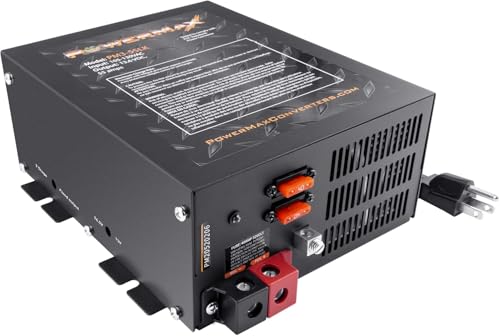
PowerMax PM3-55LK 55A RV Converter Charger — The adjustable all-rounder
The PM3-55LK is the pick that treats the owner as a competent adult. Its title promises 55 amps of deck-mount converter capacity, three-stage smart charging, lithium compatibility, and — the detail that defines it — an adjustable output spanning 13 to 16.5 volts in its fixed-output setup. That dial is the owner’s direct control over the charging voltage, which is exactly the lever a lithium conversion needs: set the output to the figure your battery maker specifies, and the converter holds it. For lead-acid owners, the same adjustability lets a knowledgeable installer match the unit to the bank rather than accepting a compromise burned in at the factory.
Fifty-five amps is the category’s centre of gravity, and the 55LK sits there deliberately. It covers the simultaneous loads of a mid-size rig — lights, pump, furnace fan, a slide or two — while retaining meaningful charging current for a typical two-battery bank. Owners stepping up from a failed factory converter of similar rating will find the swap conceptually clean: same class, same job, better manners, plus the lithium headroom the old unit lacked. The discipline the pick demands is honesty about the dial. An adjustable converter set carelessly is worse than a fixed one set correctly at the factory, because the error is yours and it is silent; the manual and the battery maker’s voltage figures are required reading, not packaging.
Consider the travel trailer owner mid-conversion as the portrait buyer: lead-acid bank removed, lithium bank fitted, factory converter now the bottleneck leaving the new batteries short of full. The 55LK answers that exact moment. It keeps the rig’s 12-volt life running, feeds the lithium bank at the voltage the owner dials in, and its three-stage behaviour still serves gracefully if a lead-acid battery ever returns to the tray. Few purchases in the RV electrical cupboard cover a transition this completely.
- Output: 55A
- Mounting: deck-mount, fixed installation
- Charging programme stated in the title: 3-stage smart charging
- Output behaviour: adjustable 13–16.5V fixed output, set by the owner
- Chemistry: lithium compatible per the title, alongside conventional RV house batteries
Strengths
- The stated voltage range gives lithium owners a direct, documented way to match their battery maker’s specification.
- Three-stage smart charging keeps lead-acid banks properly tended during long plugged-in storage.
- 55A is the versatile middle class — enough for mid-size rigs without oversizing a modest bank.
Trade-offs
- The dial is a responsibility: an incorrectly set output will undercharge or stress a bank without announcing itself.
- No automatic chemistry detection is claimed, so a future chemistry change means a manual re-set.
- Large banks and heavy simultaneous loads will outgrow 55A and point toward the 75A sibling.
Best for: a mid-size rig converting to lithium whose owner is willing to set the output voltage deliberately against the battery maker’s figures. Not suited for: an owner who wants the converter to recognise the chemistry unaided, or a large multi-battery bank with heavy 12V loads.
Conversion-minded owners can read the PM3-55LK listing alongside their battery maker’s voltage specification and confirm the stated range covers it.

PowerMax PM3-75-SME 75A RV Converter Charger — The big-bank option
Seventy-five amps is a statement about the size of the electrical life the rig leads. The PM3-75-SME exists for the fifth-wheel with a large house bank, residential-style 12-volt demands, and evenings where slides, lighting, entertainment and the furnace all draw at once while the bank is also trying to recover from a boondocking night. Its title keeps the family language — adjustable, lithium-ready — in a shorter form than its sibling’s, describing an adjustable converter charger delivering clean 12V power with smart charging for lead-acid or lithium batteries. The promise underneath is headroom: the converter stops being the constraint on the rig’s evenings.
Headroom has a second, quieter benefit. A converter working at the middle of its capacity runs cooler and with less strain than one pinned at its ceiling every evening, and electrical hardware that loafs tends to outlast hardware that sprints. Owners of big rigs replacing a failed 55-amp factory unit often discover the original was undersized for how the rig is actually used — the family grew, the devices multiplied — and the step to 75 amps is really a correction of the original specification rather than an indulgence. The check that matters is the bank: a large converter feeding a small bank must be matched thoughtfully, because the bank’s acceptance, not the converter’s enthusiasm, should govern the early charge.
The honest cost of the big unit is that it asks more of the installation. Wiring, fusing and ventilation sized for a smaller converter deserve a fresh look when the replacement carries a third more capacity, and the adjustable lithium setup still rests on the owner’s diligence, exactly as with the 55LK. Buyers who want capacity and automation together will not find detection claimed here; buyers who want capacity and control will find this the most direct route in the guide.
- Output: 75A
- Mounting: deck-mount, fixed installation
- Charging behaviour described in the title: smart charging, adjustable
- Chemistry: lead-acid or lithium, per the listing title
- Output range detail: the title does not restate the numeric voltage span — confirm the adjustable range in the full listing before matching it to a lithium specification
Strengths
- The largest capacity here, built for big banks and simultaneous evening loads.
- Adjustable lithium setup carries the PowerMax control philosophy up to the largest class.
- Working below its ceiling in a big rig should mean cooler, less strained operation than a maxed smaller unit.
Trade-offs
- Oversized for a small trailer: the bank and wiring of a modest rig gain nothing from the extra capacity.
- Installation deserves a wiring and fusing review rather than a blind like-for-like swap.
- The numeric adjustment range is not stated in its title, so lithium matchers must verify it on the full listing.
Best for: a large fifth-wheel or motorhome with a multi-battery bank and heavy simultaneous 12V demand, especially one running or planning lithium. Not suited for: a compact trailer with a single battery, where the 45A picks fit the bank and the wiring honestly.
Big-rig owners can check the 75-SME listing for its adjustment details and measure their current converter’s space and wiring before committing.

RecPro 65A RV Power Converter — The four-stage midsize
RecPro’s 65-amp unit occupies the ground between the category’s middle and its maximum, and its headline is the charging programme: four-stage charging, stated plainly in the title. That fourth stage is the RecPro family’s signature claim, extending the familiar bulk-absorption-float sequence with an additional maintenance behaviour aimed at keeping lead-acid banks in condition through the plugged-in stretches of a season. For the owner whose rig lives on shore power at a seasonal site — plugged in from May to September, bank expected to be ready every Friday — a programme designed around long holds is a rational priority.
At 65 amps the unit serves the upper-middle class of rigs: travel trailers and fifth-wheels whose banks run to several batteries and whose evenings are busy. It refills a depleted bank with real urgency compared with a 45-amp unit, which matters for the weekend pattern — arrive Friday with a low bank, and the converter should have the bank whole again while the rig’s life continues around it, not lagging a day behind the family’s demand. The RecPro makes fewer claims about lithium in its title than the PowerMax pair or the WFCO; its stated identity is a four-stage converter charger, and lithium shoppers should interrogate the full listing for chemistry specifics rather than assume them from the category.
The portrait buyer is the seasonal-site family: rig parked semi-permanently, bank mid-sized and lead-acid, the converter’s job split between Friday-night recovery and weekday vigilance. For that buyer the four-stage programme is not a spec-sheet flourish but the shape of their actual year, and the 65-amp capacity means the recovery half of the job never becomes the weekend’s subplot.
- Output: 65A
- Mounting: fixed RV installation
- Charging programme stated in the title: 4-stage charging
- Chemistry detail: the listing title does not name lithium — verify chemistry support on the full listing if your bank is lithium
- Role named in the title: power converter and battery charger
Strengths
- Four-stage charging suits rigs that stay plugged in for long stretches between trips.
- 65A refills mid-to-large banks briskly while the rig’s evening loads run.
- A clear step up for owners whose 45A factory unit lags behind a growing bank.
Trade-offs
- Lithium handling is not described in its title, so converters to lithium must verify before buying.
- More capacity than a small single-battery trailer can usefully absorb.
- No owner-adjustable output is claimed, so the charging profile is the factory’s decision.
Best for: a seasonal or frequently used mid-to-large rig on lead-acid batteries that stays plugged in for long stretches and needs its bank recovered quickly on arrival. Not suited for: a lithium bank whose owner needs documented chemistry handling, or a compact trailer with one battery.
Seasonal-site owners can read the RecPro 65A listing for its stage descriptions and check the dimensions against the compartment the old converter leaves behind.

RecPro 45A RV Power Converter — The four-stage compact-rig pick
The 45-amp RecPro is the same idea as its sibling, scaled to the rigs that actually fill most campgrounds: the compact travel trailer, the small fifth-wheel, the camper whose house bank is one or two batteries and whose 12-volt life is lights, pump, fan and a radio. Four-stage charging at this size is a genuinely pleasant specification, because smaller rigs are often stored plugged in for just as long as larger ones, and their batteries benefit from the same staged tenderness. What changes with size is only the recovery speed, and a small bank on a 45-amp unit recovers quickly in absolute terms — the reservoir is small.
This is also the natural like-for-like replacement class. A great many factory converters in compact rigs were 45-amp units, and when one fails, the owner shopping at this rating is often performing the least disruptive swap in the category: same capacity class, modern staged charging, no rethinking of wiring or bank size. The RecPro 45’s discipline is that it does not pretend to be more. It will not feed a big rig’s evening, and its title makes no lithium promises to interrogate — chemistry beyond the conventional is simply not its stated story, and buyers mid-conversion should pass it by for the PowerMax or WFCO picks with a clear conscience.
Portrait buyer: the couple with a compact trailer stored beside the house, plugged in through the winter on a maintenance basis and taken out monthly in season. Their bank is two batteries, their loads are modest, and their converter requirement is that April finds everything exactly as November left it. The RecPro 45 is specified for precisely that life.
- Output: 45A
- Mounting: fixed RV installation
- Charging programme stated in the title: 4-stage charging
- Chemistry detail: no lithium support is named in the listing title — treat chemistry questions as a full-listing check
- Class note: the common replacement rating for compact rigs
Strengths
- Four-stage care at the size class most compact rigs were built around.
- A small bank refills quickly in absolute terms at 45A.
- The least disruptive replacement path for a failed factory 45A unit.
Trade-offs
- Heavy simultaneous loads in a larger rig will expose the ceiling quickly.
- Lithium support is not stated in its title, excluding it from conversion shopping lists.
- Owners planning a bank expansion should size for the future bank, not this one.
Best for: a compact trailer or small fifth-wheel on a one- or two-battery lead-acid bank, stored plugged in and used regularly. Not suited for: a large rig with several batteries, or any lithium conversion.
Compact-rig owners can confirm the RecPro 45A listing’s dimensions against their converter compartment, since the swap is usually a same-class replacement.

WFCO WF-9845-AD-CB 45A RV Converter — The self-detecting lithium answer
The WFCO takes the lithium problem out of the owner’s hands. Its title names the mechanism directly: patented Auto Detect technology that recognises whether the connected bank is lead-acid or lithium and applies multi-stage charging accordingly. At 45 amps in a deckmount format, it is aimed at the compact-to-mid-size rig — but its real target is a moment in an owner’s life: the day the lithium bank goes in and the converter question must simply go away. No dial to set, no voltage figure to transcribe from a battery manual, no lingering doubt at midnight about whether the setting survived the swap.
That philosophy has a genuine technical elegance. Detection removes a whole class of silent errors — the converter adjusted for the old bank and never re-adjusted, the well-meaning helper who changed a setting, the seasonal worker who reconnected things differently. For rigs that pass between family members, rental duty, or owners who frankly do not want an electrical hobby, automation is not laziness; it is risk management. The counterweight is control: the owner who enjoys dialling an exact voltage, or whose lithium maker specifies something unusual, hands that discretion to WFCO’s engineers when choosing this unit, and should do so knowingly.
Forty-five amps frames its honest limits. This is not the converter for a sprawling bank or a rig whose evenings run every 12-volt appliance at once; within its class, though, it offers the most future-proof charging brain in this guide. An owner still on lead-acid today can fit the WFCO, run it correctly, and convert to lithium next year without touching the converter again — a sequence no other pick here can promise on the evidence of its title.
- Output: 45A DC
- Mounting: deckmount, fixed installation
- Chemistry handling: patented Auto Detect technology for lead-acid and lithium, per the title
- Charging programme: multi-stage charging
- Owner adjustment: none described — detection replaces the manual setup
Strengths
- Auto Detect removes the manual lithium setup step and its silent-error risk entirely.
- A lead-acid owner can install it now and convert the bank later without replacing the converter.
- Multi-stage charging serves both chemistries under one automated regime.
Trade-offs
- 45A caps its usefulness for large banks and heavy simultaneous loads.
- Owners who want to dictate an exact charging voltage surrender that control to the detection logic.
- Its value concentrates in the chemistry question; a permanently lead-acid small rig may not need it.
Best for: a compact-to-mid-size rig converting to lithium — or planning to — whose owner wants the chemistry handled automatically. Not suited for: a large multi-battery bank needing 65A or more, or an owner who insists on setting charge voltage manually.
Owners planning a conversion can read the WF-9845-AD-CB listing for the Auto Detect description and confirm their bank size sits within a 45A unit’s honest reach.

VEVOR 55A RV Power Converter — The value 55A alternative
VEVOR’s entry matches the category’s centre of gravity directly: 55 amps, multi-stage smart charging, a stated operating range of 13 to 16.5 volts, and declared compatibility with both lithium and lead-acid batteries, for camper use. Read against the PowerMax 55LK, the resemblance is obvious — same capacity class, same voltage span — and the comparison between them is the interesting shopping exercise in this guide. The VEVOR presents its range as an operating span within a smart-charging regime, while the PowerMax frames its range as an owner-adjusted fixed output; buyers should read both full listings for the precise control each offers, because that difference in philosophy, not the shared numbers, is the real distinction.
Within its own terms, the VEVOR is a coherent proposition: a modern staged converter for the mid-size rig whose owner wants dual-chemistry compatibility declared on the label and a capacity that covers a two-to-three-battery bank’s evenings without strain. It converts 110-volt AC shore power to the rig’s 12-volt life, charges while doing so, and its stated range gives lithium banks the elevated voltage their charging profiles call for. For the owner replacing a tired factory converter and wanting the lithium door left open, that is a complete sentence.
The diligence item is verification. VEVOR sells across many categories, and the careful buyer will confirm the mounting dimensions, the control method for the voltage range, and the stage behaviour from the full listing and manual rather than from the headline alone. That is not a dismissal — it is the same advice this guide gives for every pick — but with a broad-line brand it carries extra weight, because the support documentation, not the title, is where a converter earns trust over a decade of service.
- Output: 55A
- Input stated in the title: 110V AC to 12V DC conversion
- Charging programme: multi-stage smart charging
- Operating range stated: 13V to 16.5V
- Chemistry: lithium and lead-acid compatibility declared in the title
Strengths
- Dual-chemistry compatibility is declared outright, keeping the lithium option open.
- The stated voltage range spans what lithium charging profiles require.
- 55A covers the mid-size rig’s loads and bank without oversizing.
Trade-offs
- How the voltage range is controlled is not spelled out in the title — the full listing and manual must answer it.
- No automatic chemistry detection is claimed, so setup remains the owner’s task.
- Documentation depth matters for a decade-long install; verify support materials before buying.
Best for: a mid-size camper or trailer on a two-to-three-battery bank whose owner wants declared lithium and lead-acid compatibility at 55A. Not suited for: an owner wanting patented automatic detection, or a large rig whose loads point to the 75A class.
Mid-size rig owners can open the VEVOR listing to confirm how its voltage range is set and whether its mounting footprint suits the existing compartment.
How Do the Six Compare Side by Side?
| Pick | Output | Stages | Lithium handling | Defining trait |
|---|---|---|---|---|
| PowerMax PM3-55LK | 55A | 3-stage | Owner-adjustable 13–16.5V output | Manual control philosophy |
| PowerMax PM3-75-SME | 75A | Smart charging | Adjustable lithium setup | Largest capacity in the guide |
| RecPro 65A | 65A | 4-stage | Not named in title | Four-stage care, upper-middle size |
| RecPro 45A | 45A | 4-stage | Not named in title | Four-stage care for compact rigs |
| WFCO WF-9845-AD-CB | 45A | Multi-stage | Patented Auto Detect | Detection replaces manual setup |
| VEVOR 55A | 55A | Multi-stage | Compatibility declared, 13–16.5V range | Alternative take on the 55A class |
How Do You Match Converter Amps to Your Battery Bank?
Start with the bank, because the bank is the fixed fact. Add up the house batteries you run today — and be honest about the expansion you keep browsing, because a converter bought for today’s pair and outgrown by next year’s quartet is money spent twice. The working logic runs in two directions at once. The bank needs enough charging current to recover from a typical discharge during a typical plugged-in stay; a large bank sipping from a small converter spends every trip partially refilled, and partial refills, repeated, are how lead-acid banks age early. Meanwhile the rig’s own loads draw from the same converter all evening, so the charger’s share is whatever the household leaves behind.
Run the evening honestly. List what actually runs together on your busiest plugged-in night: furnace fan, a bank of lights, water pump cycling, refrigerator electronics, phone charging, perhaps a television on an inverter fed from the same bank. That simultaneous draw is the converter’s first obligation. What remains above it is charging current. A 45-amp unit in a compact rig with gentle loads might keep 25 amps free for the bank — plenty for one or two batteries. The same 45 amps in a big fifth-wheel could vanish entirely into the household, leaving the bank to tread water until the loads sleep. The picks map onto this plainly: 45A for compact rigs, 55A for the middle, 65A and 75A where banks and evenings are both large.
Lithium changes the appetite side of the equation. A lithium bank can accept charge far faster than a lead-acid bank of the same nominal size, which means an undersized converter becomes the bottleneck in a new way — the bank could refill in a short plugged-in stop, but the converter cannot feed it quickly enough to manage it. Owners converting to lithium should therefore revisit the amp question rather than assuming the old rating transfers; the conversion is the natural moment to step from 45 to 55 or beyond, matched against the bank maker’s recommended charge rate, which outranks any rule of thumb in this guide.
What Should You Check Before Swapping a Converter?
Measure the hole before ordering what fills it. Converter compartments vary, ventilation matters because these units shed heat under load, and a replacement that technically fits but breathes poorly will live a shorter, hotter life. Photograph the existing wiring before a single terminal is loosened: which cable lands where, what the fuse arrangement looks like, how the old unit is grounded. Shore-power work deserves respect — the AC side of a converter is household voltage inside a metal box, and owners who are not confident with that side of the wiring should hand the swap to a technician without embarrassment. The DC side forgives more; the AC side does not.
Then interrogate the settings before the first trip rather than after a disappointing one. If your pick is adjustable, set it against the battery maker’s published figures and record what you set, with the date, on a label inside the compartment — the next person to open that panel, possibly you in three years, deserves the information. If your pick detects chemistry automatically, confirm on the first charge that it has identified the bank as expected, using whatever indication the manual describes. Either way, the first plugged-in evening after a swap is a supervised one: check that lights hold bright under load, that the unit’s fan behaviour sounds sane, and that nothing in the compartment smells hot.
Finally, dispose of the old unit thoughtfully and keep its documentation until the replacement has survived a season. A converter that failed may carry a warranty story; a converter replaced for a lithium conversion may be perfectly healthy and saleable to a lead-acid owner. Either way, the manual for the new unit belongs in the rig’s document folder, because the person troubleshooting a dark rig at a campground in year four will not have your memory of this purchase to draw on.
How Does a Converter Behave During Months of Plugged-In Storage?
Storage is where staged charging earns its keep, and where the differences between these picks stop being theoretical. A rig parked beside the house from November to March, plugged in the whole time, asks its converter for a very specific temperament: hold the bank full, replace the small self-discharge losses, and otherwise leave the batteries in peace. A crude single-voltage unit fails this assignment quietly, holding the bank at a charging voltage indefinitely until the electrolyte pays the bill. Every pick in this guide answers with stages that settle into a float or maintenance state, which is why the stage language in their titles matters more to a storing owner than the amp headline does.
The owner’s part of the storage bargain is inspection, not faith. Visit the rig monthly: glance at the converter’s indicators if it offers them, check that the shore connection is sound, and on a serviceable flooded bank, confirm the electrolyte has not fallen — float is gentle, not magical, and a stored bank still consumes a little attention. Lithium banks change the routine rather than abolishing it; many lithium makers prefer storage at a partial charge, which is a conversation between the battery manual and the converter’s settings, and one more reason the adjustable-versus-detect decision deserves thought before winter rather than during it.
There is also the question of what else the converter is feeding while the rig sleeps. Parasitic draws — the propane detector, the entertainment system’s memory, the control boards that never fully rest — take their sip from the converter all winter. A healthy unit covers them invisibly. A failing one lets the bank absorb the drain in cycles, and the owner discovers in spring that a winter of being plugged in somehow produced a tired bank. When that paradox appears, suspect the converter before the batteries; it is the component whose whole job was preventing exactly that outcome.
What Are the Signs That a Converter Is Failing?
Converters rarely stop outright; they fade, and the fade has a signature an attentive owner can read. Lights that brighten and dim with loads they used to shrug off suggest the unit can no longer hold its voltage under demand. A water pump whose note changes as other loads switch, a furnace fan that sounds weary, control boards that reset for no clear reason — the 12-volt system is an ecosystem, and a weakening converter disturbs all of it at once, which is why converter failures are so often misdiagnosed as a string of unrelated appliance faults. When several unrelated 12-volt devices misbehave together, look upstream.
Heat and noise testify too. A converter that runs markedly hotter than its history, or whose cooling fan has moved from occasional to constant — or, worse, from present to silent — is describing its own decline. Battery behaviour completes the picture: a bank that needs water too often is being overcharged by something, and a bank that never quite reaches full on shore power is being underfed by something, and in a plugged-in rig that something is usually the same black box in the compartment. None of these signs requires test equipment to notice; they require only that the owner treat the rig’s electrical behaviour as information rather than atmosphere.
The replacement decision, once the evidence accumulates, should not be postponed in the name of economy. A fading converter taxes everything downstream — batteries age faster under its care, boards live harder lives, and the eventual failure will choose its moment, which will be a campground rather than a driveway. The picks in this guide are the considered answer to that moment, and buying one while the old unit still half-works has a practical virtue: the swap happens on your schedule, in your space, with the old wiring still legible enough to photograph.
Why Do Two Identical Rigs Behave Differently on the Same Converter?
Owners comparing notes at a campground eventually meet this puzzle: the same converter model, praised by one rig’s owner as invisible and cursed by another as inadequate. The converter is rarely the variable. Cable runs differ — a long, thin run between converter and bank taxes every amp with voltage drop, so the bank experiences a lesser charger than the spec sheet describes. Ventilation differs, and a unit throttling itself against its own heat in a sealed compartment delivers a fraction of its rating. Even the bank’s age rewrites the story, because an elderly lead-acid bank accepts charge slowly no matter how generous the supply, and its owner concludes the converter is lazy when the reservoir itself has shrunk.
The lesson generalises beyond this category: a converter charger is a component in a system the owner assembles, and its real-world performance is the system’s performance. Short, sound cable runs, a compartment that breathes, terminals cleaned on a schedule, and a bank young enough to accept what it is offered — these unglamorous conditions decide whether a well-chosen unit performs like one. Buyers who attend to them get the converter they paid for; buyers who bolt a good unit into a neglected system get a mystery they will blame on the brand. This guide’s picks assume the system half of the bargain will be kept.
What Mistakes Do RV Owners Make When Buying a Converter Charger?
The defining mistake is shopping for a charger when the product is a converter. Owners fixate on the charging stages and forget that the unit must first run the rig — then discover dim lights and a labouring pump on the first busy evening, because the amp budget was spent entirely on paper charging speed. Size for the evening load first and the bank second, in that order, and the category becomes much harder to get wrong.
The second mistake is ignoring the chemistry conversation until after the lithium bank is installed. A converter that cannot feed lithium correctly turns an expensive bank upgrade into a chronic undercharge, and the owner blames the batteries for a converter’s limitations. The third is the blind like-for-like swap: replacing a failed 45-amp unit with another 45-amp unit without asking whether the rig outgrew the original years ago. The fourth is treating adjustability as decoration — fitting an adjustable converter and never setting it, or setting it by guesswork. A dial is a commitment. Owners unwilling to make it should buy the WFCO’s detection instead, which is precisely why both philosophies are represented among the picks.
Final Recommendation
A converter is also one of the few RV components whose purchase rewards patience in a specific way: the owner who reads the battery maker’s charging specification before shopping, measures the compartment, and photographs the old wiring arrives at the listing with questions the listing can actually answer. The owner who shops first and measures later discovers the questions at the workbench. Nothing in this category is exotic, but all of it is specific, and specificity rewarded early is what separates a Saturday swap from a three-week saga of returns and adapters.
Begin with the bank and the evening, not the brand. Compact rigs on lead-acid are served cleanly by the RecPro 45A’s four-stage care; mid-size rigs should default to the 55-amp class, choosing between the PowerMax 55LK’s owner-set voltage and the VEVOR’s declared dual-chemistry range after reading how each handles the setting. Owners converting to lithium who want control should take the PowerMax route; owners converting who want the question to disappear should take the WFCO’s Auto Detect, accepting its 45-amp ceiling as the price of automation. Large rigs with big banks and busy evenings belong on the RecPro 65A or the PowerMax 75-SME. Whichever unit you bolt in, set it deliberately, supervise its first evening, and write the settings inside the compartment door — a converter chosen and installed with that much care disappears into the rig’s life for years, which is the highest praise this category offers.
Frequently Asked Questions
Is a converter charger the same thing as a battery charger?
No, and the difference drives this whole guide. A converter charger is fixed equipment: it turns shore-power AC into the 12V DC that runs the rig’s lights, pump and fans, and charges the house bank with capacity beyond the household load. A portable battery charger only charges. If your rig’s 12V system dies when the converter fails, you are shopping in the right category here.
How many amps does my RV actually need?
Enough to run your busiest simultaneous 12V loads and still leave charging current for the bank. Compact rigs with one or two batteries live happily at 45A; mid-size rigs centre on 55A; large banks with heavy evening demand justify 65A or 75A. Your battery maker’s recommended charge rate, especially for lithium, outranks any general figure.
Can I keep my old converter after converting to lithium?
Usually it will undercharge the lithium bank, because lead-acid charging profiles hold voltages a lithium bank does not want and stop short of the fill a lithium bank expects. That is the exact scenario the PowerMax adjustable units, the VEVOR’s stated range and the WFCO’s Auto Detect exist to solve; the converter is part of the conversion budget, not an afterthought.
What is the difference between three-stage and four-stage charging?
Both describe a programme that refills in bulk, finishes in absorption and holds at float. A fourth stage adds a further maintenance behaviour, which the RecPro pair carries, aimed at long plugged-in periods. In practice the stage count matters less than matching the programme to your chemistry and your storage pattern, but for rigs stored on shore power, the extra stage is a rational thing to want.
Should I choose Auto Detect or an adjustable converter for lithium?
Choose detection if you want the chemistry question answered once, permanently, with no settings to revisit — the WFCO’s approach. Choose an adjustable unit if your battery maker specifies a particular voltage and you want to set exactly that, as the PowerMax 55LK’s stated range allows. The wrong choice is the adjustable unit left unset; that is worse than either philosophy applied properly.
Does a bigger converter charge my batteries faster?
Only up to the point where the bank, not the converter, becomes the limit — and only with whatever current remains after the rig’s own loads are fed. A depleted bank on a quiet afternoon will indeed refill sooner behind 65 amps than behind 45, which is why the larger RecPro and PowerMax units suit big rigs with real recovery deadlines. But a small bank cannot accept a large converter’s full enthusiasm, and an evening’s household demand can consume the difference entirely, which is why this guide keeps returning to the same formula: loads first, bank second, headline last.
Can I install a converter charger myself?
The DC side is within many owners’ competence, but the AC side is household voltage and deserves either real confidence or a technician. Whichever route you take, photograph the old wiring first, match the new unit’s dimensions and ventilation to the compartment, and supervise the first plugged-in evening before trusting the installation with a trip.
Related Guides
- Best USB C Multiport Chargers
- Best Bedside Chargers
- Best Portable Chargers That Dont Require A Cable