What's inside
- Key Takeaways
- Quick Picks
- How Were These Six Systems Screened?
- Why Is Hands-Free Communication a Safety Feature, Not a Luxury?
- How Far Does an Intercom Really Reach?
- What Should You Check About Your Helmet Before Buying?
- How Do You Install a Helmet Intercom Properly?
- Why Does Wind Noise Decide So Much?
- How Do Music and Navigation Fit Into a Ride?
- How Should a Group Actually Use an Intercom?
- What About Charging and Battery Habits on Tour?
- What Changes for the Solo Tourer?
- Why Do Passengers Benefit Most of All?
- What Does a Daily Commute Ask of an Intercom?
- What Should You Practise Before the First Group Ride?
- How Do the Six Systems Divide the Road?
- What Do Riders Get Wrong When Buying Helmet Intercoms?
- How Do You Choose When Two Systems Both Fit?
- Final Recommendation
- Frequently Asked Questions
- Related Guides
As an Amazon Associate I earn from qualifying purchases. This post may contain affiliate links at no extra cost to you.
widgetverdict.com is reader-supported. When you buy through links on our site, we may earn an affiliate commission.
Where to buy: Amazon stocks every intercom system in this comparison, from Cardo’s three SPIRIT variants through Sena’s established dual kit to two group-ready systems from Fodsports and JESIMAIK.
A motorcycle communication headset exists for one reason above all others: so that a rider never has to touch a phone, shout over a visor, or take a hand off the bars to stay connected. The best motorcycle communication headsets are therefore safety equipment first and entertainment second. They let a rider answer a call hands-free, hear navigation prompts without glancing down, talk to a passenger or a riding partner over an intercom, and do all of it through controls designed for gloved fingers and speakers that sit inside the helmet. This guide compares six systems on exactly those terms. Three come from Cardo’s SPIRIT family, in standard and HD forms and in single and twin packs, and the differences among them are precise and worth reading closely. Sena’s SMH10D-11 represents the established dual-rider kit with a universal microphone package. Fodsports and JESIMAIK close the list with weather-sealed and group-sized systems aimed at riders who travel in company.
One discipline governs every claim below: intercom range, speaker size, and pack contents are reported exactly as the listing titles state them, and where a title is silent, the spec boxes say so. Range figures in this category are laboratory numbers achieved in open country, and city streets will shorten every one of them; treat them as comparisons among these models, not as promises about your commute.
Key Takeaways
- Safety is the category’s core: hands-free calling and intercom keep both hands on the bars and eyes on the road.
- Cardo’s SPIRIT standard reaches a stated 400m with 32mm HD speakers; the SPIRIT HD extends range to a stated 600m, grows the speakers to 40mm, and adds FM radio.
- The SPIRIT 2-Pack equips two helmets at the standard specification, the natural purchase for couples and regular two-up or two-bike pairs.
- Sena’s SMH10D-11 is a dual kit with a universal microphone package, aimed at helmet variety within one purchase.
- Fodsports’ FX-S states IP67 waterproofing, CVC noise cancellation, and two microphone types in a two-pack built on Bluetooth 5.4.
- JESIMAIK’s system claims the group’s largest conversation: a stated 10-way intercom over 2KM, with multitasking audio and two microphones in a two-pack.
Quick Picks
| Pick | Badge | Why it earns its place |
|---|---|---|
| Cardo SPIRIT | The solo rider’s Cardo | A single-pack Bluetooth intercom with a stated 400m range, 32mm HD speakers, waterproofing, and cross-brand connectivity. |
| Cardo SPIRIT HD | The longer-range HD pick | The HD step: a stated 600m range, 40mm HD speakers, FM radio, waterproofing, and fast charging in a single pack. |
| Cardo SPIRIT 2-Pack | The pair for two helmets | Two standard SPIRIT units in one box, 400m intercom and 32mm speakers, for couples and two-bike households. |
| Sena SMH10D-11 | The established dual kit | A dual Bluetooth headset and intercom system with a universal microphone kit for mixed helmet types. |
| Fodsports FX-S | The weather-sealed value pair | A two-pack with IP67 waterproofing, CVC noise cancellation, hands-free music and calls, and two microphone types. |
| JESIMAIK Helmet Intercom | The group-ride pick | A two-pack claiming a 10-way intercom over 2KM, multitasking audio, two microphones, and 40mm speakers. |
How Were These Six Systems Screened?
Every pick had to be a helmet communication system in its title, not a generic Bluetooth headset adapted by optimism: an intercom function, helmet speakers, and a microphone arrangement for use inside a helmet. Pack configuration was treated as a first-class specification, because a 1-Pack and a 2-Pack are different purchases serving different households, and this guide keeps them visibly separate rather than averaging them. Waterproofing claims were recorded exactly as stated, whether as a plain waterproof description or as a rated IP67 figure, since the two are not interchangeable and riders in wet climates deserve the distinction.
Range claims received the same literal treatment. Cardo publishes 400m for the standard SPIRIT and 600m for the HD in these titles; JESIMAIK publishes 2KM for its group system; Sena’s title for the SMH10D-11 publishes no range figure at all, and that absence is reported rather than filled from the model’s long reputation. Cross-brand connectivity, stated by the Cardo models, was weighted heavily, because real riding groups are brand-mixed and an intercom that only talks to its own kind solves half the social problem.
Why Is Hands-Free Communication a Safety Feature, Not a Luxury?
Because the alternative is a hand leaving the handlebar. Every interaction a rider performs with a phone, answering, declining, checking a navigation prompt, costs a hand, a glance, or both, at the exact moments traffic is least forgiving. A helmet intercom collapses those interactions into a button press on the helmet or a voice-driven answer, with the audio arriving through speakers already positioned at the ears. Navigation prompts become audible instead of visual, so the eyes stay where they belong. A call from home becomes answerable without a stop, or ignorable without a fumble. Group rides gain the largest safety dividend of all: the leader can warn about gravel, a junction, or a hazard the moment it appears, rather than relying on hand signals interpreted late through mirrors.
There are honest limits. A communication system should never become a reason to hold conversations that demand real attention at complex moments, and wise riders keep calls short, let the intercom carry information rather than debate, and treat music as a background for steady roads rather than a companion for hard ones. Local laws on helmet audio and phone use vary, and the rider’s responsibility is to know the rules where they ride. Used with that discipline, these systems return attention to the road, which is the only metric this category should ultimately be judged by.
How Far Does an Intercom Really Reach?
Manufacturers measure range in open terrain with clear line of sight, and the titles here follow that convention: 400m for the standard Cardo SPIRIT units, 600m for the HD, and 2KM for the JESIMAIK group system. Real roads tax those figures. Hills, buildings, trucks between riders, and even dense traffic all shorten a Bluetooth intercom’s reach, sometimes dramatically. The useful way to read the numbers is comparatively and behaviourally: a pair riding together in formation will stay connected on any system here; a group strung out over a mountain road will feel the difference between the 400m and 600m Cardos, and will test even the longest claims here.
Riding pattern decides how much range you need. A rider and passenger on one motorcycle need almost none. Two bikes travelling together need a few hundred honest metres and, more importantly, clean reconnection when the link drops at a junction. A large group spread across a touring route needs the group’s tail to hear its head, which is where multi-way systems like the JESIMAIK’s stated 10-way intercom earn their premise. Buy for the formation you actually ride, and remember that audio clarity at fifty metres matters more to safety than a theoretical link at the maximum figure.
What Should You Check About Your Helmet Before Buying?
Speaker pockets come first. Most modern helmets include recesses in the liner for intercom speakers, and the speaker diameters in these titles, 32mm on the standard Cardos, 40mm on the SPIRIT HD and the JESIMAIK, need to fit the pockets your helmet actually has. A speaker that sits proud of its pocket presses on the ear and turns a two-hour ride into a negotiation. Microphone type comes second: full-face helmets take a fixed boom or wired microphone near the chin bar, open and modular helmets often need a boom that mounts to the shell, and kits that include two microphone types, as the Fodsports FX-S and JESIMAIK titles state, exist precisely to cover that variety in one box. Sena’s universal microphone kit makes the same promise in its title.
Then check the mounting and your gloves. A unit you cannot operate with winter gloves on is a unit you will operate by stopping, which defeats the safety argument, so look at button size and layout in the listing photographs with your thickest gloves in mind. Finally, consider the helmet’s own shape around the lower edge, where these units clamp or adhere; most systems fit most helmets, but an unusually sculpted shell deserves a compatibility check in the maker’s documentation before money moves.

Cardo SPIRIT — The solo rider’s Cardo
The standard SPIRIT in its 1-Pack form is the entry point into Cardo’s ecosystem for a rider equipping one helmet. Its title assembles the essentials without ornament: a 2-way Bluetooth intercom with a stated 400m range, 32mm HD speakers, waterproof construction, cross-brand connectivity, and fast charging. Two-way means this unit talks to one other unit at a time, a passenger’s or a partner’s, which describes the majority of real riding: couples, pairs of friends, instructor and student. Cross-brand connectivity is the sleeper feature in that list, because it lets a SPIRIT hold a conversation with other makers’ units rather than exiling its owner from mixed-brand groups.
Waterproofing and fast charging are the ownership features that decide whether a system survives its first season gracefully. Rain is not an edge case in motorcycling; it is a Tuesday, and a unit that shrugs it off keeps working through the tours where communication matters most. Fast charging rescues the forgotten overnight charge with a short top-up before departure. The 32mm speakers are the family’s compact size, suited to helmets with shallower speaker pockets, and their HD designation reflects Cardo’s audio tuning rather than a measurable claim this guide can test. Buy the single SPIRIT if one helmet is the whole project; buy it as the first half of a pair only if a second unit is genuinely planned, because the 2-Pack below usually prices that intention more kindly.
- Pack: 1-Pack, one helmet
- Intercom: 2-way Bluetooth, stated 400m range
- Speakers: 32mm HD
- Weather: waterproof, per the listing title
- Connectivity: cross-brand connectivity stated
- Charging: fast charging stated; full battery endurance is not given in the title, so Cardo documentation is the verification source
Strengths
- Cross-brand connectivity keeps a solo purchase useful inside mixed-brand riding groups.
- Waterproof build and fast charging suit real touring rather than fair-weather intentions.
- The compact 32mm speakers fit shallower helmet pockets that larger drivers crowd.
Trade-offs
- Two-way intercom caps conversation at one partner, so group riders outgrow it quickly.
- The stated 400m range is the family’s shortest, felt when a pair strings out on open roads.
- One pack means one helmet; a passenger setup requires the second purchase immediately.
Best for: a solo rider who rides with one regular partner and wants Cardo’s ecosystem at its entry point. Not suited for: a group rider who needs to address several bikes at once, because a 2-way intercom cannot grow into a conference.
Read the SPIRIT 1-Pack listing on Amazon for its mounting contents, and measure your helmet’s speaker pockets against the 32mm drivers before ordering.
Cardo SPIRIT HD — The longer-range HD pick
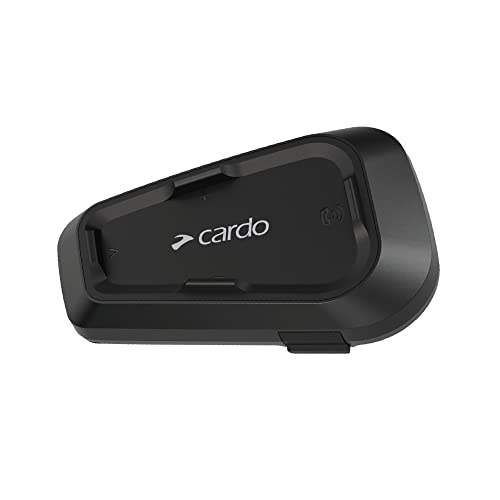
The HD is the standard SPIRIT with its three most felt specifications enlarged, and its title enumerates them cleanly: the intercom range grows from a stated 400m to 600m, the speakers grow from 32mm to 40mm HD units, and an FM radio joins the feature list, while waterproofing, cross-brand connectivity, and fast charging carry over. Each upgrade answers a specific rider. The range serves pairs who spread out on open touring roads. The larger speakers serve riders who listen at motorway speeds, where wind noise taxes small drivers hardest and fuller speakers keep music and voices intelligible at lower volumes. The FM radio serves the commuter and the solo tourer who want local radio without involving a phone at all.
The HD remains a 2-way intercom and a 1-Pack, and those two facts define its borders as clearly as its upgrades define its appeal. It is the connoisseur’s version of the pair-riding formula, not a group system and not a couple’s kit. A rider choosing between the standard and HD singles should ask where their miles happen: tight, slow, technical roads keep a pair within the standard’s reach and forgive its smaller speakers, while fast, open distance rewards every metre and millimetre the HD adds. Check your helmet’s speaker pockets with particular care here, because 40mm drivers need the room the HD’s own specification assumes.
- Pack: 1-Pack, one helmet
- Intercom: 2-way Bluetooth, stated 600m range
- Speakers: 40mm HD
- Extra: FM radio built in, per the listing title
- Weather: waterproof, per the listing title
- Connectivity and charging: cross-brand connectivity and fast charging, both stated
Strengths
- The stated 600m range is the longest in the Cardo family here, suiting open-road pairs.
- Forty-millimetre HD speakers hold clarity better against motorway wind noise.
- Built-in FM radio gives the solo rider phone-free listening for commutes and tours.
Trade-offs
- Still a 2-way intercom, so its polish serves pairs, not groups.
- Larger speakers demand deeper helmet pockets than the standard model’s 32mm units.
- As a 1-Pack it equips one helmet, leaving a regular passenger to a second purchase.
Best for: a distance rider or motorway commuter who rides as a pair and listens at speed. Not suited for: a rider whose helmet has shallow speaker recesses, since the 40mm drivers need pockets that can receive them.
Compare the SPIRIT HD listing on Amazon directly with the standard model’s, because the three enlarged specifications are the entire decision.

Cardo SPIRIT 2-Pack — The pair for two helmets
The 2-Pack takes the standard SPIRIT specification, 2-way Bluetooth intercom at a stated 400m, 32mm HD speakers, waterproofing, cross-brand connectivity, fast charging, and doubles the hardware: two complete units in one box, one for each helmet. This is the purchase shape that matches how most intercoms are actually used. A couple riding two bikes, a rider and a regular passenger with their own helmet, or two friends who always tour together do not need two separate shopping expeditions and the risk of mismatched versions; they need a pair that arrives matched, charged by the same cables, and covered by one decision.
The specification deliberately mirrors the standard single rather than the HD, so the choice between this box and two HD singles is a real one. The 2-Pack optimises for togetherness at the family’s core specification; the HD singles optimise for range and speaker size at a higher total outlay and with two separate purchases to manage. For most couples the 2-Pack’s logic wins, because the intercom’s job in a pair is conversation, and conversation happens at formation distance where 400m of stated range is ample and 32mm speakers in well-fitting pockets are clear. Save the HD deliberation for pairs whose riding genuinely stretches across open country.
- Pack: 2-Pack, two helmets
- Intercom: 2-way Bluetooth, stated 400m range
- Speakers: 32mm HD in each unit
- Weather: waterproof, per the listing title
- Connectivity: cross-brand connectivity stated, useful when the pair joins larger mixed groups
- Charging: fast charging stated for the units
Strengths
- Two matched units in one purchase equip a couple or a passenger setup immediately.
- The standard specification covers formation-distance conversation completely.
- Cross-brand connectivity lets the pair still talk to friends running other systems.
Trade-offs
- The specification is the standard one, so open-road pairs may miss the HD’s extra range.
- Two-way conversation means the pair joins group rides as listeners more than as a network.
- A solo rider has no use for the second unit, making the single packs the honest purchase.
Best for: a couple or rider-and-passenger household equipping two helmets in one decision. Not suited for: a lone rider, who would be paying to store a second unit in a drawer indefinitely.
Open the SPIRIT 2-Pack listing on Amazon to confirm both units’ contents are complete kits, each with its own mounting and microphone hardware.

Sena SMH10D-11 — The established dual kit
Sena’s SMH10 has been a default answer in helmet communication for so long that its title can afford to be brief: a motorcycle Bluetooth headset and intercom communication system, in dual form, with a universal microphone kit. The dual configuration mirrors the Cardo 2-Pack’s logic, two units for two helmets in one purchase. The universal microphone kit is its distinguishing promise: Sena includes microphone options intended to suit different helmet styles, which matters in households where one rider wears a full-face and the other a modular or open design, and where a single fixed microphone type would serve one helmet well and the other badly.
The title’s brevity cuts the other way on specifications. No intercom range figure is published in it, no speaker diameter, no waterproof rating, and this guide reports those absences rather than filling them from the model’s considerable reputation. A buyer comparing the SMH10D-11 against the Cardo range claims should pull Sena’s documentation into the comparison, where those figures live, and weigh them alongside the universal microphone advantage. What the listing does establish is the shape of the purchase: an established dual intercom system from one of the category’s two founding brands, with helmet-microphone flexibility as its signature. For a mixed-helmet household, that signature may outweigh several specification lines.
- Pack: dual, two units
- System: Bluetooth headset and intercom communication system
- Microphones: universal microphone kit included, per the listing title
- Range: the listing title publishes no intercom range figure; Sena documentation carries it and should be consulted before comparing with the Cardo claims
- Speakers: diameter not stated in the title; verify in Sena documentation against your helmet’s pockets
- Weather rating: not stated in the title; Sena documentation is the source for its water resistance specification
Strengths
- The universal microphone kit suits households whose two helmets are different styles.
- Dual packaging equips two riders in one matched purchase.
- Sena’s long presence in the category means accessories and knowledge are easy to find.
Trade-offs
- The title omits range, speaker, and weather figures, so comparison requires a documentation detour.
- Its generation is older than the Bluetooth 5.4 newcomer elsewhere in this guide.
- Buyers who shop by printed specification will find the Cardo listings more forthcoming.
Best for: a two-rider household with different helmet styles that values microphone flexibility. Not suited for: a specification-led buyer who wants range and speaker figures printed on the listing before shortlisting.
Pair the SMH10D-11 listing on Amazon with Sena’s documentation, and judge the universal microphone kit against your two helmets’ actual shapes.

Fodsports FX-S — The weather-sealed value pair
The FX-S makes weather its headline in a way the vaguer waterproof claims elsewhere cannot: an IP67 waterproof rating, stated outright in its title. IP67 is a defined standard, protection against immersion in shallow water for a limited time, and for a device that lives on a helmet in the rain it signals engineering intent rather than marketing weatherproofing. Around that seal, the title assembles a complete two-pack specification: Bluetooth 5.4, a 2-way helmet intercom, CVC noise cancellation for clearer calls, hands-free music and calling, and two types of microphone in the box, across two units in black.
CVC noise cancellation deserves its sentence: it works on the transmitted voice, trimming the wind and engine noise that otherwise bury a rider’s words, and on a motorcycle that processing is not a refinement but the difference between a call that works at speed and one that only works at traffic lights. The two microphone types extend the kit across helmet styles in the same spirit as Sena’s universal promise. What the title does not publish is an intercom range figure, and that omission matters for touring pairs; Fodsports’ documentation should be consulted before assuming this pair matches the Cardo claims. Judged on what is stated, sealing, modern Bluetooth, cancellation, and microphone choice in a two-pack, the FX-S is the pragmatist’s weather-first answer.
- Pack: 2 Pack, two units
- Bluetooth: version 5.4, stated in the listing title
- Intercom: 2-way helmet intercom; the title gives no range figure, so Fodsports documentation is where to verify reach for touring use
- Weather: IP67 waterproof rating stated
- Audio processing: CVC noise cancellation for calls
- Microphones: two types included; hands-free music and call support stated
Strengths
- A stated IP67 rating gives wet-weather riders a defined standard rather than a vague promise.
- CVC cancellation targets the wind and engine noise that ruin calls at speed.
- Two microphone types and two units cover a mixed-helmet household in one box.
Trade-offs
- No range figure appears in the title, leaving touring pairs a documentation check before purchase.
- Two-way intercom limits group conversation compared with the JESIMAIK’s multi-way claim.
- Its newer brand lacks the long accessory trail of Cardo and Sena.
Best for: a rain-regular riding pair that wants defined weather sealing and clear calls at speed. Not suited for: a long-distance touring pair who needs a published range figure to plan around and will not buy without one.
Check the FX-S listing on Amazon for its microphone contents, and Fodsports’ documentation for the range figure its title omits.
JESIMAIK Helmet Intercom — The group-ride pick
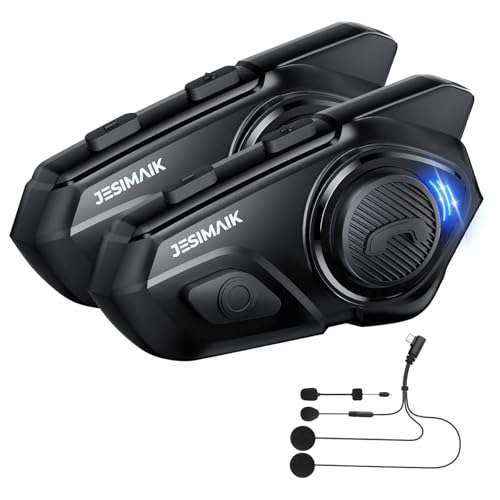
Every other system in this guide converses in pairs. The JESIMAIK’s title announces a different social scale entirely: a 10-way helmet communication system with a stated 2KM range, multitasking audio, two microphones, and 40mm speakers, sold as a 2-pack. Ten-way intercom is a group-riding premise, the club run, the training school, the tour where the leader’s warnings need to reach the tail. The 2KM figure, read with the open-terrain caution this guide applies to all range claims, is the largest stated here and matches that premise: a group strung along a road needs reach more than a pair ever will. Multitasking audio addresses the other group reality, letting intercom conversation and music or navigation share the ride rather than evicting each other.
The two-pack shape deserves a clear reading: this box equips two helmets with group-capable units, and a club intending to network ten riders will be buying several boxes, so the per-rider system choice becomes a group decision best made once, together. Two microphones in the kit extend the units across helmet styles. The title does not state a waterproof rating in the defined IP sense, so wet-climate groups should verify weather performance in JESIMAIK’s documentation rather than assuming parity with the FX-S’s IP67 claim. For the rider whose calendar is built around group miles, though, this is the only pick here designed from the group outward, and that design intent is its recommendation.
- Pack: 2 Pack, two units, each group-capable
- Intercom: stated 10-way, over a stated 2KM range
- Audio: multitasking audio, intercom alongside music or navigation
- Speakers: 40mm
- Microphones: two included in the kit
- Weather: no IP rating is stated in the listing title; JESIMAIK documentation should be checked for its water resistance specification before wet-season touring
Strengths
- A stated 10-way intercom serves club runs and group tours that pair systems cannot organise.
- The stated 2KM range is the longest claim in this guide, matching a group’s spread.
- Multitasking audio keeps navigation and music alive beneath group conversation.
Trade-offs
- Equipping a full group means several packs, so the commitment is collective, not individual.
- No defined IP weather rating appears in the title, a gap wet-climate riders must close in documentation.
- Its group talents are wasted on a rider who tours alone or as a pair.
Best for: a club or tour group that rides in formation and needs the leader’s voice at the tail. Not suited for: a solo commuter, whose needs the simpler Cardo singles cover without group machinery.
Read the JESIMAIK listing on Amazon with your group’s size in mind, and confirm how many packs your full formation requires.
How Do You Install a Helmet Intercom Properly?
Work on a table, not on the bike, with the helmet’s liner partially lifted according to its maker’s instructions. Place the speakers first, centred on where your ears sit inside the worn helmet, not where they look right in the shell on the table; wear the helmet to check, because a speaker two centimetres adrift delivers its sound to your cheekbone. Route the wires beneath the liner so nothing presses on your head, and position the microphone where your breath passes it closely without touching it, near the chin bar on a full-face or on its boom for open designs. Mount the control unit where a gloved hand finds it by landmarks, typically the lower left edge, and practise the buttons stationary until the layout is memory.
Then take a short, familiar ride and judge three things: whether you can hear prompts at your cruising speed without maximum volume, whether your partner hears your voice clearly at the same speeds, and whether any part of the installation announces itself as pressure by the half-hour mark. Adjust once, deliberately, rather than living with an almost-right fit for a season. An intercom installed with this care disappears into the ride, which is the highest compliment safety equipment can earn.
Why Does Wind Noise Decide So Much?
At motorway speed, the loudest thing in a helmet is the helmet itself moving through air, and every feature in this category is quietly negotiating with that fact. Speaker size matters because a fuller speaker, the 40mm units in the SPIRIT HD and the JESIMAIK, can present voices and music with enough body to stay intelligible without being driven to distortion. Microphone processing matters because the wind is what your partner hears unless the system trims it, which is where the Fodsports’ CVC cancellation earns its mention. Helmet fit matters most of all: a loose helmet generates more internal noise than any speaker can politely overcome, so a rider blaming an intercom for poor clarity should first check the helmet’s own seal around the neck and visor.
Volume discipline protects hearing here as surely as it does in the DJ booth elsewhere on this site. If you find yourself running any of these systems at maximum for long stretches, the correct response is better speaker placement, a quieter helmet setup, or earplugs designed for riding beneath the speakers, not more volume. Many experienced tourers wear plugs and let the intercom speak through them, arriving with hearing as fresh as their attention. Treat clarity as a fit problem before treating it as a power problem, and both your ears and your equipment will last the season.
How Do Music and Navigation Fit Into a Ride?
Navigation prompts are the intercom’s most underrated gift. A voice saying the junction is in half a mile removes the dashboard glance entirely, and on unfamiliar touring roads that single change is worth the purchase price in attention returned. Set prompt volume so it sits clearly above music but never startles, and let the system’s audio priorities duck the music beneath prompts and intercom rather than fighting them at equal level; the JESIMAIK’s multitasking audio exists for exactly this layering. Music itself suits steady, familiar roads, and wise riders lower it or lose it when the road turns technical, the weather turns, or traffic thickens. The SPIRIT HD’s FM radio deserves mention here as the phone-free option: local radio for a commute keeps the phone in a pocket and the battery for emergencies.
One habit protects all of it: decide your audio before you roll. Playlists, radio, intercom pairing, and navigation should be settled at a standstill, gloved hands on a parked bike, never negotiated at forty miles an hour. The systems in this guide are designed so that a rolling rider needs only the simplest inputs, and honouring that design is the rider’s half of the safety bargain.
How Should a Group Actually Use an Intercom?
With brevity and a light protocol agreed before departure. The leader narrates hazards and decisions: surface changes, fuel stops, the turn coming up. Riders acknowledge briefly or not at all, because a ten-way channel filled with ten commentaries is worse than silence. Agree who speaks for the group at junctions, what a dropped connection means, usually that the tail rider waits and the group reforms at the next safe stop, and how a rider signals they need to halt. The JESIMAIK’s stated 10-way capacity makes the conversation possible; the protocol makes it useful rather than chaotic.
Test the whole formation’s connections in the car park, not at the first roundabout. Pairing ten units at the roadside in the rain is a team-building exercise nobody requested. Groups that standardise on one system, or lean on the Cardo models’ stated cross-brand connectivity where brands are mixed, spend their mornings riding instead of pairing, which is the entire point of owning the equipment.
What About Charging and Battery Habits on Tour?
An intercom’s battery is a touring resource like fuel, managed rather than assumed. Build the overnight habit first: on multi-day trips the units charge beside the phone, every night, without negotiation, because a system that starts day three at half charge will choose the mountain pass to retire. The Cardo models’ stated fast charging is the safety net for the night the habit fails, turning a breakfast stop into a meaningful top-up. Learn your own unit’s honest endurance in your conditions, cold weather and high volumes shorten every battery, during local rides rather than discovering it three countries from home.
Carry the charging cable on the bike, not in the luggage you might leave at a hotel, and agree as a group that a rider with a dying unit says so early, while re-pairing and regrouping are still easy. None of the titles in this guide publish full endurance figures for these models, so the makers’ documentation is the planning source, and your own first month of rides is the verification. Battery discipline sounds dull until the first silent afternoon in a group that has lost its tail rider’s voice; after that, it sounds like professionalism.
What Changes for the Solo Tourer?
The solo rider uses an intercom differently from everyone else in this guide: no partner channel, but navigation voice, music or radio, and the ability to take a call without stopping on a hard shoulder. For that life, the SPIRIT HD is quietly the best-shaped pick here, because its FM radio and larger speakers serve solitary miles and its extra range costs nothing when unused. The standard SPIRIT serves the same pattern at its core specification. What the solo rider should resist is buying group machinery for a group that does not exist; the JESIMAIK’s talents are social, and alone they are weight without benefit.
Solo riders should also think about the emergency shape of communication: a unit that can place a call by simple controls, paired to a phone with battery to spare, is part of the safety kit on empty roads. Keep the phone charged, the unit charged, and one contact reachable by the simplest possible input, and the intercom becomes part of the same preparation as the toolkit and the waterproofs.
Why Do Passengers Benefit Most of All?
Because the passenger’s traditional communication toolkit was a shout, a tap code, and hope. An intercom gives the person on the back a voice: to point out the view, to ask for a stop before it becomes urgent, to share the navigation watch, and to be part of the ride rather than cargo on it. Couples consistently report that intercom conversation changes two-up touring from parallel solitude into a shared journey, and the 2-Pack formats in this guide, Cardo’s pair, Sena’s dual, and the Fodsports two-pack, exist because that discovery repeats in household after household. If you carry a regular passenger, equip their helmet as seriously as your own, microphone positioned with the same care, because a passenger whose mic sits badly will simply stop talking, and the silence will be misread as contentment.
What Does a Daily Commute Ask of an Intercom?
Different things from a tour: speed of readiness, tolerance for repetition, and radio or music for the boring middle. The commuter’s unit is used twice a day in all weathers, often with thick gloves and zero patience, so button layout and pairing reliability outrank every specification in this guide. A system that reconnects to the phone instantly, every morning, without a ritual, is worth more than a longer range it will never use. The SPIRIT HD’s FM radio suits the commute’s information hunger, traffic and weather between songs, while the standard SPIRIT covers the same ground where a phone already does that work. Weather sealing stops being a touring virtue and becomes a calendar one: the FX-S’s stated IP67 and the Cardos’ waterproofing are commuter specifications as much as adventure ones, because the commute happens on the wet days too.
Commuters should also protect the routine’s edges. Charge on a weekly rhythm rather than waiting for warnings, keep the unit’s home by the helmet and keys so the morning never starts with a search, and let the intercom’s call handling replace the temptation to check a buzzing phone at lights. The commute is where hands-free discipline pays its most regular dividend, five days a week, in the worst traffic the rider meets.
What Should You Practise Before the First Group Ride?
Every control, at a standstill, with the gloves you will wear. Answer and end a call, start and leave the intercom, adjust volume, and trigger your navigation prompt until each is a single confident press rather than a fumble. Then ride a short local loop with your partner or one group member and rehearse the human protocol: a hazard call, a request to stop, and the regrouping behaviour when the link drops at a junction. Ten rehearsed minutes convert the first real group ride from an equipment test into a ride, and they expose installation problems, a misplaced speaker, a boom too far from the mouth, while the stakes are a quiet street rather than a mountain road.
Rehearse the failure case too: ride out of intercom range deliberately on your practice loop and learn how your unit behaves as the link thins and how it announces reconnection. A rider who has met that behaviour on a quiet road will not be startled by it on a busy one, and the group that has agreed its regrouping habit in advance treats a dropped link as a procedure rather than a problem.
Bring the same rehearsal mindset to pairing day whenever the group changes equipment. Connections made calmly at home, in the dry, with documentation open, hold for the season; connections made at a petrol station in the rain hold until the second roundabout. The systems in this guide reward preparation in direct proportion to the size of the group using them.
How Do the Six Systems Divide the Road?
| System | Pack | Stated intercom | Speakers |
|---|---|---|---|
| Cardo SPIRIT | 1-Pack | 2-way, 400m | 32mm HD |
| Cardo SPIRIT HD | 1-Pack | 2-way, 600m | 40mm HD |
| Cardo SPIRIT 2-Pack | 2-Pack | 2-way, 400m | 32mm HD |
| Sena SMH10D-11 | Dual | Range not stated in title | Not stated in title |
| Fodsports FX-S | 2 Pack | 2-way, range not stated in title | See listing details |
| JESIMAIK Intercom | 2 Pack | 10-way, 2KM | 40mm |
The division is social before it is technical. Pairs are served by everything here; couples are served most directly by the two-pack Cardo, the Sena dual, and the Fodsports pair; groups are served only by the JESIMAIK’s multi-way design. Range and speaker upgrades refine those social choices rather than replacing them.
What Do Riders Get Wrong When Buying Helmet Intercoms?
The first error is buying the pack shape for the household they wish they had: solo riders with a 2-Pack gathering dust, couples with a single unit and a passenger shouting through a visor. Count helmets, not hopes. The second error is treating the maximum range figure as a planning distance; plan around a fraction of it in real terrain and be pleasantly surprised, rather than organising a group around a laboratory number and losing the tail at the first hill. The third error is installing speakers by eye and living with pressure and poor sound that ten minutes of wearing-checks would have prevented.
Fourth, riders forget the law and the etiquette: know your local rules on helmet audio and calls, keep conversations short in complex traffic, and never let a call continue into a situation that deserves your whole mind. Fifth, groups buy mixed systems casually and discover intercom incompatibility at the meeting point; Cardo’s stated cross-brand connectivity softens that risk, but a group should still agree its system deliberately, as the JESIMAIK section argues. Every one of these errors is a planning failure, not a product failure, and each is cheaper to avoid in this guide than at the roadside.
One more distinction is worth drawing before the verdict, between communication and entertainment, because the healthiest owners keep the hierarchy straight. These systems earn their place by returning attention to the road: the answered call that required no hand, the prompt heard instead of read, the warning spoken the second it mattered. Music, radio, and conversation are the pleasures layered on top of that foundation, and they should be the first things surrendered when conditions harden. A rider who treats the intercom as safety equipment that also entertains will use every pick in this guide well; a rider who reverses the order will eventually be reminded, by the road, of the correct one.
How Do You Choose When Two Systems Both Fit?
Break ties with the ownership details rather than the headline specifications. Which unit’s buttons can you work in your thickest gloves? Which maker’s documentation answered your range and weather questions most completely, a fair proxy for the support you will meet later? Which system do the riders you actually ride with already run, given that intercom compatibility is a social fact before it is a technical one? And which installation suits your helmet’s pockets and edge shape without force? A tie broken on those questions stays broken, because they describe your daily reality, while a tie broken on a laboratory range figure reopens at the first hill.
If the tie is between a single and a pack, buy for the second helmet only when the second rider is real and scheduled. If the tie is between the standard and HD Cardos, let your roads decide: tight and slow forgives the standard, fast and open rewards the HD. If the tie is between an established brand and a feature-rich newcomer, weigh the accessory trail and the group’s existing equipment against the newcomer’s stated sealing or group capacity. There is no universal winner hiding in this guide, only the right match for a particular rider, helmet, and formation.
Final Recommendation
Start where your riding life actually is. A pair rider entering Cardo’s world should take the SPIRIT 1-Pack; the same rider covering fast, open distance should take the HD for its range, speakers, and radio. Two helmets in one household point to the SPIRIT 2-Pack, unless the helmets differ in style, where Sena’s universal-microphone dual kit makes its case. Riders whose weeks are wet should weigh the Fodsports FX-S’s stated IP67 sealing heavily, and groups should organise around the JESIMAIK’s 10-way system as a collective decision. Whichever you choose, install it carefully, learn its buttons with gloves on, and keep the conversations worthy of the road: short, clear, and always second to the riding itself.
Frequently Asked Questions
Can I take phone calls on these systems?
Yes. Hands-free calling is a core function across this category, and it is the safety heart of the purchase: calls are answered and ended from the helmet unit, with the phone untouched in a pocket or bag. Keep calls brief in demanding traffic, and let the system serve the ride rather than the other way round.
What is the difference between the Cardo SPIRIT and SPIRIT HD?
Three stated specifications: the HD extends intercom range from 400m to 600m, enlarges the speakers from 32mm to 40mm HD units, and adds an FM radio. Both are waterproof 2-way intercoms with cross-brand connectivity and fast charging, and both are sold as single packs here.
Will these intercoms talk to other brands?
The Cardo models state cross-brand connectivity in their titles, which is designed for mixed-brand groups. Other systems’ cross-brand behaviour varies and should be confirmed in their documentation before a group commits to mixing them on a tour.
Are helmet intercoms legal to use while riding?
Rules on helmet speakers, intercoms, and phone use vary by country and region, and they change. Check the current law where you ride, and remember that legality is the floor: attention discipline, short calls, eyes up, is the standard that actually protects you.
How waterproof are these systems really?
The Fodsports FX-S states a defined IP67 rating. The Cardo models state waterproof construction without an IP figure in their titles, and the Sena and JESIMAIK titles do not publish a rating, so their documentation is the place to verify the exact protection before a wet season.
Can I move one system between two helmets?
You can, but you will not enjoy it. Speakers and microphones install semi-permanently under the liner, so regular swapping means repeated fitting and wear. Riders with two helmets in rotation usually buy a second unit or a second helmet kit where the maker offers one, and treat each helmet as complete.
Do these systems work with earplugs?
Yes, and many tourers prefer the combination: plugs tame the wind roar while the speakers, correctly placed, speak through them clearly at sensible volumes. If your clarity disappears with plugs in, adjust speaker position toward the ear canal before raising volume.
Do I need a special helmet for an intercom?
No, most modern helmets accept these systems, but speaker pockets and a workable lower edge make installation cleaner. Check your helmet’s recesses against the speaker sizes in this guide, 32mm or 40mm depending on the model, before choosing.
Should I buy the second unit now or later?
Buy it now if the second rider is real, because matched packs simplify versions, cables, and pairing. Buy later if the passenger is hypothetical; a single unit serves solo and partner riding with other brands, and the second purchase can follow the household that actually forms.
What if my group already uses a different brand?
Ask about cross-brand behaviour before buying. The Cardo models here state cross-brand connectivity in their titles, which is built for exactly your situation. For other systems, confirm compatibility in the makers’ documentation, and consider that joining an established group’s system often beats owning a theoretically finer one alone.
How long do these units take to charge?
The titles here do not publish charging times, and the Cardo models state fast charging without a figure, so consult each maker’s documentation for the numbers. Build the overnight charging habit described earlier in this guide and the exact figure will rarely matter outside a forgotten-charge morning.
Can a passenger and rider talk on one motorcycle?
Yes, and it needs almost no range at all. A 2-Pack, the Cardo SPIRIT pair, the Sena dual, or the Fodsports pair, equips both helmets, and the conversation works at any speed the helmets themselves allow. It is the simplest and often the most valued use in this whole category.


