What's inside
- Key Takeaways
- Quick Picks
- How We Chose These Picks
- What Do Watt-Hours and Outlet Watts Each Decide?
- Which AC Power Banks Fit Which Loads, Pack by Pack?
- From Pocket Bank to Mini Station: How Do the Six Capacities Compare?
- Can You Fly With a Charger That Has an AC Outlet?
- How Do You Run a CPAP or a Projector From a Battery, Step by Step?
- What Battery Habits Keep a Big Pack Healthy for Years?
- What Do Buyers Most Often Get Wrong With AC Power Banks?
- Final Recommendation
- Frequently Asked Questions
- Related Guides
As an Amazon Associate I earn from qualifying purchases. This post may contain affiliate links at no extra cost to you.
[widgetverdict.com] is reader-supported. When you buy through links on our site, we may earn an affiliate commission.
Where to buy: the six battery packs below are each one click from their linked listings, and since a charger with a mains socket lives or dies by two numbers — how much energy it stores and how hard its outlet can push — we have kept both numbers visible in every section.
The best portable chargers with ac outlet exist to answer a question an ordinary power bank cannot: what charges the things that only take a plug? A USB power bank feeds phones and tablets beautifully and then stops, because a laptop with a proprietary brick, a CPAP machine on a camping trip, a projector, a drone charger or a small appliance does not drink from a USB port — it wants a wall socket, with real alternating current behind it. These six picks put that socket on a battery. Each carries a genuine AC outlet alongside its USB ports, and each therefore lives in two worlds at once: the pocketable world of power banks, and the heavier world of portable power stations, with the six spread along the border between them.
That spread is the honest structure of this guide, so let us draw the map before the picks. Three of the six are true power banks with an added socket: an 86.8Wh pack with a 65W outlet, a 98Wh pack whose outlet reaches 100W and whose USB-C port delivers 65W PD, and a 24000mAh SinKeu with a 65W-class outlet pitched at camping and hurricane emergencies. One, the Powkey at 86Wh with a 120V outlet, sits beside them in green. And two wear the Krisdonia name and much larger capacities — a 60000mAh, 130W unit aimed at laptops, CPAP machines, drones and projectors, and an 80000mAh, 296Wh flagship that its own title calls a power station, with a 100W USB-C port. That last one is not a pocket power bank and this guide will not pretend otherwise: it is the largest-capacity choice here, a mini power station for a car boot or a cabin, and it is judged by that standard.
Two numbers will decide your pick, and the sections below return to them constantly. The first is watt-hours — stored energy, the size of the tank. The second is the AC outlet’s wattage — how demanding a device the socket can actually run. A big tank behind a weak outlet still cannot run your device; a strong outlet on a small tank runs it briefly. Hold both numbers at once, and the six picks sort themselves.
Key Takeaways
- Every pick carries a real AC outlet plus USB ports; the category exists for devices that only take a plug — laptop bricks, CPAP machines, projectors, drone chargers.
- Watt-hours measure the tank and outlet wattage measures the push; the 86.8Wh and 98Wh packs are the flight-friendly sizes, sitting under the 100Wh line airlines generally apply to cabin batteries.
- The Krisdonia 80000mAh / 296Wh unit is a mini power station, not a pocket bank — the largest capacity here, ground transport only, since its watt-hours far exceed cabin limits.
- The 100W-outlet pack (98Wh) pairs the strongest socket among the true power banks with a 65W PD USB-C port for laptops that can charge either way.
- The Krisdonia 60000mAh title states capacity in milliamp-hours without a watt-hour figure; watt-hours are the number airlines and runtime maths use, so check the listing before planning around either.
- AC output figures in these titles run 65W to 130W — enough for laptop bricks and small electronics, not for kettles, heaters or other heating appliances, which draw far beyond this class.
Quick Picks
| Pick | Badge | Why it earns its place |
|---|---|---|
| Portable Power Bank with AC Outlet 65W (86.8Wh) | The flight-sized all-rounder | 86.8Wh of storage behind a 65W 110V outlet, titled for laptops, camping, RV and smart devices — the balanced traveller of the six. |
| Portable Power Bank with AC Outlet 100W (98Wh) | The strongest true power bank | A 100W AC outlet and 65W PD USB-C in a 98Wh / 27000mAh pack — the most capable bank that still thinks like a bank. |
| Krisdonia AC Power Bank 60000mAh 130W | The CPAP and projector pick | 130W AC output with dual USB QC3.0 and Type-C, titled for laptops, CPAP, drones and projectors — built for plug-only gear. |
| Krisdonia Power Bank with AC Outlet 80000mAh | The mini power station | 296Wh and a 100W USB-C port — by far the largest tank here, for car trips and cabins rather than pockets or planes. |
| Powkey Portable Power Station with AC Outlet (86Wh) | The compact emergency brick | 86Wh and 24000mAh behind a 120V, 65W AC outlet, in green, pitched at camping, home office and emergency backup. |
| SinKeu Power Bank 24000mAh with 110V AC Outlet | The storm-season bank | 24000mAh with a 110V outlet at the 65W class, titled for iPhone 15, camping, home office and hurricane emergencies. |
How We Chose These Picks
The first filter was the socket itself. Each pick’s title had to state a real AC outlet with a voltage — 110V or 120V in these listings — because a category defined by a plug cannot be built on implication. Beyond that threshold we selected for spread across the category’s true range, from the sub-90Wh travellers to the 296Wh station, because a reader’s right answer depends entirely on which end of that range their devices live at. Six near-identical mid-size banks would have been a disservice dressed as thoroughness.
The second filter was honesty of numbers. We favoured titles that state watt-hours, the unit that actually governs runtime and airline eligibility, and where a title speaks only in milliamp-hours — the Krisdonia 60000mAh is the case in point — the pick was kept but its section carries the caveat in the open: milliamp-hours without a stated voltage cannot be converted into runtime or flight eligibility by the reader, and the listing’s watt-hour figure is a required stop before purchase. A guide that silently converted the number for you would be inventing a specification, and this guide does not invent specifications.
Third, we read each title for its intended loads and held the picks to their own claims. The Krisdonia 130W names CPAP machines, drones and projectors; the SinKeu names hurricane emergencies; the Powkey names camping and home office backup. Those framings shaped each section’s verdict — a pick is praised for serving the loads it names and marked down only where its own numbers contradict its ambitions, as when a modest outlet meets a demanding appliance. Heating appliances, we note once here and again below, are beyond every pick in this guide: a kettle or space heater draws several times the strongest outlet’s rating, and no battery of this size pretends otherwise.
What Do Watt-Hours and Outlet Watts Each Decide?
They decide different things, and confusing them is the category’s founding error. Watt-hours are the tank: total stored energy. An 86.8Wh pack holds, before conversion losses, roughly enough to refill a typical laptop battery once and a half, or a phone many times over, or to run a small device for a number of hours you can estimate by dividing the tank by the device’s draw. Every conversion inside the pack — battery to AC, battery to USB — keeps a portion of the energy as heat, so real delivery always lands below the printed figure; treat watt-hours as a generous ceiling on runtime, not a promise, and be suspicious of any runtime claim that divides too neatly.
Outlet watts are the door: the maximum load the socket can push at any instant. A laptop brick drawing within the outlet’s rating runs; a device whose draw exceeds the rating does not run slowly — it does not run, or trips the outlet’s protection. This is why the 65W outlets on three picks are laptop-and-small-electronics sockets, why the 100W and 130W outlets widen the menu to hungrier bricks and small projectors, and why the entire category stops well short of kitchen appliances. When you shop, match the door to your largest plug-only device first, then size the tank to how long it must run. Reversing that order buys a big battery that cannot start the one device you bought it for.
The USB side obeys the same logic in miniature. The 98Wh pack’s 65W PD USB-C port can charge a modern laptop directly, without the AC outlet and its conversion losses — which makes the efficient route for a USB-C laptop the cable, and the outlet the reserve for devices that cannot take USB at all. Buyers should therefore inventory their gear by socket type before choosing: a kit that is entirely USB-C wants a strong USB-C port and treats the outlet as insurance, while a kit built around a proprietary laptop brick or a CPAP machine lives and dies by the outlet’s wattage alone.
Which AC Power Banks Fit Which Loads, Pack by Pack?
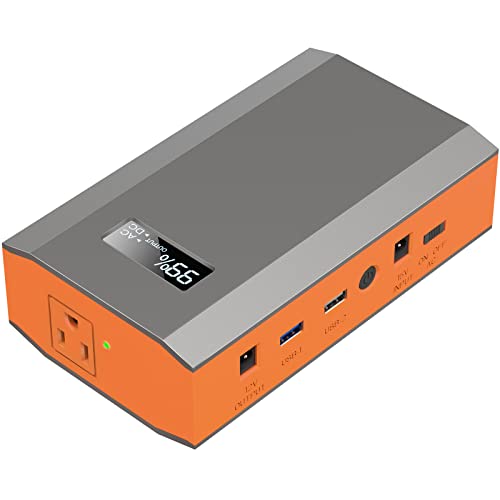
Portable Power Bank with AC Outlet 65W (86.8Wh) — The flight-sized all-rounder
This pack is the category drawn at its most portable: 86.8Wh in the tank, a 65W outlet at 110V, and a title that aims it at laptop backup, camping, RV travel and smart devices. The 86.8Wh figure is chosen well — it is most of what the sub-100Wh class allows, which means most of the runtime this size of battery can offer while staying in the cabin-friendly zone that airlines generally recognise for spare lithium batteries. For the business traveller whose laptop dies in departure lounges and the camper whose tent has lights, a camera charger and a phone queue, this is the shape of the compromise: one pack, one real socket, no drama at security.
The 65W outlet defines its menu honestly. Laptop bricks of the thin-and-light class, phone and tablet chargers plugged in as bricks, camera battery chargers, small fans, LED lighting — the population of devices that sip rather than gulp. Its maker frames it as a fast-charging power source, and the USB side handles the phone-class loads directly, leaving the outlet for the plug-only gear that justifies the category. In an RV or at a campsite it becomes the evening’s small power utility: quiet, instant, and sized for electronics rather than appliances.
Its boundaries are the boundaries of its class, stated plainly. Sixty-five watts will not run a hungry gaming laptop’s brick at full draw, and 86.8Wh divided among a laptop, two phones and a camera charger is an evening, not a weekend. Buyers whose central load is a CPAP machine through the night, or a projector for a film, should be reading the Krisdonia sections below. Buyers whose load is a laptop and a phone, in places without sockets, have found the most carryable answer in the guide — and the one that flies with them.
- Stored energy: 86.8Wh
- AC outlet: 65W, 110V
- Named uses: laptop backup, outdoor tent camping, RV, smart devices
- Flight position: under the 100Wh line airlines generally apply to cabin spare batteries — confirm your carrier’s current rules before flying
- Class: true power bank with an added socket; pocket-to-bag scale, not a station
- USB detail: the title frames the pack as a fast-charging source without enumerating its USB ports — the listing carries the port census
Strengths
- The largest tank that stays comfortably in the generally flight-friendly watt-hour class.
- A real 110V socket covers the plug-only devices an ordinary power bank cannot touch.
- Titled for the exact mixed life — laptop, camping, RV — that this size serves best.
Trade-offs
- The 65W outlet excludes high-draw bricks and anything that heats or cooks.
- 86.8Wh is one laptop-class refill plus phones, not a weekend off-grid supply.
- USB port details live on the listing, so a USB-C laptop owner should confirm the direct-cable route there.
Best for: a traveller or camper whose plug-only load is a thin laptop brick and small electronics, within one evening’s energy. Not suited for: an overnight CPAP routine or a projector evening, where its tank empties before the job does. If that traveller’s profile is yours, read this pack’s listing for its USB layout and take the socket with you.

Portable Power Bank with AC Outlet 100W (98Wh) — The strongest true power bank
Ninety-eight watt-hours is a number with intent behind it: it presses against the 100Wh line that governs cabin batteries and stops just short, extracting nearly the maximum energy a flight-friendly pack can hold. Through its outlet it pushes 100W — the strongest socket among the guide’s true power banks — and its USB-C port delivers 65W PD, which gives a USB-C laptop two ways to feed: efficiently, by cable, or universally, through its own brick in the outlet. Its title aims the combination at business travel and outdoor activities, and the pairing of near-limit capacity with a genuinely strong outlet makes it the most capable pack here that still behaves like a power bank rather than furniture.
The dual-route design deserves unpacking, because it changes how the tank gets spent. Every trip through the AC outlet pays a conversion toll — battery to alternating current, then the brick converts back down — while a USB-C cable pays a smaller one. A traveller who charges the laptop by cable and reserves the outlet for the one plug-only device in the kit (a camera charger, a colleague’s proprietary brick, a small appliance of the office roadshow) stretches 98Wh noticeably further than one who runs everything through the socket. The pack rewards a deliberate user, and its title’s business-travel framing suggests it expects one.
Where it cannot follow is into the station class. Ninety-eight watt-hours remains a day-scale tank: a working laptop plus phones, an evening of mixed devices, not a weekend cabin or a full night of medical-adjacent equipment plus everything else. The 27000mAh figure in its title is the same tank described in the other unit, and buyers comparing across this guide should compare watt-hours to watt-hours, since milliamp-hours shift meaning with voltage. Within the power-bank class, though, this is the ceiling — the strongest outlet and the near-largest legal tank in a pack still meant to be carried daily.
- Stored energy: 98Wh (also stated as 27000mAh in the title)
- AC outlet: 100W — the strongest among this guide’s true power banks
- USB-C output: 65W PD, enough to feed a USB-C laptop directly by cable
- Named uses: business travel and outdoor activities; laptop backup
- Flight position: under the 100Wh line by a small margin — carry documentation and confirm your airline’s current policy, since margins invite questions
- Class: high-capacity power bank; carried in a bag, not a pocket
Strengths
- A 100W outlet runs bricks and plug-only gear that defeat the 65W picks.
- The 65W PD USB-C port offers the efficient cable route for USB-C laptops, sparing the tank.
- 98Wh extracts nearly the whole flight-friendly capacity allowance in one pack.
Trade-offs
- Its small margin under 100Wh makes airline-rule confirmation a genuine pre-flight step, not a formality.
- Still a day-scale tank; multi-day or multi-device off-grid plans belong to the station below.
- Capacity at this level means weight at this level — it is bag luggage, not jacket luggage.
Best for: a business traveller whose kit includes one demanding plug-only device and a USB-C laptop, all in one carry-on. Not suited for: a weekend off-grid basecamp, where 98Wh is spent by the first evening. If your travel matches the description, study this pack’s listing, note its outlet’s exact rating against your brick, and fly with the strongest bank the rules generally allow.

Krisdonia AC Power Bank 60000mAh 130W — The CPAP and projector pick
Krisdonia’s first entry changes the guide’s centre of gravity. Its outlet pushes 130W — the strongest socket in these six — and its title names the loads that justify it: laptop, CPAP, drone, projector, smartphone. Read that list as the plug-only hall of fame. These are devices whose chargers and power supplies assume a wall, and a battery that can meet them on their own terms turns a tent into a bedroom, a garden into a cinema, a van into an office. Dual USB with QC3.0 plus a Type-C port handle the phone-class traffic, leaving the AC socket for the machinery it was built to serve.
The CPAP case deserves direct treatment, because for its owners this category is not a convenience. A CPAP user who camps, sails, or simply refuses to be hostage to the bedroom wall needs a battery whose outlet can run the machine through the night — and needs to know that features like heated humidification draw far harder than the machine’s base therapy, a distinction every CPAP owner should verify against their own device’s draw before trusting any pack, this one included. We state the principle rather than a runtime promise, because runtime depends on the individual machine and its settings, and a guide that printed one would be guessing with someone’s sleep. What can be said: a 130W outlet clears the power threshold of this class of equipment with room, and the capacity is the largest-but-one in the guide.
That capacity comes with this guide’s most important paperwork caveat. The title states 60000mAh and no watt-hour figure, and watt-hours are the unit that decides both airline eligibility and honest runtime comparisons. A milliamp-hour figure cannot be converted without the pack’s voltage, which the title does not give — so before this Krisdonia is planned into a flight or a runtime calculation, its watt-hour rating must be pulled from the full listing. Treat it, until that number is in hand, as a ground-travel pack: car, cabin, campsite, home backup. Within that world it is formidable — the strongest outlet here, aimed at exactly the devices that need one.
- AC outlet: 130W, 110V — the strongest socket in this guide
- Capacity as titled: 60000mAh (the title gives no watt-hour figure)
- USB: dual USB with QC3.0, plus a Type-C port
- Named devices: laptop, CPAP, drone, projector, smartphone and others
- Flight position: watt-hours are not stated in the listing title, so flight eligibility cannot be confirmed from the title — read the Wh rating on the full listing before any flight plan
- Class: high-capacity bank at the edge of the station category
Strengths
- The 130W outlet clears the draw of plug-only gear — CPAP machines, projectors, drone chargers — that the 65W picks cannot start.
- Capacity is aimed at overnight and evening-length jobs, not just top-ups.
- QC3.0 USB ports plus Type-C keep phone-class charging on the efficient direct route.
Trade-offs
- The missing watt-hour figure in the title blocks flight planning and runtime maths until the listing is consulted.
- CPAP runtime depends on the individual machine and its humidity settings; no honest single number exists.
- Size and weight follow capacity — this is vehicle and cabin luggage.
Best for: a CPAP user, drone pilot or projector host whose plug-only gear needs a 130W socket on the ground — campsite, van, garden, cabin. Not suited for: a carry-on plan made from the title alone, since its watt-hours must be confirmed on the listing before any airline conversation. If your loads match its list, open the Krisdonia 60000mAh listing, find its Wh figure first, and plan the night around real numbers.

Krisdonia Power Bank with AC Outlet 80000mAh — The mini power station
Let us be precise about what this is, because its own title is: a 296Wh power station, in its maker’s words, wearing a power bank’s name. At 80000mAh and 296 watt-hours it stores roughly three times the energy of the flight-friendly picks, feeds devices through an AC outlet and a USB-C port rated at 100W, and names MacBook Pro and Air, iPhone, iPad and Dell and HP laptops among its charges. This is the largest-capacity choice in the guide by a wide margin, and it competes not with the banks above but with the small end of the power-station shelf — the unit that lives in a car boot, under a cabin desk, or beside the home office router, and comes out when the power goes off or the campsite has none.
Scale changes what the numbers mean. A 296Wh tank turns the runtime conversation from top-ups into shifts: a laptop worked from for a full day away from mains, a CPAP run with margin rather than anxiety, a projector evening plus the phones, a router and lights kept alive through an outage’s first night. The 100W USB-C port matters at this scale too, because big tanks invite waste, and feeding the laptop by cable rather than through the outlet’s double conversion keeps more of those 296 watt-hours doing useful work. The AC outlet then serves the genuinely plug-bound: the brick-only laptop, the machine, the charger that speaks no USB.
The costs of scale are mobility and the airport. Two hundred ninety-six watt-hours is far beyond the limits airlines apply to lithium batteries in the cabin — this station travels by road or stays at home, and no airline approval process for passengers covers a battery of this size as a carry-on item. It is also, unavoidably, a heavy object: energy density is physics, and a tank this size announces itself in the hand and the boot. Buyers should therefore place it honestly in their plans — it is basecamp and backup infrastructure, the thing that makes other devices’ batteries matter less, not a companion for a jacket pocket or a flight bag. Judged as infrastructure, it is the guide’s heavyweight champion. Judged as a power bank, it would be a misunderstanding, and this guide declines to misunderstand it.
- Stored energy: 296Wh (also stated as 80000mAh in the title) — the largest tank in this guide
- USB-C output: 100W
- AC outlet: present in the title; its wattage rating is a figure to confirm on the full listing before matching a demanding brick to it
- Named devices: MacBook Pro/Air, iPhone, iPad, Dell and HP laptops
- Flight position: 296Wh exceeds the limits applied to passenger cabin batteries — ground transport and home use only
- Class: mini power station, per its own title — car boot, cabin and home-backup scale
Strengths
- 296Wh changes the job from topping up to powering through — full workdays, full nights, outage evenings.
- A 100W USB-C port gives modern laptops the efficient direct route at station scale.
- One unit consolidates what would otherwise be two or three smaller banks with change left over.
Trade-offs
- It cannot fly with you; 296Wh is outside passenger battery limits by a wide margin.
- Weight and bulk are inherent to the capacity — it is carried by vehicle or kept in place.
- The outlet’s wattage is not stated in the title, so a demanding plug-only load needs the listing’s figure first.
Best for: a driver, cabin owner or home-office worker who wants one substantial reserve for laptops and plug-only gear on the ground. Not suited for: any journey involving a passenger aircraft, or any pocket. If your power problem is measured in days and outages rather than layovers, read the Krisdonia 296Wh listing for its outlet rating and give it a permanent corner to guard.

Powkey Portable Power Station with AC Outlet (86Wh) — The compact emergency brick
The Powkey calls itself a power station at 86Wh, and the framing tells you its intended life: not the daily commute, but the drawer it waits in. Its title pitches a 120V outlet rated at 65W, a 24000mAh / 86Wh lithium pack, and a mission list of camping, home office and emergency backup — the power cut during a storm, the night the grid fails with work unsaved, the campsite evening. The green finish is a small honesty of its own: this is outdoor-and-utility equipment, styled to be found in a dark hallway rather than to match a desk.
At this scale the station-versus-bank distinction is mostly vocabulary, and the useful comparison is with the 86.8Wh bank at the top of the guide. The Powkey offers a similar tank with a 120V outlet where the other offers 110V — a distinction that matters to almost nobody, since North American devices accept either — and a 65W outlet class that serves the same laptop-brick and small-electronics menu. Its emergency framing, though, points at a different buying logic: a backup device is judged on the night it is needed, and its virtues are that it was charged, that it was findable, and that its outlet ran the router, the light and the phone chargers until morning. Capacity for a full laptop workday is not its brief; capacity for the essentials is.
Its limits follow that brief. Eighty-six watt-hours spent on a space heater is a fantasy this guide will not entertain — no pick here runs heating appliances — and spent on a hungry laptop it is an hour-scale resource, not a day. The buyer whose emergency plan centres on a CPAP machine should be reading the Krisdonia sections, where the tanks are sized for nights. The Powkey’s buyer is the household that wants one honest, compact reserve for communications and light, kept charged against the outage that comes once or twice a year — and for that buyer, its modest scale is not a compromise but the correct size of the answer.
- Stored energy: 86Wh (24000mAh)
- AC outlet: 120V, 65W class
- Colour: green
- Named uses: camping, home office, outdoor, emergency backup power
- Flight position: under the 100Wh line generally applied to cabin batteries — still confirm your carrier’s current rules
- Class: compact station-scale pack, sized for essentials rather than workdays
Strengths
- Emergency-first framing matches how such a pack is actually used: charged, stored, decisive on one bad night.
- A 120V / 65W outlet covers routers, lights, phone chargers and a laptop’s careful ration.
- Compact enough to live in the drawer or the car without negotiating for space.
Trade-offs
- 86Wh is essentials-scale; overnight medical equipment or full workdays exceed it.
- The 65W outlet class excludes demanding bricks and all heating appliances.
- As a stored backup it needs a charging routine, or the emergency finds it empty — a discipline cost, not a hardware one.
Best for: a household that wants one compact reserve for outages — router, lights, phones — plus campsite evenings. Not suited for: a CPAP-centred emergency plan, where its tank is measured in hours the night will outlast. If essentials-backup is the job, check the Powkey’s listing, charge it, and let it wait in the drawer like the insurance it is.

SinKeu Power Bank 24000mAh with 110V AC Outlet — The storm-season bank
The SinKeu’s title reads like a checklist written by someone who has lived through a hurricane season: 24000mAh, a 110V AC outlet, a 65-watt class output, and a mission list that runs from the iPhone 15 to outdoor camping to the home office to, explicitly, hurricane emergency. That last phrase is the product’s centre of gravity. When the grid goes down for days, the hierarchy of needs is unglamorous — phones alive for news and family, a light that is not a candle, a router while the line lasts, a fan if the night is airless — and a bank with a real socket serves that hierarchy in a way a USB-only bank cannot, because half the essentials in a house speak only plug.
Its numbers sit in the guide’s sensible middle. The 24000mAh capacity pairs with a 110V outlet at the 65W class: enough socket for laptop bricks of the modest sort, chargers, small fans and lighting, and enough tank for the communications layer of an outage — phones charged repeatedly, small devices kept in rotation. The same numbers serve its camping brief without strain, since campsite loads and outage loads are cousins: small, electrical, evening-shaped. What the SinKeu is not is a whole-home answer, and its title does not claim to be one; the household that wants refrigeration or medical equipment through a long outage is shopping for the station class above, or beyond this guide entirely.
Two buying notes belong to its emergency role. First, a backup battery’s real specification is its state of charge on the day the storm arrives, which is a habit, not a feature: buy it before the season, charge it, and refresh it on a calendar rhythm, because a 24000mAh bank at forty percent is a smaller bank wearing a bigger one’s coat. Second, its watt-hour figure should be read on the listing before the pack is compared precisely against the Wh-stated picks here — the title speaks in milliamp-hours, and the honest comparisons in this category are made in watt-hours. Neither note diminishes the SinKeu’s proposition: a socket and a tank, sized for the essentials, bought by people who have read a weather forecast and believed it.
- Capacity as titled: 24000mAh
- AC outlet: 110V, 65-watt class per the title
- Named uses: iPhone 15 charging, outdoor camping, home office, hurricane emergency
- Stored energy in watt-hours: the title speaks in milliamp-hours, so take the Wh figure from the full listing before comparing tanks precisely
- Flight position: cannot be settled from the title’s figures alone — confirm the Wh rating and your airline’s rules if flying is planned
- Class: mid-size bank with a socket, aimed at essentials and evenings
Strengths
- Its emergency framing is specific and credible — phones, lights and small plug-only essentials through an outage.
- A 110V socket covers the half of the household kit that USB-only banks cannot serve.
- The same numbers suit camping without adaptation, so it earns its keep outside storm season too.
Trade-offs
- The watt-hour figure is absent from the title, complicating precise comparison with the Wh-stated picks.
- Essentials-scale only: refrigeration, heating and overnight medical loads are beyond its class.
- A stored emergency battery demands a refresh routine; neglected, it is a smaller battery than its label.
Best for: a household in storm country that wants phones, lights and small plug-only gear covered through an outage, plus a camping bank between seasons. Not suited for: whole-home backup ambitions or a CPAP plan, where the Krisdonia tanks are the honest starting point. If that household is yours, read the SinKeu’s listing for its watt-hours, buy it before the forecast forces the issue, and keep it charged.
From Pocket Bank to Mini Station: How Do the Six Capacities Compare?
| Pick | Stored energy | AC outlet | Strongest direct USB route | Travel character |
|---|---|---|---|---|
| Power Bank with AC Outlet 65W | 86.8Wh | 65W, 110V | See listing | Cabin-friendly class; daily carry |
| Power Bank with AC Outlet 100W | 98Wh / 27000mAh | 100W | 65W PD USB-C | Cabin-friendly class, near the line |
| Krisdonia AC Power Bank 60000mAh | 60000mAh (Wh on listing) | 130W, 110V | Type-C plus QC3.0 USB | Ground travel until Wh confirmed |
| Krisdonia 80000mAh Power Station | 296Wh / 80000mAh | Rating on listing | 100W USB-C | Ground only — beyond cabin limits |
| Powkey Power Station 86Wh | 86Wh / 24000mAh | 65W, 120V | See listing | Cabin-friendly class; stored backup |
| SinKeu Power Bank 24000mAh | 24000mAh (Wh on listing) | 65W class, 110V | See listing | Confirm Wh before flight plans |
The table’s honest lesson is that this category is really two categories sharing a keyword. The first three rows from the top of the capacity range — no: read it by travel character instead. Two packs live in the cabin-friendly class and the daily bag. One station lives in the car and the house. Between them sit the ground-travel heavyweights and the stored-backup pair, each answering a different emergency. A buyer who starts from where the battery will live — seat pocket, car boot, hallway drawer — will find the table nearly chooses for them; a buyer who starts from the biggest number will spend the ownership explaining the choice to airlines, or to their own shoulder.
Can You Fly With a Charger That Has an AC Outlet?
Generally, yes — if its watt-hours keep it in the class airlines accept, and if it travels in the cabin with you. The rules that govern spare lithium batteries on passenger aircraft are built on watt-hours: batteries up to 100Wh are generally permitted in hand luggage, larger ones up to a higher ceiling may be allowed only with the airline’s approval, and beyond that ceiling they do not fly as passenger baggage at all. Checked baggage is not the loophole — spare batteries belong in the cabin, where the crew can reach them, and every pick in this guide should be packed accordingly. Rules vary by carrier and country and change over time, so treat this section as the shape of the system, and your airline’s current page as the law of your specific flight.
Applied to the six: the 86.8Wh bank and the 86Wh Powkey sit comfortably in the generally permitted class, and the 98Wh pack sits just under the same line — close enough that carrying its specification, or a screenshot of its listing, is a sensible courtesy to the security conversation. The Krisdonia 296Wh station is not a borderline case; it exceeds the framework entirely and travels by road. The two milliamp-hour-titled packs — the Krisdonia 60000mAh and the SinKeu — cannot be placed until their watt-hour ratings are read on their listings, because the number on the security officer’s chart is watt-hours and no other unit will be accepted as a substitute. Plan the purchase around that reading if flying matters to you.
Two habits make battery flying uneventful. First, protect the terminals and the pack itself — a case or a pouch, no loose metal companions in the same pocket — because the rules’ spirit is preventing short circuits and damage, not merely counting watt-hours. Second, keep the pack reachable and identifiable: a battery buried at the bottom of a stuffed carry-on invites the long version of the inspection. The travellers these rules were written around carry exactly the sub-100Wh class this guide leads with, and they pass through security every day without incident. Size your purchase to join them, if the air is where your charging problems live.
How Do You Run a CPAP or a Projector From a Battery, Step by Step?
Start a week early, at home, with the device plugged into the battery on your own floor — the rehearsal principle that separates a plan from a hope. For a CPAP machine, note its power supply’s rating, then run the machine from the pack for a full night at home with your normal settings. If a heated humidifier or heated hose is part of your therapy, test with them on and then, if your clinician’s guidance permits, understand what turning them off does to your runtime, because humidity features are typically the largest single draw after the blower itself. The Krisdonia picks are the candidates for this job in this guide; the sub-100Wh packs are not sized for a full night’s therapy plus margin, and no traveller should discover that at altitude or in a tent.
For a projector evening, the arithmetic is friendlier but the rehearsal is the same. Note the projector’s draw, divide the tank by it with a healthy discount for conversion losses, and learn whether your film fits the battery before the audience assembles. Charge the pack fully the same day, run the projector from the outlet, and keep phones on the USB ports rather than the socket, since every device on the AC side pays the conversion toll. A garden cinema that ends twenty minutes before the credits is a story told against the host for years; the packs in this guide, honestly matched, are how it ends with the credits instead.
Whatever the load, finish the routine with the pack’s own recharge. A battery of this class takes hours, not minutes, to refill — the station longest of all — so the plan for a two-night trip includes where the pack itself feeds: the car’s outlet on the drive, the cabin’s wall, the home socket the night before. Owners who build that return journey into the plan own a power system. Owners who do not own a very capable one-night battery and a second night of improvisation.
What Battery Habits Keep a Big Pack Healthy for Years?
Lithium packs age by calendar, by heat and by how they are stored, and a charger in this category is bought for years of standby and service, so its storage habits are part of the purchase. A pack kept for emergencies should not sit at a full charge in a hot garage for a year, nor be left empty in a drawer until it forgets itself; the widely used practice for lithium storage is a partial charge, a cool dry place, and a refresh cycle a few times a year — the same calendar rhythm the SinKeu and Powkey sections recommend for readiness. A pack in daily service asks less ceremony: use it, charge it, keep it out of sustained heat, and let its management electronics do their work.
Heat deserves its own sentence because these packs work hardest exactly where heat gathers — tents in sun, car boots in summer, the floor beside a router. Charging or discharging any lithium battery in high ambient heat shortens its life and, at extremes, its temper; shade and airflow are free performance. The second habit is cable and port hygiene: the high-output USB-C ports on the 98Wh and Krisdonia packs deliver their best through sound cables, and a worn cable that negotiates badly can masquerade as a fading battery for months.
Finally, know the signs of a pack asking for retirement: swelling, a shell that no longer sits flat, heat out of proportion to the load, capacity that has plainly collapsed. A battery that shows them should be recycled through a proper channel, not demoted to a drawer — the same seriousness this guide applied to wall chargers applies double to a device that is, in essence, stored energy in a box. Bought well and kept well, any of the six should serve for years; the difference between a five-year pack and a two-year pack is usually the owner’s habits, not the factory’s.
What Do Buyers Most Often Get Wrong With AC Power Banks?
The founding mistake is matching the tank and forgetting the door: buying the largest capacity in reach, then discovering its outlet cannot start the one plug-only device that motivated the purchase — or the reverse, a strong outlet on a tank that empties before the film ends. The two numbers must be shopped together, against a named device and a named duration. The second mistake is appliance optimism. These are electronics batteries; kettles, heaters, hair dryers and most kitchen machinery draw multiples of the strongest outlet here, and a buyer whose outage plan secretly centres on hot drinks needs a different class of machine and a different guide.
The third mistake is unit confusion, and the listings themselves invite it: milliamp-hours and watt-hours printed side by side as if interchangeable, when only watt-hours compare across packs or speak to airlines. The two mAh-titled picks in this guide are good products whose sections tell you exactly which number to fetch from the listing — fetch it, and make every comparison in watt-hours from then on. The fourth mistake is buying the station for the pocket or the pocket bank for the station’s job: a 296Wh unit resented daily for its weight, or an 86Wh pack blamed nightly for a CPAP it was never sized to run. Both were the right product in the wrong life.
The last mistake is neglect after purchase. An emergency battery uncharged is furniture; a travel battery whose watt-hours were never checked is a security-queue negotiation; a pack stored cooking in a summer car boot is a shorter-lived pack than its owner paid for. The hardware in this guide is the easy half. The ownership habits — charge it, check it, store it kindly, rehearse the big loads at home — are the half that decides whether, on the one night it matters, the socket on the battery simply works.
One scenario deserves a paragraph of its own because it assembles several picks’ virtues at once: the working road trip. A car delivers its occupants to places with no sockets at all — trailheads, viewpoints, the far end of a campsite — while asking nothing of a battery during the drive, since the vehicle itself is a generator on wheels. The routine that emerges is a rhythm: the pack feeds laptops and cameras at the stop, then refills from the car or the evening’s lodging while its owner does other things. In that rhythm the mid-size picks shine brightest, the station becomes the basecamp variant of the same idea, and the whole category stops looking like emergency equipment and starts looking like what it increasingly is — the normal way a certain kind of traveller simply works.
Final Recommendation
Choose by the load you can name. The traveller with a laptop brick and a phone queue should take the 86.8Wh bank, or the 98Wh pack if one plug-only device in the kit is demanding and the strongest flight-class outlet is worth having. The camper, CPAP user or projector host should take a Krisdonia — the 130W 60000mAh for the strongest socket, the 296Wh station when the job is measured in days and outages rather than evenings. The household buying insurance should take the Powkey for a compact essentials reserve or the SinKeu for storm-season coverage with a camping second life. Every pick here puts a real wall socket where no wall exists; match its tank and its outlet to your device and your duration, and that small miracle becomes a routine you stop noticing — which, for backup power, is the highest compliment there is.
Frequently Asked Questions
Can these chargers run a kettle or a space heater during an outage?
No, and the arithmetic is not close. Heating appliances draw many times the output of the strongest outlet in this guide, which tops out at 130W. These packs are built for electronics — laptops, phones, routers, lights, CPAP machines, projectors — and a buyer whose outage plan requires heat or cooking needs a far larger class of power station. Size the battery to electronics and let the kettle wait for the grid.
How long will one of these run my laptop?
Estimate it from watt-hours, then discount. Divide the pack’s watt-hours by your laptop’s average draw — not its brick’s maximum rating, which overstates working consumption — and expect to land noticeably below the raw division, because converting battery power to AC and back costs energy at both steps. A USB-C laptop charged directly by cable, as the 98Wh pack and the Krisdonia station allow, keeps more of the tank, which is why this guide keeps steering cable-capable laptops away from the socket.
Why do some listings show mAh and others Wh for the same kind of product?
Because milliamp-hours describe charge at a particular voltage, and that voltage differs between packs, the same mAh figure can mean different amounts of actual energy. Watt-hours already include the voltage, so they compare honestly across products and they are the unit airlines regulate. When a title gives only mAh — two picks here do — the watt-hour figure on the full listing is the number to shop by.
Is it better to charge a laptop through the AC outlet or the USB-C port?
By cable, whenever the laptop accepts USB-C charging. The outlet route converts the battery’s power to AC and the laptop’s brick converts it back, paying a toll at each conversion; the cable route converts once. The outlet earns its place for devices that cannot charge by USB — proprietary bricks, CPAP machines, chargers — which is the entire reason this category exists. Use each route for what it is for and the tank lasts longest.
Can I leave one of these plugged in as a permanent home backup?
You can keep it charged and ready, which is the right posture for the emergency picks, but treat readiness as a routine rather than a state: a partial-to-full charge kept in a cool place, refreshed on a calendar cycle, beats a pack forgotten at full charge in a hot cupboard for a year. Lithium batteries age in storage as surely as in service, and the refresh habit is what keeps the stored number on the label honest.
What should I check first when a device will not run from the outlet?
The device’s draw against the outlet’s rating — the door-versus-load question this guide returns to throughout. Find the wattage on the device’s own power supply or label; if it exceeds the outlet’s figure, the pack is protecting itself, not failing. If the draw fits, test the same device on a wall socket to rule the device out, and try the pack’s USB ports with a phone to confirm the battery itself is alive and charged.
Related Guides
Related guides
- Best Backup Hard Drives for Home, Family Archives and Whole-House Copies
- Best 17 Laptops: The Complete Tier-by-Tier Guide to Big-Screen Machines
- Best Routers for Remote Work: VPN Gateways, Travel Routers and Home Wi-Fi That Holds a Call
- Best Sim Racing Monitors: Ultrawide Cockpits From 34-Inch OLED Speed to the 49-Inch Wrap


