What's inside
- Key Takeaways
- Quick Picks
- How Did We Choose These Six Studio Monitoring Headphones?
- Why Does the Closed-Back Versus Open-Back Choice Decide Everything?
- What Do Impedance and Sensitivity Mean for Your Setup?
- The Six Monitoring Headphones in Detail
- When Should Headphones, Not Speakers, Carry the Mix?
- What Does Field Recording Ask of a Monitoring Headphone?
- Sealed or Open, Driven by What? The Six Headphones at a Glance
- How Do You Build a Headphone Routine a Studio Can Trust?
- What Mistakes Do Studio Headphone Buyers Make Most Often?
- Final Recommendation
- Frequently Asked Questions
- Related Guides
As an Amazon Associate I earn from qualifying purchases. This post may contain affiliate links at no extra cost to you.
widgetverdict.com is reader-supported. When you buy through links on our site, we may earn an affiliate commission.
Where to buy: From a white entry-level Audio-Technica to the two beyerdynamic reference models that between them define the open-versus-closed argument, all six studio monitoring headphones in this guide are carried by Amazon.
Start with the fact this category’s name tries to hide: none of the six products below has a microphone. They are monitoring headphones — wired, over-ear, built for tracking, mixing, and field recording — and the word “headset” in the search that brought you here describes what people ask for, not what these products are. The best monitor headsets for studio work are, in truth, the best monitor headphones, and this guide will use the accurate word from here on. If you need a microphone for streaming, broadcasting, or calls, you need a different category of product — a broadcast or streaming headset with a boom — and no amount of studio pedigree will bolt one onto these six. What they offer instead is the thing studios actually buy headphones for: an honest, repeatable version of your recording, delivered the same way on the thousandth listen as on the first.
Within that honest definition, the six divide along lines that matter. Five are closed-back, sealing the ear against the room — the tracking choice, because a click track leaking from the headphones into a live microphone ruins takes. One, the beyerdynamic DT 990 Pro, is open-back: its sound escapes and the room’s sound enters, which disqualifies it beside a microphone and qualifies it at the mixing desk, where its openness is precisely the point. Impedance splits them again — the DT 770 Pro here is the 80 Ohm version its listing says plays from a phone or laptop, while the DT 990 Pro is a 250 Ohm model its listing says is best from a headphone amp or interface. Around those two references stand the working staples: Audio-Technica’s M30x and M20x, Sennheiser’s HD 280 Pro with its stated 32dB of attenuation, and Shure’s SRH440A. Every claim below comes from the listings themselves.
Key Takeaways
- None of these six monitoring headphones has a microphone — buyers who need one should shop streaming or broadcast headsets instead.
- Five picks are closed-back for tracking isolation; the beyerdynamic DT 990 Pro is open-back and belongs at the mixing desk, not beside a live mic.
- The Sennheiser HD 280 Pro states 32dB of attenuation — the only isolation figure published in these listings.
- Impedance is a purchasing decision: the DT 770 Pro (80 Ohm) is listed as playing from a phone or laptop, while the DT 990 Pro (250 Ohm) is listed as best from an amp or interface.
- Audio-Technica brackets the range — the M20x with published driver and response figures, the M30x as the step-up tracking and mixing model.
- The Shure SRH440A’s collapsible design is the portability pick for field recording and location work.
Quick Picks
| Pick | Badge | Why it earns its place |
|---|---|---|
| Audio-Technica ATH-M30x Professional Studio Monitor | The balanced tracking step-up | Closed-back over-ear with screw-on adapter and carrying pouch, aimed at tracking, mixing, and field recording. |
| Sennheiser HD 280 Pro Monitoring Headphones | The isolation specialist | Closed-back with a stated 32dB attenuation and a coiled cable, built for monitoring, recording, and fieldwork. |
| Shure SRH440A Studio Headphones | The collapsible field pick | Closed-back with enhanced frequency response and a collapsible frame for recording work that travels. |
| beyerdynamic DT 770 Pro (80 Ohm), Closed-Back Studio | The tracking standard | The listing calls it the tracking standard for recording and podcast — 80 Ohm, velour pads, 3m cable, plays from a phone or laptop. |
| beyerdynamic DT 990 Pro (250 Ohm), Open-Back Studio | The mixing reference | Open-back mixing reference at 250 Ohm — best from an amp or interface, and openly audible to others in the room. |
| Audio-Technica ATH-M20x Monitor Headphones (White) | The entry point with published figures | 40mm drivers, 96dB sensitivity, 15-20kHz response as stated — the accessible start of the M-series line, in white. |
How Did We Choose These Six Studio Monitoring Headphones?
We required three things. First, a genuine monitoring brief in the listing itself — studio tracking, mixing, recording, or fieldwork named by the manufacturer, rather than a consumer headphone wearing studio clothes. Second, a wired over-ear design, because that is what tracking and mixing sessions actually use: no battery, no Bluetooth latency, no codec between the desk and the ear. Third, published particulars where the category allows them — attenuation, impedance, driver size, sensitivity, cable length — because a studio purchase is a specification purchase, and the listings that print their numbers deserve the analytical preference this guide gives them.
We also insisted the roundup contain the category’s central argument rather than six copies of one answer. So the set holds the closed-versus-open contrast in its purest available form — two beyerdynamic siblings, one sealed and one open, from the same family and the same design language — and around them the three great working alternatives: Audio-Technica’s M-series at two levels, Sennheiser’s isolation-led HD 280 Pro, and Shure’s collapsible SRH440A. A reader who understands why those six coexist understands the category; a reader who only needs a verdict can take the DT 770 Pro for tracking and the DT 990 Pro for mixing and stop reading, though the sections below exist to make that verdict earned rather than asserted.
Why Does the Closed-Back Versus Open-Back Choice Decide Everything?
Because a headphone in a studio does two different jobs, and the jobs have opposite requirements. Tracking — recording a vocalist, a guitarist, a podcast guest — puts the headphones beside a live microphone. The singer must hear the backing track; the microphone must not. A closed-back headphone seals the ear with a solid cup, keeping the track inside and the room outside, so the only thing the mic captures is the performance. Five of the six picks are closed for exactly this reason, and the Sennheiser HD 280 Pro quantifies the idea with the roundup’s only published isolation figure: 32dB of attenuation, which is the difference between a click track that prints faintly onto a quiet vocal and one that does not print at all.
Mixing reverses the requirement. At the desk there is no live microphone to protect, and the enemy is the sealed cup itself: closed headphones build up pressure, exaggerate certain resonances, and present a soundstage that lives inside the skull. An open-back design vents the cup, letting sound behave more as it does in a room — wider, less fatiguing across a long session, and more truthful about stereo placement and reverb tails. The DT 990 Pro’s listing is admirably blunt about the trade: sound is audible to others. In a shared room that is a social problem; beside a microphone it is a technical disqualification; at a mixing desk at midnight it is irrelevant, and the openness is the entire reason to buy it.
The working rule follows: record closed, mix open, and own both if the studio does both — which is why the two beyerdynamics appear in this guide as a pair rather than as rivals. Studios on a single-headphone budget should default to closed-back, because a closed headphone can mix adequately while an open one cannot track at all; the DT 770 Pro’s listing literally names it the tracking standard, and its 80 Ohm specification keeps it usable from modest sources. But nobody who has mixed on a good open-back returns willingly to mixing on a sealed cup, and the DT 990 Pro is here for the moment a studio’s budget admits the second pair.
What Do Impedance and Sensitivity Mean for Your Setup?
Impedance is the number that decides what your headphones plug into happily. The DT 770 Pro in this roundup is the 80 Ohm version, and its listing states the consequence directly: it plays from a phone or laptop, and is best with an amp — a middle specification that runs adequately from almost anything and improves with a proper headphone output. The DT 990 Pro is 250 Ohm, and its listing is equally direct: best from a headphone amp or audio interface. A 250 Ohm headphone on a weak laptop output plays quietly and can sound thin, not because it is worse but because it is underdriven; the same headphone on an interface’s headphone stage is a reference instrument. Buyers must therefore read impedance as a system question — what will drive these? — and the two beyerdynamic listings, to their credit, answer it in plain language.
Sensitivity is impedance’s partner figure: how loud a headphone plays for a given input. Only one listing here publishes it — the ATH-M20x, at 96dB sensitivity alongside its 40mm drivers and 15-20kHz frequency response — and its presence makes the M20x the most spec-transparent entry point in the six. Where listings omit these figures, as several do, this guide notes the omission rather than importing numbers from other versions of the same model, because manufacturers sell these families in multiple variants and a figure borrowed from a sibling is a figure invented for your purchase. Check the exact variant’s documentation; in this category, the variant is the product.
Cables are the third practical specification, and the listings give two data points worth planning around: the HD 280 Pro’s coiled cable, which stretches across a desk and recoils out of the way — a fieldwork and desk virtue — and the beyerdynamics’ 3m cables, the DT 770’s straight and the DT 990’s coiled per their listings, which set the working radius between the interface and the chair. A studio’s geography is measured in these metres: the vocalist’s distance from the desk, the engineer’s from the rack. Nobody buys a reference headphone for its cable, but everybody curses a short one daily. Headphone extension leads exist and are legitimate studio furniture; what is not legitimate is discovering the need for one mid-take, with a performer watching the engineer rummage. Measure the distances when the studio is set up, not when it is booked.
The Six Monitoring Headphones in Detail
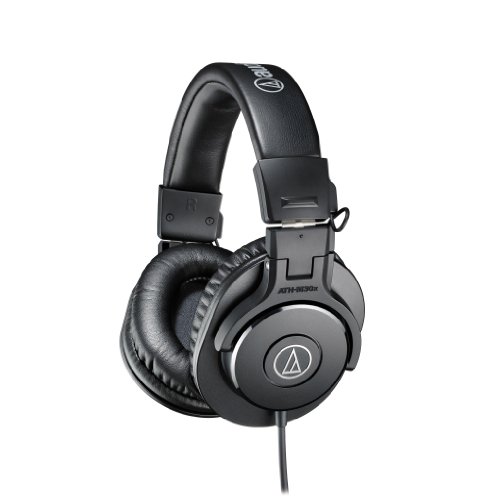
Audio-Technica ATH-M30x Professional Studio Monitor — The balanced tracking step-up
The M30x occupies the sensible middle of Audio-Technica’s M-series: a closed-back, over-ear monitor whose listing names tracking, mixing, and field recording as its brief, with a screw-on adapter and a carrying pouch in the box. The screw-on adapter is a small detail that signals the intended world — the M30x expects to meet both the 3.5mm output of a laptop and the quarter-inch headphone socket of an interface or mixer, and to lock onto the latter rather than wobble in it. The pouch signals the other half of its brief: this is a headphone meant to travel between the studio and the location, and to survive the bag it travels in.
There is a podcast-specific reading of the M30x worth making, because podcasting is where many of these headphones will actually work. A two-person podcast recorded in a treated room needs exactly what the M30x briefs: closed backs so each host’s microphone hears only its host, enough comfort for a ninety-minute conversation, and an adapter that locks into the interface’s headphone distribution without wobble. Hosts also take headphones on and off constantly — for water, for a doorbell, for the producer’s hand signals — and a headphone that survives that handling while keeping its seal honest across a season is the unglamorous definition of a podcast workhorse. The M30x’s generalist specification is, in that world, a specialisation. As a purchase, the M30x is the step-up for a buyer who has outgrown an entry model but does not yet need the beyerdynamic tier — the project studio’s second pair, the podcast producer’s tracking headphone, the field recordist’s sealed monitor. Its listing publishes fewer figures than its smaller sibling the M20x, which is a mild irony this guide notes without penalty: the M-series’ reputation in working studios is the context, and the closed-back tracking brief is the substance. Judge it as the balanced generalist of the six — no single specification leads the roundup, and no job in its stated brief is beyond it.
- Design: closed-back, over-ear
- Stated roles: studio tracking, mixing, field recording
- Adapter: screw-on (for quarter-inch sockets) included
- Carrying: pouch included
- Driver and response figures: not published in the listing title — the M20x below is the sibling whose figures are printed
Strengths
- A tracking-mixing-fieldwork brief in one closed-back design covers most project-studio jobs.
- The screw-on adapter suits interface and mixer sockets properly, not approximately.
- A carrying pouch acknowledges the location work its listing claims.
Trade-offs
- The listing prints fewer hard figures than the cheaper M20x, so spec-led buyers must consult Audio-Technica’s documentation.
- Closed-back mixing fatigue applies, as with every sealed pick here.
- It is out-isolated on paper by the HD 280 Pro’s stated 32dB figure.
Best for: a project studio or podcast producer wanting one closed-back headphone that tracks, mixes, and travels without specialisation.
Isolation cannot be compared from this title at all: it publishes no attenuation figure, unlike the 32dB the Sennheiser further down states in plain numbers.

Sennheiser HD 280 Pro Monitoring Headphones — The isolation specialist
The HD 280 Pro’s listing leads with the number this category usually whispers: 32dB of attenuation from a closed-back design, with a coiled cable, for monitoring, recording, and fieldwork. Attenuation is a tracking headphone’s core promise measured honestly — how much of the headphone’s own playback and the room’s noise the seal keeps apart — and 32dB is a serious figure that serves two masters at once. In the studio it keeps the backing track out of the vocal microphone; in the field it keeps the environment out of the recordist’s judgement, so the boom operator or location engineer hears the microphone’s feed rather than the street’s opinion of it. Sennheiser’s long presence in broadcast and location sound stands behind that second use, and the listing’s word “fieldwork” is doing real work.
The coiled cable completes the field picture: it reaches across a camera position or a desk and contracts when the distance closes, staying out of the tangle zone around feet and tripod legs. There is a broadcast habit worth borrowing here: location sound crews standardise on one headphone model across the whole crew, so that every pair of ears on the production hears the same presentation of the same microphone feed, and a note about the sound means the same thing to everyone who heard it. A small studio or podcast network can copy that discipline cheaply by choosing one closed-back model — this Sennheiser is a natural candidate — for every monitoring position, reserving variety for the single mixing chair. Consistency of monitoring is a quality standard disguised as a purchasing habit. The honest counterweight to the isolation crown is comfort and clamp — a seal that attenuates 32dB is achieved partly through fit pressure, and long sessions will tell some wearers about it; the guide’s advice is the usual one for this class, which is to expect a firm fit and to value it for the isolation it buys. Drummers and other loud-source performers forgive the clamp fastest, because for them the attenuation works twice — keeping the backing track in and the kit’s own volume manageable at the ear — and strong isolation also lets any performer monitor at lower volume, which across a career of sessions is a hearing-conservation argument no studio should wave past. For the buyer whose sessions are loud, live, or on location, the HD 280 Pro is the specification-led choice of the six: it publishes the figure the job depends on.
- Design: closed-back
- Attenuation: 32dB as stated in the listing — the only published isolation figure in this roundup
- Cable: coiled
- Stated roles: monitoring, recording, fieldwork
- Impedance: not published in the listing title — confirm the figure for this variant in Sennheiser’s documentation if your source is weak
Strengths
- A stated 32dB attenuation leads this roundup on the tracking-critical specification.
- The coiled cable suits desks and location positions where distance changes constantly.
- A monitoring-recording-fieldwork brief from a broadcast-rooted maker is a coherent whole.
Trade-offs
- Isolation-grade fit means clamp pressure some wearers feel on long sessions.
- Closed-back mixing limitations apply at the desk, as with all sealed picks.
- The title leaves impedance unpublished, so low-power sources need a documentation check.
Best for: a recordist tracking beside live microphones or monitoring on location, where published isolation is the deciding figure.
Not suited for: a mixer seeking an open, spacious presentation for long desk sessions, because the HD 280 Pro’s sealed design optimises the opposite virtue.

Shure SRH440A Studio Headphones — The collapsible field pick
The SRH440A’s distinguishing word in its listing is “collapsible”, and in a roundup of desk-bound references that word is a passport. Shure describes a studio-grade closed-back headphone with enhanced frequency response for recording, built into a frame that folds for transport — the headphone for the recordist whose studio is wherever the session is: the podcast recorded in a client’s office, the location shoot, the rehearsal room capture. Shure’s own heritage is microphones, and a headphone from a microphone company tends to be designed by people who think about what the mic hears — which, for a closed-back tracking and monitoring tool, is exactly the right ancestry.
“Enhanced frequency response” deserves the calm reading this guide gives all such phrases: it signals a tuning with some emphasis beyond a ruler-flat line, which many recordists prefer for checking detail and many mixers treat cautiously for balance decisions. There is a defensible logic to a slightly enhanced monitor for recording work specifically: the recordist’s task is fault-finding — the buzz, the rattle, the sibilant edge, the room’s fingerprint on a vocal — and a presentation that leans toward detail serves fault-finding the way a brighter torch serves an inspection. The same tuning at the mixing desk would be a liability only if the mixer forgot it was there; an engineer who knows their headphone’s emphases mixes through them, which is the whole doctrine of reference familiarity this guide keeps returning to. The listing does not publish a response range or impedance in its title, so those verifications belong to Shure’s documentation for this model. What the title does establish — closed-back, studio-grade intent, collapsible portability — defines the pick clearly: the travelling recordist’s monitor, bought for the sessions that happen away from the home desk, where its folding frame and sealed cups solve the two problems location work actually has.
- Design: closed-back, over-ear, collapsible
- Tuning: enhanced frequency response per the listing
- Stated role: recording and studio monitoring
- Portability: collapsible design for transport
- Response range and impedance: not published in the listing title — Shure’s specification for the SRH440A is the verifying document
Strengths
- A collapsible frame makes it the natural travelling pick among six desk-anchored rivals.
- Closed-back sealing suits tracking and location monitoring alike.
- A microphone maker’s monitoring headphone is designed with the mic’s perspective in mind.
Trade-offs
- Enhanced response is a tuning choice mixers should audition before trusting for balances.
- Key figures are absent from the title, requiring a documentation step.
- Folding joints are moving parts that reward careful packing over a long life.
Best for: a recordist or podcast producer whose sessions happen in changing rooms and who needs a sealed studio headphone that folds into the kit bag.
Not suited for: a mixer who wants a documented flat response on paper before purchase, because this listing publishes a tuning description rather than figures.

beyerdynamic DT 770 Pro (80 Ohm), Closed-Back Studio — The tracking standard
The DT 770 Pro’s listing does something rare in this category: it assigns the product its job in so many words — “the tracking standard for recording and podcast”. Decades of studio habit stand behind that phrase; the DT 770 is the headphone found on the hook beside vocal booths because it seals well, survives being thrown on and off a hundred times a session, and presents a sound energetic enough that performers sing confidently into it. This listing is the 80 Ohm version, and it states the practical consequence plainly: it plays from a phone or laptop and is best with an amp, which makes it the most source-flexible reference here — a tracking headphone that also works at a laptop on a train.
Performer psychology is the DT 770’s unlisted specification. A singer tracking through headphones is performing into a void unless the headphone feed feels alive — present, confident, close — and generations of engineers have found that this sealed beyerdynamic’s presentation makes performers sing like they mean it, where a duller or more distant feed produces cautious takes. That is not a measurable claim and this guide files it as studio folklore with an unusually long pedigree; but folklore is why the same model hangs in booth after booth, and a buyer equipping a vocal room is buying the performers’ confidence as much as the seal. The remaining particulars are the working kind: velour ear pads that breathe across a long session, and a 3m cable long enough to give a performer room to move at the microphone without tugging the interface off the desk. Read the pick whole and it is the closed-back reference against which the other sealed models here are alternatives: the M30x as the generalist step-up, the HD 280 Pro as the published-isolation specialist, the SRH440A as the traveller. A studio buying its first serious tracking headphone, with no other information, is buying the headphone its listing calls the standard — and for once the superlative is a description of the installed base rather than a boast.
- Design: closed-back studio headphones
- Impedance: 80 Ohm — plays from a phone or laptop, best with an amp, per the listing
- Pads: velour ear pads
- Cable: 3m
- Stated role: the tracking standard for recording and podcast, per the listing
Strengths
- The tracking-standard brief is explicit — this is the vocal-booth reference of the six.
- 80 Ohm impedance runs from modest sources and still rewards a proper amp.
- Velour pads and a 3m cable are session-length, performer-distance practicalities done right.
Trade-offs
- Closed-back presentation is not the mixing ideal its open sibling serves.
- The 3m straight cable is a studio tether, not a commuting convenience.
- Buyers wanting a published attenuation figure will find none stated here — the HD 280 Pro owns that claim.
Best for: a studio or podcaster whose first reference purchase must track performers reliably from almost any source.
Not suited for: a mixer building a desk around an open-back presentation, because the DT 770’s sealed design is optimised for the booth, not the desk.

beyerdynamic DT 990 Pro (250 Ohm), Open-Back Studio — The mixing reference
The DT 990 Pro is the DT 770’s mirror image, and its listing is honest about every term of the mirror. Open-back: the cups vent to the room, so the soundstage widens, the pressure of a sealed cup disappears, and long mixing sessions stop feeling like wearing the music indoors. Mixing reference: that is the stated job, the desk rather than the booth. And then the two candours that define its ownership — sound is audible to others, and at 250 Ohm it is best from a headphone amp or audio interface. A buyer who reads those four facts and still wants it is exactly the buyer it was made for; a buyer who flinches at any of them has been saved a mistake by the listing itself.
Spell out the disqualification plainly, because it is the most important sentence in this pick: an open-back headphone must never be used by a performer in front of a live microphone, because its escaping sound — the listing concedes it is audible to others — will be captured by the mic and printed onto the recording, click, backing track, and all. The bleed is not a subtle degradation, either: it arrives time-delayed by the distance between headphone and microphone, comb-filtering the performer’s own voice and embedding a ghost of the backing track that no plugin politely removes. Engineers have salvaged sessions by re-recording; nobody has salvaged one by mixing harder. The DT 990’s exclusion from the booth is total, and its excellence at the desk is the compensation. Studios that own the DT 990 keep it at the desk the way they keep the good chair at the desk. In return, the mixer gets the presentation this roundup’s other five cannot give: reverb tails that decay into apparent space, stereo placements that sit outside the skull, and a treble clarity that exposes sibilance and edit clicks before clients hear them. Velour pads and a 3m coiled cable complete a specification that asks only for a proper headphone output to drive it.
- Design: open-back studio headphones
- Impedance: 250 Ohm — best from a headphone amp or audio interface, per the listing
- Leakage: sound is audible to others, per the listing — never for tracking beside a live mic
- Pads: velour ear pads
- Cable: 3m coiled
Strengths
- Open-back presentation is the mixing reference experience none of the sealed picks can offer.
- The listing’s candour about leakage and drive requirements prevents mis-purchase.
- Velour pads suit the long sessions mixing actually involves.
Trade-offs
- Absolutely not a tracking headphone — its leakage prints onto recordings.
- 250 Ohm impedance underperforms on weak laptop and phone outputs.
- It offers the room’s noise a free path in, so noisy environments undo its virtues.
Best for: a mixer with an interface or headphone amp, working at a desk in a room quiet enough for an open design.
Not suited for: a performer recording vocals at home, because everything the DT 990 plays will be audible to the microphone an arm’s length away.

Audio-Technica ATH-M20x Monitor Headphones (White) — The entry point with published figures
The M20x is the doorway into this category, and its listing — alone among the Audio-Technica pair here — publishes its working figures: 40mm drivers, 96dB sensitivity, and a 15-20kHz frequency response, in a white finish that distinguishes it in a studio full of black headphones. Those numbers describe an honest entry monitor: a response range that covers the musically essential spectrum, a sensitivity figure that lets a buyer predict its loudness from their source, and drivers of the size this class standardises on. Its stated brief — monitoring, tracking, and mixing — is the same trio as its sibling’s, at the level where project studios, students, and podcast beginners actually start.
Classrooms and teaching studios should linger on this pick a moment longer, because their buying logic differs from a lone producer’s. An instructor equipping six monitoring positions needs a headphone that is adequate everywhere, priced for multiples, robust enough for student handling, and — the white finish again — visibly accountable at the end of a class when the cupboard count happens. The M20x’s published figures also serve teaching directly: a student can be shown the sensitivity and response numbers on their own headphone’s listing and taught what those numbers predict, which turns the fleet purchase into course material. Few entry products anywhere in this guide justify themselves on that many independent grounds. It tracks adequately because it is closed-back; it mixes adequately because the M-series tuning is a known quantity; and it teaches its owner what they actually need next — more isolation, an open-back desk pair, a collapsible traveller — with the lesson priced at the category’s entry point. The white finish is not trivial either: in shared studios and classrooms, a visibly distinct headphone is a headphone that gets returned, and instructors equipping a teaching room will understand that virtue immediately. As an entry point with its figures on the table, the M20x is the most transparent purchase in the six.
- Design: professional studio monitor headphones (closed-back M-series design)
- Drivers: 40mm as stated in the listing
- Sensitivity: 96dB as stated in the listing
- Frequency response: 15-20kHz as stated in the listing
- Finish: white; stated roles are monitoring, tracking, and mixing
Strengths
- Published driver, sensitivity, and response figures make it the most spec-transparent entry here.
- The M-series brief covers the beginner’s three jobs in one purchase.
- A white finish stands out in shared studios, classrooms, and kit rooms.
Trade-offs
- It is the entry rung — its siblings and the beyerdynamics exist because owners outgrow it.
- The 15-20kHz stated range is narrower on paper than full-range claims elsewhere.
- No adapter or pouch is named in its title, unlike the M30x’s listing.
Best for: a student, beginner, or teaching room equipping a first monitoring position with published figures and a visible finish.
Not suited for: a professional mixer seeking a final reference, because the M20x is designed as the start of the ladder this roundup climbs.
When Should Headphones, Not Speakers, Carry the Mix?
Every studio in this guide’s audience lives part of its life on headphones, and the honest reasons are worth stating because they shape which pair to buy. The first is the room: an untreated bedroom or a rented space lies to a pair of monitor speakers in ways a headphone simply bypasses, delivering the recording without the room’s reflections folded in. The second is the hour: mixing at midnight in a shared house is a headphone activity or it is no activity at all — and here the open-back DT 990’s leakage cuts the other way, audible to a partner in the next room, while a closed pair keeps the session private. The third is detail: edits, clicks, breath noise, sibilance, and the low-level junk that hides under a mix are all easier to hear on headphones than on speakers at sane volumes, which is why engineers reach for a pair as a magnifying glass even in rooms full of expensive monitors.
The corresponding limits should be stated with equal plainness. Headphones exaggerate stereo width decisions, flatter or conceal bass in ways that vary by model, and disconnect the mix from the physical experience of sound in a space — which is where most listeners will hear it. The working synthesis, repeated in the routine section below, is to treat headphones as one reference among two: mix primarily where your room allows, check on the other system always, and let disagreements between the two send you to a third — a car, a phone speaker, a colleague’s setup. A studio choosing between the six here is not choosing a sole arbiter of truth; it is choosing the magnifying glass and the tracking tool, and should buy them with that humility built in.
What Does Field Recording Ask of a Monitoring Headphone?
Three of these listings name fieldwork or field recording in their briefs — the M30x, the HD 280 Pro, and, through its collapsible portability, the SRH440A — and the field makes demands a desk never does. The recordist’s problem is judgement in noise: standing in a street, a venue, or a windswept location, they must decide whether what the microphone captured is good, while the environment shouts its own version into their ears. Isolation is therefore the field specification, which is why the HD 280 Pro’s stated 32dB attenuation reads like a location recordist’s requirement written as a number. The sealed cup lets the mic feed be the loudest thing in the recordist’s world; everything else is commentary.
Portability and cable behaviour complete the field brief. A collapsible frame like the SRH440A’s rides in a kit bag without consuming it; a coiled cable like the HD 280 Pro’s adapts as the recordist moves between the recorder, the camera, and the subject; a carrying pouch like the M30x’s keeps the pair clean between the bag and the head. Durability in the field is mostly about these logistics — headphones die in bags and on location floors more often than they die electrically. A studio buying for location work should weight the field-named picks accordingly, and should test the chosen pair outdoors before the paying job: the street outside your building is a free and brutally honest audition room.
Sealed or Open, Driven by What? The Six Headphones at a Glance
| Headphone | Design | Key published figure | Cable | Natural job |
|---|---|---|---|---|
| ATH-M30x | Closed-back | Screw-on adapter included | Not in title | Tracking, mixing, field |
| HD 280 Pro | Closed-back | 32dB attenuation | Coiled | Isolated monitoring, fieldwork |
| SRH440A | Closed-back, collapsible | Enhanced response (description) | Not in title | Travelling recording |
| DT 770 Pro | Closed-back | 80 Ohm | 3m | Tracking standard |
| DT 990 Pro | Open-back | 250 Ohm | 3m coiled | Mixing reference |
| ATH-M20x | Closed-back | 40mm, 96dB, 15-20kHz | Not in title | Entry monitoring |
How Do You Build a Headphone Routine a Studio Can Trust?
A monitoring headphone earns its keep through consistency, and consistency is a routine before it is a specification. Keep the tracking pair and the mixing pair in their places — the closed set by the microphone position, the open set at the desk — because a headphone borrowed across jobs is a headphone that is never where the session needs it, and because the costliest studio accident in this category is an open-back set wandering into a tracking session. Label them if the studio is shared; the DT 990’s leakage is not a subtle flaw, and the take it ruins will be the best one of the day.
Volume discipline belongs in the routine for a reason no listing will mention: monitoring loud is easy, pleasurable, and corrosive. Loud playback flatters a mix in the moment — everything sounds bigger and more exciting — while fatiguing the ears that must judge it an hour later, and sustained high levels at close range are a genuine hazard to the hearing the whole studio depends on. The professional habit is to work at a moderate, consistent level, turning up briefly to check low-level detail and returning to the reference level for decisions. A headphone that sounds right at sane volumes — all six here are built for exactly that work — protects both the mix and the mixer, and a studio that sets a level convention and keeps it will make more consistent records than one chasing excitement at the volume knob. Mix engineers who work on headphones keep a small set of reference recordings — tracks they know intimately — and check every new headphone, and every few months their familiar one, against them. That habit converts a headphone from a purchase into an instrument: you learn where its bass sits relative to the truth, how its treble flatters sibilance, and how its stereo width compares to your monitors, and thereafter its deviations are data rather than surprises. Cross-check mixes on a second system — the other pair in this roundup is the obvious partner — because a balance that survives both a sealed and an open presentation, or a headphone and a speaker, is a balance that will survive your listeners’ equipment too.
Session etiquette for performers belongs in the routine too, because headphones in a studio are shared instruments. The engineer sets the performer’s level with the performer, not for them — too quiet and the singer strains against the track, too loud and the seal is defeated by the bleed the level creates — and checks in after the first take rather than the fifth. Performers should be told plainly that the closed pair is theirs to adjust for fit but not to drape around a neck against a live microphone, where its cups can still leak into the recording. Small courtesies of that kind are what a headphone routine actually consists of, and studios that write them down stop re-learning them at the cost of takes.
Care closes the routine. Velour pads, like the beyerdynamics’, collect the session and should be brushed and aired; all pads compress over years and change both comfort and seal, so treat them as consumables with a replacement rhythm rather than as lifetime parts. Coil cables as they were meant to be coiled, keep the coiled-cable models’ stretch within reason, and store headphones on a hook or stand rather than in the bottom of a gig bag — the SRH440A’s collapsible frame excepted, and even it prefers a pouch. None of the six here is fragile, but all six are precision instruments whose accuracy lives in small physical tolerances, and a studio that treats them accordingly will still be trusting the same pairs in five years.
What Mistakes Do Studio Headphone Buyers Make Most Often?
The first is the one this article opened with: buying a “headset” for a job that needs a microphone, or a microphone-equipped gaming headset for a job that needs monitoring accuracy. These six have no microphones, deliberately — decide which absence you can live with before money moves. The second mistake is tracking with an open-back headphone, and it is unforgiving: the DT 990 Pro’s own listing warns that its sound is audible to others, and a microphone is the most attentive “other” in the building. Third comes the impedance shrug — plugging a 250 Ohm reference into a feeble laptop output, hearing it play quietly and thinly, and concluding the headphone is overrated, when the system was simply underdriven.
Fourth, buyers mix exclusively on one sealed headphone and never cross-check, then wonder why their mixes translate oddly to speakers and cars; the fix is a second perspective, not a more expensive single one. Fifth, figures get borrowed across variants — a family like the DT 770 is sold in several impedances, and the number that matters is the one printed for the exact unit in the listing, as this guide has insisted throughout. And sixth, the quietest mistake: treating pads and cables as eternal. A compressed pad leaks, a leaking closed-back tracks worse, and the engineer blames the microphone — when the consumable was the cause all along.
Final Recommendation
Build the studio’s headphone shelf the way the work divides. For tracking — the job five of these six exist for — the beyerdynamic DT 770 Pro is the reference purchase: the listing’s own words call it the tracking standard, its 80 Ohm specification forgives modest sources, and its velour pads respect long sessions. Choose the HD 280 Pro instead when a published isolation figure is the requirement, the M30x for a balanced generalist that travels, the SRH440A when the sessions themselves travel, and the M20x to equip a first position honestly. Then, when the desk earns a second pair, the DT 990 Pro waits with the only open-back presentation in the six — provided an amp or interface is there to drive it and no microphone ever has to hear it. Buy the sealed pair first, the open pair second, keep each in its place, and the recordings made through them will repay the discipline every time a vocalist puts on the headphones and trusts what they hear.
Frequently Asked Questions
Do any of these studio headphones have a microphone?
No. All six are monitoring headphones — wired, over-ear, microphone-free — built for tracking, mixing, and field recording. The word “headset” in the category’s common name is a misnomer this guide flagged at the outset. If your work needs a voice channel — streaming, broadcasting, commentary, calls — shop for a broadcast or streaming headset with a boom microphone as a separate purchase.
Can I track vocals with the DT 990 Pro if I keep the volume low?
It is a bad bargain at any volume. The DT 990 Pro is open-back, and its listing states that its sound is audible to others; a vocal microphone will capture the backing track it leaks, printing bleed onto the recording that no mix can fully remove. Track with any of the five closed-back picks here — the DT 770 Pro is the family’s tracking standard — and keep the 990 at the desk where its openness is a virtue.
Will the 250 Ohm DT 990 Pro work with my laptop?
It will play, but likely quietly and below its best; its listing specifies that it is best from a headphone amp or audio interface, and that advice should be taken literally. If your only source is a laptop or phone, the 80 Ohm DT 770 Pro — listed as playing from a phone or laptop — is the beyerdynamic that matches your setup today.
Which headphone here isolates best for recording drums or loud sources?
On published evidence, the Sennheiser HD 280 Pro: its listing states 32dB of attenuation, the only isolation figure in this roundup. Isolation in practice also depends on fit and seal, so audition with your own head and glasses — but for a buyer who needs the figure on paper before purchase, the HD 280 Pro is the one that provides it.
Why do studios keep several pairs of the same model?
Consistency and arithmetic. Consistency, because a crew monitoring on identical headphones hears the same presentation and can trust each other’s notes. Arithmetic, because group sessions need a pair per performer, and a standard model means any pair fits any head, any cable reaches any position, and a failure is a swap rather than a session redesign. It is why the accessible end of this roundup — the M20x and M30x — matters to institutions out of proportion to its price: fleets are bought at the rung the budget can multiply.
Are closed-back headphones good enough for mixing?
Good enough to be useful, not ideal enough to be the last word. Most of the world’s project-studio mixing happens on closed-back headphones like the five here, and an engineer who knows their pair’s character produces translatable work on them. The open-back DT 990 Pro offers the more natural presentation for dedicated mixing, and the professional habit — whatever you mix on — is to cross-check on a second system before calling a mix finished.
Should I buy replacement pads and cables into the budget?
Yes — treat them as the consumables they are. Pads determine both comfort and, on a closed-back model, the seal that its isolation depends on; a flattened, cracked pad quietly downgrades a tracking headphone before any electronic part ages. Cables are the other wear item, flexed at the same two joints every session. Studios that hold a spare set of pads for their main tracking pair never lose a session to a consumable, and the cost belongs in the purchase decision rather than in a later emergency.
How many headphones does a small studio actually need?
Two pairs cover most small studios honestly: a closed-back pair for whoever is performing — the DT 770 Pro is this roundup’s tracking reference — and a second pair at the desk, closed if the budget stops there, open like the DT 990 Pro if it stretches. Studios recording groups need a closed pair per performer position, which is where the M20x and M30x earn their place as fleet purchases. Buy the desk pair and the booth pair as deliberate, different tools rather than two copies of one compromise.
What does a screw-on adapter tell me about the M30x?
That it expects professional sockets. A screw-on adapter locks the plug into a quarter-inch headphone output on an interface, mixer, or headphone amp so it cannot be tugged loose mid-take, while still adapting down for smaller outputs. It is a small hardware detail that marks the M30x’s intended world: desks and interfaces, with location work in between.


