What's inside
- Key Takeaways
- Quick Picks
- How Did We Choose These Radio and Earpiece Bundles?
- Why Do Range Claims Shrink So Much Indoors?
- Which Bundle Matches Your Team, Site and Working Day?
- Walkie Talkie Headset Bundles Compared by Pack Size and Power
- How Should You Test a New Fleet in Your Own Environment?
- What Mistakes Do Radio Buyers Keep Making?
- How Do You Run Channel Discipline for a Team Event?
- What Are Privacy Codes, and Why Do They Not Make You Private?
- How Should a Warehouse or Retail Team Deploy a Six-Pack?
- What Changes for Skiing, Hiking and Outdoor Pairs?
- How Do Event Stewards Use Earpieces Across a Long Day?
- What Role Do These Radios Play in Emergency Preparedness?
- How Should Batteries Be Treated Across a Fleet’s Life?
- How Do You Choose Between FRS Convenience and GMRS Capability?
- What Does a Sensible Sign-Out System Look Like for a Shared Fleet?
- How Should a First-Time Buyer Run the First Weekend?
- Why Do Convoys and Worksites Still Choose Radios Over Phones?
- What Should You Teach Children Using a Family Set?
- How Does Weather Change a Radio Day?
- What Separates a Fleet That Lasts From One That Fades?
- How Do Hotels and Hospitality Teams Use These Bundles Quietly?
- What Should Schools Know Before Issuing Radios for Trips and Playgrounds?
- How Do You Keep Earpieces Hygienic Across a Shared Fleet?
- What Is the Real Cost of Owning a Fleet for Three Years?
- A Last Word on Choosing the Channel Plan Before the Event
- And One Small Ritual That Saves Fleets: The End-of-Day Count
- How Should a Buyer Read a Bundle Listing Like an Inspector?
- Closing Thought: Radios Reward the Teams That Brief
- One More Scenario: The Community Event That Borrows Your Fleet
- How Should a Buyer Decide Between the Three Six-Packs?
- Final Recommendation
- Frequently Asked Questions
- Related Guides
As an Amazon Associate I earn from qualifying purchases. This post may contain affiliate links at no extra cost to you.
widgetverdict.com is reader-supported. When you buy through links on our site, we may earn an affiliate commission.
Where to buy: every pick in this roundup is a bundle — handheld radios with earpieces in the same box — so the listings below are complete team kits at stated pack sizes rather than single radios needing accessories hunted separately.
The best wireless walkie talkie with headsets combinations solve a specific problem: a team spread across a building, a site or a hillside that needs to talk instantly, hands-free enough to keep working, without depending on phone signal. All six picks here bundle rechargeable two-way radios with earpieces, in packs of two, four, six or twelve, with channel counts, flashlights and charging arrangements stated by their makers. The earpiece is not an accessory in this category; it is what turns a radio on a belt into a communication system a warehouse picker, event steward or ski group can actually use while moving.
Two honesty anchors frame everything that follows. First, range: every distance figure attached to radios like these is a manufacturer claim measured in open, unobstructed conditions — a ridge to a ridge, a boat to a shore. Inside a building, range collapses to floors and wings; in forest, to a few hundred metres of trees; in a city, to blocks. We repeat that wherever range is discussed, because buying radios on a headline distance is the category’s most expensive misunderstanding. Second, licensing, for United States buyers: FRS radios are licence-free for personal and business use, while GMRS operation requires an FCC licence — a simple, no-exam licence that covers the holder’s family. Some bundles in this market are FRS, some are GMRS-capable, and the service a given model uses is a fact to confirm on its listing and documentation before you transmit, not after.
Within those anchors, the shopping axes are practical: pack size against team size, channel count against how many groups must talk separately, battery and charging style against the working day, and earpiece comfort against shift length. The picks run from a slim two-pack for a pair of hikers to a twelve-pack that equips an entire venue team, and each earns its place by serving a recognisable team honestly rather than by claiming the longest imaginary range.
Key Takeaways
- All six picks are radio-plus-earpiece bundles; the headset is in the box, not an extra.
- Stated ranges are open-condition claims — expect a fraction of them indoors or in woodland.
- FRS use is licence-free in the US; GMRS requires an FCC licence, so confirm each model’s service.
- Pack sizes run two, four, six and twelve — buy for the largest team that must talk at once.
- Sixteen channels is the common pattern, letting separate groups share one fleet.
- Charging style — USB-C, docks or adapters — decides how painless the nightly routine is.
Quick Picks
| Pick | Badge | Why it earns its place |
|---|---|---|
| pxton Walkie Talkies with Earpieces (4 Pack) | The family four-pack | Sixteen channels, earpieces, flashlights and rechargeable batteries in a four-radio bundle. |
| Retevis RT22 (2 Pack) | The pocket pair | Slim, lightweight radios with earpieces, a stated ten-hour battery and USB-C charging. |
| Arcshell AR-5 (6 Pack) | The six-radio workhorse | Six rechargeable radios with earpieces, batteries and chargers for a full small team. |
| BAOFENG Walkie Talkies with Earpieces (12 Pack) | The whole-venue dozen | Twelve sixteen-channel radios with earpieces and flashlights for large crews. |
| Retevis RT68 (6 Pack) | The licence-free business set | FRS radios described as licence-free, with a stated 500mW speaker and twelve-hour battery. |
| Rechargeable Walkie Talkies with Earpieces (6 Pack) | The VOX-equipped six | Sixteen channels, VOX hands-free, a stated 1500mAh battery and flashlights in a six-pack. |
How Did We Choose These Radio and Earpiece Bundles?
We required the bundle to be complete: radios, earpieces, batteries and a way to charge them, all in one box, because a team purchase that arrives missing its headsets is a project rather than a product. We required rechargeable power for the same reason — a fleet fed on disposable batteries bleeds money and dies at inconvenient moments. Channel counts were read as group capacity: sixteen channels lets a venue run stewards, parking and production as separate conversations on one fleet, which matters more in practice than any single radio’s elegance.
We also weighted the makers’ honesty signals. Listings that state their service plainly — the RT68’s licence-free FRS positioning — or their battery capacity and speaker power numerically give a buyer something checkable; listings long on range adjectives and short on specifics were treated with corresponding suspicion, and you will find no range figure repeated in this guide without its open-conditions health warning attached. Finally, we spread the pack sizes deliberately, because team size is the first specification: a couple hiking needs the RT22’s two slim radios, while a festival site needs the BAOFENG dozen, and neither is a substitute for the other. Teams graduating from radios to produced events sometimes step up to full-duplex systems like those in Best Headsets for Theater and Stage Crews — a different tool for a different job, worth understanding before you outgrow push-to-talk.
Why Do Range Claims Shrink So Much Indoors?
Radio waves at these frequencies travel in near-straight lines and are absorbed or reflected by almost everything a building is made of: concrete floors, steel racking, foil-backed insulation, lift shafts. The open-condition claim assumes the opposite world — clear air between two radios with nothing to eat the signal. Between those worlds lies your actual experience: the same pair of radios that chats across a lake may manage two floors of a hotel, a warehouse’s length if the aisles are kind, or a few streets of a dense neighbourhood. Forest is similarly hungry, with wet foliage absorbing signal enthusiastically.
The practical response is to test in your own environment during the return window, at your busiest hour, between your furthest real positions — loading bay to top floor, car park to stage door — and to plan channel discipline around the coverage you actually get. A fleet that covers your site honestly at modest distances beats a fleet bought for a headline number it will never see. Treat every stated range in this guide, and on every listing, as the size of the radio’s ambition rather than the map of your building.
Which Bundle Matches Your Team, Site and Working Day?
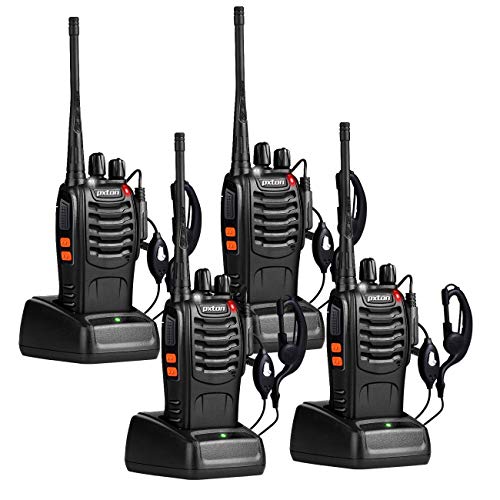
pxton Walkie Talkies with Earpieces (4 Pack) — The family four-pack
The pxton four-pack is the generalist bundle: four rechargeable sixteen-channel radios with earpieces, built-in flashlights and lithium-ion batteries with chargers. Four radios is the natural size of a family campsite, a pair of cars in convoy, or a small event’s core team, and sixteen channels give that group room to split — adults on one channel, a kids’ channel, a quiet channel for the person at the gate. The flashlight, easy to dismiss as garnish, earns its place on night duties and in tents, which is where these radios actually live.
As with every bundle here, the honest checks are service and range: confirm from the listing documentation which radio service the set operates under in your country, and if it is a GMRS design, United States users should hold the FCC licence that service requires; FRS operation needs none. Then test the four radios across your real ground. Judged on those terms, the pxton set is the straightforward answer for a household or small team buying its first fleet: complete, sensibly sized, and simple enough that the instructions get read once and the radios get used for years.
- Pack size: four radios with earpieces
- Channels: sixteen per the listing title
- Extras: built-in flashlight on each radio
- Power: rechargeable lithium-ion battery and charger
Strengths
- Four radios suit families and small teams exactly.
- Sixteen channels allow sub-group conversations.
- Flashlights prove useful on night duties.
Trade-offs
- A fifth team member needs a second purchase.
- Service type must be confirmed before transmitting.
- Earpieces are basic single designs for long shifts.
Best for: a family or four-person team wanting one complete box for trips, convoys and events.
Not suited for: a six-person site crew, because two members would be coordinating by phone while four talk by radio.
The pxton bundle’s contents are listed on its Amazon page.
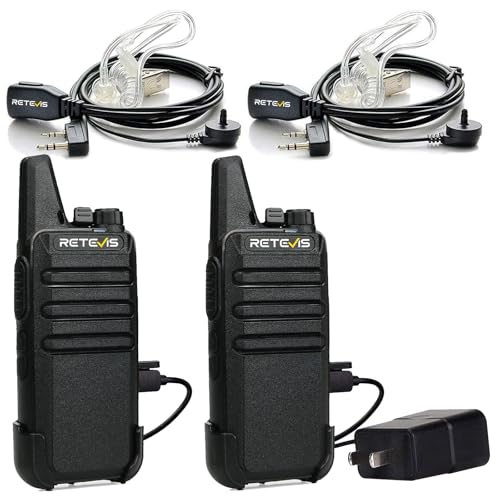
Retevis RT22 (2 Pack) — The pocket pair
The RT22 pair is the minimalist’s radio: two slim, lightweight units with earpieces, a stated ten-hour battery and USB-C charging, described by Retevis as pocket-friendly with a ready-to-use setup. Slimness is a genuine feature for its intended habitats — skiing, hiking, a retail floor — where a radio lives in a jacket pocket or on a lanyard rather than in a belt holster, and where a bulky handset would simply be left behind. USB-C charging aligns the pair with the cables a modern household already carries, removing the proprietary-charger failure mode from trips.
Ten hours, as stated, covers a ski day or a market shift with the understanding that cold and heavy use tax any battery. Retevis is an established radio maker, and the RT22’s long market life in the two-pack niche reflects a design that does one job — keep two people in touch, unobtrusively — without pretending to run a festival. Pairs who later discover they are really a team of five should look at the six-packs below rather than accumulating mismatched pairs.
- Pack size: two radios with earpieces
- Build: slim, lightweight, pocket-friendly antenna
- Battery: ten hours stated by the maker
- Charging: USB-C connection
Strengths
- Slim format gets carried instead of left behind.
- USB-C charging matches modern travel kits.
- Ready-to-use setup suits non-technical pairs.
Trade-offs
- Two radios is a hard ceiling for groups.
- Slim bodies mean smaller controls with gloves.
- Stated battery assumes moderate transmit time.
Best for: a hiking, skiing or retail pair who want unobtrusive radios with earpieces for a full day out.
Not suited for: an event team of five volunteers, because three of them would be outside the conversation the pair is having.
See the RT22 pair’s specification on its Amazon listing.

Arcshell AR-5 (6 Pack) — The six-radio workhorse
The Arcshell AR-5 six-pack is the fleet purchase in its classic form: six rechargeable long-range radios with earpieces, lithium-ion batteries and chargers included. Six is the size of a restaurant’s floor team, a warehouse shift, a church’s welcome and production volunteers, or a school trip’s staff — groups large enough to need channels and spares, small enough to equip in one box. The AR-5 design has circulated in this niche for years, which in fleet terms is a virtue: replacement units and earpieces are easy to source, and the radios’ behaviour is a known quantity to thousands of small teams.
The bundle’s discipline requirements are the fleet ones this guide repeats: number the radios, assign channels by role, and build the charging station before the first event rather than after the first dead battery. Confirm the operating service from the documentation — and the licensing position that follows from it — before the fleet’s first transmission. On those terms the AR-5 is the unglamorous, correct answer for a six-person team that wants to stop thinking about radios.
- Pack size: six radios with earpieces
- Power: rechargeable lithium-ion batteries
- Charging: chargers included in the box
- Role: small-team fleet for work and events
Strengths
- Six radios equip a full small team at once.
- Long market presence eases replacements.
- Complete box ends accessory hunting.
Trade-offs
- Six charging places need a permanent home.
- Basic earpieces may tire ears on long shifts.
- Documentation check needed for service and licensing.
Best for: a restaurant, warehouse or school-trip team of six needing one matched, rechargeable fleet.
Not suited for: a solo traveller or a pair, because four radios would live in a drawer as the world’s most prepared spares.
The AR-5 six-pack’s contents are confirmed on its Amazon page.

BAOFENG Walkie Talkies with Earpieces (12 Pack) — The whole-venue dozen
Twelve radios is a statement of organisational scale: a festival site, a large venue, a multi-building school or a production with stewards, parking, gates and a control point all talking at once. This BAOFENG bundle puts twelve sixteen-channel rechargeable radios with earpieces and flashlights into that role. Sixteen channels across twelve radios is the real specification — it lets a controller assign channels by function and keep a quiet command channel while the gate team chats freely on theirs, which is how large fleets avoid becoming one noisy room.
Scale brings management duties that are the actual price of the dozen: a sign-out board, a charging wall, a channel plan written down, and a named person who owns the fleet. BAOFENG’s name comes from the amateur and enthusiast radio world, and buyers should do the licensing homework with particular care here — confirm the service these radios operate under from the documentation, and in the United States hold the FCC licence if that service is GMRS; do not assume a bulk bundle is licence-free because it is sold in bulk. Equipped and governed properly, the dozen turns a large site’s communication from improvisation into infrastructure.
- Pack size: twelve radios with earpieces
- Channels: sixteen per the listing title
- Extras: flashlight on each radio
- Power: rechargeable batteries and chargers
Strengths
- Twelve radios cover a whole venue’s roster.
- Sixteen channels support function-by-function plans.
- One matched fleet simplifies training and spares.
Trade-offs
- Fleet governance becomes a real job.
- Charging twelve units needs dedicated space.
- Licensing homework is essential before first use.
Best for: a festival, venue or campus team whose roster genuinely reaches double figures on event days.
Not suited for: a household of four, because eight radios of overhead would turn a simple pleasure into an inventory problem.
The twelve-pack’s full contents are shown on its Amazon listing.

Retevis RT68 (6 Pack) — The licence-free business set
The RT68 is the roundup’s regulatory breath of fresh air: a six-pack of FRS radios whose listing states the position plainly — rugged and compact, licence-free, with a stated 500mW speaker output and a twelve-hour battery, aimed at schools, retail and hospitality. For a business buyer, that clarity is worth money: no licence administration, no ambiguity for staff, just a fleet that can be issued on day one. The speaker figure matters in its habitats too — a radio that must be heard over a kitchen or a shop floor needs voice power at the handset, not only in the earpiece.
Retevis describes the model as built for long-term supply, which is fleet language for “you can buy the same radio next year” — a genuine procurement virtue for businesses whose teams grow by ones and twos. Twelve stated hours covers a long retail day, with the usual caveat that transmit-heavy use spends batteries faster. For a school, shop or restaurant group wanting six radios with the licensing question already answered in the listing, this is the most administratively peaceful pick here.
- Pack size: six radios with earpieces
- Service: FRS, described as licence-free
- Speaker: 500mW output stated by the maker
- Battery: twelve hours stated in the title
Strengths
- Licence-free FRS status removes paperwork entirely.
- Strong stated speaker suits noisy workplaces.
- Long-term supply positioning aids growing fleets.
Trade-offs
- FRS power limits range versus GMRS designs.
- Six radios cap the team it can serve.
- Business styling is function-first throughout.
Best for: a school, retail or hospitality team wanting a licence-free fleet with a loud, clear handset speaker.
Not suited for: a rural team needing the extra reach a licensed GMRS setup can offer, because the RT68’s licence-free convenience is bought with FRS power limits.
The RT68’s licence-free specification is stated on its Amazon page.

Rechargeable Walkie Talkies with Earpieces (6 Pack) — The VOX-equipped six
The sixth pick differentiates on hands-free operation: six rechargeable sixteen-channel radios with earpieces, flashlights, a stated 1500mAh battery and VOX, the voice-activated transmit mode that lets a user speak without pressing a button. VOX is genuinely valuable where hands are committed — a picker wearing gloves, a steward holding a torch and a clipboard, a parent carrying a child — and genuinely annoying where background noise triggers it accidentally, so its sensitivity setting becomes part of the team’s setup ritual. The stated battery capacity gives buyers a number to compare, which this guide always prefers to adjectives.
The listing aims the set at business, school, events and emergency-survival use, and that breadth fits a six-pack bought by a household or small organisation that wears several hats across a year. As ever: confirm the operating service and its licensing position from the documentation, test coverage across your real ground, and teach the team the difference between VOX for working moments and push-to-talk for noisy ones. A fleet that masters both modes gets the best of the design.
- Pack size: six radios with earpieces
- Channels: sixteen per the listing title
- Battery: 1500mAh stated in the title
- Modes: VOX hands-free plus push-to-talk, flashlight
Strengths
- VOX frees hands for physical work.
- Stated battery capacity aids honest comparison.
- Sixteen channels support sub-group plans.
Trade-offs
- VOX can trigger on loud background noise.
- Unbranded support depends on the seller.
- Service and licensing need confirming in the manual.
Best for: a six-person team whose work keeps hands busy and who will set VOX sensitivity carefully per role.
Not suited for: a persistently loud environment like a plant room, because voice-activated transmission would fire on machinery noise instead of speech.
VOX and battery details for this six-pack are on its Amazon listing.
Walkie Talkie Headset Bundles Compared by Pack Size and Power
| Bundle | Radios | Channels | Notable stated trait |
|---|---|---|---|
| pxton with Earpieces | 4 | 16 | Flashlights, rechargeable Li-ion |
| Retevis RT22 | 2 | See listing | Slim build, 10-hour battery, USB-C |
| Arcshell AR-5 | 6 | See listing | Complete fleet box with chargers |
| BAOFENG with Earpieces | 12 | 16 | Largest fleet, flashlights |
| Retevis RT68 | 6 | FRS set | Licence-free, 500mW speaker, 12-hour battery |
| Rechargeable Six-Pack | 6 | 16 | VOX, 1500mAh battery stated |
Where a listing title does not state a figure, the table says so rather than guessing — check the specific listing before ordering if that number decides your purchase. Home teams coordinating across a house and garden may also appreciate the dedicated-base thinking in Best Headsets to Use With TV, where a fixed transmitter solves the indoor version of the coverage problem.
How Should You Test a New Fleet in Your Own Environment?
Charge everything, assign the channels you actually plan to use, and walk the honest map: furthest car park corner to control point, loading bay to top floor, start line to far gate. Transmit from the awkward places — stairwells, behind the cold store, inside the metal-clad barn — because those are the positions your team will occupy when it matters. Test at your busiest hour, when bodies, vehicles and neighbouring networks crowd the air, and write down the dead spots while the return window is open. Then decide like an adult: a fleet that covers your real map at working distances is a success even if the number on its box described a mountain ridge.
Repeat the test with earpieces in, at working noise levels. A radio that is clear in a quiet office may vanish against a kitchen’s extraction fan or a crowd’s roar, and the earpiece’s fit decides whether a steward hears a warning at the moment it counts. Crews who communicate for a living — including the student pilots in Best Headsets for Flight Training — all learn the same lesson: audio discipline is tested in the real environment or it is not tested at all.
What Mistakes Do Radio Buyers Keep Making?
Believing the range headline is the first and most expensive: teams buy for a number measured between mountaintops, then discover their building allows a tenth of it and conclude the radios are faulty. The second mistake is skipping the licensing homework — transmitting on a service that requires a licence, in the United States GMRS, without holding one, because the bundle’s marketing never mentioned it. The third is pack-size optimism in both directions: four radios for a six-person team, or twelve for a family, each stranding the purchase’s value in a different way. Fourth, buyers neglect the charging station, so a fleet’s second event begins with three flat radios and an argument.
Fifth, earpieces get treated as an afterthought until a steward works a ten-hour shift with a hard bud in one ear; comfort is a specification, and teams should trial earpieces across a full shift before an event depends on them. Finally, nobody writes the channel plan down. Sixteen channels are a gift only if everyone knows that stewards live on channel two and the controller monitors nine; a plan kept in one person’s head leaves with that person.
How Do You Run Channel Discipline for a Team Event?
Keep it telephonic and brief: call signs or role names, short transmissions, an acknowledgement for every instruction, and one person — the controller — whose voice has right of way. Reserve a quiet channel for control traffic and let working chatter live elsewhere, so urgency never has to shout over logistics. Teach the two failure behaviours on day one: the open microphone broadcasting a private conversation to the fleet, and the radio left on the wrong channel hearing nothing at all. Both are cured by the same ritual — a radio check by name at the start of every shift, which confirms coverage, channel and earpiece in ninety seconds and gives the controller a map of who is actually out there.
What Are Privacy Codes, and Why Do They Not Make You Private?
Most multi-channel radios add a second layer of codes — CTCSS or DCS tones — that filter which transmissions your radio plays aloud. Two groups can share a channel frequency with different codes and each hear only their own traffic, which is a traffic-management gift at a busy site. But the name misleads newcomers: anyone with a radio set to the channel without a code, or with a scanner, can hear everything. Privacy codes organise; they do not encrypt. Teams handling genuinely sensitive coordination — security at a venue, a school’s safeguarding radio — should understand that distinction before the first event, choose channels and codes deliberately, and keep sensitive content off open radio as a matter of doctrine rather than technology.
How Should a Warehouse or Retail Team Deploy a Six-Pack?
Assign by zone and role rather than by person: goods-in, floor lead, stockroom, till point, manager, spare. Each zone keeps its radio on its charger at shift change, so the fleet belongs to the operation rather than to individuals’ lockers. Channels follow the same logic — one working channel for the floor, one quiet channel for the manager and lead — and the earpiece becomes part of the uniform for customer-facing roles, where a blaring handset would undo the atmosphere the shop is selling. The RT68’s licence-free status and loud stated speaker suit exactly this world, while the AR-5’s classic form serves the back-of-house team. A month of this routine and the radios disappear into the business’s nervous system, which is the highest state a fleet can reach.
What Changes for Skiing, Hiking and Outdoor Pairs?
Outdoor use inverts the indoor problem: distance opens up, but weather and terrain close it in interesting ways. A ridge between two skiers can block a signal that would cross a lake happily, and cold saps batteries — the RT22’s stated ten hours assumes kinder temperatures than a January chairlift. Keep radios inside a jacket layer where body warmth protects the battery, agree a check-in rhythm rather than chatting continuously, and set the earpiece under a hat so wind noise stays out of the microphone’s life. Groups larger than a pair should step up to a four or six-pack rather than hoping two radios can coordinate a party spread across a mountain; the lost-skier scenario is the one where the missing third radio explains itself.
How Do Event Stewards Use Earpieces Across a Long Day?
Comfort becomes coverage. A steward who removes an uncomfortable earpiece at hour three is off the network for the incident at hour four, so event organisers should trial earpiece styles across a full shift, allow the earpiece ear to alternate where the design permits, and keep a few alternative buds in the control point’s kit. Volume discipline matters as much: fleet chatter at moderate level preserves both hearing comfort and attention, and a controller who keeps transmissions short and purposeful protects the whole team’s ears across a long day. The flashlight radios in this roundup — the pxton, the BAOFENG dozen and the VOX six-pack — earn quiet credit on evening events, where the steward’s other hand is usually holding the thing the torch would have occupied.
What Role Do These Radios Play in Emergency Preparedness?
An honest one, within limits. When phone networks congest or fail, a charged set of radios lets a household, a street or a small business coordinate locally — who has power, who needs help, where the meeting point is. The six-packs here, with their stated battery capacities and flashlights, fit a preparedness cupboard sensibly, provided the cupboard’s owner rotates charging a few times a year and the family has agreed channels and a simple plan in advance. What these radios are not is a substitute for official emergency channels or a guarantee of reaching beyond the neighbourhood; their range honesty applies in a crisis exactly as on a campsite. Preparedness that understands its tools’ limits is real preparedness; the rest is shopping.
How Should Batteries Be Treated Across a Fleet’s Life?
Lithium packs age by cycles and by storage habits. Fleets should live on their chargers between duties only if the maker intends that pattern, or in a charged-and-rotated store if not — the manual for your specific bundle arbitrates, and reading it is a fleet manager’s first job. Mark each battery with its radio’s number and its year, retire packs that swell, crack or fade early without sentimentality, and never mix a tired pack into the event-day set because it was charged and hopeful. The stated capacities in this roundup — the RT22’s ten hours, the RT68’s twelve, the VOX set’s 1500mAh — are fresh-battery figures; a three-year-old fleet will do less, and a wise controller plans the shift around the fleet’s real stamina, learned from the log rather than the box.
How Do You Choose Between FRS Convenience and GMRS Capability?
Start with the map, not the marketing. If your team’s real world is one building, one shop floor or one school — distances measured in rooms — FRS’s licence-free simplicity wins outright, and the RT68 exists to serve exactly that decision. If your world is a farm, a rural site or a convoy spread over open country, GMRS’s higher permitted power and repeater options become relevant, and the licence — in the United States, a straightforward FCC grant with no exam, covering the holder’s immediate family — is a modest administrative step for a real capability gain. Businesses should note that GMRS licensing is personal rather than organisational in structure, which is one reason so many commercial fleets choose FRS or licensed business radio instead. The bundles in this roundup sit mostly on the consumer side of that line; confirm each model’s service, license your operation if it needs it, and the question closes itself.
What Does a Sensible Sign-Out System Look Like for a Shared Fleet?
A board, a marker and a habit. Radios numbered on the housing, a grid of numbers on the control point wall, and a rule that a radio moves only when its number is written beside a name. At shift’s end the board should be empty and the chargers full; any gap is investigated that evening, not at the next event’s panic. Pair the board with the channel plan printed and taped beside it — stewards on two, control on nine, parking on five — so a volunteer joining mid-season can become competent from the wall alone. Fleets die of small mysteries: the radio in a coat pocket, the charger in the wrong room, the channel nobody wrote down. The board kills all three mysteries for the price of a marker.
How Should a First-Time Buyer Run the First Weekend?
Day one is for the house: unbox, number, charge fully, and read the one page of the manual that covers channels, codes and the earpiece connection. Then run a family-scale test — house to garden, shop floor to stockroom — and set everyone’s volume at working noise, not at kitchen quiet. Day two is for the real map: the furthest positions of your actual use, at a realistic hour, with notes taken on what worked. Agree the channel plan and the call signs while the experience is fresh, write them down, and put the radios on their chargers in their permanent home. A fleet that survives its first weekend with a written plan and a charging home will still be serving in five years; a fleet that begins as a pile of radios in a drawer has already told you its future.
Why Do Convoys and Worksites Still Choose Radios Over Phones?
Because a radio call is a broadcast to the team at the speed of a button, while a phone call is a private negotiation with a ringing tone. A convoy leader warning about a hazard needs every driver to hear it in the same second; a site foreman stopping a lift needs the same. Phones also depend on coverage that rural roads and basement plant rooms decline to provide, and on batteries shared with every other demand of a smartphone’s day. Radios ask for none of that: one purpose, one button, a battery that does a single job. The earpiece completes the argument in vehicles and on sites, keeping the message in the driver’s or the banksman’s ear while hands stay where the work is. That is why fleets like the ones in this roundup persist in a smartphone world — they were never competing with phones, they were competing with shouting.
What Should You Teach Children Using a Family Set?
Three habits cover most of it: say your name before your message, keep messages short because everyone hears everything, and treat the agreed channel as the family’s meeting point — if you are lost, stay where you are and call. Parents should set the channel and codes themselves, run one practice call from the garden before the campsite depends on it, and be honest about range in terms a child understands: the radios work across the site, not across the county. A family set like the pxton four-pack, used that way, gives children a genuine taste of disciplined communication — and gives parents a quieter holiday than the alternative of searching a campsite by voice.
How Does Weather Change a Radio Day?
Rain is mostly a comfort and handling problem — wet gloves on small buttons, earpieces under hoods — while the signal itself passes through weather with less drama than through buildings. Cold is the real adversary, taxing batteries and stiffening fingers, and altitude cuts both ways: a summit-to-valley path can be gloriously clear while the forested slope below swallows the same radios whole. Teams planning outdoor events should brief the weather’s specific tax in the morning — spare batteries kept warm for winter work, earpieces checked under rain hoods, a fallback channel agreed if the main one misbehaves — and treat the forecast as part of the comms plan rather than small talk. The radios in this roundup are consumer tools honestly used; matching their deployment to the day is the user’s half of the bargain.
What Separates a Fleet That Lasts From One That Fades?
Ownership, in the organisational sense. The lasting fleet has a named keeper, a charging home, a written channel plan, a fault habit — radios that misbehave get numbered, noted and rested — and a small annual rhythm of battery checks and earpiece replacements. The fading fleet has a drawer. Everything else about the two fleets can be identical hardware, which is the quietly hopeful message of this whole category: the bundles here are capable enough that management, not machinery, decides their fate. Buy the size your team truly is, license what the law asks, test the ground you truly have, and then keep the small promises — charged, numbered, written down — that turn six radios in a box into a system a team can trust.
How Do Hotels and Hospitality Teams Use These Bundles Quietly?
Hospitality runs on invisible coordination: housekeeping reporting a room ready, maintenance answering a leak, the front desk asking for a cot without announcing any of it to the lobby. Earpieces are the industry’s uniform for a reason — a message delivered silently into one ear preserves the calm the guests are paying for. A six-pack like the RT68, sold explicitly for hospitality with a licence-free position and a speaker strong enough for the plant room, maps onto a small hotel’s departments almost one-to-one. The deployment details mirror the warehouse pattern: radios belong to posts, chargers live in the back office, channels separate housekeeping from maintenance, and the night shift inherits a fleet that is charged because the day shift’s routine made it so. Guests never see any of this, which is precisely the product being bought.
What Should Schools Know Before Issuing Radios for Trips and Playgrounds?
Schools use radios where supervision is spread thin: playground duty, bus lines, field trips, sports days. The requirements are safeguarding-shaped — communication must be instant, auditable in the sense that staff share one channel culture, and simple enough for supply staff to use without training. The RT68’s school positioning and licence-free status suit that world, and the six-pack size covers a duty team with a spare. Schools should set the doctrine in advance: radios are for coordination and safety, channels are agreed per activity, and a lost radio is reported immediately because it is a safeguarding tool rather than a toy. On trips, the test discipline applies doubly — walk the museum, the park or the zoo’s far corner during the recce, not with thirty children in tow.
How Do You Keep Earpieces Hygienic Across a Shared Fleet?
Earpieces are worn in ears, shared across shifts, and stored in pockets — a hygiene regime is not optional. Issue earpieces personally where the fleet allows, because an earpiece is the one component that argues for individual ownership even inside a shared system; where sharing is unavoidable, wipe buds between users, replace foam covers on a schedule, and store earpieces aired rather than sealed in a warm case. Keep two spare earpieces per fleet size in the kit box, because the earpiece cable is the most fragile component in every bundle here and its failure should cost a swap, not a radio. Teams that treat the smallest part with this respect find the largest parts last longer too — care, like its opposite, is contagious across a kit box.
What Is the Real Cost of Owning a Fleet for Three Years?
The box price is the down payment. Year one adds earpiece replacements and perhaps a spare radio bought after the first loss teaches its lesson. Year two adds the first battery retirements, arriving earliest on the hardest-used units. Year three is when unmanaged fleets quietly halve — radios migrated to cars, chargers divorced from their sets — while managed fleets, numbered and boarded, are still at full strength with a modest consumables bill. None of the ongoing costs are large; all of them are predictable, and a team that budgets the small rhythm — earpieces yearly, batteries as they fade, one spare per fleet — will never face the large cost, which is rebuying the system. That arithmetic is the final argument for buying the right size once: a fleet bought correctly is a three-year asset, and a fleet bought carelessly is an annual subscription to the same problem.
A Last Word on Choosing the Channel Plan Before the Event
Write the plan on one page: which channel each group lives on, which channel is reserved for control, what the fallback is if a channel turns out to be busy with a neighbouring site’s traffic — a real possibility at festivals, where your channel seven may be another organisation’s channel seven too. Arrive early enough to listen before you transmit, shift the plan if the air is crowded, and brief the change by name at the radio check. Five minutes of spectrum politeness at the start prevents a day of talking over strangers, and it models the professionalism the earpieces were bought to project.
And One Small Ritual That Saves Fleets: The End-of-Day Count
Before anyone leaves, count the radios back onto their chargers out loud, by number. It takes one minute, it catches the radio in the van, the coat and the wrong building while those places are still reachable, and it gives the fleet a daily proof of completeness that no inventory audit can match. Teams that adopt the count rarely lose radios; teams that rely on memory lose them at the statistical rate memory deserves. End the day counted, and the next event starts with a fleet instead of a mystery.
How Should a Buyer Read a Bundle Listing Like an Inspector?
Read for what is counted, not what is photographed. The honest numbers in a listing are the ones this guide has used: radios in the pack, channels, battery capacity or hours as the maker states them, and the service the radio operates under. Photographs of a radio beside a mountain lake are not data. Check that earpieces are counted for every radio, that chargers match the pack size, and that the manual — usually linked or summarised — names the service and any licence it implies. A listing that survives that reading, in a bundle from this roundup, can be bought with confidence; a listing that dissolves under it was never a bargain at any price.
Closing Thought: Radios Reward the Teams That Brief
Every successful fleet in this guide’s imagination shares one scene: ninety seconds at the start of a shift where names are called, channels confirmed and earpieces checked, led by someone who treats the ritual as the foundation of the day rather than a delay to it. The hardware in these six bundles is ready for that scene. Give it the brief, the board and the count, and it will repay you in the only currency teams actually spend — moments that did not go wrong.
One More Scenario: The Community Event That Borrows Your Fleet
Well-run fleets get borrowed — by the school fair, the fun run, the street party — and a lending habit protects both sides: the sign-out board records the borrowing team and the count, the channel plan travels with the radios on its printed card, and the return count happens before the kit goes back on its chargers. Fleets that lend gracefully become neighbourhood infrastructure, and their keepers become the people events call first — a reputation worth more than the radios, built one counted return at a time.
How Should a Buyer Decide Between the Three Six-Packs?
Three of these bundles seat six, and they separate on philosophy rather than size. The Arcshell AR-5 is the traditionalist: a long-running fleet design bought for its known behaviour and easy replacements. The Retevis RT68 is the administrator: FRS licence-free status stated in plain language, a speaker built for noisy rooms, and a maker promising long-term supply to growing businesses. The VOX six-pack is the opportunist: voice-activated transmission and a stated battery capacity for teams whose hands are otherwise employed. Put your own constraint first — replacement anxiety, licensing paperwork, or busy hands — and the three-way choice resolves itself without a coin toss. All three then submit to the same final exam: your building, your ground, your busiest hour, tested inside the return window.
Final Recommendation
Size the fleet to the team and the licence to the law, then let coverage tests in your own environment cast the deciding vote. Pairs should take the slim Retevis RT22 and enjoy radios that actually get carried; families and small teams belong on the pxton four-pack; six-person operations should choose between the Arcshell AR-5’s classic fleet form, the RT68’s licence-free clarity for business use, and the VOX six-pack where hands-free working matters. Only genuinely large rosters should take the BAOFENG dozen, with the governance to match. And whichever box arrives, repeat the catechism this guide has preached throughout: the range on the box was measured in open country, your building will allow a fraction of it, and in the United States an FRS radio needs no licence while a GMRS one needs an FCC licence — confirm your model’s service, test your own ground, and the fleet will serve honestly for years.
Frequently Asked Questions
How far will these radios really reach in a town?
Far less than the box suggests. Expect streets rather than miles in built-up areas, a few floors inside a building, and better results across open ground or water. The only trustworthy figure is the one you measure between your own furthest positions during a test.
Do I need a licence for these radios in the United States?
For FRS radios, no — FRS is licence-free, and the RT68 in this roundup is sold on exactly that basis. GMRS operation does require an FCC licence, which is inexpensive, exam-free and covers your immediate family. Confirm which service any bundle uses from its documentation before transmitting.
What does VOX actually do?
VOX transmits automatically when you speak, without a button press. It is excellent when hands are busy and frustrating where background noise triggers it, so fleets usually enable it for specific roles and keep push-to-talk as the default elsewhere.
Can different brands in this roundup talk to each other?
Sometimes, if they share the same service, channel scheme and privacy codes — but fleets are happiest matched. Mixed fleets should be tested radio-to-radio before an event, and growing teams should extend within the model they already own where possible.
Why do earpieces matter so much for team work?
An earpiece keeps messages private, audible in noise, and hands free, and it stops a whole room hearing fleet traffic. For stewards, pickers and coordinators working around the public, that combination is the difference between a radio carried and a radio used.
How many spare radios should a team hold?
At least one beyond the roster for small fleets, and roughly one in six for larger ones. Spares cover the dropped radio, the flat battery and the volunteer who arrives unexpectedly — the three certainties of event day.
Related Guides
More communication guides from the same shelf: Best Headsets to Use With TV for home listening systems, Best Headsets for Flight Training for cockpit headsets, and Best Headsets for Theater and Stage Crews for full-duplex production intercom.


