What's inside
- Key Takeaways
- Quick Picks
- How Did We Judge Stands That Mostly Differ in the Fine Print?
- Why Does the Upright Angle Matter More Than the Wattage?
- What Do the Wattage Figures Really Promise?
- How Did the Stand Become the Nightstand’s Default Shape?
- What Should a Two-Stand Household Buy Differently?
- The Detailed Picks: Six Upright Stands Examined
- What Do These Six Upright Stands Offer Beyond a Flat Pad?
- How Long Should a Stand Last, and What Ages First?
- What Mistakes Do Stand Buyers Keep Making?
- How Should You Set Up a Stand for Its Surface?
- Final Recommendation
- Frequently Asked Questions
- Related Guides
As an Amazon Associate I earn from qualifying purchases. This post may contain affiliate links at no extra cost to you.
widgetverdict.com is reader-supported. When you buy through links on our site, we may earn an affiliate commission.
Where to buy: the six stands in this guide are listed on Amazon; two details in each title decide most of the purchase — whether an AC adapter is included or pointedly not, and which phone families the stand names — so read those lines before the photographs, which are all, inevitably, of a phone standing handsomely on a desk.
The best upright wireless fast chargers begin from a small ergonomic truth: a phone charging flat on a pad is a phone out of service, face-down in the world, while a phone charging upright is still a clock, a calendar, a video call, a recipe at eye level. The stand format turns charging from a parking event into a piece of furniture that happens to feed the phone. Face ID unlocks at a glance, notifications stay readable across the desk, and the alarm clock on the nightstand is the same device that was draining at midnight. That is why the upright stand, among all wireless charging shapes, is the one people keep for years.
Six stands make the case below, and they are closer cousins than their listings admit — three wear the NANAMI name alone. They divide on stated wattage, from the Yootech’s plain 10W maximum to the 15W figures quoted by the later stands; on adapter policy, which ranges from the Yootech’s explicit “no AC adapter” to stands bundling 30W PD or 20W USB-C adapters in the title; and on allegiance, with most titles addressing iPhone and Samsung Galaxy families in the same breath and one stand leaning Galaxy-first. The differences are modest but real, and they map neatly onto desks, nightstands and phone loyalties.
Key Takeaways
- Upright stands keep the phone usable while charging — glanceable, unlockable, propped for calls — which flat pads cannot offer.
- Stated wattage spans 10W maximum (Yootech) to 15W (the later NANAMI and the adapter-bundled station); your phone’s own wireless ceiling decides what you actually receive.
- Adapter inclusion is the hidden price difference: the Yootech title says no adapter is included, while three rivals bundle PD or USB-C adapters by name.
- NANAMI accounts for three of the six picks, at different stated paces and adapter arrangements — read each title on its own evidence.
- One pick adds a second act: the 30W-adapter stand doubles as a 2-in-1 station with an extra USB-A port.
- Every title addresses both iPhone and Samsung Galaxy families, in varying order and emphasis.
Quick Picks
| Pick | Badge | Why it earns its place |
|---|---|---|
| Yootech Wireless Charging Stand | The honest 10W classic | A 10W-maximum upright stand with the widest stated phone span in the guide, sold adapter-free for desks that already own one. |
| NANAMI Fast Wireless Charging Stand | The nightstand original | NANAMI’s fast-charging stand, titled as a nightstand dock for the current iPhone and Galaxy generations. |
| NANAMI Wireless Charging Stand for Galaxy | The Galaxy-leaning upgrade | An upgraded NANAMI stand that leads with Samsung Galaxy compatibility and keeps the iPhone family in the same title. |
| Wireless Charging Stand with 30W Adapter | The 2-in-1 station | A stand bundled with a 30W PD adapter and an extra USB-A port, charging a phone upright and a second device by cable. |
| 15W Wireless Charging Stand with Adapter | The three-brand 15W | 15W upright charging with a 20W USB-C adapter included, titled across iPhone, Samsung Galaxy and Google phones. |
| NANAMI 15W Wireless Charging Stand | The 15W NANAMI with adapter | NANAMI’s 15W-maximum stand with a PD20W adapter in the box, spanning the current iPhone and Galaxy lines. |
How Did We Judge Stands That Mostly Differ in the Fine Print?
By reading the fine print as the product. An upright wireless stand is a mature, simple device — a coil, a frame, a power feed — so the buying decision genuinely lives in the titles’ details: the wattage each maker states, the adapter each box does or does not contain, and the phone families each listing names. We ranked stated wattage first among equals, because it is the only performance figure these titles offer, while keeping the standing caveat in view: a stand can only deliver what the phone accepts, and both Apple and Samsung phones cap wireless intake at their own levels, which have risen generation by generation.
Adapter policy came second, and it is more economic than technical. A stand without an adapter is a fair purchase for a desk already rich in USB power — and the Yootech says so in its title with unusual candour — but a first stand bought adapter-free often becomes two purchases. The bundled-adapter picks state their inclusions proudly (30W PD on the 2-in-1 station, 20W USB-C on the 15W station, PD20W on the NANAMI 15W), and that completeness is a real, priceable virtue. Third came allegiance: which family a title leads with is a hint about coil placement and optimisation, worth a thought when your household is firmly one camp.
Finally, we placed the stand in the household’s wider charging geography. The nightstand and desk chargers are the fixed points; the car and the pocket are served by other citizens of the same ecosystem — Best Home Level 2 EV Chargers and Best Tesla Chargers for the vehicle, Best PS4 Controller Chargers for the den’s controllers. A stand bought well is the one whose wattage, adapter and angle suit the exact surface it will live on, and this guide’s job is to make that surface-level decision honestly.
Why Does the Upright Angle Matter More Than the Wattage?
Because you interact with the angle a hundred times for every time you interact with the wattage. A phone on a stand wakes with a look: Face ID and its Android equivalents are designed for exactly the geometry a stand provides, so the charging phone unlocks, shows the notification, and returns to its clock without being touched. On the nightstand, that geometry is the alarm clock and the 3 a.m. time check. At the desk, it is the video call that frames your face rather than your ceiling, the recipe that stays readable with wet hands in the kitchen, the second screen that a flat pad turns into a coaster.
Wattage, by contrast, mostly dissolves into the overnight. A stand that feeds a phone across eight sleeping hours has succeeded at any of the paces in this guide; the stated figures matter in the margins — the desk stand that must meaningfully refill a phone between meetings, the evening top-up before going out. There, the 15W class earns its title space over the 10W classic, always subject to the phone’s own acceptance. Buyers should therefore interrogate their surface first — nightstand, desk, kitchen counter — and let the surface choose the priority: angle and glanceability for the bedside, pace for the desk, splash-tolerance and visibility for the kitchen.
The stand format carries one honest cost: footprint and presence. A stand is furniture in a way a pad is not, visible from across the room, and its design sits in your sightline for years. The titles below are mostly silent on aesthetics beyond their photographs, so let the product page’s images carry that judgement — while remembering that the stand you find handsome in a listing photo must also be handsome at 7 a.m., unwashed, holding a phone at 4 percent.
What Do the Wattage Figures Really Promise?
Wireless charging wattage is a negotiation between three parties: the adapter feeding the stand, the stand’s coil, and the phone’s own receiver and software. The title figures — 10W maximum on the Yootech, 15W on the later picks — describe the stand’s side of that negotiation under the right conditions, with the right adapter. This is why adapter policy and wattage cannot be separated: a 15W stand fed by an elderly 5W adapter is a 5W experience wearing a 15W title, and the picks that bundle matched adapters are, in effect, guaranteeing the negotiation’s first term. The Yootech’s adapter-free honesty simply hands that term to you.
The phone’s side of the negotiation varies by family and generation, and the titles’ compatibility lists are the map. iPhones and Galaxy phones have each raised their wireless ceilings across generations, at different rates and with different conditions, and a stand bought for today’s phone may be the ceiling or the floor for tomorrow’s. The pragmatic reading: a 15W stand is the current mainstream’s full ask, a 10W stand serves overnight and older generations completely, and no stand in this guide can outrun the phone placed on it. Match the stand to the phone you own, glance at the one you might buy next, and let the nightstand hours forgive the rest.
Heat is the negotiation’s tax. Wireless transfer wastes a share of its energy as warmth, more at higher paces and in thicker cases, and a phone that charges warm on a stand is behaving normally within its design — the phone’s own management throttles when it judges the temperature impolite. Cases deserve their standing warning: a stand presumes a wireless-charging-compatible case of sane thickness, and metal plates, grips and wallet backs between coil and phone will tax or defeat any pick in this guide equally.
How Did the Stand Become the Nightstand’s Default Shape?
The alarm clock did it. For a decade the phone has been the household’s alarm, and an alarm that lies face-down on a pad is an alarm you fumble for in the dark, while an alarm on a stand presents its face to the room like the clock radio it replaced. Phone makers noticed the behaviour and built for it — standby displays that turn a charging phone into a bedside clock with the time in large, dim type exist precisely because millions of phones were already spending their nights upright on stands. The stand did not create the habit; it furniture-ised a habit the phone had already formed, which is why the format feels inevitable rather than novel.
The desk followed the nightstand for a different reason: the video call. A phone propped at stand angle is a camera at face height and a screen at reading height, and the hybrid-working years turned that accident of geometry into a daily utility. Add the kitchen — recipes, timers, a video playing where hands cannot hold anything — and the stand’s three rooms are complete. Each room asks something slightly different of the same object, which is why this guide refuses to crown a single winner for all surfaces: the nightstand prizes grace and footprint, the desk prizes pace and camera geometry, the kitchen prizes visibility and a wipeable indifference to splashes.
What unites the rooms is permanence. A stand is not carried, lent or packed; it is installed into a life the way a lamp is, and it is judged across years of mornings rather than across a specification sheet. That permanence is the deepest reason the fine print matters — the adapter you did not buy and the wattage you assumed will be re-encountered every single day, in miniature, at the exact moment you are least inclined to forgive them.
What Should a Two-Stand Household Buy Differently?
Most households that love their first stand buy a second, and the second purchase should not be a photocopy of the first. The rooms differ, so the stands should: the nightstand unit can be the graceful one — the Yootech’s honest overnight pace, the NANAMI nightstand original — while the desk unit should be the athlete, a stated 15W with its adapter included, because the desk is where charging time is actually experienced as time. Buying two identical mid-range stands gives both rooms a compromise; buying each room its specialist gives both rooms the right tool, usually for a similar total outlay.
There is also a household-diplomacy dividend in choosing deliberately per room. The shared nightstand stand serves two phones in sequence and belongs to neither partner; the desk stand is personal infrastructure. And the kitchen, if it gets the third stand, is where the 2-in-1 station earns its sprawl — the one surface where a second port and a generous adapter solve problems for the whole family rather than one phone’s owner. Read the six titles as a room-by-room menu rather than a league table, and the guide’s apparent redundancies — three NANAMI siblings, two 15W stations — resolve into what they are: fittings for different rooms wearing similar clothes.
One discipline governs the multi-stand household above all: standardise the invisible parts. Adapters that can feed any stand in the house, cables of one connector family, and a household rule that stands are not borrowed between rooms — these small consistencies are what make a two- or three-stand home feel like a system rather than an accumulation. The stands themselves may differ by room; the ecosystem underneath them should not.
The Detailed Picks: Six Upright Stands Examined

Yootech Wireless Charging Stand — The honest 10W classic
The Yootech earns its place at the head of this guide through two acts of candour rare in the category. Its title states a ceiling — 10W maximum — where rivals reach for the unquantified word “fast”, and it states an omission — no AC adapter — where rivals simply let buyers discover the empty corner of the box. Read together, those two statements describe a stand sold to adults: here is exactly what it does, here is exactly what you must bring. For a desk or nightstand already equipped with a decent USB adapter, that is not a limitation but a fair price structure, paying only for the stand itself.
The compatibility span is the widest stated here, unspooling across iPhone generations from the 18 Pro line back through the SE 2022 and the 8, and across Galaxy S flagships from the S25 family back to the S22 — a list that reads like a household census. A stand that serves that span is a stand that survives phone upgrades, partners’ phones and the guest phone, which is precisely the life a nightstand charger leads. The 10W ceiling, meanwhile, deserves its honest framing: overnight, it is indistinguishable from faster stands, because the phone is full by morning either way; between meetings, it is the figure that asks for patience.
Picture its natural posting: a guest room, a partner’s side of the bed, the household’s second nightstand — the places where a phone must be charged reliably by people who will never read a specification. The wide span means the visitor’s phone, whatever its badge or vintage within the stated range, simply works; the honest ceiling means nobody’s expectations were inflated in advance; and the stand itself, once fed by whatever adapter the house provides, asks nothing further of anyone. Infrastructure for other people is a real category of purchase, and it rewards exactly this pick’s virtues: compatibility, candour and the absence of surprises.
Yootech is a name this category’s regulars will recognise, and in a field of specification-led listings a maker’s continuity counts for something — stands live for years, and a brand that still exists when yours is ageing is worth a line in the ledger. Buy this pick knowingly: adapter on hand, overnight rhythm, wide household span. Buyers whose desk stand must sprint between calls should read on to the 15W class; buyers whose stand must simply never lie to them have found their classic.
- Stated output: 10W maximum
- Adapter: none included — stated plainly in the listing title
- Format: upright wireless charging stand
- Compatibility per title: iPhone 18 Pro/Pro Max, 17 line, Air, 16/15/14/13, SE 2022, 12/11/X/8; Galaxy S25/S24/S23/S22
- Case guidance: the listing title keeps this to itself — the product page’s details are the deciding read
- Brand: Yootech
- Second-device charging: not claimed in the title
Strengths
- Widest stated compatibility span in the guide, surviving household phone turnover.
- Unusual title honesty about both its ceiling and its missing adapter.
- A recognised accessories name in a field of anonymous listings.
Trade-offs
- 10W ceiling trails the 15W class for daytime top-ups.
- Adapter must come from your own drawer — a second purchase if it cannot.
- No second-device or station features in the title.
Best for: nightstands and multi-phone households with an adapter already in hand.
Not suited for: a desk that must refill a phone meaningfully between meetings.

NANAMI Fast Wireless Charging Stand — The nightstand original
The first of this guide’s three NANAMI stands is the one whose title uses the room’s name: a fast wireless charger presented as a nightstand phone charger dock, compatible across the current iPhone generations — the 18 Pro line, the 17 family including the Air — and Samsung’s Galaxy S26, S25 and S24 lines. That nightstand framing is a design brief in miniature. A bedside stand is judged on glanceability in the dark, on a footprint that shares a small surface with a book and a glass of water, and on charging that simply completes by morning; outright pace is the desk’s criterion, not the pillow’s.
NANAMI’s presence three times in this guide is itself data: the maker has made upright stands a specialism, iterating the format across generations of phones, and this pick is the line’s straightforward fast-charging expression. The title does not attach a wattage figure to its “fast” — a silence this guide records rather than repairs — so buyers for whom the number matters should either confirm it on the product page or step to the NANAMI 15W below, whose title states the figure and bundles the adapter to feed it. What this title does state, compatibility across both flagship families at their current generations, it states completely.
Its bedside manner deserves a paragraph of its own, because the nightstand is the one surface where a charger’s failures are experienced half-asleep. A stand that accepts the phone in one unthinking motion, that does not demand a visual check at midnight, that keeps the screen’s glow angled toward the room’s centre rather than the sleeper’s eyes — those are the properties that decide whether a nightstand charger is loved or tolerated, and they are properties of geometry and tolerance rather than of wattage. The original NANAMI’s long presence in this format is its evidence: designs that annoyed people at 1 a.m. do not get iterated across this many phone generations.
Consider this the default NANAMI: the nightstand-shaped one, current-generation fluent, unadorned by station features or adapter claims. Households furnishing a bedside first and a desk second will find its priorities correctly ordered; households buying for a Galaxy-first desk should weigh its sibling next door, which leads with that family in its title. In a category of near-identical cousins, the honest differences are these small orderings of emphasis, and this pick’s emphasis is the room where phones sleep.
- Stated output: fast charging claimed; the listing title keeps the wattage figure to itself — the product page’s details are the deciding read
- Adapter: inclusion not stated in the listing title
- Format: upright stand, presented as a nightstand dock
- Compatibility per title: iPhone 18 Pro/Pro Max, 17/Air, 16, 15/15 Pro; Galaxy S26/S26+, S25, S24
- Brand: NANAMI
- Second-device charging: not claimed in the title
- Case guidance: not stated in the listing title
Strengths
- Nightstand-first design brief matches the surface most stands actually live on.
- Current-generation compatibility stated for both flagship families.
- A specialist maker’s core model, iterated across phone generations.
Trade-offs
- No wattage figure in the title for pace-led comparisons.
- Adapter inclusion unstated — confirm before assuming a complete kit.
- Sibling models crowd the same brand, demanding careful title reading.
Best for: bedside charging for current iPhone or Galaxy owners who value fit over figures.
Not suited for: a desk setup that needs the wattage printed on the listing before shortlisting.
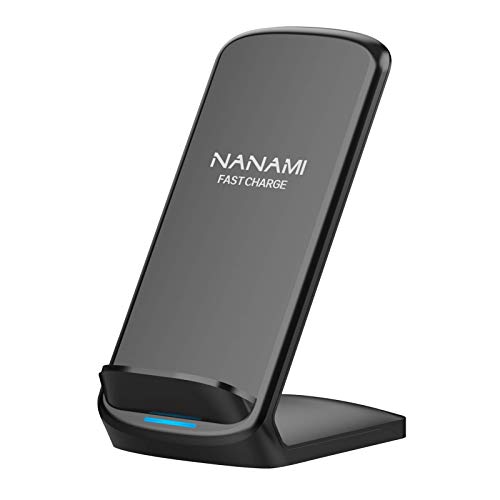
NANAMI Wireless Charging Stand for Galaxy — The Galaxy-leaning upgrade
The second NANAMI arranges the same ingredients in a different order, and the order is the message: an upgraded fast wireless charger leading with Samsung Galaxy compatibility — S26, S26+, S25, S24, S23 named — and presenting itself as a phone charger dock for the iPhone 18 Pro line, 17 and Air, 16 and 15 families after. In a category where most titles lead with the iPhone by reflex, a stand that addresses the Galaxy household first is making a claim about where its coil geometry and its maker’s attention were centred. Samsung-first households, accustomed to being the second clause in every listing, will recognise the courtesy.
The word “upgraded” invites the guide’s standing question — upgraded from what, measured how? — and the title, characteristically, declines to answer with a figure. What can be said on evidence is that this is NANAMI’s Galaxy-forward iteration of its stand line, current at the S26 generation, and dual-family in its compatibility. The practical advice mirrors its sibling’s: if the number matters, the product page or the 15W NANAMI are your routes; if the allegiance matters, this is the stand in the six that speaks your household’s language first.
There is a small practical point in this pick’s favour that mixed titles often fumble: by naming the Galaxy generations first and specifically — plus variants included — it gives the Samsung buyer the exact-match confidence that a generic “compatible with Samsung” line never does. A buyer whose phone is an S25 can find their phone in this title in two seconds, and that findability is a genuine feature in a marketplace where compatibility anxiety is the main tax on every purchase. The iPhone span, arriving second, is complete enough that the courtesy costs the Apple side nothing.
Mixed households should note the completeness of the iPhone span despite the Galaxy lead — the current Pro line, the Air, the numbered generations are all present, so this is a leaning, not an exclusion. Its natural home is the Galaxy owner’s desk or nightstand, where a stand tuned and titled for the family’s phones removes the small doubt that shadows cross-family accessories. In a six-stand guide with three from one maker, this is the sibling with a flag, and households flying that flag should start here.
- Stated output: upgraded fast charging claimed; wattage figure not stated in the title
- Adapter: inclusion not stated in the listing title
- Format: upright wireless charging stand and dock
- Compatibility per title: Galaxy S26/S26+, S25, S24, S23 first; iPhone 18 Pro line, 17/Air, 16 line, 15/14 also named
- Brand: NANAMI
- Second-device charging: not claimed in the title
- Case guidance: the listing title keeps this to itself — the product page’s details are the deciding read
Strengths
- Galaxy-first titling suits Samsung households tired of second-clause status.
- Full current iPhone span retained for mixed households.
- Specialist maker’s iterated stand design.
Trade-offs
- “Upgraded” is claimed without a wattage figure to verify it against.
- Adapter inclusion unstated in the title.
- Differentiation from its NANAMI siblings rests on emphasis more than hardware claims.
Best for: Samsung Galaxy households that want a stand addressed to them first.
Not suited for: a specification-led buyer who ranks stands by printed wattage alone.

Wireless Charging Stand with 30W Adapter — The 2-in-1 station
This pick expands the stand’s job description. Its title bundles a 30W PD adapter — the strongest adapter figure in the guide — and describes a 2-in-1 charging station whose extra USB-A port serves a second device by cable while the phone charges upright. Read that as a desk-consolidation argument: the nightstand or workstation that currently hosts a stand, a loose cable and a borrowed adapter becomes one object with one plug. For the surfaces where charging sprawl actually happens — the family desk, the kitchen command corner — that consolidation is worth more than a wattage headline.
The 30W adapter deserves its own sentence, because adapter headroom is invisible until it is absent. A generously rated PD adapter feeds the stand at its full ask with capacity to spare, and headroom in a power supply is cool, quiet longevity. The extra USB-A port, meanwhile, is the household’s pressure valve: earbuds, a watch cable, a guest’s phone, the e-reader that only ever charges in a panic. None of those devices needs speed; all of them need a port that exists, in the place where people already are.
There is a subtle second use for the extra port that households discover within a week: it decouples the family’s charging from the phone’s schedule. The stand’s phone may leave at dawn, but the port stays, feeding the household’s small devices through the day — the torch, the speaker, the child’s tablet — from the surface where everyone already congregates. A charging station, unlike a charger, becomes a place, and places accumulate habits. If your home has a surface where devices already gather to be fed by a rotating cast of borrowed cables, this pick is less an upgrade than a formalisation of an existing republic.
The title does not state the stand’s own wireless wattage, and this guide records the gap in its customary place below; buyers ranking purely on stated wireless pace should look at the 15W pair that follow. But judged as a station — the complete, adapter-included, two-device answer to a messy surface — this pick has no rival in the six. It is the choice for the household that is not really shopping for a charger but for the end of a small daily clutter, with charging as the respectable excuse.
- Stated output: fast charging claimed; wireless wattage not stated in the title
- Adapter: 30W PD adapter included, per the listing title
- Format: upright stand, 2-in-1 charging station
- Second-device charging: extra USB-A port, per the listing title
- Compatibility per title: iPhone 18/17/16/15/14/13/12; Galaxy S26/S25/S24/S23/S22
- Brand: the listing title keeps this to itself — the product page’s details are the deciding read
- Case guidance: not stated in the listing title
Strengths
- 30W PD adapter included — the guide’s strongest stated adapter, with headroom.
- Extra USB-A port turns one surface into a two-device station.
- Broad stated span across iPhone and Galaxy generations.
Trade-offs
- Wireless wattage unstated in the title for pace-led shoppers.
- Station format claims more surface than a minimal stand.
- Anonymous listing — the specification carries the case.
Best for: family desks and kitchen corners where one tidy station should replace a tangle.
Not suited for: a minimalist nightstand with room for exactly one slim object.

15W Wireless Charging Stand with Adapter — The three-brand 15W
This station’s title is the most even-handed in the guide: 15W upright wireless charging, a 20W USB-C adapter included, and a compatibility span that names iPhone generations, the Samsung Galaxy lines including the Z Flip and Fold families and the Note 20, and Google phones besides. That third family is unique here — Pixel owners, accustomed to reading wireless-charger listings as literature about other people’s phones, are addressed in the title itself. For a mixed household — and the modern household is increasingly a three-brand household — that breadth is a purchasing argument no wattage figure can match.
The stated 15W places it in the guide’s fastest wireless class alongside the NANAMI 15W, and the included 20W USB-C adapter closes the negotiation’s first term: the stand arrives able to deliver what its title promises, without a drawer audit. The foldables’ presence in the compatibility list deserves a nod, too — a folding phone on an upright stand is a specific geometry, and a title that names the Z Flip and Fold is at least claiming to have considered it, which is more than the flat-pad world usually offers that form factor.
Households with a folding phone should linger here a moment longer, because the foldable’s charging life is genuinely awkward elsewhere: flat pads meet a hinge, pockets meet a thicker folded slab, and many stands meet a device whose centre of gravity was designed by a origami enthusiast. A title that names the Fold and Flip families is claiming the geometry was considered — coil placement against a folded footprint, a ledge that holds a half-open device. It is the only title in the six to make that claim, and for the foldable household it may outweigh every other row in the comparison table.
Its compromises are the anonymous listing’s usual ones: no brand narrative in the title, no design story, and a compatibility list whose “Google etc.” tail should be confirmed on the product page by the specific Pixel owner. None of that dims the central proposition — stated pace, included adapter, three families named. For the household that cannot agree on a phone brand but can agree on a nightstand, this is the diplomatic pick of the six, and diplomacy, in charging as elsewhere, is an underrated feature.
- Stated output: 15W wireless charging
- Adapter: 20W USB-C adapter included, per the listing title
- Format: upright desk wireless charging stand and station
- Compatibility per title: iPhone 17 Pro/17/Air, 16 line, 15/14/13; Galaxy S25/S24/S23/S22, Z Flip, Fold, Note 20; Google phones
- Brand: not named in the listing title
- Second-device charging: station format; extra ports not stated in the title
- Case guidance: not stated in the listing title
Strengths
- Only title here to name Google phones alongside iPhone and Galaxy.
- Stated 15W pace with the matched adapter included.
- Foldable Galaxy models named — rare attention to that geometry.
Trade-offs
- Anonymous listing; the “etc.” in its compatibility tail needs the product page.
- No extra-port station features stated, unlike the 2-in-1 pick.
- Design and finish are unquoted in the title.
Best for: mixed-brand households, Pixel included, wanting stated 15W pace and a complete box.
Not suited for: a brand-loyal buyer who wants a maker’s name on the nightstand.

Foldable owners should linger on this title’s compatibility list, because it is the only one here naming the Galaxy Z Flip and Z Fold lines alongside Note 20 and Google handsets. A folding phone meets an upright coil differently from a slab: the hinge changes where the handset’s centre of mass rests and which panel faces the stand. Naming those models is therefore more than list-padding; it is the maker stating that this geometry was considered. Anyone charging a foldable nightly should still confirm placement behaviour on the product page, yet starting from a title that acknowledges the form factor beats discovering the omission after delivery.
NANAMI 15W Wireless Charging Stand — The 15W NANAMI with adapter
The third NANAMI completes the family’s argument by fixing the first two’s omissions: a stated 15W maximum, and a PD20W adapter included in the box. That pairing — the figure and the means to feed it — makes this the most self-sufficient NANAMI in the guide, and arguably the most straightforward purchase in the six for a buyer who wants the specialist maker’s stand at the current mainstream pace without a second order for an adapter. Its compatibility span runs across the current iPhone generations and the Galaxy S lines in the now-familiar dual-family pattern.
Set against its siblings, the division of labour clarifies. The nightstand original sells room-fit and leaves its figure unstated; the Galaxy-leaning model sells allegiance; this one sells completeness at a stated pace. Set against the three-brand 15W station, the contest is brand-and-focus versus breadth: NANAMI’s stand specialism and adapter inclusion against the rival’s Pixel welcome and foldable roll-call. Neither contest has a neutral winner — they are the same money pointed at different households, which is what a good guide is for.
The remaining unknowns are the category’s standard ones: case guidance and design detail live on the product page, and the stand’s angle and footprint should be pictured against your actual nightstand before ordering. But on the evidence titles can give — pace stated, adapter bundled, span current, maker specialised — this pick assembles the fewest caveats in the guide. If the NANAMI name was your destination anyway, this is the version whose box contains the fewest apologies.
- Stated output: 15W maximum
- Adapter: PD20W adapter included, per the listing title
- Format: upright wireless charging stand
- Compatibility per title: iPhone 18 Pro line, 17/Air/Pro/Pro Max, 16/15/14/13 series; Galaxy S26/S25/S24/S23/S22
- Brand: NANAMI
- Second-device charging: not claimed in the title
- Case guidance: the listing title keeps this to itself — the product page’s details are the deciding read
Strengths
- Stated 15W pace with the matched PD adapter in the box.
- The specialist maker’s most complete single purchase in this guide.
- Current-generation span across both flagship families.
Trade-offs
- No Pixel or foldable names in its title, unlike the three-brand rival.
- No second-device port for station duties.
- One of three similar NANAMI titles — order the right sibling carefully.
Best for: buyers who want the NANAMI stand at full stated pace with nothing else to source.
Not suited for: a Google Pixel household needing its phone named in the title.
What Do These Six Upright Stands Offer Beyond a Flat Pad?
| Pick | Stated output | Adapter | Leads with | Defining trait |
|---|---|---|---|---|
| Yootech Wireless Charging Stand | 10W max | None included | Both families, widest span | Honest classic |
| NANAMI Fast Wireless Charging Stand | Not stated in title | Not stated in title | Nightstand framing | Bedside original |
| NANAMI Wireless Charging Stand for Galaxy | Not stated in title | Not stated in title | Galaxy first | Allegiance pick |
| Wireless Charging Stand with 30W Adapter | Not stated in title | 30W PD included | Both families | 2-in-1 station, USB-A port |
| 15W Wireless Charging Stand with Adapter | 15W | 20W USB-C included | iPhone, Galaxy, Google | Three-brand span |
| NANAMI 15W Wireless Charging Stand | 15W max | PD20W included | Both families | Complete NANAMI |
Beyond the pad, all six offer the same foundational gift — a phone that stays a phone while it feeds — and the table shows how differently they package it. The stated-output column has three figures and three silences; the adapter column has three inclusions, one honest exclusion and two silences. A buyer who reads only one column will choose worse than a buyer who reads both, because a stand’s real pace is the marriage of the two: coil and supply together, or the weaker of them alone.
The allegiance column, finally, is softer information and should be weighted softly. A Galaxy-first title and a three-brand title are hints about optimisation and audience, not gates; every stand here will charge every family it names. Let the hard columns — output, adapter — build the shortlist, and let allegiance break only the ties that remain.
How Long Should a Stand Last, and What Ages First?
A wireless stand has no moving parts and no battery of its own, which makes it one of the longest-lived objects in the modern home’s electronic census — the realistic lifespan is measured in phone generations, not seasons. What ages is not the stand but its context. Phone families raise their wireless ceilings, so a 10W stand bought in one era becomes the household’s gentle charger in the next, demoted from the desk to the guest room rather than discarded. Adapters age faster than stands — they are the component under electrical stress — which is one more argument for the picks whose adapters are specified generously in the title, and for treating a bundled adapter as a replaceable part rather than a life sentence.
The physical wear points are humble: the ledge where the phone rests collects the micro-scratches of a thousand placements, the cable’s strain relief tires where it leaves the stand’s back, and dust settles in the coil’s housing on kitchen-adjacent surfaces. None of these is fatal; all of them reward the occasional wipe and the cable routed without a hard bend. A stand’s true obituary is usually written by a phone purchase — a new form factor, a new ceiling, a new household allegiance — and the six titles’ broad compatibility spans are, read correctly, longevity claims: the wider the span, the more phone generations the stand expects to survive.
Buy accordingly. A stand is not the place for either extravagance or false economy, because its cost is amortised across thousands of nights while its annoyances are charged nightly. The adapter included, the wattage stated, the span broad — those are the line items that compound. Everything else is a photograph.
What Mistakes Do Stand Buyers Keep Making?
The adapter ambush leads: a stand ordered in the evening, unboxed the next day, and discovered to need a power supply the household cannot spare — the Yootech’s title honesty exists precisely to prevent it, and the bundled-adapter picks exist to abolish it. Second is the wattage mirage, expecting a title figure to arrive regardless of adapter, case or the phone’s own ceiling. Third is the case oversight — a stand is not defeated by many things, but a metal-backed or wallet case is one of them, and the discovery belongs before the purchase. Fourth is surface blindness: a stand bought for a nightstand already crowded with a lamp, a book and a water glass, in a footprint nobody measured.
Fifth is sibling confusion, a hazard this guide’s own table makes vivid: three NANAMI stands with overlapping titles are three different purchases, and the buyer who orders “the NANAMI one” from memory may receive the nightstand original when the 15W complete version was the intent. Read the full title at the moment of ordering, every time, in this category above all. Sixth is buying a second stand identical to the first for a different surface with different needs — the desk wants pace, the nightstand wants grace, and one household can honestly need two different picks from this list of six.
How Should You Set Up a Stand for Its Surface?
Nightstand first. Place the stand where the phone’s face falls naturally into your waking sightline, angled away from the pillow’s direct line if overnight notifications light the room, and route the cable so the morning reach for the alarm never drags the stand with it. Enable the phone’s standby clock behaviour if it offers one; a stand plus a night mode is the alarm clock the hotel industry should fear. Keep water on the far side of the lamp — the nightstand’s eternal zoning law — because stands and glasses have been enemies since before charging was wireless.
Give the stand its first week under observation, the way you would a new chair. Notice whether the phone lands centred without a thought, whether the angle catches the window’s glare at your working hour, whether the cable’s route survives the desk’s daily weather of mugs and notebooks. Small placements are adjustable in week one and geological by month two, so spend the attention early. The stands in this guide are patient objects; the only mistake they cannot forgive is being installed, unexamined, in the wrong thirty centimetres of a room.
Desk stands earn a different discipline: position for the camera’s eye, not the typist’s, so video calls frame a face; keep the stand clear of the keyboard’s debris field; and if the desk is shared or public-facing, remember the stand displays your notifications to the room — a privacy setting, not a charging one, decides whether that is charming or compromising. Kitchen stands, the format’s rising third surface, want distance from steam and splashes and a spot where the recipe can be read with hands otherwise engaged. In every room the rule is the same: the stand serves the surface’s ritual, and the ritual was there first.
Final Recommendation
For the buyer who wants one recommendation and no homework, the NANAMI 15W stand is the guide’s centre of gravity: stated pace, matched adapter in the box, a specialist maker and a current span across both flagship families. The three-brand 15W station displaces it honestly in Pixel-owning or foldable-owning households; the 2-in-1 station displaces it wherever a surface needs consolidating more than a phone needs feeding; the Yootech remains the connoisseur’s classic for adapter-rich homes and overnight rhythms; and the two remaining NANAMI siblings serve the nightstand-first and Galaxy-first households their titles describe. Whichever stand you choose, you are buying a small piece of furniture that will hold your phone up to the world for years — choose the one whose angle suits your mornings, and every glance at the time will quietly confirm the purchase.
Frequently Asked Questions
Will an upright stand charge my phone through its case?
Through an ordinary wireless-charging-compatible case, yes — that is the ecosystem all six stands are built for. Thick armour cases, metal backs, magnetic wallet attachments and pop grips between the coil and the phone will weaken or block charging on any stand in this guide. If your case is a fortress, confirm its wireless compatibility on the product page of your chosen stand before ordering.
Is 15W meaningfully faster than 10W on a stand?
Overnight, no — both finish the job hours before morning. In daytime top-ups, yes, subject to your phone’s own wireless ceiling: a phone that accepts the higher pace refills noticeably quicker between meetings on a 15W stand fed by a proper adapter. That is why the desk is the 15W class’s natural home and the nightstand is where the Yootech’s honest 10W loses nothing.
Do I need the adapter the stand suggests?
You need an adapter that can feed the stand’s stated pace; the bundled-adapter picks remove the guesswork by including matched units — 30W PD, 20W USB-C and PD20W across the three inclusions here. If you are buying the adapter-free Yootech or an unstated sibling, check the wattage of the adapter you plan to use, because the stand can only serve what it is fed.
Can one stand serve both my iPhone and my partner’s Galaxy?
Yes — every title in this guide names both families, and a stand charges whichever compatible phone is placed on it. The allegiance differences are matters of emphasis and optimisation hints, not exclusivity. Households sharing one nightstand stand should simply confirm both phones appear in their chosen pick’s stated span, as all six here provide.
Why does my phone charge slowly or pause on the stand?
The usual suspects are a weak adapter starving the stand, a case taxing the connection, heat prompting the phone’s own management to slow down, or misalignment — the phone resting off the coil’s sweet spot. Work through them in that order: feed the stand properly, thin the barrier, let the pair cool, reseat the phone. A stand is a simple device; its mysteries are almost always in its supply chain of power and placement.
Can I use one stand in the kitchen for recipes and calls?
Yes, and it is the format’s fastest-growing room. The upright angle keeps a recipe readable at counter distance and a video call framed while your hands are occupied, and charging continues through both. Keep the stand away from direct steam and the splash zone behind the sink, wipe it as you wipe the counters, and prefer a pick whose adapter is included so the kitchen’s one free socket becomes a complete station in a single installation.
Is a stand better than a pad for a nightstand?
For most people, yes, and the reason is the alarm-clock geometry: the time, the alarm and the morning’s first notifications are visible without picking the phone up, which a pad cannot offer. A pad wins only where the nightstand is tiny, the phone must lie hidden, or a second device needs the same surface to charge flat. Judge by the ritual of your own mornings.
Can a stand also charge my earbuds or a second phone?
The stands themselves address one phone at a time in every title here. The exception in spirit is the 2-in-1 station pick, whose extra USB-A port invites a cabled second device — earbuds, a partner’s handset, a small tablet — beside the upright phone. Buyers wanting two wireless devices fed simultaneously should look beyond this category rather than expect a stand to improvise it.
Related Guides
The stand is the fixed point of a wider charging map: Best Home Level 2 EV Chargers for the car on the drive, Best Tesla Chargers for the NACS household, and Best PS4 Controller Chargers for the den’s other nightly residents.


