What's inside
- Key Takeaways
- Quick Picks
- How We Chose These Picks
- Desktop Box, Internal Bay or NAS: Where Should 8TB Live?
- Why Does 8TB Remain Hard-Drive Territory?
- How Do You Plan a Storage System Around an 8TB Drive?
- What Does an 8TB Backup Routine Look Like Week to Week?
- How Long Can an 8TB Drive Serve Before Retirement Should Be Planned?
- How Does an 8TB Drive Serve a Photographer or a Small Studio?
- What Should a Growing Household Know About Living With 8TB?
- How Do Power, Heat and Noise Behave at This Scale?
- Which 8TB Decisions Do Buyers Most Often Regret?
- Final Recommendation
- Frequently Asked Questions
- Related Guides
As an Amazon Associate I earn from qualifying purchases. This post may contain affiliate links at no extra cost to you.
widgetverdict.com is reader-supported. When you buy through links on our site, we may earn an affiliate commission.
Eight terabytes is the capacity where storage stops being an accessory and becomes infrastructure, and the best 8tb hard drives are bought by people who have usually already filled everything smaller. A media library that became a collection, a photography archive measured in decades, a small business whose records finally needed a room of their own — the 8TB shelf serves all of them in three physical forms: desktop external boxes that anchor a desk, internal drives that disappear into a tower or a NAS, and the NAS drives themselves, built to spin for years in company. This guide covers five linked picks across those forms plus one prose-only NAS alternative, and it treats the form decision — box, bay or array — as seriously as the brand decision, because at this scale the form is most of the ownership experience.
Context first: no portable hard drive reaches 8TB, so every pick here is mains-powered or machine-powered, and none of them travels in a coat pocket. What 8TB buys instead is permanence — a single device that ends capacity management for years, a backup target with room for deep version history, an array member whose replacements are measured in half-decades. The prices per terabyte at this size are the hard drive industry’s best argument for its own survival in an SSD age, and the drives below are the strongest current expressions of that argument.
Five of the six picks carry verified listings; the sixth, WD’s Red Plus 8TB, is described without a link as the IronWolf’s standing rival. One pick — the internal BarraCuda — uses shingled recording and is fenced into its proper roles with the same plainness this series applies everywhere. Read the form-factor comparison before choosing if your mind is not already made up; at 8TB, changing form later means migrating eight terabytes, which nobody does for fun.
Key Takeaways
- Seagate Expansion 8TB is the straightforward desktop anchor; WD Elements Desktop 8TB is its bare-disk rival, and WD My Book 8TB adds hardware encryption to the same desk-bound brief.
- Seagate IronWolf 8TB is the NAS pick: conventional recording, 7,200 RPM-class pace and enclosure engineering for years of continuous multi-bay service.
- The internal BarraCuda 8TB offers the cheapest route to 8TB inside a desktop tower, with shingled recording that suits bulk storage and media duty — never arrays.
- WD Red Plus 8TB, covered prose-only, is the IronWolf’s direct NAS alternative for buyers in WD’s ecosystem.
- An 8TB drive concentrates eight terabytes of consequence: whatever form you choose, its contents need a second copy on a second device.
Quick Picks
| Drive | Badge | Why it earns its place |
|---|---|---|
| Seagate Expansion 8TB | Desktop value anchor | The simplest route to 8TB on a desk: plug in, drag and drop, with Rescue services attached to the listing. |
| WD Elements Desktop 8TB | Plain powered capacity | WD’s no-software desktop box for owners whose backup system is already their own. |
| WD My Book 8TB | Encrypted desktop archive | Password protection and backup software around a full 8TB for archives that must lock. |
| Seagate BarraCuda 8TB (Internal) | Internal desktop bulk | The tower-builder’s 8TB: a 3.5-inch internal drive for game libraries and media storage at minimal cost per terabyte. |
| Seagate IronWolf 8TB | NAS heavyweight | Built for arrays that never sleep — CMR recording, vibration engineering and health reporting for serious home and office NAS. |
| WD Red Plus 8TB | NAS alternative, unlinked | WD’s conventional-recording NAS line at 8TB, described fully without a verified listing. |
How We Chose These Picks
Selection at 8TB began with form coverage, because the capacity is sold in three shapes that barely compete with one another. Desktop externals were shortlisted for the buyer who wants capacity without opening a case; internal desktop drives for the tower owner who wants the capacity integrated; NAS drives for the array builder. Each form received its strongest current candidates, and the prose-only Red Plus was added because a NAS shortlist at this size that omitted WD’s line would misrepresent the market’s actual duopoly.
Within each form, the filters were the ones this series applies throughout: recording technology stated and matched to role, warranty and service ecosystem weighed as ownership facts, and enclosure quality — power supply, ventilation, footprint honesty — treated as part of the product for the externals. The internal BarraCuda’s shingled recording is disclosed in its analysis and specifications and fenced to desktop bulk roles; the NAS picks are both conventional-recording, as array duty demands.
Links follow pool verification exactly. Five models matched verified listings, including both desktop WD boxes and both Seagate flagships of their forms. The Red Plus 8TB could not be matched to a pool listing with confidence, so it receives the full analytical treatment — specification, strengths, trade-offs, verdict — without a purchase link, and readers may source it through any retailer they trust.
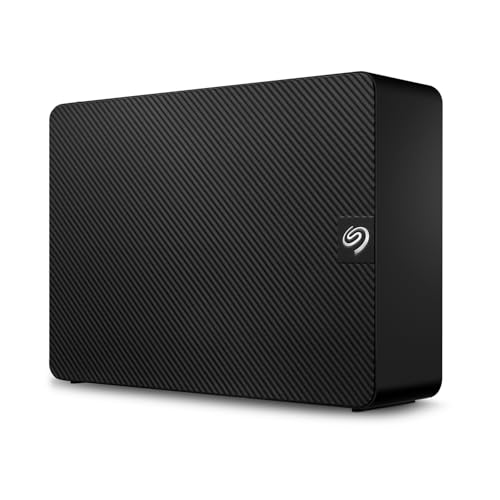
Seagate Expansion 8TB — Desktop value anchor
The Expansion formula reaches its natural scale at 8TB: a black desktop enclosure, a full-size mechanism, a power adapter and absolutely no interest in supervising your data. For the buyer whose requirement is a large, calm place for things to live — the media library that feeds the house, the backup target that receives the nightly run, the archive that ends the annual capacity shuffle — the Expansion’s refusal to add features is its feature. It mounts as a standard drive, every operating system and backup tool already knows how to use it, and its whole personality is availability.
Scale changes the ownership texture in ways worth naming. An 8TB desktop drive is a commitment of desk geography: it wants ventilation, a stable shelf and a permanent socket, and it rewards that commitment by disappearing from thought for years. Its spin-up is a household sound, present in a quiet room; its presence in a backup schedule is the difference between a library that fits with its history intact and one trimmed to fit a smaller target. Buyers upgrading from the 6TB class will feel the change less as speed than as silence — the silence of a capacity question that stops being asked.
The listing’s Rescue services association carries the same meaning it did at 6TB, amplified by the stakes: eight terabytes held in one enclosure is a great deal of household history, and a professional recovery route is worth more attached to this drive than to any smaller one. It remains a safety net rather than a strategy — the strategy is a second copy, which at this scale usually means a second drive in the 6TB class or a NAS — but as nets go, it is the one bundled with the value pick, and that combination is why the Expansion opens this guide.
Choose it as the default 8TB desktop: when your systems are your own, your desk has the socket, and your requirement is room without ceremony. The two WD boxes beside it in this guide answer the same requirement with different garnishes — bareness on one side, encryption on the other — and the choice among the three is the pleasant kind, between correct answers.
First-time buyers at this size sometimes hesitate over the enclosure’s plainness, expecting a flagship capacity to arrive with flagship theatre. The Expansion’s restraint is better understood as confidence: Seagate sells this box in enormous numbers to buyers who measure it entirely by whether the library is there when asked, and on that measure the plain box has outlasted many cleverer designs. Judge it after a year of mornings, not by the unboxing.
- Capacity and format: 8TB in a powered desktop enclosure
- Connection: USB 3.0, drag-and-drop ready from the box
- Power: mains adapter supplied; stationary by design
- Support: Seagate Rescue recovery cover attached to this model
- Software: deliberately minimal — serves your existing tools
- Model reference: STKP8000400
Strengths
- The simplest full-size 8TB for desks and shelves.
- Recovery services bundled where the stakes justify them.
- Standard-disk behaviour every backup tool understands.
Trade-offs
- No built-in encryption for the archive it holds.
- Desk-bound, socket-hungry and proud of it.
- Single-drive concentration demands a second copy elsewhere.
Best for: household media anchors and backup targets at full scale.
Not suited for: travellers, or archives that must lock themselves.

WD Elements Desktop 8TB — Plain powered capacity
WD’s desktop Elements at 8TB is the Expansion’s mirror written in a different house style: the same powered, stationary, full-size proposition, with WD’s book-adjacent enclosure design and an even stricter refusal of software. Where the Seagate offers its recovery association, the Elements offers nothing at all beyond the disk — and for the substantial audience whose backup architecture is already built from their own chosen tools, nothing is exactly the specification. The drive is a filesystem with a power supply, and it intends to be judged as one.
That bareness has a long-horizon virtue this guide has praised at every capacity: legibility to the future. An Elements drive pulled from service in eight years will mount on whatever machine is current and present its files in a standard filesystem, with no vendor layer to resurrect and no account to recover. Archives are long commitments, and the drive that asks nothing of the future is a rational custodian for them — a point that matters more at 8TB, where the archive is the household’s whole estate, than at any smaller size.
Daily manners are desktop-standard: an adapter to house, a mechanism whose working sounds are audible in a silent room and irrelevant in a lived-in one, and sustained-copy behaviour a class above the portables thanks to the full-size mechanism and its dedicated power. The enclosure wants the same placement care as every desktop pick here — air around it, stability under it, cables routed where feet cannot find them.
Between this and the Expansion, decide by the garnishes and the day’s pricing: Rescue services and Seagate’s ecosystem on one side, WD’s bareness and ecosystem on the other, identical capacity and near-identical daily life underneath. Between this and the My Book below, decide by the single question of encryption — whether the drive must lock itself, or whether your home and your systems already handle that duty.
There is a small ritual worth performing when an Elements Desktop enters service: write its role and purchase year on a label and fix it to the case. It sounds like fussiness until the household owns three black enclosures that look identical at midnight during a restore, at which point the label becomes the difference between a system and a guessing game. The barest drive in this guide rewards the one accessory it does not ship with.
- Capacity and format: 8TB powered desktop enclosure
- Connection: USB 3.0 host link
- Power: mains adapter in the box
- Software: none of consequence — your tools, your rules
- Encryption: none built in
- Design: upright book-style case for shelf placement
Strengths
- Purest standard-disk behaviour in the 8TB desktop class.
- Future-legible: no vendor layer between files and any future machine.
- Full-size mechanism handles marathon copies calmly.
Trade-offs
- No encryption and no recovery-service garnish.
- Stationary and socket-dependent, like all its desktop peers.
- Bareness means every system around it is your responsibility.
Best for: self-sufficient backup architects wanting a pure 8TB disk.
Not suited for: owners who expect the drive itself to encrypt or rescue.

WD My Book 8TB — Encrypted desktop archive
At 8TB the My Book’s proposition sharpens into something close to a philosophy: this is the drive for the archive that represents a life’s accumulation — the digitised family history, the photographer’s complete works, the small firm’s records — and its hardware password protection exists because an archive of that completeness deserves a lock that travels with the data rather than with the building. The enclosure can be carried out of a house in a burglary or a hurried office clear-out; the encryption means the archive does not leave with it in any usable form.
The My Book has been WD’s fuller-featured desktop line for long enough that its manners are a known quantity: book-style case that stands on a shelf like its namesake, backup software included for households that want the drive to run the routine, and the password system integrated into that software with the same forgotten-means-wiped honesty as the portable Passports. At this capacity the software’s versioning depth matters — 8TB of target invites a backup history measured in years, and the tool that manages it should be one you are content to live with.
Set against its 6TB prose-only sibling in the companion guide, the 8TB My Book’s case is simpler to state: at 6TB, encryption is one feature among several competing for the decision; at 8TB, the archive is usually complete enough that the lock becomes the deciding feature, and this is the only linked desktop pick here that offers it. Buyers whose threat model is purely mechanical — failure, not theft — will find the Expansion and Elements answer them for less ceremony.
Adopt the My Book with the password discipline this series repeats at every encrypted pick: set it deliberately, record it in a password manager the same hour, and make sure the archive’s other custodians — spouse, business partner, executor of the digital estate — know where the record lives. An 8TB archive locked by a forgotten password is the most complete data loss a household can purchase, and it is entirely avoidable with ten minutes of administration on day one.
Executors and family historians should note the My Book’s other quiet virtue: it is the pick a non-technical heir can actually use. The drive stands on a shelf, connects with one cable, and — with the password recorded where the estate’s documents say it is — opens like a book in every sense. Archives are ultimately kept for other people, and a format the other people can operate is a feature no benchmark measures.
- Capacity and format: 8TB in the book-style desktop enclosure
- Connection: USB host connection
- Power source: supplied mains adapter; the drive stays where it is plugged in
- Locking: built-in password gate backed by hardware-level encryption
- Software: WD backup tools included in the package
- Model family: My Book desktop archive line
Strengths
- The linked desktop pick whose archive locks itself.
- Backup software with room to keep years of versions.
- Shelf-friendly design that suits a permanent archive address.
Trade-offs
- A lost password loses the entire archive, by design.
- Costs more than the plain desktop boxes for the same capacity.
- Software ecosystem commitment comes with the features.
Best for: complete household or studio archives that must be locked.
Not suited for: anyone whose password discipline is aspirational.

Seagate BarraCuda 8TB (Internal) — Internal desktop bulk
The internal route to 8TB runs through this drive: a standard 3.5-inch SATA mechanism, model family ST8000DM004, that mounts inside a tower and becomes part of the machine rather than a satellite of it. The appeal is integration and arithmetic — no enclosure, no adapter, no desk footprint, and the lowest price for each terabyte on this page — aimed at the desktop owner whose case has a free bay and whose storage appetite has outgrown every internal drive below this size. Game libraries, media collections and download archives are its home workloads, and in them it is entirely in its element.
The recording technology must lead its honest paragraph, as it does for every shingled pick in this series. The 8TB BarraCuda uses shingled magnetic recording: superb at holding vast amounts of data cheaply, content under sequential reads and deliberate writes, and prone to slowing under sustained random-write pressure as its bands are reorganised. A game library is nearly the ideal shingled workload — installs arrive in large streams, play is reading, updates are occasional events the drive absorbs overnight. A database, a virtual-machine store or a torrent drive under constant churn is the opposite, and should be pointed at the conventional-recording picks instead.
Two fences follow from that, stated without ambiguity: this drive does not belong in a NAS or any RAID array, where rebuild behaviour under shingled recording becomes a liability measured in days; and it should not be a desktop’s only drive if the desktop’s work is write-punishing. Within its fences it is a genuinely strong product — quiet for its class at 5,400 RPM, capacious beyond most libraries’ ambitions, and cheap enough per terabyte that buying it as a dedicated library drive, leaving the system SSD lean, is the standard enthusiast pattern.
Fitting follows the internal liturgy: power down, mount in a 3.5-inch bay with airflow, SATA data and power leads, initialise as GPT so the whole 8TB is addressable, format, and give the volume a name that states its job. Ten minutes of work buys years of not thinking about game installs again — which, for the audience this drive serves, is the entire review in one sentence.
Streamers and capture-heavy players find a second vocation for this drive: the footage archive. Recordings accumulate at a pace that humiliates smaller drives, and a dedicated 8TB internal volume — written to in long sequential sessions, read back in edits, and otherwise left alone — matches the shingled mechanism’s talents as if designed for it. Keep the live capture target on faster storage and let the BarraCuda be the warehouse, and the arrangement plays to every strength the drive has.
- Capacity and format: 8TB internal drive, 3.5-inch bay mounting
- Interface: SATA 6 Gb/s direct connection
- Spindle: 5,400 RPM, quiet class for internal bulk
- Cache: 256MB buffer fitted
- Recording: shingled (SMR) — bulk and media roles only
- Model reference: ST8000DM004
Strengths
- Cheapest storage per terabyte of the six picks.
- Integrates invisibly into a tower — no box, no adapter.
- Ideal manners for game libraries and media collections.
Trade-offs
- Shingled bands make long random-write sessions crawl.
- Forbidden fruit for NAS and RAID use.
- Requires a free 3.5-inch bay and a few minutes with a screwdriver.
Best for: tower owners wanting a vast internal library drive.
Not suited for: NAS enclosures, arrays or write-churning workloads.

Seagate IronWolf 8TB — NAS heavyweight
Everything the IronWolf name promises at smaller capacities is amplified at 8TB, because this is the size at which NAS ownership becomes serious: arrays holding a household’s entire estate or a small firm’s working records, volumes whose rebuilds are day-long events, enclosures that will not be opened for years at a time. The 8TB IronWolf answers with the line’s full engineering — conventional recording across every platter, a 7,200 RPM-class spindle for array responsiveness, rotational vibration sensors for crowded chassis, and health-management reporting that lets the NAS speak about this drive specifically rather than in generic warnings.
Rebuild arithmetic is where this pick earns its premium in writing. When an 8TB member of an array fails — plan for the day, because at this scale it is a when, not an if — the replacement rebuild copies every surviving byte under sustained load. Conventional recording keeps that process at full pace; the IronWolf’s firmware cooperates with the controller instead of timing out under stress; and its workload rating assumes exactly this life. A cheaper desktop drive inside the same array is not a saving but a postponement, usually collected during the rebuild itself.
The ownership pattern this drive suits is the set-and-supervise NAS: bought in matched sets, installed together, monitored through the enclosure’s health pages, and replaced individually as the years produce a failure. Its Rescue-services association, present in the line’s positioning, adds the professional recovery route behind the array’s own redundancy — belt, braces and a telephone number. For the home archivist graduating from external drives, a pair of these in a mirrored two-bay enclosure is the single most defensible storage purchase in this entire guide.
Desktop users should leave it in its habitat: in a single tower bay it works, but its tuning spends money on vibration neighbours that do not exist and acoustics that assume a cupboard. The BarraCuda above is the tower’s 8TB; this is the array’s, and the guide’s structure — form first, brand second — exists to keep those two sentences from being confused at the checkout.
Small firms reach this drive by a predictable road: the shared folder outgrew the office PC, the external drive doing network duty started frightening people, and the first real NAS arrived needing members worthy of it. The IronWolf 8TB is the drive that road ends at — the point where a business’s records stop living on borrowed hardware and start living on equipment designed for the responsibility, with monitoring and a recovery pathway behind it.
- Intended habitat: NAS enclosures, multi-bay, always-on
- Capacity: 8TB per member, matched sets recommended
- Interface: SATA 6 Gb/s with array-tuned behaviour
- Spindle: 7,200 RPM class for responsive arrays
- Buffer and recording: 256MB cache; conventional recording throughout
- Engineering: vibration sensors, health-management reporting, Rescue association
Strengths
- Rebuild-safe CMR behaviour at full array scale.
- Health reporting the NAS can act on early.
- Engineered for years of continuous multi-bay service.
Trade-offs
- Premium pricing, multiplied across matched array sets.
- Acoustics tuned for cupboards, not desksides.
- Wasted talents in a single desktop bay.
Best for: serious home and small-office NAS arrays.
Not suited for: single-bay desktop use or bargain hunting.
WD Red Plus 8TB — NAS alternative, unlinked
The Red Plus 8TB is the IronWolf’s standing rival, and at this capacity the rivalry is between two mature, conventional-recording NAS lines whose owners defend them with the loyalty usually reserved for football clubs. WD’s proposition mirrors Seagate’s axis by axis: CMR recording as an advertised commitment, NASware firmware for always-on multi-bay service, vibration handling for enclosures, and a workload rating sized for arrays that work for a living. A buyer choosing between them on specification alone will find the honest answer is that both are correct, and the decision lives in ecosystem, enclosure compatibility lists and regional warranty experience.
It appears in this guide without a link because no pool listing could be verified for it — the same bookkeeping status as its 4TB sibling in the companion guide, and equally not a judgement on the drive. Readers whose NAS vendor’s compatibility documentation favours the Red Plus, whose existing array already runs its smaller siblings, or whose retailer prices it kindly should choose it with confidence and apply every piece of array guidance in this guide unchanged: matched sets, rebuild patience, health monitoring, second copies.
One ecosystem note is worth the weighing: WD and Seagate surface drive health differently through NAS platforms, and owners with strong feelings about their enclosure’s dashboard usually already know which brand’s reporting they prefer. Let that preference decide, and spend the deliberation saved on the backup architecture around the array — the part of the system that will actually determine whether the data survives the decade.
Loyalty in this corner of the market is usually earned the slow way: a Red Plus that carried an array through a house move, a power cut and a controller failure becomes the default for the next array without a fresh evaluation. That is not irrationality — storage is a trust good, and a drive family that has held your data safely has provided the only evidence that ultimately matters. New buyers borrow that evidence from the installed base; owners already have their own.
- Habitat: NAS enclosures for home and small business
- Capacity: 8TB, array-matched sets advised
- Interface: SATA 6 Gb/s
- Spindle class: performance NAS tuning for continuous duty
- Recording: conventional (CMR), the line’s stated commitment
- Positioning: WD’s NAS line at its serious-capacity tier
Strengths
- A full-strength NAS line with CMR guaranteed by positioning.
- Broad enclosure compatibility and proven array firmware.
- The natural choice for arrays already running WD members.
Trade-offs
- No purchase link available in this guide.
- Same matched-set cost multiplication as any NAS drive.
- Health-reporting flavour varies by NAS platform.
Best for: NAS builders in WD’s ecosystem or extending WD arrays.
Not suited for: readers who want a purchase link attached to every pick here.
Desktop Box, Internal Bay or NAS: Where Should 8TB Live?
| Drive | Form | Recording | Its address is… |
|---|---|---|---|
| Seagate Expansion 8TB | Desktop external | Desktop class | A shelf with a spare socket |
| WD Elements Desktop 8TB | Desktop external | Desktop class | Behind the monitor |
| WD My Book 8TB | Desktop external | Desktop class, encrypted | The archive shelf |
| BarraCuda 8TB | Internal 3.5-inch | Shingled | Inside a tower |
| IronWolf 8TB | Internal NAS | Conventional | Inside an array |
| WD Red Plus 8TB | Internal NAS | Conventional | Inside an array, WD flavour |
The pattern at 8TB is a fork with three tines, and each tine has a plain first choice: the Expansion for the desk, the BarraCuda for the tower, the IronWolf for the array — with the Elements, My Book and Red Plus refining each answer for bareness, encryption and brand ecosystem respectively. Buyers who can name their tine can finish shopping from this table; buyers who cannot should decide the tine first, because migrating eight terabytes between forms later is the most tedious sentence in storage.
Why Does 8TB Remain Hard-Drive Territory?
Solid-state storage wins every contest except the one this guide is about. At 8TB, an SSD costs several times what any drive here costs, and for the workloads that fill 8TB — archives, libraries, backups, media — the SSD’s speed buys almost nothing the owner can feel: a film streams identically, a backup completes overnight either way, a photograph opens from a folder of ten thousand at the speed of the catalogue, not the disk. The hard drive’s cost per terabyte is not a compromise at this scale; it is the correct engineering answer to bulk that waits.
The industry’s centre of gravity confirms it: capacities beyond the consumer shelf — the 20TB-and-up drives of the data centre — are mechanical, because the economics of bulk have never stopped favouring platters. An 8TB home drive is the consumer expression of that same arithmetic, built from the same technology family that stores most of the world’s data. Buying one is not nostalgia for spinning rust; it is participation in the only storage economics that have ever worked at scale.
There is a further, quieter argument from the repair bench: hard drives fail in ways the industry understands completely, with symptoms that announce themselves and recovery techniques refined over decades. The data-recovery profession exists because platters forgive accidents that solid-state media does not. None of that should be a purchasing strategy — recovery is the last resort, not a feature — but it completes the honest picture of a technology whose weaknesses are known, priced and manageable, which at archive scale is its own kind of strength.
The mature system uses each technology where it wins: SSD for the system and the active work, hard drives at this capacity for the estate those systems produce. This guide’s picks are the estate’s housing, and they should be bought with the confidence that the division of labour behind them is the industry’s settled practice, not a budget apology.
How Do You Plan a Storage System Around an 8TB Drive?
Start from the copy map, not the product page. List what the 8TB will hold, mark which of it is irreplaceable, and assign every irreplaceable item a second home — another drive in this guide’s smaller classes, a NAS volume, a cloud tier — before the purchase is made. An 8TB drive bought into a written copy map becomes infrastructure on day one; an 8TB drive bought on impulse becomes a concentration of risk with excellent specifications.
Budget honesty belongs in the plan too. An 8TB system is not the drive alone: it is the drive, its copy partner, the protected power strip or small UPS that guards it, and eventually its successor. Totalled honestly, the system still costs a fraction of one professional recovery engagement — the comparison that should end every internal debate about whether the second copy is worth buying. It is, at roughly the price of the lesson it prevents.
Then plan the drive’s own lifecycle in the same sitting: its role, its fill reserve — treat the last terabyte as untouchable planning space — its health-check rhythm, and its successor trigger, whether that is an age, a health event or the reserve being reached. None of this requires expertise; it requires a single page of notes kept with the household records, updated when anything changes. Storage systems fail administratively before they fail mechanically, and the page of notes is the administration.
Growth, once more, deserves its forecast before the purchase hardens: measure the estate today, estimate its yearly growth from the last two years’ evidence, and confirm that 8TB — with its final terabyte held in reserve — covers the horizon you intend, whether that is a NAS’s decade or a desktop archive’s five years. If the arithmetic overflows the reserve, the honest move is to plan the system as multi-drive from the start rather than to buy this capacity and be surprised by it.
Finally, rehearse the bad day once. Know which cable you would pull, which copy you would promote, which files you would restore first and how long the bulk restore will take. A household that has walked that path mentally recovers from the real event in hours of copying rather than days of improvisation — and the rehearsal, like the copy map, costs nothing but an honest half hour at the start.
What Does an 8TB Backup Routine Look Like Week to Week?
At this scale the routine is necessarily a system rather than a habit, because no human remembers to copy eight terabytes. The working pattern is continuous or nightly incremental backup from the machines to the 8TB target — small, automatic, versioned — with a monthly verification ritual in which a handful of files from different eras are restored and opened. The target’s size is what makes the pattern luxurious: version history can stretch back years, so the backup stops being a mirror of the present and becomes a time machine with a search box.
The economics of the routine deserve one honest line: the second device, the protected power and the occasional successor are not extras bolted onto the 8TB purchase but the purchase itself, spread across the years it serves. Budgeted that way from the start, the system costs less per protected terabyte than any smaller arrangement the household outgrew on the way here.
Rotation still applies at the top of the market. A second device — often a 6TB-class portable, per the companion guide — carries a periodic full copy offsite, while the 8TB anchor handles the daily work at home. The anchor’s size makes its own replacement planning leisurely: when its health report first stirs, the successor can be bought, copied to over a weekend at full verification, and swapped without a single hour in which the estate exists in only one place.
One rhythm worth stealing from professionals is the restore drill with a date attached: twice a year, pick a month from the deep history at random and restore its photographs to a scratch folder, open a dozen, and delete the folder. The drill takes minutes, proves the entire chain — drive, software, catalogue, files — in a way no status light can, and converts the household’s faith in its backup from an assumption into a memory of having watched it work.
The routine’s last element is documentation of itself: what runs, when, where the copies live, and what a restore looks like, written for the household member who did not build it. Storage systems outlive their builders’ attention spans and sometimes their builders; the page that explains the system is part of the system, and at 8TB it protects more data than any single feature on any drive in this guide.
How Long Can an 8TB Drive Serve Before Retirement Should Be Planned?
Mechanical drives in their intended habitats commonly serve many years, and the stationary, ventilated, undisturbed life available to this guide’s desktop and NAS picks is the kindest service storage knows. The honest planning horizon is not a number of years but a set of signals: the first reallocated sectors, a surface scan that slows in patches, a new sound in the enclosure’s vocabulary, or simply the arrival of the successor capacity the household has been waiting for. Any of those starts the migration conversation while the old drive can still participate in it willingly.
Owners sometimes ask whether a drive’s age should be counted in years or in hours, and the health report answers with both: power-on hours measure the bearings’ true life, while calendar years measure the lubricants, the electronics and the simple probability of an accident. A NAS drive accumulates hours at the maximum rate and should be judged by them; a desktop archive that sleeps most of its life may be chronologically old and mechanically young. Read the report, not the birthday, when the retirement question arrives.
Retirement from primary duty need not mean disposal. An 8TB drive demoted from archive anchor becomes a magnificent tertiary copy — the drawer drive, the offsite rotation’s senior partner — where its remaining life is spent asleep and its failure would cost nothing. Drives managed down a ladder of duties, each rung less critical than the last, deliver the full value of their engineering; drives run until they die in the top job deliver a crisis instead.
One more demotion deserves naming, because households discover it by accident and then rely on it: the retired 8TB makes a superb gift within the family — wiped, health-checked and handed to the relative whose own backup situation is a laptop and a prayer. Storage generosity of that kind quietly raises the whole family’s resilience, and it costs nothing but the wipe and the conversation that accompanies it.
When the end genuinely comes, close it properly: a full verified wipe if the drive spins, physical destruction if it does not, and a note in the storage records that the device left service. Eight terabytes of a household’s life deserves an ending as deliberate as its beginning.
How Does an 8TB Drive Serve a Photographer or a Small Studio?
Creative archives are the 8TB class’s most demanding civilian workload, because they combine size, irreplaceability and constant growth in one folder tree. A working photographer’s archive — raw files from every commission, the edited masters, the delivered sets — grows by terabytes across a career, and the 8TB desktop picks in this guide are sized to hold a substantial practice entire: the Expansion or Elements as the working archive, the My Book where the archive must lock, each with its contents mirrored elsewhere by the copy-map discipline this guide keeps repeating.
The working pattern matters as much as the capacity. Active projects belong on fast storage where the editing happens; the 8TB drive is the vault behind the work, receiving finished projects and holding the deep back-catalogue that clients occasionally — and always unexpectedly — ask to see again. Studios that organise the vault by year and client, with the catalogue database backed up as religiously as the images, can retrieve a five-year-old commission in minutes; studios that treat the big drive as a pile discover that 8TB of unfindable is worse than 2TB of organised.
Assistants, second shooters and editors enter the picture in growing studios, and the archive drive becomes shared infrastructure with shared rules: who may write to it, who may only read, and how a finished project earns its place in the vault. Written down once, those rules protect the archive from its most common enemy — not hardware failure but helpful tidying — and they cost a single conversation at the moment the 8TB drive enters service.
Delivery and redundancy complete the professional picture. Client work carries obligations that outlast the shoot — reprints, disputes, anniversaries — and an archive that exists once is a promise the studio may fail to keep. The professional pattern pairs the 8TB anchor with an offsite rotation and treats the pair, not the drive, as the archive. At that point the 8TB purchase stops being equipment and becomes part of the studio’s word, which is the correct way to think about storage at this scale.
What Should a Growing Household Know About Living With 8TB?
The lived experience of this capacity is mostly the absence of experiences: no deletion negotiations before a download, no backup that fails for space in the night, no library trimmed to fit. Families feel it as the media server that simply has everything, the photo archive that accepts the new phone’s entire camera roll without a preliminary cull, the games shelf that never asks which title must die for the new release. Capacity at this level is a household utility, noticed only when imagined away.
The responsibilities scale quietly alongside. An 8TB drive holds enough of a family’s life that its loss would be a genuine bereavement rather than an inconvenience, and the household’s arrangements should reflect that before the drive arrives, not after its first strange noise: the copy map, the offsite partner, the health-check rhythm, the page of notes that explains the system to whoever inherits its care. None of this is onerous; all of it is cheaper than the alternative.
The household’s relationship with its screens changes subtly as well. A media library that holds everything stops being a ration and becomes a room — browsed, shared and argued over like a bookshelf — and the television’s question shifts from “what is available?” to “what shall we watch?”, which is the question entertainment was supposed to ask all along. Storage people rarely list joy among the specifications, but at this capacity it belongs on the list.
Children growing up inside such a system absorb a useful inheritance: the assumption that the family’s photographs and documents simply persist, organised and backed up, as a fact of the house. That assumption is the real product being bought at 8TB — not the terabytes themselves but the decade of not worrying about them — and it is available at any capacity to households that build the system; 8TB merely makes the system roomy enough to forget.
How Do Power, Heat and Noise Behave at This Scale?
Full-size mechanisms are honest machines: they draw real power, shed real heat and make real sound, and an 8TB installation should be planned with all three admitted. Power first — every desktop pick here wants its own socket on a protected strip, and a NAS full of IronWolfs wants a supply and a circuit that respect the array’s spin-up appetite. Households that put the storage on a small uninterruptible supply gain the graceful shutdowns that protect filesystems during outages, an upgrade whose value is proven exactly once and remembered forever.
Heat is the slow variable, as throughout this series: enclosures in open air, NAS boxes with their airflow unobstructed, internal drives in the case’s intake path. An 8TB drive’s data is too valuable to cook slowly in a sealed cabinet for the sake of tidiness, and the temperature line in the health report — checked on the usual rhythm — is the early warning that placement, not the drive, needs to change.
There is a placement corollary for renters and the desk-bound generally: the 8TB system should be assembled so it can move house in one box — drive, adapter, cables, the page of notes — because systems that survive a move intact are systems whose backup rhythm never breaks. Label the adapter with the drive’s name; adapters breed in drawers and the wrong one at the new address is a small, stupid crisis that a strip of tape prevents forever.
Noise sorts the picks by habitat one final time. The desktop externals murmur at desk distance and vanish across a room; the IronWolf’s array manners assume a cupboard and reward one; the internal BarraCuda inherits whatever acoustic character its tower already has. Buyers sensitive to sound should place the 8TB where the house keeps its other humming infrastructure — with the router, the boiler, the network cabinet — and let distance do what no specification can.
Which 8TB Decisions Do Buyers Most Often Regret?
Parking a shingled drive in a NAS. The internal BarraCuda’s price invites it; its recording technology punishes it during rebuilds. Arrays get conventional-recording drives — IronWolf or Red Plus — or they get a long, risky rebuild in their future.
Concentrating the estate without a copy map. Eight terabytes in one device with no second home is the largest single point of failure a household can buy. The copy map comes first; the drive comes second.
Buying the desktop box for a tower with a free bay. The internal BarraCuda delivers the same library duty without the enclosure, the adapter or the desk footprint. Open the case before ordering the box.
Setting the My Book’s password casually. At 8TB, a forgotten password is not an inconvenience but the loss of the complete archive. Record it in a password manager the day it is set, or do not set it.
Filling the drive to the brim and calling it efficiency. A full 8TB drive has no room for version history, filesystem housekeeping or the next camera. The last terabyte is a reserve, and spending it should trigger the successor conversation, not celebration.
Final Recommendation
Choose by address. On the desk, the Expansion 8TB is the default anchor, the Elements Desktop the bare-disk alternative, and the My Book the one to buy when the archive must lock itself. Inside a tower, the BarraCuda 8TB is the library drive, fenced happily into the bulk role it was built for. Inside an array, the IronWolf 8TB is this guide’s first choice, with the Red Plus as its legitimate unlinked counterpart for WD households.
Eight terabytes is a decade-scale decision dressed as a purchase — make it once, copy-map it properly, and let it be the last capacity question your household asks for years.
If one habit must survive this guide, let it be the rehearsal of the bad day: know tonight which copy you would promote tomorrow, and the largest drive you own becomes the calmest object in the house instead of the largest worry in it.
Frequently Asked Questions
Can I use an 8TB desktop drive as my only backup?
It can be your backup target, but the estate it protects then exists in exactly two places — the machines and this drive — and the drive itself has no backup of its own catalogue or protection against theft, fire or a power event at its address. Add an offsite copy, even a smaller rotating one, and the system becomes respectable; without it, you own a single point of failure with a large capacity.
Is the internal BarraCuda 8TB good for gaming?
For library duty, yes — it holds a very large collection and serves older or less demanding titles directly, while current flagship games belong on an SSD for load performance. Its shingled recording handles game installs and occasional updates without drama. It is a vault and a library, not a performance drive, and judged as one it excels.
IronWolf or Red Plus for a first serious NAS?
Both are correct; choose by your enclosure’s compatibility list, the health-reporting style you prefer in its dashboard, and which brand’s smaller drives — if any — the array already runs. This guide links the IronWolf because its listing could be verified; the Red Plus loses nothing but the link.
Why is there no 8TB portable in this guide?
Because there is no 8TB portable hard drive to include: the 2.5-inch format tops out at 6TB, as the companion guide covers. Any product claiming portable 8TB at hard-drive prices deserves deep suspicion; genuine portable capacity beyond 6TB currently means SSD technology at a very different cost.
How long does it take to fill or copy an 8TB drive?
At hard-drive pace, a complete fill or full copy is measured in many hours — typically an overnight-to-weekend undertaking depending on file sizes. Plan migrations accordingly: start them when the household can spare the time, verify as they complete, and never begin one on the morning the data is needed elsewhere.
Does an 8TB drive need special formatting?
Only the usual one, at larger stakes: initialise as GPT so the full capacity is addressable, since the older MBR scheme stops near 2.2TB. Internal drives and NAS volumes handle this in their setup flows; desktop externals arrive ready. The choice takes ten seconds and cannot be revisited without erasing the drive, so make it consciously.
Related Guides
From the archive shelf to the desk’s other essential hardware, these guides continue from here:
- the best 10 headsets for work, calls and play
- our guide to the best 120 dollar headsets
- the best 200 gaming headsets worth hearing



[…] the best 8TB hard drives for libraries that outgrow this class […]