What's inside
- Where to Buy
- Key Takeaways
- Quick Picks
- How These Picks Were Chosen
- Comparison Table
- How to Choose a Printer for Heavy Cardstock
- Why does the feed route decide what card a printer can handle?
- What should you check in the media table before ordering card stock?
- How do you test a new card stock without wasting the pack?
- Common Mistakes With Heavy Cardstock
- Final Recommendation
- Frequently Asked Questions
- Related Guides
As an Amazon Associate I earn from qualifying purchases. This post may contain affiliate links at no extra cost to you.
[SITE_DOMAIN] is reader-supported. When you buy through links on our site, we may earn an affiliate commission.
Where to Buy
All six machines are sold on Amazon under the model names in their headings, and each heading link opens that model’s listing. Cardstock work depends on the exact model’s documented media limits, so take the model code from the listing straight to the manufacturer’s specification table before ordering either the printer or a serious quantity of card.
Cardstock is where a printer’s paper path stops being a detail and becomes the whole story. A greeting card blank, a postcard stock, a heavyweight invitation card: these are not thicker versions of paper so much as small boards that happen to accept ink, and a machine either bends them around its internal corners or it does not. Crafters and small studios searching for the best printers for heavy cardstock cards are asking a mechanical question, which of these machines will take a stiff sheet in, move it without cracking its surface or jamming at the turn, lay down rich colour, and deliver it flat enough to fold, score or sell. Everything else, speed, screens, software, is decoration on that single question.
The honest complication comes first, because it shapes the whole guide: the maximum card weight each machine accepts is almost never printed in its listing title. Not one title below states a grammage limit, a maximum thickness, or the words heavy cardstock. Those figures live in the specification tables of the manufacturers’ documentation, expressed as a paper-weight range per feed route, and they differ by route within the same machine. So this guide judges what can be judged from design and title: the class of paper path each machine belongs to, wide-format photo machines built for media variety, tank all-in-ones built for economy, a wide office machine built for large formats, and then sends you to the exact model’s media table for the number that decides your card stock’s fate. Any guide that printed a weight limit beside these names without that table behind it would be inventing the fact you most need to be true.
The six divide into three families. Three are wide-format photo printers, an Epson EcoTank Photo, an Epson Expression Photo HD and a Canon PIXMA PRO, machines whose reason for existing is beautiful output on varied media up to 13 x 19 inches or 13 inches wide. Two are tank all-in-ones, an Epson EcoTank wide-format and a Canon MAXIFY MegaTank, whose argument is economy across hundreds of cards. The sixth is an HP OfficeJet Pro wide-format all-in-one whose title promises printing up to 11×17, the office route to big, bold card work. Each review keeps its family honest about what its titles do and do not promise.
Key Takeaways
- Maximum card weight is stated in no listing title here; the deciding figure lives in each model’s manufacturer media table, per feed route.
- Path geometry is the real axis: straighter, low-bend routes and manual or rear feeds treat stiff card more kindly than curved cassette paths.
- The three wide-format photo machines, ET-8550, XP-15000 and PIXMA PRO-200S, are built for rich colour on varied media up to 13 inches wide.
- The two tank all-in-ones, ET-15000 and MAXIFY GX2020, argue economy across long runs of cards rather than ultimate photo finish.
- The HP OfficeJet Pro 9730 brings an 11×17 format claim from its title, suiting oversized cards and folded pieces.
- Test your exact card stock, one sheet, every feed route the manual allows, before a priced job depends on the result.
Quick Picks
| Pick | Badge | Why it earns its place |
|---|---|---|
| Epson EcoTank Photo ET-8550 | Wide photo colour, tank economy | A cartridge-free 6-colour wide-format photo all-in-one printing up to 13 x 19 in. |
| Epson Expression Photo HD XP-15000 | Wide photo finish | 6-colour wide-format photo printing up to 13 x 19 in. with auto 2-sided printing. |
| Canon PIXMA PRO-200S | Professional 13-inch photo colour | An 8-colour dye ink professional photo printer with a 3-inch colour LCD. |
| Epson EcoTank ET-15000 | Wide tank workhorse | A cartridge-free wide-format supertank all-in-one up to 13 x 19 in. with Ethernet. |
| Canon MAXIFY GX2020 MegaTank | Business tank for card runs | Print, copy and scan with duplex printing and a refillable tank system for home and office. |
| HP OfficeJet Pro 9730 | 11×17 office wide format | A wide-format wireless all-in-one printing up to 11×17 with duplex print and scan. |
How These Picks Were Chosen
Selection began with media ambition rather than with speed or price. Machines were favoured when their design class is built around varied, demanding media: photo printers whose buyers print on everything from glossy sheets to matte boards, wide-format machines whose trays and feeds must accept large, stiff stock as a matter of routine, and tank systems whose economics suit the long card runs that craft sellers actually produce. A fast office laser with a narrow media imagination had no place here, however excellent its documents, because this guide’s subject is the sheet that does not want to bend.
Title discipline then separated the claims that could be made from the claims that could not. Sizes could be claimed where titles print them, 13 x 19 inches on the wide machines, 11×17 on the HP. Colour systems could be claimed where titles name them, six colours here, eight dye inks there. Weight limits could be claimed nowhere, and so they are claimed nowhere: every specification box records the maximum card weight as not stated in the listing title and directs the reader to the manufacturer documentation for the exact model, where the media table gives the figure per feed route.
Balance across card makers completed the shortlist. The Etsy seller printing two hundred greeting cards, the photographer printing portfolio cards on the finest stock, and the office printing oversized display cards are solving different problems with the same raw material. The six picks give each of them a machine whose family strengths match their problem, and each review names the card maker it suits and the one it would disappoint.

Epson EcoTank Photo ET-8550 — Six colours, wide format, tank economy
The ET-8550 is the card maker’s intersection of three desires that rarely meet: photo-class colour, wide format, and ink that does not punish experimentation. Its title describes a wireless wide-format all-in-one tank printer, cartridge-free, with 6-colour wide-format photo printing, scanning and copying, up to 16 ppm, and output up to 13 x 19 inches, aimed at creators and home studios. For card work, each clause earns its place. Six colours widen the palette a card design can use, holding gradients and skin tones that four-colour machines flatten. The wide format means a single sheet can carry a spread of cards to be cut down, or one oversized piece that smaller machines cannot attempt at all.
The EcoTank system changes the psychology of heavy card printing specifically. Card stock is expensive per sheet and test prints are unavoidable, because every new stock behaves differently in the feed and under the ink. A cartridge machine taxes each test; a tank machine makes tests nearly free, and the card maker who tests freely produces better cards. That economy also suits the proofing rhythm of card design, where a design is printed, folded, held, adjusted and printed again across an afternoon, and the cost of the loop decides how many iterations a design gets before it is sold.
Wide-format machines in this class earn their card reputation through their feed arrangements for specialty media, and the buyer should confirm the ET-8550’s exact routes and weight limits in Epson’s documentation for this model, because the title states neither. The media table will give the maximum weight per route, and the route with the straightest path and the highest stated limit is the route your heaviest card belongs on. That check, done once, converts this machine from a promising design into a verified card tool for your specific stock.
For creators whose cards are also their portfolio, photographs reproduced at card scale, illustrations, typographic pieces on matte board, the ET-8550 is the most complete answer in this guide, and its listing is where to check price on Amazon. Its compromises are the class compromises: it is a photo machine first, with scanning and copying as supporting acts, and its virtues are wasted on a buyer whose cards are plain text on standard stock.
Card sellers should also think about what the wide format does to their cutting table. A 13 x 19 sheet printed with a grid of cards, cut down on a trimmer, produces more finished cards per print cycle than any standard sheet, and the tank system makes the grid’s inevitable test print, the one that proves registration before the run, a trivial cost. The workflow this machine enables, design the sheet, proof the sheet, run the sheet, cut the sheet, is the small-studio version of how cards are manufactured at scale, and it is available here without a single cartridge being opened in anger.
- Function: wireless wide-format all-in-one tank printer; print, scan, copy
- Colour system: cartridge-free 6-colour, per the title
- Format: up to 13 x 19 in.; up to 16 ppm, per the title
- Audience stated: creators and home studios
- Maximum card weight: Not stated in the listing title — verify with the manufacturer documentation
Strengths
- 6-colour output holds gradients and tones card designs need
- Tank economy makes stock testing and proofing nearly free
- 13 x 19 in. format carries card spreads or oversized pieces
Trade-offs
- Maximum card weight must be confirmed in the documentation
- Photo-first design, with office functions in supporting roles
- Wide-format body needs real desk space
Best for: a creator or home studio printing colour-rich cards and card spreads, testing stocks freely on tank ink.
Not suited for: work that needs a documented heavy-card guarantee from the listing alone, because the title states no maximum card weight.
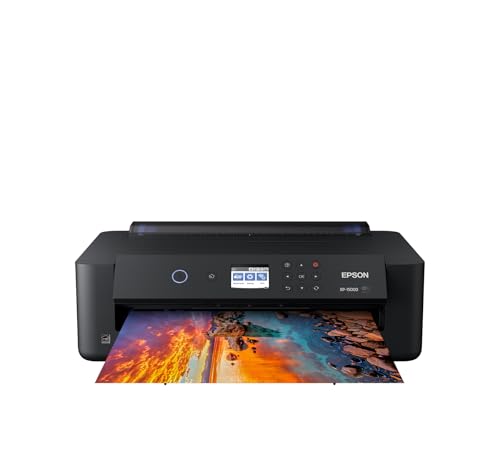
Epson Expression Photo HD XP-15000 — The wide photo specialist
The XP-15000 is the established wide-format photo route, a machine whose title promises 6-colour wide-format photo printing up to 13 x 19 inches, up to 9.2 ppm, and auto 2-sided printing, aimed at photographers and home studios. Its card argument is specialisation: a printer designed to make photographs on varied media treats a heavy card as one more photographic medium, a surface whose coating and stiffness the machine’s media settings exist to accommodate. Card makers whose work is photographic, prints of their own images sold as cards and postcards, are this machine’s natural owners.
Auto 2-sided printing, stated in the title, has a particular card meaning that deserves care. Many cards are printed on one side and written on the other, but a growing class, double-sided postcards, information cards, portfolio pieces with the story on the back, needs the second side printed too. Automatic duplexing on photo machines is generally a paper feature rather than a heavy-card feature, and the documentation for this model will state which media its duplex path accepts. A card maker planning two-sided heavy pieces should read that line before assuming the stiff stock can take the duplex turn, since the turn is exactly where thick media meets its limit.
The 9.2 ppm figure in the title sets honest expectations about pace. Photo machines trade speed for control, laying ink carefully on media that rewards care, and a card run on the XP-15000 is a supervised, quality-first run rather than a batch blast. For a photographer printing fifty fine cards, that pace is the price of the finish and it is gladly paid. For a seller printing five hundred commodity cards, the same pace is a bottleneck, and the tank machines below exist for that seller.
Confirm the media table for this exact model before committing a favourite stock: maximum weight per route, and which route Epson intends for its heaviest papers. With that confirmed, the XP-15000 offers card makers a mature photo platform whose output quality is its whole reputation. Readers can check price on Amazon to weigh it against the EcoTank Photo above, cartridge convenience here against tank economy there.
Photographers choosing this machine for cards often discover a second use that justifies it alone: the same wide photo output that carries a card spread carries the portfolio print and the exhibition piece, so the card work shares a machine with the maker’s primary art rather than competing with a dedicated card device for desk space. A home studio is a zero-sum surface, and a machine that serves the art and the merchandise with one set of media habits, one set of papers learned deeply, earns its footprint twice. The XP-15000’s long presence in studios rests on exactly that double service.
- Function: wireless wide-format inkjet photo printer
- Colour system: 6-colour wide-format photo printing, per the title
- Format: up to 13 x 19 in.; up to 9.2 ppm, per the title
- Duplex: auto 2-sided printing stated in the title
- Maximum card weight: Not stated in the listing title — verify with the manufacturer documentation
Strengths
- Photo-specialist output for image-led cards and postcards
- Wide 13 x 19 in. format for spreads and oversized pieces
- Established platform with mature media documentation
Trade-offs
- Stated pace of 9.2 ppm suits quality runs, not bulk batches
- Duplex media limits must be checked for heavy stock
- Cartridge ink makes extensive stock testing costlier
Best for: a photographer printing image-led cards in modest runs, where finish outweighs pace.
Not suited for: two-sided heavy card work planned without checking the duplex media limits, because the title’s auto 2-sided claim does not state which media it covers.

Canon PIXMA PRO-200S — Eight dye inks at 13 inches
The PIXMA PRO-200S is the professional’s entry in this guide, and its title is admirably narrow: a professional 13-inch wireless inkjet photo printer with a 3-inch colour LCD and 8-colour dye ink. No scanning, no copying, no office pretensions. For card makers, that narrowness is information. A machine built only to print photographs, with eight dye inks devoted to colour range and smoothness, is a machine whose media handling exists for one purpose: to carry fine papers through a straight, careful path and return them with exhibition colour on them. Cards printed on it are not a side job; they are the job, at card scale.
Eight dye inks matter to card designs in a way spec sheets understate. Dye inks soak into coated surfaces and produce the smooth gradients and saturated colour that photographic cards live on, and eight inks widen the achievable range beyond what six can mix, particularly in the difficult territories of deep reds, violets and shadow detail. A card carrying a sunset, a portrait or a product photograph shows the difference without any test equipment: the card simply looks printed by a machine that cared. The 3-inch colour LCD supports the standalone workflow such printing often uses, selecting and confirming at the machine rather than at a desk.
The professional framing also implies the documentation discipline this guide keeps requiring. Canon’s media information for the PRO-200S will state the papers and weights each feed route accepts, including its manual feed arrangements for fine art and heavier media, and a card maker should read those figures as the machine’s true card specification. The title’s silence on weight is not a gap in the machine; it is a gap in the title, and the manual closes it precisely.
Choose the PRO-200S when the card is a photographic product and its selling price can carry a professional printer’s running costs, since eight dye cartridges are a commitment as well as a palette. It will not scan your artwork or copy your invoices, and it is not built for five hundred identical commodity cards. For fifty beautiful ones, repeatedly, it is the connoisseur’s pick here, and its listing is where to check price on Amazon.
Standalone operation deserves a further word, because card production often happens away from the design desk, at a market-prep table or in a studio corner where the computer is not. A colour LCD at the machine, with printing driven from memory media or a wireless connection, lets the maker proof, adjust and run cards where the finishing happens, scissors, scorer and envelopes within reach. Production geography sounds trivial until a workflow forces twenty walks a day between desk and printer; the PRO-200S is built for the corner it will live in, and its controls acknowledge that the corner, not the desk, is where cards are made.
- Function: professional 13-inch wireless inkjet photo printer
- Colour system: 8-colour dye ink, per the title
- Controls: 3-inch colour LCD
- Format: 13-inch class, per the title
- Maximum card weight: Not stated in the listing title — verify with the manufacturer documentation
Strengths
- 8-colour dye ink gives the widest colour range in this guide
- Print-only professional focus on media handling and finish
- Colour LCD supports standalone, at-machine workflows
Trade-offs
- No scanning or copying functions at all
- Eight-cartridge running costs suit premium cards, not commodity runs
- Card weight limits live in the documentation, not the title
Best for: a photographer or illustrator selling premium photographic cards in modest runs at a professional finish.
Not suited for: an all-in-one desk that must also scan and copy, because the title describes a print-only professional photo machine.

Epson EcoTank ET-15000 — Wide format with supertank stamina
The ET-15000 brings the wide format down from the photo studio into the working office and craft room. Its title describes a wireless all-in-one wide-format supertank printer, cartridge-free, with print, scan, copy and fax, up to 17 ppm, output up to 13 x 19 inches, and Ethernet, aimed at home and small offices. For card work, that combination reads as stamina: a machine that can print a card spread at 13 x 19, copy the order form that came with it, and do both again tomorrow for months, on tank ink whose cost per card stays low enough to keep a small business’s margins intact.
The distinction between this machine and the EcoTank Photo above is colour ambition. The ET-15000’s title claims no six-colour photo system; it is a general wide-format workhorse whose output serves business graphics, bold designs and text-led cards handsomely. A card maker whose designs are typographic, illustrative in flat colour, or informational will not miss the photo palette. A card maker whose designs are photographic gradients should notice the difference and choose the photo machine deliberately rather than discover it across a print run.
Ethernet, named in the title, is a small-office virtue that card sellers grow into: the printer wired beside the packing bench, reachable from every computer in the business, holding its place in the network through long production days. Fax, also named, dates the design’s office ambitions and costs the card maker nothing. The all-in-one shape means the machine that prints the cards also scans the artwork and copies the paperwork, consolidating a small studio’s whole paper workflow at wide format.
The media table remains the deciding document: Epson’s documentation for the ET-15000 states the weight range for each route, and a card seller should confirm that their stock sits inside the range for the route they intend to use, ideally with margin. With that confirmed, this is the wide card machine for volume-minded generalists, and its listing is where to check price on Amazon against the photo specialist above it.
Production sellers should run the margin arithmetic that makes this machine’s case in numbers rather than adjectives. A card’s selling price must absorb stock, ink, cutting time and the occasional ruined sheet; across hundreds of cards, the ink term is the one that silently decides whether the line is profitable. Cartridge-free printing shrinks that term to the point where a maker can price for the market instead of for the cartridge, and can say yes to a rush reprint without recalculating the job. The ET-15000’s wide format then multiplies the benefit, more cards per sheet, fewer sheets per order, less handling per finished piece.
- Function: wireless all-in-one wide-format supertank printer; print, scan, copy, fax
- Ink system: cartridge-free, per the title
- Format: up to 13 x 19 in.; up to 17 ppm, per the title
- Networking: Ethernet stated alongside wireless
- Maximum card weight: Not stated in the listing title — verify with the manufacturer documentation
Strengths
- Wide format plus tank economy suits long card production runs
- All-in-one functions cover a small studio’s whole paper workflow
- Ethernet gives a production bench a stable wired connection
Trade-offs
- No photo colour system is claimed in the title
- Card weight limits must be confirmed per feed route
- Office-first design, with photo finish as a secondary concern
Best for: a craft seller or small office printing bold, design-led cards in long runs at wide format on tank ink.
Not suited for: photographic cards needing a multi-colour photo palette, because the title claims no photo ink system for this model.

Canon MAXIFY GX2020 MegaTank — Business tank discipline for card batches
The GX2020 is the card machine for a business that prints cards the way it prints everything else: in batches, on schedule, with the costs watched. Its title describes a MegaTank MAXIFY all-in-one wireless colour printer with print, copy and scan, duplex printing, a refillable tank system and a compact desktop design for home and office. Nothing in that sentence mentions cardstock, and this review will not pretend it does. What the sentence describes is an economical, business-shaped platform whose tank system and duplex printing suit the card-adjacent work small businesses actually do: product cards, instruction cards, appointment and loyalty cards, packaging inserts, printed in colour, in runs, without a cartridge thought.
Duplex printing is this pick’s card-relevant hardware claim, with the usual caution attached. Two-sided cards are a real business format, the loyalty card with terms on the back, the product card with care instructions reversed, and automatic duplexing produces them without manual refeeding. Whether a given card weight may use the duplex path is a media-table question, since the duplex turn is the tightest bend in most machines, and Canon’s documentation for the GX2020 is where that permission is written. Single-sided heavy cards through the straighter route, two-sided lighter cards through duplex: that division, once the table confirms it, is a workable production system.
The MAXIFY line’s business character shows in the combination rather than in any single figure: wireless print, scan and copy for a team, a compact desktop footprint for a bench that also packs orders, and a tank system whose refills are an occasional event rather than a weekly errand. A small business printing cards among its other jobs needs the machine to disappear into the routine, and this title describes a machine designed to do exactly that.
Its limits for this guide’s subject should be plain. It is not a photo printer, and its colour, while business-capable, is not the palette of the three photo machines above. Its card weight limits are undocumented in the title and must be read in Canon’s media information before a heavy stock is standardised on it. Within those bounds, it is the pragmatic card batch machine for a working business, and its listing is where to check price on Amazon.
Businesses should notice how this machine changes who can print the cards. A temperamental media workflow concentrates production in the one employee who has mastered it; a business tank all-in-one with a documented card routine, the right route, the right setting, a test sheet first, can be operated by whoever is free. That delegation is worth money in a small firm, because card jobs arrive with deadlines that do not consult the master’s calendar. The GX2020’s whole design language, compact, wireless, refillable, duplex, speaks of a machine meant to be used by a team rather than tended by a specialist.
- Function: all-in-one wireless colour printer; print, copy, scan
- Duplex: duplex printing stated in the title
- Ink system: refillable tank system, per the title
- Design: compact desktop design for home and office
- Maximum card weight: Not stated in the listing title — verify with the manufacturer documentation
Strengths
- Tank economy suits scheduled batches of business cards and inserts
- Duplex printing covers two-sided card formats on suitable media
- Compact all-in-one fits a packing bench workflow
Trade-offs
- No photo colour system is claimed in the title
- Duplex use with heavy card depends on the media table
- Card weight limits are not stated in the title
Best for: a small business printing colour business cards, inserts and loyalty cards in regular batches on tank ink.
Not suited for: photographic card products, because the title claims no photo ink system or photo positioning for this model.

HP OfficeJet Pro 9730 — The 11×17 route to oversized cards
The OfficeJet Pro 9730 closes the guide with a format argument from the office side. Its title describes a wide-format wireless all-in-one colour inkjet printer with print, scan, copy and fax, printing up to 11×17 through its automatic document feeder class design, duplex printing and scanning, positioned as best for office, with a three-month trial of Instant Ink included. For card makers, the 11×17 figure is the headline: an oversized sheet that folds to a large card, carries a grid of smaller cards for cutting, or serves whole as a display card, signage or certificate, formats the 13-inch photo machines reach differently and standard machines cannot reach at all.
Duplex print and scan, both stated, give the office card workflow a completeness the photo machines do not attempt. A two-sided oversized piece, a folded programme, a display card with its reverse printed, comes off this machine in one routine, and the document feeder and scanning side handle the administrative paper that surrounds any office production run. Instant Ink’s trial, named in the title, introduces HP’s subscription supply rhythm, which offices that print in pulses often prefer to stockpiling cartridges; card makers should simply note that heavy card runs consume ink at design rates, not document rates, when judging any subscription’s fit.
The card-specific cautions are the guide’s standard ones, applied without exception. The title states a format, not a weight: the maximum card stock for each route lives in HP’s documentation for the 9730, and an 11×17 sheet of heavy card is a large, stiff object whose behaviour in any path must be confirmed rather than assumed. Office machines also prioritise document virtues, and a card maker seeking photographic subtlety should compare this machine’s output character against the photo picks above with open eyes.
Choose the 9730 when the card work is oversized, office-led and two-sided: folded pieces, display cards, certificate stock, grids of cards on big sheets, produced inside a general office workflow. It is the breadth pick of this guide, and its listing is where to check price on Amazon, trial terms included, before the first 11×17 pack is ordered.
Oversized work also changes the finishing options in ways card makers should exploit deliberately. An 11×17 sheet can be scored and folded into a large-format card that no standard printer in this guide can produce as a single piece, and a piece of that presence, a table card, a certificate, a display notice, carries authority that smaller formats borrow from frames and mounts. Offices that discover the format often find uses cascading: the folded programme leads to the big invitation, the big invitation to the display card. The 9730’s value is partly that cascade, a capability bought once and applied by the whole office’s imagination afterwards.
- Function: wide-format wireless all-in-one colour inkjet; print, scan, copy, fax
- Format: up to 11×17, per the title
- Duplex: duplex print and scan stated in the title
- Bundle: 3-month trial of Instant Ink included, per the title
- Maximum card weight: Not stated in the listing title — verify with the manufacturer documentation
Strengths
- 11×17 format enables folded and oversized card work
- Duplex print and scan complete an office production routine
- All-in-one breadth covers the paperwork around card jobs
Trade-offs
- Card weight limits must be confirmed in the documentation
- Office-first output character, not a photo palette
- Subscription trial needs judging against design-rate ink use
Best for: an office producing oversized, folded or two-sided card pieces at 11×17 inside a general workflow.
Not suited for: photographic card products needing a photo ink system, because the title positions this machine for office work and claims no photo palette.
Comparison Table
| Pick | Cardstock angle | Headline fact from its listing title |
|---|---|---|
| Epson EcoTank Photo ET-8550 | Photo colour on varied media, tank tests | 6-colour wide-format photo; up to 13 x 19 in.; cartridge-free |
| Epson Expression Photo HD XP-15000 | Photo finish, established platform | 6-colour wide-format photo; up to 13 x 19 in.; auto 2-sided |
| Canon PIXMA PRO-200S | Premium photographic cards | 8-colour dye ink; professional 13-inch; 3-inch colour LCD |
| Epson EcoTank ET-15000 | Wide tank production runs | Cartridge-free wide-format; up to 13 x 19 in.; Ethernet |
| Canon MAXIFY GX2020 | Business card batches on tank ink | Refillable tank system; duplex printing; print, copy, scan |
| HP OfficeJet Pro 9730 | Oversized and folded pieces | Up to 11×17; duplex print and scan; Instant Ink trial |
How to Choose a Printer for Heavy Cardstock
Start with your card, weighed and measured, not with the printers. Find the stock’s weight from its packaging or its maker, in grams per square metre or in the cover-weight terms card sellers use, and write the number down. That number is your key for every media table you are about to read, and a card maker who does not know it is shopping blind, however expert they are in design. If you use several stocks, the heaviest one is the key, because a machine that accepts the heaviest accepts the rest, while the reverse is a shelf of unusable card.
Take that number to the manufacturer documentation for each candidate, and read the media table by route, not by headline. Most machines in this class offer more than one way in, a cassette for everyday paper and a rear or manual route for specialty media, and the weight limits differ, sometimes dramatically, between them. Your card belongs on the route whose stated limit covers it with margin to spare. A stock sitting exactly at a stated maximum will feed on a good day and refuse on a humid one; margin is what turns a specification into a routine.
Then match the family to the product. Photographic cards belong on the photo machines, where colour systems are the design’s raw material. Long runs of bold, flat-colour cards belong on the tank machines, where the cost per card protects the margin across hundreds. Oversized and folded pieces belong on the machine whose stated format covers them. Choosing the family first and the model second prevents the commonest card-printer error, which is buying an excellent machine from the wrong family and spending a year working around its nature.
Finally, test the exact stock before the priced work. One sheet through each permitted route, printed with your densest design, folded or scored if the product folds, and judged in the hand: surface uncracked, colour even, sheet flat. A machine and a stock that pass that test together are a production system. Everything before the test is candidacy, and card makers who respect the difference rarely ruin a job that matters.
Storage closes the loop between buying a machine and feeding it well. Card stock stored on edge warps; card stock stored under weight takes the weight’s opinion of flatness; card stock in a damp room absorbs the room. Flat, dry, lightly covered storage keeps the sheets in the condition the media table assumes, and a maker whose feeding problems appear mysteriously in August should check the storeroom before the printer. Heavy card is the most storage-sensitive material in this entire series of guides, and the cheapest feed upgrade available is a shelf that treats it properly.
Why does the feed route decide what card a printer can handle?
Because stiffness is a property that only matters when something tries to bend it. Inside most printers, paper from a cassette is lifted, turned and delivered through a path with at least one significant curve, a route engineered for flexible sheets. A heavy card entering that route must either bend to the curve’s radius or resist it, and resistance shows up as feed hesitation, surface scuffing where rollers fight for grip, or a jam at the turn itself. A rear or manual route, where a machine offers one, typically shortens the path and softens or removes the curve, letting the card travel closer to flat, which is the state it was manufactured in and the state it prints best in.
Roller pressure tells the same story at smaller scale. Feed systems grip with sprung rollers set for a range of thicknesses; a card near the top of the range is gripped firmly and driven positively, while a card beyond it is gripped inadequately or not admitted at all. The media table’s weight limit is the manufacturer’s statement of where that grip engineering ends, which is why this guide treats the table, rather than any owner’s anecdote about a thicker card that once went through, as the authority. A card that feeds once by force of luck is not a workflow; it is a story with a jam scheduled inside it.
What should you check in the media table before ordering card stock?
Three lines. The maximum weight for the route you intend to use, in the units your stock is sold in, converting carefully if the table and the packaging disagree in units. The size range for that same route, because a route that accepts your weight may not accept your sheet size, and wide-format card work lives exactly at the intersection of those two limits. And any media-type exclusions the manufacturer prints, since some routes bar particular surfaces or constructions regardless of weight. A stock that passes all three lines is a stock you can order in quantity; a stock that passes two is a sample pack and a test, nothing more.
Check also what the table says about duplex, if your card is two-sided. The duplex path is a second, tighter route inside the machine, with its own media limits, usually narrower than the straight route’s. Many disappointed card makers have confirmed their stock for printing and forgotten to confirm it for turning. The table holds both answers, a page apart, and reading both is the whole of the discipline this guide has been recommending from its first section.
How do you test a new card stock without wasting the pack?
Sacrifice two sheets, deliberately, and learn everything they can teach. The first sheet goes through the route the media table recommends for your weight, printed with the densest, darkest design you produce, because dense coverage is where feeding, drying and surface behaviour are all stressed at once. Examine it wet and dry: banding, pooling on coated areas, scuffs where rollers gripped, and the sheet’s flatness an hour later. Fold or score it if the product folds, because a stock that prints beautifully and cracks at the score has failed the only test that matters.
The second sheet tests the routine rather than the material: load it as part of a small stack, at the stack height you intend to use, and print the design you will actually sell. This sheet answers the production questions, whether the stack feeds without doubles, whether registration holds from sheet to sheet, whether the tenth sheet will look like the first. Two sheets spent this way convert a pack of unknown stock into a known production material, and the maker who begrudges them will spend ten learning the same lessons inside a priced job, where each lesson costs a card somebody has already paid for.
Common Mistakes With Heavy Cardstock
Feeding card through the everyday cassette because it fits is the beginner’s defining error. Fit is a question of dimensions; feeding is a question of bending, grip and weight, and the cassette route is commonly the most curved and the most weight-limited in the machine. The card that fits and then jams, creases or emerges scuffed has not met a defective printer; it has met the wrong route. The manual’s media table names the route intended for the heaviest media, and the card belongs there even when the cassette is closer to hand.
Overstacking the feed comes next. Card is loaded like paper, a sheaf of it, and the bottom sheets, compressed under the stack’s weight and gripped unevenly, feed in pairs or not at all. Heavy media feeds best in small stacks, sometimes in single sheets for the heaviest stocks, topped up patiently. Card work has a rhythm closer to feeding a press than to loading an office printer, and makers who adopt that rhythm stop having feed problems they previously blamed on their machines.
Judging a card straight off the printer causes its own damage. Ink on heavy stock needs its drying or setting moment, coatings need handling care while fresh, and a fold made too early cracks a surface that would have folded cleanly an hour later. Build the pause into the workflow: print, rest the sheets flat, then score, fold and trim. Card is a material with a memory and a timetable, and the makers who respect both produce the pieces that look manufactured rather than homemade.
Keep a stock book beside the printer: one page per card stock you have proven, recording its weight, its source, the route and settings that fed it cleanly, and a trimmed sample of the finished card taped to the page. Card production accumulates materials the way cooking accumulates recipes, and memory serves neither reliably. The book turns each new stock from an experiment into a lookup, and when a favourite stock is discontinued, as stocks are, the book’s record of its weight and finish is the specification for finding its replacement. Each of these machines rewards that bookkeeping equally, because the machine holds only half of what a proven card requires; the other half is the maker’s record of how the two were introduced.
One sample from every production run should join that book as well, dated and annotated with any drift noticed, so the maker can see a machine’s output change across seasons before a customer does.
Drift caught on a sample page is a maintenance prompt; drift caught by a customer is a refund, and the distance between those two outcomes is one dated sample per run.
The stock book habit has one more beneficiary: the second maker. Studios grow, partners join, a spouse takes over the card line for a season, and the book hands them every proven combination without an apprenticeship of ruined sheets. Knowledge that lives in a book survives holidays, growth and forgetfulness; knowledge that lives in one maker’s hands leaves the studio every evening. Heavy card work, with its routes and limits and timings, is exactly the kind of craft that deserves to be written down while it is being learned.
Final Recommendation
Let your heaviest stock and your product type choose together. For colour-rich cards with the freedom to test stocks cheaply, the Epson EcoTank Photo ET-8550 is this guide’s centre of gravity; for photographic cards at a premium finish, the Canon PIXMA PRO-200S is the connoisseur’s machine, with the Epson XP-15000 as the established wide photo alternative. For long runs of bold cards on a budget that must survive contact with reality, the ET-15000’s wide tank stamina leads, the MAXIFY GX2020 serves the business batch, and the HP OfficeJet Pro 9730 owns the oversized, folded, office-led work at 11×17. Whichever name you choose, let its media table, read by route, confirm your card’s weight before the stock is ordered in quantity, and the machine will do the rest beautifully.
Frequently Asked Questions
What weight of cardstock can these printers handle?
No listing title in this guide states a maximum weight, so the figure must be read in the manufacturer documentation for the exact model, in the media table, where limits are given per feed route. Expect the specialty or rear route to carry the highest limit and the cassette and duplex routes to carry lower ones. Order card stock only against the route-specific figure for the route you will actually use.
Is an inkjet or a laser better for heavy cardstock?
All six shortlisted machines are inkjets, which reflects where heavy card work is actually done. Inkjet printing lays ink without a hot fuser and photo inkjets in particular are engineered around varied media. Laser engines can print lighter card within their documented limits, but heat, curved paths and toner transfer make them the less forgiving class for genuinely heavy stock, and none is shortlisted here for that reason.
Can I print on both sides of heavy cardstock?
Only within the duplex media limits of the exact model, which are separate from its single-sided limits and usually lower, because the duplex path bends the sheet more tightly. Two titles here state auto or duplex printing, the XP-15000 and the GX2020, plus duplex on the HP, but none states which media the duplex path accepts. Read that line in the media table before designing a two-sided heavy card around it.
Why does my card come out curled or cracked when folded?
Curl is the path’s memory: a sheet bent around rollers emerges holding some of the curve, and resting the sheets flat under light weight restores them. Cracking at a fold is a surface and timing issue, eased by scoring the fold line before folding and by letting fresh prints rest before finishing. Both are material behaviours, not machine faults, and both are managed at the finishing table rather than at the printer.
Should I choose a tank printer or a cartridge printer for cards?
Choose by run length and testing appetite. Tank machines, three of the picks here, make tests and long runs cheap, which suits sellers iterating designs and printing in hundreds. Cartridge photo machines suit makers whose runs are shorter and whose priority is the widest colour palette or the finest photographic finish. The stock does not care which system feeds the ink; the economics of your workflow do.
Should I score cardstock before or after printing?
Print first, score second, in almost every workflow. Scoring before printing creates a channel that ink can pool in and a weakened line that the feed must carry through the path at its most vulnerable point. Printing on the flat sheet keeps the surface uniform for the rollers and the ink, and scoring afterwards, on rested prints, gives a clean fold with the design already in place. Makers working with pre-scored blanks should treat them as a distinct stock, test them as such, and confirm in the media guidance that scored media is acceptable for the route.
Related Guides
Heavy card closes this series on special media: best art projectors for beginners begins the neighbouring projector guides for creative desks, best inexpensive art projectors continues them at the value end, and best led projectors for artists covers the LED tracing machines artists pair with printed work.


