What's inside
- Key Takeaways
- Quick Picks
- How We Chose These Picks
- What Does Living With a Very Short Cable Actually Feel Like?
- The Six Power Banks, Pick by Pick
- How Do the Six Compare Side by Side?
- How Do Airline Rules Treat Power Banks, Pick by Pick?
- How Do You Keep a Built-In Cable Alive for Years?
- How Do You Choose Between One Big Pack and Two Small Ones?
- What Does a Power Bank Do to a Phone Battery Over a Year?
- How Should You Pack a Power Bank for a Travel Day?
- What Mistakes Do Cable-Free Power Bank Buyers Keep Making?
- Final Recommendation
- Frequently Asked Questions
- Related Guides
As an Amazon Associate I earn from qualifying purchases. This post may contain affiliate links at no extra cost to you.
[widgetverdict.com] is reader-supported. When you buy through links on our site, we may earn an affiliate commission.
Where to buy: all six power banks below are sold through the linked listings, and every one carries its charging cable built into its own body — that shared trick is the entire category, and its limits are examined as honestly as its conveniences.
The best portable chargers that dont require a cable exist because of a small, universal humiliation: the power bank remembered, the cable forgotten. A battery pack without its cable is a paperweight with a charge indicator, and the industry’s answer is to build the cable in — a short lead that lives in a slot, a groove or a loop on the pack itself, ready to unfold the moment a phone fades. The six picks below all make that promise, across capacities from 10,000 to 50,000 milliamp-hours, with variations that matter: one adds a foldable wall plug so the pack recharges itself from a socket with no cable either, one carries four different built-in cables to cover a family’s mixed devices, and one is a small brick of a thing whose capacity raises questions about aeroplanes that this guide will answer plainly.
The trade-off must be stated before any pick is praised, because it is structural and no brand escapes it. A built-in cable is a short cable. It reaches from the pack to the phone in your hand or on the same café table, and no further; you will not use the phone comfortably at arm’s length while it charges, you will not charge a phone in a bag from a pack in a different bag, and if the built-in lead ever fails, the pack’s headline convenience fails with it unless a separate port saves the day. Buyers who understand that they are purchasing proximity — the pack and the phone living as a pair for the duration of the charge — will love this category. Buyers expecting a cable’s freedom from a cable-free product will be annoyed by physics, and this guide would rather they be annoyed now, in print, than later, in an airport.
Capacity needs its own honesty paragraph. The milliamp-hour figure is the pack’s internal reservoir, not the amount that arrives in a phone: conversion losses, heat and the phone’s own charging management take their share of every transfer, which is why this guide treats manufacturers’ claims about how many times a pack refills a given phone as the manufacturers’ own statements, quoted as such, rather than as measurements. The same scepticism applies to speed claims printed on listings. What can be compared cleanly is what the titles state: capacity, the cables built in, the ports alongside them, whether a wall plug is integrated, and the maximum output figures the makers choose to publish.
Key Takeaways
- Every pick carries at least one built-in cable; the shared trade-off is length — the phone and the pack must stay close together while charging.
- Two Anker picks anchor the range: a 20,000mAh, 87W-max unit for heavy travel days, and a 10,000mAh Nano that adds a foldable wall plug for cable-free recharging of the pack itself.
- The charmast carries four reinforced built-in cables with six outputs and three inputs, the widest device coverage here — and its title says carry-on only.
- The VEEKTOMX and POERUNI both pair built-in cables with an AC wall plug, so the pack refills from a socket without borrowing a cable.
- The OHOVIV’s 50,000mAh capacity makes it the camping pick — and, as the picks explain, effectively a ground-travel one, since its energy content sits beyond the 100Wh line airlines use for unrestricted carry-on.
- Claims about refill counts and percentage-in-minutes speeds are manufacturer statements, and this guide attributes them rather than endorsing them.
Quick Picks
| Pick | Badge | Why it earns its place |
|---|---|---|
| Anker Power Bank 20,000mAh (Built-In USB-C Cable) | The long-haul reservoir | 20,000mAh with a built-in USB-C cable, three ports and an 87W maximum, for travel days that eat phones and laptops alike. |
| Anker Nano 3-in-1 Portable Charger 10,000mAh | The self-sufficient pocket pack | 10,000mAh and 30W with a built-in USB-C cable and a foldable wall plug, so even its own recharge needs no cable. |
| charmast Power Bank 10,000mAh (Built-In Cables) | The family connector kit | Four reinforced built-in cables, six outputs and three inputs, covering a household of mixed phones from one pack. |
| VEEKTOMX Portable Charger (Built-In Cables + AC Plug) | The pocket all-in-one | 10,000mAh in a pocket-size body with USB-C and Micro-USB built-in cables plus an AC wall plug, serving up to four devices. |
| OHOVIV Power Bank 50,000mAh (Built-In Cables) | The base-camp battery | 50,000mAh with four built-in cables for multi-day ground travel and camping — with the flight caveat stated in its section. |
| POERUNI Portable Charger 10,000mAh (Cables + Wall Plug) | The display-equipped all-rounder | Two built-in cables, an AC wall plug and an LED display, with USB-C fast charging for phones across both ecosystems. |
How We Chose These Picks
The first requirement was definitional: the cable had to be built in, stated in the title, and central to the product rather than a bundled afterthought in the box. A pack that merely ships with a loose cable is an ordinary power bank wearing this category’s clothes, and several such were set aside. Every pick below integrates its lead into the body, which is the feature the search term actually promises and the feature whose failure mode — shortness — this guide keeps in view.
We then mapped the variations that make six similar products worth separating. Capacity splits the field into pocket packs at 10,000 milliamp-hours, a long-haul 20,000, and the 50,000 outlier. Self-recharging splits it again: three picks integrate a wall plug, ending the irony of a cable-free pack that needs a cable to refill itself, while the others recharge through a port like conventional packs. Cable count splits it a third way, from the Ankers’ single USB-C lead to the charmast’s four-cable fan. A buyer reading the six sections below is really choosing a point in that three-dimensional space, and the guide is organised to make the coordinates plain.
Maker claims were handled with the discipline described in the introduction. Where a title states a refill count or a speed percentage, the pick’s section attributes it to the manufacturer and moves on; where a title states hardware — ports, plugs, cables, wattage ceilings — the guide treats it as specification. The flight question around the largest pack is handled the same way: the conversion from its stated capacity to watt-hours is arithmetic any buyer can repeat, and the airline threshold it crosses is a published rule, so the guide states both and lets the conclusion draw itself.
Finally, we kept the two Ankers deliberately adjacent in spirit but separate in judgement, because they answer different days: the big pack serves the traveller whose phone, earbuds and possibly laptop all drink deeply between sockets, while the Nano serves the commuter whose requirement is that the whole system — pack included — never needs a cable hunted down. Conflating them into one Anker entry would have hidden the most useful comparison in the guide.
What Does Living With a Very Short Cable Actually Feel Like?
Picture the charge in progress. The pack and the phone rest together — on the train tray, the café table, the passenger seat — joined by a lead measured in centimetres. Using the phone means holding the pack with it, a two-object grip that is perfectly natural for a quick message and quietly tiresome across a long call. Charging in a pocket works when the pack and phone share the pocket, which they usually can, since the pocket-class picks are phone-sized themselves. Charging across any distance does not work at all, and no technique changes that; the lead’s length is the product’s constitution.
The compensations are real and worth weighing rather than waving away. There is nothing to forget, nothing to tangle, nothing to leave in a hotel room — the three classic cable failures are abolished by architecture. The built-in lead is also always the right lead for the pack’s primary purpose, stored in its slot rather than coiled in a bag’s archaeological layers. Travellers who have bought emergency cables in four airports will feel the value of that in their bones. The category is a trade, openly: freedom of distance exchanged for certainty of presence, and like most trades it suits some lives exactly and others not at all.
Durability is the shadow the trade casts. A detachable cable that frays is a small, replaceable annoyance; a built-in cable that frays amputates the pack’s reason to exist, unless the pack also offers ordinary ports — which is why the port counts in the spec boxes below matter beyond their arithmetic. The charmast’s title even uses the word reinforced about its cables, a maker acknowledging the failure mode in its own headline. Owners can help: unplug by the connector rather than the lead, let the cable rest in its slot rather than dangling by it, and never use the built-in lead as a carrying loop, however tempting the loop shape looks.
One more lived detail: the built-in cable defines which phone the pack loves. Most picks here lead with USB-C, the current default for Android phones and recent iPhones alike. The charmast and VEEKTOMX hedge with multiple cable types, including leads for older connectors, which is why they suit households whose devices span generations. A buyer with a single modern phone gains nothing from cables they will never unfold; a buyer carrying for a family gains everything. Match the fan of cables to the family of phones, not to an abstract fear of missing out.
The Six Power Banks, Pick by Pick

Anker Power Bank 20,000mAh (Built-In USB-C Cable) — The long-haul reservoir
Anker’s big pack is the pick for the travel day that does not end when it should: the delayed connection, the conference with no free sockets, the festival field. Twenty thousand milliamp-hours is the capacity class that refills a phone several times over in manufacturer terms and — in the real-world terms this guide prefers — keeps a phone, earbuds and a second phone alive across a long day with margin to spare. The built-in USB-C cable handles the primary phone; three ports in total and an 87-watt maximum output extend the pack’s usefulness to a tablet or even a USB-C laptop in a pinch, which is a remarkable amount of infrastructure to carry in one hand.
That 87-watt ceiling deserves its context. It is a maximum across the pack’s output, reached under the conditions the maker specifies, and its practical meaning is that this pack does not sip when a hungry device asks — a laptop that would laugh at a phone-class pack can genuinely drink here. The traveller’s kit this suits is the modern one: phone on the built-in lead, laptop on a port with its own cable, earbuds wherever they fit. Note the consequence hiding in that sentence — the laptop still needs its cable, because the built-in lead belongs to the phone’s story. The category’s promise is per-device, not universal.
The pack’s size is the honest counterweight. Twenty thousand milliamp-hours of cells is a object with presence in a bag, not a coat-pocket whisper, and the buyer should choose it the way they choose a larger suitcase: because the trip demands it. For the daily commute it is surplus; for the long-haul day it is the difference between rationing a phone and forgetting the battery icon exists. Anker’s travel-essential framing in the title is, for once, a fair description of the intended habitat.
- Capacity: 20,000mAh
- Built-in cable: USB-C
- Ports: three in total, per the listing title
- Maximum output stated: 87W — a ceiling across the pack’s output, as the manufacturer states it
- Stated compatibility: MacBook, recent iPhone lines, Samsung and Switch named
Strengths
- The deepest reservoir among the pocketable picks, sized for multi-device travel days.
- An 87W ceiling lets it serve a USB-C laptop credibly, not just phones.
- The built-in lead covers the primary phone while ports remain free for the rest of the kit.
Trade-offs
- Noticeably larger and heavier in the bag than the 10,000mAh class.
- Only the phone’s cable is built in; a laptop still travels with its own lead.
- No wall plug is integrated, so refilling the pack itself needs a cable and a charger at the destination.
Best for: a long-haul traveller carrying a phone plus a tablet or USB-C laptop, who wants one reservoir for the whole kit. Not suited for: a light commuter who will feel its size daily and use a fraction of its capacity.
Long-day travellers can check the Anker listing’s dimensions against their bag’s smallest pocket before committing to the big reservoir.
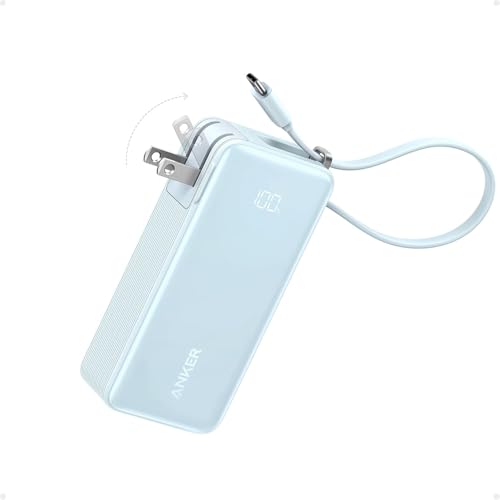
Anker Nano 3-in-1 Portable Charger 10,000mAh — The self-sufficient pocket pack
The Nano completes the category’s logic in a way the other picks admire from a distance. Its built-in USB-C cable charges the phone; its foldable wall plug charges the pack itself, straight from a socket, with no cable involved in either direction; and its 30-watt output gives the phone a genuinely brisk refill by the standards of pocket packs. Three-in-one, in this title, means pack, cable and plug in a single 10,000 milliamp-hour object — the traveller’s entire charging problem reduced to one thing that goes in a jacket pocket and asks for nothing else, ever.
Ten thousand milliamp-hours is the commuter’s capacity: enough for a full phone refill with a reserve, in manufacturer terms roughly a couple of charges for many phones, and small enough that the pack disappears into daily carry. The 30W figure matters because pocket packs historically charged at a stroll; a pack that can move a phone’s percentage visibly during a coffee stop changes how its owner uses it — opportunistically, in fragments, rather than in planned overnight sessions. The blue finish named in the title is a small thing that is not nothing: a pack that can be spotted in a bag’s dark interior is a pack that gets found.
The limits are the class’s limits, stated cleanly. This is a one-phone system; a tablet-and-laptop traveller should be reading the big Anker’s section instead. The wall plug makes the pack its own charger only where sockets match its prongs, so international travellers still owe the trip an adapter thought. And the built-in lead is short, as every lead in this guide is short. Within its brief — one phone, one person, no cables anywhere in the story — the Nano is the most complete execution of the category’s idea in this guide.
- Capacity: 10,000mAh
- Output stated: 30W
- Built-in cable: USB-C
- Self-charging: foldable wall plug integrated — the pack plugs directly into a socket
- Finish named in the title: blue
Strengths
- The only pick whose own recharge is also cable-free, thanks to the foldable plug.
- 30W output makes short top-ups genuinely worthwhile rather than symbolic.
- Pocket capacity matched to a commuter’s day instead of a expedition’s week.
Trade-offs
- One phone is its world; tablets and laptops exceed its brief and its capacity.
- The plug’s prongs suit its home sockets — foreign travel needs an adapter plan.
- No second built-in cable for a partner’s different phone.
Best for: a commuter or light traveller with one USB-C phone who wants the entire charging system to be a single pocket object. Not suited for: multi-device travellers, or households wanting one pack to serve several phone types.
Commuters can confirm on the Nano listing that its plug format matches the sockets where they actually spend their nights.

charmast Power Bank 10,000mAh (Built-In Cables) — The family connector kit
The charmast answers the household version of the forgotten-cable problem: not one phone but a family’s worth, spanning generations of connectors. Four reinforced built-in cables fan out of a 10,000 milliamp-hour body, with six outputs and three inputs stated in its title — the widest connectivity arithmetic in this guide. A parent carrying this pack is carrying an answer for the teenager’s phone, the grandparent’s older handset, the tablet and their own device, without a cable drawer being raided before the trip. The word reinforced, applied to the cables in the title itself, acknowledges the category’s known weakness and claims to have engineered against it.
Six outputs deserves a moment’s arithmetic honesty. Outputs are doors, not rivers: several devices can connect, but they share the pack’s output and its 10,000 milliamp-hour reservoir, so a family charging four phones at once is dividing a commuter-sized battery four ways. The charmast’s real talent is sequential generosity — one pack, in one bag, that can take turns with everyone’s phone across a day out — rather than simultaneous miracles. Its title also carries the phrase carry-on only, a maker-side reminder that lithium packs belong in the cabin, which this guide echoes in its flight section below.
The three inputs are the quiet convenience: the pack itself can be refilled through whichever cable the destination offers, ending the specific irony of a universal pack stranded by its own missing recharge lead. It lacks the integrated wall plug of the Nano, VEEKTOMX and POERUNI, so a socket alone is not enough — a charger or a powered port must mediate. Buyers choosing between the charmast and the plug-equipped picks are choosing between breadth of devices served and independence of the pack itself, and the right answer depends on whose phones fill their bag.
- Capacity: 10,000mAh
- Built-in cables: four, described as reinforced in the listing title
- Connectivity stated: six outputs, three inputs
- Fast-charging figure stated: 3A
- Carriage note in the title: carry-on only
Strengths
- Four cable types cover mixed-generation households from a single pack.
- Three input options make refilling the pack itself easy almost anywhere.
- Reinforced cables address the built-in category’s chief durability worry head-on.
Trade-offs
- A 10,000mAh reservoir divided among a family is a day-out ration, not a weekend supply.
- No wall plug, so the pack still needs a charger between it and the socket.
- Four cables are four things to keep seated in their slots rather than dangling.
Best for: a parent or group organiser carrying charging duty for several phones of different generations on days out. Not suited for: a solo traveller who will never unfold three of the four cables, or anyone wanting plug-in self-charging.
Family carriers can scan the charmast listing’s cable list and match each built-in lead to a phone in their household before buying.

VEEKTOMX Portable Charger (Built-In Cables + AC Plug) — The pocket all-in-one
The VEEKTOMX pursues the Nano’s all-in-one idea with a broader device net. Ten thousand milliamp-hours, a pocket-size body per its title, built-in cables in USB-C and Micro-USB flavours, and an AC wall plug for its own refills — serving, its title says, up to four devices across phones, tablets and e-readers, with the Kindle named alongside iPhone and Samsung. The Micro-USB cable is the tell of its intended world: not the flagship present, but the accumulated household — the older tablet, the e-reader, the relative’s handset — where yesterday’s connector is still tonight’s emergency.
Up to four devices should be read with the same arithmetic this guide applied to the charmast: connection breadth, shared reservoir. The VEEKTOMX’s virtue is that across a hotel evening it can take the phone, then the e-reader, then the tablet in turn, and refill itself from the wall socket between turns without a single loose cable entering the story. For the traveller whose kit is wide but shallow — many small devices, none of them ravenous — that rotation is precisely the service required, and the pocket-size framing means the whole system rides along without a packing decision.
Its ceiling shows against the flagship present. A modern phone wanting the fastest wired pace will find a pocket all-in-one’s output modest, and the title’s silence on a wattage figure — no number is stated there — means speed shoppers should treat pace as an unknown to verify on the full listing rather than a promise to bank on. This pick is bought for coverage and self-sufficiency, not for velocity, and judged on those terms it is a coherent, likeable design.
- Capacity: 10,000mAh
- Built-in cables: USB-C and Micro-USB named in the title
- Self-charging: AC wall plug integrated
- Devices: up to four, per the title — iPhone, iPad, Samsung and Kindle named
- Output figure: no wattage is stated in the listing title — verify charging pace on the full listing if speed decides your purchase
Strengths
- Wall plug plus two cable types make it the broadest self-sufficient pocket pick.
- Micro-USB coverage rescues the older devices flagship-focused packs ignore.
- Pocket-size framing suits daily carry rather than trip-only duty.
Trade-offs
- No stated wattage in the title leaves its charging pace unproven at headline level.
- A 10,000mAh reservoir shared across four devices is a rotation, not a feast.
- Owners of only modern USB-C devices carry a Micro-USB cable they will never use.
Best for: a traveller with a mixed-age kit — phone, e-reader, older tablet — who wants one pocket object that also refills itself from the wall. Not suited for: a flagship owner shopping on charging speed, or a laptop carrier of any kind.
Mixed-kit owners can read the VEEKTOMX listing for its output figures and confirm the pace suits their least patient device.

OHOVIV Power Bank 50,000mAh (Built-In Cables) — The base-camp battery
The OHOVIV is the category’s heavy artillery, and this section will treat its size as the headline it truly is. Fifty thousand milliamp-hours is five commuter packs in one body, with four built-in cables and a stated 22.5-watt fast-charge output; the manufacturer’s title claims refills counted in double figures for a recent iPhone and a percentage figure for a thirty-minute charge, both of which this guide attributes to the maker rather than repeats as findings. The honest translation is simpler: this is a reservoir for multi-day ground travel, camping and worksites, where several people’s phones drink from one source across days and the nearest wall socket is a rumour.
Now the flight question, plainly. Airlines draw their unrestricted carry-on line at 100 watt-hours per battery, with larger packs requiring approval and an upper boundary beyond that. Converting this pack’s stated capacity at the standard cell voltage puts its energy content well past the 100Wh line — in the neighbourhood of 185 watt-hours by that arithmetic — which places it outside ordinary cabin allowances altogether. Treat the OHOVIV as a ground-travel product: the car, the campsite, the cabin, the site hut. A buyer who needs this capacity in the air needs several smaller packs instead, each under the line, which is how frequent flyers have always solved it.
Weight is the second plain fact. Fifty thousand milliamp-hours of cells is heavy in the hand and heavier in the day bag, and the pack earns its place only where its reservoir is genuinely spent — the group trip, the off-grid weekend, the power-cut shelf at home where it doubles as household insurance. Bought for a commute, it is a brick of good intentions. Bought for base camp, it is the difference between a group’s phones rationing themselves by day two and a group that stops thinking about batteries entirely, which is the exact luxury its capacity exists to sell.
- Capacity: 50,000mAh
- Built-in cables: four
- Output stated: 22.5W fast-charge, per the manufacturer
- Energy note: the stated capacity converts to roughly 185Wh — beyond the 100Wh unrestricted airline carry-on line, so plan on ground travel
- Maker claims in the title: refill counts and a thirty-minute percentage figure, attributed to the manufacturer rather than verified here
Strengths
- A multi-day reservoir that can carry a whole group’s phones through an off-grid stretch.
- Four built-in cables mean the group needs no cable discipline to use it.
- Doubles as home emergency capacity when it is not travelling.
Trade-offs
- Effectively excluded from ordinary air travel by its energy content — ground trips only.
- Heavy enough that carrying it is a decision, not an afterthought.
- Its headline refill claims are the manufacturer’s, and real transfers will land below them.
Best for: camping groups, road trips, worksites and home power-cut insurance, where days pass between sockets and several phones share one source. Not suited for: air travellers, daily commuters, or anyone whose bag has a weight opinion.
Ground travellers can confirm the OHOVIV’s weight on its listing and decide honestly whether their trip spends enough capacity to justify carrying it.
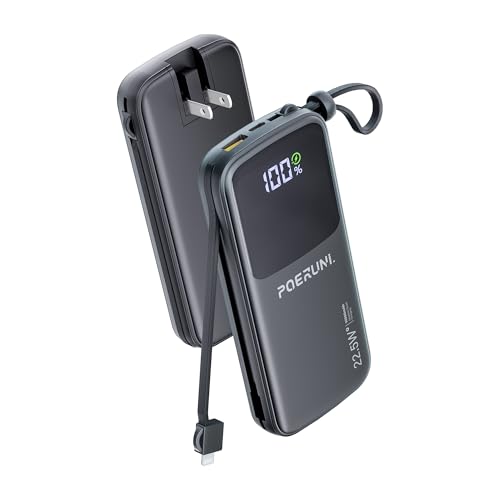
POERUNI Portable Charger 10,000mAh (Cables + Wall Plug) — The display-equipped all-rounder
The POERUNI closes the guide with the all-in-one formula plus the one feedback feature the others leave out: an LED display. Two built-in cables and an AC wall plug cover the charging and self-charging; USB-C fast charging is named for iPhone, Samsung and Android phones generally; and the display reports the pack’s remaining charge as a figure rather than a row of ambiguous dots. Anyone who has shaken a four-dot power bank and guessed has felt the small irritation that a percentage readout abolishes — knowing the reservoir’s state precisely changes a pack from a hope into a plan.
Set against its plug-equipped rivals, the POERUNI’s coordinates are clear. It carries two cables where the charmast carries four, so its household breadth is narrower but its body simpler; it integrates the wall plug the charmast lacks, so its independence is greater; and against the Nano it trades the single-cable focus for a second lead and the display. These are fine-grained differences, and that is the honest state of the 10,000 milliamp-hour class: the capacities tie, so the purchase is decided by which small features match the buyer’s actual annoyances. If yours is the guessing game at the indicator lights, this is your pick.
The standard cautions complete the picture without diminishing it. The built-in leads are short, as the category demands; the reservoir is a day-class ration for one phone with a friend’s top-up in reserve, not a group supply; and the display, while useful, is one more thing drawing a whisper of the charge it reports. None of that dents the proposition for its intended owner: the traveller who wants cables, plug and certainty in one pocketable object, and who reads a percentage the way other people read a fuel gauge.
- Capacity: 10,000mAh
- Built-in cables: two
- Self-charging: AC wall plug integrated
- Feedback: LED display stated in the title
- Stated compatibility: iPhone, Samsung and Android smartphones, with USB-C fast charging named
Strengths
- A percentage display replaces indicator-dot guesswork with a plannable number.
- Cables plus wall plug make the pack fully self-sufficient in both directions.
- Two cable types cover the common two-phone household without a four-cable fan.
Trade-offs
- Two cables serve a narrower household than the charmast’s four.
- Day-class capacity: a group or a tablet-heavy trip will drain it ahead of schedule.
- No wattage figure is headlined in the title, so pace shoppers should verify on the full listing.
Best for: a one-or-two-phone traveller who wants cables, a wall plug and an honest percentage readout in a single pocket pack. Not suited for: a family needing four connector types, or a camper needing multi-day capacity.
Travellers can check the POERUNI listing’s cable types against their two phones and confirm the display shows the percentage format they prefer.
How Do the Six Compare Side by Side?
| Pick | Capacity | Built-in cables | Wall plug? | Defining trait |
|---|---|---|---|---|
| Anker 20,000mAh | 20,000mAh | USB-C | No | 87W ceiling, three ports, laptop-capable |
| Anker Nano 3-in-1 | 10,000mAh | USB-C | Yes, foldable | Fully cable-free in both directions |
| charmast | 10,000mAh | Four, reinforced | No | Widest device coverage, 6 outputs / 3 inputs |
| VEEKTOMX | 10,000mAh | USB-C + Micro-USB | Yes | Pocket all-in-one for mixed-age kits |
| OHOVIV | 50,000mAh | Four | No | Multi-day reservoir, ground travel only |
| POERUNI | 10,000mAh | Two | Yes | LED percentage display |
How Do Airline Rules Treat Power Banks, Pick by Pick?
The universal rule comes first: lithium power banks travel in the cabin, never in checked luggage, because a battery incident in the cabin can be reached and one in the hold cannot. The charmast’s title states the same rule from the maker’s side with its carry-on-only note. Within the cabin, the governing figure is watt-hours rather than the milliamp-hours printed large on the box: airlines allow batteries up to 100 watt-hours without fuss, treat the band above it as approval territory, and draw a hard ceiling not far beyond. Converting the picks by the standard arithmetic — capacity multiplied by the nominal cell voltage — the 10,000 milliamp-hour class lands near 37 watt-hours and the big Anker near 74, both comfortably cabin-legal for any traveller.
The OHOVIV is the exception this guide flagged in its own section, and it deserves the repetition: its stated capacity converts to roughly 185 watt-hours, beyond the approval band’s ceiling as most airlines publish it, which is why its section assigns it to the road and the campsite. Travellers assembling serious aerial capacity should instead carry two compliant packs — the arithmetic of the rules rewards several medium batteries over one enormous one. When in doubt, the airline’s own dangerous-goods page outranks every figure in this guide, including this paragraph’s conversions, because carriers set their own conditions within the common framework.
A last practical note: capacity markings must be legible. Security staff judge a pack by what they can read on it, and a well-travelled unit whose printing has worn away invites questions no itinerary needs. Keeping the big Anker or the Nano in the hand luggage’s accessible pocket, markings outward, is the thirty-second habit that makes their legality effortless to demonstrate at the belt.
How Do You Keep a Built-In Cable Alive for Years?
Treat the lead as the product, because functionally it is. Unplug by gripping the connector body rather than hauling on the cable; let the lead return to its slot or groove after each use instead of leaving it dangling as a handle; and keep the pack out of the bag’s crush zone, where a bent connector takes the weight of everything else you own. These habits sound fussy until the alternative is priced: a frayed detachable cable is a trivial replacement, while a frayed built-in cable retires the pack’s main idea, leaving only its spare ports — if it has them — as a consolation.
Storage matters in the months between trips. A pack stored fully flat or brim-full for a season ages faster than one stored around the middle of its range, and a pack stored in a hot car ages fastest of all. The traveller who drops the Nano or the POERUNI into a drawer at a partial charge, in a cool room, will meet a healthier reservoir at the next trip than the one who abandons a full pack in a glovebox all summer. None of this requires instruments — the POERUNI’s percentage display even makes the partial-charge habit effortless to keep — only the decision to treat the pack as equipment rather than as a disposable.
How Do You Choose Between One Big Pack and Two Small Ones?
The traveller’s version of this dilemma deserves a direct answer, because the airline rules quietly rig it. Two 10,000 milliamp-hour packs carry the same nominal energy as one 20,000, but they distribute differently: they can charge two phones in two pockets, survive the loss or lending of one unit, and sit in two different bags so that a forgotten bag is not a total outage. One big pack counters with simplicity and, in the Anker’s case, an output ceiling the pocket packs cannot match — the laptop enters the conversation only beside the large reservoir. The choice is therefore not arithmetic but choreography: how many people, how many devices, how many separate journeys through the day.
Households face the same fork in domestic dress. A single charmast in the family bag centralises the duty and the responsibility; a Nano in each teenager’s own bag decentralises both, at the cost of more objects to keep charged. Experience suggests the decentralised system fails more gracefully — an uncharged pack strands one person, not the expedition — while the centralised system is cheaper to keep honest, because one reservoir is easier to remember than four. Neither answer is wrong, and this guide’s picks were chosen so that both systems can be built from within its six: Ankers for the distributed fleet, charmast or OHOVIV for the central reserve, according to whether the reserve must also fly.
The tiebreaker, when the arguments balance, is recharge logistics. Every pack in a fleet is a mouth to feed the night before travel, and a household that reliably charges one object may reliably fail at four. The plug-equipped picks soften this — a Nano can drink from any socket it meets, including the airport’s — but the honest planner counts the evening’s charging positions alongside the day’s devices, and buys the fleet size their sockets, not their ambitions, can sustain.
What Does a Power Bank Do to a Phone Battery Over a Year?
Owners sometimes worry that portable charging is a lesser kind of electricity that wears a phone faster. The phone cannot tell where its power was born: a pack speaking proper USB-C delivers the negotiated voltage and current the phone requested, and the phone’s own management — which lives in the handset, not the charger — governs the session’s pace and its gentle finish. The realistic wear factors in a traveller’s life are heat and habit, not the reservoir’s brand: charging in a hot car, or holding a phone at a brim-full charge for days, ages a battery more than any number of pocket-pack top-ups in a cool café.
There is even a sense in which the pocket pack is the kinder instrument. The top-up pattern it encourages — a partial refill at midday rather than a deep nightly drain — keeps a phone’s battery in the middle ranges where lithium chemistry is most comfortable, instead of cycling it from empty to full daily. Owners need not perform rituals around this; the convenience pattern and the gentle pattern happen to be the same pattern, which is a rare alignment in consumer electronics and worth enjoying without superstition in either direction.
The pack’s own battery obeys the same chemistry and the same courtesies. It will lose capacity across years of cycles, faster if stored hot and full, slower if kept cool and middling between trips, as the earlier section described. A realistic expectation — a good pack serving several years of travel before its shrinkage becomes noticeable — makes the purchase arithmetic easy, and makes the built-in cable’s survival, not the cells’, the true lifespan question for this category. Which returns the argument, fittingly, to treating the lead gently: in a cable-free pack, the cable is the component that decides how long the whole idea lasts.
How Should You Pack a Power Bank for a Travel Day?
The pack belongs where the phone’s worst hour will find it: the same bag, the same pocket ecosystem, reachable without unpacking. Travellers who bury the reservoir at the bottom of a carry-on have bought insurance they cannot claim at the gate; the pocket-class picks exist precisely to live in the jacket or the seat-back organiser, beside the phone they serve. Keep the built-in lead seated in its slot during transit — a dangling lead snags, bends and ages in fast-forward — and let the pack travel at a partial-to-full charge rather than brimmed for a week in advance, which is kinder to its cells and indistinguishable to its owner on the day.
At security, the routine is the one described earlier: cabin bag, markings legible, accessible pocket. At the destination, the plug-equipped picks repay a small habit — plug the pack into the hotel socket on arrival, before the phone needs it, so the reservoir refills during the evening’s first hour rather than competing with the phone at midnight. The travellers who never meet a flat pack are not carrying more capacity than everyone else; they are running this unglamorous sequence without thinking, the way they lock a door. Build the sequence once and the category delivers its whole promise: the charge is simply always there, in the pocket, attached to nothing you could have forgotten.
What Mistakes Do Cable-Free Power Bank Buyers Keep Making?
The founding mistake is expecting distance from a proximity product: buyers picture charging a phone across the room from a pack on the desk, and the built-in lead’s few centimetres disappoint a fantasy the category never promised. The second is capacity literalism — reading 10,000 milliamp-hours as 10,000 delivered to the phone, when conversion losses guarantee the delivered figure lands well below the printed one, which is why refill-count claims in titles are manufacturers’ poetry rather than physics. The third is flying by milliamp-hours: assuming a huge pack is a better travel pack, when the watt-hour rules make the largest unit here the one that stays home. The fourth is forgetting the pack’s own recharge — buying breadth of cables without a plug or a plan, and meeting a flat pack holding four perfect leads. Each mistake is avoidable in the listings themselves, which is why this guide keeps returning to what the titles actually state.
Final Recommendation
Before the verdict, one reassurance for the undecided: this is among the lowest-regret purchases in the charging world, because the failure mode of guessing slightly wrong is mild. A pocket pack a size too small still rescues the phone’s worst hour; a pack a size too large still fits the bag it was bought for, the OHOVIV’s flight question aside. The category punishes only the two errors this guide has flagged from its first page — expecting distance from a short lead, and expecting an airline to admire a very large battery — and a buyer who avoids those two will land somewhere between content and delighted with any of the six.
Match the pack to the day it must survive. Commuters should take the Anker Nano and enjoy the only fully cable-free system here, plug included; travellers who want the same independence with a percentage readout or a second cable should take the POERUNI. Mixed-generation households should take the charmast’s four reinforced leads, or the VEEKTOMX if a wall plug and an e-reader’s Micro-USB matter more than the extra cables. Long-haul travellers with laptops in the kit should take the big Anker and its 87-watt ceiling. Campers, road-trippers and the power-cut prepared should take the OHOVIV — and leave it in the car, where its magnificent, flightless reservoir belongs. Whichever you choose, rehearse the short cable before the trip: pack and phone together, in the hand or the pocket, because that small physical fact is the category, and the owners who embrace it stop losing charges to forgotten cables for good.
Frequently Asked Questions
How long are the built-in cables?
Short — long enough to join a pack and a phone resting together or sharing a hand or pocket, and no longer. No title in this guide states an exact length, and buyers for whom a few centimetres either way would decide the purchase should read the full listing’s dimensions. Plan on proximity: if your charging style needs distance, this category is the wrong one and a conventional pack with a long cable is the honest alternative.
How many times will a 10,000mAh pack charge my phone?
Fewer than the division suggests. Conversion losses in the pack and the phone mean the delivered energy lands meaningfully below the printed capacity, so a 10,000 milliamp-hour pack realistically delivers something in the region of one full refill for a large modern phone, with a useful reserve — despite the rounder claims manufacturers print. Treat every refill count in a title as the maker’s best-case statement, and size up a class if your day regularly empties a phone twice.
Can I fly with these power banks?
The 10,000 and 20,000 milliamp-hour picks convert to roughly 37 and 74 watt-hours respectively, comfortably inside the 100Wh cabin allowance, and all power banks must travel in hand luggage regardless. The OHOVIV’s 50,000 milliamp-hour capacity converts to roughly 185 watt-hours, beyond the ceiling airlines publish even for approved batteries — regard it as a ground-travel pack, and always let your carrier’s current rules outrank any guide’s arithmetic.
What happens if the built-in cable breaks?
The pack’s headline convenience ends, but the better designs here keep working through their ordinary ports with a detachable cable — which is one reason the port counts in this guide’s spec boxes matter. Prevention beats the fallback: unplug by the connector, store the lead in its slot, and never carry the pack by its cable. The charmast’s reinforced cables are a maker’s attempt to move that failure further away, not to abolish it.
Is a wall plug on a power bank actually useful?
It completes the idea. A pack with a foldable plug — the Nano, the VEEKTOMX, the POERUNI — refills itself from any socket with no cable hunted down, which means the traveller’s whole system survives a trip with zero loose leads. The usefulness peaks in hotels and cafés, where the pack can drink from the wall while its built-in cable feeds the phone, both jobs done by one object in one socket.
Can I charge the pack and a phone from it at the same time?
Some designs allow pass-through charging — the pack drinking from the wall while the phone drinks from the pack — and the plug-equipped picks make the arrangement physically tempting in a hotel socket. Whether a given unit supports it is a listing-level detail this guide will not guess at, and even where supported, the habit is best kept occasional: the pack works harder and warmer in that mode than in either job alone. The calmer routine is sequential — pack first on arrival, phone after — and it asks only an hour’s patience.
How do I know when a power bank is reaching the end of its life?
The signs are gradual and honest: refills that once carried a phone comfortably now leave it short, a pack that warms more than its history during ordinary work, a casing that no longer sits flat, or a built-in cable whose connection has become a negotiation of angles. The first two are retirement conversations; a swelling casing ends the conversation immediately, and the pack should be recycled through a proper battery channel rather than binned. Most owners will meet the gentle version years into ownership, by which time the pack has long since repaid its place in the bag.
Should I buy one pack per person or one pack for the group?
Both systems work, and the guide’s fleet section argues their cases in full; the short version is that distributed packs fail gracefully and central packs are easier to keep charged. A couple travelling together usually lands happily on one pocket pack each, while a family day out is well served by a single charmast in the organiser’s bag — with the understanding that the organiser’s bag, and the organiser, become infrastructure for the day.
Can these packs charge a laptop?
One of them credibly can: the big Anker’s stated 87-watt ceiling and USB-C ports put a laptop within its abilities, though the laptop will use a port and its own cable rather than the built-in lead. The 10,000 milliamp-hour class is phone territory — a laptop would drain one as an appetiser — and the OHOVIV’s stated output suits phones and tablets across a campsite, not a workstation.
Related Guides
Related guides
- Best 14-Inch High-End Laptops: Flagships From Apple, Lenovo, ASUS and LG
- Best 15 Laptops Under $1000: Six 15-Inch Machines That Spend the Budget Honestly
- Best Battery NiMH Chargers: Six Units That Understand the Chemistry
- Best 3D Printers With Auto Leveling: Beds That Set Themselves, Ranked by How Much Else They Calibrate


