What's inside
- Key Takeaways
- Quick Picks
- How Did We Choose These LiFePO4 Chargers?
- Why Does a LiFePO4 Battery Need 14.6 Volts?
- How Many Amps Does Your Bank Actually Need?
- Which of the Six Chargers Fits Your Battery?
- How Do You Charge a LiFePO4 Battery Step by Step?
- What Does the “Intelligent” Part of a Smart Charger Actually Do?
- Which Connector Should Your Charger Use?
- How Does Charging Change in an RV, on a Boat, or Off Grid?
- How Do You Size a Charger for Parallel Banks and Future Upgrades?
- How Do These Six LiFePO4 Chargers Compare Side by Side?
- What Mistakes Do LiFePO4 Owners Make When Charging?
- How Should You Store a LiFePO4 Battery Between Seasons?
- What Should You Check When a Charge Goes Wrong?
- How Does a Wall Charger Fit Alongside Solar and Alternator Charging?
- Why Do Documentation and Support Deserve a Line in Your Decision?
- Final Recommendation
- Frequently Asked Questions
- Related Guides
As an Amazon Associate I earn from qualifying purchases. This post may contain affiliate links at no extra cost to you.
**[widgetverdict.com] is reader-supported. When you buy through links on our site, we may earn an affiliate commission.**
Shore power, a solar shed, a trolling-motor battery in the garage — wherever a 12V lithium iron phosphate pack lives, it eventually needs a wall charger that speaks its language. This guide to the best lifepo4 battery intelligent battery chargers compares six dedicated units, from a gentle 1A maintainer for ride-on toy packs to a 40A workhorse for big RV and off-grid banks. Every pick below is a charger whose listing title states a 14.6V output for 12V LiFePO4 batteries, because that voltage is the whole point: a 4S lithium iron phosphate pack is full at 14.6V, and a charger built for lead-acid will leave it short or treat it badly.
You can order any of the six from Amazon, and the fastest way to narrow the field is to start with two numbers you already know: the capacity of your battery in amp-hours, and how quickly you honestly need it full again. A 1A charger on a 100Ah bank is an overnight-and-then-some proposition, while a 40A unit refills the same bank between breakfast and lunch but demands thick cables and a healthy respect for heat. The middle of this list — 10A and 20A models — is where most RV, boat and solar owners will land. If your charging questions actually concern a bike battery rather than a stationary bank, our companion guide to Best Ebike Battery Chargers covers that very different voltage world.
Key Takeaways
- All six picks output 14.6V, the correct full-charge voltage for a 12V (4S) LiFePO4 battery; none of them is a general-purpose lead-acid charger in disguise.
- Charge current runs from 1A to 40A across the list, and matching amps to your bank size matters more than any other single decision.
- Three picks — the Dumfume, the VATRER POWER and the 40A unit — state 0V activation or wake-up in their listing titles, which helps revive a pack whose protection board has shut it down.
- Anderson connectors appear on the two 20A models, a practical sign they are aimed at RV and solar wiring rather than occasional bench use.
- The little ExpertPower 1A unit with its DC 5521 plug and alligator clips belongs with small packs such as kids’ ride-on toys, not with house banks.
Quick Picks
| Pick | Badge | Why it earns its place |
|---|---|---|
| ExpertPower 12V 1A LiFePO4 Smart Charger | Best for small packs | A slow, simple 1A charger with a DC 5521 plug and alligator clips, sized for ride-on toys and other small deep-cycle packs. |
| 14.6V 2A LiFePO4 Charger (4S) | Best gentle top-up | Two amps through dual alligator clips for owners who maintain a modest 4S pack and are in no hurry at all. |
| BROODAY 14.6V 10A LiFePO4 Charger | Best mid-size everyday charger | Ten amps, an LED indicator and overheat protection make it the natural default for a single 50–100Ah battery. |
| Dumfume 12V 20A LiFePO4 Charger | Best for RV and solar banks | Twenty amps, 0V activation and an Anderson connector, aimed squarely at RV, solar and off-grid deep-cycle banks. |
| VATRER POWER 12V 20A LiFePO4 Charger | Best 20A alternative | A second 20A option with 0V activation, multiple protections and an Anderson connector for home, RV and off-grid use. |
| 12V 40A LiFePO4 Charger | Fastest refill | Forty amps with 0V wake-up and three connectors for large 12.8V banks in RV, boat, car and solar service. |
How Did We Choose These LiFePO4 Chargers?
The first filter was chemistry honesty. A charger only qualified if its own listing title named LiFePO4 or lithium iron phosphate and stated the 14.6V output that a 12V 4S pack needs. Generic “smart chargers” that bury lithium support somewhere in fine print did not make the cut, because a buyer searching for the best lifepo4 battery intelligent battery chargers deserves units whose primary job is this chemistry, not an afterthought mode on a lead-acid box. That single rule removed a surprising amount of clutter from consideration.
Next we spread the survivors across the current range on purpose. A list of six near-identical 10A chargers would help nobody, so the picks run 1A, 2A, 10A, 20A, 20A and 40A, letting you match charge speed to bank size instead of forcing one compromise on everyone. Connector style was the third sort: barrel plug and clips for small equipment, plain dual clips for simple hookups, and Anderson connectors where a semi-permanent RV or solar installation benefits from a locking, high-current connection.
Finally, we paid attention to the rescue features that titles actually state. A LiFePO4 pack that has been drained until its battery management system disconnects can read near zero volts at the terminals, and some ordinary chargers refuse to start into that. The Dumfume, VATRER POWER and 40A picks all advertise 0V activation or wake-up in their titles, so they were placed where readers with occasionally neglected banks will find them. Where a title says nothing about a feature, this guide says so too, rather than assuming it is present.
Why Does a LiFePO4 Battery Need 14.6 Volts?
A “12V” lithium iron phosphate battery is really four cells in series — the 4S layout named in one pick’s title — and each cell reaches full charge at about 3.65V. Multiply by four and you get 14.6V, the number printed on every charger in this guide. That is higher than the float voltages used for lead-acid, and the charging curve is different too: LiFePO4 packs take a steady current for most of the charge, then fill the last portion quickly once voltage climbs, with very little of the long absorption tail that lead-acid batteries need.
This is also why borrowing a charger across chemistries goes wrong in both directions. A lead-acid charger with an equalisation pulse can push a lithium pack into territory its protection board dislikes, while a charger that stops at a lead-acid-friendly voltage leaves a LiFePO4 bank noticeably short of full. The packs tolerate a great deal — it is one reason the chemistry is loved in RV and marine service — but “tolerant” is not the same as “indifferent”, and a dedicated 14.6V charger removes the guesswork entirely.
Just as important is what LiFePO4 is not. It is not the lithium-ion chemistry used in ebike packs and power-tool batteries, which charge to 4.2V per cell and follow different rules. Keeping those worlds separate is a theme across this category; readers cross-shopping phone and bike charging will find our guides to Best Multi-Device Wireless Chargers for iPhone and Best Chargers for Google Pixel Phones useful precisely because each chemistry and device family gets its own dedicated hardware.
How Many Amps Does Your Bank Actually Need?
Divide your battery’s amp-hour capacity by the charger’s amps and you get a rough floor for charge time in hours, before the slower finishing stage adds a little more. A 100Ah battery on the 10A BROODAY is therefore a ten-hour-plus commitment, the same battery on a 20A Dumfume or VATRER is roughly five hours, and the 40A unit cuts that to around two and a half. Small packs flip the logic: a 7Ah ride-on toy battery on a 40A charger would be absurd and potentially rough on the pack, which is exactly the niche the 1A ExpertPower exists for.
Manufacturers of LiFePO4 batteries commonly suggest charging at a fraction of capacity — often somewhere around 0.2C to 0.5C, meaning 20 to 50 amps for a 100Ah battery — but the battery’s own documentation is the authority for your specific pack, not a general guide. If your bank is two 100Ah batteries in parallel, treat it as 200Ah for charge-time maths. If it is a single small 20Ah fish-finder or gate battery, the 2A and 10A picks are the sensible neighbourhood and the big units are simply oversized tools.
Heat is the quiet constraint at the top end. Forty amps through clips and cables generates warmth at every imperfect connection, which is one reason the higher-current picks lean on Anderson connectors and why the BROODAY’s stated overheat protection is worth having at 10A. Whatever size you choose, charge on a non-flammable surface, keep the charger’s vents clear, and check in during the first full cycle with a new unit to learn how warm it normally runs.
Which of the Six Chargers Fits Your Battery?
The detailed reviews below follow the same order as the quick picks table, smallest current first. Read the connector line of each spec box as carefully as the amp rating: more charging projects stall on a plug that does not match than on a charger that is a few amps too small.

ExpertPower 12V 1A LiFePO4 Smart Charger — Best for small packs
ExpertPower aims this little unit at a job the big chargers on this list would do badly: keeping small LiFePO4 packs, including the batteries in kids’ ride-on cars, topped up gently. Its listing title names the DC 5521 male connector alongside alligator clips, and that pairing tells the story — plug straight into equipment that accepts a barrel connector, or clip onto bare terminals when the pack is out of the vehicle. One amp is slow by design. On a small deep-cycle pack of the size used in ride-on toys, an overnight session at 1A restores a full charge without stressing small cells or thin factory wiring.
Owners of toy vehicles will recognise the frustration this solves. Ride-on cars often ship with a basic wall adapter of unclear chemistry, and once the original is lost, a dedicated LiFePO4 charger with the common 5521 barrel size is the tidy replacement. The clips extend its usefulness to small standalone packs for fish finders, trail cameras or a gate opener, provided the battery is genuinely lithium iron phosphate. What it is not is a house-bank charger: at 1A, a 100Ah RV battery would need days, not hours, and no amount of patience makes that a sensible pairing.
- Output: 14.6V at 1A, for 12V LiFePO4 deep-cycle batteries
- Connectors: DC 5521 male plug and alligator clips, both named in the listing title
- Stated role: kids’ ride-on toy cars and small rechargeable packs
- Wake-up behaviour for a fully shut-down pack: the title is silent on 0V activation, so check the ExpertPower documentation before counting on it
Strengths
- Gentle 1A rate suits small cells and thin toy-vehicle wiring
- Two connection styles cover both barrel sockets and bare terminals
- Purpose-built for LiFePO4 rather than adapted from a lead-acid design
Trade-offs
- Far too slow for RV, solar or marine banks of any real size
- No 0V activation is claimed in the title for deeply discharged packs
- Barrel-plug fit depends on your equipment using the 5521 size
Best for: a ride-on toy, fish finder or similar small 12V LiFePO4 pack that charges overnight at home. Not suited for: a 100Ah house bank, where 1A stretches a recharge across several days. If this little ExpertPower sounds like your charger, order it with the 5521 plug in mind and confirm your socket size first.
14.6V 2A LiFePO4 Charger (4S) — Best gentle top-up
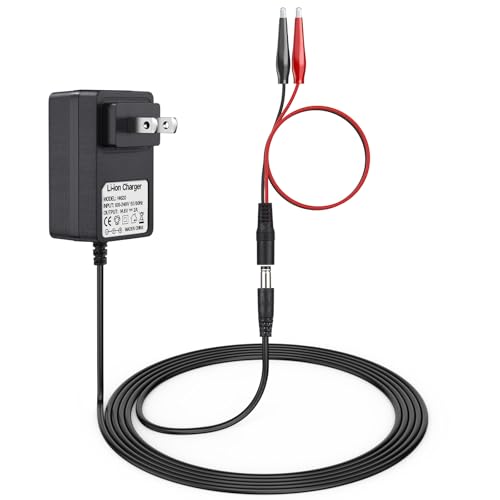
This unbranded 2A unit is the list’s quiet maintainer: a 14.6V charger built for a 4S 12V lithium iron phosphate pack, delivered through dual alligator clips. Two amps doubles the ExpertPower’s pace while staying firmly in gentle territory, which suits a single modest battery — a 20Ah to 50Ah pack for a kayak fish finder, a small solar lighting setup, a backup sump or an amateur radio go-box — that gets used on weekends and recharged without urgency through the week.
The dual-clip arrangement keeps things universal. There is no barrel size to match and no Anderson housing to wire; you clip red to positive, black to negative, and the charger does the rest. That simplicity is also its ceiling. Clips are a temporary connection, fine on a bench or in a battery box you open occasionally, but nobody should build a permanent RV installation around crocodile clips, and 2A will not rescue a depleted 100Ah bank before a trip. Treat this pick as the honest, inexpensive maintainer for one small-to-midsize pack, and it does that job without pretending to be more.
- Output: 14.6V at 2A, specified for 4S 12V lithium iron phosphate packs
- Connector: dual alligator clips, per the listing title
- Brand: unbranded listing; documentation depth is thinner than the named brands here
- Extra modes or wake-up claims: none are stated in the title, so treat it as a straightforward charger
Strengths
- Clips fit any exposed 12V terminals without extra wiring
- 2A pace is kind to smaller packs that dislike fast charging
- Explicit 4S wording confirms it targets 12V LiFePO4 specifically
Trade-offs
- Unbranded support and manuals are usually minimal
- Clips are a temporary connection, not an installation method
- Still slow on anything beyond a midsize single battery
Best for: one 20–50Ah LiFePO4 battery that can recharge slowly between outings. Not suited for: a permanent hard-wired RV installation, because clip connections are meant to be temporary. Readers who like the no-fuss clip-on approach can pick up this 2A charger as a dedicated maintainer for that one pack.

BROODAY 14.6V 10A LiFePO4 Charger — Best mid-size everyday charger
Ten amps is the Goldilocks rate for the most common LiFePO4 battery on the market, the single 100Ah drop-in, and the BROODAY is built exactly around that pairing. Its title promises fast charging and high efficiency, an LED indicator so you can read charge status at a glance, a durable housing, and overheat protection — a sensible feature set for a charger that will spend long afternoons in garages, RV bays and boat lockers where airflow is an afterthought. Expect roughly an overnight or a long day to refill a flat 100Ah battery, and a few hours to replace a typical weekend’s partial discharge.
The BROODAY’s appeal is that it asks little of the owner. There is no bank wiring to plan and no connector ecosystem to adopt; it is the charger you buy when the battery is a single unit and the routine is “plug in after the trip, unplug before the next one”. The LED matters more than it sounds, because LiFePO4’s flat discharge curve makes state-of-charge guesswork from voltage alone unreliable while charging. Overheat protection earns its keep in summer, when a closed RV compartment can already be hot before the charger adds its own warmth to the air.
- Output: 14.6V at 10A for 12V lithium iron phosphate batteries
- Feedback: LED charge indicator named in the title
- Protection: overheat protection stated in the title
- 0V activation: not claimed in the title; a pack shut down by its own protection board may need another method first
Strengths
- 10A rate matches a single 100Ah battery almost perfectly
- Overheat protection suits enclosed RV and boat compartments
- LED indicator removes guesswork during long charges
Trade-offs
- No stated 0V wake-up for a pack that has shut itself down
- One battery at a time; multi-bank boats need a different tool
- Slower than the 20A pair when a big bank is flat
Best for: a single 50–100Ah LiFePO4 battery in a camper, boat or cabin that recharges between trips. Not suited for: reviving a pack reading near zero volts, since no 0V activation is claimed in its title. For the classic one-battery setup, the BROODAY is the order most readers should place first.

Dumfume 12V 20A LiFePO4 Charger — Best for RV and solar banks
The Dumfume steps into serious bank territory: 20A delivered through an Anderson connector, with 0V activation for packs that have shut down, smart fast charging and an LED indicator, and a title that names RV, solar and off-grid deep-cycle batteries as its home ground. Twenty amps halves the BROODAY’s charge times — a flat 100Ah battery in roughly five hours, a 200Ah two-battery bank in about ten — and the Anderson connector is the right choice at this current, giving a firm, polarity-keyed connection instead of clips that can be knocked loose in a moving RV.
That 0V activation deserves emphasis because it solves the most confusing failure in LiFePO4 ownership. Drain a pack far enough and its management system disconnects the terminals; the battery then looks dead to an ordinary charger, which sees almost no voltage and refuses to begin. A charger that can apply a gentle wake-up first, as the Dumfume’s title claims, turns a “dead battery” panic into a normal recharge. Off-grid users, whose banks occasionally get drawn down by a cloudy week, are exactly the people who meet this scenario.
- Output: 14.6V at 20A for 12V LiFePO4 deep-cycle batteries
- Connector: Anderson, named in the title, suited to semi-permanent wiring
- Rescue feature: 0V activation stated in the title
- Feedback: LED indicator; stated environments are RV, solar and off-grid
Strengths
- 0V activation can recover a pack its own protection board shut down
- Anderson connector stays put in vehicles and battery bays
- 20A pace handles 200Ah banks in an overnight session
Trade-offs
- Anderson wiring may need an adapter for a bare-terminal battery
- Oversized and unnecessarily forceful for small single packs
- Fan-class chargers at this size are not silent roommates
Best for: RV, solar and off-grid banks of 100–200Ah that occasionally get run flat. Not suited for: a small 20Ah accessory pack, where 20A is far beyond a gentle rate. If your bank has ever shown you a near-zero reading, put the Dumfume at the top of your order list.

VATRER POWER 12V 20A LiFePO4 Charger — Best 20A alternative
VATRER POWER’s 20A charger matches the Dumfume feature for feature on paper — 14.6V output, 0V activation, an Anderson connector and an LED indicator — and adds an explicit “multiple protection” claim in its title, with home, RV and off-grid use named as its territory. Having two credible 20A options matters because this is the size class most serious buyers land in, and small preferences decide between them: the wording of the protection suite, the feel of the housing, or which listing’s documentation answers your questions more clearly.
In daily use the VATRER is aimed at the same rhythm as its rival: a house bank that works for a living. Think of a cabin that runs lights and a fridge from 200Ah of LiFePO4, or an RV that boondocks for two nights then takes shore power for one. Twenty amps restores a meaningful chunk of that usage overnight, and the 0V activation is the insurance policy for the morning the bank was accidentally left powering a load until its protection board intervened. The Anderson connector again signals intent — this charger expects to be part of an installation, not an occasional visitor on clips.
- Output: 14.6V at 20A for 12V LiFePO4 batteries
- Connector: Anderson, per the listing title
- Rescue feature: 0V activation stated in the title
- Protection: described in the title as multiple protection, with an LED indicator for status
Strengths
- Full 20A pace with the wake-up feature deep-discharged banks need
- Multiple-protection wording covers the usual fault list
- Anderson connection suits a fixed place in the battery bay
Trade-offs
- Very close in concept to the Dumfume; choice comes down to details
- Too much charger for a single small accessory battery
- Needs an Anderson-compatible lead on the battery side
Best for: a home, RV or off-grid bank around 200Ah that should recharge overnight on shore power. Not suited for: occasional clip-on top-ups of a small pack kept on a shelf. Buyers who prefer the VATRER POWER’s protection wording can order it as their 20A anchor charger.

12V 40A LiFePO4 Charger — Fastest refill
Forty amps is where LiFePO4 charging stops being an overnight background task and becomes a turnaround tool. This unbranded 40A unit pairs its 14.6V output with 0V wake-up and three connectors, and its title names the full spread of big-battery life: RV, boat, car, marine and solar, on 12.8V lithium deep-cycle batteries. On a 200Ah bank it can return roughly half the capacity in a little over two hours of bulk charging; on the 280Ah and 300Ah singles now common in RV retrofits, it is the difference between a generator run that annoys the whole campground and one that finishes before lunch.
With that pace comes responsibility. Forty amps needs sound cabling, clean terminals and ventilation, and it should be matched to a battery whose documentation welcomes a charge rate in that range — most large LiFePO4 batteries do, but the manual, not enthusiasm, decides. The three included connectors soften the installation question, letting the charger move between a boat bank and an RV bank without rewiring either. The 0V wake-up rounds out a specification clearly written for people whose batteries work hard and occasionally get pushed past empty.
- Output: 14.6V at 40A for 12.8V LiFePO4 deep-cycle batteries
- Connectors: three included, per the title, for RV, boat, car and solar setups
- Rescue feature: 0V wake-up stated in the title
- Brand: unbranded listing, so read its documentation carefully on arrival
Strengths
- Fastest bulk charging here by a wide margin
- Three connectors make one charger serve several vehicles
- 0V wake-up included despite the high-output design
Trade-offs
- Demands heavy, clean cabling to run safely at full current
- Overkill — and potentially too forceful — for small batteries
- Unbranded documentation may be brief
Best for: large 200Ah-plus banks in RV, marine or solar service where recharge time is limited by a generator or a short shore-power stop. Not suited for: batteries under about 50Ah, whose makers rarely sanction a 40A charge rate. When turnaround time is the whole problem, this 40A charger is the one to order.
How Do You Charge a LiFePO4 Battery Step by Step?
Start with the battery at rest. Disconnect loads where practical, or at least switch off anything drawing serious current, because a charger fighting a running inverter or fridge will take far longer and may misread the pack’s state. Check the terminals: corrosion or a loose lug that barely matters at 2A becomes a hot spot at 20A or 40A. Connect the charger to the battery before plugging the charger into the wall — clips or Anderson first, mains second — so any small spark happens at the wall socket rather than at the battery terminals.
Confirm the charger’s indicator shows charging has begun, then leave it alone. LiFePO4 charging looks uneventful for most of the session: current flows steadily while voltage rises slowly, then voltage climbs to 14.6V and current tapers as the pack fills. Resist the urge to judge progress by terminal voltage in the first hour; the chemistry’s flat curve makes a half-full battery read almost the same as a nearly full one. The charger’s own LED, on the picks that have one, is the progress report to trust.
When the charger signals completion, unplug from the wall first and then disconnect the battery leads. If the pack will sit unused, know that LiFePO4 stores happiest at a partial charge rather than brim-full — for a battery going into a winter garage, many makers suggest storing it somewhere around half charge and checking it every few months. A small maintainer-class pick like the 1A or 2A unit is handy for that periodic refresh, even in a household whose main charger is a 20A or 40A model.
What Does the “Intelligent” Part of a Smart Charger Actually Do?
The word “intelligent” on these listings is doing real work, even if it is marketing’s favourite adjective. A dumb charger pushes a fixed voltage and current until you unplug it. A smart charger runs a programme: it checks what it is connected to, delivers full current during the bulk stage, watches voltage climb toward 14.6V, tapers the current as the pack approaches full, and then stops or drops to a benign holding state instead of cooking the battery indefinitely. On the picks here that advertise it, the same electronics handle fault detection — reversed polarity, a short, overheating — and the 0V wake-up routine for a pack whose protection board has disconnected the terminals.
This programme matters more for lithium iron phosphate than for the lead-acid batteries many owners are upgrading from. A lead-acid battery forgives hours of extra float charging; a LiFePO4 pack gains nothing from being held at full voltage and ages faster for it. The intelligent part is therefore less about cleverness and more about knowing when to stop. It is also why the charger’s indicator behaviour is worth learning on the first charge: a unit that shows bulk, finishing and complete stages teaches you your bank’s normal rhythm, so the day something behaves differently — a charge that ends suspiciously fast, a stage that never completes — you notice early, while the cause is still a loose terminal rather than a dying cell.
One honest caveat: “smart” describes the charge programme, not clairvoyance. None of these chargers can tell you the true remaining capacity of a battery, diagnose a weak cell inside a sealed pack, or repair damage from a past deep freeze. Those jobs belong to a battery monitor with a shunt, or to the pack maker’s own diagnostics. Buy the intelligence for the charging curve and the protections, and let it do that one job well.
Which Connector Should Your Charger Use?
Connector choice looks like a detail and behaves like a decision, because it determines how the charger fits into your routine. Alligator clips, found on the ExpertPower, the 2A charger and in bench-style use generally, are the universal donor: they fit any battery with exposed posts, they move between batteries in seconds, and they are the right answer for a charger that visits several packs. Their weakness is commitment — a clip can be knocked off by a dog, a hose or a careless elbow, and a clip connection that is half-seated concentrates heat at the contact point during a long high-current session.
The DC 5521 barrel on the ExpertPower belongs to a different world: equipment with a charging socket. Ride-on toys, small power stations and some lighting kits accept a barrel plug, and when the size matches, charging becomes a one-handed, no-tools act a child can be taught. The catch is in the numbers — 5521 describes a 5.5mm outer barrel with a 2.1mm centre pin, and lookalike sizes exist. Measure, or test-fit gently; forcing a near-miss barrel is how sockets get damaged.
Anderson connectors, fitted to both 20A picks, are the installation answer. The housings are polarity-keyed so they cannot be connected backwards, they lock together with a firm push, and they are rated for the sustained current that RV and solar banks demand. The price of admission is that your battery side needs a matching Anderson lead, which may mean crimping or buying a short adapter harness once. Owners who charge in the same bay every week find that one-time effort repaid on every single connection afterwards — and the three-connector bundle on the 40A charger exists for households that split the difference, keeping clips for the boat and an Anderson lead for the RV.
How Does Charging Change in an RV, on a Boat, or Off Grid?
In an RV, the charger competes with everything else on the shore-power pedestal and works in a compartment that bakes in the sun. That is the environment the 20A pair is built for: enough current to restore a bank during a one-night stop, a connector that will not vibrate loose on the next driving day, and a wake-up feature for the morning after the furnace and lights ran longer than the battery could. Owners who mostly boondock and recharge from a generator should weight the 40A pick more heavily than its size suggests, because every amp of charge current is minutes subtracted from generator run time, fuel and noise.
On a boat, moisture and neglect are the twin enemies. A charger that lives aboard should be treated as an appliance: mounted, ventilated, with cables secured against chafe. The picks here are portable bench-style units rather than sealed onboard chargers, so the honest pattern for most owners is charging at the dock or at home, with terminals inspected for the green creep of corrosion each time. A battery that sits all winter in an unheated hull also meets the cold rule: bring it somewhere warmer before charging if its maker warns against charging near or below freezing.
Off grid, the wall charger is often the backup for a solar array rather than the main act, and its job is rescuing the bank during a grey week. That rescue role is exactly where 0V activation stops being a spec-sheet curiosity: solar controllers may refuse a bank that has disconnected itself, and the wall charger with wake-up becomes the only path back. Cabin owners learn to keep that charger, a known-good cable and the battery manual in the same drawer, because the day they are needed is never a day with spare time for detective work.
How Do You Size a Charger for Parallel Banks and Future Upgrades?
Banks grow. The single 100Ah battery of this season becomes two in parallel next season, and a charger sized perfectly for the first becomes half as fast on the pair. When you buy, size for the bank you plausibly own in two years, within reason: a 20A charger on today’s 100Ah battery is merely brisk, not harmful, provided the battery’s documentation allows that rate, and it saves a second purchase when the second battery arrives. The exception is the small-pack end of life — ride-on toys and accessory batteries never grow into banks, and the little chargers remain the right tools there forever.
Series wiring is the harder boundary. Two 12V batteries in series make a 24V bank, and nothing in this guide charges it as a unit; owners either charge each 12V battery separately with a charger from this list or buy a dedicated 24V LiFePO4 charger. Never improvise by clipping a 14.6V charger across half a series string while it is working — separate the batteries properly first. Parallel banks, by contrast, charge happily as one larger 12V battery, with the charger connected across the pair’s main positive and negative take-off points so current shares evenly between them.
Cable length is the last sizing variable nobody mentions. A charger placed far from the bank pushes its current through longer leads, and voltage drop along those leads can make the charger think the battery is fuller than it is, ending the bulk stage early. Keep leads short, thick and clean-connected, especially at 20A and 40A, and treat any extension you add as part of the charging system rather than an innocent accessory.
How Do These Six LiFePO4 Chargers Compare Side by Side?
| Charger | Output | Connector | 0V wake-up in title | Natural home |
|---|---|---|---|---|
| ExpertPower 12V 1A | 14.6V, 1A | DC 5521 plug + clips | Not stated | Ride-on toys, small packs |
| 14.6V 2A Charger (4S) | 14.6V, 2A | Dual alligator clips | Not stated | One small-to-midsize pack |
| BROODAY 14.6V 10A | 14.6V, 10A | Clips (bench style) | Not stated | Single 50–100Ah battery |
| Dumfume 12V 20A | 14.6V, 20A | Anderson | Yes — 0V activation | RV, solar, off-grid banks |
| VATRER POWER 12V 20A | 14.6V, 20A | Anderson | Yes — 0V activation | Home, RV, off-grid banks |
| 12V 40A Charger | 14.6V, 40A | Three connectors included | Yes — 0V wake-up | Large RV, boat, solar banks |
Read the table as a ladder rather than a league table. Each step up in current roughly halves charging time for a given bank and adds installation seriousness; each step down buys gentleness and simplicity. The wake-up column splits the list cleanly in two, and for owners whose banks ever run to shutdown, that column may matter more than the amp column.
What Mistakes Do LiFePO4 Owners Make When Charging?
The most damaging habit is using whatever charger is already in the garage. A lead-acid charger with a desulfation or equalisation stage subjects a lithium pack to voltage behaviour it was never designed around, and even a gentle lead-acid maintainer finishes at the wrong voltage. The second mistake is the mirror image: assuming a LiFePO4 charger is a universal lithium charger. These six units are for 12V iron-phosphate packs only — they are not for lithium-ion ebike batteries, power-tool packs or a 24V bank built from two batteries in series.
Undersizing is the third classic. Buying the 1A or 2A pick for a 100Ah battery because it costs less leads to a charger that runs for days, gets unplugged mid-charge out of impatience, and leaves the bank chronically part-full. Oversizing has its own version: a 40A charger clipped onto a small battery with thin leads, where the weak points are the connections rather than the charger. Finally, owners often charge a freezing-cold battery without a thought. Many LiFePO4 makers warn against charging below freezing unless the pack has internal heating or a low-temperature cutoff, so a battery that spent the night in an unheated boat deserves a warm-up period indoors first — check your battery’s documentation for its stated limits.
How Should You Store a LiFePO4 Battery Between Seasons?
Lithium iron phosphate’s low self-discharge makes seasonal storage mercifully simple, but the details differ from lead-acid habit in one important way: do not store the battery brim-full on a maintainer all winter. Most makers suggest parking the pack at a partial state of charge — commonly somewhere in the middle of its range — in a cool, dry place, then checking it every few months and topping up if it has drifted low. The small picks in this guide earn a second job here: a 1A or 2A charger is the perfect tool for that gentle seasonal refresh, even in a household whose main bank runs on a 40A unit.
Before storage, charge or discharge the pack to that middle state, clean the terminals, and disconnect everything — a forgotten parasitic load is the usual reason a stored battery is found shut down in spring. If the storage space freezes, that alone is not the problem it would be for charging; the chemistry tolerates cold storage far better than cold charging, though the battery maker’s documentation remains the final word for your model. Label the battery with the date and its state of charge when you shelve it. Future you, standing in the garage in April, will be grateful for information that present you considered too obvious to write down.
When the pack comes back into service, give it one full, supervised charge on its regular charger before loading it with work. Watch the first cycle the way you did when the battery was new: normal warmth, normal indicator behaviour, normal time to full. A battery that wakes from storage and charges exactly as it always has is a battery you can plan a season around.
What Should You Check When a Charge Goes Wrong?
Most charging failures are connection failures wearing a disguise. If a charger will not start, work outward from the battery: are the clips on the correct terminals and biting clean metal rather than paint or corrosion? Is an Anderson connector fully seated — they can feel pushed home a few millimetres before they actually are? Is the wall outlet live, tested with a lamp rather than assumed? Only after those checks does the battery itself become the suspect, and the first question about the battery is whether its protection board has disconnected it, which a multimeter reading near zero volts at the terminals strongly suggests.
A charge that ends far too quickly usually means the charger is seeing high voltage early: a corroded terminal, a loose lug or a thin, long cable run can all fake fullness. Clean, tighten, shorten. A charge that never ends points the other way — a load still connected and drawing current, or a battery that genuinely cannot reach the finishing voltage, which deserves the maker’s attention rather than another overnight attempt. Warmth is information too: a charger that runs hot in open air, or one connector that is noticeably hotter than the other, is telling you where the resistance lives. Fix the connection, not the symptom.
Keep notes the first few times you charge a new bank: date, starting state, charger used, hours to full. Those four lines per session become the baseline that makes every later anomaly obvious at a glance, and they cost less than a minute each. Battery systems reward owners who notice change early, and noticing is mostly a matter of having written down what normal looks like.
How Does a Wall Charger Fit Alongside Solar and Alternator Charging?
Many LiFePO4 banks live on three charging sources at once: solar through a charge controller, the engine alternator through a DC-DC charger in a vehicle, and a wall charger like the six here when mains power is available. These sources coexist happily as long as each is set for lithium iron phosphate and each connects to the bank properly; the battery simply accepts current from whichever sources are active, and the total inflow is the sum. The wall charger’s moment is the controlled one — a full, complete charge on shore power resets your sense of the bank’s health in a way partial solar days never quite do, which is why many owners schedule a deliberate wall-charge before a long trip even when the panels have kept up.
Two habits keep a multi-source system honest. First, after adding any new charger, watch one complete cycle to confirm the sources are not confusing each other — a solar controller that sees the wall charger’s voltage may pause its own output, which is normal, but it should resume sensibly afterwards. Second, remember that state-of-charge meters drift; a full wall charge, where the charger itself declares completion at 14.6V with current tapered away, is the reference point that lets you recalibrate both the meter and your expectations. Owners who treat the wall charger as the bank’s home base, and solar and alternator as away fixtures, rarely get surprised by a bank that reads fuller than it is.
None of this requires the biggest charger on the list. It requires the charger whose current matches your bank and whose connector matches your installation, used deliberately a few times a season. The rest of the year it can sit in its bay, ready for the grey week, the winter refresh or the pre-trip top-up — the three moments when a dedicated LiFePO4 wall charger quietly justifies every penny of its modest existence.
Why Do Documentation and Support Deserve a Line in Your Decision?
Chargers are simple devices until the day one behaves oddly, and then the manual becomes the product. The named brands on this list — ExpertPower, BROODAY, Dumfume, VATRER POWER — publish documentation you can actually consult, while the two unbranded picks ask you to rely on the listing and your own multimeter. That difference is worth weighing alongside amps and connectors, especially for a charger that will live in a vehicle or a cabin hours from home. Before the first charge, download or photograph the manual, note the indicator meanings somewhere you will find them in the dark, and register the purchase details in the same note file as your battery records. When a charger eventually needs replacing, buy the same class again unless your bank has changed; consistency keeps your hard-won sense of “normal” valid across years of weekends.
Final Recommendation
For the single-battery majority, the BROODAY 10A is the centre of gravity: right-sized for a 100Ah pack, protected against overheating, and simple to live with. Owners of 100–200Ah RV, solar or off-grid banks should step up to the Dumfume or VATRER POWER 20A models, where the Anderson connector and 0V activation earn their place the first time a bank runs itself flat, while genuinely large banks on a schedule belong with the 40A unit. Keep the small end of the list in mind for the packs it was designed for — the ExpertPower for ride-on toys and small equipment, the 2A clip-on charger as a patient maintainer — and every battery in the house gets charged at the pace it actually wants. A 14.6V charger matched to the bank in front of it is one of those purchases that quietly removes a whole category of weekend problems.
Frequently Asked Questions
Can I charge a LiFePO4 battery with a regular lead-acid charger?
It is a poor idea even when it appears to work. Lead-acid chargers may include equalisation pulses and finish at voltages chosen for a different chemistry, so the pack can end up undercharged or stressed. A dedicated 14.6V LiFePO4 charger, like all six picks here, follows the curve this chemistry expects.
What does 0V activation actually do?
When a LiFePO4 battery is drained far enough, its internal protection board disconnects the terminals, and a normal charger sees almost no voltage and will not start. A charger with 0V activation — the Dumfume, VATRER POWER and 40A picks state it in their titles — can coax the board awake with a gentle initial output so a normal charge can follow.
How long will a 100Ah battery take on these chargers?
Roughly, divide capacity by amps and add a little for the finishing stage: about ten hours on the 10A BROODAY, five on either 20A model, and around two and a half on the 40A unit. The 1A and 2A picks are measured in days at that capacity, which is why they are aimed at small packs.
Can one of these chargers handle a 24V LiFePO4 bank?
No. Every pick here outputs 14.6V for a 12V 4S battery. A 24V bank is an 8S system needing roughly double that voltage from a charger designed for it, and connecting a 12V charger will simply fail to charge it properly.
Is it safe to leave a LiFePO4 charger connected for days?
A smart charger that terminates or maintains correctly is designed for long connections, and the maintainer-class 1A and 2A picks are often used that way. Even so, charge in a ventilated spot on a non-flammable surface, and follow both the charger and battery makers’ guidance for unattended use.
Why does my battery read almost the same voltage half-full and nearly full?
That is the famous flat discharge curve of lithium iron phosphate: voltage stays in a narrow band through most of the capacity and moves decisively only near empty and near full. It is a virtue in use and a nuisance for gauging, which is why charger indicators and proper battery monitors exist.
Should I charge two batteries in parallel with one charger?
Yes — a parallel pair behaves as a single 12V battery with the combined capacity, and any charger here can serve it, with charge time scaled to the total amp-hours. Connect the charger across the bank’s main take-off points, positive to one battery and negative to the other, so both batteries share current evenly rather than one doing most of the work.
Does a bigger charger wear out a LiFePO4 battery faster?
Within the charge rates the battery maker allows, no meaningful harm comes from charging at 20A instead of 10A; the chemistry is built for it. Damage comes from charging outside the maker’s stated limits — too much current for a small pack, charging in deep cold, or holding the battery at full voltage for weeks — which is why matching the charger to the manual matters more than choosing the smallest unit out of caution.
What happens if the power cuts out halfway through a charge?
Note what the charger was doing when you found it dark, because the restart check takes two minutes and tells you a great deal. When mains power returns, a smart unit should wake on its own, re-read the battery at the terminals, and resume from a stage that suits the voltage it finds rather than blindly restarting its full programme from the beginning. Watch the indicator through the first few minutes after power comes back: a steady return to charging is the healthy pattern, while a charger that sits idle, cycles on and off, or reports an error on a battery it handled happily yesterday deserves investigation before you leave it unattended again. Check the clips or Anderson connector as well, since an outage is often discovered hours later and a lead disturbed in the meantime can masquerade as an electronics fault. If the battery spent the outage partly charged, nothing is harmed; this chemistry tolerates interrupted sessions and partial fills without the memory effects older chemistries taught owners to fear. Keep the charger’s own manual beside the battery manual until that restart behaviour is familiar.
Related Guides
Charging questions rarely stop at one battery. Riders should read Best Ebike Battery Chargers before borrowing any charger across chemistries, desk and travel setups are covered in Best Multi-Device Wireless Chargers for iPhone, and Android owners will find the right fast-charge bricks in Best Chargers for Google Pixel Phones.


