What's inside
- Key Takeaways
- Quick Picks
- How Did We Narrow Down Student Pilot Headsets?
- Why Does Passive Noise Reduction Suit Training Aircraft?
- Which Details Decide Whether a Student Headset Fits Your School?
- Flight Training Headsets Compared on Plugs, Seals and Microphones
- How Should a Student Test a Headset Before the First Lesson?
- What Mistakes Do Student Pilots Make When Buying a Headset?
- How Do Seals, Booms and Cables Survive a Training Syllabus?
- When Does the ANR Upgrade Actually Make Sense?
- How Does a Headset Change Your Radio Work as a Student?
- What Should Flight Schools Look for When Buying Headsets in Multiples?
- How Do Glasses, Sunglasses and Caps Change the Seal Equation?
- What Does a Cross-Country Lesson Reveal That Circuits Hide?
- How Should Students Budget Across a Whole Syllabus?
- What Happens on the Day Your Headset Meets a Different Aircraft?
- How Do Winter and Summer Change Headset Comfort?
- Why Do Instructors Care Which Headset a Student Buys?
- How Should a Student Practise Listening Before Solo?
- What Should You Inspect on a Used or Borrowed Set?
- How Does Headset Choice Affect Passenger Briefings Later?
- What Role Does the Headset Play on Checkride Day?
- How Do You Keep Volume Discipline in a Loud Cockpit?
- What Separates a Training Headset From a Touring Headset?
- How Should a Student Choose Between the Six in Ten Minutes?
- What Does a Sensible First-Month Routine Look Like?
- Why Does Owning Beat Borrowing Across a Whole Course?
- A Note on Listening Effort and Long Lessons
- How Do You Brief a Passenger on Your Old Student Headset?
- Final Recommendation
- Frequently Asked Questions
- Related Guides
As an Amazon Associate I earn from qualifying purchases. This post may contain affiliate links at no extra cost to you.
widgetverdict.com is reader-supported. When you buy through links on our site, we may earn an affiliate commission.
Where to buy: student headsets live a hard life between school fleets and personal kits, so the listings gathered here focus on general-aviation models sold complete with bags and standard dual plugs rather than on exotic variants a trainee cannot use.
The best headsets for flight training are the ones a student can afford to own early, plug into almost any school aeroplane, and wear for a two-hour lesson without a headache doing the teaching. Flight training is noisy, expensive and cognitively crowded; the headset’s job is to remove the cockpit roar from that list so radio calls, instructor guidance and engine sounds that actually matter can get through. Every pick in this roundup is a passive-noise-reduction general aviation headset with the twin-plug arrangement school fleets expect, a noise-cancelling microphone, and a price tier a student can reach without financing their hobby like a second aircraft.
Ownership matters more than novices expect. School-loaned headsets are shared, adjusted by strangers, and occasionally held together by optimism; your own headset fits your head, carries your settings, and removes one variable from checkride day. The six models here span the realistic student budget ladder, from straightforward passive sets to one Bluetooth-equipped step-up for pilots who want music or phone audio between lessons. One honest boundary: the premium active-noise-cancelling tier, where a Lightspeed Sierra class headset lives, sits above this group as an upgrade destination rather than a pick — students who fall in love with flying tend to migrate there after a licence, and we mention it in prose so the ladder is visible without pretending it belongs in a student budget.
A second boundary concerns experience. Nobody on this page is logging your hours for you, and no headset makes radio work easier by magic; what a well-sealed passive set does is lower the effort of listening, which compounds across a syllabus. Read the picks with your school’s fleet in mind, and before any purchase, confirm the plug type your training aircraft actually use — the general aviation twin plug is the standard these picks follow, but a five-minute question to your instructor is cheaper than a return.
Key Takeaways
- All six picks use passive noise reduction and GA twin plugs, the combination school fleets are wired for.
- Gel ear seals appear across the group because seal quality, not electronics, decides passive quiet.
- Every listing includes a noise-cancelling microphone, which matters more to being understood than to hearing.
- Mono and stereo switching shows up on several picks, matching older and newer intercom panels alike.
- The Rugged Radios RA210-BT is the lone Bluetooth model, aimed at students wanting audio beyond the intercom.
- Verify plug compatibility with your school’s aircraft before ordering any headset.
Quick Picks
| Pick | Badge | Why it earns its place |
|---|---|---|
| SVXSODA GA629B Aviation Headset | The complete student kit | Mono and stereo twin plugs, gel muffs, a noise-cancelling mic and a full accessory kit with bag. |
| KORE P1 Aviation Headset | The rated passive benchmark | A stated 24dB NRR, acoustic ear cups and GA dual plugs aimed squarely at student pilots. |
| AIRVOICE Pilot Headset | The lightweight lesson pick | An ultra-lightweight build with neodymium speakers and SNR hearing protection positioning. |
| KA-1 General Aviation Headset | The gel-seal veteran | Mono and stereo compatibility, gel ear seals and an adjustable headband with bag included. |
| HELETUL Aviation Pilot Headset | The school-blue all-rounder | Switchable mono and stereo, an MP3 input and dual GA plugs in a durable training design. |
| Rugged Radios RA210-BT | The Bluetooth step-up | Dual GA plugs plus Bluetooth audio, gel seals and a noise-cancelling mic for pilots past the basics. |
How Did We Narrow Down Student Pilot Headsets?
We required three things before a model could appear here. First, the general aviation twin-plug connection, because that is what the training fleet at a typical school presents on its panel; headsets built around helicopter plugs, panel-power plugs or consumer jacks were set aside no matter how attractive their audio. Second, a noise-cancelling microphone, since a student’s transmissions are half the product — instructors and controllers must understand a nervous first solo call clearly. Third, passive noise reduction honest about its mechanism: ear cups, seals and clamping doing the work, with any decibel figure treated as the maker’s stated rating rather than our measurement.
Beyond the gate, we weighed the details that decide whether a headset survives a syllabus: gel seals that tolerate summer ramps, a bag that keeps the set off the hangar floor, headband adjustment that holds a setting between lessons, and weight, because a trainee’s neck notices grams by the second hour. We also kept the group deliberately within student-reach pricing tiers — no figures are printed here, but the ladder from the simplest passive set to the Bluetooth RA210-BT represents the realistic spread a trainee actually shops. Pilots who later work production audio will find a different discipline in Best Wireless Headsets for Churches, where intercom headsets serve camera and sound crews rather than cockpits.
Why Does Passive Noise Reduction Suit Training Aircraft?
A training aeroplane is loud in a particular way: a piston engine and propeller produce a steady, broadband roar that fills the cabin for the entire flight. Passive reduction attacks that roar with mass and seal — deep cups, dense foam, gel seals that conform around glasses arms — and it does so with no batteries to die during a lesson. The stated figures in this group, like the KORE P1’s 24dB NRR, describe laboratory attenuation, and real-world quiet depends heavily on how completely the seal closes on your particular head. A slightly cheaper headset worn with a perfect seal will outperform a dearer one leaking around a spectacle frame.
Active cancelling, by contrast, samples the roar and generates an opposing signal; it is genuinely more effective against engine drone, which is why the upgrade tier exists and why a Lightspeed-class ANR set is the classic first purchase after a licence hardens into a habit. For training, though, passive sets carry real virtues beyond cost: they are lighter on electronics that can fail, they teach students to manage volume and squelch deliberately, and a school can maintain a fleet of them with nothing more exotic than replacement seals. The honest advice is to learn on passive, then decide with experienced ears whether ANR earns its premium in your flying.
Which Details Decide Whether a Student Headset Fits Your School?

SVXSODA GA629B Aviation Headset — The complete student kit
The GA629B arrives as a system rather than a bare headset: twin plugs switchable between mono and stereo operation, gel ear muffs, a noise-cancelling microphone, a custom-fit headband and a full accessory kit with its own bag. For a student equipping themselves for the first time, that completeness has practical value beyond convenience — everything arrives matched, the bag establishes a storage habit from day one, and there is no second order for the bits a bare listing forgot. The mono-stereo flexibility matters in mixed fleets, where an older trainer may feed a mono intercom while a newer panel offers stereo.
Think of this as the low-friction start. The gel muffs address the seal question that dominates passive performance, and the adjustable headband acknowledges that a headset adjusted in January must still fit over a cap in July. Nothing here chases features beyond the training brief, which is precisely the point: a student budget spent on seal, microphone and completeness returns more learning per lesson than the same budget spent on novelty. Instructors who lend headsets to ab initio students tend to value exactly this kind of unremarkable reliability.
- Connection: GA twin plugs, mono and stereo operation
- Seals: gel ear muffs included
- Microphone: noise-cancelling type stated in the listing
- Kit: full accessory kit and headset bag included
Strengths
- Complete boxed kit suits a first personal purchase.
- Mono-stereo switching covers mixed school fleets.
- Gel muffs support the seal passive quiet depends on.
Trade-offs
- Accessory breadth means more small parts to keep track of.
- Students wanting phone audio get no Bluetooth here.
- Fit relies on the headband range suiting smaller heads.
Best for: a newly enrolled student equipping from zero who wants one box to end the shopping.
Not suited for: a trainee whose school flies panels needing a non-GA plug standard, because the twin-plug design is committed to general aviation panels.
The GA629B’s Amazon listing itemises the accessory kit in full.

KORE P1 Aviation Headset — The rated passive benchmark
The KORE P1 is the pick that puts a number on its quiet: the listing states a 24dB NRR passive rating, paired with acoustic ear cups, a noise-cancelling microphone and GA dual plugs, with a headset bag in the box. A published NRR gives students a comparison anchor the rest of the group mostly avoids, and it signals a design built around attenuation as its headline virtue. The P1 is mono, which matches the intercom reality of many training fleets and removes a switch a beginner does not need to manage.
KORE built its name in the student segment, and the P1’s proposition is focus: no Bluetooth, no auxiliary ambitions, just seal, cups and a clear microphone at a tier flight schools themselves buy in multiples. That fleet presence is a soft endorsement worth noting — schools are unsentimental purchasers, and models that survive their buying cycles tend to be models whose parts and behaviour hold up. For a student who wants the group’s clearest passive specification and nothing extraneous, this is the natural shortlist topper.
- Rating: 24dB NRR passive reduction stated by the maker
- Connection: GA dual plugs, mono operation
- Cups: acoustic ear cup design
- Microphone: noise-cancelling, with bag included
Strengths
- A stated NRR anchors comparison shopping honestly.
- Mono simplicity matches typical trainer intercoms.
- Fleet-style focus keeps the design lesson-proof.
Trade-offs
- Mono-only operation will not exploit stereo panels.
- No auxiliary input for music between lessons.
- Attenuation still depends on your personal seal.
Best for: a student who wants the clearest stated passive rating in the group and flies mono intercom trainers.
Not suited for: a pilot training on a stereo-panel aircraft who wants both channels fed, because the P1 is a mono design by intent.
Check the P1’s stated rating and contents on its Amazon page.
AIRVOICE Pilot Headset — The lightweight lesson pick
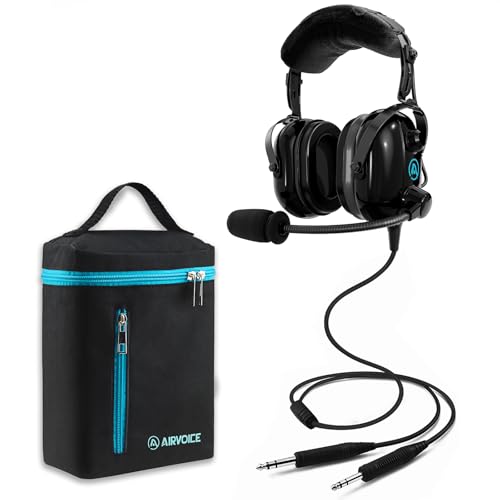
AIRVOICE leads with weight, describing an ultra-lightweight build with neodymium speakers, SNR hearing protection positioning and a noise-cancelling microphone for flight school students. Weight is an underrated specification in training: lessons stack radio work, lookout, checklists and new motor skills into the same hour, and a heavy headset adds a slow physical tax that students often misread as general fatigue. A lighter set also suits smaller heads and younger trainees, for whom adult-sized fleet headsets can clamp like machinery.
The SNR framing comes from the European rating tradition rather than the American NRR used by the KORE, and the two numbers are not directly interchangeable — treat each as its maker’s stated figure within its own system. What matters practically is the combination the listing describes: light structure, modern speaker drivers and a microphone designed to reject cockpit noise. Students who finish lessons with neck ache from a school set, or who simply run small, should audition this design philosophy first.
- Build: ultra-lightweight design stated in the listing
- Speakers: neodymium driver type
- Protection: SNR positioning per the maker’s listing
- Microphone: noise-cancelling type for instruction audio
Strengths
- Low weight reduces end-of-lesson neck fatigue.
- Neodymium speakers keep clarity without bulk.
- Sized kindly for smaller heads and younger students.
Trade-offs
- Light builds can feel less armoured in a flight bag.
- SNR and NRR figures resist direct cross-shopping.
- Clamping force may loosen on very active head movement.
Best for: a smaller-framed student or any trainee who ends lessons with a sore neck from fleet headsets.
Not suited for: a rough-handling school fleet buyer, because an ultra-light personal set is designed for one careful owner rather than daily multi-student rotation.
The AIRVOICE listing on Amazon sets out its weight-led design.

KA-1 General Aviation Headset — The gel-seal veteran
The KA-1 is the group’s established name: mono and stereo compatibility, passive reduction, a noise-cancelling microphone, gel ear seals, an adjustable headband and a bag. Its design language is conservative in the way training equipment should be — nothing about it requires explanation to an instructor, and its dual-mode audio matches it to almost any panel a student will meet during a syllabus that may span several aircraft types. Gel seals are the feature to dwell on: they conform around glasses, distribute pressure evenly, and maintain the acoustic seal when a student turns to check a wing during steep turns.
Longevity thinking also favours this pick. A headset bought at lesson five may still be serving at the instrument rating, and a straightforward passive design with replaceable soft parts ages gracefully. The KA-1 asks the student to forgo entertainment inputs and wireless extras entirely; in exchange it offers the fewest possible surprises across a long training arc. Students who suspect they will upgrade to ANR after licensing often choose exactly this kind of set as the durable, lendable spare it later becomes.
- Audio: mono and stereo compatibility
- Seals: gel ear seals fitted as standard
- Headband: adjustable, with headset bag included
- Microphone: noise-cancelling type
Strengths
- Gel seals hold quiet through head movement.
- Dual audio modes suit varied training panels.
- Conservative design ages into a dependable spare.
Trade-offs
- No music or phone connectivity of any kind.
- Traditional styling will not tempt gadget lovers.
- Gel seals need eventual replacement to stay plump.
Best for: a student planning a long syllabus across mixed aircraft who values seal and simplicity.
Not suited for: a trainee who wants entertainment audio piped in during ferry flights, because the KA-1 deliberately offers no auxiliary path.
See the KA-1’s Amazon listing for its seal and bag details.
HELETUL Aviation Pilot Headset — The school-blue all-rounder
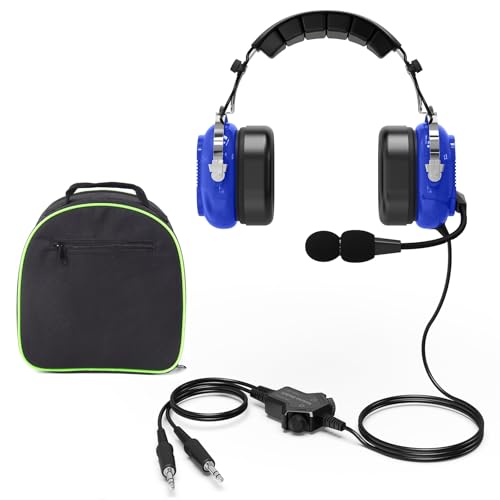
HELETUL’s entry, finished in blue, combines GA dual plugs, passive reduction, switchable mono and stereo, and an MP3 input — a small feature with outsized lifestyle value, since it lets a student pipe music or recorded briefings through the headset during quiet ground time or long cross-country legs where school policy permits. The listing emphasises durability and comfort for student training, which reads as an acknowledgement that training headsets get dropped, stuffed into bags and adjusted by adrenaline.
The colour is not frivolous either: in a school environment where a dozen black headsets share a shelf, a blue set is identifiable at a glance, and personal kit that cannot be confused with fleet kit avoids awkward ownership disputes. Functionally the HELETUL sits mid-group on every axis — seal approach, audio modes, extras — which makes it the pick for a student who cannot decide which single virtue to maximise and would rather have none missing.
- Connection: GA dual plugs for training panels
- Audio: switchable mono and stereo, MP3 input
- Design: durable build aimed at flight school use
- Finish: blue colourway for easy identification
Strengths
- MP3 input adds ground-time and briefing utility.
- Distinct colour separates personal kit from fleet kit.
- Balanced specification leaves no training need unaddressed.
Trade-offs
- Mid-group on every axis means best-in-class nowhere.
- Auxiliary cable adds one more item to the flight bag.
- Blue finish is a matter of taste in formal fleets.
Best for: a student who wants one balanced headset with a music input and an unmistakable identity in the school cupboard.
Not suited for: a minimalist who regards an MP3 input as clutter, because the HELETUL’s appeal rests partly on that extra flexibility.
The HELETUL’s Amazon page shows its input and switching layout.

Rugged Radios RA210-BT — The Bluetooth step-up
The RA210-BT is where this student roundup leans toward the qualified pilot’s world: dual GA plugs and passive reduction keep it fully legitimate in a trainer, while Bluetooth audio, gel ear seals and a noise-cancelling microphone widen its life beyond the intercom. Rugged Radios comes from the motorsport and off-road communications world, and that heritage shows in a design meant to be handled with gloves and opinions. For a student nearing licence completion — or a renter who flies for pleasure already — the Bluetooth link turns ferry time and waiting time into listening time without a second headset.
Discipline is the caveat to state plainly: entertainment audio has no place competing with instruction or busy radio environments, and students should treat the Bluetooth as a between-lessons and quiet-cruise feature, muted instantly when the workload rises. Used that way, the RA210-BT is the one pick here that can postpone the ANR upgrade conversation, because it already covers the convenience half of why pilots upgrade. It also suits the growing number of trainees who record lessons or use tablet briefings as part of their study loop on the ground.
- Connection: dual GA plugs plus Bluetooth audio
- Seals: gel ear seals fitted
- Microphone: noise-cancelling type
- Audience: pilots, students and flight schools per the listing
Strengths
- Bluetooth extends usefulness beyond training flights.
- Gel seals keep passive quiet competitive in-group.
- Rugged communications heritage suits active handling.
Trade-offs
- Bluetooth demands charging discipline the others avoid.
- Entertainment audio needs self-discipline in busy airspace.
- Feature breadth exceeds a first-lesson student’s needs.
Best for: a late-stage student or new licence holder who flies for pleasure and wants one headset for training and leisure.
Not suited for: a first-month student whose school bans personal audio devices in the cockpit, because the Bluetooth that defines this pick would have to stay switched off.
Review the RA210-BT’s Bluetooth behaviour on its Amazon listing.
Flight Training Headsets Compared on Plugs, Seals and Microphones
| Pick | Audio modes | Seal | Standout trait |
|---|---|---|---|
| SVXSODA GA629B | Mono and stereo | Gel muffs | Full accessory kit with bag |
| KORE P1 | Mono | Acoustic cups | Stated 24dB NRR rating |
| AIRVOICE Pilot Headset | Panel dependent | Lightweight cups | Ultra-light build, neodymium speakers |
| KA-1 | Mono and stereo | Gel seals | Adjustable headband, bag included |
| HELETUL Pilot Headset | Mono and stereo | Training cups | MP3 input, blue finish |
| Rugged Radios RA210-BT | Panel plus Bluetooth | Gel seals | Wireless audio beyond the intercom |
Every row shares the twin-plug foundation, so the real shopping happens in the other columns: choose your audio-mode needs from your school’s panels, your seal preference from your face and glasses, and your standout trait from your stage of training. Students who will later teach others to listen under pressure may enjoy the classroom counterpart in Best Headsets With Mics for Classroom Settings, where the noise problem is thirty children rather than one engine.
How Should a Student Test a Headset Before the First Lesson?
Borrow the discipline of a preflight check. At the school, plug the headset into the actual intercom of an aircraft you will fly, engine off, and run a radio check with the instructor: your microphone’s clarity at normal speaking effort is the first verdict. Check both volume controls and any mono-stereo switch against that panel, because a mismatch discovered on the ramp is a lesson rescheduled. Then wear the set for twenty minutes of ground briefing; pressure points announce themselves early if you give them the chance, and seal leaks reveal themselves when you turn your head and move your jaw as you would in a scan.
Finish with logistics. Does the bag fit your flight bag? Do the plugs reach the panel jacks in the aircraft you fly without straining? Can you operate the microphone boom with your left hand while your right stays on the throttle quadrant? A headset that passes those ordinary tests will serve; one that fails them will nag for a hundred hours. The crew world applies the same environment-first logic — see how production teams think about it in Best Headsets for Theater and Stage Crews.
What Mistakes Do Student Pilots Make When Buying a Headset?
The expensive mistake is buying the upgrade first: ordering premium active cancelling before knowing whether flying itself suits you, then selling at a loss when the hobby pauses. The ladder exists for a reason, and every pick here is priced in spirit as a first rung. The compatibility mistake is assuming all aviation plugs are alike; helicopter and military-derived systems differ, and a headset that cannot plug into the school fleet is a paperweight with ear cups. The comfort mistake is judging by a two-minute shop fit and discovering the clamp at hour two of a cross-country. The maintenance mistake is treating seals as permanent; compressed, cracked seals quietly erase the passive rating you paid for, and replacements are part of ownership.
A subtler error is chasing a decibel figure across rating systems. NRR and SNR numbers come from different test traditions and cannot be ranked against each other like-for-like; use them as within-system anchors and let seal quality, which no number captures, carry its proper weight. Finally, students forget the microphone. Hearing the instructor is only half the circuit — a noise-cancelling mic that keeps your transmissions intelligible in a loud cockpit is a safety feature wearing a convenience costume.
How Do Seals, Booms and Cables Survive a Training Syllabus?
Treat the headset like an instrument rather than luggage. Coil cables loosely instead of wrapping them tight around the cups, because conductor fatigue begins at sharp bends near the plug. Keep the set in its bag between lessons, off the rear shelf of a hot car where gel seals soften and adhesives age. Wipe seals after summer flights; sunscreen and sweat are seal materials’ natural enemies. Position the microphone boom a consistent finger’s width from your lips and stop re-bending it daily — booms remember abuse. Schools that rotate headsets among students should log seal replacements the way they log oil changes, because a fleet’s quiet degrades gradually and nobody notices until radio work feels strangely hard for everyone.
Storage at home deserves the same thought. A hook by the flight bag beats a drawer of tangled cables, and a headset stored assembled and adjusted is a headset that goes flying. These habits sound mundane next to engine management and air law, yet they decide whether your purchase is still performing at the checkride or merely present.
When Does the ANR Upgrade Actually Make Sense?
The honest trigger is hours, not envy. A student flying twice a month to a licence will be well served by every passive pick here for the whole syllabus. A pilot who then starts flying weekly, takes longer cross-country trips, or notices listening fatigue after flights has built the case for active cancelling with their own logbook. At that point a Lightspeed Sierra class headset — the tier we deliberately left as a prose reference rather than a pick — becomes a considered upgrade, and the passive set retires honourably to the passenger seat, where it will serve friends and family for years. Buying in that order costs less across a flying life than buying the flagship first and discovering the hobby did not stick.
There is also a training argument for patience: passive headsets make students deliberate about volume, squelch and mic technique, skills that transfer to any aircraft, including the elderly fleet aircraft whose intercoms reward competence. Arrive at ANR with those habits formed and the technology amplifies skill instead of masking its absence.
How Does a Headset Change Your Radio Work as a Student?
New students often blame their radio calls on confidence when the real culprit is effort: straining to decode a controller through a leaky school headset consumes the same mental budget needed to compose a reply. A personal headset with a proper seal lowers that decoding cost, and the improvement shows up as shorter pauses, fewer requests to repeat, and readbacks that arrive complete. Instructors notice the change before students do, because the student’s voice steadies when the incoming audio stops fighting the engine. None of this is the headset teaching phraseology — study still does that — but it removes static from the channel where learning happens.
Microphone technique compounds the effect. A noise-cancelling boom rewards a consistent position and a normal speaking voice; students who shout into the mic distort their own transmissions and tire themselves out. Practise on the ground with the intercom: set the boom once, speak at conversation level, and have the instructor confirm clarity from the other seat. That five-minute calibration, repeated until it is habit, does more for your radio reputation than any specification on a box. When the checkride comes, the examiner hears a pilot who sounds settled, and some of that settlement is simply good audio hygiene learned early.
What Should Flight Schools Look for When Buying Headsets in Multiples?
A school buying six or twelve headsets shops differently from a student buying one. Standardisation tops the list: identical models mean identical controls, interchangeable seals, and a single troubleshooting conversation. Durability evidence matters more than feature lists, because fleet headsets are adjusted by every student, dropped on concrete, and left in sun-warmed cockpits. Passive designs win fleet tenders for structural reasons — no batteries to manage, no electronics to drown in a spilled drink, and a failure mode that degrades gracefully into slightly-less-quiet rather than silence.
Schools should also think about identification and hygiene. Numbered or coloured headsets, like the HELETUL’s distinctive blue, simplify issue-and-return discipline and let a school retire a damaged unit without ambiguity. Replaceable seals turn hygiene from a complaint into a schedule. And a school that standardises on a twin-plug passive model from this group can hold a small pool of spares, so a failure on a busy Saturday costs a swap rather than a cancelled lesson. Students benefit from that reliability invisibly, in lessons that start on time with working audio.
How Do Glasses, Sunglasses and Caps Change the Seal Equation?
Anything that crosses the seal line taxes passive quiet. Sunglasses are near-universal in training, and their arms lift the cup’s edge exactly where the seal needs continuity; gel seals earn their reputation here by flowing around the arm instead of bridging over it. Ball caps add a button at the crown that some headbands press into the scalp across a long lesson — a small thing at minute ten, a genuine ache at hour two — which is why students often migrate the cap under the headset or choose low-profile headwear. Long hair worn loose can also break a seal at the jaw line; tying it back is an acoustic decision as much as a tidy one.
The practical response is to test in full flying dress. Bring the sunglasses you actually fly with, wear the cap you actually wear, and judge the headset in that configuration during a ground trial. A model that seals beautifully on a bare head in a quiet shop may leak in the real cockpit, and the reverse is also true: the gel-sealed picks in this group often test better in the field than their modest appearance suggests. Fit is a system, and the headset is only one component of it.
What Does a Cross-Country Lesson Reveal That Circuits Hide?
Short lessons forgive almost any headset. A cross-country exposes everything: two or more hours of continuous wear, frequency changes across different controllers, the need to hear a passenger or instructor over a changed engine note in the descent, and the slow build of clamp pressure that circuits never reach. Students planning their qualifying cross-country should treat the flights before it as headset trials, adjusting headband tension and seal position while the stakes are low. A set that disappears from awareness by the second hour has passed the only comfort examination that matters.
Cross-country flying also tests the small logistics: a cable that reaches the panel without crossing the yoke path, a volume control findable by touch while eyes stay outside, a bag that keeps the set protected during the away landing’s café stop. Pilots who fly with passengers later will repeat these tests from the other seat, handing a spare headset to a nervous friend and discovering that a simple, forgiving passive design is the kindest introduction to light aviation anyone can offer.
How Should Students Budget Across a Whole Syllabus?
Flying consumes money at a rate that surprises every new student, so the headset decision deserves a place in the overall plan rather than an impulse slot. The sensible allocation buys the headset early — its benefit accrues on every lesson — and buys it once at the passive tier, reserving the ANR decision for after the licence when flying frequency is known. Money not spent on premature electronics funds hours, and hours are the only currency that actually produces a pilot. Every pick in this roundup respects that logic: none demands a flagship outlay, and several are priced in spirit for schools buying multiples.
Protect the investment with the cheap rituals: bag, hook, seal replacements, gentle cable handling. A student headset that survives training becomes the passenger set, the spare set, or a resale item with honest value to the next student at the club — the GA629B’s complete kit and the KA-1’s classic design both hold that second life well. Viewed across a flying career, the first headset is not a compromise purchase; it is the foundation layer of a personal kit that grows by addition rather than replacement.
What Happens on the Day Your Headset Meets a Different Aircraft?
Syllabuses wander: the school’s second trainer, a club aircraft for the skills test, a friend’s machine for a post-licence flight. Each panel brings its own intercom personality — one feeds generous volume, another whispers, a third hisses faintly with the alternator. A switchable mono-stereo headset like the GA629B, the KA-1 or the HELETUL absorbs much of that variety without fuss, while a mono design like the KORE P1 simply asks the panel to be what most panels are. The student’s part is procedural: plug in before engine start, run the intercom check during the taxi checks, and set volumes while the workload is zero. Discovering an audio surprise after takeoff is a self-inflicted emergency of the minor kind, and it is entirely preventable.
Carry that discipline into rental flying later and it pays rent for years. Renters who test audio on the ground, brief passengers on the spare headset, and keep their own kit maintained are the renters schools trust with the good aircraft. The headset, humble as it seems, is where that reputation starts.
How Do Winter and Summer Change Headset Comfort?
Summer training is a contest with heat: gel seals soften pleasantly but absorb sweat, cups trap warmth against the ears, and a black headset left on a glareshield can become genuinely hot to wear. Wiping seals after each flight and storing the set out of direct sun are summer rituals, not fussiness. Winter reverses the problem — cold-soaked cups are stiff for the first minutes, seals conform more slowly, and gloves make small volume knobs clumsy, which is where the RA210-BT’s rugged, glove-friendly design language earns a nod. Students flying year-round should judge a headset across both regimes if they can, or at least buy with the harsher of their seasons in mind.
Neither season changes the fundamentals — seal, microphone, plugs — but both punish neglected kit faster than a temperate spring. A training syllabus usually spans at least two seasons, so durability across temperature swings is part of what your money buys in this group.
Why Do Instructors Care Which Headset a Student Buys?
An instructor hears the student through the student’s microphone, dozens of times a day, and a poor boom microphone taxes every exchange. Instructors develop quiet preferences for headsets whose mics stay positioned, whose volume controls students can find without looking down in the circuit, and whose seals let students hear a correction the first time. There is also a workload argument: every repeated instruction is a small withdrawal from the lesson’s finite attention, and clear audio deposits some of it back. Students shopping before their first lesson can simply ask the school which models behave well in their fleet; the answer is free expertise, and schools are rarely shy about sharing it.
That conversation has a second benefit — it reveals the school’s own fleet standard, so a student can match plug type and audio mode with certainty rather than inference. Buying after that conversation converts the riskiest part of the purchase into a formality.
How Should a Student Practise Listening Before Solo?
Listening is a trainable skill, and the headset is its gym equipment. On the ground, students can stream live air traffic audio through any convenient device to build an ear for pace and phraseology, then bring that ear to lessons where their own headset delivers the real thing. In the aircraft, the discipline is anticipation: know which call comes next in the sequence, listen for your callsign as a trigger, and keep a hand near the volume when transitioning between a quiet tower and a booming one. A headset with a stable seal makes that practice cleaner, because the signal stops varying with every head movement.
By first solo, the goal is for the audio environment to feel ordinary — engine subdued, radio clear, microphone familiar — so that attention can live entirely on flying the aeroplane. Every pick here can deliver that ordinariness; the student’s practice is what turns equipment into readiness.
What Should You Inspect on a Used or Borrowed Set?
Training ecosystems circulate second-hand headsets, and a careful inspection separates a bargain from a false economy. Squeeze the seals: they should rebound slowly and evenly, without cracking sounds or flat spots. Flex the headband gently and watch for hairline stress whitening near the yokes. Work every control through its full travel, listening for scratchy volume pots, and inspect the plug barrels for bent pins and the cable for kinks near the strain reliefs — the two places training cables actually die. Smell is diagnostic too; a set that lived in a damp bag announces it. Any pick in this roundup bought new avoids the lottery, but a student offered a club spare can apply the same checks in two minutes and know what they are trusting.
How Does Headset Choice Affect Passenger Briefings Later?
After the licence, your student headset’s second career begins in the right seat’s mirror image: it becomes the set you hand to passengers. Simplicity wins that job — a passive set with obvious volume control and a forgiving fit makes a first-time passenger comfortable in seconds, and a microphone they can mute or move aside reduces their self-consciousness. Pilots who bought a complete kit like the GA629B or a classic like the KA-1 discover the purchase quietly upgraded every pleasure flight they give, because the passenger’s experience of light aviation is largely an audio experience. Buying with that future in mind is not extravagance; it is recognising that training kit rarely retires, it just changes seats.
What Role Does the Headset Play on Checkride Day?
Examiners do not grade headsets, but they do grade communication, and communication rides on audio. Arriving with your own familiar set removes three small risks at once: an unfamiliar volume control, a borrowed seal that leaks, and a microphone boom positioned for somebody else’s face. Set your volumes during the taxi, confirm the intercom early, and the communication portion of the test becomes a demonstration of habits rather than a negotiation with equipment. Students who trained in their own headset from this group consistently describe the checkride cockpit as feeling ordinary, and ordinary is the highest compliment a test environment can earn.
Pack a contingency anyway: fresh seals are overkill, but knowing the school’s spare set works, and having used it once, turns a morning-of failure into a shrug. Preparation is mostly the art of making surprises boring.
How Do You Keep Volume Discipline in a Loud Cockpit?
The temptation is to solve noise with volume, and it works until it doesn’t: excessive intercom level fatigues listening and distorts at the peaks. The better sequence is mechanical first — seat the seals properly, close the gap around sunglasses, position the mic — and electronic second, raising volume only to the point where speech sits clearly above the now-reduced roar. Recheck after takeoff, because the climb changes the noise picture and a setting made on the ground rarely survives the first thousand feet unchanged. Students who learn that sequence on a passive set carry it into every aircraft afterwards, including ones with active cancelling, where the same discipline keeps levels sane.
What Separates a Training Headset From a Touring Headset?
Touring headsets optimise for hours aloft: active cancelling, Bluetooth entertainment, plush everything. Training headsets optimise for the school environment: shared panels, short intense lessons, rough handling, simple controls, and a purchase decision a student can make in their first month. The overlap is real — every pick here will happily fly a tour — but the priorities differ, and recognising the difference protects a student budget from touring ambitions arriving two years early. When the touring phase genuinely begins, the pilot will know it from the logbook, and the upgrade conversation in this guide will be waiting.
How Should a Student Choose Between the Six in Ten Minutes?
Run a decision sprint. First question: does your school’s fleet include stereo panels you will actually fly? If not, the mono KORE P1 loses nothing. Second: do you wear glasses on every flight? Then gel seals — GA629B, KA-1 or RA210-BT — move to the front. Third: are you small-framed or neck-sensitive? The AIRVOICE jumps the queue. Fourth: do you want sounds beyond the intercom before you hold a licence? Only the HELETUL’s MP3 input and the RA210-BT’s Bluetooth answer yes, and they answer at different levels of commitment. Fifth: are you buying for a fleet rather than yourself? Standardise on the simplest model your instructors approve of and spend the savings on spare seals. Five questions, honestly answered, will land nearly every student on the right pick in this group without a spreadsheet.
What Does a Sensible First-Month Routine Look Like?
Week one: buy after the school conversation, unbox at home, and learn every control by touch in a quiet room. Week two: fly the set on two lessons, adjusting headband and boom once, deliberately, then leaving them alone. Week three: test it in the school’s second aircraft type if your syllabus uses one, and note the intercom differences in your training record. Week four: inspect the seals, coil the cable the gentle way, and confirm the bag routine is automatic. By the end of the month the headset should have become invisible — a piece of personal equipment whose settings you trust and whose presence you notice only when a classmate borrows a school set and winces. That invisibility, not any specification, is the true graduation of a first headset.
Why Does Owning Beat Borrowing Across a Whole Course?
Borrowed headsets reset to zero every lesson: someone else’s headband setting, someone else’s boom bend, someone else’s idea of clean. Ownership compounds in the opposite direction — your settings persist, your seals mould gradually to your head, and your hands learn the controls until they operate without supervision from your eyes. Across forty or fifty lessons, those small continuities free real attention for the flying itself. That, in the end, is the entire argument of this roundup: the equipment is modest, the effect is cumulative, and the student who buys a sound passive set early buys back a little concentration on every single flight that follows.
A Note on Listening Effort and Long Lessons
Two-hour lessons late in a syllabus — navigation exercises, mock tests — expose listening effort as a physical quantity. Students describe it as tiredness behind the eyes, a growing urge to ask for repeats, a radio that seems to get faster as the flight goes on. The radio has not changed; the listener’s margin has. A well-sealed personal headset widens that margin from the first minute, which is why its benefit is most visible exactly when training gets hardest. Treat any headset trial accordingly: judge it at the end of your longest lesson type, not after a gentle circuit session, and you will judge the product your future self actually has to live with.
How Do You Brief a Passenger on Your Old Student Headset?
Keep it to four sentences: how to put it on, where the volume lives, how to move the microphone aside, and permission to speak up at any time about comfort. Fit the seals for them rather than describing the process, set a conservative volume before engine start, and check in after takeoff when the noise picture settles. Passengers judge their first light-aircraft flight largely by how cared-for they felt, and a familiar, well-kept student headset — the same one that carried your syllabus — delivers that care better than a neglected premium set ever will.
Final Recommendation
Start where your training actually is. A brand-new student equipping from nothing should take the SVXSODA GA629B’s complete kit or the KA-1’s gel-sealed versatility and stop shopping; either will carry a syllabus without drama. Students who want a stated attenuation figure to anchor the decision should choose the KORE P1, while smaller-framed trainees and anyone nursing neck fatigue should try the AIRVOICE first. The HELETUL suits the student who wants a music input and a headset nobody else will mistake for theirs, and the RA210-BT is the pick when training is nearly done and leisure flying is coming into view. Buy the rung you stand on, keep the seals fresh, and let your logbook — not envy — tell you when the next rung matters.
Frequently Asked Questions
Will these headsets plug into any training aircraft?
They follow the general aviation twin-plug standard that most school fleets use, which covers the great majority of piston trainers. A minority of aircraft use different arrangements, so confirm with your school before ordering; the question takes minutes and prevents the commonest return in the category.
Is passive noise reduction enough for a piston trainer?
For training, yes, provided the seal is good. Passive sets lower the roar to a level where instruction and radio work are comfortable, and they do it without batteries. Pilots flying long hours weekly are the ones who typically outgrow passive and move to active cancelling.
Why do several picks offer both mono and stereo?
Older intercoms feed a mono signal and newer panels may offer stereo; a switchable headset behaves correctly on both. If your school’s fleet is uniform, the setting is chosen once; in mixed fleets the flexibility prevents one-ear audio surprises.
How should I position the microphone boom?
Place the microphone close to the corner of your mouth, roughly a finger’s width away, and speak across it rather than directly into it. A noise-cancelling mic positioned there captures your voice while rejecting much of the cockpit roar behind it.
Can I use one of these headsets as a passenger later?
Absolutely, and that is the natural second life of a student headset. Any pick here works for a passenger on a pleasure flight, which is another reason to favour durable passive designs over fragile novelty.
What should I replace first as the headset ages?
The ear seals. They determine the passive rating, they absorb the sweat and sunscreen, and they are designed to be consumable. Fresh seals on an older headset often restore the quiet the owner thought the whole unit had lost.
Related Guides
More headset briefings from the same shelf: Best Headsets for Theater and Stage Crews for backstage intercom systems, Best Wireless Headsets for Churches for volunteer production teams, and Best Headsets With Mics for Classroom Settings for school computer labs and language rooms.


