What's inside
- Key Takeaways
- Quick Picks
- How We Chose These Picks
- Where Does the Money Actually Go in the Best 120 Dollar Headsets?
- How the Six Stack Up When the Budget Is Fixed
- Should You Spend This Tier’s Money on Wired or Wireless?
- How Do You Stretch a Headset at This Level Across More Years?
- How Do These Headsets Behave Across PC, PlayStation, Xbox, and Switch?
- What Can EQ Actually Fix at This Level — and What Can It Not?
- How Should Your First Week With the New Headset Go?
- Which Shortcuts at This Budget Come Back to Bite?
- What Does Ownership Look Like After the First Year?
- One Distinction Worth Understanding: How Sealed Is Your Listening?
- Buying One of These for Someone Else? Read This First
- Final Recommendation
- Frequently Asked Questions
- Related Guides
As an Amazon Associate I earn from qualifying purchases. This post may contain affiliate links at no extra cost to you.
widgetverdict.com is reader-supported. When you buy through links on our site, we may earn an affiliate commission.
The hunt for the best 120 dollar headsets sits at the most contested altitude in the whole market. Below this tier, headsets compromise on something structural — a flimsy frame, a microphone you apologise for, drivers that give up on music. Above it, you start paying for wireless radios, exotic materials, and brand gravity. Right around this mark, though, sits a band of headsets that get the fundamentals genuinely right: real comfort, honest sound, a microphone nobody complains about, and a frame that will still be intact when the next console generation arrives. That is the territory this guide maps.
A word about how the budget works here, because it matters. The figure in the keyword is a shopping ceiling, not a price tag: street prices drift with seasons, bundles, and colour choices, and any guide that stapled a fixed number to each model would be lying to you within a month. Treat the six picks below as the headsets that live in this neighbourhood — the ones a shopper with roughly this much to spend should be comparing — and check price on Amazon for the current position of the one you choose. What this guide guarantees is the comparison itself: what each design gives you, what it withholds, and which kind of buyer walks away happiest.
The six split along a clean fault line. Four are wired or wireless designs from the major gaming houses, each with a distinct theory of value at this level. Two are prose-only inclusions — widely sold budget designs that shoppers cross-shop against this tier constantly, included so you can see exactly what stepping down buys and what it costs. The wired-versus-wireless question looms larger at this budget than at any other, because here the radio is the single most expensive decision in the product: choosing wireless means choosing simpler drivers or a plainer frame elsewhere. Read the picks with that trade in mind and the right answer for your desk usually announces itself.
Key Takeaways
- At this tier the HyperX Cloud III is the wired benchmark: it spends the whole budget on sound, comfort, and microphone instead of a radio.
- The SteelSeries Arctis Nova 5 is the wireless exception that works, because its long battery and app-based EQ give the radio something worthwhile to carry.
- EPOS H3 and Sony INZONE H3 show two wired philosophies — sealed acoustic focus from a Sennheiser-descended audio house, and PlayStation-centred spatial tuning from Sony.
- The two prose-only budget designs prove the rule: stepping below this tier saves money by spending it from the microphone and the frame first.
- Decide wired versus wireless before comparing models; at this budget it is the decision that determines everything else.
Quick Picks
| Pick | Badge | Why it is here |
|---|---|---|
| HyperX Cloud III | Wired benchmark | Every unit of budget goes into drivers, foam, and a detachable condenser mic — the fullest wired package at this level. |
| SteelSeries Arctis Nova 5 | Wireless that justifies itself | Sixty-hour battery, dual-device wireless, and phone-controlled EQ presets built for specific games. |
| EPOS H3 | Sealed-focus wired | A closed acoustic chamber and studio-leaning tuning from a house with Sennheiser lineage, with a flip-to-mute boom. |
| Sony INZONE H3 | PlayStation native | Sony’s own wired headset with 360 Spatial Sound personalisation and a light, long-session fit. |
| HyperX Cloud Stinger 2 | Budget step-down | The lighter, simpler HyperX that shows what the tier below trades away — and what it sensibly keeps. |
| Logitech G335 | Featherweight wired | A very light wired design in bold colours that prioritises wearability and simplicity over refinement. |
How We Chose These Picks
Budget tiers reward a particular kind of honesty: at this level, every design is a visible compromise, and the reviewer’s job is to name the compromise rather than pretend it away. We selected headsets whose compromises are chosen well — models that sacrifice the things their target buyer will not miss and protect the things that buyer touches daily. A headset that trims its packaging, its RGB, and its software suite to protect its drivers and cushions is making the right cuts. A headset that trims its microphone to afford lighting effects is making the wrong ones, and none of those appear here.
The wired-versus-wireless balance was deliberate. Wireless at this altitude used to mean tinny drivers and a battery that faded by year two; the Arctis Nova 5 is included as evidence that the equation has improved, not as proof it has vanished. Against it stand three wired designs that demonstrate what the same money buys when no radio needs feeding: better microphones, richer tuning, sturdier frames. Neither side wins in general. Each wins for a specific desk, and the detailed sections argue each case on its own terms.
The two prose-only picks were chosen as measuring instruments. Shoppers at this budget constantly ask whether the cheaper famous-name options are “basically the same,” and the honest answer requires those options to be in the room. The Cloud Stinger 2 and the G335 are good products for their tier — but placing them beside the Cloud III exposes exactly which components absorb the savings, and it is rarely the ones the shopper hoped. They carry no links in this guide; they are here to be compared, not sold.
We also screened out the tier’s decorative failures: headsets that spend on lighting strips, novelty materials, or licensed artwork while shipping a microphone their own makers would not use on a call. At this altitude the budget is zero-sum, and every visible flourish is paid for by an invisible component. The six survivors are not the plainest-looking headsets in their class, but none of them asks you to fund a light show with your microphone.
Comfort evidence was weighted heavily, because a budget headset worn four hours a night accumulates more wear — on its cushions and on its owner — than a flagship worn on weekends. We favoured designs with replaceable or generously padded cushions, headbands that spread load, and clamps that hold without punishing. Sound was judged across games, music, and voice rather than on a single demo track, and microphones were judged on how a voice survives a real room: fan running, keyboard live, speaker at natural volume rather than performing for the mic.
Where Does the Money Actually Go in the Best 120 Dollar Headsets?
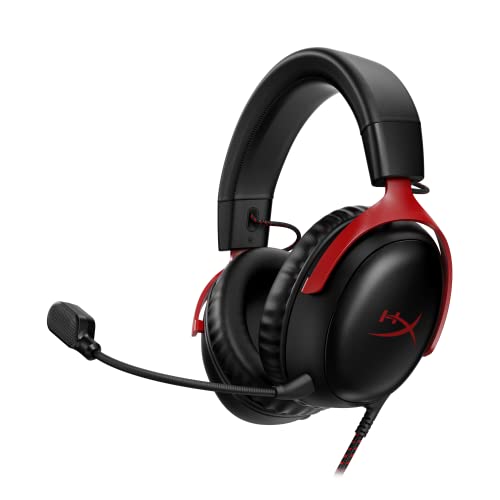
HyperX Cloud III — Wired benchmark
Judged purely as an allocation of budget, the Cloud III is the most instructive product in this guide. HyperX spent nothing on a radio, nothing on lighting, nothing on a companion app empire — and the savings surface everywhere you touch: deep memory foam on ears and crown, an aluminium-reinforced frame that flexes without complaint, and a detachable 10mm condenser microphone that captures voices with a clarity wired rivals at this level rarely match. It is the standing proof that the wired route at this tier is not a compromise but a strategy.
Its angled 53mm drivers are tuned for the long haul — a warm, smooth presentation with enough low-end body to give engines and scores their weight, and enough restraint up top to keep bright games from turning harsh at hour three. Positional cues in shooters arrive cleanly, because the tuning never lets effects smear across the stereo image. Listeners coming from bass-cannon budget sets sometimes find the first evening almost polite; by the third evening most of them describe it as the first headset they forget they are wearing, which is the higher compliment.
Practical life with the Cloud III is pleasingly dull. USB-C, USB-A, and 3.5mm connections mean the same headset serves a PC, both consoles’ controllers, a Switch, and any laptop ever made, with no pairing rituals and no battery gauge to babysit. The microphone unplugs for music-only duty, its LED mute indicator ends the guesswork about whether you are live, and the whole product asks for nothing — no firmware, no account, no software suite — between the box and the game. In a tier where some rivals spend your money on features that need maintaining, that absence is itself a feature.
The honest limits are the ones its strategy dictates. There is no wireless path at any price of fiddling; the cable is the deal, and it will find your chair’s wheels if you let it. There is no active noise cancelling, so open-plan offices and loud households leak in around the passive seal. And listeners who want their sound sharpened for one specific competitive title will do their own EQ work rather than choosing from curated presets. None of this is hidden. The Cloud III is a headset that knows exactly what it bought with your money, and shows you the receipts every time you put it on.
- Sound: angled 53mm drivers with a warm, fatigue-free tune
- Links: USB-C, USB-A, and 3.5mm — every port covered by cable
- Mic: 10mm condenser boom, detachable, with a visible mute LED
- Padding: memory foam at the ears and across the headband
- Skeleton: metal-reinforced frame built for daily handling
Strengths
- Budget visibly spent on sound, comfort, and microphone quality
- Connects to everything with zero setup or charging discipline
- Detachable mic converts it into tidy headphones for music
Trade-offs
- Wired only — the cable is a permanent part of the experience
- No noise cancelling beyond what the cushions passively block
- No curated game presets; tuning adjustments are your own work
Best for: buyers at this budget who sit at one desk and want maximum substance per coin.
Not suited for: players who roam the room mid-match or share the headset across a house.

SteelSeries Arctis Nova 5 — Wireless that justifies itself
Wireless headsets at this altitude usually ask you to accept a quiet bargain: freedom now, paid for with thinner sound and a microphone that sounds like a phone call from 2009. The Arctis Nova 5 is the design that finally renegotiates that bargain. Its 40mm neodymium magnetic drivers sound genuinely composed — clear, spacious, and musical enough that the wireless link stops feeling like an apology — and its battery endurance, rated around sixty hours, stretches charging into a weekly errand rather than a nightly one. It earns its radio.
The feature that changes daily life most is the companion app’s library of game-specific EQ presets, over a hundred of them, switchable from your phone in seconds. Presets are easy to dismiss as garnish until you load one shaped for your main title and hear the mix reorganise itself — dialogue forward, footsteps unsmothered, explosions trimmed to drama rather than mud. Because the adjustment happens from the phone while the game runs, you actually use it, which is more than can be said for most desktop EQ suites that demand an alt-tab and a tutorial.
Connection runs over a USB-C dongle for the low-latency link, with Bluetooth alongside for a phone, so the headset covers the two-device reality of most desks. The microphone is an AI-assisted ClearCast design that works hard on room noise; your voice arrives clean and slightly processed, entirely respectable for team chat and ordinary calls, if short of the natural warmth the Cloud III’s condenser achieves. Comfort is classic SteelSeries: a suspension-style fit that floats the weight, earcups that breathe reasonably, and a silhouette that does not embarrass you when the doorbell camera catches you wearing it.
Its trade-offs are the honest residue of the wireless equation. The build leans lighter and more plastic than the Cloud III’s metal-reinforced frame, and it asks to be handled like electronics rather than equipment. Xbox support runs through the appropriate variant and connection, so console buyers should confirm the exact configuration before ordering. And the app, for all its virtues, is one more account-and-update relationship in your life. For buyers whose priority is cutting the cord at this tier without cutting the quality, though, this is the design that makes the cut cleanly.
- Sound: 40mm neodymium magnetic drivers, app-tuned per game
- Links: USB-C dongle wireless plus Bluetooth for a second device
- Endurance: roughly sixty hours between charges
- Mic: AI-assisted ClearCast boom with noise reduction
- Presets: 100+ game EQ profiles switchable from the phone app
Strengths
- Wireless freedom without the usual collapse in sound quality
- Game-specific presets you can swap mid-session from your phone
- Week-scale battery life makes charging a minor chore
Trade-offs
- Lighter, more plastic build than the wired benchmark
- Microphone is clean but audibly processed next to the Cloud III
- Console buyers must check they have the right variant
Best for: players at this budget who want the cord gone and refuse to pay for it in sound.
Not suited for: rough handlers who treat a headset like a tool bag item.

EPOS H3 — Sealed-focus wired
The EPOS H3 comes from a different family tree than the gaming brands around it: EPOS grew out of the Sennheiser communications world, and the H3 sounds like it. This is a closed acoustic headset, sealed tightly against the room, tuned with a restraint that gaming headsets rarely attempt. Bass is present and controlled rather than theatrical, the midrange — where voices, footsteps’ upper harmonics, and most musical information live — is rendered with unusual tidiness, and the whole presentation feels engineered rather than flavoured. For listeners whose ears tire of excitement, it is a relief.
That sealed chamber is the H3’s defining physical decision, and it cuts both ways in ways worth understanding before you buy. The isolation is real: household noise, a partner’s television, a mechanical keyboard all recede, and low listening volumes become practical because you are not competing with the room. The cost is the closed-in feeling some wearers dislike — a sense of pressure and of your own voice booming slightly in your head when you speak, since the seal keeps your voice’s bone conduction prominent. Players who talk constantly in chat notice this more than quiet listeners do, and it is the single most common reason this otherwise excellent headset gets exchanged.
The microphone flips up to mute, a gesture so natural it becomes automatic within a day, and its capture is clear and focused, befitting the company’s communications heritage. The boom is not detachable, which keeps the silhouette gaming-specific — this is not a headset that moonlights as commuter headphones the way the Cloud III can. Build quality is dense and serious, with a volume wheel on the earcup that your fingers will find without looking, and the 3.5mm connection (with the appropriate console/PC cables in its ecosystem) keeps it compatible with controllers and PCs alike without software of any kind.
Choose the H3 when your listening room is noisy, your taste in sound runs tidy, and your sessions are more about concentration than spectacle. It is the connoisseur’s wired pick at this tier — less universally lovable than the Cloud III, more distinctive in the ways that matter to the right owner. Listeners who want their games to feel like blockbuster trailers should look at the warmer tunings elsewhere in this guide; listeners who want to hear the mix as it was made will feel immediately at home.
- Chamber: closed acoustic design for strong passive isolation
- Sound character: controlled bass, tidy midrange, engineered restraint
- Mic: flip-up boom that mutes as it lifts
- Controls: earcup volume wheel reachable without looking
- Link: wired 3.5mm connection for PC and controllers
Strengths
- Sealed isolation that quiets a noisy household effectively
- Refined, unexaggerated tuning that suits long listening
- Flip-to-mute boom is effortless and unambiguous
Trade-offs
- Sealed fit makes your own voice sound boomy while chatting
- Non-detachable mic keeps it visibly a gaming headset
- Restraint in the tuning will underwhelm spectacle-seekers
Best for: focused listeners in noisy homes who value isolation and tonal tidiness.
Not suited for: chat-heavy players who dislike hearing their own voice sealed in.

Sony INZONE H3 — PlayStation native
Sony makes the PlayStation, and the INZONE H3 is what happens when the platform owner designs the wired headset for its own living rooms. The integration story leads: connect it to a PS5 and Sony’s 360 Spatial Sound for Gaming is there waiting, with the companion software able to personalise the spatial profile to your own ears using a phone photograph. That personalisation sounds like a novelty until a sound that used to be vaguely “behind you” resolves into a specific doorway — spatial audio tuned to your ear shape is measurably more convincing than the generic version.
Outside the spatial story, the H3 is a study in lightness. It is one of the easiest headsets in this guide to wear for a long evening: soft-fit earcups, a gentle clamp, and a weight that never accumulates into the slow crown ache that ends sessions. The 40mm drivers are tuned in Sony’s house style — clean, slightly bright, with bass that is articulate rather than massive — which flatters dialogue-driven games, films, and the brighter end of most music libraries. In bass-heavy shooters the low end is present and controlled, though players who want explosions in their sternum should audition the warmer Cloud III first.
The boom microphone flips to mute like the EPOS design, and captures a clear, serviceable voice for party chat and casual calls. It is not the condenser richness of the Cloud III, nor does it pretend to be; it is the microphone of a headset whose budget went into fit and spatial processing. The wired connection splits its loyalties between the PS5’s USB world and the 3.5mm world of controllers and PCs, and the INZONE software hub on PC gives it EQ and settings depth that console-only rivals lack.
Who is it for? The PlayStation-first household, above all — the player whose gaming happens on the couch, whose sessions run long, and whose ears appreciate a headset designed by the same company that designed the console’s audio pipeline. PC players get a good wired headset; PS5 players get a coherent system. That asymmetry is the H3’s identity, and the guide respects it rather than marking it down for specialising.
- Spatial: 360 Spatial Sound with ear-shape personalisation
- Fit: soft-fit cups and a light frame for long couch sessions
- Sound: 40mm drivers in Sony’s clean, articulate house tuning
- Mic: flip-to-mute boom for party chat and calls
- Software: INZONE Hub on PC for EQ and settings
Strengths
- Personalised spatial audio that genuinely sharpens direction
- Among the lightest, easiest long-session fits in this guide
- First-party coherence with the PlayStation audio pipeline
Trade-offs
- Bass weight is articulate rather than physical
- Microphone is serviceable, not a standout
- Its best tricks are reserved for the Sony ecosystem
Best for: PlayStation-first players who game long hours from the couch.
Not suited for: bass devotees or PC-only players indifferent to spatial audio.
HyperX Cloud Stinger 2 — Budget step-down
The Cloud Stinger 2 is included in this guide as an honest measuring stick, and it deserves to be described fairly before it is compared. As the lighter, simpler sibling in HyperX’s own line, it keeps the family essentials: 50mm drivers with a DTS Headphone:X spatial licence in its ecosystem, a swivel-to-mute microphone, and a featherweight frame that younger players and long sessions both appreciate. On its own terms, at its own level, it is a sensible product — which is exactly why it is the right instrument for showing what the step up to this guide’s tier actually buys.
Place it beside the Cloud III and the savings announce their addresses. The frame is plastic where the flagship is metal-reinforced, and it feels it in the hand and across a year of desk life. The cushions are thinner, so the third hour is less kind. The microphone, while perfectly intelligible, captures a thinner, more nasal voice than the Cloud III’s condenser — the difference between sounding present and sounding like a voice memo. The drivers play the same music recognisably, but with less body in the low end and less composure when a scene gets dense. None of these gaps is dramatic alone; together they are the definition of a tier.
We discuss the Stinger 2 without a purchase link in this guide because its role here is comparative: it represents the class of headsets a shopper with this guide’s budget is tempted to settle for, usually to keep change for a game. The arithmetic is understandable and usually regretted, because the headset is the component you touch every session while the game is finished in a month. If your budget truly cannot stretch, the Stinger 2 is among the least regrettable ways to spend less. If it can stretch, the distance to the Cloud III is the best-value distance in this entire guide.
- Sound: 50mm drivers, lighter and leaner than the flagship’s
- Frame: all-plastic build that keeps weight and cost down
- Mic: swivel-to-mute boom, intelligible but thin-toned
- Cushions: slimmer padding suited to shorter sessions
- Character: the family essentials, simplified everywhere else
Strengths
- Very light frame that younger and smaller heads wear easily
- Keeps the HyperX essentials — decent drivers, simple mute
- Sensible fallback when the budget genuinely cannot stretch
Trade-offs
- Plastic build and thin cushions age faster under daily use
- Microphone voice quality is a clear step below this tier
- Sound loses body and composure in dense scenes
Best for: buyers whose budget is truly fixed below this tier and who need the safest spend.
Not suited for: shoppers using it as a “basically identical” substitute for the Cloud III.
Logitech G335 — Featherweight wired
The G335 makes one argument loudly: weight is a feature. Logitech stripped this wired design down to a suspension-strap frame that barely registers on the head, dressed it in colours that refuse to be office equipment, and kept the essentials — 40mm drivers, a flip-to-mute boom, a 3.5mm plug that works with every controller and laptop — while discarding nearly everything else. For players who find most gaming headsets to be helmets, the G335 is a genuine alternative rather than a lesser version of one.
That lightness is also the map of its compromises. The drivers are competent and clear, voiced for games and chat, but they do not have the low-end authority or the dense-scene composure of the headsets above them in this guide, and music exposes the gap fastest. The microphone is fine for Discord and party chat — intelligible, unremarkable — and its fixed, slimmer boom feels less substantial than the detachable condensers at this tier. The fabric cushions breathe well and seal loosely, which warm rooms will forgive and noisy rooms will not.
Like the Stinger 2, the G335 appears here without a link, as the second measuring instrument of the guide: it shows the other direction a smaller spend can go. Where the Stinger trims the flagship formula, the G335 pursues a different virtue — wearability — and accepts thinner sound as its price. Buyers whose heads genuinely cannot abide a full-weight headset may rationally choose it over everything above. Buyers choosing it merely because it is cheaper, while hoping for this tier’s sound, are the ones this guide exists to warn.
Durability expectations should be set accordingly. The G335’s frame flexes by design, its parts are light because they are slight, and it will reward owners who hang it up rather than toss it. Treated kindly, it serves its purpose for years; treated like the metal-framed Cloud III, it will not. Knowing which owner you are is, as ever, the actual purchasing decision.
- Frame: suspension-strap design, among the lightest wired sets sold
- Sound: 40mm drivers tuned for games and chat clarity
- Mic: flip-to-mute boom, fixed and slim
- Cushions: breathable fabric with a loose, cool seal
- Colours: bold finishes that reject the office look
Strengths
- Featherweight fit that headset-haters can actually wear
- Simple 3.5mm connection works with everything
- Breathable cushions suit warm rooms and long evenings
Trade-offs
- Sound lacks the body and composure of this guide’s tier
- Light construction demands gentle handling
- Loose seal lets noisy rooms in
Best for: players who prioritise a barely-there fit over sonic refinement.
Not suited for: anyone expecting flagship sound at a featherweight spend.
How the Six Stack Up When the Budget Is Fixed
| Headset | Connection | Microphone | Where the money went |
|---|---|---|---|
| HyperX Cloud III | Wired, all formats | Detachable condenser | Drivers, foam, frame |
| SteelSeries Arctis Nova 5 | Wireless + Bluetooth | AI-assisted boom | Radio, battery, app presets |
| EPOS H3 | Wired 3.5mm | Flip-to-mute boom | Sealed chamber, tuning |
| Sony INZONE H3 | Wired USB / 3.5mm | Flip-to-mute boom | Spatial audio, light fit |
| HyperX Cloud Stinger 2 | Wired 3.5mm | Swivel-to-mute boom | Essentials only, simplified |
| Logitech G335 | Wired 3.5mm | Flip-to-mute boom | Weight reduction, style |
The table’s last column is the one to study. At a fixed budget, a headset is a pile of money wearing a shape, and each row shows a different shape. The Cloud III piles everything into the physical product. The Nova 5 diverts a large share into radio and battery and earns it back with presets and freedom. The EPOS and Sony designs spend on a single acoustic idea each — the sealed chamber, the personalised spatial field — and serve narrower tastes more deeply. The two prose-only rows show piles with less in them overall, which is not an insult but a measurement: they are what the same brands build when the pile shrinks.
A useful exercise before buying: name the two things you would refuse to give up — microphone quality and wireless freedom, say — and strike every row that surrenders one of them. Most readers end with one or two survivors, and the detailed sections above exist to separate those finalists. Budget shopping fails when it is done by spreadsheet across twenty models; it succeeds when it is done by elimination across six honest ones.
Should You Spend This Tier’s Money on Wired or Wireless?
The wired case is arithmetic. A cable costs almost nothing, never runs flat, never drops out, and lets the entire budget feed the parts you hear and feel. Three of this guide’s four linked picks are wired because, at this altitude, wired designs still deliver more substance per unit of money — the Cloud III’s microphone and frame are what a radio’s budget looks like when it is spent on hardware instead. If your headset lives at one desk and your chair has no reason to roll away mid-session, wired is not the cautious choice; it is the greedy one, and greed here is rational.
The wireless case is about the shape of your rooms. If the headset travels between a desk and a couch, if you play standing with a VR-adjacent setup, if you take calls while making tea — the cable stops being a triviality and becomes the product’s defining annoyance, resented daily. The Nova 5 exists for that reader, and its compromises are chosen to protect the experience: sound stays composed, the battery outlasts your week, and the presets give the electronics something to be for. Wireless bought for a life that needs it is money well spent; wireless bought as a spec-sheet trophy for a desk-bound life is a radio you paid for and a microphone you did without.
One more consideration belongs to households rather than individuals: shared headsets drift toward wireless because nobody wants to untangle a cable from someone else’s setup, and the Nova 5’s dual connection suits a headset that serves two people’s machines. Solo desk owners, conversely, extract the least from wireless and should let the wired picks court them first. The budget does not change; what changes is which design’s compromises land on things you never use.
How Do You Stretch a Headset at This Level Across More Years?
Protect the cushions and you protect the headset. At this tier the drivers and frames generally outlast the foam by years, so the owner who replaces cushions when they flatten — and keeps a spare set if the headset is a daily driver — effectively owns a newer headset than the owner who does not. Store the headset on a stand or hook rather than on the desk surface where it gets knocked, sat on, and buried under paperwork; most “mystery” deaths at this level are desk accidents, not electronic failures.
Treat the cable or the dongle as the second consumable. Wired owners: give the cable a gentle coil and a route that avoids chair wheels and drawer edges. Wireless owners: the dongle lives in one port permanently or it lives in a labelled pouch — the middle option, loose in a drawer ecosystem, is how dongles vanish. Battery-equipped owners should avoid the two extremes, permanent dock storage at full charge and long cupboard storage completely flat; ordinary daily use with charging when warned is the kindest regime.
Finally, keep the software relationship healthy where one exists. The Nova 5’s app and the INZONE Hub deliver firmware and features that genuinely improve these products over time, but they reward a light touch: update when a fix or feature matters to you, keep your working EQ presets exported or screenshotted, and never let an update land the night before a tournament or a presentation. A headset at this tier, maintained with this little ceremony, should still be your headset when the next budget conversation happens.
How Do These Headsets Behave Across PC, PlayStation, Xbox, and Switch?
Platform behaviour at this tier follows the connection, so it pays to learn each pick’s map before it arrives. The Cloud III owns the simplest map in the guide: its 3.5mm plug works in every controller and handheld ever made, while its USB options add full feature support on PC and PlayStation. An Xbox player uses it through the controller jack and loses nothing essential; a Switch player plugs in and plays. There is no configuration of a modern gaming household in which this headset is a stranger.
The INZONE H3’s map is Sony-shaped by design. On PlayStation it is a citizen — USB connection, spatial personalisation, console-level integration — and on PC the INZONE Hub makes it a well-supported wired headset with EQ depth. On Xbox it falls back to the controller’s 3.5mm jack, functional but stripped of its signature features. The EPOS H3’s map is the classic wired one: 3.5mm everywhere, with its experience identical on every platform because nothing about it depends on software. That uniformity is a genuine virtue for multi-platform households that resent per-device personalities.
The Nova 5’s map is the one to read twice, because wireless platform support is where this tier hides its sharpest print. Its dongle-based link serves PC and PlayStation in the standard configuration, Bluetooth covers phones and tablets, and Xbox support depends on the specific variant — a distinction that has generated more returns than any sound complaint in this category. The two prose-only wired designs, Stinger 2 and G335, share the simple 3.5mm map: everywhere, identically, without features that vary. If your household games on three platforms and your patience for configuration is thin, the wired rows of this guide are your friends, and the Cloud III is their captain.
What Can EQ Actually Fix at This Level — and What Can It Not?
Equalisation is the most oversold tool in headset marketing, so here is a sober account of its powers at this tier. EQ can rebalance a tuning: pull the INZONE H3’s brightness down a notch for a long film, add a little low-end warmth to the EPOS H3 for a bass-light soundtrack, or carve the Nova 5’s preset further toward footsteps. The Nova 5’s hundred-plus game presets are essentially EQ done by people who tested each title, and their convenience is real — most owners will use a preset weekly and a manual EQ almost never.
What EQ cannot do is manufacture capability the hardware lacks. It cannot give the G335’s small drivers the Cloud III’s composure in a dense scene, because that composure is distortion headroom, not frequency balance. It cannot widen a sealed chamber’s soundstage into an open one, and it cannot repair a microphone — voice processing like the Nova 5’s noise reduction is a different tool solving a different problem. Boosting a frequency the driver reproduces poorly mostly boosts the distortion with it, which is why experienced listeners cut more than they boost.
The practical routine for a new owner at this tier is modest: live with the factory tuning for a week, because ears adapt and first impressions overvalue difference. Then adjust one thing — the thing your most-played content keeps getting wrong — and live with that for another few days. Owners who chase a perfect curve across every genre end up with five presets they distrust; owners who fix their one recurring annoyance end up with a headset that sounds like theirs. At this budget, that modest ambition is exactly the right size.
How Should Your First Week With the New Headset Go?
Day one is for fit, not judgement. Wear the headset through one full session at your normal volume and note the first place discomfort appears and roughly when. A hotspot at twenty minutes that fades is the cushions settling; pressure that grows past the hour is information, and it rarely reverses — use the return window while it is wide rather than negotiating with your own skull for a month. Adjust the headband one notch looser than feels secure; most new owners wear headsets a size too tight and blame the clamp.
Day two is for your voice. Record yourself through the headset’s microphone on your phone or PC — thirty seconds of ordinary speech, once in quiet, once with the room in its normal state — and listen back on speakers. You are checking for the things your teammates will never politely report: a boom too close and booming, too far and thin, or room noise riding under every sentence. Boom position fixes most of it; an inch nearer or farther transforms a capture more than any software toggle at this tier.
The rest of the week is for the boring systems: learning the mute gesture until it is reflex, learning where the wireless model drops out in your home if it is wireless, deciding where it lives when it is off your head, and — for app-connected models — setting up exactly one EQ preset for your main game and leaving the other hundred alone. A headset integrated into your routines disappears; a headset still being configured a month later never quite does. The picks in this guide were chosen partly for how quickly they disappear.
Which Shortcuts at This Budget Come Back to Bite?
The classic mistake is buying the tier below while telling yourself it is the same product with a different badge — the two prose-only sections above exist to retire that story with specifics. The second mistake is the mirror image: stretching far above the tier for a flagship whose extra features (a charging dock, a second battery, exotic finishes) you will never use, while the money could have bought the games themselves. This tier is a sweet spot precisely because both directions from it waste something.
A third mistake is judging the microphone by a store demo or a streamer’s processed audio rather than by a plain recording. Microphone differences at this level are large, permanent, and experienced by everyone except you — which makes them easy to undervalue at purchase and impossible to upgrade later without replacing the headset. Record a test on your phone through the headset before the return window closes. A fourth mistake: ignoring variant and platform details on wireless models. The right headset in the wrong console configuration is the wrong headset, and the check takes two minutes.
Lastly, beware the bundle mirage — a mediocre headset made to look like this tier by the company it keeps in a box with a keyboard and a mouse mat. The six designs in this guide earned their places as standalone products against standalone rivals. A headset that needs a bundle to look like value is telling you where its value lives.
What Does Ownership Look Like After the First Year?
Year one is when a headset at this tier reveals whether its compromises were the right ones. The Cloud III’s story is usually uneventful, which is the point: its cushions soften gradually, its cable survives if it was routed kindly, and nothing about it requires a relationship with a software vendor. Owners typically report that it becomes invisible infrastructure — the highest state a wired headset can reach. The EPOS H3 follows a similar arc, with one addition: its sealed cushions work harder than open designs and may want replacing sooner in warm climates, a small and predictable expense.
The Nova 5’s second year is where wireless ownership shows its character. Battery capacity fades gently — a sixty-hour battery that becomes a fifty-hour battery has changed nothing about your week, which is precisely why generous initial endurance is a longevity feature rather than a spec-sheet trophy. Its app relationship continues to deliver presets for new games, and its lighter frame will have collected the small scars that plastic collects. Owners who handled it like electronics still have a headset; owners who handled it like luggage have a story.
The INZONE H3 ages as Sony’s ecosystem ages: its spatial personalisation remains its party trick, and its light frame shows wear mainly in the cushions, which is the right place for wear to live. The two step-down designs tell the cautionary version of the same story — thinner cushions flatten sooner, lighter frames loosen, and by the time their owners shop again they have usually decided to buy this tier properly. That decision, made by thousands of owners a year, is the market evidence behind this guide’s central claim: the distance between the step-down shelf and this tier is the best-value distance in headsets.
None of this requires ceremony. A headset at this level asks for cushions when they flatten, a cable or dongle kept out of harm’s way, and handling matched to its construction. Give it that, and the purchase you are researching today stops being a purchase surprisingly quickly — it just becomes the headset, the one on the hook, the one whose sound is simply what your games sound like.
One Distinction Worth Understanding: How Sealed Is Your Listening?
Buried inside this guide’s six is a spectrum shoppers rarely shop by, yet feel every session: how sealed the listening experience is. At one end sits the EPOS H3, whose closed chamber walls the room out and keeps your audio in — the right design for shared flats, late nights, and anyone whose gaming neighbours a sleeping child. At the other end sit the fabric-cushioned, loosely sealed designs like the G335, which let the room breathe through your session; you hear the doorbell, the kettle, the person asking whether you want tea, and your ears stay cool at the price of some immersion and some leaked sound.
The middle of the spectrum is where the tier’s best sellers live, and deliberately so. The Cloud III’s deep foam seals firmly without the H3’s pressure-chamber intensity; the Nova 5 and INZONE H3 land nearby with their own balances of isolation and air. Most buyers should start in this middle and only migrate toward an end if they can name the reason: a genuinely noisy room argues for the sealed end, a genuinely warm one for the open end, and a household where being reachable matters argues for staying permeable. It is a preference with no wrong answer — but it is a preference worth discovering in a guide rather than at hour two of your first evening.
Buying One of These for Someone Else? Read This First
A large share of headsets at this tier are bought as thoughtful gifts for players, students, and remote workers, and gift logic differs from self-purchase logic in one crucial way: the buyer cannot audition fit, and the recipient may not say the fit is wrong. That asymmetry should steer gift buyers toward the forgiving designs. The Cloud III’s deep foam and relaxed clamp accommodate the widest range of heads happily, its wired connection cannot be the wrong variant, and its detachable microphone lets it live a double life as school or work headphones. It is, not coincidentally, also this guide’s first recommendation for uncertain buyers generally.
Wireless gifts carry a specific risk worth naming: platform variants. A Nova 5 bought in the wrong console configuration is a wonderful headset for a machine the recipient does not own, and the return conversation is nobody’s idea of a celebration. If you do not know the recipient’s platform with certainty, either ask — the surprise is worth less than the fit — or choose from the wired rows, where the question cannot arise. The INZONE H3 is the exception that rewards certainty: for a known PlayStation household it is the most thoughtful gift in the guide, because it shows the buyer understood the recipient’s actual gaming life.
Two smaller gift notes. First, keep the receipt and the return window sacred: even the right headset can be wrong for one particular head, and a graceful exchange preserves both the gift and the relationship. Second, resist upgrading the gift with accessories the recipient has not asked for — cases, stands, and docks are personal choices, and the money is better held against the cushion replacement they will want in year two. A headset chosen with this much care does not need wrapping-paper reinforcements.
Final Recommendation
For the majority of readers shopping this tier, the Cloud III is the answer: it is the fullest expression of what this budget buys when nothing is diverted to a radio. Choose the Arctis Nova 5 when your rooms and habits genuinely demand wireless — it is the rare design at this level that makes the trade without short-changing your ears. Choose the EPOS H3 for sealed focus and tidy sound in a noisy home, and the INZONE H3 if your gaming life is PlayStation-shaped and your sessions run long. Keep the Stinger 2 and G335 in their honest roles: respectable fallbacks for a fixed smaller budget or a head that demands featherweight design, not secret equivalents of the tier above them. Spend this money once, on the compromise you chose deliberately, and it will feel well spent every single session for years to come.
Frequently Asked Questions
Is the $120 figure a firm price for these headsets?
No — it is the budget frame of the search, not a price list. Street prices for every model here move with promotions, bundles, and colours, sometimes landing below the frame and sometimes above it. Use the tier to define your comparison set, then check price on Amazon for the current position of your finalist before deciding.
Why are two picks prose-only with no purchase link?
The Cloud Stinger 2 and Logitech G335 are included as honest measuring sticks for the tier below, so you can see exactly what a smaller spend gives up. They are discussed fully but not linked, because this guide’s recommendations at this budget are the four designs above them.
At this budget, is wireless finally worth it?
For the right life, yes — the Arctis Nova 5 proves a wireless design at this level can keep its sound composed and its battery long. But the wired picks still deliver more microphone and build for the same money. Wireless is worth it when your rooms demand it, not as a default.
Which of these has the best microphone?
The Cloud III’s detachable condenser boom captures the fullest, most natural voice of the six. The Nova 5’s processed capture is cleaner in noisy rooms but sounds slightly artificial by comparison. If your voice matters professionally, that ordering should weigh heavily.
Will a headset at this level work on both PC and console?
The wired picks largely will — the Cloud III’s USB and 3.5mm options cover PCs, controllers, and handhelds broadly. Wireless is where platform lines harden, so Nova 5 buyers should confirm the variant matches their console before ordering.
How long should a headset bought at this tier last?
Three to five years of daily use is a fair expectation for the linked picks, provided cushions are replaced as they wear. The plastic-framed step-down designs can also last, but they reward gentler handling. Longevity at this level is mostly a handling story, not an electronics one.
Related Guides
For the wider field beyond a single budget, browse our complete shortlist of the best headsets overall. Ready to spend at the premium level instead? The finest gaming headsets around $200 show what the next tier buys, while plug-anywhere shoppers should read the top headsets built on a 3.5mm connection.
Related guide: Best Bose Headsets
Related guide: Best Plantronics Headsets
Related guide: Best Corded Headsets for Online Meetings
Related guide: Best Headsets for Voice Acting


