What's inside
- Key Takeaways
- Where to Buy
- Quick Picks
- How the Contenders Were Chosen
- Six Sets Under the Controller
- Figures First: The Group Compared
- What the PS5 Actually Needs: A Specification Audit
- Setting Up a Gaming Wall: Distance, Light and Sound
- HDR Gaming: Tone Mapping Without Tears
- Two Consoles, One Wall: Port Arithmetic
- Performance Modes and the 120Hz Question
- The Living-Room Treaty: Sharing a Gaming Wall
- Reading a Gaming Listing Like an Engineer
- Own Goals: Gaming-Buying Errors
- Frequently Asked Questions
- Final Recommendation
As an Amazon Associate I earn from qualifying purchases. This post may contain affiliate links at no extra cost to you.
[SITE_DOMAIN] is reader-supported. When you buy through links on our site, we may earn an affiliate commission at no extra cost to you. Prices and availability change; check the Amazon listing for the current details.
A PlayStation 5 is a demanding guest: it arrives expecting a 4K screen that can keep up with its fastest modes, and the best gaming tvs ps5 are the sets that answer without making the console — or its owner — negotiate. Six televisions stand below, every one a 4K Mini-LED or QLED model whose listing speaks the language of play: refresh figures at 144Hz and beyond, variable refresh, game modes with proper names, and in one case the group’s only explicit HDMI 2.1 census. The reviews quote those figures strictly from the listings, because gaming is the category where an assumed specification hurts fastest — a port that cannot take the signal, a panel slower than its marketing, a mode buried where a player will never find it.
One boundary deserves stating before the first review, dryly and once: this guide ranks televisions only. Searches for this topic surface a flood of HDMI cables, which are accessories — sometimes necessary ones, never televisions — and no cable appears among the picks, however golden its connectors. The same discipline governs input lag throughout: no listing in this group states a lag figure, so none is printed here. Instead, the guide teaches the game-mode check that determines real-world responsiveness on any of these sets, which is worth more than an unverifiable millisecond borrowed from a forum.
The field divides by philosophy as much as by figure. iFFALCON’s 55-inch set leads with the most explicit console brief in its title — PS5 and Xbox readiness, four HDMI 2.1 ports, a 144Hz panel with VRR language reaching to 240Hz. Hisense fields two 65-inch Mini-LEDs, the E7 Cinema on Fire TV and the U7 on Google TV, the latter stating a native 165Hz with VRR 330. Toshiba’s Z670R brings a named Game Mode Pro and a REGZA engine to Fire TV. TCL closes with two Google TV sets, the 55-inch QM6K and the 65-inch T7, whose Game Accelerator figures headline their gaming claims. Sizes split evenly between 55 and 65 inches, platforms between Google TV and Fire TV — a fair map of where console gaming actually lives in 2026.
What the PS5 itself asks of a television frames every review: 4K resolution for its flagship output, high-refresh capability for the games that offer performance modes, VRR for the games whose engines waver, and a low-latency game mode so inputs land when thumbs say so. HDR gaming adds tone-mapping taste to the list. A set that states its answers to those asks in its own listing — as several here do, in numbers — has done most of the buyer’s homework already. The rest of the homework is below, ending with a retro detour for players whose libraries span decades: our HD televisions for retro gaming guide covers the classic-console end of the same hobby.
Key Takeaways
- This guide ranks televisions only — the HDMI cables that flood this topic’s search results are accessories, and none is a pick here.
- The iFFALCON 55U85 states the most explicit console brief: PS5 and Xbox ready, four HDMI 2.1 ports, 144Hz with VRR language to 240Hz.
- Hisense’s U7 states the group’s highest native figure — 165Hz, with VRR 330 — on a 65-inch Mini-LED Google TV.
- No listing here states an input-lag figure, so none is quoted; the game-mode check taught below is the reliable responsiveness test.
- Toshiba’s Z670R names a Game Mode Pro and a REGZA Engine Zri, the group’s most gaming-specific processing vocabulary on Fire TV.
- Platforms split between Google TV (U7, both TCLs, iFFALCON) and Fire TV (E7, Toshiba), so ecosystem allegiance should vote alongside refresh figures.
Where to Buy
- iFFALCON 55 Inch 4K MiniLED TV — Check price on Amazon
- Hisense 65 Inch E7 Cinema — Check price on Amazon
- Toshiba 55 Inch Z670R — Check price on Amazon
- Hisense 65 Inch U7 — Check price on Amazon
- TCL 55 Inch QM6K — Check price on Amazon
- TCL 65 Inch T7 — Check price on Amazon
Quick Picks
| Pick | Best for | Refresh / Gaming Spec | Display | Check |
|---|---|---|---|---|
| iFFALCON 55 Inch 4K MiniLED TV | Console-explicit brief | 144Hz, 4x HDMI 2.1 stated | 55-inch MiniLED 4K | Check price on Amazon |
| Hisense 65 Inch E7 Cinema | Cinema-polished speed | Native 144Hz, FALD | 65-inch Hi-QLED Mini-LED | Check price on Amazon |
| Toshiba 55 Inch Z670R | Named game mode | Native 144Hz, REGZA Engine | 55-inch Mini-LED QLED | Check price on Amazon |
| Hisense 65 Inch U7 | Specification ceiling | Native 165Hz, VRR 330 | 65-inch Mini-LED ULED | Check price on Amazon |
| TCL 55 Inch QM6K | Bright-room all-rounder | 144Hz, High Brightness | 55-inch QLED Mini LED | Check price on Amazon |
| TCL 65 Inch T7 | Big-screen motion value | Native 144Hz, VRR | 65-inch QLED | Check price on Amazon |
How the Contenders Were Chosen
Entry required a gaming argument stated in the listing itself: a refresh figure, a VRR claim, a named game mode, or an explicit console-readiness line. Marketing warmth without a checkable claim did not qualify, which is why some famous living-room sets are absent and why a lesser-known badge — iFFALCON — leads the order: its title simply states more of what a PS5 owner needs to know than any rival’s, including the group’s only HDMI 2.1 port census. Every pick is a 4K television with Mini-LED or QLED architecture, because backlight control is what HDR gaming spends.
Figures were sorted by species before any comparison was allowed. Native refresh — stated by the U7 at 165Hz and the E7 at 144Hz — describes the panel. Plain stated figures — 144Hz on the iFFALCON, QM6K and T7 — describe the set as listed. Accelerator figures — TCL’s Game Accelerator 288 on the T7, the VRR 240Hz language on the iFFALCON — describe enhanced modes and headroom, and are reported as such, never as panel facts. Keeping those species separate is the difference between a buying guide and a brochure, and the reviews maintain the separation even where it makes a favourite look slower on paper.
Finally, the group was balanced across the two real gaming-room sizes and the two platforms console households actually run, so that a reader can fix size and ecosystem first and then argue about hertz with a clear conscience. Six sets, two sizes, two platforms, one console at the centre — the arithmetic of the actual market, reflected without distortion.
Six Sets Under the Controller

iFFALCON 55 Inch 4K MiniLED TV
Best for: a console-first 55-inch corner where four stated HDMI 2.1 ports, PS5 and Xbox readiness and Dolby Vision Gaming remove every preliminary question
Not suited for: a brand-loyal purchase — iFFALCON’s name carries none of the incumbents’ weight, and its case rests entirely on its stated specification
- Screen size: 55 inches
- Panel: 4K MiniLED
- Console readiness: PS5 and Xbox Ready, per the listing
- HDMI: 4x HDMI 2.1, as stated
- Refresh and VRR: 144Hz; VRR 240Hz language in the listing
- Gaming HDR: Dolby Vision Gaming
- Formats and audio: Dolby Atmos; IMAX Enhanced
- Platform: Google TV; Alexa named
The iFFALCON 55U85 writes the title this entire category wishes every maker would write. It begins with the consoles — PS5 and Xbox Ready — continues with the sockets — 4X HDMI 2.1, the only port census stated anywhere in this group — and then gives the panel’s figures: 144Hz, VRR language reaching 240Hz, Dolby Vision Gaming for HDR play, Dolby Atmos, IMAX Enhanced for film nights, Google TV as the platform. Even its odd line, the nod to hotel, home and office use, tells a truth about 55-inch sets: they migrate between roles, and a set specified for consoles at home loses nothing by being legible in a lobby. For a buyer tired of translating marketing into specifications, this listing is a glass of water.
Dolby Vision Gaming deserves its own sentence, because HDR gaming splits into camps and this set declares for the dynamic one: scene-by-scene tone mapping applied to games that support it, rather than a single static curve. The MiniLED backlight beneath gives that mapping something to work with — local zones for the flashlight beams and neon that game worlds specialise in. The VRR figure should be read as the listing phrases it, headroom language around a 144Hz panel, and even read conservatively the combination covers the PS5’s entire output envelope with room to spare. An unfamiliar badge is a fair hesitation; a specification this explicit is the correct reply to it, because every claim can be checked against the console in the first evening.
There is also a multi-console dividend in that port census. Four HDMI 2.1 sockets mean the PS5, a second console, a soundbar’s return channel and a spare can coexist without a switcher or a weekly cable ritual — the exact furniture of the two-console household this set names in its first line. Sets that ration full-specification ports make that household choose; this one declines to, and says so where a buyer can read it before paying.
First-evening verification is easy with this set, which is a virtue in itself: connect the console, confirm the high-refresh mode engages, run a familiar game, and every headline claim has been tested against reality before the packaging leaves the house. Equipment that invites its own audit tends to pass it, and the 55U85’s listing reads like an invitation from the first line to the last.
Strengths
- Four HDMI 2.1 ports stated outright — unique in this group
- PS5 and Xbox readiness declared in the title itself
- 144Hz MiniLED panel with Dolby Vision Gaming
Trade-offs
- Brand recognition trails every rival in this group
- VRR 240Hz is headroom language; the panel figure is 144Hz
- Hotel and office positioning may read oddly to home buyers
Console households tired of decoding listings should start with this one’s plain speech — Check price on Amazon

Hisense 65 Inch E7 Cinema
Best for: a 65-inch Fire TV gaming room where a native 144Hz panel, full-array local dimming and Dolby Vision IQ serve play and cinema in one specification
Not suited for: a Google TV household’s seamless second screen — the Fire TV platform is a deliberate ecosystem step, and should be taken knowingly
- Screen size: 65 inches
- Panel: Hi-QLED Mini-LED, 4K UHD
- Platform: Smart Fire TV; Alexa+
- Model year: 2026 new, per the listing
- Refresh rate: Native 144Hz
- Backlight: FALD — full-array local dimming
- Formats: Dolby Vision IQ, Dolby Atmos, HDR10+ Adaptive
- Motion and picture: AI Picture; MEMC
The E7 Cinema scales Hisense’s explicit style to 65 inches: Hi-QLED Mini-LED, native 144Hz, AI Picture, Dolby Vision IQ with Atmos, FALD, HDR10+ Adaptive, MEMC, Alexa+, on Fire TV as a 2026 model. For gaming, the load-bearing words are native and FALD. Native certifies the 144Hz as a panel property rather than a processing impression — the strongest form of the claim any set here makes at this size alongside its own brand sibling — and full-array local dimming certifies that the Mini-LED backlight is zoned, so HDR games with pitch-black corridors and muzzle-flash highlights get the contrast architecture they were mastered on. A PS5 feeding this panel meets no stated bottleneck.
The Cinema half of its name argues the set’s evenings after the controller is down: Dolby Vision IQ adapts HDR to the room’s ambient light — valuable in the shared, lamp-lit rooms 65-inch sets inhabit — and HDR10+ Adaptive keeps it company, while MEMC motion processing serves sport and can be restrained for film and play. Fire TV with Alexa+ suits Amazon-ecosystem households, for whom the platform is a feature rather than a switch. Between this and the U7 reviewed next, Hisense offers the group’s cleanest internal debate: Fire TV cinema polish at a native 144Hz, against Google TV gaming maximalism at 165Hz — a debate with no loser, only allegiances.
AI Picture, the listing’s processing line, matters to gamers more than its brevity suggests: much console output arrives below the panel’s native glory in older titles and performance modes, and a named picture engine is the set’s promise to upscale and present that material with intent. Back-catalogue players — and every PS5 library grows one — should weight that line accordingly.
The E7’s 65 inches also future-proof the room’s seating experiments — a racing rig added, a sofa moved back, a second row for tournament nights — because a native fast panel at this size stays commanding from wherever the furniture lands. Cinema sets are bought for a room; gaming cinemas are bought for a room that keeps changing its mind, and the E7’s specification tolerates the indecision gracefully.
Strengths
- Native 144Hz panel claim, the strongest species of refresh statement
- FALD Mini-LED backlight stated as architecture, not implication
- Dolby Vision IQ adapts HDR gaming and film to room light
Trade-offs
- Fire TV platform will not suit Google TV-standardised homes
- No HDMI port census stated in the listing title
- MEMC smoothing requires discipline around film and game modes
Fire TV players wanting cinema manners with their hertz should open the E7’s listing — Check price on Amazon

Toshiba 55 Inch Z670R
Best for: a 55-inch Fire TV setup where a named Game Mode Pro, the REGZA Engine Zri and a native 144Hz QLED Mini-LED panel carry the gaming brief
Not suited for: a Google TV or casting-centred household — the Z670R’s ecosystem is Fire TV with Alexa, and its talents concentrate on the panel and its modes
- Screen size: 55 inches
- Panel: Mini-LED QLED, 4K UHD
- Platform: Smart Fire TV; Alexa Built-in
- Model year: 2026 new, per the listing
- Refresh rate: Native 144Hz
- Processor: REGZA Engine Zri
- Gaming mode: Game Mode Pro, per the listing
- Formats and audio: HDR10+, Dolby Vision IQ, Dolby Atmos
Toshiba’s Z670R is the connoisseur’s entry in this group: a Mini-LED QLED panel at a native 144Hz, driven by a named engine — REGZA Engine Zri — with a named gaming mode, Game Mode Pro, on Fire TV, wrapped in a 2026 model that closes its title with the words Japan Quality. That closing phrase is positioning, certainly, but the REGZA name carries genuine lineage in television engineering, and its presence signals a set whose picture processing is a designed system rather than an assembled one. For gamers, Game Mode Pro is the operative line: a dedicated, named low-latency mode is exactly what the responsiveness check taught in this guide looks for, and Toshiba prints it where a buyer can find it before purchase.
The format list supports the gaming core with cinema breadth — HDR10+, Dolby Vision IQ for room-aware HDR, Dolby Atmos — making the Z670R the Fire TV counterpart to the group’s dual-purpose ideal: competitive sessions under the Pro mode, films under Vision IQ, one panel. At 55 inches it suits the desk-adjacent and small-room gaming stations where the PS5 often actually lives, rather than the ceremonial main room. Its listing states no port census, so multi-device households should verify sockets in documentation; what it states — panel, engine, mode, formats — forms the most coherent processing story in this group, told by a badge many buyers had stopped watching and should start again.
There is a quiet pleasure in a heritage name returning with its homework done. The Z670R does not trade on nostalgia; it lists a native figure, names its engine, names its game mode, and lets the specification argue. Players who enjoy equipment with a point of view — and Toshiba’s has always been engineering-led — will find this set’s listing the most literate in the group.
Ownership texture matters at 55 inches, where the set often shares a desk’s wall or a bedroom’s: Fire TV’s familiarity, Alexa’s presence, and a game mode with a name a player can find in the dark of a menu at midnight. The Z670R’s coherence is experiential as much as electrical — everything about its listing suggests a machine whose gaming path has been walked by its designers, end to end, with a controller in hand.
Strengths
- Game Mode Pro named in the listing — the group’s clearest latency-mode claim
- Native 144Hz Mini-LED QLED panel with REGZA Engine Zri
- Dolby Vision IQ, HDR10+ and Atmos cover film after play
Trade-offs
- No HDMI census stated in the listing title
- Fire TV platform only, with Alexa as the assistant
- Brand’s current range is less widely compared than rivals’
Engineering-minded players should give the Z670R’s literate listing its due — Check price on Amazon

Hisense 65 Inch U7
Best for: a 65-inch gaming wall shared with a PC, where a native 165Hz panel, VRR 330 and anti-reflection treatment outrun every console currently made
Not suited for: a PS5-only room on a strict brief — part of this set’s headroom serves hardware a console cannot feed, and its premium follows that headroom
- Screen size: 65 inches
- Panel: Mini-LED ULED, 4K UHD, Hi-QLED
- Platform: Smart Google TV
- Model year: 2026 new, per the listing
- Refresh rate: Native 165Hz
- VRR: VRR 330, as stated in the listing
- Formats: HDR10+, Dolby Vision IQ, Dolby Atmos, IMAX Enhanced
- Audio and screen: 2.1.2 channel audio; Anti-Reflection treatment
The U7’s listing reads like a dare: Mini-LED ULED with Hi-QLED colour, native 165Hz, VRR 330, HDR10+, Dolby Vision IQ and Atmos, IMAX Enhanced, anti-reflection, 2.1.2-channel audio, Google TV, 2026. For the PS5 specifically, the operative fact is surplus — a native panel figure beyond the console’s ceiling and variable-refresh headroom beyond its range mean the television will never be the component that limits a game’s presentation, this generation or the visible part of the next. Surplus is sometimes waste and sometimes insurance; on a 65-inch wall bought for a decade, with a gaming PC plausibly joining the console, it prices as insurance, and the anti-reflection treatment defends the whole arrangement against the bright rooms such walls usually face.
The 2.1.2 audio stated in the title changes the accessory plan: height and low-frequency channels built in give game worlds verticality and weight before any soundbar is considered, and IMAX Enhanced covers the film nights. Against its own E7 sibling, the U7 trades Fire TV for Google TV and cinema polish for gaming maximalism — same maker, same size, opposite emphases, a choice this guide is happy to leave exactly where Hisense put it: with the player’s ecosystem and appetite. As the group’s specification ceiling, the U7 earns the title its listing claims for it — premium gaming — in the only currency accepted here, printed figures.
A word for the PC player sharing this wall: 165Hz native with VRR headroom to 330 is a specification written for graphics hardware that does not yet know it will be bought. Console-first households should simply enjoy the absence of ceilings; dual-platform households should recognise the U7 as the one set in this group that refuses to make them choose which machine the wall was built for.
The U7 also quietly solves the shared-wall negotiation: IMAX Enhanced films for the household’s cinema faction, Dolby Vision IQ for the lamp-lit hours, and a gaming specification that needs no defending to the PC faction. One wall, three constituencies, no faction asked to subsidise another’s compromise — that is what a flagship gaming premium is supposed to purchase, and the listing itemises the purchase.
Strengths
- Native 165Hz with VRR 330 — the group’s highest stated motion figures
- Mini-LED backlight, anti-reflection treatment, Dolby Vision IQ
- 2.1.2 channel built-in audio stated in the listing
Trade-offs
- Headroom exceeds PS5 output, so part of the brief awaits other hardware
- 65 inches demands gaming-room space and distance
- No HDMI census stated in the listing title
Players building for a decade should measure their wall against the U7’s listing — Check price on Amazon
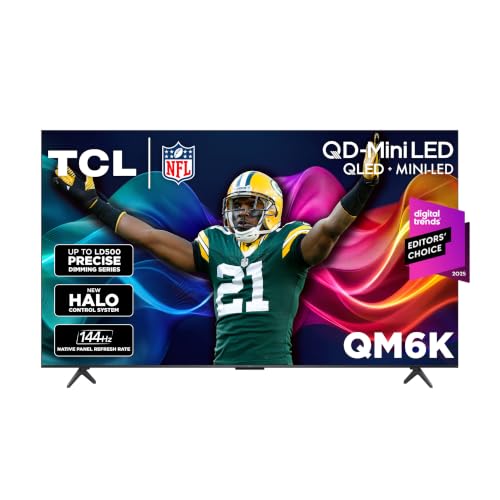
TCL 55 Inch QM6K
Best for: a bright 55-inch room where Mini-LED contrast, a stated 144Hz and Premium Gaming language meet TCL’s value-tier positioning
Not suited for: a port-counting multi-console build as the opening requirement — the listing leads with panel and brightness, leaving its HDMI census to documentation
- Screen size: 55 inches
- Panel: QLED Mini LED, 4K HDR
- Platform: Smart Google TV with Voice Remote
- Refresh rate: 144Hz, as stated in the listing
- Brightness: High Brightness, per the listing
- Formats: IMAX Enhanced, HDR10, Dolby Vision
- Audio: Dolby Atmos Audio
- Gaming positioning: Premium Gaming, per the listing
The QM6K brings TCL’s Mini-LED value argument to the gaming room: a QLED Mini LED panel with a stated 144Hz, High Brightness as a design aim, IMAX Enhanced and the HDR canon — HDR10, Dolby Vision — with Dolby Atmos Audio, a voice remote and Google TV, under a Premium Gaming banner. For PS5 play, the combination that matters is zones plus speed: local dimming gives HDR game worlds their blacks — the cave, the night circuit, the space between stars — while the 144Hz figure gives performance-mode titles a panel that can receive their frames. High Brightness, meanwhile, serves the daylight sessions that gaming rooms with windows actually host, where lesser panels wash out by afternoon.
Premium Gaming as a phrase earns its keep here only because the number beside it can be checked; this guide’s rule is that the figure carries the claim, and 144Hz carries it adequately for any console in production. What the listing does not state is its HDMI census or a VRR figure, and both silences are recorded rather than filled — a two-console household should verify ports in TCL’s documentation before ordering. Within its stated terms, the QM6K is the group’s Mini-LED all-rounder at 55 inches: film-certified, bright-room ready, and fast enough that the console, not the screen, sets the evening’s limits. Desk-bound players downsizing their ambitions to laptop scale will find the portable counterpart in our AMOLED laptops survey, where response and contrast argue the same case at sixteen inches.
The voice remote and Google TV pairing suit gaming rooms more than their living-room reputation suggests: voice search finds the companion video, the walkthrough, the settings explainers that modern gaming constantly consults, without surrendering the controller. It is a small, daily mercy, and households that game together will use it more than any single HDR format in the list.
TCL’s recent form in this class is itself evidence: the QM6K formula repeats across sizes because the allocation — zones, speed, brightness, formats — matches what mixed rooms actually request. At 55 inches for a PS5, that allocation lands with particular neatness, since the size is where console stations most often double as the household’s second cinema, and the set’s film certifications stop the doubling from feeling like a demotion.
Strengths
- Mini-LED local dimming with a stated 144Hz panel
- High Brightness brief suits windowed gaming rooms
- IMAX Enhanced and Dolby Vision cover film between sessions
Trade-offs
- No VRR figure or HDMI census stated in the listing title
- Premium Gaming is positioning; the checkable claim is the 144Hz figure
- Google TV only — no Fire TV variant in this group
Bright-room players should weigh the QM6K’s zones-and-speed listing carefully — Check price on Amazon

TCL 65 Inch T7
Best for: a 65-inch sports-and-gaming room where a native 144Hz QLED panel, stated VRR and Game Accelerator 288 headline a value-tier big screen
Not suited for: dark-room HDR connoisseurship — the T7’s QLED panel lacks the Mini-LED backlight its QM6K sibling and the Hisense pair deploy
- Screen size: 65 inches
- Panel: QLED, 4K
- Platform: Smart Google TV; Alexa+ named
- Refresh rate: Native 144Hz Refresh Rate
- Gaming features: Game Accelerator 288 and VRR, per the listing
- Formats: Dolby Vision HDR, HDR10+
- Audio: Dolby Atmos
- Backlight class: QLED; Mini-LED not stated in the listing
The T7 scales TCL’s motion-first formula to 65 inches and states its terms with unusual completeness: a native 144Hz refresh rate — native, printed twice in effect, in the headline and again in the specification tail — Game Accelerator 288, VRR named for sports and gaming, Dolby Vision HDR with HDR10+, Dolby Atmos, Google TV with Alexa+ alongside. For a PS5 room that also lives for sport, that is a coherent creed: the panel is genuinely fast, variable refresh steadies console engines, the accelerator mode serves the fastest content, and the formats cover film when the fixtures end. At 65 inches, value-tier panels with honest native figures are rarer than their marketing suggests, and this listing’s honesty is its headline feature.
The trade is the familiar one within TCL’s own range: no Mini-LED backlight, so dark-scene authority sits below the QM6K and the Hisense pair, and a night race or a cave sequence will show more halo around its highlights. Game Accelerator 288 should be read as the enhanced-mode figure it is, with the native 144Hz as the panel fact — the listing itself provides both numbers, and this guide simply insists on attributing each correctly. For bright and mixed rooms, for sport-first households, and for players whose games live in daylight worlds, the T7’s allocation — size, native speed, VRR, formats — is a rational champion, and its sibling rivalry with the QM6K is the cleanest either/or in this entire guide.
Alexa+ riding alongside Google TV deserves its recurring footnote: cross-assistant compatibility costs the Google experience nothing and buys the Amazon-invested household a second voice path to the same screen. In a 65-inch family gaming room, where remotes vanish and voices multiply, that redundancy is a feature with daily mileage on it.
The T7’s strongest argument may be temporal: native 144Hz panels at 65 inches, at value positioning, would have been a flagship sentence not long ago. Buying the moment when a specification migrates down the range is the oldest value skill in consumer electronics, and this listing — native figure printed, VRR named, formats complete — is that migration caught in the act.
Strengths
- Native 144Hz stated plainly at a 65-inch size
- VRR named in the listing, with Game Accelerator 288 for fast content
- Dolby Vision, HDR10+ and Atmos complete the format list
Trade-offs
- No Mini-LED backlight, so dark-scene control trails the group’s Mini-LED sets
- Accelerator figure is an enhanced mode, not the panel’s native rate
- No HDMI census stated in the listing title
Sport-and-play households at 65 inches should read the T7’s native figures on its listing — Check price on Amazon
Figures First: The Group Compared
Gaming comparisons live or die by figure discipline, so the table below keeps the species separate: native figures are labelled native, stated figures stand plain, and accelerator or headroom language is named as such. Read that way, the group’s honest shape appears — three native or stated 144Hz panels, one 165Hz outlier, and port candour from exactly one maker.
| Pick | Size | Refresh / Gaming Spec | Display | Headline trait |
|---|---|---|---|---|
| iFFALCON 55 Inch 4K MiniLED TV | 55 in | 144Hz; VRR 240Hz language | MiniLED 4K | 4x HDMI 2.1 stated; Dolby Vision Gaming |
| Hisense 65 Inch E7 Cinema | 65 in | Native 144Hz | Hi-QLED Mini-LED | FALD; Dolby Vision IQ |
| Toshiba 55 Inch Z670R | 55 in | Native 144Hz | Mini-LED QLED | Game Mode Pro; REGZA Engine Zri |
| Hisense 65 Inch U7 | 65 in | Native 165Hz | Mini-LED ULED | VRR 330; anti-reflection; 2.1.2 audio |
| TCL 55 Inch QM6K | 55 in | 144Hz stated | QLED Mini LED | High Brightness; IMAX Enhanced |
| TCL 65 Inch T7 | 65 in | Native 144Hz | QLED | Game Accelerator 288; VRR named |
Two hierarchies coexist in that table, and a wise buyer consults both. The panel hierarchy runs from the U7’s native 165Hz down through the native and stated 144Hz sets — a hierarchy of ceilings, relevant to PC players and future consoles. The practical hierarchy for a PS5 bought today is flatter: every set here meets or exceeds the console’s output envelope on its stated figures, which promotes the secondary axes — ports, backlight, platform, size — to deciding votes. That is why the iFFALCON’s stated port census and the Toshiba’s named game mode matter out of proportion to their syllable count: they answer the questions the hertz race leaves open.
Backlight splits the group four-to-two in Mini-LED’s favour, with the T7’s standard QLED as the value counterweight and the QM6K proving TCL plays both sides of its own divide. Platform splits it evenly by household rather than by quality. A reader who fixes size, platform and backlight from the table has, in most cases, a shortlist of one — and the reviews above exist to confirm that the survivor’s stated details match the room it is about to enter. Players furnishing a portable corner beside the main wall — for travel play, a child’s desk or a second room — will find the survey in our mini laptops guide a useful companion, since the same household often buys its big screen and its small one in the same season and deserves the same stated-figure discipline applied to both.
What the PS5 Actually Needs: A Specification Audit
Strip the marketing away and a games console asks a television for five things. Resolution headroom for its 4K output. A panel fast enough for its high-frame performance modes, with the input path to accept those signals at full specification — the role HDMI 2.1 plays, stated outright only by the iFFALCON in this group and left to documentation elsewhere. Variable refresh, so a game engine’s wobble does not become screen tearing. A low-latency game mode that strips picture processing out of the signal path. And HDR tone mapping that respects the game’s own calibration. Every review in this guide grades its set against those five asks using only stated evidence, which is why some famous names score quietly: the audit rewards printers of figures, not printers of adjectives.
Why is no input-lag number quoted anywhere in this guide?
Because no listing states one, and lag figures quoted without a measurement method, a resolution and a refresh context are numerology. The reliable substitute is procedural: every modern set in this class carries a game mode, and the owner’s check — console on the correct input, game mode engaged, motion processing restrained — determines whether the set’s inherent responsiveness reaches the thumbs. A named mode, like Toshiba’s Game Mode Pro, is the strongest listing-level evidence available, and it is reported here as exactly that: evidence of design intent, verifiable in the first session, rather than a borrowed millisecond.
Do accelerator figures count for anything?
Yes, within their species. Game Accelerator figures describe enhanced motion modes — useful for sport and for players who like processed fluidity — and VRR headroom figures describe the range a set will track. They become dishonest only when read as native panel rates, which is why this guide attributes each number to its species every time. A listing that prints both, as the T7 does with its native 144Hz beside its Accelerator 288, is being more honest than one that prints only the larger number, and deserves credit for the distinction.
Setting Up a Gaming Wall: Distance, Light and Sound
Gaming distance runs closer than film distance, because interfaces carry text and maps reward field of view: a 55-inch set serves a desk-adjacent or close-sofa station at roughly one and a half to two metres, while 65 inches wants two to two and a half for the same immersion without head-turning. Light discipline matters differently than for film — daytime play is normal, HUD elements are bright by design — which elevates the U7’s anti-reflection treatment and the QM6K’s stated High Brightness from garnish to equipment. Sound, finally, is positional information in competitive play and atmosphere in narrative play; the U7’s stated 2.1.2 channels and the Atmos support across the group are starting points, with headsets remaining the precision instrument of choice for late sessions.
Cable and port hygiene, the unglamorous layer, decides whether stated specifications survive contact with the room. Full-specification inputs should host the consoles; the audio-return channel should host the bar; and any cable asked to carry high-refresh 4K should be certified for the task — bought as an accessory, judged as an accessory, and never, as this guide’s opening boundary insists, confused with the television itself. Labelling the inputs in the set’s menu on day one repays itself at every source switch for years.
HDR Gaming: Tone Mapping Without Tears
HDR gaming adds one ritual film never asks for: calibration inside the console, where the system’s own HDR setup screens teach the television the player’s brightness intentions. Do that ritual once, in the room’s usual light, with the set in its game mode, and the tone mapping arguments that fill forums mostly evaporate. Dolby Vision Gaming, stated by the iFFALCON, automates more of this for supported titles; Dolby Vision IQ sets adapt to the room’s light; the rest rely on the console’s calibration plus the set’s HDR presentation. The panel’s backlight then decides how much of that carefully mapped range survives — Mini-LED zones for the flashlight-and-darkness worlds, standard QLED brightness for the daylight ones — which returns the decision, as every gaming decision here returns, to the room and the library rather than to a slogan.
Two Consoles, One Wall: Port Arithmetic
The two-console household is now the normal household, and its arithmetic is unforgiving: each console wants a full-specification input, the soundbar wants the return channel, and a PC, a camera or a retro upscaler wants whatever remains. Only the iFFALCON’s listing performs this arithmetic in public, stating four HDMI 2.1 ports; every other set here asks the buyer to consult documentation, which should be done with the actual device list in hand rather than from memory. A switcher can rescue a shortfall, but it adds a remote, a failure point and a negotiation to every session — the hidden tax on a port census discovered too late.
Placement of the consoles themselves deserves a sentence: ventilation around a hard-working console, cable runs short enough to stay within certification comfort, and inputs labelled in the television’s menu so the household’s less technical members can find the right source without a phone call. Gaming rooms fail socially more often than they fail electrically, and these small courtesies are what keep a shared wall shared happily.
Performance Modes and the 120Hz Question
Modern console games increasingly offer a choice between fidelity and performance, and the television decides how real that choice feels. On a panel whose stated figure meets the performance mode’s ambition, the faster mode delivers its fluidity in full; on a lesser panel, the same mode is a rumour. Every set in this group states figures at or above the threshold where performance modes live, which is precisely why they are in this group — the entry rule was a stated gaming argument, and the argument had to survive arithmetic. Players should still confirm, per title, what a given game actually outputs; the console’s display settings screen reports the signal the set is receiving, and believing that screen over any advertisement, including the ones quoted here, is the healthiest habit in gaming.
The Living-Room Treaty: Sharing a Gaming Wall
A gaming wall in a shared home survives by treaty. The terms that work: game mode and console inputs configured once, properly, so nobody needs the settings menu mid-session; a film mode equally ready, so the cinema faction’s evenings feel first-class rather than tolerated; and volume discipline after hours, where the Atmos-capable sets’ night modes and a headset jack — or a headset habit — keep the peace. The televisions in this group all carry the raw materials of such a treaty. What they cannot supply is the negotiation, and households that hold it early will find every specification in these listings suddenly easier to enjoy.
There is a longer game, too. A wall specified from printed evidence — native figures, named modes, counted ports — ages into whatever the next console generation asks, because its purchase was based on capacities rather than on a single console’s launch checklist. The PS5 framed this guide’s questions, but the answers were deliberately bought in the television’s own terms: speed, zones, sockets, formats. Consoles rotate every several years; a well-chosen wall presides over two or three of them, and the sets above were picked to preside without needing to be re-argued.
Reading a Gaming Listing Like an Engineer
A closing skill, transferable to every gaming purchase after this one: read a television listing in the order an engineer would. Panel first — type, backlight architecture, native figure. Signal path second — port census and specification, VRR presence and range. Processing third — the named engine and the named game mode, which together decide how the set treats everything the panel cannot. Formats fourth, platform fifth, positioning language last and at the steepest discount. The listings in this group reward that order unusually well, because most of them were plainly written by people expecting to be read that way; the ones that were not still surrender their facts to it, species by species, which is all a buyer can ask of a title.
Own Goals: Gaming-Buying Errors
Reading an accelerator figure as a panel rate
Game Accelerator 288 and VRR headroom numbers describe modes and ranges. The panel facts in this group are the native and stated figures — 165Hz, 144Hz — and confusing the species leads to buying a mode under the impression of buying a screen.
Assuming every HDMI socket is equal
Only one listing here states its HDMI 2.1 census. Consoles belong on full-specification inputs, soundbars on the return channel, and any set whose title is silent on ports deserves a documentation check before it is asked to host a two-console stack.
Leaving the console on a film picture mode
A fast panel under film processing feels like a slow panel with better marketing. Game mode exists on every set in this class; the two-minute check that the console’s input uses it is the cheapest performance upgrade in gaming.
Buying a cable when the problem is a television — or the reverse
Accessories cannot add refresh, zones or ports to a set that lacks them, and a fine set cannot rescue a cable that cannot carry its signal. Diagnose which layer owns the symptom before spending on either — the discipline this guide opened with, applied at home.
Frequently Asked Questions
Do I need HDMI 2.1 for a PS5?
For the console’s high-frame modes at 4K, the full-specification input is the path the hardware was designed around. The iFFALCON states four such ports; the other listings leave their censuses to documentation, which should be checked before purchase by any household planning to use those modes.
Is 144Hz useful when the console tops out lower?
Yes, as headroom and as panel quality: a faster panel typically brings cleaner motion handling across all content, and the headroom serves PCs and future hardware. The U7’s native 165Hz is bought on exactly that logic — surplus today, relevance across the set’s long service.
What does VRR actually fix?
The tearing and judder that appear when a game’s frame rate wavers below the display’s refresh. With VRR the set tracks the console’s output instead of forcing the game onto a fixed grid. It is named by the T7, quantified as 330 on the U7, and expressed as 240Hz headroom language on the iFFALCON.
Which of these is best purely for the PS5?
The iFFALCON states the most console-specific brief — readiness, four HDMI 2.1 ports, Dolby Vision Gaming. The U7 counters with the highest stated panel figures, the Toshiba with a named Game Mode Pro. Purely for the console, the first listing’s explicitness is hard to argue with; for a mixed PC household, the ceiling moves to the U7.
Why are there no input-lag milliseconds in this guide?
Because no listing states them, and the guide prints only stated evidence. Responsiveness in practice is governed by game mode engagement and the signal path, both checkable in the first session. A named game mode — Toshiba’s Game Mode Pro — is the strongest claim a listing can make short of a measured figure.
Can these sets double as film televisions?
Emphatically — every listing carries cinema credentials beside its gaming ones: IMAX Enhanced on the iFFALCON, QM6K and U7, Dolby Vision variants across the group, Atmos throughout. The gaming wall and the film wall are the same wall in most houses, and this group was chosen to serve both shifts.
Should a gaming TV also be the household’s film TV?
In most houses it already is, and this group was chosen accordingly — every set carries cinema formats and certifications beside its gaming figures. The dual role argues for backlight quality and an accurate picture mode alongside the hertz, which is why Mini-LED sets dominate this list.
Is a soundbar necessary for gaming?
Not at first. Several listings state Atmos capability and the U7 goes further with 2.1.2 channels built in. Play for a fortnight; if positional audio or dialogue is the measured shortcoming, buy against that measurement. Competitive players will likely end on headsets regardless of the speaker budget.
What size suits a PS5 best, 55 or 65 inches?
The room and the seating decide, not the console. Desk-adjacent and close-sofa stations favour 55 inches, where interfaces stay legible and the field of view fills; dedicated gaming rooms with two-plus metres of distance reward 65. Both sizes appear here with full gaming specifications, so the choice can be made on geometry alone.
Do these TVs suit Xbox as well as PlayStation?
The questions are the same — 4K, high refresh, VRR, game mode — and one listing, the iFFALCON’s, names Xbox readiness beside the PS5 outright. For the others, the stated figures are console-agnostic; verify any platform-specific HDR or audio format preferences in documentation if a particular title matters.
How do I know the high-refresh mode is really engaged?
Ask the signal, not the badge. The console’s display or video output settings report the resolution and refresh being sent, and most sets overlay the incoming signal’s details on an info screen. Check both once, in game mode, on the correct input — after that, the configuration holds and the question never needs asking again.
Are these sets overkill for casual players?
Their panels are fast, but nothing about a fast panel punishes casual play — it simply waits, unbothered, for the sessions that want it. Casual players benefit most from the backlights and formats these sets carry for film. Overkill would be a dedicated monitor wall; a dual-purpose television is merely well dressed.
What is the first game to test a new gaming TV with?
One you already know by heart. Familiarity turns the session into an instrument: motion you have seen a hundred times reveals the new panel’s handling instantly, and a favourite HDR scene exposes the backlight’s manners. Save the new release for the second evening, when the wall has stopped being equipment and gone back to being a window.
Final Recommendation
Fix the room’s size and platform, then let stated figures arbitrate. At 55 inches, the iFFALCON’s explicit console brief — readiness, four HDMI 2.1 ports, Dolby Vision Gaming — makes it the PS5 purist’s answer; Toshiba’s Z670R answers with engineering, a named engine and a named game mode; TCL’s QM6K with brightness and zones. At 65 inches, Hisense’s pair splits the vote by ecosystem — E7 Cinema polish on Fire TV, U7 maximalism on Google TV — while TCL’s T7 carries native speed and VRR to the size at a value tier. Every one of the six will show the console at its best; they differ in which questions they answer before the box is even opened.
One habit will protect the purchase better than any specification in these pages: on the first evening, walk the whole chain once — console settings, input choice, game mode, HDR calibration — and write down what you set while the menus are still fresh in memory. Gaming walls drift when many hands adjust them; a note in a drawer turns a mysterious future sluggishness into a two-minute restoration instead of a weekend of suspicion aimed at a television that was never at fault.
That, finally, is the standard this category should be held to: a gaming television’s listing should read like a specification, not a poster. The sets above were chosen because theirs do — figures printed, modes named, ports counted where it matters most — and a purchase made from printed evidence, in the right size, on the right platform, tends to disappear into years of play where the only specification still being discussed is the score.


