What's inside
- Key Takeaways
- Where to Buy
- Quick Picks
- Sorting the Shelf: How These Six Were Picked
- The Six 50-Inch QLEDs in Detail
- Six Cabinets, Four Philosophies
- Neo QLED Versus QLED: The Distinction, Taught Properly
- Viewing Distance and the 50-Inch Room
- Choosing the Platform at This Size
- HDR Formats at 50 Inches: A Field Guide
- Small Screens, Serious Sound
- Longevity and the Second-Room Promotion Path
- Gaming at Fifty Inches: A Realistic Word
- Faults Specific to Buying at 50 Inches
- Frequently Asked Questions
- Final Recommendation
As an Amazon Associate I earn from qualifying purchases. This post may contain affiliate links at no extra cost to you.
[SITE_DOMAIN] is reader-supported. When you buy through links on our site, we may earn an affiliate commission at no extra cost to you. Prices and availability change; check the Amazon listing for the current details.
Fifty inches is the diplomat of screen sizes, and the search for the best 50 qled tvs is really a search for colour that behaves itself in the rooms this size serves: the main bedroom, the second lounge, the flat where the sofa sits close and the wall sits closer. QLED — a quantum-dot layer that converts backlight into purer, more saturated colour — suits those rooms because it holds its vibrancy at the moderate brightness real life uses, without demanding the light discipline of more delicate panel technologies. Six sets below take that shared colour technology and spend their budgets very differently, and the differences are the whole point of reading on.
The first distinction to learn, because the reviews lean on it constantly, is backlight class. Neo QLED, in Samsung’s vocabulary, means Mini-LED backlighting: thousands of small diodes in dimmable zones behind the quantum-dot layer, giving the picture local control over brightness. Standard QLED keeps the quantum-dot colour but lights it more conventionally. Two Samsung sets here carry Neo QLED badges of different generations, TCL fields one of each kind, Hisense brings a Mini-LED set wearing its Hi-QLED name, and Roku closes the list with a standard QLED whose argument is the platform rather than the panel. Same shelf, same size, genuinely different machines.
Fifty inches also imposes its own physics, and this guide gives viewing distance its own section rather than a footnote. At this diagonal, 4K resolution resolves into invisibility at typical bedroom distances, HDR formats matter more than pixel counts, and a set’s sound and platform — the things used half-asleep at midnight — punch far above their specification weight. Five of the six listings are 4K; all six are smart; the platforms span Google TV, Fire TV, Samsung’s own system with Alexa built in, and Roku, so the interface question deserves as much attention as the panel one.
Every claim in the reviews traces to a listing title. Where a set states a refresh figure, it is quoted; where a title prefers processor names and colour-volume claims, those are the terms used, and the silences are recorded in the spec boxes rather than papered over. Cross-shopping the next size up in a different panel family is a legitimate move, and our 55-inch OLED television comparison covers that diagonal for readers whose rooms turn out larger than they remembered.
Key Takeaways
- Neo QLED means Mini-LED backlighting behind the quantum-dot layer; standard QLED keeps the colour film on a conventional backlight — the group’s central distinction.
- Samsung’s QN90F and QN70H are both Neo QLED, separated by generation and feature emphasis; TCL’s QM6K is Mini-LED while its Q65 is standard QLED.
- Hisense’s E7 Cinema states a native 144Hz panel and full-array local dimming under its Hi-QLED Mini-LED banner.
- The Roku Select Series is the platform pick: QLED colour with Roku’s simple interface and a Bluetooth headphone mode named in its listing.
- At 50 inches, viewing distance does more for perceived quality than any specification — roughly one and a half to two and a half metres is this size’s home territory.
- Platforms split four ways across the six listings, so existing subscriptions, assistants and casting habits should vote early.
Where to Buy
- Samsung 50 Inch Neo QLED QN90F — Check price on Amazon
- Samsung 50 Inch QN70H — Check price on Amazon
- TCL 50 Inch Q65 — Check price on Amazon
- TCL 50 Inch QM6K — Check price on Amazon
- Hisense 50 Inch E7 Cinema — Check price on Amazon
- Roku 50 Inch Select Series QLED — Check price on Amazon
Quick Picks
| Pick | Best for | Backlight / Processor | Display | Check |
|---|---|---|---|---|
| Samsung 50 Inch Neo QLED QN90F | Bright-room flagship | Mini LED, Vision AI | 50-inch Neo QLED 4K, Glare Free | Check price on Amazon |
| Samsung 50 Inch QN70H | Colour-volume leader | NQ4 AI Processor | 50-inch Neo QLED Mini LED, 2026 | Check price on Amazon |
| TCL 50 Inch Q65 | Format-rich all-rounder | Google TV | 50-inch QLED 4K, Dolby Vision | Check price on Amazon |
| TCL 50 Inch QM6K | Mini-LED all-purpose | Google TV, voice remote | 50-inch QLED Mini LED, 144Hz | Check price on Amazon |
| Hisense 50 Inch E7 Cinema | Motion and formats | Fire TV, AI Picture | 50-inch Hi-QLED Mini-LED, native 144Hz | Check price on Amazon |
| Roku 50 Inch Select Series QLED | Platform simplicity | Roku, voice remote | 50-inch QLED 4K, flat screen | Check price on Amazon |
Sorting the Shelf: How These Six Were Picked
The shelf at 50 inches is crowded with near-identical cabinets, so the selection hunted for contrast in approach. Each pick had to embody a distinct answer to the same question — what should a 50-inch QLED emphasise? Samsung’s QN90F answers with flagship Neo QLED hardware and glare handling; its QN70H stablemate answers with a newer processor generation and an explicit colour-volume claim. TCL’s pair splits the brand by backlight, standard QLED in the Q65 against Mini-LED in the QM6K, so a reader can watch one manufacturer price the backlight step in public. Hisense answers with motion — a stated native 144Hz — and Roku with radical simplicity.
Listings were read strictly. A refresh rate appears in these pages only where a title prints it, which is why the QM6K and E7 carry figures and the Samsungs, whose titles prefer Vision AI and processor language, do not. Colour-volume claims are quoted as claims. Platform names are treated as specifications, because at this size the interface is half the product. The result is a group where no two sets make the same promise, which is the only kind of group worth a reader’s evening.
One absence deserves a sentence: no OLED appears here, deliberately. The category under examination is QLED at 50 inches, and OLED’s candidacy at this size is a different guide’s business. Within the category, though, nothing was spared — if a backlight class, platform or philosophy exists at this diagonal, it stands below with its listing in hand.
The Six 50-Inch QLEDs in Detail

Samsung 50 Inch Neo QLED QN90F
Best for: a bright main bedroom or second lounge where Glare Free treatment, Neo Quantum HDR+ and Samsung’s Gaming Hub headline a flagship brief at 50 inches
Not suited for: a blackout cinema corner chasing the last shade of black — Mini-LED goes far, but this set’s talents are tuned for lit rooms and mixed content
- Screen size: 50 inches
- Panel: Neo QLED 4K, Mini LED
- Model year: 2025 model
- Platform features: Vision AI; Gaming Hub; Alexa Built-in
- HDR: Neo Quantum HDR+
- Audio: Object Tracking Sound Lite with Dolby Atmos
- Screen treatment: Glare Free
- Refresh rate: Not stated in the listing title — verify with the manufacturer documentation
The QN90F carries Samsung’s flagship QLED vocabulary down to 50 inches without diluting it, and its listing reads like the larger models’ in miniature: Neo QLED with Mini LED backlighting, Neo Quantum HDR+, Vision AI, Object Tracking Sound Lite with Dolby Atmos, a Glare Free screen treatment, the Gaming Hub, Alexa Built-in. The Glare Free line deserves first attention in this size class, because 50-inch sets live in bedrooms with windows opposite beds and in flats where the screen cannot choose its wall. A treatment that keeps reflections from mirroring the room back at the viewer defends every kind of content, all day, without a curtain being drawn.
Object Tracking Sound Lite is the second quietly important feature: Samsung’s system steers effects toward their on-screen position using the set’s speakers, with Dolby Atmos in support, which at bedroom scale can postpone or replace a soundbar entirely. The Gaming Hub gathers cloud and console gaming into one screen, a platform convenience that pairs naturally with a second-room set. What the title does not state is a refresh figure, and the spec box records that; gaming readers should verify the panel’s motion specification in Samsung’s documentation. Judged on its stated terms — glare control, HDR, sound, hub — the QN90F is the most complete 50-inch proposition here.
Vision AI, Samsung’s current umbrella for its picture and interface intelligence, sits over the whole proposition, handling upscaling and adjustments the listing leaves to the brand name rather than enumerating. In a second-room set that receives everything from broadcast to streams to a console, that quiet automation is the feature most likely to be appreciated weekly and mentioned never — the mark of infrastructure doing its job.
The QN90F also suits the increasingly common second-lounge arrangement, where a household’s best daytime room doubles as its evening cinema. Glare Free handling serves the day shift; Neo Quantum HDR+ and the Mini-LED backlight serve the night one; the Gaming Hub covers the weekend. Few 50-inch sets are specified for all three shifts without a weak one, and the completeness — rather than any single headline — is what a flagship badge at this size is actually selling.
Strengths
- Glare Free treatment defends the picture in the window-lit rooms this size inhabits
- Neo QLED Mini-LED backlight with Neo Quantum HDR+
- Object Tracking Sound Lite with Dolby Atmos strengthens built-in audio
Trade-offs
- No refresh figure stated in the listing title for gaming comparisons
- Flagship QLED positioning carries the group’s firmest pricing pressure
- Samsung’s platform differs from Google TV and Fire TV habits some homes run
Bright-room shoppers should start with the QN90F’s glare-led listing — Check price on Amazon

Samsung 50 Inch QN70H
Best for: colour-led viewing at 50 inches, where an explicit 100% Color Volume claim, the NQ4 AI Processor and 2026 vintage set the terms
Not suited for: glare-dominated rooms as the first priority — the QN90F sibling states the Glare Free treatment this listing does not mention
- Screen size: 50 inches
- Panel: Neo QLED Mini LED, 4K
- Model year: 2026
- Processor: NQ4 AI Processor
- Colour claim: 100% Color Volume with Quantum Dot, per the listing
- Backlight: Quantum Mini LED
- Platform features: Samsung Vision AI; Alexa Built-in
- HDR format names: Not stated in the listing title — verify with the manufacturer documentation
Where the QN90F leads with environment — glare, sound, hub — the QN70H leads with colour mathematics. Its listing states 100% Color Volume with Quantum Dot, a claim that the quantum-dot layer holds full saturation as brightness climbs, which is precisely where lesser panels wash out: a sunlit meadow, a neon street, a kit under floodlights should stay saturated rather than pastel. Quantum Mini LED backlighting supplies the zones, the NQ4 AI Processor runs the picture with 4K Upscaling named for the sub-4K majority of real viewing, and Samsung Vision AI presides as the platform intelligence, with Alexa Built-in for voice.
As the 2026 entry in Samsung’s pair, the QN70H also represents the newer model-year position, with the longevity in updates that implies. Its title is silent on specific HDR format badges and on glare treatment, and the review respects both silences: this is the set for well-behaved rooms and eyes that prioritise colour fidelity, buying the newest Samsung processing at the size. Between the two Samsungs, the choice is refreshingly legible — environment and audio completeness on one side, colour claim and generation on the other — and neither requires an apology whichever way it falls.
The colour-volume claim also flatters the content bedrooms actually run: animation with children, nature documentaries, football in saturated kits, games with stylised palettes. A panel that keeps colour honest at living-room brightness flatters all of it continuously, in a way a peak-HDR demo never gets the chance to. For mixed family duty at 50 inches, that everyday saturation may outrank every other line in this comparison.
Ownership of the QN70H will likely be defined by unglamorous consistency: broadcast upscaled cleanly by the NQ4 processor, streams saturated as their makers intended, and an interface that stays current as Samsung’s platform evolves through the model’s 2026 vintage. It is the set for the reader who reads a colour-volume claim, understands it, and would rather have that quiet guarantee than a longer feature list aimed at rooms unlike theirs.
Strengths
- 100% Color Volume with Quantum Dot stated explicitly in the listing
- NQ4 AI Processor with named 4K Upscaling
- Neo QLED Mini-LED backlight in a 2026 model
Trade-offs
- No Glare Free treatment mentioned, unlike its QN90F sibling
- HDR formats not itemised in the listing title
- No refresh figure stated in the listing title
Colour-first readers will want the QN70H’s volume claim in its own words — Check price on Amazon

TCL 50 Inch Q65
Best for: a Google TV household at 50 inches wanting Dolby Vision and Atmos, HDR Pro+ and a voice remote on a standard QLED panel
Not suited for: backlight connoisseurs — the Q65’s standard QLED lighting cannot carve dark scenes the way this group’s Mini-LED sets can
- Screen size: 50 inches
- Panel: QLED, 4K UHD
- Platform: Google TV; Works with Alexa
- Model year: 2024 model
- Formats: Dolby Vision, Dolby Atmos, HDR Pro+
- Gaming feature: Game Accelerator Enhanced Gaming, per the listing
- Remote: Voice Remote
- Backlight class: Standard QLED; Mini-LED not stated in the listing
The Q65 is the control sample in this group’s backlight experiment: everything the quantum-dot layer offers, on a conventional backlight, inside Google TV. Its listing is generous with formats — Dolby Vision, Dolby Atmos, HDR Pro+ — and practical with features: Game Accelerator for enhanced gaming, a voice remote in the box, Alexa compatibility alongside the Google platform. For a household whose viewing is series, films and casual gaming in a room that dims in the evening, this specification covers the actual week with room to spare, and its 2024 vintage places it at the mature, keenly positioned end of TCL’s range.
The honest limit is the one the whole article keeps returning to: without Mini-LED zones, a bright object in a dark scene shares its light with the neighbourhood, and black levels sit at standard-QLED altitude. In lit and moderately lit rooms — the rooms 50-inch sets mostly serve — that limit is easy to live with and hard to spot beside the Mini-LED sets unless the two are viewed side by side in the dark. TCL’s own QM6K, reviewed below, exists for the viewer who cannot unsee it. The Q65 exists for everyone else, and its format list ensures they give up nothing in compatibility for choosing it.
Google TV at this size deserves a sentence of its own: the platform’s content-led home screen and casting suit bedroom viewing habits, where a phone is always nearer than a remote and a recommendation row beats an app grid at midnight. The Q65 delivers that platform without asking its buyer to fund a backlight they may never test — an allocation of money toward daily interface rather than occasional contrast, which many households would choose again on reflection.
The Q65’s HDR Pro+ line deserves a gloss: it is TCL’s enhanced HDR presentation branding on a set that already lists Dolby Vision and Atmos, meaning the format bases are covered twice over — by the licensed standards and by the maker’s own tuning. Households should read it as assurance that HDR streams will be handled with intent rather than merely accepted, which at the standard-QLED tier is the difference between a set that surprises and one that merely complies.
Strengths
- Dolby Vision, Dolby Atmos and HDR Pro+ cover the format bases fully
- Google TV platform with voice remote and Alexa compatibility
- Game Accelerator named for console sessions
Trade-offs
- Standard QLED backlight trails Mini-LED sets on dark-scene control
- 2024 model year is the group’s elder alongside its TCL sibling’s newer vintage
- No native refresh figure stated in the listing title
Google TV loyalists at this size should read the Q65’s format-rich listing closely — Check price on Amazon

TCL 50 Inch QM6K
Best for: a 50-inch gaming and film mix where Mini-LED backlighting, a stated 144Hz and IMAX Enhanced justify stepping up within TCL’s own range
Not suited for: a purely casual bedroom set — its brightness and gaming brief exceed what news-and-series duty will ever ask of it
- Screen size: 50 inches
- Panel: QLED Mini LED, 4K HDR
- Platform: Smart Google TV with Voice Remote
- Refresh rate: 144Hz, as stated in the listing
- Formats: IMAX Enhanced, HDR10, Dolby Vision
- Audio: Dolby Atmos Audio
- Brightness: High Brightness, per the listing
- Positioning: Latest Model, per the listing
Shrinking the QM6K formula to 50 inches produces this group’s most concentrated specification. The listing repeats its larger sibling’s creed — QLED Mini LED, 144Hz, High Brightness, IMAX Enhanced, HDR10, Dolby Vision, Dolby Atmos Audio, voice remote, Premium Gaming — at the size where bedrooms and gaming corners live. The Mini-LED backlight is the load-bearing line: local dimming at 50 inches transforms film nights in small rooms, where the viewer sits close enough to see haloing on lesser panels, and the stated 144Hz gives PC players and high-frame console modes a panel that can actually receive what their hardware sends.
IMAX Enhanced at this size is a pleasant extravagance — a certification and content programme that most 50-inch sets never meet — and High Brightness suits the dual-purpose rooms, part study and part cinema, where this set will likely serve. Against TCL’s own Q65 the comparison is now explicit and entirely about the backlight and the refresh figure: pay for zones and speed, or save and keep the formats. Against Samsung’s Neo QLED pair, the QM6K counters brand processing with a stated motion figure neither Samsung title offers. That is a genuinely three-sided argument, and it is why this size class rewards reading over defaulting.
Premium Gaming in the title is supported, unusually, by the number beside it; 144Hz is a claim a buyer can test, and its presence disciplines the rest of the listing’s language. For the player whose desk or console corner doubles as the film room, the QM6K at 50 inches may be the single most dual-purpose object in this guide — small enough for the desk wall, specified enough for the sofa.
Fifty inches of QM6K also makes an unusually strong desk-adjacent gaming display for rooms that cannot fit a dedicated monitor setup of quality: the 144Hz figure, Mini-LED contrast and Google TV’s casting cover work-adjacent video, play and film from one panel. Buyers splitting life between a console, a PC and a streaming habit in a single small room are this set’s natural constituency, and its listing seems written with their floor plan open on the desk.
Strengths
- Mini-LED backlight with local dimming at a 50-inch size
- 144Hz stated in the listing, the group’s joint-highest motion figure
- IMAX Enhanced and High Brightness headline the film brief
Trade-offs
- Specification exceeds casual bedroom duty, which will not use its headroom
- Google TV only — no Fire TV or Roku alternative at this spec within TCL here
- HDR10+ not named, where the Hisense rival lists it
Players and film fans sharing one small room should examine the QM6K listing in full — Check price on Amazon
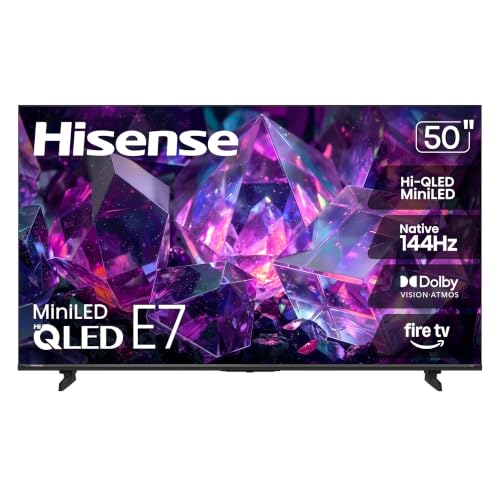
Hisense 50 Inch E7 Cinema
Best for: motion-led viewing on Fire TV, where a native 144Hz panel, full-array local dimming and Dolby Vision IQ arrive in a 2026 model
Not suited for: a Google TV or Roku household standardising its interface across rooms — this set’s Fire TV platform is its own ecosystem commitment
- Screen size: 50 inches
- Panel: Hi-QLED Mini-LED, 4K UHD
- Platform: Smart Fire TV; Alexa+
- Model year: 2026 new, per the listing
- Refresh rate: Native 144Hz
- Backlight: FALD — full-array local dimming
- Formats: Dolby Vision IQ, Dolby Atmos, HDR10+ Adaptive
- Motion and picture: AI Picture; MEMC
Hisense’s E7 Cinema writes the most technical title in this group and seems to enjoy it: Hi-QLED Mini-LED, native 144Hz, AI Picture, Dolby Vision IQ and Atmos, FALD, MEMC, HDR10+ Adaptive, Alexa+, on Fire TV, as a 2026 model. Unpack the load-bearing terms. Native 144Hz is a panel claim, the strongest species of refresh statement. FALD — full-array local dimming — confirms the Mini-LED backlight is zoned rather than decorative. Dolby Vision IQ adapts HDR to the room’s ambient light, a feature with real value in the multi-purpose rooms this size serves, and HDR10+ Adaptive keeps it company. MEMC is motion estimation and compensation, the smoothing technology sport viewers either love or disable, present here to be judged rather than hidden.
The Cinema in its series name is doing honest work: this is a film-and-sport specification wearing a gaming-grade panel. Fire TV as the platform will decide some purchases by itself — households on Amazon’s ecosystem, with Alexa routines and Fire devices in other rooms, gain continuity; Google TV and Roku households should count the interface switch as a cost. Alexa+ in the title signals the current generation of that assistant. On stated hardware alone, the E7 stands shoulder to shoulder with the QM6K at the top of this group’s motion table, and its format list — Vision IQ plus HDR10+ Adaptive — is arguably the most room-aware here.
There is a confidence in a listing that names its dimming architecture and its motion processing outright, inviting verification instead of deflecting it. Hisense has built its challenge to the established brands on exactly that transparency, and at 50 inches the E7 is the challenger in full voice. Owners who enjoy a specification that argues back will enjoy this one.
The E7’s AI Picture line signals Hisense’s processing ambitions, and in a set whose hardware is this explicit, the processing claim reads as the final layer rather than a substitute for one. Sport benefits most visibly — MEMC smoothing under user control, a native fast panel beneath it — while film viewers can restrain the processing and let the FALD backlight do the evening’s work. Two audiences, one panel, settings apart: a flexibility the listing earns by stating its parts separately.
Strengths
- Native 144Hz panel with FALD Mini-LED backlight, both stated plainly
- Dolby Vision IQ and HDR10+ Adaptive adapt HDR to room light
- 2026 model on Fire TV with Alexa+ for Amazon-ecosystem homes
Trade-offs
- Fire TV platform will not suit homes standardised on Google TV or Roku
- MEMC smoothing divides opinion and may be disabled by film purists
- Hi-QLED branding requires translation for shoppers comparing across brands
Specification readers will appreciate how much the E7’s listing is willing to state — Check price on Amazon

Roku 50 Inch Select Series QLED
Best for: a simplicity-first bedroom or guest room where Roku’s interface, a voice remote and Bluetooth headphone mode matter more than backlight architecture
Not suited for: a home-cinema brief — the listing makes no Mini-LED, HDR-format or refresh claims, and its virtues are platform virtues
- Screen size: 50 inches
- Panel: QLED, 4K (2160p), flat screen
- Platform: Roku Select Series Smart TV
- Model year: 2026
- Remote and audio: Voice Remote; Wi-Fi and Bluetooth Headphone Mode
- Content emphasis: Live local news, sports and movies, per the listing
- HDR formats: Not stated in the listing title — verify with the manufacturer documentation
- Backlight class: QLED; Mini-LED not stated in the listing
The Roku Select is the group’s argument that a television can win on manners. Its listing leads with the platform and the experience — Roku’s interface, a voice remote, Wi-Fi, a Bluetooth Headphone Mode, live local news, sports and movies — and mentions the QLED panel almost as a credential rather than a crusade. That ordering matches how this set will actually be used: in a bedroom where the news runs with morning coffee, in a guest room where a visitor must master the remote in ninety seconds, in a rental where the interface cannot require a tutorial. Roku’s home screen remains the industry benchmark for not getting in the way, and pairing it with quantum-dot colour at 4K covers the picture side respectably.
Bluetooth Headphone Mode is the listing’s sleeper feature and deserves promotion: private listening through wireless headphones, straight from the television, is the difference between a partner sleeping and a partner enduring a finale. For shared bedrooms it may be the single most-used feature in this entire guide. The spec box records the title’s silences — no HDR formats, no backlight architecture, no refresh figure — without treating them as scandals; this set’s buyer is purchasing calm, colour and compatibility with every major service, and on those terms the listing is complete. Readers who need the cinema brief should climb to the Mini-LED sets above, starting with the console-ready options in our gaming TVs for PS5 guide if play is part of the room’s life.
Roku’s own-brand televisions also simplify the support story: one company answers for panel and platform alike. In guest rooms, rentals and parents’ bedrooms — the habitats this set is built for — that single point of responsibility, plus an interface a stranger can drive, outweighs dimming zones nobody in those rooms will ever inspect. It is the group’s most honest mismatch of ambition to audience, in the audience’s favour.
The Select Series name itself is a promise of curation — Roku choosing the specification so the buyer does not have to — and at 50 inches that promise lands in rooms where decision fatigue is the real enemy: the spare room refresh, the parent’s upgrade, the rental refresh between tenants. Every one of those purchases values a set that can be unboxed, connected and understood in an afternoon, and then not thought about for years.
Strengths
- Roku interface with voice remote is the group’s simplest to live with
- Bluetooth Headphone Mode enables private listening without accessories
- QLED colour at 4K with live local content emphasised
Trade-offs
- No HDR formats or backlight architecture stated in the listing title
- No gaming or refresh claims for console-led rooms
- Platform minimalism omits the smart-home depth of rival ecosystems
Guest rooms and quiet bedrooms should give the Roku Select’s calm listing a look — Check price on Amazon
Six Cabinets, Four Philosophies
Laid side by side, the group resolves into four philosophies wearing six badges: Samsung’s flagship completeness, TCL’s backlight ladder within one brand, Hisense’s specification maximalism, and Roku’s platform minimalism. The table shows where each set’s listing spends its words, which is a reliable map of where each maker spent its money.
| Pick | Size | Backlight / Processor | Display | Headline trait |
|---|---|---|---|---|
| Samsung 50 Inch Neo QLED QN90F | 50 in | Mini LED, Vision AI | Neo QLED 4K | Glare Free, Gaming Hub, Atmos sound |
| Samsung 50 Inch QN70H | 50 in | NQ4 AI Processor | Neo QLED Mini LED | 100% Color Volume claim, 2026 |
| TCL 50 Inch Q65 | 50 in | Google TV | QLED 4K | Dolby Vision, Atmos, HDR Pro+ |
| TCL 50 Inch QM6K | 50 in | Google TV voice remote | QLED Mini LED | 144Hz, IMAX Enhanced |
| Hisense 50 Inch E7 Cinema | 50 in | Fire TV, AI Picture | Hi-QLED Mini-LED | Native 144Hz, FALD, Vision IQ |
| Roku 50 Inch Select Series QLED | 50 in | Roku | QLED 4K | Bluetooth Headphone Mode |
The backlight divide organises everything. Four sets — both Samsungs, the QM6K, the E7 — carry Mini-LED architectures under three different brand names, and two — the Q65 and the Roku — keep standard QLED lighting. In a darkened room the divide is visible; in a lit bedroom it narrows to a nuance; in a guest room it vanishes entirely. A buyer should therefore grade the divide by their darkest regular viewing, not by the technology’s prestige, and spend the difference on the platform or sound they will touch daily if the divide grades low.
Platform is the second divide and the more personal one. Google TV appears twice, both TCLs; Fire TV once, with Alexa+; Roku once; Samsung’s own system twice, with Alexa built in and, on the QN90F, a Gaming Hub. Households rarely regret standardising, and often regret fragmenting, so the platform column of the table deserves a household vote before the panel column gets one. Readers whose 50-inch decision is really a retro corner in disguise will find kindred restraint in our HD televisions for retro gaming guide, where modest panels are chosen on purpose.
Neo QLED Versus QLED: The Distinction, Taught Properly
Both terms describe the same colour technology — a quantum-dot film that converts blue backlight into highly saturated reds and greens — and differ only in what sits behind the film. Standard QLED uses a conventional LED backlight, typically edge-lit or a simple direct array, so brightness is managed across large areas at once. Neo QLED, Samsung’s name for its implementation, substitutes Mini-LEDs: diodes small enough to pack in thousands, grouped into zones that brighten and dim independently. Hisense’s Hi-QLED Mini-LED and TCL’s QLED Mini LED are the same architectural idea under rival badges, which is why this guide groups by architecture rather than by trademark.
What do dimming zones actually change on screen?
Three things a viewer can see without instruments. First, dark scenes hold their darkness beside bright objects — a candlelit face, a night street — instead of the whole frame lifting to grey. Second, HDR highlights gain headroom, because a zone can push hard locally while its neighbours rest. Third, subtitles and credits stop blooming into halos. What zones do not change is colour science, sharpness or motion; a standard QLED set with good processing, like the Q65, can still win on those axes. The distinction is real but specific, and buying it for the right reason — dark-room film viewing — is what turns it from marketing into value.
Is quantum-dot colour itself worth insisting on?
At this size and in these rooms, yes, with a caveat. Quantum-dot colour holds saturation at the brightness levels living rooms use, so the picture looks rich at noon settings rather than only in a darkened demo. The caveat is that every set in this guide already has it, which converts the question from whether to which backlight and platform should carry it. QLED is the entry ticket here, not the differentiator — a useful simplification the group offers for free.
Viewing Distance and the 50-Inch Room
Fifty inches has a natural habitat, and it is defined by the tape measure. Sit closer than about a metre and a half and individual pixels on lesser content, plus the sheer field of view, start to intrude; sit beyond roughly two and a half metres and the set begins to read as a 43-inch would, its 4K detail dissolving into the distance. Between those bounds — the depth of a double bed plus a dresser, a small lounge’s sofa-to-wall span, a flat’s combined living space — the size is invisible in the best sense, neither apologising nor dominating. Measure the room’s actual seating, not its hoped-for rearrangement, and let the number confirm or veto the diagonal before any panel argument begins.
Height and angle complete the physical brief. Bedroom sets are watched reclined, which raises the ideal mounting point and argues for a tilt-capable bracket; second-lounge sets are watched upright from varied seats, which argues for the wider viewing angles QLED panels generally hold and for centring the screen on the main sofa rather than the room. Glare geometry matters at this size because the rooms are windowed: the QN90F’s stated Glare Free treatment is one answer, curtain discipline is another, and rotating the seating plan a few degrees is the free one nobody tries first.
Sound follows distance too. At two metres, the built-in audio of a set like the QN90F — Object Tracking Sound Lite with Atmos — covers dialogue and effects respectably, while the Roku’s Bluetooth headphone mode covers the after-hours hours. A soundbar at this size should be bought for a measured complaint, usually dialogue clarity over music in mixes, rather than as a reflex; small rooms forgive small speakers more than large rooms forgive large ones.
Choosing the Platform at This Size
Bedroom and second-room sets are used in fragments — twenty minutes of news, an episode, a match half — and fragmentary use punishes slow, cluttered interfaces more than main-room use does. Roku’s minimalism, Google TV’s recommendation rows and Fire TV’s Amazon integration each optimise a different fragment: finding live local content, resuming a series, and continuing an Amazon-centric library respectively. Samsung’s platform adds the Gaming Hub’s consolidation on the QN90F. The right question is not which interface is best in the abstract but which one the household’s other screens already speak, because the second television should feel like a dialect of the first, not a foreign language learned at midnight.
HDR Formats at 50 Inches: A Field Guide
The listings here name four HDR dialects, and a buyer benefits from knowing their relations. HDR10 is the universal baseline every service supports. Dolby Vision adds scene-by-scene instructions mastered per title, and appears across this group — plainly on the TCLs, as Vision IQ with room adaptation on the Hisense. HDR10+ is the rival dynamic system, named in adaptive form on the E7 and as HDR Pro+ branding on the Q65. Neo Quantum HDR+ is Samsung’s own presentation tier on the QN90F. No household needs all four; a household needs the one its favourite services actually send, which for most streaming libraries means Dolby Vision earns its prominence in these listings.
The subtler point is that HDR at 50 inches is a contrast story before it is a brightness story. At bedroom distances, the difference between a highlight that blooms across a standard backlight and one contained by Mini-LED zones reads immediately, while absolute peak brightness — the showroom metric — matters mostly in sunlit rooms. That is why this guide keeps returning to backlight architecture when HDR is discussed: the format supplies the instructions, but the backlight decides how faithfully a small screen can obey them.
Small Screens, Serious Sound
Fifty-inch rooms punish audio excess and reward audio fit. A full surround rig in a bedroom is a wiring hobby, not an upgrade; the realistic ladder runs from the set’s own speakers — strongest here where listings name systems, as Samsung’s Object Tracking Sound Lite does — through a compact soundbar for dialogue weight, to headphones for the night hours, where the Roku’s Bluetooth mode sets the group’s standard. Each step should be bought against a named dissatisfaction, because small-room acoustics flatter modest equipment and expose overbuilt equipment’s clutter immediately.
Dialogue deserves its own sentence, since it is the commonest small-room complaint and the least related to bass. Night modes and dialogue-enhancement settings, buried in every modern platform’s audio menu, compress a mix’s dynamic range so whispers and explosions coexist at bedroom volume. Ten minutes finding that setting on setup day will do more for a 50-inch set’s perceived quality than any accessory purchased in its first year.
Longevity and the Second-Room Promotion Path
Second-room sets live interesting lives: today’s bedroom flagship is tomorrow’s kitchen or study set, and a 50-inch QLED’s portability between roles is part of its value. Panels at this size move house easily, remount without drama, and suit almost any room’s geometry, so a well-chosen set rarely becomes obsolete in a household — it merely changes address. That argues for buying the platform the household already speaks and the colour technology that will still flatter content in five years, both of which this group offers in several combinations.
Update support is the variable to weight. The 2026 models here — QN70H, E7, Roku Select — carry the longest runway of platform updates by construction, while the 2024 and 2025 sets trade a year or two of runway for maturity and position. None of the six is anywhere near abandonment, but a buyer planning a decade in one room should let vintage vote; a buyer planning the promotion path can safely let it abstain.
Gaming at Fifty Inches: A Realistic Word
Bedroom and second-room gaming has its own character — a console that migrates, a PC in the same room, sessions measured in episodes rather than marathons — and it rewards different virtues than a dedicated gaming wall does. Panel speed matters where it is stated: the QM6K’s 144Hz and the E7’s native 144Hz are the group’s verifiable credentials, and the QN90F’s Gaming Hub organises the software side of play even though its title states no refresh figure. Port counts and specifications live in manufacturer documentation for every set here, and a player with a specific console or graphics card should confirm the match there before the box is opened, because a television’s gaming life is decided as much by its sockets as by its screen.
Input behaviour completes the picture. Every modern set in this class carries a game mode that trims processing for responsiveness; the owner’s job is simply to make sure the console’s input actually uses it, a two-minute menu check that separates a responsive set from a sluggish-feeling one with identical hardware. At 50 inches, viewed from a bed or a desk chair, that responsiveness is felt at unusually close range — one more reason this size class, chosen well, punches so far above its diagonal for players.
Faults Specific to Buying at 50 Inches
Treating Neo as a spelling rather than a structure
Neo QLED’s Mini-LED backlight is a physical difference with visible consequences in dark scenes; skimming it as a trim level leads buyers to compare prices across architectures and conclude falsely that one brand is simply dearer.
Mounting for the room’s photograph instead of its seating
A set centred on a wall but off-axis from the bed or sofa will be watched at an angle for a decade. Centre on the viewers, then let the wall’s symmetry adjust — the picture is the room’s focal point only when it is actually being watched.
Ignoring the headphone question until the first late final
Shared bedrooms discover private listening the hard way. The Roku states Bluetooth Headphone Mode in its listing; other sets’ listings leave the feature to documentation. Households with different bedtimes should settle the question before purchase, not during extra time.
Buying refresh for consoles the room will never host
A stated 144Hz panel is a genuine asset for PC and high-frame console play, and dead weight for a set that will show news and series for a decade. Match the motion specification to the sources actually moving into the room.
Frequently Asked Questions
What does Neo QLED add over regular QLED?
A Mini-LED backlight with local dimming zones behind the same quantum-dot colour layer. The visible gains are dark-scene control, HDR highlight headroom and reduced haloing. Samsung’s QN90F and QN70H carry the Neo badge here; TCL’s QM6K and Hisense’s E7 achieve the same architecture under their own Mini-LED names.
How far should I sit from a 50-inch TV?
Roughly one and a half to two and a half metres suits most viewers and content at this size. Closer emphasises immersion and reveals lesser sources; farther dissolves the 4K advantage. Bedroom geometry — bed length plus a gap — lands naturally in the sweet spot, which is why this size owns the category.
Which of these is best for gaming?
The QM6K and E7 state 144Hz-class panels — the QM6K at 144Hz, the E7 natively — making them the group’s stated motion leaders, and the QN90F adds Samsung’s Gaming Hub. Port specifications should be verified in manufacturer documentation for the specific console or PC involved before ordering.
Is standard QLED, like the TCL Q65, a false economy?
No. Its quantum-dot colour and full format list serve lit and moderately lit rooms completely; what it surrenders is dark-scene backlight control. In a bedroom that rarely goes fully dark, the surrender may never be witnessed, and the saving is real every day.
Why does the Roku cost its place with so few stated specifications?
Because its listing sells a different asset: the simplest interface in the group, a voice remote, and Bluetooth headphone listening. For guest rooms, rentals and technology-averse households, those are not consolation features — they are the entire purchasing brief, met completely.
Can a 50-inch set serve as a main television?
In flats and small lounges, yes — the size was the main-room standard not long ago, and these panels are far better than the sets that held that title. The Mini-LED models in particular give up nothing in picture architecture to their larger siblings; only the field of view shrinks, and room size decides whether that matters.
Do I need Mini-LED for a bedroom TV?
Only if the bedroom hosts serious film viewing in darkness. Mini-LED’s gains live in dark scenes; a bedroom used for news, series with the lamp on and morning television will rarely summon them. The Q65 and Roku exist precisely for those rooms, and their owners are not enduring a lesser product — they are declining an unused one.
Which platform is easiest for guests and grandparents?
Roku’s, by design consensus — its home screen is a grid of services with no recommendation layer to explain, and the Select Series pairs it with a voice remote for those who prefer speaking. Google TV runs it close for households already signed into Google elsewhere.
Are 50-inch QLED sets bright enough for a sunny room?
Quantum-dot panels are among the stronger categories for lit rooms, and this group adds specific defences: the QN90F’s Glare Free treatment, the QM6K’s stated High Brightness, and Dolby Vision IQ’s room adaptation on the E7. Orientation still matters — a screen facing a window suffers on any technology — but within the category, these listings name their answers.
What is HDR Pro+ on the TCL Q65?
TCL’s branding for its enhanced HDR presentation, listed alongside Dolby Vision and Dolby Atmos on the Q65. Read it as the maker’s tuning layer over the licensed formats rather than a separate standard a service must support — the practical meaning is that HDR streams are handled with the brand’s own processing intent applied.
Should the second room match the main room’s platform?
Where possible, yes. Interface consistency across rooms is a daily convenience that specification sheets never price, and this group offers Google TV, Fire TV and Samsung options that likely mirror a household’s main set. Roku is the exception worth making deliberately, for rooms whose users value its simplicity over household uniformity.
Final Recommendation
Grade your room’s darkness and your household’s platform first; the shortlist then writes itself. Bright, mixed-use rooms point to Samsung’s QN90F and its glare treatment, or to the QN70H where colour volume and the newest processing lead. Film-and-gaming rooms at this size point to TCL’s QM6K or Hisense’s E7, the stated-motion Mini-LED pair, divided mainly by Google TV against Fire TV allegiance. Series-and-news households on Google TV take the Q65 without a backward glance, and any room where simplicity is the supreme virtue takes the Roku and its headphone mode.
One practical mercy of this size class deserves the penultimate word: every set here can be unboxed, mounted and understood by one person in an afternoon, and none demands a room be rebuilt around it. The decision that remains is therefore purely about picture philosophy and platform — the two things the listings state most clearly — rather than about logistics, which is how television buying ought to feel and so rarely does.
Fifty inches rewards the reader who resists both snobberies — the one that calls it too small for cinema and the one that calls it too grand for a bedroom. It is the size of real rooms and real evenings, and with quantum-dot colour now standard across the class, the evenings it serves are richer than its modest diagonal suggests — which is, in the end, exactly the trick a second screen is supposed to perform.