What's inside
- Key Takeaways
- Quick Picks
- How We Chose These Picks
- What Makes a Speaker a Great Two-Channel Performer?
- Which Amplifiers Bring Out the Best in These Speakers?
- How Do Sources Change What These Speakers Reveal?
- How Do the Six Speakers Compare for Music?
- How Does the Listening Room Shape a Two-Channel Choice?
- How Should You Set Up a Two-Channel Listening Position?
- What Mistakes Do Two-Channel Buyers Make?
- Which Genres Rearrange This Ranking?
- What About the Second System — Desks, Dens and Bedrooms?
- How Should You Audition Two-Channel Speakers?
- Why Does Two-Channel Endure in a Surround and Soundbar World?
- What Should You Spend on Everything Else?
- Final Recommendation
- Frequently Asked Questions
- Related Guides
As an Amazon Associate I earn from qualifying purchases. This post may contain affiliate links at no extra cost to you.
widgetverdict.com is reader-supported. When you buy through links on our site, we may earn an affiliate commission.
Where to buy: five towers in this guide link to Amazon listings we verified one by one — most are priced per cabinet, so a stereo pair means two — while the Danish pick at the end is sold through hi-fi dealers and is named for auditioning rather than clicking. Nothing here is bundled, refurbished or bundled-with-anything; what the listing names is what the notes describe.
The best 2 channel speakers are judged by a single, unforgiving standard: what they do to a recording when nothing else is in the room. No centre channel to carry the voice, no subwoofer to carry the weight, no surround effects to hide behind — just two cabinets, an amplifier and the music, exactly as stereo was designed and exactly as most great recordings were made. It is the purest format in home audio, and the least forgiving of a speaker that cheats, because in two channels there is nowhere for a flaw to hide.
This guide ranks six towers as music machines. The virtues that matter here are the listener’s virtues: a soundstage that places a string quartet in space rather than smearing it across a wall, tonal balance that lets a voice sound like a person rather than a demonstration, bass with pitch and shape rather than mere presence, and the kind of long-session comfort that keeps a listener in the chair through the second side of a record. Our companion guide to 2.0 home theatre speakers examines a similar field through cinema’s eyes — dialogue, effects, receiver configuration — and reaches a different order, because a speaker that flatters a film score and a speaker that honours a recording are related but not identical achievements.
Every pick is a passive tower for a stereo amplifier, though AV receivers with a good stereo mode serve several of them well. Sources are assumed to be the modern mixture — streaming, CD, vinyl, files — and the rankings weight how a speaker treats all of them, including the imperfect recordings every real collection contains. Choose by the character that matches your library, and two channels will do what they have done for sixty years: disappear, leaving the music in the room.
Key Takeaways
- Two-channel listening is the purest test of a speaker: imaging, tonal honesty and bass pitch decide everything, with nowhere to hide.
- The Wharfedale Diamond 12.4 is our music-first default — warm, spacious and kind to the imperfect recordings real collections are made of.
- The ELAC F6.2 is the neutral choice, presenting recordings as they were made for listeners who want the truth, politely delivered.
- The SVS Prime Tower images with unusual precision and keeps bass lines legible inside dense mixes.
- The Klipsch RP-8000F II is the live-energy pick: rock, jazz and orchestral dynamics with a physicality the others admire from a distance.
- The Polk ES60 is the streaming era’s easy listener — smooth, forgiving and happy with every source a modern household owns.
Quick Picks
| Pick | Badge | Why it earns its place |
|---|---|---|
| Wharfedale Diamond 12.4 | Best overall for music | A warm, spacious presentation that turns long listening sessions into the point of the evening. |
| ELAC Debut 2.0 F6.2 | Best neutral presentation | Even-handed and composed, it lets the recording — not the speaker — set the mood. |
| SVS Prime Tower (Pair) | Best imaging and bass discipline | A three-way design that keeps voices centred and bass lines readable in busy arrangements. |
| Polk ES60 | Best easy listening | Smooth, generous sound that treats streamed and older sources with unusual kindness. |
| Klipsch RP-8000F II | Best live energy | Horn efficiency and twin big woofers reproduce the physical thrill of a performance. |
| Dali Oberon 5 | Best slim music tower (prose-only) | A Danish design with a light, open character in a cabinet narrow rooms can welcome. |
How We Chose These Picks
Music-first selection begins with the soundstage, because stereo’s whole promise is spatial. We favoured speakers whose imaging is stable and specific — a singer located, not approximated; a piano with width as well as position; a quartet whose inner voices can be followed individually. That quality comes from driver matching, cabinet discipline and dispersion control, and it cannot be added later by any amplifier or cable, which is why it outranks every other criterion in this guide.
Tonal honesty came second, defined carefully. Honest does not mean identical: the six picks here span warm to neutral to vivid, and all are honest in the sense that their character is consistent, predictable and free of the vices — a treble spike that fatigues, a midrange hollow that thins voices, a bass hump that turns every recording into the same recording. We penalised vices, not personalities. A listener is entitled to choose a warm speaker or a vivid one; nobody chooses to be shouted at by a resonance.
Bass quality — pitch, shape, decay — ranked above bass quantity, because music lives in the bass line rather than under it. Amplifier manners mattered too: two-channel systems are built around stereo amplifiers of every size from compact modern designs to vintage receivers, so efficiency and impedance behaviour earned real weight. Finally, we favoured ranges with the fit, finish and support to serve as the permanent heart of a listening room, because that is the job these speakers are hired for. The Dali Oberon 5 meets every product test and appears without a link solely because its dealer-channel sales left no marketplace listing we could verify responsibly.
What Makes a Speaker a Great Two-Channel Performer?
Start with the stereo image, the format’s founding miracle. Two matched cabinets, correctly placed, can conjure a singer standing between them, a drum kit arranged behind, and a hall’s reflections around both — information that exists in the recording as nothing more than level and timing differences between channels. A great two-channel speaker preserves those differences faithfully: its drivers are matched closely enough that the image does not wander, its dispersion is even enough that the image survives small movements of the listener, and its cabinet adds no smear of its own. When those conditions hold, the speakers vanish from the listener’s account of the experience, and only the performance remains.
Tonal balance is the second pillar, and the more personal one. A voice reproduced with its chest and breath intact, a cello with its wood, a cymbal with its shimmer rather than its splash — these are the textures that make listening an evening’s occupation rather than a background. Speakers differ legitimately in how they present those textures, which is why this guide describes character rather than crowning a single frequency response. What cannot be defended at any character is unevenness: a balance that changes its mind across the range, flattering one instrument and betraying the next.
The third pillar is dynamic honesty at domestic levels. Most two-channel listening happens far below demonstration volume, in the range where a system must render a whisper and a chorus from the same setting of the volume control. Speakers that only wake up when driven hard fail the format’s daily life, however thrilling their peaks. Every pick here holds its balance at the levels of real evenings — and the best of them, played quietly late at night, can make a room feel like a studio control room with the lights low, which is the experience this entire category exists to provide.
Which Amplifiers Bring Out the Best in These Speakers?
Two-channel systems are built around their amplifiers more intimately than any other format, because the amplifier’s character is part of the sound in a way listeners can learn to recognise. The Wharfedale is the gracious partner: its easy load and warm balance suit everything from a vintage receiver kept alive for its tuner to a compact modern integrated, and it returns the compliment by making modest electronics sound generous. The Dali, through dealers, behaves similarly in smaller rooms. If your amplifier is old, small or beloved beyond reason, these are your speakers.
The ELAC and the SVS sit at the revealing end. Both reward amplifiers chosen for current delivery and control, and both will show the difference when an owner upgrades from a receiver’s stereo mode to a dedicated integrated — not as a night-and-day transformation, but as a tightening of bass, a calming of treble and a stage that settles into focus. That responsiveness is a feature for system builders: the speaker is not the ceiling, so the system can grow around it for years. The Polk sits happily between the camps, content with a receiver today and appreciative of better tomorrow.
The Klipsch inverts the usual arithmetic. Its efficiency means the amplifier’s job is not power but poise — a small, clean amplifier of modest output can be the ideal partner, and several owners pair the big Klipsch towers with low-powered designs that would leave every other pick in this guide undernourished. When auditioning amplifiers for any of these speakers, bring the speaker’s character into the decision: warm with vivid, neutral with either, and never stack the same quality three deep, because a chain of bright components is how a good system becomes a tiring one.

Wharfedale Diamond 12.4 — Best overall for music
The Diamond 12.4 tops a music ranking because it understands what listening is for. Its presentation is warm without being vague, spacious without being diffuse: voices carry body and breath, acoustic instruments keep the wood in their sound, and the soundstage arranges performers in a space that feels like a venue rather than a diagram. Kevlar-woven woofers and a carefully voiced soft dome tweeter produce a top end that declines to glare, so the bright masterings and honest live recordings that populate real collections remain pleasures instead of endurance tests.
Long sessions are its home ground. Where forensic speakers can make an evening feel like an inspection, the 12.4 makes it feel like attendance — the listener stops auditing the system and starts following the music, which is the entire purpose of the expenditure. Jazz trios settle into the room, folk recordings gain intimacy, and orchestral works unfold with a breadth that belies the cabinet’s modest footprint. Its bass is full and tuneful rather than seismic, keeping double basses and kick drums in proportion with the band above them.
The compromises are choices, plainly made: the leading edge of a snare drum is rounded where the Klipsch snaps it, and the finest treble detail is presented rather than spotlighted. Listeners whose libraries are pristine and whose taste runs analytical should read the ELAC’s notes next. Listeners whose libraries are loved should start here, because the Diamond 12.4 is the speaker in this guide most likely to be played every day of the decade it will serve.
Vinyl listeners form a particular constituency for the 12.4, and not by accident. Its forgiving top end treats surface noise and the brighter pressings of every era kindly, while the warm midrange gives voices and acoustic guitars the body that makes record listening feel distinct from streaming. Paired with a modest turntable, it anchors the kind of system that gets played nightly rather than demonstrated occasionally.
There is a quiet test the F6.2 passes that showroom auditions rarely apply: low volume after midnight. Its balance survives the descent intact — bass present, voices clear, treble airy rather than vanished — where lesser designs need loudness compensation to stay awake. Households in flats, with neighbours below and children asleep, will use that quality more than any other in this guide.
Electronic music makes an unexpected case for the Prime pair. Synthesised bass lines carry pitch and rhythm simultaneously, and the SVS’s disciplined low end keeps both legible where looser speakers smear the line into a pulse. Producers’ details — the second kick pattern, the sub-bass harmony — survive the journey to the listener, which is all accuracy ever means.
The ES60’s second life deserves mention: as the music system of a room that also watches films, it asks no change of settings, no second pair, no compromise mode. One system, one character, every source — for households rationing floor space and patience alike, that unity is a feature no specification table captures.
Orchestral listeners should not let the rock reputation mislead them. The RP-8000F II renders a full orchestra’s climax with a physical scale the other picks admire, and its horn keeps brass and percussion located inside the swell rather than smeared across it. Mahler is a dynamic event before he is anything else, and this is the Mahler pick of the six.
- Configuration: twin Kevlar-coned woofers, soft dome tweeter, slot-ported cabinet
- Musical strength: tonal warmth, spacious staging, fatigue-free treble
- Amplifier manners: an easy load that flatters modest stereo amplifiers
- Listening style: favours long sessions and real-world recordings
Strengths
- Warmth and space make records inviting rather than impressive
- Kind to bright, old and imperfect recordings
- Easy amplifier load suits vintage and compact amplifiers alike
Trade-offs
- Rounded transients beside the Klipsch’s attack
- Finest detail is understated on pristine recordings
- Bass favours tune over depth at the lowest notes
Best for: record collectors and long-session listeners with broad, imperfect libraries. Not suited for: analytical listeners who want every flaw illuminated.

ELAC Debut 2.0 F6.2 — Best neutral presentation
The F6.2 is the speaker for the listener who wants the recording, the whole recording and nothing added to the recording. Its three aramid woofers and waveguide tweeter produce the most even-handed balance in this guide — no region promoted, none apologised for — so the mood of a playback is set by the engineer who made it rather than the speaker that reproduces it. Chamber music keeps its proportions, studio productions reveal their architecture, and a great vocal recording sounds like a person because nothing in the chain is editorialising.
That neutrality becomes a diagnostic tool for the rest of the system, which enthusiasts count as a virtue: source upgrades, a better cartridge, a cleaner stream — each improvement is audible because the speaker is not masking the chain behind a personality. The imaging is precise and stable, the bass firm and articulate, and the whole presentation holds together at the low volumes of late listening as faithfully as at full voice.
The F6.2 asks for an amplifier with real current behind its rating and rewards it immediately. Its finish is functional, its character is restraint, and listeners who want their speakers to add drama should look at the Klipsch. For the listener building a system meant to grow in truthfulness over years, this is the anchor pick of the guide.
- Configuration: three 6.5-inch aramid woofers, cloth dome tweeter in a waveguide
- Musical strength: neutrality that reveals recordings and sources alike
- Amplifier manners: moderate sensitivity, rewards honest current
- Listening style: favours critical listening and system building
Strengths
- The most even-handed balance of the six picks
- Imaging stays precise across genres and volumes
- Reveals source improvements instead of masking them
Trade-offs
- Restraint can read as plain beside vivid rivals
- Asks more of the amplifier than the easygoing picks
- Functional finish rather than furniture-grade
Best for: critical listeners and system builders who value truth over flavour. Not suited for: listeners who want the speaker to supply the excitement.
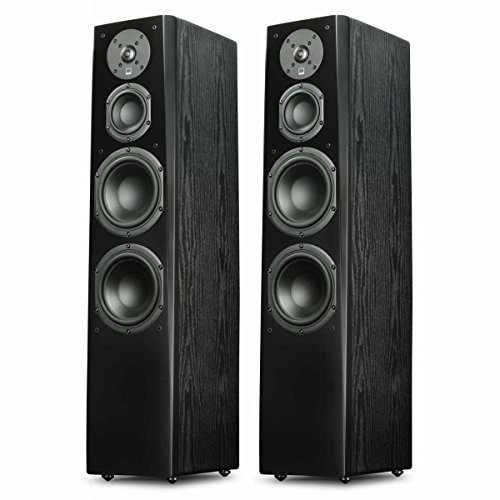
SVS Prime Tower (Pair) — Best imaging and bass discipline
The Prime Tower’s three-way architecture pays its musical dividend in the midrange. A dedicated driver for the voices and instruments that live there — separate from the twin woofers working beneath it — means a singer stays composed while the bass line digs in, and a piano’s left hand never clouds its right. In dense arrangements, from prog rock to full orchestra, that separation is the difference between following the music and merely receiving it, and it gives the Prime the most legible presentation of any pick here.
Imaging follows from the same discipline. The Prime pair places performers with a surveyor’s confidence and holds them there as the music swells, so a listener can lean into a mix and pick out the second guitar without the stage dissolving. The bass, true to the maker’s heritage, is deep for the cabinet and unusually well mannered — notes start and stop with the recording, not with the room’s memory of them — which makes rhythm sections sound expensive.
Sold as a pair, supported like a long-term purchase, and voiced for accuracy, the Prime Tower suits the listener whose taste runs to precision and whose library rewards it. It will not warm a cold recording or forgive a bad one; it will show you exactly what you own, beautifully, and for a certain kind of listener that is the highest compliment a speaker can earn.
- Configuration: three-way design, twin woofers, dedicated midrange, aluminium dome
- Musical strength: midrange separation and imaging precision in dense mixes
- Pricing: a matched pair in one listing, no per-speaker arithmetic
- Listening style: favours accuracy and rhythmically complex music
Strengths
- Dedicated midrange keeps voices clear inside busy arrangements
- Bass lines stay pitched and readable at any level
- Imaging precision rewards careful placement richly
Trade-offs
- Accuracy exposes poor recordings without sentiment
- Needs a capable amplifier to show its best
- Plain cabinet beside the Wharfedale’s furniture manners
Best for: listeners who follow arrangements and prize imaging and rhythm. Not suited for: collectors of rough recordings who want them forgiven.

Polk ES60 — Best easy listening
The ES60 is the two-channel pick for the way music is actually consumed now: streamed playlists that jump from a remastered classic to a bedroom recording to a live bootleg in four tracks, played through a system that must make all of them enjoyable. Polk’s voicing — generous through the midrange, smooth at the top, with Power Port bass that stays composed near the walls of real rooms — is engineered kindness, and it works. Nothing in a shuffled library ambushes the listener, and the system’s owner stops skipping tracks for sonic reasons, which is a quiet revolution in a household’s listening life.
That kindness is not vagueness. The ES60 images credibly, presents voices with presence, and carries enough scale for orchestral and electronic music to feel funded. Its high-resolution certification reflects a tweeter that extends cleanly for the better sources, while the overall balance refuses to punish the lesser ones. As the music half of a system that also serves television — a common double life — it is the most accommodating pick in this guide.
Purists will note the presentation favours enjoyment over dissection, and they will be right, and for most households it will not matter. The ES60 is the speaker for listeners who measure a system by how often it is on, and by that measure it may be the most successful pick here.
- Configuration: three 6.5-inch woofers, 1-inch tweeter, downward Power Port
- Musical strength: smooth generosity across wildly mixed sources
- Placement: bass design tolerates the wall distances of real rooms
- Listening style: favours playlists, streams and long background hours
Strengths
- Makes mixed-quality libraries uniformly enjoyable
- Smooth treble never fatigues during long listening
- Placement-friendly bass suits ordinary living rooms
Trade-offs
- Analytical detail sits behind the ELAC and SVS
- Warmth can soften the attack of aggressive music
- Tall cabinet still asks for sensible positioning
Best for: streaming-era households and listeners who value ease over analysis. Not suited for: critical listeners dissecting reference recordings.

Klipsch RP-8000F II — Best live energy
Some recordings are documents; others are events, and the RP-8000F II is built for the events. Twin 8-inch cerametallic woofers and the second-generation Tractrix horn give it the efficiency and headroom to reproduce the physical sensation of live music — the kick drum in the sternum, the brass section’s glare, the roar of a rock band at full tilt — from amplifiers of ordinary size. Jazz at club levels, orchestral climaxes, live albums of every era: this is the pick that makes listeners grin, because it restores the dimension of music that polite speakers edit out.
The second-generation tuning keeps that energy habitable. The horn’s revised geometry smooths the aggression older Klipsch designs could show on bright recordings, and the cabinet’s composure at volume means the excitement is the music’s rather than the speaker’s distress. Imaging is bold rather than forensic — performers are present and physical more than they are precisely surveyed — and for live material that trade feels like honesty about what a concert actually is.
It needs room, in every sense: physical space for the cabinet and its rear port, and acoustic space for the levels it invites. In that room, with that library, nothing else in this guide is as much fun, and fun is a legitimate specification in a hobby people pursue for joy.
- Configuration: dual 8-inch cerametallic woofers, second-generation Tractrix horn
- Musical strength: dynamic scale and live-performance physicality
- Amplifier manners: high efficiency flatters modest stereo amplifiers
- Listening style: favours rock, jazz and orchestral events at real levels
Strengths
- Live recordings gain genuine physical presence
- Plays loud from small amplifiers without strain
- Revised horn keeps long sessions on the right side of bright
Trade-offs
- Needs a medium-to-large room to breathe
- Imaging is bold rather than pinpoint
- Forward character exposes bright masterings honestly
Best for: live-music lovers and rock listeners with room to play. Not suited for: small rooms or listeners who prefer a recessive presentation.
Dali Oberon 5 — Best slim music tower (prose-only)
Dali’s Oberon 5 brings a distinctly Danish sensibility to this ranking: a slim cabinet, a wood-fibre woofer cone, and a voicing that prizes openness and ease over both warmth and analysis. The sound is light on its feet — quick, clear and unforced, with a soundstage that seems to float free of the cabinets — and it suits the smaller listening rooms where the bigger picks here cannot physically go. Apartment listeners with serious taste are its constituency, and it serves them with a refinement that small speakers rarely attempt.
The Oberon 5’s limits are its dimensions stated honestly: bass is articulate rather than deep, and large rooms at high levels will find the ceiling of a slim cabinet quickly. Within its intended habitat it is a delight, partnering modest amplifiers gracefully and wearing finishes that suit Scandinavian-influenced rooms as if designed alongside them — because it was. We list it without a link because Dali sells through its dealer network and marketplace listings were not verifiable when we checked; through a dealer, with an audition in a room like yours, it may be the easiest pick in this guide to fall for.
An audition note for the Oberon 5: hear it in a room the size of yours, at your distance, because its virtues are close-range ones — the floating stage, the unforced detail — that cavernous showrooms understate. Dealers who stock Dali generally understand this and will set the demo accordingly; trust the ones who do.
- Configuration: slim tower with wood-fibre cone woofers and a soft dome tweeter
- Musical strength: openness, speed and an unforced soundstage
- Form: the narrowest cabinet in this guide, for rooms width forgot
- Buying note: dealer-network product; audition locally where possible
Strengths
- Open, floating imaging from a cabinet small rooms accept
- Quick, articulate bass suits acoustic and vocal music
- Design and finishes integrate with styled interiors
Trade-offs
- No stable verified Amazon listing at the time of writing
- Bass depth and output ceiling reflect the slim cabinet
- Less physical scale than the twin-woofer picks
Best for: smaller listening rooms and design-conscious music lovers. Not suited for: large rooms or listeners chasing maximum scale and depth.
How Do Sources Change What These Speakers Reveal?
A two-channel system is a chain of revelations, and the speaker is merely the last place they become audible. Streaming at its highest quality tiers is now a genuinely fine source, and every pick here will show the difference between it and a compressed stream as a greyness in the treble and a flatness in the stage — most audible on the ELAC and SVS, least punished by the Wharfedale and Polk. CD, properly transported into a decent converter, remains the benchmark of consistency, and vinyl, properly set up, adds the particular presence that keeps its constituency loyal through every format war.
The practical advice is unfashionable: spend on the source you use daily before spending on the accessories you use never. A cartridge aligned by someone who knows how, a streaming tier upgraded, a library re-ripped without compression — each improves every record you own simultaneously, which no cable can claim. The speakers in this guide are honest enough to make those improvements obvious, and forgiving enough, in the warm half of the ranking, to let you enjoy the library while you make them.
One source note belongs to this format alone: the humble radio, streamed or broadcast, sounds disproportionately good through a real two-channel system, because voices and acoustic music are its whole diet. Owners rediscovering speech radio and live concert broadcasts through proper towers report the same surprise as film viewers in our companion guide — the everyday material, not the demonstration material, is where a good pair earns its keep across the years.
How Do the Six Speakers Compare for Music?
| Pick | Character | Imaging | Strongest repertoire |
|---|---|---|---|
| Wharfedale Diamond 12.4 | Warm, spacious | Broad and enveloping | Vocal, folk, jazz, classics |
| ELAC Debut 2.0 F6.2 | Neutral, composed | Precise and stable | Classical, studio productions |
| SVS Prime Tower (Pair) | Accurate, disciplined | Pinpoint in dense mixes | Prog, orchestral, electronic |
| Polk ES60 | Smooth, generous | Credible and forgiving | Playlists, streams, pop |
| Klipsch RP-8000F II | Vivid, physical | Bold and present | Rock, live albums, big jazz |
| Dali Oberon 5 | Open, light-footed | Floating and free | Acoustic, vocal, small rooms |
How Does the Listening Room Shape a Two-Channel Choice?
Rooms have characters as definite as speakers’, and the pairing of the two is the real purchase. A lively room — hard floors, bare walls, glass — adds its own brightness and echo to everything played in it, which argues for the calmer speakers in this guide: the Wharfedale’s warmth, the Polk’s smoothness or the Dali’s ease will absorb the room’s contribution and leave the music balanced. The vivid Klipsch in a lively room is a double helping of the same spice, thrilling for an hour and tiring for an evening.
A damped room — carpeted, curtained, furnished with the soft clutter of actual life — takes the opposite pairing gracefully. Here the ELAC’s neutrality and the SVS’s precision lose nothing to the room’s absorption, and the Klipsch’s energy arrives intact rather than multiplied. Most real rooms sit between the poles, which is why the middle characters in this guide are the safest recommendations and the extreme characters are the most rewarding when the match is right.
Size completes the triangle of considerations. The big Klipsch and the full-range ELAC need air around them to develop their bass and their stage; the Dali and the Wharfedale — the latter surprisingly — can work in modest rooms when placed with care, because their bass is voiced for tune rather than excavation. Measure your room’s patience as honestly as your budget: a speaker the room resents will be played quietly, then rarely, then not at all, and no specification in this guide can rescue a purchase the room has voted against.
How Should You Set Up a Two-Channel Listening Position?
Two-channel rewards geometry more than any other format, because the image is built entirely from the relationship between two speakers and one listener. Begin with the classic triangle: speakers and seat at its three points, the speakers roughly as far apart as the seat is distant, pulled clear of the wall behind them as far as the room allows. Toe-in then becomes the fine control — speakers aimed at the listener sharpen focus and centre the voice; aimed straighter down the room, they widen the stage and soften the top. There is no universal correct angle, only the angle at which a familiar voice sits most convincingly in your room, and finding it is an evening well spent.
Then treat the seat as part of the system. The listening position should sit away from the wall behind it where possible, because a head near a boundary hears that boundary’s bass reinforcement as boom. Symmetry matters more than any single dimension: a pair equidistant from their side walls images honestly, while an asymmetric pair can be coaxed but never fully cured. Finally, mark the positions once they are right — tape on the floor, a note in the system notebook — because a two-channel setup that survives cleaning day intact is worth more than a theoretically perfect one that drifts.
What Mistakes Do Two-Channel Buyers Make?
The first is auditioning with a single spectacular track, usually chosen for bass or brilliance, when the system must live with voices at low volume on ordinary evenings. The second is pairing by reputation rather than by character — a vivid speaker behind a bright source behind a lively room multiplies one quality into a flaw. The third is neglecting the amplifier’s quality in favour of its quantity, when two-channel exposes amplifier character more nakedly than any other format. The fourth is placing the speakers where the furniture dictates and never learning what they can do a metre into the room. And the fifth, quietest mistake is upgrading the speakers before the source: a two-channel system reveals its weakest link without mercy, and that link is often the stream, the cartridge or the recording itself — the cheapest fixes in the whole chain.
Which Genres Rearrange This Ranking?
Rankings are averages, and libraries are not. A classical listener’s order promotes the ELAC and the SVS — the speakers that keep orchestral architecture legible — and finds the Klipsch’s drama thrilling in climaxes and restless in chamber works. A jazz listener splits by era: small-group recordings glow on the Wharfedale, big bands swing hardest on the Klipsch, and modern studio jazz rewards the SVS’s separation. A rock listener’s order inverts the classical one almost exactly, with the Klipsch first, the Polk’s generosity valued for live recordings, and the neutral pair respected rather than loved.
Singer-songwriter and folk libraries — the voice-and-guitar core of many collections — belong to the Wharfedale and the Dali, whose midrange kindness and intimacy turn a listening chair into a small venue. Electronic libraries belong to the SVS and the Klipsch for opposite reasons: discipline and force. Hip-hop splits the difference, wanting the SVS’s bass legibility for the verses and the Klipsch’s physicality for the hooks, and settling happily on the Polk’s generosity when the system must also do everything else.
None of this invalidates the ranking; it explains what a ranking is. Our order weights the broad library most two-channel buyers actually own, across an evening that might hold four genres. Read your own library honestly, promote the pick whose character serves its centre of gravity, and the guide has done its work — the best two-channel speaker is the one matched to the records, not the one matched to a chart.
What About the Second System — Desks, Dens and Bedrooms?
Two-channel thinking does not end at the main room, and several picks here have second lives worth planning for. A pair demoted by an upgrade — or bought deliberately for a smaller space — serves a den, a study or a large bedroom with the same virtues it showed in the main system, because imaging and tonal honesty are distance-independent qualities. The Dali was designed for exactly these rooms; the Wharfedale and Polk adapt to them without complaint; and even the big Klipsch, in a house with a generous spare room, becomes the most entertaining second system imaginable.
This demotion path is part of the economics of buying well once. A speaker from a serious maker, bought for the main room and retired to a second one a decade later, delivers twenty years of service across two roles — an argument no disposable alternative can answer. Buyers choosing between the picks here on a knife edge might let that future break the tie: the speaker you can imagine in the next room, serving the next phase of the house, is usually the speaker to buy for this one.
How Should You Audition Two-Channel Speakers?
Bring the recording you have played most in your life, and one you have always suspected sounds bad. The familiar recording is the reference your ears actually own — you know where the singer breathes, how the room around the piano sounds, where the bass sits — and a speaker that renders it honestly, at the scale your room allows, has passed the only test that predicts a decade of satisfaction. The suspect recording is the forgiveness test: if a beloved but rough record remains listenable, the speaker’s character suits your library; if it becomes an exhibit, you are auditioning a laboratory instrument, however impressive its precision.
Insist on your own amplifier class, your own distance and your own volume — the modest level of a real evening, not the dealer’s demonstration level, which flatters every speaker and misleads every buyer. Listen from slightly off the sweet spot as well, because households move, partners join, and a stage that only exists for one head in one chair is a stage that will be enjoyed alone. The dealers who stock the makers in this guide generally honour such auditions, because a two-channel purchase made on evidence rarely comes back — and a returned speaker helps nobody’s evening, least of all the listener’s.
Why Does Two-Channel Endure in a Surround and Soundbar World?
Because the music was made for it. The overwhelming majority of recordings in every library — every classic album, every jazz session, every singer-songwriter record, most modern productions — exist as two channels, mixed by engineers listening to two speakers in a room much like yours. A two-channel system is not a reduced version of some grander format for this material; it is the native format, reproduced as its makers heard it. Surround systems must synthesise an environment for stereo music, and synthesis, however clever, is an interpretation layered over the original.
There is also the matter of attention. Two speakers and a chair constitute an invitation to listen — really listen, album-length, phone elsewhere — in a way that background-capable formats do not. Owners of good two-channel systems consistently report the same behavioural change: the listening session returns as an activity rather than an accompaniment. That is the deepest reason the format survives every technology cycle, and the reason a guide like this one still begins with imaging and tonal honesty rather than features. The features date. The chair, the pair and the record do not.
What Should You Spend on Everything Else?
The two-channel budget has a natural order, and respecting it prevents the classic lopsided system. Speakers first, because they set the character nothing downstream can revise. The room’s basics second — placement freedom, a rug, the seat in the right place — because they are free or nearly so and worth more than electronics. The amplifier third, matched in character to the speakers as this guide describes. The source fourth, upgraded at the point where its limits, not its badge, are what you hear. Everything after that — cables beyond the adequate, isolation beyond the sensible, accessories beyond the useful — belongs to the hobby’s decorative wing, and should be funded only after the library itself has had its share, because new records improve a two-channel system more reliably than new feet for it.
That order also explains why this guide can rank speakers without knowing your amplifier: at every level of the chain, the speaker is the decision that survives the others being revisited. Choose the pair whose character you want to live inside, and the rest of the system becomes a series of pleasant, reversible experiments around a constant. It is the most forgiving possible structure for a hobby famous for expensive mistakes.
Final Recommendation
Let your library decide, because in two channels the library is the specification. If it is broad, loved and imperfect, the Wharfedale Diamond 12.4 will make it the centre of your evenings for a decade. If it is pristine and your taste is analytical, the ELAC F6.2 tells the truth most completely, and the SVS Prime Tower tells it with the sharpest imaging and the most disciplined bass. Take the Polk ES60 when the system’s real job is making every modern source enjoyable without ceremony, the Klipsch RP-8000F II when music in your house is an event with a volume control to match, and seek out the Dali Oberon 5 at a dealer when the room is small and the taste is not. Two speakers, honestly chosen, remain the shortest path between a recording and the person it was made for.
A closing note on patience, which two-channel rewards more than any format. A new pair changes over its first weeks — drivers loosen, owners learn, rooms get rearranged around them — and the system that sounds merely promising on the first evening often sounds inevitable by the tenth, once the toe-in has been revisited and the seat has found its true position. Judge on the tenth evening. It is the standard this guide’s ranking quietly assumes, and the standard by which every pick here was chosen to be judged.
Keep the packaging until the return window closes and the serial numbers somewhere permanent after that. A two-channel pair is the component least likely to be replaced in the entire system, which makes its paperwork the longest-lived — and, when a driver needs service in year nine, the most valuable page in the house.
And once the system is settled, protect the ritual around it: a shelf or a playlist that holds the current rotation, a chair that is understood to be the listening chair, and an evening a week when the pair is used for nothing but the music. Systems do not stay central to a household by accident; they stay central because the household keeps the appointment the equipment makes possible.
One more experiment is free and reliably educational: swap the listening seat’s distance by half a metre in each direction over a week of evenings, and notice how the stage’s depth and the bass’s weight trade against each other. Two-channel systems are tuned by their owners in a way no other format permits, and that tuning — personal, patient, reversible — is not a chore the format imposes. It is the hobby itself, practised at its purest.
Then let the system be. The owners who extract the most from two channels are not the ones who adjust it most; they are the ones who, having adjusted it well once, spend the following years adjusting nothing but the record on the turntable and the name on the playlist. Every pick in this guide was chosen to reward exactly that loyalty.
Loyalty, in the end, is the metric no measurement captures and every long-term owner recognises: the system that gets switched on. By that metric the warm, the neutral and the vivid picks here will each find their households — and the households, a decade from now, will still be switching them on.
So choose the character, place the pair with care, and give the music the room. Two channels have carried the world’s recordings for generations of listeners who asked nothing more of their equipment than honesty — and have been repaid, evening after evening, in the only currency the hobby mints.
That repayment compounds quietly: a system listened to nightly for a decade delivers its cost back at a rate per evening that no other purchase in the house can match, which is why the owners of good two-channel pairs so rarely describe them as expensive, however the receipt read on the day.
Buy once, place carefully, listen nightly — the whole philosophy of this guide fits in those six words, and every speaker in it was chosen to make the philosophy easy to keep.
The first record to play, once the pair is placed, should be the oldest favourite you own — not the best recording, the most loved one. A system that honours that record has understood the assignment, and every pick here was shortlisted with exactly that first evening in mind.
Play it at the volume the song asks for, in the seat the system was tuned around, and let the search end there — with music, which is where every honest search in this hobby ends.
The search ending is not a small thing. It is the difference between a hobby that consumes its owner and one that serves them, and it is available at every rank in this guide to the buyer who chooses by library, room and character rather than by chart position alone.
Choose well, and it ends tonight — with the record playing, the chair occupied, and two speakers doing the oldest job in home audio exactly as it was meant to be done.
Frequently Asked Questions
What amplifier power do two-channel towers need?
Far less than folklore claims, and quality matters more than quantity. The Klipsch and Wharfedale thrive on modest stereo amplifiers; the ELAC and SVS reward amplifiers with honest current delivery. Judge by how an amplifier behaves into real speakers at your listening levels, not by its headline figure.
Can an AV receiver run a serious two-channel system?
Yes, with the right expectations. A good receiver in stereo or direct mode drives every pick here respectably, and adds streaming and television convenience. A dedicated stereo amplifier usually extracts the last measure of refinement — an upgrade for later, not a prerequisite for starting.
Is vinyl or streaming the better source for these speakers?
Both, honestly served. These towers reveal the quality of whichever source feeds them: a well-set-up turntable and a high-quality stream each sound like themselves. Spend on the source you actually use most, and set it up carefully — two-channel forgives nothing and rewards everything.
Do two-channel speakers need a subwoofer?
For music, the towers here reach low enough that most listeners will never miss one. Listeners with large rooms, organ or electronic libraries, or a taste for the deepest foundation can add one later; a well-integrated subwoofer is an extension of a two-channel system, not a correction of it.
How far apart should the speakers and the seat be?
Start with an equilateral arrangement — speakers as far apart as the seat is from them — then adjust by ear. Closer spacing suits smaller rooms and sharpens the centre image; wider spacing suits larger rooms and broader stages. The recording you know best is the measuring instrument.
Related Guides
Complete the listening room with our best 300 floor speakers, our best 15 inch powered speakers, and the cinema view in our guide to 2.0 home theater speakers.



[…] Complete the system with our best 300 floor speakers, our best 2 0 home theater speakers, and our best 2 channel speakers. […]