What's inside
- Key Takeaways
- Quick Picks
- How Did We Choose Low-Power Cards Without Inventing Their Wattage?
- What Does Low Power Actually Cost a Gamer, and What Does It Buy?
- Which Low-Power Card Fits Your Small Machine?
- How Do You Read a Low-Power Listing When No Wattage Is Stated?
- Which Games Belong to Which Tier of This Guide?
- How Do You Match a Low-Power Card to a Power Supply You Cannot Change?
- What Does a Low-Power Card Ask of Its Owner Over the Years?
- How Do the Six Low-Power Picks Compare Side by Side?
- How Should You Fit a Low-Power Card into a Small Machine?
- Why Do Heat and Noise Matter More in a Small Machine?
- What Mistakes Do Low-Power Buyers Keep Making?
- How Should a Household Choose When the Small Machine Serves Everyone?
- Final Recommendation
- How Does a Low-Power Card Change What a Small PC Is For?
- What Is the Quickest Sound Advice a Small-PC Owner Can Use?
- Why Does This Guide Rank Fit Above Performance?
- How Should You Prove a Low-Power Card on Its First Night?
- What Is the One-Sentence Version of This Guide?
- Frequently Asked Questions
- Related Guides
As an Amazon Associate I earn from qualifying purchases. This post may contain affiliate links at no extra cost to you.
widgetverdict.com is reader-supported. When you buy through links on our site, we may earn an affiliate commission.
Where to buy: this guide’s cards are all Amazon listings; the quick picks table links each one to its verified listing. Several share chip names across very different boards, so confirm the exact listing title before ordering.
There is a species of PC that gaming guides pretend does not exist: the small, quiet machine with a modest power supply, bought as an office box or a home theatre hub, whose owner would like it to play games without becoming a different computer. The best low power graphics cards for gaming are built for exactly that machine. Their defining traits are class traits, and this guide will describe them as such: low-profile and short boards that fit slim cases, designs that draw their power through the PCIe slot itself rather than demanding a supplementary power connector the small supply may not even have, and cooling proportioned to a chip that sips instead of gulps. A note on numbers before the picks: most of the listing titles in this category do not state a wattage, so this guide does not print one. Where a card’s low-power nature matters, we argue from its design — slot-powered, low profile, single fan — rather than inventing a figure the listing never gave.
The six picks divide by ambition. At the top, two RTX 3050 6GB cards in small-form dress are the real gaming instruments of the group: modern silicon with DLSS, sized and powered for machines that could never host their full-height relatives. Below them, MAXSUN’s two RX 550 boards — one low profile, one ITX — trade modern features for GDDR5 light gaming in the smallest bodies here. MSI’s GT 1030 follows as the display-and-media card with a little light gaming in its past, and the GT 610 closes the list as the honest floor: a card whose gaming claim belongs to history, included because some low-power briefs are really display briefs wearing a gaming search term. Each section grades its card against the small machine it was built for, and says plainly where the gaming ends.
Key Takeaways
- Low power in this class is a design language: low-profile boards, slot-fed power and no supplementary connector to hunt for.
- The two RTX 3050 6GB cards are the group’s real gaming instruments, with DLSS and modern drivers.
- MAXSUN’s RX 550 pair covers the smallest cases — one low profile, one ITX — with GDDR5 light gaming.
- The GT 1030 is a display and media card first; its DDR4 memory keeps its gaming light and old.
- The GT 610 is included honestly as a display card for legacy machines, not as a gaming recommendation.
- Listing titles here rarely state wattage, so this guide argues from design rather than printing invented figures.
Quick Picks
| Pick | Badge | Why it is here |
|---|---|---|
| maxsun GeForce RTX 3050 6GB | Best Low-Power Gaming Card | Current NVIDIA silicon and DLSS in a slim small-form-factor board. |
| SOYO GeForce RTX 3050 6GB Low Profile | Best True Low-Profile Gamer | A low-profile 3050 with HDMI 2.1 and DisplayPort 1.4a for slim cases. |
| MAXSUN Radeon RX 550 4GB Low Profile | Best SFF Light Gamer | GDDR5 and a low-profile body for small machines and older titles. |
| MAXSUN AMD Radeon RX 550 4GB | Best ITX All-Rounder | The same GDDR5 formula in an ITX board for compact standard cases. |
| MSI GeForce GT 1030 4GB | Best for Media and Displays | A single-fan, low-profile card with DisplayPort and HDMI for quiet HTPC duty. |
| GeForce GT 610 2GB Low Profile | The Honest Floor | A legacy display card for old machines and HTPC basics — gaming only in the historical sense. |
How Did We Choose Low-Power Cards Without Inventing Their Wattage?
The selection began with the machine, not the chip. A card qualified only if its design belongs to the low-power class as the class is physically defined: a low-profile or short board, a cooler sized to a modest chip, and a power arrangement that lives within what the PCIe slot provides, sparing the small power supplies in slim machines from a connector they do not carry. That filter admitted the small-form RTX 3050s, the compact RX 550s, and the display-class cards below them, and it excluded the full-size boards that dominate gaming guides — including several cards elsewhere on this site that are better gamers and worse answers to this question.
The second rule governed the writing rather than the picking, and it is worth stating in the guide itself: wattage figures appear only where a listing title states them, and in this pool the titles largely do not. So the spec boxes below describe what the titles do state — memory, format, outputs, interface — and the analysis argues low-power character from verifiable design facts: slot-fed designs, low-profile brackets, single-fan coolers, small-form intent printed in the listings themselves. A guide that printed precise wattages it had invented would be more impressive and less true, and at this end of the market, where the buyer’s whole problem is a constrained machine, truth about constraints is the product.
What Does Low Power Actually Cost a Gamer, and What Does It Buy?
What it buys is compatibility with the machines people already own. The slim office PC with its proprietary supply, the home theatre box in the television cabinet, the small tower under a child’s desk — none of these can accept a card that wants supplementary power connectors, two full-height slots and a wind tunnel. A slot-powered, low-profile card turns each of them into a games machine in an afternoon, without a power supply transplant, without a new case, and without the fan noise that makes a living-room PC unwelcome. That transformation, not a frame rate, is the product this category sells.
What it costs is ceiling. The same power envelope that makes these cards compatible caps their rendering ambition: the RTX 3050 pair plays the broad library at 1080p with DLSS as a valued colleague, the RX 550s play the older and lighter shelves, and the cards below them are display instruments with gaming in their ancestry. Resolution ambitions stop at 1080p throughout this guide, and settings ambitions should be set by the card’s tier rather than the game’s menu defaults. Buyers who understand that exchange — compatibility now, ceiling accepted — are this category’s happy customers. Buyers who expect a low-profile card to behave like its full-size namesake have mistaken a shared chip name for a shared power budget, and no cooler design can repeal that arithmetic.
Which Low-Power Card Fits Your Small Machine?

maxsun GeForce RTX 3050 6GB — Best Low-Power Gaming Card
maxsun’s small-form RTX 3050 is the card that makes this category feel modern. The silicon is the entry tier of NVIDIA’s recent line — the 6GB GDDR6 configuration whose gaming character this site has described in its full-size forms — carrying DLSS upscaling, ray tracing hardware and a place in the current driver branch, and maxsun packages it, per the listing title, as a slim board for mini and small-form-factor PCs. That combination is the whole argument: the software story of a current card, in a body and power class that a slim machine can host. At 1080p, across the back catalogue and the lighter half of the current library, this is a gaming card in the full sense, merely one that arrives in a smaller envelope.
The envelope’s terms are the class terms. A compact cooler has less thermal margin than the twin-fan boards elsewhere on this site, so long sessions in warm, small cases deserve decent airflow rather than a sealed cabinet. The 6GB buffer and its narrow memory path set the same ceiling they set everywhere: textures in the newest heavy releases are managed, not maxed. maxsun is a smaller brand than the majors, which places the usual weight on reading the individual listing. None of that dents the pick’s position. If the brief is the most gaming a low-power slot can honestly hold today, this card is the answer the rest of the list is measured against.
- Memory: 6GB GDDR6
- Format: slim, small-form-factor board
- Features: DLSS upscaling and ray tracing support
- Role: 1080p gaming in compact, low-power machines
Strengths
- Current-generation feature set in a small-form body.
- DLSS stretches its 1080p reach in supported titles.
- The strongest gaming claim in this guide, honestly bounded.
Trade-offs
- 6GB caps texture ambition in the newest releases.
- Compact cooling wants airflow a sealed cabinet denies.
- Smaller brand — the listing deserves a careful read.
Best for: slim and small-form PCs being promoted into real 1080p gaming. Skip it if your machine has a full-size case and a healthy power supply — the standard boards serve that desk without the compact premium.

SOYO GeForce RTX 3050 6GB Low Profile — Best True Low-Profile Gamer
Where maxsun’s board is small, SOYO’s is explicitly low profile — the half-height format that slimline office cases and home theatre enclosures physically require — and that single adjective is why it earns its own section rather than a footnote to the pick above. The specification beneath the bracket matches the class leader: an RTX 3050 with 6GB of GDDR6, the listing title stating a 96-bit bus and 2304 stream processors, and outputs that are usefully current for the format — HDMI 2.1 and DisplayPort 1.4a. A low-profile card with an HDMI 2.1 socket is a considered thing: it can drive a modern television properly from a half-height slot, which is the exact biography of a living-room gaming conversion.
SOYO is a budget brand, and the buyer’s diligence is the standard one for this shelf: confirm the low-profile bracket is in the box and the outputs match the listing’s description before the return window becomes a topic. The gaming terms are the 3050’s own — the broad library at 1080p, DLSS as a genuine tool, the newest heavy releases at managed settings — delivered in the one body shape that fits the machines this guide exists for. Between this card and the maxsun above, the decision is nearly pure geometry: measure the case’s bracket height and internal length, and let the tape measure pick. Performance will not separate them; fit already has.
- Memory: 6GB GDDR6, 96-bit bus
- Stream processors: 2304SP (as stated in the listing title)
- Format: low profile board
- Outputs: HDMI 2.1 and DisplayPort 1.4a
- Interface: PCI Express
Strengths
- True half-height format for slimline cases and HTPC enclosures.
- HDMI 2.1 suits a modern television from a low-profile slot.
- Full 3050 gaming brief — DLSS included — in the smallest body here.
Trade-offs
- Budget brand — verify bracket and outputs on arrival.
- Half-height cooling is the tightest thermal brief in the guide.
- The 6GB ceiling applies exactly as it does to its sibling.
Best for: slimline and home theatre cases that need a half-height card and real games. Skip it if your case takes full-height boards — the maxsun above and the standard 3050s elsewhere offer more cooler for the same silicon.

MAXSUN Radeon RX 550 4GB Low Profile — Best SFF Light Gamer
MAXSUN’s low-profile RX 550 is the pick for the machine whose ambitions are modest and whose case is not. The formula is the RX 550’s familiar one — 4GB of GDDR5, the genuine graphics memory that separates this card from the DDR-based display cards below it — in a small-form-factor, low-profile body built for gaming PCs of the compact kind, as its listing title puts it. That memory choice is what keeps the word gaming in this section without embarrassment: older titles, indie games and esports staples at reduced settings are playable in fact, not in marketing, and the card doubles as a completely competent display and media engine for the other twenty-three hours of the machine’s day.
The boundaries are generational. The RX 550’s architecture predates modern upscaling entirely, its driver story is a finished one, and contemporary releases are outside its reach at settings worth accepting. What it offers instead is the low-power class’s virtues in their purest small form: a half-height board, an undemanding power profile of the slot-fed kind, and a price that treats the whole upgrade as an afternoon’s experiment rather than a build decision. For a hand-me-down PC being given to a younger player with a library of classics, or a small media machine that occasionally becomes a games machine, this is the proportionate purchase — enough card, in the right shape, with nothing spent on capability the brief never ordered.
- Memory: 4GB GDDR5
- Format: low profile, small form factor
- Role: displays, media and light older games
- Support: DirectX 12 era feature set
Strengths
- GDDR5 gives it light gaming reach the DDR cards below cannot match.
- Low-profile SFF body fits the compact machines of its brief.
- A proportionate price for a light-duty transformation.
Trade-offs
- No modern upscaling; contemporary releases are out of reach.
- A finished driver story on an ageing architecture.
- Light gaming means light — settings and resolutions stay modest.
Best for: small machines playing older and lighter libraries. Skip it if the library includes recent releases — the two RTX 3050s above are this guide’s only route to them.

MAXSUN AMD Radeon RX 550 4GB — Best ITX All-Rounder
The second RX 550 in this guide wears a different body for a different case: ITX length rather than low profile, a short board for compact standard-height cases — the small towers and cube builds where bracket height is fine but card length is the constraint. The heart is shared with its sibling above: 4GB of GDDR5 across a 128-bit bus, a PCIe 3.0 interface, DirectX 12 support, and the same honest light-gaming envelope across older and lighter titles. MAXSUN lists it as a computer and gaming video card in ITX form, and for once the listing’s two nouns divide the card’s life accurately — computer first, most days; gaming second, of the classic and casual kinds.
Why does this guide carry both RX 550 bodies? Because in the low-power class, fit is not a detail — it is the category. A low-profile card in a standard case wastes nothing but solves a problem the case does not have, while an ITX board in a slimline case solves nothing at all, being physically unable to enter it. Buyers should therefore read these two sections as one pick wearing two coats, and choose by the case on their desk: half-height bracket, take the low-profile board; standard bracket with a short interior, take this one. The gaming, the media behaviour and the finished-driver terms are identical twins beneath the sheet metal.
- Memory: 4GB GDDR5, 128-bit bus
- Format: ITX-sized compact board
- Interface: PCIe 3.0 x16
- Support: DirectX 12
- Role: displays, media and light older games
Strengths
- ITX length fits compact standard-height cases.
- GDDR5 memory keeps light gaming genuinely available.
- The versatile single-slot answer for small general PCs.
Trade-offs
- Same generational ceiling as its low-profile sibling.
- Not a half-height card — slimline cases need the other board.
- Modern releases remain outside its settings reach.
Best for: compact towers and cube cases wanting displays plus light gaming. Skip it if your case is a slimline — its low-profile twin above is the same card in the shape you need.
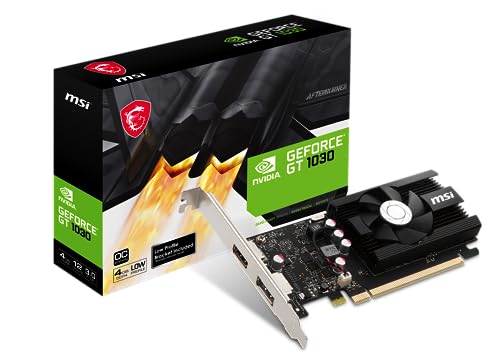
MSI GeForce GT 1030 4GB — Best for Media and Displays
The GT 1030 enters this guide through the media door. MSI’s board is a low-profile, single-fan card with DisplayPort and HDMI outputs, HDCP support and a 4GB memory complement that its listing title specifies as DDR4 across a 64-bit bus — and that memory type is the honest centre of its character. DDR4 confines the card’s gaming to the very light and the old, at reduced settings, and no section of this guide will inflate that. What the card does superbly is the low-power class’s other great job: driving modern displays from a small, quiet, slot-fed board, in a home theatre PC under a television or a slim office machine feeding two screens.
For that job its particulars are well judged. The single fan and low-profile body suit enclosures that sit within earshot and within sight. DisplayPort is the output small media machines most often lack and most often need. And MSI is a major maker, which at this end of the market buys a listing that says what the card is — the spec box above quotes its DDR4 plainly, in a category where less scrupulous listings let buyers assume GDDR5. Buy this card as the media and display instrument it is, and it will be quietly excellent for years. Buy it as a gaming card and the disappointment was printed in its own specification, in this guide, before purchase.
- Memory: 4GB DDR4, 64-bit bus
- Format: low profile, single fan
- Outputs: DisplayPort and HDMI
- Support: DirectX 12, HDCP
- Role: media and displays first
Strengths
- Low-profile, single-fan quietness for living-room duty.
- DisplayPort plus HDMI covers modern screen pairings.
- A major maker’s honestly specified board.
Trade-offs
- DDR4 memory limits gaming to the lightest, oldest titles.
- Two outputs only — screen-count desks should look elsewhere.
- Shares a chip name with a faster GDDR5 variant; read listings closely.
Best for: home theatre PCs and slim two-screen machines. Skip it if games beyond the lightest are the purpose — that purpose belongs to the RX 550s and 3050s above.

GeForce GT 610 2GB Low Profile — The Honest Floor
Every category has a floor, and this guide prints its floor without makeup. The GT 610 is a legacy entry-level card — its listing title says exactly that, describing a 2GB DDR3 low-profile board for PC, small-form-factor and HTPC use, with HDMI and VGA outputs on a PCI Express 1.1 x16 interface. Its architecture belongs to the era when a card like this was how a basic PC got a picture at all. As a gaming card in the present tense, it is not one: the games it can run are historical artefacts and 2D titles, and this section exists so that no reader buys it under any other impression.
Why include it at all? Because the low-power search that leads readers here is often, underneath, a rescue search: an old machine, a dead card, a home theatre PC of a certain age that needs its HDMI output back, a small legacy system whose owner needs a picture for the least possible money and power. For those briefs the GT 610’s virtues are real — it is low profile, it is undemanding to the point of invisibility, its outputs match the legacy machines it serves, VGA included, and it asks nothing of a power supply that a decade-old small box cannot give. Judged as a display card for legacy hardware, it is a complete product. Judged as anything else, it is a history lesson, and the guide has now taught it twice.
- Memory: 2GB DDR3
- Format: low profile board
- Outputs: HDMI and VGA
- Interface: PCI Express 1.1 x16
- Role: legacy display and HTPC basics
Strengths
- Fits and feeds legacy small machines nothing else here targets.
- VGA output keeps elderly displays and projectors in service.
- The least demanding card in the guide, in every sense.
Trade-offs
- Gaming ability is historical, not current.
- 2GB of DDR3 is the smallest memory specification here.
- An interface and architecture from a closed era.
Best for: legacy rescues, basic HTPC display duty and oldest-machine repairs. Skip it if any living game is in the plan — every other card in this guide stands between it and that plan for a reason.
How Do You Read a Low-Power Listing When No Wattage Is Stated?
Since this category’s listings so often omit the number buyers most want, the skill that replaces it is reading the design signals that power draw leaves behind. The first signal is the power connector, or its absence: a card designed to live on slot power says so in its photographs and its connector panel, because there is simply no socket for a supplementary lead. Treat the photograph as evidence and the headline as advertising — if a listing’s images show a power socket, the card expects to use it, whatever the title implies. The second signal is the cooler. A single fan under a compact shroud, or a heatsink proportioned like the GT 1030’s, is a thermal budget made visible: the card cannot be planning to shed heat it has no machinery to move. The third signal is the bracket. Low-profile design and low power are travelling companions so reliable that a half-height board with a small cooler is, in practice, a statement about its appetite.
The fourth signal is the chip itself, read by generation and tier rather than by name. Entry chips of recent generations — the RTX 3050’s class — were designed for exactly this envelope, and their small-form variants inherit that intent. Elderly chips like the GT 610’s were low-power by the standards of an era when everything was, relatively, and their modern virtue is that small machines’ supplies have only grown more capable since. What a buyer should not do is import a wattage from a different board sharing the chip: partners set power behaviour board by board, a full-size 3050 and a low-profile 3050 are different instruments, and a figure borrowed from the wrong instrument is worse than no figure, because it feels like knowledge. This guide’s refusal to print unstated wattages is not pedantry. It is the same reading discipline, applied to itself.
There is a practical verification available after purchase that costs nothing and settles everything: the machine itself. A slot-powered card in a small PC either runs the library stably through a long session or it does not, and instability under load in a constrained machine announces itself honestly — shutdowns and driver resets are the power supply’s way of filing a report. Buy through channels with a sane return window, run the real workload in the first week, and let the machine deliver the verdict the listing withheld. It is the low-power category’s version of a benchmark, and it has the advantage of being run on the only hardware that matters: yours.
Which Games Belong to Which Tier of This Guide?
It helps to sort the gaming world the way these cards experience it. The top shelf — current releases with modern engines — belongs to the RTX 3050 pair alone in this guide, and even there it is visited at 1080p with settings chosen rather than inherited, DLSS engaged where the title offers it. The middle shelf is the broad back catalogue: the celebrated releases of the last decade, remasters, and the indie catalogue, which the 3050s handle with ease and the RX 550s handle with settings discipline. The shelf below is the competitive and the light — esports titles built to run on anything, strategy and simulation games whose demands are modest, and the 2D catalogue — where every card down to the GT 1030 can participate at reduced settings, and where the RX 550s are genuinely at home. Below that lies the historical shelf, the GT 610’s country, where the games are old enough that the card’s vintage stops mattering.
The reason for printing the shelves is that most low-power buyers own games on several of them at once, and the right card is the one whose shelf coverage matches the library’s centre of gravity — not its single most demanding title, which would drag the purchase up a tier for one game’s sake, and not its average either, but the shelf where the hours actually accumulate. A household machine whose evenings are competitive titles and classics is honestly served by an RX 550. A machine bought to join friends in current releases needs the 3050 tier and should not be talked down from it by the word “low-power” in the guide’s title — low power describes the card’s appetite, not its ambition, and the top of this category has more ambition than its reputation suggests.
How Do You Match a Low-Power Card to a Power Supply You Cannot Change?
Many small machines cannot change their power supply at all — the unit is proprietary in shape, in connectors or in both — and for their owners the low-power class is not a preference but the only door. The matching discipline for such a machine runs in a fixed order. First, confirm the slot and the bracket, as the setup section insists, because a proprietary case is also proprietary about its dimensions. Second, choose only from the slot-powered designs, and verify that property from the card’s photographs and connector panel rather than from any headline — a card with no supplementary socket cannot ask for what it has no mouth to receive. Third, prefer the newer architectures where the budget allows, because each generation does its work with better manners than the last, and in a machine whose supply cannot grow, manners are capacity.
There is a reassurance owed to owners of such machines, and this guide pays it plainly: the class exists because manufacturers design for exactly your constraint. Slim office PCs are among the most numerous computers on earth, and the low-profile, slot-fed card is a mature product category built for them — not a hack, not a compromise improvised by enthusiasts, but the intended upgrade path, with the RTX 3050’s small-form variants as its current flagship expression. The machine you cannot change is not a machine that cannot game. It is a machine whose gaming must be chosen from a shorter, more honest list — the six names above, sorted by the shelves of games they cover.
What Does a Low-Power Card Ask of Its Owner Over the Years?
Less than most components, and mostly in the currency of expectations kept current. The driver story follows the chip’s generation: the RTX 3050 pair rides the current branch and will collect its improvements as they come, while the RX 550s and the display cards are finished products whose owners should install the correct driver once, record it, and let stability be the feature. The thermal story asks for an annual kindness — small cases gather dust in their small intakes faster than towers do, and a low-power card’s little cooler has the least margin to spare for a felted heatsink. Five minutes with the case open, once or twice a year, is the entire maintenance contract of this category, and it is the difference between a card that ages quietly and one that ages loudly.
The expectation story is the one this guide has told from its first page: these cards’ ceilings are fixed at purchase, in a market whose demands climb. The 3050 owner’s library will eventually outgrow the card’s comfort, the RX 550 owner’s already knows its borders, and both machines will then face the category’s evergreen question — another low-power card, or a different machine. There is no shame in either answer, and a hand-me-down economy waits below: a retired low-profile card is exactly what the next small machine in the household needs for its displays. Buy the card for the machine’s present, maintain it with the small kindnesses above, and it will serve every year of the life it was designed for.
How Do the Six Low-Power Picks Compare Side by Side?
| Pick | Memory | Format | Outputs | Honest role |
|---|---|---|---|---|
| maxsun RTX 3050 6GB | 6GB GDDR6 | Slim small-form board | As listed per board | Real 1080p gaming, compact machines |
| SOYO RTX 3050 6GB LP | 6GB GDDR6, 96-bit | Low profile | HDMI 2.1, DP 1.4a | Real 1080p gaming, slimline cases |
| MAXSUN RX 550 LP | 4GB GDDR5 | Low profile SFF | As listed per board | Light older games, half-height cases |
| MAXSUN RX 550 ITX | 4GB GDDR5, 128-bit | ITX compact | As listed per board | Light older games, short cases |
| MSI GT 1030 | 4GB DDR4, 64-bit | Low profile, single fan | DP, HDMI | Media and two modern screens |
| GeForce GT 610 | 2GB DDR3 | Low profile | HDMI, VGA | Legacy display rescue |
The table sorts the category the way the category sorts itself: GDDR memory at the top, where the gaming lives; DDR memory at the bottom, where the displays live; and format running down the middle as the deciding vote, because in small machines the right card is the one that fits. Note the two shared-chip pairs — the 3050s and the RX 550s — where the difference is body shape alone. In this class more than any other on the site, the tape measure is a benchmarking tool.
How Should You Fit a Low-Power Card into a Small Machine?
Measure before you order, in three dimensions: the bracket height the case accepts — full or half — the card length the interior allows before the drive cage or front panel intervenes, and the slot’s surroundings, because a low-profile card still needs its fan’s air. With the machine off and unplugged, check the PCIe slot is genuinely free; small office PCs sometimes hide a slot behind a cable run or a shroud. Seat the card, fit the correct bracket for the case — several of these boards ship around the low-profile format, so confirm what is in the box — and connect the display to the card rather than the motherboard, the eternal first troubleshooting step.
Then verify the power story physically rather than by assumption. The class promise of these cards is that they live on slot power, so if the board you receive asks for a supplementary connector, stop: either the listing was not what it claimed, or the card is not the low-power model you ordered, and either discovery is cheaper before installation than after. Install the current driver for the chip family from NVIDIA or AMD, reboot, and set expectations in the first game you open — 1080p, settings a notch below instinct, upscaling on where the 3050s offer it. A small machine set up with that honesty will game quietly for years, which was the entire point of the exercise.
Why Do Heat and Noise Matter More in a Small Machine?
A full-size gaming tower forgives thermal sins with volume; a small machine has nowhere to forgive them in. The same heat that a large case dilutes into its empty air becomes, in a slim enclosure, the air the card itself breathes a moment later — which is why the low-power class’s modest appetites are a thermal feature and not merely an electrical one. A card that draws little power has little heat to shed, its small cooler can shed that little quietly, and the machine stays the kind of object a living room tolerates. This is also why the setup section’s airflow advice carries unusual weight here: an intake path and an exhaust path, unobstructed, are worth more in a small case than any fan curve, and a cabinet door closed against a gaming PC is a decision about temperature whether its owner meant it as one or not.
Noise follows the same logic to the same conclusion. In an office tower under a desk, fan noise is a background fact. In a home theatre machine three metres from the listener, it is part of the soundtrack. The low-power cards’ small fans, turning against small thermal loads, are the category’s quiet gift — provided the case lets them work at the low speeds they were designed for. A buyer whose machine lives in the television cabinet should therefore read every pick in this guide through its cooler first and its chip second. The frame rates will be what the tier says they are. The evenings will sound like the cooler says they will.
What Mistakes Do Low-Power Buyers Keep Making?
The first is shopping by chip name and ignoring the body. An RTX 3050 in a full-size board and an RTX 3050 in a half-height board share a chip and nothing else — not the cooler, not the power story, not the case it can enter — and the buyer who orders the name without the format has bought a return label. The second mistake is assuming a wattage nobody stated: listings in this class often omit power figures, and a buyer who needs certainty should verify the card’s power arrangement — slot-fed or connector-fed — rather than trusting a number from a forum. Third is sealing a small gaming PC into a cabinet with no airflow and blaming the card for the thermal consequences.
Fourth is expecting the display-class cards to game because their listings use the word. The GT 1030’s DDR4 and the GT 610’s vintage are printed in this guide in plain sight; a buyer who reads them and hopes anyway has been warned by the only party whose job was to warn them. Fifth, and most common of all, is forgetting the bracket: the low-profile card arrives, the slim case waits, and the box contains the wrong bracket — a thirty-second listing check that saves a week. In a category defined by constraints, the mistakes are all constraint mistakes.
How Should a Household Choose When the Small Machine Serves Everyone?
Most small machines are not one person’s instrument — they are the household’s shared computer, and their card must negotiate between a parent’s media habits, a child’s library and the machine’s own modest cabinet. The negotiation has a reliable order. Displays come first, because every user needs them: the outputs and the low-profile fit are the non-negotiables, and they are settled by the television and the case before any gaming is discussed. The library comes second, taken at its centre of gravity rather than its loudest title — the shelves framework from earlier in this guide, applied to the household’s combined shelf. Noise comes third, and in a shared living space it outranks its usual position: the card whose cooler the room can forget is the card the household keeps, and a technically stronger card that announces itself through every film will be resented by exactly the people who never play its games.
Run that order honestly and the household’s answer is usually one of the middle picks — an RX 550 for the classics-and-media house, a low-profile 3050 for the house whose children have discovered current releases — rather than either extreme of the table. The GT 1030 serves the house where gaming is a rumour and films are the religion. The GT 610 serves the house keeping an old machine alive for one dedicated purpose. What the shared machine cannot survive is a card bought for one member’s maximum ambition and every other member’s daily patience. Low power, in a household, is not a specification. It is a peace treaty, and the six cards above are its available terms.
Final Recommendation
Let the case cast the deciding vote, then let the library cast the second. If the machine is a slimline and the library is real, the SOYO RTX 3050 low profile is the conversion this category exists to make; if the case is a compact standard tower, maxsun’s small-form 3050 carries the same silicon with more air around it. If the library is older and lighter, the RX 550 pair — low profile or ITX, by the same tape measure — spends proportionately. The GT 1030 is the media machine’s card, and the GT 610 is the legacy rescue, each honourable in its brief. Our own first hand-over for a small machine that wants to game is the maxsun RTX 3050, because it is the one card here whose owner will never have to explain, mid-sentence, that the games are old — in a slim box, on slot power, it simply plays.
How Does a Low-Power Card Change What a Small PC Is For?
It is worth ending the analysis where the category began: with the machine’s identity. A slim office PC without a graphics card is a appliance with a fixed menu — documents, browser, video calls, and nothing with a third dimension. The afternoon a low-profile card goes in, the machine’s menu quietly doubles, and it doubles again in the household’s imagination: the back catalogue becomes playable, the television gains a games library, the child’s homework machine gains a reward system. No other single component change at this scale of money and effort rewrites a computer’s purpose so completely, because no other component was the locked door. The processor was always adequate. The memory was always enough. The door was the graphics, and this category is the set of keys cut for small locks.
That is also the standard the six picks should be judged by, finally — not against the flagship machines they will never be, but against the door each one opens. The 3050s open the widest door, into the current library. The RX 550s open the classics and the indie shelf. The GT 1030 opens the media room, and the GT 610 opens the past itself, which for a legacy machine is the only door there is. A buyer who knows which door their machine stands in front of has finished the decision; the rest of this guide is hinges and handles. Choose the key that fits the lock, turn it once, and let the small machine become the bigger one it was always one card away from being.
What Is the Quickest Sound Advice a Small-PC Owner Can Use?
Measure the case, name the shelf of games, and buy the smallest card that honestly covers both — the low-profile 3050 for the current shelf in a slim case, its maxsun sibling where the bracket allows, an RX 550 for the classics, and a display card without embarrassment when displays were the errand all along. Every disappointment this category produces comes from skipping one of those three clauses: the unmeasured case, the unnamed shelf, or the card bought for a library its new owner does not own. The clauses cost a minute and a tape measure. The disappointments cost a return label and a weekend, and they are entirely optional. One more clause belongs in the small print, learned from every machine this category has ever rescued: after the card is in and the games are running, resist upgrading the rest of the little PC around it for at least a season. The small machine’s charm is its proportion, and a card chosen to fit it deserves a season of being exactly enough before anyone reaches for a bigger case, a louder supply and a different computer wearing the same name.
Why Does This Guide Rank Fit Above Performance?
Because in a small machine, performance that does not fit is a theory. Every other guide on this site can assume a tower with room to spare and a supply with connectors to burn, and can therefore rank by silicon alone. This category’s machines grant neither assumption, so its ranking inverts the usual order: the bracket and the length decide which cards exist for you at all, the power arrangement decides which of those may stay, and only then — among the survivors — does performance get its vote. That inversion is why two cards sharing a chip appear as separate picks here, why a legacy display card can share a table with a modern gaming chip without absurdity, and why the guide keeps returning to the tape measure as if it were a benchmarking tool. In this category, it is one. The fastest card in the world, measured against a case it cannot enter, scores zero — and a guide that ranked it first would have failed its only job.
How Should You Prove a Low-Power Card on Its First Night?
Measure once more with the card in hand, fit the bracket the case actually needs, and then run the household’s real evening as the acceptance test: the film at living-room volume, the game from the shelf the card was bought for, the second screen doing its ordinary work. Listen from the sofa, not the desk chair, because the sofa is where this category’s noise verdicts are delivered. Check after an hour that the cabinet or case is warm rather than hot, and that nothing has throttled, reset or complained. Then write the small note — card, driver, the shelf it serves — and tape it inside the case door, where the next person to open this machine will find the whole story in ten seconds. A low-power card installed that way disappears into the machine’s life, which is precisely what it was designed to do.
What Is the One-Sentence Version of This Guide?
Low power is a fit before it is a figure — a card that enters the case, lives on the slot’s power, stays quiet in the room and covers the shelves of games the household actually plays — and the six cards above are that sentence in six bodies, from the 3050 pair’s genuine modern gaming down to the GT 610’s legacy key. Every section here has been an unfolding of the same discipline: read the design instead of the headline, measure the machine instead of assuming it, grade each card against the door it opens rather than the flagship it is not. A buyer who finishes this page with a tape measure in hand and a shelf of games in mind has everything the purchase requires. The wattage the listings withheld turns out, in the end, to have been the least important number in the category — because the machines themselves, run honestly through their first week, report everything that matters.
Frequently Asked Questions
Do these cards need a power connector from the power supply?
The class is defined by living on the power the PCIe slot itself provides, which is why these cards suit small machines whose supplies may not offer a spare connector. Verify the individual listing and the physical card on arrival — if a board asks for a supplementary connector, it is not the low-power model its listing described, and that is a reason to pause before installing.
Why does this guide not print wattage figures?
Because the listing titles for these cards largely do not state them, and a buyer’s guide should not manufacture the numbers its readers will plan around. The guide instead argues from what the listings do verify — low-profile and small-form designs, slot-fed power arrangements, compact single-fan coolers — which are the facts that decide whether a card suits a constrained machine.
Can a low-power card really play modern games?
The RTX 3050 pair can, at 1080p, across the lighter half of the current library and the whole back catalogue, with DLSS assisting where titles support it. The RX 550s play older and lighter games. The GT 1030 and GT 610 are display instruments whose gaming belongs to earlier eras. The category’s promise is compatibility with small machines, and within that promise the 3050s are genuine gaming cards.
What is the difference between the two RX 550 cards here?
The body, and only the body. One is a low-profile board for half-height slimline cases; the other is an ITX-length board for compact standard-height cases. The chip, the 4GB of GDDR5 and the light-gaming envelope are shared. Measure your case’s bracket height and card length, and the choice makes itself.
Will a low-profile card fit my slim office PC?
That is exactly the machine the format exists for — provided the PC has a free PCIe slot and the card’s length clears the interior. Check both, confirm the low-profile bracket is included with the board you order, and the installation is the work of minutes. The SOYO RTX 3050 and MAXSUN RX 550 low-profile boards in this guide were both built for that biography.
Related Guides
Cool the small build with Best Aftermarket CPU Coolers chosen for compact towers, plan its heart with Best CPU AIO Coolers, or match the processor’s cooling to a Ryzen heart in Best CPU Air Coolers Ryzen.


