Our Top Picks


What's inside
- How the chargers in this roundup differ at a glance
- Nilight 7/8inch Motorcycle Handlebar USB Charger PD Type C Voltmeter 12V (B0CJ2CPN1K)
- MOTOPOWER MP0609A 3.1Amp Motorcycle USB Port Kit SAE to USB Adapter On Motorcycle (B01DYE54LI)
- Motorcycle USB Charger, 3-in-1 Fast Charging with USB-A and USB-C plus Retractable Type-C Cable, 12-24V Waterproof IP56, LED Voltmeter (B0GHQMSBP1)
- EXTRACTME Motorcycle USB Charger, 6.8A Quick Charge 3.0 Dual USB Motorcycle Phone Charger with Voltmeter and ON/Off Switch, Waterproof (B093CY6887)
- BATIGE Motorcycle USB Charger SAE to USB Adapter Type C and USB 3.0, Quick Charge, with Voltmeter, ON/Off Switch, 3.6FT SAE Extension (B09G63XGVW)
- KEMIMOTO Motorcycle USB Charger with Type-C and USB-A Ports, 61-Inch Extra-Long IP66 Waterproof Cable, 30W High-Speed (B0G8L2KRPF)
- MOTOPOWER MP0609C 3.1Amp Waterproof Motorcycle Dual USB Charger Kit SAE to USB Adapter Cable Phone Tablet GPS Charger (B06XWW2TRT)
- EXTRACTME Motorcycle USB Charger, 6.8A Quick Charge 3.0 Dual USB Motorcycle Phone Charger with Voltmeter and ON/Off Switch, Waterproof (B0CJXTMT3Z)
- YONHAN Motorcycle Phone Charger Dual USB Type C PD and QC 3.0, Total 60W 6.8A SAE to USB Adapter with Voltmeter (B072JM3NWG)
- How to choose the right motorcycle USB charger
- Installation basics for SAE and 12V wiring
- Common mistakes and how to avoid them
- Care, storage, and long-term reliability
- Check prices on Amazon
- Disclosure
As an Amazon Associate I earn from qualifying purchases. This post may contain affiliate links at no extra cost to you.
A motorcycle USB charger solves a problem that did not exist a generation ago. Navigation now lives on a phone mounted to the bars, headsets and action cameras travel on almost every longer ride, and all of those devices expect USB power. A motorcycle, however, offers only a 12V battery and an electrical system designed around starting, lighting, and ignition. The chargers in this roundup bridge that gap, and our research for this guide is based on the published specifications in each product title, the established conventions of 12V motorcycle electrics, and the charging standards named by the manufacturers.
Every model here connects, directly or through an SAE lead, to the bike’s 12V system. SAE connectors are the long-standing two-pin standard used by battery tenders and accessory pigtails, so many bikes already carry a fused SAE lead waiting under the seat. From that connection, the designs diverge: some mount on a 7/8 inch handlebar, some work as removable adapter kits, some add a voltmeter, some add an on off switch, and the charging standards range from a straightforward 3.1Amp USB outlet to USB-C Power Delivery and Quick Charge 3.0 combinations with much higher total output.
Choosing well means matching four things to your own riding. First, the ports must match your devices: USB-A for legacy accessories, USB-C PD for current phones that support it, and QC 3.0 for compatible Android handsets. Second, the mounting and cable length must suit your bike’s layout. Third, weather protection must match your climate, which is where numbered IP ratings such as IP56 and IP66 give a comparable benchmark. Fourth, battery protection matters: a fuse in the lead and a physical on off switch both protect a small motorcycle battery from faults and from standby drain during storage. Readers planning a broader charging setup for home and garage can also browse best 65 watt usb c chargers for higher-power USB-C options off the bike.
How the chargers in this roundup differ at a glance
The nine listings fall into three broad families. The first family is the simple SAE adapter kit, represented by the two MOTOPOWER models. These convert an existing SAE lead into USB power with the least permanent change to the bike. The second family is the switched voltmeter charger, represented by the Nilight, the two EXTRACTME listings, and the BATIGE. These add battery monitoring and a physical switch, and they suit riders who leave the charger installed year-round. The third family is the high-coverage charger, represented by the 3-in-1 retractable-cable model, the long-cable KEMIMOTO, and the YONHAN with both PD and QC 3.0. These aim at riders with several devices or unusual mounting needs.
- Bar-mounted designs put the port and voltmeter in the rider’s normal field of view.
- Adapter kits keep installation reversible and can move between bikes with SAE leads.
- Voltmeters show resting and charging voltage, which helps spot a weakening battery early.
- On off switches isolate the charger so standby draw cannot flatten a stored bike’s battery.
- Numbered IP ratings such as IP56 and IP66 describe tested dust and water protection levels.
- Total output figures are shared across ports, so two-device charging speed depends on the combined rating.
None of these distinctions is visible from a product photograph alone, which is why the individual sections below work through each listing on its published specifications. Where a title states a figure, such as a cable length, an amperage, or an IP rating, that figure is used. Where a title does not state a figure, this guide does not invent one, and the section explains what a rider should confirm on the listing before ordering.
Nilight 7/8inch Motorcycle Handlebar USB Charger PD Type C Voltmeter 12V (B0CJ2CPN1K)
This model, ASIN B0CJ2CPN1K, is a handlebar-mounted design sized for 7/8 inch bars, a PD Type C outlet alongside a 12V voltmeter readout, an on off switch, and an SAE inline connection protected by a 10A fuse. The sections that follow describe what that specification means in daily use, which riders it fits, and what to check before fitting it.
Mounting position is the defining choice here. A charger that clamps directly to a 7/8 inch handlebar puts the port and the voltmeter inside the normal glance line, so a rider can check battery voltage before starting and confirm charging at a stop without reaching under bodywork.
The PD Type C outlet matters because many current phones, action cameras, and tablets negotiate faster charging over USB-C Power Delivery than over a legacy USB-A socket. Pairing that port with a voltmeter in one housing reduces the number of separate accessories competing for bar space.
The SAE inline lead with a 10A fuse is the safety story. SAE connectors are a long-established convention on motorcycle battery tenders and accessory leads, so a fused SAE pigtail can share an existing battery connection point, and the fuse provides a defined protection point between the battery and the outlet.
The on off switch deserves attention from anyone who parks a bike for days at a time. Any device wired directly to a 12V battery can draw a small standby current, and a physical switch gives the rider a simple way to isolate the charger completely when the bike is stored.
MOTOPOWER MP0609A 3.1Amp Motorcycle USB Port Kit SAE to USB Adapter On Motorcycle (B01DYE54LI)
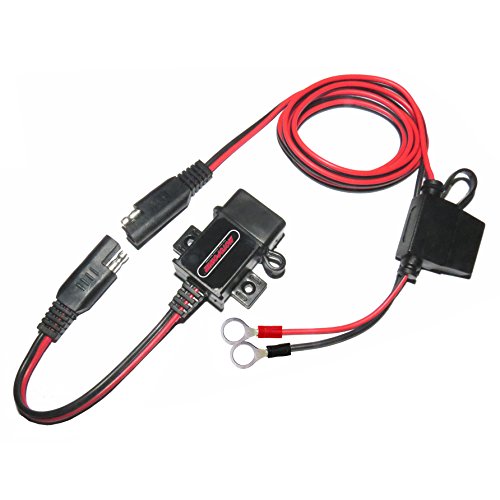
This model, ASIN B01DYE54LI, is a 3.1Amp SAE to USB adapter kit intended as a straightforward single-purpose charging lead for a motorcycle. The sections that follow describe what that specification means in daily use, which riders it fits, and what to check before fitting it.
Simplicity is the appeal of this MOTOPOWER kit. The published specification centres on one job: converting an SAE connection on the bike into a USB outlet rated at 3.1Amp, which suits phones, GPS units, and other small devices that charge over standard USB power.
Because the kit works from an SAE lead, installation can follow the same route as a battery tender pigtail. That matters for riders who remove accessories seasonally, since an SAE connection can be unplugged without cutting wires or opening the battery terminals again.
A kit format also helps riders who prefer a temporary setup. The adapter can travel between bikes that already carry SAE leads, or be removed entirely for a track day or a sale, leaving the underlying battery lead in place.
Riders comparing this model with higher-output options should focus on device count and charging standard rather than headline numbers alone. A single modest outlet that matches one phone or one GPS unit can be a cleaner solution than a larger housing that never gets fully used.
Motorcycle USB Charger, 3-in-1 Fast Charging with USB-A and USB-C plus Retractable Type-C Cable, 12-24V Waterproof IP56, LED Voltmeter (B0GHQMSBP1)
This model, ASIN B0GHQMSBP1, is a 3-in-1 layout combining USB-A and USB-C ports with a retractable Type-C cable, a 12 to 24 volt input range, IP56 waterproofing, and an LED voltmeter. The sections that follow describe what that specification means in daily use, which riders it fits, and what to check before fitting it.
The retractable Type-C cable is the feature that separates this charger from port-only designs. A built-in cable removes the loose lead that otherwise flaps in the wind, gets trapped under a tank bag, or disappears into a pannier, and it retracts when the device is removed.
Offering USB-A and USB-C alongside that cable gives the rider three ways to connect. An older GPS or headset can use USB-A, a current phone can use USB-C, and a second device can use the retractable lead at the same time, subject to the total output the housing can supply.
The 12 to 24 volt input range widens the fitment picture beyond a single 12V motorcycle battery. That range is relevant to larger electrical systems and to riders who move accessories between vehicles, although the wiring and fuse protection still need to match the vehicle in question.
An IP56 rating describes protection against dust and strong water jets under the IP code system, which is a meaningful specification for an exposed cockpit accessory. The LED voltmeter completes the picture by showing system voltage in a format that can be read quickly at a fuel stop.
EXTRACTME Motorcycle USB Charger, 6.8A Quick Charge 3.0 Dual USB Motorcycle Phone Charger with Voltmeter and ON/Off Switch, Waterproof (B093CY6887)
This model, ASIN B093CY6887, is a dual USB charger rated at 6.8A in total with Quick Charge 3.0 support, a voltmeter, an on off switch, and a waterproof housing. The sections that follow describe what that specification means in daily use, which riders it fits, and what to check before fitting it.
Dual USB output at a combined 6.8A is aimed at riders who charge two devices at once, most commonly a phone running navigation and a second item such as a headset, camera, or a passenger device. Quick Charge 3.0 support matters for compatible Android phones that can negotiate that standard.
The voltmeter and the on off switch appear together for a practical reason. The voltmeter tells the rider what the charging system is doing, while the switch lets the rider disconnect the accessory load entirely, which is useful when diagnosing a weak battery or storing the bike.
Waterproofing is listed without a specific IP number in the product title, so riders who ride in sustained heavy rain should treat the housing, cap, and cable routing as a system. A cover that is closed when no cable is inserted is a large part of real-world weather protection on any bar-mounted outlet.
This EXTRACTME configuration suits a rider who wants the familiar dual USB-A style layout rather than a USB-C PD layout. Device compatibility should drive that choice: check the ports your phone and accessories actually use before choosing between USB-A QC and USB-C PD designs.
BATIGE Motorcycle USB Charger SAE to USB Adapter Type C and USB 3.0, Quick Charge, with Voltmeter, ON/Off Switch, 3.6FT SAE Extension (B09G63XGVW)
This model, ASIN B09G63XGVW, is an SAE to USB adapter combining a Type C port and a USB 3.0 port with Quick Charge, a voltmeter, an on off switch, and a 3.6FT SAE extension lead. The sections that follow describe what that specification means in daily use, which riders it fits, and what to check before fitting it.
The 3.6FT SAE extension is the practical headline. Battery location varies widely between motorcycles, and an extension lead gives the installer routing options: along the frame, under the seat, or up toward the cockpit without placing tension on the connectors.
Pairing Type C with USB 3.0 covers both generations of device. A current phone can use the Type C port, while a legacy accessory can use the USB port, and Quick Charge support addresses compatible devices that can request a faster charge profile.
As with the other switched designs in this roundup, the on off switch protects the battery from standby draw during storage, and the voltmeter provides a quick health check. A healthy resting 12V motorcycle battery and a charging system under load show different voltage ranges, and a visible readout makes changes over time easier to notice.
Cable length should be planned rather than improvised. Measure the route from the battery to the intended mount point, allow slack for steering movement if the lead reaches the bars, and avoid routing near exhaust heat or sharp frame edges. The extension only helps if the finished route is tidy and protected.
KEMIMOTO Motorcycle USB Charger with Type-C and USB-A Ports, 61-Inch Extra-Long IP66 Waterproof Cable, 30W High-Speed (B0G8L2KRPF)
This model, ASIN B0G8L2KRPF, is a Type-C and USB-A charger with a 61-inch extra-long cable rated IP66 for waterproofing and a 30W high-speed output figure in the title. The sections that follow describe what that specification means in daily use, which riders it fits, and what to check before fitting it.
At 61 inches, the cable is the longest routing proposition in this group, and that length suits bikes where the battery sits far from the cockpit or where the rider wants the outlet positioned away from the bars, for example near a luggage rack or inside a storage area.
The IP66 rating is the strongest numbered waterproof specification in this roundup. Under the IP code, the first 6 indicates dust-tight protection and the second 6 indicates protection against powerful water jets, which is a relevant benchmark for an accessory that lives outdoors in all weather.
A 30W high-speed figure paired with Type-C and USB-A ports gives a clear two-device story: one modern USB-C device and one USB-A accessory, charged from the same housing. Riders should still confirm that their phone supports the charging profile the port offers.
Extra cable length is not automatically better. Surplus lead must be coiled, secured, and kept away from moving parts and heat, so this KEMIMOTO option makes the most sense when the measured route genuinely needs the reach rather than as a default choice for a compact bike.
MOTOPOWER MP0609C 3.1Amp Waterproof Motorcycle Dual USB Charger Kit SAE to USB Adapter Cable Phone Tablet GPS Charger (B06XWW2TRT)
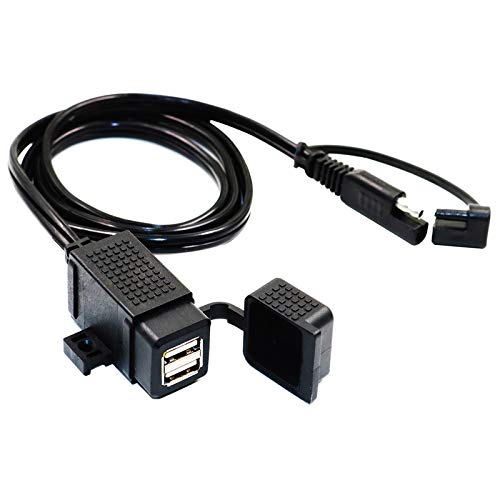
This model, ASIN B06XWW2TRT, is a waterproof dual USB charger kit rated at 3.1Amp, supplied as an SAE to USB adapter cable for phone, tablet, and GPS charging. The sections that follow describe what that specification means in daily use, which riders it fits, and what to check before fitting it.
The MP0609C takes the same 3.1Amp SAE kit idea as its sibling in this list and applies it to a dual USB layout described as waterproof. Two outlets from one SAE lead suit the classic touring combination of a phone and a dedicated GPS unit.
Naming phone, tablet, and GPS in the title reflects how riders actually use these kits. A tablet is unlikely to sit on the bars, but it may charge under the seat or in luggage during a stop, while the phone or GPS stays powered in the cockpit.
A kit with an adapter cable keeps the installation reversible. There is no permanent panel to cut and no hardwired housing to remove, which appeals to riders with leased, shared, or frequently changed motorcycles.
Because the total rating is 3.1Amp across the kit, expectations should be set accordingly. Two small devices charging steadily is a realistic use case; demanding maximum speed from two large devices at once is a job for the higher-output designs elsewhere in this roundup.
EXTRACTME Motorcycle USB Charger, 6.8A Quick Charge 3.0 Dual USB Motorcycle Phone Charger with Voltmeter and ON/Off Switch, Waterproof (B0CJXTMT3Z)
This model, ASIN B0CJXTMT3Z, is a second EXTRACTME listing with the same headline specification as its sibling: 6.8A total, Quick Charge 3.0 dual USB, voltmeter, on off switch, and waterproof construction. The sections that follow describe what that specification means in daily use, which riders it fits, and what to check before fitting it.
Two EXTRACTME listings with closely matching titles appear in this roundup, and that itself is useful buying information. When listings overlap this closely, the sensible approach is to compare the exact listing details, the included parts, and the seller information at the time of purchase rather than assuming any difference that the titles do not state.
On the published specifications, the configuration is the familiar one: dual USB with Quick Charge 3.0 for compatible phones, a combined 6.8A rating for two-device charging, a voltmeter for battery and charging-system awareness, and a switch to isolate the unit when parked.
That combination addresses the three questions riders ask most often about bar power: can it charge two things, can it tell me what my battery is doing, and can it drain my battery while parked. The switch answers the third question, and the voltmeter helps with the second.
Riders choosing between the two EXTRACTME listings should let availability, included accessories, and the exact listing description decide, since the titles provided for our research do not establish a specification difference between them. Keeping a record of the ASIN ordered also helps if support is needed later.
YONHAN Motorcycle Phone Charger Dual USB Type C PD and QC 3.0, Total 60W 6.8A SAE to USB Adapter with Voltmeter (B072JM3NWG)
This model, ASIN B072JM3NWG, is a dual USB charger combining Type C PD and QC 3.0, with a total figure of 60W and 6.8A in the title, an SAE to USB connection, and a voltmeter. The sections that follow describe what that specification means in daily use, which riders it fits, and what to check before fitting it.
The YONHAN unit carries the broadest charging-standard coverage in this group. Type C PD serves modern phones and larger USB-C devices, QC 3.0 serves compatible phones that use that Qualcomm standard, and having both in one housing reduces the chance that a future phone change makes the charger obsolete.
The combined figures in the title, 60W total and 6.8A, place this design at the high-output end of the roundup. Total output is shared across ports, so the practical benefit is headroom: two devices can charge together without the housing operating at its limit the whole time.
The SAE to USB format keeps installation in the familiar battery-lead pattern used across this category, and the voltmeter adds the monitoring function that touring riders in particular value on long days far from home.
This is the natural shortlist entry for a rider who carries several devices, swaps phones often, or shares the bike with a passenger whose devices use a different charging standard. Riders with a single phone and a GPS may not need this much headroom, and a simpler kit may suit them better.
How to choose the right motorcycle USB charger
Start with your devices, not with the charger. List everything you intend to power on the bike: typically a phone, and then some combination of GPS unit, headset, action camera, heated-accessory controller, or a passenger phone. Note the connector each device uses and the fastest charging standard each device supports. A phone that supports USB-C Power Delivery benefits from a PD port. A phone that supports Quick Charge benefits from a QC 3.0 port. A device with neither standard charges at standard USB rates from any port, which is perfectly adequate for keeping a GPS topped up on a long day.
Next, count simultaneous devices honestly. Many riders imagine charging three devices and in practice charge one. If your real pattern is a single phone running navigation, a switched single- or dual-port charger with a voltmeter is a balanced choice. If you tour two-up or run a camera all day, look at the dual-port designs with higher combined output, such as the 6.8A models or the 60W YONHAN configuration described above. Remember that headline output is a total shared across ports, not a promise for each port at the same time. For charging kit used off the bike, at a desk or in a hotel room, best dual usb c wall chargers covers the wall-powered side of the same problem.
Then plan the physical installation. Measure from the battery terminals to the place the outlet will live, following the route the cable will actually take along the frame. Compare that measurement with stated cable lengths where the title provides them, such as the 3.6FT SAE extension on the BATIGE or the 61-inch cable on the KEMIMOTO. Decide whether a handlebar mount suits your bars: the Nilight design is specified for 7/8 inch handlebars, a very common diameter, but tapered and oversized bars exist, so measure your own bar at the mounting point before ordering any clamp-on accessory.
Weather protection deserves a calm reading. The IP code rates enclosures with two digits: the first for solid particles, the second for water. IP56 indicates dust protection and resistance to strong water jets; IP66 indicates dust-tight construction and resistance to powerful water jets. A charger described only as waterproof, without digits, makes a general claim that cannot be compared as precisely. Whichever design you choose, fitting the protective cap whenever a port is empty, and routing cables so water is not funnelled into the housing, does as much for longevity as the rating itself.
Battery protection is the final filter. Prefer a fused connection between battery and charger, as on the Nilight lead with its SAE inline 10A fuse, because the fuse is the component intended to fail safely if a cable chafes or a fault develops. Prefer a physical on off switch if the bike sits unused for a week or more at a time, because even a small standby draw matters to a compact motorcycle battery. Riders who maintain batteries with other charging equipment may also find best 18650 battery chargers useful for the loose cells used in torches and other ride accessories.
Installation basics for SAE and 12V wiring
Most installations in this category follow the same sequence. Disconnect the battery before working on its terminals, following the motorcycle manufacturer’s instructions. Fit or locate the fused SAE lead, route it along the frame using existing cable guides where possible, and secure it with ties that do not pinch the insulation. Keep the lead clear of the exhaust, the steering stops, the chain or belt, and any panel edge that could chafe it. Connect the charger, confirm the switch and voltmeter behave as expected with the ignition in the relevant position, and only then refit bodywork.
- Turn steering from lock to lock after fitting and confirm no cable is pulled tight.
- Leave a gentle service loop near connectors so parts can be unplugged without strain.
- Fit connector caps when ports are empty, especially before washing the bike.
- Check the fuse type and rating after installation so a spare can be carried on tour.
- Recheck terminal tightness after the first few rides, since vibration can loosen hardware.
Riders who use solar maintenance charging in a garage or yard can compare approaches in best 12 volt solar chargers, which covers the 12V maintenance side rather than on-bike USB power.
Common mistakes and how to avoid them
The most common mistake is leaving an unswitched charger connected all winter and blaming the battery in spring. If your chosen design has a switch, use it; if it does not, unplug the SAE connector during long storage or keep the battery on a suitable maintainer. The second mistake is routing a cable where steering movement stretches it. A lead that looks perfect with the bars straight can become a guitar string at full lock, and connectors fail early under that repeated strain.
The third mistake is buying on a single headline number. A high total output does not help a device that cannot use the offered standard, and a modest kit is not inadequate if it matches one phone and one GPS. The fourth mistake is ignoring the cap. Waterproof ratings assume the enclosure is intact; a missing cap or a cable holding a cover open changes the real exposure. The fifth mistake is mixing up resting voltage and charging voltage when reading a voltmeter. A reading taken with the engine running reflects the charging system, while a reading after the bike has sat reflects battery state, and comparing like with like over several weeks is what reveals a trend.
Care, storage, and long-term reliability
Care for a motorcycle USB charger is mostly care for its connections. Inspect the SAE pins and the USB sockets periodically for corrosion, dirt, and bent contacts, and clean them only with the bike powered down. Keep caps closed in rain and during washing. Check cable insulation where it passes frame edges, and replace a damaged lead rather than taping over a fault on a circuit connected directly to the battery. If the bike is stored outdoors, a cover reduces ultraviolet exposure for housings and cables alike. When a charger is removed for the season, coil its lead loosely, keep the fuse with it, and store it dry so the whole kit can go back on in minutes.
Finally, keep expectations aligned with the physics of the system. A motorcycle charging system has limited spare capacity, especially at idle and on smaller bikes. Running several high-draw accessories together with heated clothing and auxiliary lights can exceed what the system comfortably supplies, and the voltmeter fitted to many of these chargers is exactly the tool that makes that visible. Watch the trend, reduce load if voltage sags persistently at cruising speed, and treat the charger as one part of a healthy electrical system rather than a cure for an ageing battery.
Check prices on Amazon
Live listings for the shortlist in this guide are pulled from Amazon below, so prices and availability are always current at the moment you look.


Disclosure
This guide was prepared for widgetverdict.com readers who ride and who need dependable power at the handlebars. It is based on our research into the published specifications for each listing above, and it will be revised if manufacturers change those specifications. As an Amazon Associate we earn from qualifying purchases. Product names and charging-standard names belong to their respective owners, and inclusion in this guide reflects the specification match described in each section rather than any payment from a manufacturer.
Beyond the individual listings, it is worth thinking about how a charger fits the rhythm of your riding. A commuter who rides daily in all weather values a cap that closes positively, a switch that can be operated with gloves, and a voltmeter that can be read at a glance in traffic. A touring rider values routing length, a fused lead that can be serviced at the roadside, and ports that match both a phone and a camera. A rider who owns several motorcycles values the SAE standard itself, because a bike-side lead on each machine lets one accessory philosophy work across the whole garage without rewiring each time.
Accessory power also interacts with how a phone is mounted and used. Navigation applications, bright screens, and poor signal areas all increase phone power consumption, which is why a charger that merely slows the drain can disappoint even when it is working exactly as specified. Matching the charging standard to the phone, using a sound cable, and keeping connectors clean usually matters more than chasing the largest number in a product title. The chargers above give riders a range of honest ways to make that match, from the simplest SAE kit to dual-standard designs with substantial headroom.


