Our Top Picks


What's inside
- Why Weather Proofing Matters for Bluetooth Headsets
- IPX5, IPX7, and IPX8: What the Ratings Actually Mean
- TOZO T10: The IPX8 Option With Wireless Charging and 55H Playtime
- JBL Endurance Race 2: Wing Enhancer, Twistlock, and Two Colour Choices
- Sport Earbuds With Earhooks: IPX7, 75H Playtime, and an ENC Microphone
- TOZO A1: Lightweight IPX5 Earbuds With App EQ and AI Call Mics
- TRAUSI Wireless Earbuds: IPX7 Protection, Bluetooth 5.4, and Fast Charging
- How to Choose the Right Weather Proof Headset
- Caring for Earbuds After Rain and Sweat
- Frequently Asked Questions
- Check prices on Amazon
- Conclusion: Matching the Rating to Your Real Weather
As an Amazon Associate I earn from qualifying purchases. This post may contain affiliate links at no extra cost to you.
This page is a product research guide. The team behind this site studies manufacturer listings, published specifications, and product documentation to compare headsets on paper, and the recommendations below are built from that research rather than from any claim of personal use. Some links on this page point to Amazon, and if you buy through one of those links the site may receive a commission at no extra cost to you. As an Amazon Associate we earn from qualifying purchases. Prices and availability change over time, so the listing for each model is always the final word on what is offered at the moment you shop.
Why Weather Proofing Matters for Bluetooth Headsets
A Bluetooth headset lives a harder life than almost any other piece of audio gear. It sits in a pocket, gets dropped into a gym bag, rides along on early morning runs, and spends hours pressed against skin that sweats. A phone can stay in an armband or a zippered pocket when the sky opens up, but earbuds are exposed by design. They sit at the opening of the ear, facing the weather directly, and there is no practical way to shield them while still hearing your music, your podcast, or your training cues. That exposure is exactly why weather proofing has become one of the most useful features to shop for in a wireless headset.
Moisture is the main enemy. Rain is the obvious threat, but sweat is often the bigger one over the life of a product. A single run in a downpour might last twenty minutes, while a hard training session can soak a pair of earbuds in sweat several times a week, month after month. Sweat carries salt, and salt is unkind to charging contacts, speaker grilles, and microphone openings. Water resistant seals and coatings slow that damage down, and a proper ingress rating gives you a shared, measurable language for how much protection a manufacturer is claiming.
Weather proofing also changes how confidently you can use a headset day to day. Without it, every forecast becomes a small decision: take the good earbuds and risk them, or leave them home and train in silence. With a rated pair, that decision mostly disappears. You can head out in light rain, finish a workout when a shower rolls in, and rinse away the grime of a session according to the care guidance for that rating level. For commuters, the same logic applies to wet platforms, splashes from passing traffic, and the general dampness of a winter walk to the station.
The five models compared in this guide all carry an explicit water resistance story in their listings. The TOZO T10 is listed with an IPX8 rating, the JBL Endurance Race 2 is described as waterproof and dustproof, the sport earbuds with earhooks carry an IPX7 rating, the TOZO A1 carries an IPX5 rating, and the TRAUSI earbuds carry an IPX7 rating. Those differences matter, and a large part of this guide is devoted to explaining what each level actually means so you can match the rating to the way you train, travel, and work.
Fit is the second theme running through this comparison. A waterproof seal is only useful if the earbud stays in your ear while you move. The models here take different approaches: over ear hooks on the sport model, a wing enhancer with Twistlock technology on the JBL, and ergonomic in ear shapes on the TOZO and TRAUSI models. Weather proofing and secure fit work together, because the moment an earbud works loose and falls onto wet pavement, both its comfort and its protection are put to the test in the worst possible way.
IPX5, IPX7, and IPX8: What the Ratings Actually Mean
The IP code, short for ingress protection, is an industry standard way of describing how well a sealed enclosure keeps out solids and liquids. For earbuds, the number that matters most is the second digit, the one that follows the letter X in codes such as IPX5 or IPX7. The X simply means the product was not rated for solid particle ingress in that position, or that the rating is not stated, while the final digit describes water protection on a scale that climbs from dripping water up to sustained immersion. A higher number always includes the protection levels below it in the testing framework, although real world wear, age, and damage can reduce the protection of any individual unit over time.
IPX5 describes protection against water jets. In the standard test, the enclosure is sprayed with water from a nozzle from multiple directions, and the product must keep working without harmful water ingress. In everyday language, an IPX5 earbud is built to shrug off rain, splashes, and heavy sweat. It is a sensible rating for gym training, walking, commuting, and running in ordinary wet weather. What IPX5 does not claim is immersion protection, so an IPX5 bud should not be deliberately submerged, held under a tap at close range for long periods, or worn in the shower as a matter of routine.
IPX7 steps up to temporary immersion. The standard test submerges the enclosure in water, typically at a depth of around one metre for thirty minutes, under controlled conditions. For an earbud, that level of protection is a meaningful comfort margin: a bud dropped into a puddle, a sink, or a wet kit bag has a far better chance of surviving the accident, and heavy rain or very wet training conditions sit comfortably within the claimed protection. IPX7 is the rating most sport focused earbuds aim for, and two of the models in this guide, the earhook sport buds and the TRAUSI buds, are listed at exactly this level.
IPX8 goes beyond IPX7. The immersion conditions for IPX8 are specified by the manufacturer and are more demanding than the IPX7 test, whether in depth, duration, or both. The TOZO T10 in this guide is listed with an IPX8 rating, which places it at the top of this comparison for claimed water protection. It is still worth reading IPX8 carefully: it is a statement about immersion resistance under the conditions the manufacturer declares, not a promise that the earbuds are designed for swimming workouts, and Bluetooth radio signals do not travel usefully through water in any case. Treat IPX8 as the strongest rain, sweat, and accident protection in this line up rather than as an invitation to take any earbud into the pool.
Dust deserves a mention too. The JBL Endurance Race 2 is described in its listing as waterproof and dustproof, which speaks to a different kind of weather: dry, gritty conditions. Trail dust, chalk in a climbing or lifting gym, sand carried on the wind, and the general grit of a work site can all work their way into charging contacts and mesh covers. A dustproof design helps a headset survive the dry side of outdoor life, not just the wet side, and that breadth is part of what makes the JBL interesting for people whose training and work happen in mixed environments.
One final point applies to every rating in this guide. IP tests are carried out on new products under controlled conditions, with clean water. Soap, salt water, chlorinated pool water, and high pressure jets are all harsher than the test conditions, and seals age. The sensible way to use a rating is as a margin of safety for the conditions you actually face, chosen one step above your typical day, rather than as a licence to push a product to its limit on purpose.
TOZO T10: The IPX8 Option With Wireless Charging and 55H Playtime
The TOZO T10 leads this comparison on the headline number that matters most for weather: its listing states an IPX8 waterproof rating, the highest water protection level among the models gathered here. For a runner who trains through winter, a commuter who walks in all conditions, or anyone who has already lost a pair of earbuds to a soaking, that rating is the core of the T10’s appeal. It frames the T10 as the choice for people who want the largest margin between the weather they expect and the protection the manufacturer claims.
The listing also states a 55H playtime figure, which is a substantial total for a true wireless design and reduces how often the case needs to meet a charger. Wireless charging is named in the listing as well, and that pairs neatly with the weather theme: a case that can top up on a charging pad involves fewer cable connections in damp gym bags and on wet kitchen counters, and it keeps the daily routine simple for people who already use a pad for their phone. The T10 connects over Bluetooth 5.3, the version stated in its listing, which is the connection standard it shares with the smaller TOZO A1 further down this guide.
Sound and control features round out the listing. The T10 is described as offering powerful bass stereo sound, and its app support includes the ability to customise the EQ through the TOZO app, so listeners who find the factory tuning too heavy or too light for spoken word content can adjust the balance to taste. The design is described as ergonomic and in ear, aimed at the work and travel uses named in the listing as much as at exercise. In black, it is the understated, general purpose option in this group: the model that tries to cover the desk, the train, and the rainy run with one set of features rather than specialising in any single one of them.
Who should shortlist the T10? Anyone whose first question is about water protection, and whose second is about how rarely they want to think about charging. The combination of the IPX8 claim, the stated 55H playtime, and wireless charging makes it the most weather hardened all rounder here. Readers who care most about call quality in crowded places may also want to compare it with the noise cancelling microphone designs below, and readers focused purely on locked in sport fit should weigh its ergonomic in ear shape against the wing and hook designs that follow.
JBL Endurance Race 2: Wing Enhancer, Twistlock, and Two Colour Choices
The JBL Endurance Race 2 takes a different route to weather confidence. Its listing describes the earbuds as waterproof and dustproof, covering both the wet and the gritty sides of outdoor training, and it puts fit at the centre of the design. The listing names an ergonomic wing enhancer with Twistlock technology, a combination aimed at keeping each bud seated and stable while you move. For runners, lifters, and court players, that stability is a weather feature in its own right, because a bud that stays in place keeps its seal where it belongs and never takes an unplanned trip across wet ground.
The listing also highlights a Sports Mode designed to enhance your workout, which positions the Race 2 firmly as a training tool rather than a general lifestyle bud. JBL’s endurance line has long been aimed at athletes, and this model follows that brief: secure fit first, environmental protection built in, and controls and tuning oriented around exercise sessions. If your listening happens mostly during training, and your training happens outdoors in whatever weather the week delivers, this is the model in the guide written most directly for you.
There are two listings for the Endurance Race 2 in this comparison, and it is important to be straightforward about what they are. One is the black version and the other is the blue version of the same model. They are two colour choices of a single design, not two different products, and nothing in the listings suggests the colour changes the fit system, the protection, or the feature set. Choosing between them is purely a matter of preference: black for a low profile look that pairs with anything, blue for a bit of visibility and personality in the gym bag. Treat the pair of listings as one model with a colour decision attached, and judge it once, on the strength of the design itself.
That honesty matters for comparison shopping in general. Colour variants are sometimes listed separately for stock and search reasons, and a careful buyer should always check whether two similar listings differ in substance or only in finish. Here, the answer is finish. So the Endurance Race 2 earns one place in this guide, with the note that it can be had in black or in blue, and its case rests on the waterproof and dustproof description, the wing enhancer and Twistlock fit, and the workout oriented Sports Mode named in its listing.
Sport Earbuds With Earhooks: IPX7, 75H Playtime, and an ENC Microphone
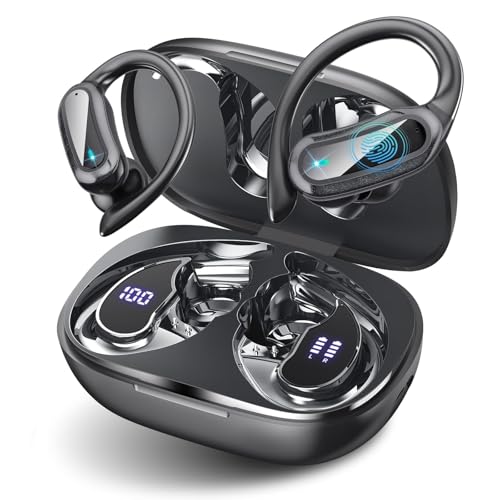
The third design in this guide is the sport headphone listing built around earhooks. Its listing states a 75H playtime figure, the largest total named in this comparison, and Bluetooth 5.4, the newer connection version it shares with the TRAUSI model below. The headline fit feature is right there in the description: earhooks that loop over the ear to hold each bud in place during gym work, running, and general workouts, which are the uses the listing names directly.
Weather protection is covered by an IPX7 waterproof rating in the listing. As explained in the ratings section, IPX7 is the immersion level: a strong claim for a sport bud, well matched to heavy sweat, hard rain, and the occasional accidental drop into something wet. For most runners and gym users, IPX7 is the point where water protection stops being a worry in any realistic training scenario, and it is one of the reasons this model reads as a purpose built sport option rather than a lifestyle bud with a rating added.
Calls are the other strength the listing emphasises. These earbuds are described as featuring an ENC noise cancelling microphone, which means the microphone system works to reduce environmental noise around your voice during calls. That matters for the way sport earbuds are actually used: a quick call taken on a windy street, a voice note recorded between sets, or a check in from a busy gym floor. The listing also promises deep bass and stereo sound, the tuning direction most workout playlists ask for, and the design is an in ear style in black. If you want one headset that trains with you all week and still handles calls respectably, this earhook model makes a direct case: the longest stated playtime in the guide, IPX7 protection, Bluetooth 5.4, and a microphone system designed to keep your voice clear in noisy places.
The earhook shape does come with a lifestyle trade off worth naming. Hooks are superb while you are moving, but they make the buds a little less discreet and a little less suited to lying on a pillow or wearing under a close fitting hat than a low profile in ear design. That is not a flaw, it is a specialisation. Buyers who train daily will usually take the security every time, while buyers who mostly listen at a desk may prefer one of the smoother designs in this guide.
TOZO A1: Lightweight IPX5 Earbuds With App EQ and AI Call Mics
The TOZO A1 is the lightest touch option in this line up, in more than one sense. Its listing describes light weight in ear headphones on Bluetooth 5.3, with an IPX5 waterproof rating. IPX5, as covered earlier, is protection against water jets, rain, splashes, and sweat. That is a different promise from the immersion ratings elsewhere in this guide, and it should be matched to the right life: daily training in ordinary conditions, walks and commutes in the rain, and gym sessions where sweat is the main moisture involved. For those uses, IPX5 is a rational, proven level of protection, and it often comes in smaller, lighter designs precisely because the sealing task is simpler.
The A1’s listing leans into calls and customisation. It names two microphones for AI calls, positioning the A1 for people whose earbuds spend as much time on phone and video calls as on music. It also offers app based sound shaping, with 32 EQ options available via the app according to the listing, a wide palette for listeners who like to tune a headset for podcasts one day and bass heavy playlists the next. The sound itself is described as immersive premium sound with bass emphasis, and the earbuds come with a charging case in black. Taken together, the A1 reads as the commuter and desk friendly member of this group: light, customisable, call aware, and protected well enough for the weather of an ordinary week.
That positioning makes the A1 a useful reminder that the highest rating is not automatically the right purchase. A buyer who never trains in storms, never drops earbuds anywhere wetter than a gym floor, and values low weight and call features will be better served by a design that spends its budget on those things. The honest way to read the A1 is as a fair weather to wet weather headset with strong everyday features, sitting one rung below the immersion rated models on the weather ladder and asking to be judged on comfort, calls, and tuning instead.
TRAUSI Wireless Earbuds: IPX7 Protection, Bluetooth 5.4, and Fast Charging
The TRAUSI earbuds close the comparison with a specification list aimed squarely at fitness use. The listing states Bluetooth 5.4 headphones with fast charging, an IPX7 waterproof rating, a noise cancelling microphone, stereo sound, and a comfort fit design for fitness and workouts, in black. That is a focused bundle: current connection version, immersion level water protection, help for calls in noisy places, and charging that is described as fast for people who remember to plug in shortly before they head out.
IPX7 puts the TRAUSI buds level with the earhook sport model on claimed water protection, and ahead of the IPX5 A1, which makes them a serious option for wet weather training. The comfort fit description suggests a design meant to be worn through long sessions without becoming a distraction, and the fitness framing in the listing is consistent from start to finish. Where the earhook model secures the bud mechanically over the ear, the TRAUSI design appears to rely on its in ear comfort fit, which some buyers will prefer for its simplicity and lower profile in everyday wear between workouts.
The noise cancelling microphone is worth underlining for the same reason as on the earhook model. Outdoor training and clear calls rarely go together, because wind and traffic compete with your voice. A microphone system built to suppress that surrounding noise is one of the most practical features a weather proof headset can offer, since the whole point of weather protection is that you keep using the headset in exactly the conditions where calls are hardest. Readers comparing microphone focused designs may also want to look at headsets built primarily around conversation, such as the ones gathered in our guide to best anc bluetooth wireless headsets, where noise management is the headline feature rather than a supporting one.
On paper, then, the TRAUSI model is the straightforward sport all rounder of the group: IPX7 protection, Bluetooth 5.4, fast charging, a noise cancelling mic, and a comfort fit, without the hooks of the sport model or the app EQ emphasis of the TOZO designs. Buyers who want immersion level protection in a clean, low profile shape should give it a close look.
How to Choose the Right Weather Proof Headset
Start with your weather, honestly described. If your exposure is sweat and ordinary rain, IPX5 is a defensible choice and opens the door to lighter designs like the TOZO A1. If you train outdoors year round, run through storms, or work in wet environments, step up to IPX7, where the earhook sport buds and the TRAUSI buds sit. If you want the largest claimed margin in this guide, the IPX8 rated TOZO T10 is the top of the ladder. Choosing one level above your normal conditions is a good rule, because ratings describe new products under controlled conditions and real life is messier than a test tank.
Next, choose your fit system, because fit decides whether you enjoy wearing the headset at all. Earhooks, like those on the sport model, give the most mechanical security and are the classic answer for running and vigorous gym work. Wing designs, such as the ergonomic wing enhancer with Twistlock technology on the JBL Endurance Race 2, stabilise the bud inside the ear without anything over the top of it, which many people find cleaner with glasses, caps, and helmets. Plain ergonomic in ear shapes, used by the TOZO T10, the TOZO A1, and the comfort fit TRAUSI buds, are the lowest profile option and the easiest to live with all day. There is no universal winner here, only the system that matches your ears and your activities.
Then look at the battery story as the listing states it. In this guide, the earhook sport model names 75H playtime and the TOZO T10 names 55H, both substantial totals that suit people who charge infrequently and train often. The TRAUSI listing highlights fast charging instead, which suits a different habit: short, frequent top ups. Think about which pattern matches your real routine rather than chasing the largest number, and remember that playtime figures in listings generally describe the earbuds together with their charging case rather than a single uninterrupted session.
Calls deserve their own decision. If you take calls outdoors, microphone features matter as much as water ratings. The earhook model names an ENC noise cancelling microphone, the TRAUSI buds name a noise cancelling mic, and the TOZO A1 names two mics for AI calls. Each listing is pointing at the same goal, keeping your voice intelligible against wind, traffic, and gym noise, through a different design. Buyers whose headset is mainly for the road may come at the whole question from the opposite direction and start with a design built for drivers, like those in our roundup of best truck bluetooth headsets, before deciding how much weather protection they need.
Connection version is the quieter specification. Bluetooth 5.4 appears in the earhook sport model and the TRAUSI listing, while Bluetooth 5.3 appears in both TOZO listings. In daily use, either version supports the stable, efficient connection modern earbuds are expected to deliver, and the difference is unlikely to be the deciding factor next to fit, protection, and battery. Treat it as a sign of how current the design is rather than a reason to reject an otherwise suitable model.
Finally, budget honestly. Weather proof headsets span a wide range, and this guide deliberately avoids printing prices because they move too often to state responsibly here. The listings themselves will show the current figures. Readers working to a tight limit will find useful context in our guide to best affordable wireless headsets, and the main lesson of this comparison still applies there: buy the rating and the fit your life actually requires, and let features you will never use go to someone else’s budget.
Caring for Earbuds After Rain and Sweat
A water resistance rating is not a maintenance plan, and a few simple habits will do more for the lifespan of a weather proof headset than any specification. The first habit is drying. After a wet run or a sweaty session, wipe the earbuds with a soft, dry cloth before they go back into the case. Pay attention to the charging contacts, because moisture and salt left sitting on metal points are a slow recipe for corrosion and unreliable charging. If the buds are genuinely soaked, let them air dry at room temperature before charging them, since connecting power to wet contacts is the one combination worth avoiding every time.
The second habit is respecting what the rating does not cover. IP tests use clean water, so salt water, soapy water, and chlorinated water all deserve extra caution and a gentle rinse with fresh water only where the manufacturer guidance for that model allows it, followed by thorough drying. High pressure water is another trap: a shower jet or a tap at full force can push water past seals that happily resist rain, which is why immersion rated buds can still be vulnerable in a shower. Steam rooms and saunas add heat to the equation, and heat is hard on batteries regardless of water protection.
The third habit is keeping the case in the story. The case is part of the system, and it is rarely as water resistant as the buds themselves. A damp case pocket in a gym bag, a case left on a wet bench, or buds returned to a case that is still wet inside will quietly undo the good work of the seals. Dry the case, leave it open to air after wet sessions, and check the ear tips and mesh covers regularly for the wax, dust, and grit that outdoor life deposits. Small, boring care, repeated weekly, is what turns a rated headset into a long lasting one.
It is also worth keeping a wired fallback in mind for the rare situations where wireless is the wrong tool, such as long flights on older entertainment systems or a dead battery at the wrong moment. A simple wired option from our guide to best 3 5 mm headsets takes up almost no space in a bag and never needs charging, which makes it a sensible companion rather than a competitor to the headsets in this guide.
Frequently Asked Questions
Can weather proof earbuds be worn in heavy rain? For the models in this guide, rain is the central use case the ratings address. IPX5 protects against water jets and heavy splashing, while IPX7 and IPX8 describe immersion resistance that sits well above anything rainfall can deliver. The practical limits are elsewhere: dry the buds before charging, keep the case dry, and remember that wind driven rain plus an insecure fit can still cost you an earbud on a dark street, which is an argument for hooks or wings rather than a higher number.
Can you swim with IPX7 or IPX8 earbuds? The ratings describe immersion resistance under controlled conditions, not a swimming programme, and none of the listings in this guide present their model as a swimming product. Bluetooth signals also fade almost immediately underwater, so music delivery itself breaks down in a pool. Treat immersion ratings as accident insurance for drops, puddles, and soakings, and leave the earbuds on the pool deck.
What is the difference between waterproof and dustproof in this guide? The JBL Endurance Race 2 listing uses both words, and they describe protection against different intruders. Waterproof speaks to rain, sweat, and splashes. Dustproof speaks to grit, chalk, sand, and trail dust. Most buyers think about the wet side first, but for trail runners, climbers, and people who work outdoors in dry conditions, the dust side can matter just as much over the life of the product.
Does a higher IP rating mean better sound? No. The rating measures sealing, not audio quality. In this guide, sound descriptions come from the listings themselves: powerful bass stereo on the TOZO T10, deep bass and stereo sound on the earhook sport model, immersive premium sound with bass on the TOZO A1, and stereo sound on the TRAUSI buds. App based EQ, offered on both TOZO models in different forms, is the more useful sound feature for most listeners, because it lets the tuning adapt to the listener instead of the other way round.
How long will the batteries last? Only two listings in this guide state a playtime figure, and those figures should be quoted exactly as given: 55H for the TOZO T10 and 75H for the earhook sport earbuds. The TRAUSI listing emphasises fast charging rather than a total. Figures like these generally combine the earbuds and their charging case, and real results vary with volume, features in use, and battery age. The sensible comparison is between stated figures and charging style, matched against your own routine.
Which model is best for calls? Three listings make an explicit microphone claim: the ENC noise cancelling mic on the earhook sport model, the noise cancelling mic on the TRAUSI buds, and the two mics for AI calls on the TOZO A1. If calls are your priority and your environment is a quiet home or office, the A1’s call focused design and light weight are attractive. If your calls happen on windy streets and gym floors, the sport models pair their microphone systems with more secure fits, which keeps the mic position stable while you move.
Check prices on Amazon
Live listings for the shortlist in this guide are pulled from Amazon below, so prices and availability are always current at the moment you look.

Conclusion: Matching the Rating to Your Real Weather
The best weather proof Bluetooth headset is the one whose protection and fit match the conditions you actually meet. For the strongest claimed water protection in this comparison, the TOZO T10 pairs an IPX8 rating with a stated 55H playtime, wireless charging, app EQ customisation, and Bluetooth 5.3. For training focused fit and protection against both water and dust, the JBL Endurance Race 2 offers its wing enhancer with Twistlock technology and Sports Mode, in black or in blue as two colour choices of the same model. For the longest stated playtime and the security of earhooks, the sport earbuds combine 75H, IPX7 protection, Bluetooth 5.4, and an ENC microphone. For light weight, calls, and deep app customisation at an IPX5 level suited to everyday wet weather, the TOZO A1 makes its case. And for a clean sport all rounder, the TRAUSI buds bring IPX7 protection, Bluetooth 5.4, fast charging, and a noise cancelling mic in a comfort fit shape.
None of these models asks you to accept a trade between weather protection and everyday usefulness, which is really the story of this category. Water resistance has moved from a specialist extra to a standard expectation, and the differences that remain are the honest ones: how much protection, held in the ear how, with what battery and microphone story attached. Read the rating one level above your weather, pick the fit your activities demand, dry the buds before you charge them, and the headset you choose should see you through many seasons of rain, sweat, and everything in between.