What's inside
- Where to Buy
- Key Takeaways
- Quick Picks
- How We Chose These Picks
- Comparison
- How to Choose a TV for Bright Daylight
- What Is the Difference Between Anti-Glare and Raw Brightness?
- Can an Indoor Bright-Room TV Work on a Covered Porch?
- Do You Need 2000 Nits, or Is 1000 Enough?
- Where Should a Bright-Room TV Sit in the Room?
- Common Mistakes
- Final Recommendation
- Frequently Asked Questions
- Related Guides
As an Amazon Associate I earn from qualifying purchases. This post may contain affiliate links at no extra cost to you.
[SITE_DOMAIN] is reader-supported. When you buy through links on our site, we may earn an affiliate commission.
Where to Buy
The six sets below fight daylight by two different strategies, and each linked name opens its Amazon page. Indoor anti-reflection leads with the Hisense 55-inch U7 Mini-LED, whose listing pairs an anti-reflection screen with serious gaming credentials. The outdoor strategy opens with the SYLVOX Mini-LED QLED Outdoor TV 55-inch, which states a full-sun brightness figure no indoor set attempts. Its sibling, the SYLVOX Outdoor QLED TV 55-inch, is pitched at partial sun and gazebos, as its page explains. The large-screen indoor route runs through the Hisense 85-inch U6 Pro Series, whose glare-free claim is worth reading in full. Samsung’s entry, the Samsung 85-Inch Class M70H Series, brings Mini LED processing to the same big format. And the Hisense 85-inch E7 Cinema Series closes the list with a cinema-named model whose listing details its full-array dimming.
The best tvs with bright daylight viewing are chosen by a different physics from every other television in a house. A normal set fights darkness; these fight the sun — through windows in a living room, across a conservatory, or directly overhead on a terrace. The weapons are two, and confusing them is the classic buying error in this category. Indoors, the weapon is the screen finish: anti-reflection, anti-glare and glare-free surfaces that stop the room mirroring itself in the picture. Outdoors, finish alone cannot win, and the weapon becomes raw brightness measured in nits, behind weather sealing. This guide keeps the two strategies separate from its first page to its last, because a set built for one battlefield is a poor purchase for the other.
The indoor contingent numbers four. Hisense’s 55-inch U7 leads it with an anti-reflection Mini-LED panel and the guide’s strongest gaming specification. At 85 inches, three large sets compete for the bright big room: Hisense’s U6 Pro, which states a glare-free finish; Samsung’s M70H, a Mini LED set whose title leans on its processing and colour rather than a finish claim; and Hisense’s E7 Cinema, a Mini-LED model with full-array dimming whose daylight case rests on its panel class rather than a printed anti-glare promise. The outdoor contingent is SYLVOX twice over: a 2000-nit Mini-LED set specified for full sun, and a 1000-nit QLED set specified for partial sun and gazebos, both sealed against weather. Every brightness figure in this guide comes from a listing title; where a title prints no nits, none are claimed.
Size interacts with daylight in a way buyers underestimate. A bright room is usually a large room — the open-plan space, the garden-facing extension — and a large room pushes seating farther from the screen, which is why three of the six picks are 85-inch sets. The 55-inch picks serve the smaller bright room and the terrace. Read the reviews with your own room’s two numbers in hand: the distance from sofa to screen, and the direction the light comes from at viewing time. Those two facts, honestly faced, choose among these six more reliably than any specification ranking.
Key Takeaways
- Indoor daylight is fought with screen finishes — anti-reflection on the Hisense U7, glare-free on the Hisense U6 Pro — while outdoor daylight is fought with stated nits.
- The SYLVOX Mini-LED states 2000 nits and full-sun intent; its QLED sibling states 1000 nits for partial sun and gazebos. Both are IP56 sealed.
- Three picks are 85-inch sets for large bright rooms: Hisense U6 Pro, Samsung M70H and Hisense E7 Cinema.
- The Hisense U7 doubles as the gaming pick, with a native 165Hz panel and VRR 330 in its title.
- Anti-glare film or accessories are not televisions and appear nowhere in this guide; every pick is a complete set.
- Brightness figures are credited only where a listing title prints them; the indoor Samsung and E7 titles print none.
Quick Picks
| Pick | Badge | Why it makes the cut |
|---|---|---|
| Hisense 55-inch U7 Mini-LED | Indoor anti-reflection leader | Mini-LED panel with an anti-reflection finish, native 165Hz and Dolby Vision IQ for bright rooms that also game. |
| SYLVOX Mini-LED QLED Outdoor TV 55-inch | Full-sun outdoor | A stated 2000 nits, IP56 sealing and Mini-LED QLED for terraces in direct sunlight. |
| SYLVOX Outdoor QLED TV 55-inch | Partial-sun outdoor | A stated 1000 nits with no-glare tuning and IP56 weatherproofing for gazebos and covered decks. |
| Hisense 85-inch U6 Pro Series | Big-room glare-free | 85-inch Mini-LED with a glare-free claim, native 144Hz and Dolby Vision IQ for large bright rooms. |
| Samsung 85-Inch Class M70H Series | Big-room Samsung | 85-inch Mini LED with Samsung Vision AI Companion and Pure Spectrum Color for the large bright living room. |
| Hisense 85-inch E7 Cinema Series | Big-room cinema panel | 85-inch Mini-LED with full-array dimming, native 144Hz and Dolby Vision IQ under a cinema banner. |
How We Chose These Picks
The filter was the use case itself. A candidate needed a daylight credential stated in its listing title: an anti-reflection, anti-glare or glare-free finish for indoor sets, or a stated nit figure with weather sealing for outdoor sets. Ordinary bright-room marketing without a title-level claim was not enough, and accessories were excluded categorically — an anti-glare film is an accessory that modifies a television, not a television, and no film, screen protector or add-on appears among these picks. Every pick is a complete set whose daylight behaviour is part of its own specification.
The six then had to cover the category’s real geography. Indoors, that meant one set for the smaller bright room and a genuine contest at 85 inches, where three makers’ big panels compete for the garden-facing living room. Outdoors, it meant both of SYLVOX’s honest tiers — full sun and partial sun — because the difference between those two conditions is the most expensive misunderstanding in outdoor television, and a guide that listed only the stronger set would invite buyers to overbuy for a shaded gazebo or underbuy for an open terrace. Platforms were recorded as part of each pick’s identity: Fire TV carries the Hisense contingent, Google TV the SYLVOX pair, and Samsung’s own ecosystem the M70H.
Brightness discipline governed every sentence. Nits appear in this guide only where a title prints them — 2000 and 1000, both SYLVOX — and the indoor sets’ brightness is discussed through their finishes and panel classes, never through invented figures. Motion figures received the same treatment: native rates are called native only where the title uses the word, and the U6 Pro’s Motion Rate 480 is labelled a processing index wherever it appears. A daylight guide lives on trust in its numbers, because its readers are buying against the sun, and the sun checks every claim.
Hisense 55-inch U7 Mini-LED — Indoor anti-reflection leader
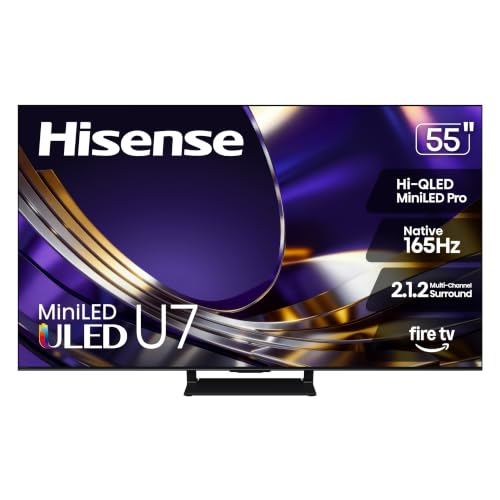
The U7 is the indoor daylight pick in its most complete form: a 55-inch Mini-LED ULED panel with an anti-reflection finish, carrying Hisense’s premium gaming specification — a native 165Hz refresh rate with VRR 330 — and Dolby Vision IQ with Atmos, IMAX Enhanced and a 2.1.2 channel audio arrangement. Read that specification as a room description. The anti-reflection finish handles the windows; the Mini-LED backlight holds the picture’s depth while the finish does its work; the gaming figures handle the console that shares the bright room; and Vision IQ adapts tone mapping as the room’s light changes across the day. Few sets in any category are this clearly designed around a single environment, and the environment is the one this guide exists for.
Anti-reflection deserves a precise explanation, because it is the feature doing the daylight work. A glossy panel in a bright room behaves as a dark mirror, laying the window and the sofa over every scene; an anti-reflection finish scatters that mirror image so the picture underneath stays legible and its colours stay their own. The effect is most valuable exactly where bright-room viewers suffer most — daytime sport, daytime news, the afternoon film with children — and it costs the picture nothing at night, when the Mini-LED panel’s dimming takes over as the set’s main virtue. A finish is not a compromise bought for the day at the evening’s expense; on this set the two shifts are covered by two different technologies, each stated in the title.
The gaming specification is not decoration on a daylight set. Bright rooms are family rooms, family rooms hold consoles, and a native 165Hz panel with high-rate VRR is a serious gaming specification by any standard — the strongest stated in this guide. Fire TV with Alexa+ carries the platform side, which will suit Amazon households and give others a decision to make. The size is the honest limit: 55 inches serves the smaller bright room and the nearer seating distance, and a household with a long, sunlit open-plan space should take the same maker’s 85-inch arguments below instead. For the standard bright living room that also games, the U7’s listing is the most complete daylight proposition here.
Sound completes the room picture. A 2.1.2 channel arrangement stated in the title signals a set designed to fill a lively, hard-surfaced bright room — the kind with glass, tile and conversation in it — from its own speakers. Bright rooms are rarely quiet rooms, and a daylight television whose audio cannot hold its own against its environment fails its brief as surely as a dim panel does. The U7’s specification, read whole, is a bright room answered on every front at once.
One buyer’s check remains: anti-reflection finishes vary in how they treat the sharpest viewing angles, and a household whose seating spreads wide across the room should confirm the set’s behaviour from its side seats during the first days of ownership, while returns are painless. That is a placement check, not a doubt about the technology — and it applies to every finish-led set in this guide.
The U7’s daylight story also survives the room’s second shift, which is worth stating because many bright-room sets are bought as specialists and resented as generalists. When the sun leaves, this set does not become the wrong television: the Mini-LED panel, the Vision IQ formats and the gaming specification are a flagship-flavoured generalist wearing an anti-reflection finish. Households replacing one main set, rather than adding a daylight specialist beside an evening set, should weight that dual competence heavily — it is the difference between a purchase that solves a problem and one that solves a problem while creating a smaller one at night.
- Screen size: 55-inch
- Panel and resolution: Mini-LED ULED, 4K UHD
- Finish: Anti-reflection
- Refresh rate: Native 165Hz, VRR 330
- Formats: Dolby Vision IQ, Atmos, IMAX Enhanced, HDR gaming per listing
- Audio: 2.1.2 channel
- Platform: Smart Fire TV, Alexa+
- Model: 55U7SF, 2026 new
Strengths
- Anti-reflection finish answers the indoor daylight problem directly.
- Native 165Hz with VRR 330 is the guide’s strongest gaming specification.
- Mini-LED depth and 2.1.2 audio keep evenings and sound at the same level.
Trade-offs
- At 55 inches it cannot serve a long open-plan room’s seating distance.
- Fire TV platform, so Google and Samsung households face a switch.
- Its gaming headroom is surplus for a household that never connects a console.
Best for: a standard bright living room that games, where one 55-inch set must answer windows, consoles and film nights together.
Not suited for: seating distances beyond what a 55-inch canvas fills, where the 85-inch picks below take over.

SYLVOX Mini-LED QLED Outdoor TV 55-inch — Full-sun outdoor
Full sun is a specification, not a mood, and this SYLVOX is the only pick that claims it in numbers: a 55-inch Mini-LED QLED outdoor panel stating 2000 nits, with an anti-glare finish, a 120Hz refresh rate, IP56 waterproofing, two 30W speakers and support for Dolby Vision and Atmos. Each figure answers a named outdoor hardship. The nits fight direct sunlight, which no indoor finish survives. The IP56 sealing keeps weather and dust out of a set that lives outside. The speaker power throws sound across open air, where there are no walls to help. And the Mini-LED QLED panel keeps the picture itself respectable once the survival questions are answered.
Understand what 2000 nits means in practice by comparison with the guide’s other outdoor tier: it is twice the stated brightness of the partial-sun model below, bought for terraces and gardens where the screen faces open sky at viewing time. That is a specific, expensive capability, and the honest way to shop it is by the sun’s actual behaviour over your seating — not the sun at noon in a photograph, but the light at the hours you will watch. A terrace shaded by the house after midday may never need this tier; a west-facing deck at evening fixture time lives in exactly the glare this set was built to defeat.
The outdoor life also reorders the usual priorities. Google TV is a sensible platform for a set used spontaneously — matches, gatherings, background viewing — because its content-first home screen serves grab-and-watch habits. Dolby Vision and Atmos support, stated in the title, keep the set’s film evenings honest after the sun goes down, when an outdoor screen becomes a garden cinema and its panel quality finally gets a dark room to prove itself in. Buyers should still plan the installation as an outdoor project: a stable mounting or stand position, safe power routing, and a storage or cover habit for the worst of winter, since IP56 sealing is weather resistance for a working set, not a licence to neglect it. If your viewing genuinely happens under open sky, the full-sun SYLVOX listing is the only starting point in this guide.
A word for the household hesitating between this set and an indoor model carried outside on fine days: that habit ends, usually with one unexpected shower or one afternoon of glare that makes the match unwatchable. Outdoor viewing that matters should be built on an outdoor set, and the price of learning that by experience is a ruined indoor television. The SYLVOX exists so the lesson does not have to be learned that way.
Finally, note the anti-glare finish’s supporting role even here. Brightness wins the war against sunlight, but finish decides the skirmishes — the reflection of a bright patio, a white wall, the sky itself in a dark scene. A full-sun set that states both its nits and its finish, as this one does, is describing a complete daylight system rather than a single heroic number, and that completeness is what a buyer is paying for.
Neighbours and gatherings belong in the full-sun calculation too. An outdoor screen bright enough for open sky is also a screen that can be watched from across a garden rather than from a arranged row, which changes the social geometry of outdoor sport and film: viewers drift, stand, return with drinks, and the picture holds for all of them. That drift-proof quality is a large part of what the tier’s brightness actually buys in a lived garden, beyond the raw contest with the sun, and households that host outdoors will feel it at the first gathering.
- Screen size: 55-inch
- Panel and resolution: Mini-LED QLED, 4K
- Brightness: 2000 nits as stated, for full sun
- Finish: Anti-glare
- Refresh rate: 120Hz
- Weather rating: IP56 waterproof
- Audio: Two 30W speakers; Dolby Vision and Atmos supported
- Platform: Google TV (outdoor TV platform per listing)
Strengths
- A stated 2000 nits is the guide’s only full-sun brightness claim.
- IP56 sealing makes it a genuine outdoor resident, not a visitor.
- Mini-LED QLED panel and 30W speakers keep picture and sound serious.
Trade-offs
- Its full-sun premium is wasted under permanent shade or a covered roof.
- Outdoor installation needs power routing and a winter habit planned.
- At 55 inches it serves a terrace, not a large garden’s far seating.
Best for: an open terrace or deck where the screen faces direct sun at viewing hours.
Not suited for: a covered gazebo or shaded patio, where the 1000-nit sibling covers the same life at a lower tier.

SYLVOX Outdoor QLED TV 55-inch — Partial-sun outdoor
The second SYLVOX is the honest middle of outdoor television: a 55-inch smart 4K QLED stating 1000 nits, a no-glare screen, IP56 weatherproofing, Dolby Vision and Atmos and Google TV, positioned by its own listing for gazebo and partial-sun use. That positioning is the review’s headline, because it saves buyers money in both directions. A shaded or covered outdoor room does not need the full-sun tier’s 2000 nits, and an open terrace cannot be served by this set’s 1000 — and SYLVOX, to its credit, prints the intended conditions on the box rather than letting the numbers blur.
Partial sun describes most real outdoor rooms. The gazebo with a roof and open sides, the deck under a pergola, the covered terrace where the light is bright but the sky is never directly in the screen — these spaces need brightness well beyond an indoor set’s and sealing an indoor set cannot offer, without the full artillery of the open-sky tier. At a stated 1000 nits with a no-glare finish, this set is specified for exactly that band of conditions, and its IP56 rating matches its sibling’s, so the weather side of the bargain does not drop with the brightness tier.
As a television it keeps the outdoor range’s manners: Google TV for spontaneous viewing, Dolby Vision and Atmos for the evening sessions when the gazebo becomes a cinema, and a QLED panel whose colour holds up in ambient light. The Deck Pro QLED 3.0 designation in the listing marks it as a current generation of the line. Buyers should map their own space against the listing’s language with care — stand in the gazebo at viewing time, note where the sun actually falls, and choose the tier the light describes. Households whose outdoor room is honestly partial will find the partial-sun SYLVOX listing gives them the right set without the full-sun premium.
The savings logic deserves one more sentence, because outdoor projects have supporting costs — mounting, power, seating, perhaps a cover — and money not spent over-buying brightness is money available for the installation that makes the set usable weekly. Outdoor television succeeds as a place, not as a product, and this tier’s honesty about its conditions is what lets a household budget the place properly.
One caution completes the review: partial sun is a condition that changes with the seasons. A gazebo shaded in June may take direct low sun in September, and a buyer near the boundary between the tiers should weight the year’s worst viewing month, not its best, when choosing between this set and its 2000-nit sibling.
The partial-sun set also suits the household building its outdoor room in stages. A gazebo and a screen this year, seating and lighting the next: a set specified honestly for the shade the structure already provides lets the project start at the right tier instead of the maximal one, and its weatherproofing means it can stay in place while the rest of the room catches up around it. Staged projects fail when the first purchase guesses at the finished conditions; this set’s printed conditions remove the guesswork for the most common finished state — covered, bright and open-sided.
- Screen size: 55-inch
- Panel and resolution: QLED, Smart 4K
- Brightness: 1000 nits as stated, for partial sun
- Finish: No glare
- Weather rating: IP56 weatherproof
- Formats: Dolby Vision and Atmos
- Platform: Google TV
- Intended setting: Gazebo or partial sun per listing
- Line: Deck Pro QLED 3.0, 2026
Strengths
- A stated 1000 nits matched honestly to partial-sun conditions.
- The same IP56 weatherproofing as the full-sun tier.
- No-glare finish handles the bright shade a gazebo actually has.
Trade-offs
- Direct open-sky sun at viewing time will outrun its brightness tier.
- Seasonal sun angles can move a borderline space into full-sun territory.
- Outdoor placement still needs the power and mounting plan any outdoor set does.
Best for: a gazebo, pergola deck or covered terrace in bright shade rather than direct sun.
Not suited for: an open, west-facing terrace at evening viewing hours, where the full-sun tier is the correct spend.

Hisense 85-inch U6 Pro Series — Big-room glare-free
Scale changes the daylight problem, and the U6 Pro is Hisense’s answer at scale: an 85-inch Mini-LED ULED panel with a glare-free finish stated in its title, a native 144Hz refresh rate, Dolby Vision IQ and Atmos, HDR10+ and Alexa+ on Fire TV. In a large bright room — the garden-facing extension, the open-plan space with glass on two sides — the screen must be big enough for distant seating and finished well enough for the light that fills the room, and this set is the only 85-inch pick whose title makes the finish claim outright. That claim is its identity in this guide.
The glare-free wording matters because at 85 inches the reflection problem grows with the glass. A large glossy panel in a bright room is a large dark mirror, and the bigger the canvas, the more of the room it returns to the viewer. A stated glare-free finish on a Mini-LED panel of this size is therefore not a garnish but the enabling technology of the whole format in daylight. Vision IQ’s light-aware adaptation supports it across the day, adjusting the picture as the room’s brightness swings, so the set bought for the afternoon still behaves at dusk without a settings expedition.
The television beneath the finish is a serious large-format set: native 144Hz for sport and gaming at scale, Mini-LED depth for film, HDR10+ alongside Dolby Vision IQ for format breadth. Its Motion Rate 480 figure also appears in the title, and it is recorded here as what it is — the manufacturer’s processing index, not a panel rate; the native 144Hz is the figure that ranks. Fire TV places it in Amazon’s ecosystem with the U7 above. Against the Samsung M70H, the U6 Pro’s argument is the stated finish; against its own E7 sibling, it is the same. A household whose big room is a bright room should start with the U6 Pro listing and its glare-free claim, and make the other two 85-inch sets argue their way past it.
Installation at this size is a project with its own paragraph. An 85-inch panel is a two-person, planned hang or a substantial stand, with the wall or furniture checked before delivery day and the viewing distance confirmed against the room’s real seating. In a bright room, placement also has a light dimension: even a glare-free finish rewards a wall that does not face the largest window directly, and the half hour spent choosing the wall is the cheapest picture improvement available at this size.
There is a household pattern the U6 Pro fits precisely: the family whose main room was extended toward the garden and whose old television never survived the move — washed out by day, too small by night. That room needs size and finish together, and it is a common enough room in modern houses that its set earns a central place in this guide.
The U6 Pro’s size also changes its relationship with sport, and sports households in big bright rooms should register the point. At 85 inches, a stadium’s wide shot stops being a diagram and becomes a place: individual players hold their detail, the ball stays trackable from the far sofa, and the room’s daylight — the condition that used to exile big matches to a smaller, darker room — is answered by the finish rather than fled from. Big rooms were built for gatherings, and gatherings are when sport is watched; a set that lets both happen in the same room is solving the household’s actual problem.
- Screen size: 85-inch
- Panel and resolution: Mini-LED ULED, 4K UHD
- Finish: Glare-free as stated
- Refresh rate: Native 144Hz; Motion Rate 480 (manufacturer processing index)
- Formats: Dolby Vision IQ, Atmos, HDR10+
- Platform: AI Smart Fire TV, Alexa+
- Model: 85U6SF Pro, 2026 new
Strengths
- The only 85-inch pick whose title states a glare-free finish.
- Native 144Hz and Mini-LED depth serve sport, gaming and film at scale.
- Dolby Vision IQ adapts the picture as the bright room’s light changes.
Trade-offs
- An 85-inch installation is a planned, two-person project.
- Its Motion Rate 480 must not be read as a native panel figure.
- Fire TV platform, which Google and Samsung households must accept or reject whole.
Best for: a large, glassy living room or extension where an 85-inch screen must stay legible through the day.
Not suited for: rooms whose seating sits closer than an 85-inch canvas needs, where the 55-inch U7 is the right scale.

Samsung 85-Inch Class M70H Series — Big-room Samsung
Samsung’s M70H approaches the bright big room through processing and colour rather than a finish claim: an 85-inch Mini LED 4K panel with a Mini LED Processor 4K, Pure Spectrum Color, the Samsung Vision AI Companion, and a motion system the title describes as Motion Xcelerator with DLG 120Hz. Its listing also leans on endless free content, the platform pitch of a set meant to be the big room’s always-available screen. In this guide’s company, the M70H is the ecosystem-and-processing pick: the set for the Samsung household whose bright room needs scale and whose trust sits with the maker’s picture pipeline.
Discipline about claims is this review’s duty. The M70H’s title states no anti-glare or glare-free finish and no nit figure, so this guide credits it with neither, and a household whose room’s problem is a specific reflected window should weigh the Hisense U6 Pro’s stated finish heavily against it. What the title does support is a Mini LED panel — with the brightness headroom and dimming control that panel class brings to bright rooms — driven by a named 4K processor and a colour system whose pitch is spectrum purity. Bright rooms punish weak processing as surely as weak finishes, because a picture fighting ambient light needs its tone mapping done well; the M70H’s case rests on exactly that competence.
The motion wording deserves the guide’s standard care. Motion Xcelerator plus DLG 120Hz describes Samsung’s motion system in its own terms; it is reported here as stated, not converted into a native panel figure, and buyers comparing refresh numbers across this guide should rank the Hisense sets’ stated native rates as native and this set’s system as its own thing. Samsung households will recognise the trade and many will take it willingly: the platform they know, the maker’s support, free content in depth, and a big Mini LED canvas. Households without that allegiance should let the finish question lead. Samsung loyalists with a large bright room should read the M70H listing for its processing and colour story in full.
Scale economics complete the picture. At 85 inches, a household is buying a room’s centrepiece for a decade, and the maker’s support depth, platform familiarity and content bench are decade-scale considerations in a way a single specification is not. The M70H’s buyers are purchasing Samsung’s whole apparatus at the size their room demands, and for an existing Samsung home that apparatus is the argument.
Placement advice for this set mirrors the U6 Pro’s with one addition: Samsung’s free-content bench makes the M70H a strong background television — the big screen running news, sport and ambient content through a bright day — so its wall should be the room’s natural focal wall, visible from the kitchen and the garden doors alike, where a background screen earns its acreage.
There is a subtlety in the M70H’s free-content pitch that bright-room households will recognise. A large screen in a living room spends much of its day as ambient company — news in the morning, sport in the afternoon, a channel running while the room is used for other things — and a deep bench of free content serves that ambient life without a subscription decision attached to it. Premium panels are usually discussed in terms of their finest hour; the M70H’s listing also speaks to its ordinary hours, and in a bright main room the ordinary hours are the majority.
- Screen size: 85-inch class
- Panel and resolution: Mini LED, 4K
- Processor: Mini LED Processor 4K, Samsung Vision AI Companion
- Colour: Pure Spectrum Color
- Motion: Motion Xcelerator + DLG 120Hz as stated
- Content: Endless free content per listing
- Finish: Not stated in the listing title — verify with the manufacturer documentation
- Model year: 2026 model
Strengths
- Mini LED scale with Samsung’s named 4K processing and colour system.
- Vision AI Companion and a deep free-content bench suit an always-on big room.
- Samsung platform continuity for households already in the ecosystem.
Trade-offs
- No anti-glare or glare-free finish is stated in its title.
- Its motion figure is a system description, not a stated native panel rate.
- An 85-inch hang needs the same planned installation as any set this size.
Best for: a Samsung household with a large bright room that values processing, colour and platform depth at 85 inches.
Not suited for: a room with one dominant reflected window, where the U6 Pro’s stated glare-free finish answers the actual problem.

Hisense 85-inch E7 Cinema Series — Big-room cinema panel
The E7 Cinema is the third 85-inch answer, and its name declares its priority: cinema. Its title specifies an 85-inch Hi-QLED Mini-LED panel with full-array local dimming — FALD in its own abbreviation — a native 144Hz refresh rate, Dolby Vision IQ and Atmos, HDR10+ Adaptive, MEMC motion handling, AI Picture and Alexa+ on Fire TV. In a daylight guide, its case is the panel itself: Mini-LED brightness headroom and full-array control give a big picture the output to hold a bright room, while its cinema tuning waits for the evening. It is the pick for the household whose bright room becomes its film room after dark and refuses to buy two televisions’ worth of compromise.
Precision about its daylight claim matters as much here as anywhere. The E7’s title states no anti-glare or glare-free finish, and none is credited; its daylight competence is argued from its Mini-LED panel class and full-array dimming, which is a real argument — backlight output and control are half the bright-room battle — but a different one from a finish. A household whose room’s enemy is a reflected window should take the U6 Pro’s stated finish; a household whose room is simply bright, with light spread generally rather than mirrored from one pane, will find the E7’s panel output the relevant weapon. The guide separates those two rooms because they are genuinely different, and this set serves the second.
The cinema credentials are the strongest film stack among the 85-inch picks: Vision IQ’s adaptive tone mapping, HDR10+ in its Adaptive form, full-array dimming for night scenes and MEMC for the motion smoothing film viewers will want to audition and set to taste. Native 144Hz keeps its sport and gaming honest at scale. Against its own U6 Pro sibling, the E7 trades the stated finish for the cinema banner and the FALD emphasis; against the Samsung, it trades ecosystem for Fire TV and a fuller format list. Households that darken the big room nightly for films, and merely need it to survive the day respectably, should examine the E7 Cinema listing as their first 85-inch candidate.
There is a value in a set whose priorities are printed in its name. Cinema tells the buyer how the maker tuned it — picture first, formats complete, motion handled — and a household that shares that priority ordering can buy with unusual confidence that the set’s defaults will match its own. In a category where every model claims everything, a declared specialisation is information, and the E7’s is declared twice: once in its name and once in its format list.
Installation and light planning follow the 85-inch pattern of its siblings, with one cinema-specific addition: leave the room a way to darken. Curtains or blinds that can take the room from bright-day general use to film-night darkness are the E7’s natural partner, and a household that installs both gets the two televisions this one set is designed to be.
The E7’s MEMC provision deserves a film viewer’s footnote. Motion estimation settings are the most taste-dependent feature on any cinema-leaning set: some viewers want broadcast sport smoothed, others find any smoothing on film unnatural, and the correct setting is the one the household’s eyes prefer, found by audition rather than by instruction. What matters for this guide is that the provision is stated and adjustable within a set whose other cinema credentials — dimming, formats, adaptive tone mapping — are complete. A cinema set should hand its owner the controls and the range; the E7’s title describes exactly that handover.
- Screen size: 85-inch
- Panel and resolution: Hi-QLED Mini-LED, 4K UHD
- Backlight: FALD full-array local dimming
- Refresh rate: Native 144Hz
- Formats: Dolby Vision IQ, Atmos, HDR10+ Adaptive
- Motion and picture: MEMC, AI Picture
- Platform: Smart Fire TV, Alexa+
- Finish: Not stated in the listing title — verify with the manufacturer documentation
- Model: 85E7SF, 2026 new
Strengths
- Full-array Mini-LED dimming gives the big panel genuine night-scene control.
- The fullest film format stack among the 85-inch picks, Vision IQ included.
- Native 144Hz keeps sport and gaming credible at full scale.
Trade-offs
- No anti-glare finish is stated, so mirrored-window rooms belong to the U6 Pro.
- Its cinema tuning is surplus for a room that never darkens for films.
- An 85-inch installation is a planned project, as with both big-room rivals.
Best for: a large bright room that becomes the household’s cinema after dark, with generally spread light rather than one mirrored window.
Not suited for: a room whose daylight problem is a single reflected pane of glass, which needs the U6 Pro’s stated glare-free finish.
Comparison
| Pick | Setting | Size | Daylight weapon as stated | Platform |
|---|---|---|---|---|
| Hisense U7 | Indoor | 55-inch | Anti-reflection finish, Mini-LED | Fire TV |
| SYLVOX Mini-LED Full Sun | Outdoor | 55-inch | 2000 nits, anti-glare, IP56 | Google TV |
| SYLVOX QLED Partial Sun | Outdoor | 55-inch | 1000 nits, no glare, IP56 | Google TV |
| Hisense U6 Pro | Indoor | 85-inch | Glare-free finish, Mini-LED | Fire TV |
| Samsung M70H | Indoor | 85-inch | Mini LED panel and processing; no finish stated | Samsung |
| Hisense E7 Cinema | Indoor | 85-inch | Mini-LED FALD output; no finish stated | Fire TV |
How to Choose a TV for Bright Daylight
Begin by locating the battlefield. If the screen lives indoors, your enemy is reflection and your weapon is a finish: the U7’s stated anti-reflection at 55 inches, the U6 Pro’s stated glare-free at 85. If the screen lives outdoors, your enemy is the sky itself and your weapon is stated brightness behind sealing: 2000 nits for open sun, 1000 for partial shade, both IP56. Never let an indoor set drift outside on optimism, and never pay outdoor prices for an indoor reflection problem.
Within the indoor field, separate the two kinds of bright room. A room with one dominant window that mirrors in the screen needs a stated finish above all. A room that is generally bright, with light spread from many directions, needs panel output and processing, which is where the Samsung M70H and Hisense E7 argue their cases. Then let size follow seating distance, let the platform follow the household, and treat every brightness number you meet — in this guide or any other — as real only when the manufacturer prints it.
What Is the Difference Between Anti-Glare and Raw Brightness?
They solve different halves of the same problem. Brightness is how much light the panel emits to compete with the light in the room; an anti-glare or anti-reflection finish is how the screen’s surface handles the light that hits it, scattering reflections so they stop forming a mirror image over the picture. Indoors, where the enemy is a reflected window, finish usually matters more than output, which is why the indoor picks here lead with their surfaces. Outdoors, where the enemy is the whole sky’s ambient light, output must lead, which is why the SYLVOX sets state nits first and finishes second. Anyone who understands which half their room is losing can shop the correct weapon instead of the larger number.
Can an Indoor Bright-Room TV Work on a Covered Porch?
It can be carried there, and it should not live there. Indoor sets — including the four in this guide — carry no weather sealing, and a covered porch still delivers humidity, dust, temperature swings and the occasional driven rain that indoor electronics are not built to survive. Their finishes also answer indoor light, not outdoor ambient levels. The honest route to porch viewing is the one this guide’s outdoor pair represents: a set with a stated IP rating and a brightness tier matched to the porch’s shade. Households tempted to improvise should price the improvisation’s likely ending — a failed indoor set — against the outdoor set’s premium, and choose the sealed set first.
Do You Need 2000 Nits, or Is 1000 Enough?
It depends entirely on where the sun is at viewing time, and the two SYLVOX listings are unusually honest about the boundary. A screen under a roof, a pergola or the house’s own shade is in partial sun, and the stated 1000 nits with a no-glare finish is specified for it. A screen facing open sky — particularly west-facing at evening hours, when the sun is low and aimed at the panel — is in full sun, and that is the condition the 2000-nit set exists for. Stand where the set will live, at the hours you will watch, in the season you will watch most, and let the light you find there choose the tier. Guessing upward wastes money; guessing downward wastes the whole purchase.
Where Should a Bright-Room TV Sit in the Room?
Placement is the cheapest daylight technology there is, and it is free. A screen placed so that no window sits directly in its reflection zone — perpendicular to the main glass rather than facing it, or on the same wall as the largest window where the room allows — can halve the glare problem before any finish is asked to work. Seating should be arranged with the same survey: the viewer’s own reflection zone matters less than the screen’s, but a sofa facing both the screen and a bright doorway will tire its occupants by mid-afternoon. Walk the room at viewing hours with the light as it will be, mark where reflections would land on the intended wall, and only then fix the position. Every set in this guide performs better on a well-chosen wall, and the finish-led picks perform dramatically better.
Curtains and blinds complete the placement answer rather than replacing the television choice. A bright room that can be dimmed one notch — a sheer drawn, a blind angled — converts an impossible viewing hour into a merely bright one, which is the condition these sets are specified for. Households that treat light control and television as one purchase, planned together, end up with rooms that work at every hour; households that buy the set alone often discover the missing half at the first sunny weekend.
Common Mistakes
Treating an anti-glare accessory as a television strategy is the error this category invites most. A film applied to a dim, glossy panel does not create brightness, does not add sealing and can dull the picture it was meant to save; the sets in this guide build their daylight behaviour into the panel and finish at the factory. Buy the behaviour, not the accessory.
Buying brightness by rumour is the second error. Panel brightness is quoted loosely across the industry, in peak figures and window sizes that rarely match a living room, which is why this guide credits nits only where a title prints them and discusses the other sets through their finishes and panel classes. A buyer comparing an unprinted figure from a forum against SYLVOX’s stated 2000 is comparing a rumour with a specification.
The third error is forgetting that daylight moves. The room that is gentle at 10 a.m. can be a glare trap at 5 p.m., and the terrace shaded in June can be exposed in September. Judge the room at the worst hour of the worst month you will actually watch in, place the screen for that hour, and the set you choose will hold its picture across the year instead of across a demo.
Final Recommendation
Indoor buyers with a standard bright room and a gaming habit should take the Hisense U7 and its anti-reflection finish. Large bright rooms with a mirrored-window problem belong to the U6 Pro’s stated glare-free claim; large bright rooms that darken for cinema belong to the E7; Samsung households at scale take the M70H for its processing and platform. Outdoors, the decision is a single question of sun: open sky takes the 2000-nit SYLVOX, shade and cover take its 1000-nit sibling, and neither should be asked to do the other’s job.
Daylight buying rewards the household that studies its own light before studying any specification. An hour spent watching how the sun crosses your room or terrace will choose among these six more reliably than a week of comparing numbers — because in this category, uniquely, the room is half the product, and the honest sets are the ones that tell you which half they were built for.
One final audience should hear its name before the verdicts: the household whose bright room is bright because it is loved that way. Some families will not darken their living space for any television, and they should not be asked to — the room’s light is the point of the room. Every pick in this guide was chosen for that household’s terms rather than the showroom’s: finishes that accept the light, panels with the output to live in it, and outdoor sets that take the viewing into the light’s source altogether. A television that respects the room it serves gets watched more, in more hours, by more of the household — and that, in the end, is the only viewing figure that matters.
Frequently Asked Questions
What is the brightest TV in this guide?
By stated figures, the SYLVOX Mini-LED outdoor set at 2000 nits, built for full sun. Its QLED sibling states 1000 nits for partial sun. The indoor sets’ titles print no nit figures, so none are claimed for them here.
Is an anti-glare film a cheaper alternative to these TVs?
No. A film is an accessory, not a television: it cannot add brightness, backlight control or weather sealing, and it may dull the panel beneath it. The daylight behaviour in this guide is built into each set at the factory.
Which indoor TV is best for a room with a big window opposite the screen?
A stated finish is the answer: the Hisense U7’s anti-reflection at 55 inches, or the Hisense U6 Pro’s glare-free claim at 85 inches. The Samsung M70H and E7 titles state no finish, so their daylight case rests on panel output instead.
Can I leave a SYLVOX outside all year?
Both SYLVOX sets state IP56 weatherproofing and are built to live outdoors. Sensible owners still plan a cover or storage habit for the worst winter weather, since sealing is weather resistance for a working set, not a substitute for care.
What size suits a bright open-plan room?
Usually 85 inches, because bright open-plan rooms push seating far from the screen. The three 85-inch picks divide by finish claim, cinema tuning and ecosystem; the 55-inch sets suit smaller bright rooms and terraces.
Does a brighter room need a different picture setup?
Yes. Sets with light-aware features such as Dolby Vision IQ adjust as the room changes; on any set, choose the picture mode you will use at viewing time and set it under that light, not under showroom conditions.
Related Guides
The art-wall cousin of this problem is covered in our guide to frame TVs, where matte finishes serve decoration as well as daylight. And for the fast-action side of bright-room viewing, the 55-inch TVs for sports round-up ranks native refresh rates with the same honesty about motion figures.


