Our Top Picks



What's inside
- Why a display matters more than it first appears
- Display types explained: LCD, digital, and LED
- Buying criteria: capacity, output, ports, and inputs
- The products, one by one
- Comparison table
- Travel notes: carrying large and small banks well
- Frequently asked questions
- Check prices on Amazon
- Closing: choose the readout, then the reserve
As an Amazon Associate I earn from qualifying purchases. This post may contain affiliate links at no extra cost to you.
There is a particular kind of uncertainty that follows a portable charger around. The phone is low, the day is not finished, and the small battery pack in a bag may or may not have enough charge left to help. With a plain pack, that question often stays unanswered until the phone is plugged in and either climbs or stalls. A portable charger with a display changes that moment. Instead of guessing from memory, or trying to remember when the pack was last charged, you can look at a screen and see a readout of remaining charge before you commit your phone, tablet, or laptop to it.
This guide is about that single, practical difference. Every product covered here states a display in its own listing title: an LCD display, a digital display, or an LED display. That is the defining theme that connects a compact 10,000mAh model with built-in cables and a wall plug to much larger 50,000mAh and 80,000mAh battery banks built for groups, long days outdoors, and multi-device charging. Capacity, output, ports, and form factor vary widely across the six, and those differences matter. But the display is what lets you use all of that capacity with less guesswork.
We are a mobile-power research desk comparing published listings and spec sheets. This guide is built from published listings, specifications, and documentation, not from personal use, and the product descriptions below stay close to what each listing itself states. Some links in this guide point to Amazon and the site may earn a commission if you buy through them, at no change to the way the products themselves are presented here. As an Amazon Associate we earn from qualifying purchases.
Why a display matters more than it first appears
At first glance, a display can look like a minor extra, a small window added to a box that would work without it. In daily use, its value is less about novelty and more about planning. A percentage or level readout turns remaining charge into information you can act on. If the display shows a healthy level before you leave home, you can head out without topping the pack up first. If it shows a low level, you know to recharge the pack itself, choose a smaller task for it, or bring a second option. That decision happens before a phone reaches a critical level, which is exactly when good information is most useful.
Plain LED dots, by contrast, usually divide the battery into a handful of broad steps. One dot, two dots, three dots, four dots: the system is simple and it does tell you something, but each dot covers a wide range. Two dots could mean the pack is comfortably halfway through its charge, or close to dropping to one dot. For a small pack used for a single phone top-up, that roughness may be acceptable. For a large-capacity bank that you rely on across a weekend, a work site, or a family trip, the gap between a broad indication and a clearer readout becomes more important, because there is simply more capacity to manage and more devices depending on it.
A display also helps on the way back up. When you recharge the power bank itself, a readout lets you see progress at a glance instead of unplugging on a guess or leaving it connected far longer than needed out of caution. It helps when sharing a pack, too. In a household, a car, or a group trip, several people may draw from the same bank across a day. A visible readout gives everyone the same information, so the next person is not surprised by a pack that looks identical from the outside but is nearly empty inside.
Display types explained: LCD, digital, and LED
The six products in this guide use three display labels in their titles, and it helps to understand what those labels generally mean without assuming more than a title states. Product listings do not all use display terminology in exactly the same way, so the safest approach is to note the exact wording for each product, then use general category knowledge to understand the family it belongs to.
LCD display
LCD stands for liquid crystal display. In the context of a power bank, an LCD panel is typically a small screen segment set into the casing that presents charge information as numbers or symbols. The 80,000mAh model at the top of this guide explicitly states an LCD display in its title. An LCD readout is generally associated with a clear, structured presentation of remaining charge, often read as a percentage-style figure rather than a row of indicator lights. For a very large battery bank, that kind of presentation fits the scale of the product: with so much stored energy, a more precise indication helps you divide it sensibly between phones, a tablet, and other devices across a long period away from a wall outlet.
Digital display
Digital display is the most common label in this group. The NOBIS 20,000mAh 65W model, one of the 50,000mAh models with four-port simultaneous charging, and another 50,000mAh model with three outputs and two inputs all use the phrase digital display in their titles. As a category term, a digital display presents remaining charge in numeric or clearly segmented form, designed to be read quickly. The appeal is directness. You glance, you read a level, and you decide. There is no need to translate a pattern of lights into a rough estimate, and no need to remember how many dots were showing the last time you looked. For fast-charging packs that may serve a laptop as well as a phone, that quick readability matches the broader purpose of the product: capable power, presented plainly.
LED display
LED stands for light-emitting diode. Two products here use LED wording: the compact POERUNI 10,000mAh charger with two built-in cables and a wall plug, which states an LED display, and the DAOLOT 50,000mAh model, which also states an LED display. An LED-based readout on a power bank presents charge information using illuminated elements, and depending on the design it can be a numeric-style readout or a clear level indication built from LED technology. The important point for a buyer is not to dismiss LED wording as automatically the same as plain indicator dots. A listing that names an LED display as a feature is presenting the readout as part of how you monitor the pack, and in this guide each product is described using the display term its own title gives it.
Across all three labels, the shared idea is visibility. The exact panel technology differs, the wording differs, and the surrounding products differ greatly in size and output, but each one is designed to answer the same question at a glance: how much charge is left? Keep that question in mind as you read the individual sections, because the best match is rarely just about which display label sounds most advanced. It is about which combination of display, capacity, ports, and charging speed fits the devices you actually carry.
best portable chargers that dont require a cable
Buying criteria: capacity, output, ports, and inputs
Capacity is measured in milliamp hours, written as mAh, and the range in this guide is wide: 10,000mAh at the compact end, 20,000mAh in the middle, then several 50,000mAh models and one 80,000mAh model. As a general category truth, higher capacity means more stored energy and, usually, a larger and heavier product. It also means more potential charges for a phone before the bank itself needs recharging, though the real number of charges always depends on the device battery, conversion losses, cable condition, and how the power is used. No honest guide can turn a capacity figure into an exact promise of charges for every phone, because phones and tablets differ. What capacity does tell you, reliably, is the class of job a pack is built for.
A 10,000mAh pack is generally a daily-carry class product: a buffer for a phone through a long day, travel delays, or heavy camera and navigation use. A 20,000mAh pack steps up to longer days, two devices, or a phone plus a tablet, and in this guide that middle size is paired with the highest stated output for laptop-oriented use. The 50,000mAh class is a shared or multi-day class, suited to several devices or several days of phone charging away from reliable outlets. An 80,000mAh bank sits in the high-capacity class, aimed at extended outdoor use and groups, as its listing states, and it should be chosen deliberately, with its size accepted as part of the trade.
Output is the second number to read carefully. Listings in this guide state figures such as 22.5W, PD 30W, and 65W. In general terms, a higher wattage figure indicates support for faster charging under the right conditions, with the device, cable, and port all needing to support the relevant standard for the fastest result. A phone that cannot accept a high input will not charge at that full figure simply because the bank offers it; the device and the charger negotiate what the device can take. That is why output should be matched to your most demanding device. If a laptop is part of your kit, the 65W NOBIS model and the PD figure in the 80,000mAh listing deserve attention. If phones are the whole job, a 22.5W fast-charging model may cover the need without paying for capability that stays unused.
Ports and outputs decide how flexible that power is. Several products here state four outputs, three outputs, or five outputs, and inputs are stated separately for some models, such as three inputs or two inputs. More outputs can mean more devices charging at once, which matters for families, shared workspaces, and travel with a phone, a tablet, and accessories. At the same time, simultaneous charging generally shares the available capability across devices, so a bank charging four devices should be understood as a convenience for parallel top-ups rather than a promise that every port performs as if it were alone. Reading the output and port counts together gives a more honest picture than either number on its own.
Built-in cables and a built-in wall plug form a separate criterion, represented here by the POERUNI model. Its title states two built-in cables and an AC wall plug. As a category, built-in cables reduce the chance of leaving a cable behind and keep a bag tidier, while a wall plug can make recharging the bank itself simpler because the plug is part of the product. The trade is flexibility: you use the connectors the product provides, in the lengths it provides them. For a commuter or frequent traveller who values a self-contained kit, that trade can be very appealing. For someone who charges many different devices in different places, separate ports and your own cables may suit better.
best 40000 mah portable chargers
Finally, consider how the pack itself is recharged and how long you can go between those recharges. A model with multiple inputs, as stated for the DAOLOT and one other 50,000mAh model, offers more than one way to refill the bank, which can be handy when different cables are available in different places. A model with a wall plug removes a separate step. None of these approaches is universally better. The right choice follows your routine: where the pack will live, where it will be refilled, and who else might use it.
The products, one by one
The six products below are presented in an order that moves through the range of sizes and roles, from the largest bank to the compact self-contained charger and back through the 50,000mAh group. Each section sticks to what the listing title states, plus general category context, so that comparisons rest on published information rather than assumption.
1. 80,000mAh high-capacity power bank with LCD display and five outputs
This is the largest product in the guide by stated capacity: 80,000mAh, described as high capacity in its own title. It states PD 30W and fast charging at 22.5W, five outputs, and an LCD display. Its listed compatibility covers iPhone, Samsung, iPad, and MacBook, and its stated setting includes outdoors and camping. Even from the title alone, the intended role is clear. This is a bank for situations where wall power may be absent for a long stretch and where more than one device, possibly belonging to more than one person, will need attention.
The LCD display is especially relevant at this scale. Managing 80,000mAh by rough indication would mean each broad step represents a large amount of energy, enough to charge a phone more than once. A clearer LCD readout helps you allocate that energy: deciding whether there is comfortably enough for a tablet as well as phones, whether to reserve charge for the next day, or whether the bank should be refilled at the next opportunity. For camping and outdoor use, where the next outlet may be hours or days away, that allocation decision is the heart of the product.
Five outputs reinforce the group role. Five devices will not always need charging at once, but on a shared trip the bottleneck is often not total energy, it is access. Several people returning to camp or a vehicle at the same time can connect without taking turns. The listed device range, from phones to an iPad and a MacBook, also signals breadth rather than a single-device focus. Buyers considering this model should think in terms of a base-camp or vehicle-based kit, a shared household backup, or a work bag where capacity is valued over compactness. If your need is a light pocket charger for one phone, the smaller models below are the more proportionate choice, and choosing them is not settling for less; it is matching the tool to the job.
2. NOBIS portable charger 20,000mAh 65W with digital display
The NOBIS model occupies a very different position. Its stated capacity is 20,000mAh, its stated output is 65W, and its title describes a 2C+2A configuration, meaning two USB-C and two USB-A connections as presented in the listing shorthand. It states a digital display, dual USB-C fast charging, and a listed audience of laptop, phone, and tablet. In short, this is the performance-oriented middleweight of the group: not the largest store of energy, but the highest stated wattage, aimed at people whose carry includes a laptop.
That combination changes the buying conversation. For a laptop user, a power bank is not only about how much energy it holds, but whether it can deliver that energy in a form the laptop can use effectively while travelling, working away from a desk, or sitting through a long delay. A 65W figure, as stated, places this model in the laptop-capable conversation in a way the 22.5W models do not claim for themselves. The digital display supports that role by making the remaining level easy to check before a work session, so you can judge whether the bank is ready for the laptop, should be reserved for a phone, or needs recharging first.
The four-connection layout, split between USB-C and USB-A, also suits a mixed kit. Many people carry a newer laptop and phone alongside an older accessory or a second device that still uses USB-A. A bank that provides both connection families avoids adapters and cable swapping. The listing phrase on-the-go captures the intended balance: substantial capacity and high output in a class that is still framed as portable, rather than as a stationary reserve. If your daily bag already holds a laptop, this is the model in the guide whose published specifications speak most directly to that bag.
3. Portable charger 50,000mAh 22.5W with digital display and four-port simultaneous charging
This 50,000mAh model states 22.5W fast charging, four-port simultaneous charging, both USB-C and USB-A, and a digital display. Its listed compatibility names iPhone models across several generations, from the iPhone 14 through the iPhone 18 as written in the title, along with Samsung and Android devices more broadly. The emphasis is on parallel phone charging at a large capacity, for households, groups, or a single user who wants a bank that rarely needs refilling.
Four-port simultaneous charging is the headline behaviour. In practical terms, a product framed this way is meant to sit at the centre of a charging moment: multiple phones connected together at the end of a day, on a trip, during an outage at home, or in a shared space. The mix of USB-C and USB-A supports both newer and older cables, which matters in a group where not everyone carries the same connector. The digital display then acts as the shared gauge for the group, showing the level that everyone is drawing from.
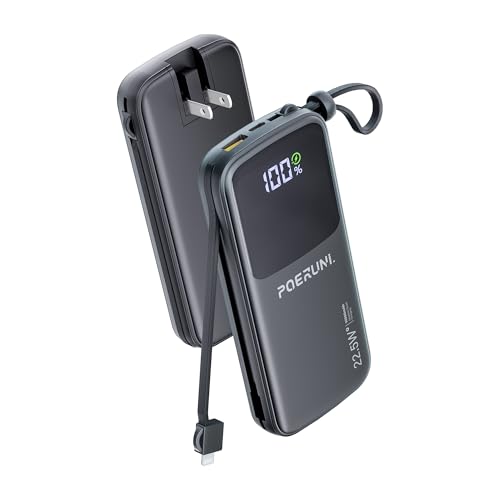
4. POERUNI 10,000mAh portable charger with two cables, wall plug, and LED display
The POERUNI model is the smallest in this guide by stated capacity, at 10,000mAh, and it is also the most self-contained. Its title states two built-in cables, an AC wall plug, an LED display, and USB-C fast charging, with listed compatibility for iPhone, Samsung, and Android smartphones. Where the larger banks ask you to assemble a kit around them, this product is presented as the kit in itself: charger, cables, and a way to plug into the wall, gathered into one item.
That design answers a common failure mode in everyday charging, which is not a lack of capacity but a missing cable. A standard power bank left in a bag without its cable is only potential. Built-in cables remove that step, so the charger you remembered to bring is also the charger you can actually use. The wall plug works in the same spirit on the refill side. Instead of finding a separate adapter and cable to recharge the bank, the plug is part of the product as listed, which simplifies the routine at home, in a hotel, or at an office.
The LED display completes the daily-carry picture. For a compact pack used in short, frequent bursts, a clear readout helps you decide whether the pack needs a quick refill before a commute or can wait until the evening. Because a 10,000mAh pack is generally used for phone top-ups rather than multi-day reserves, its level changes noticeably with each use, and a display makes those changes visible rather than something to estimate. This model will not replace a large bank for a group trip, and it does not claim to. Its stated strengths are convenience, integration, and readiness, and for a solo phone user those strengths can matter more than raw capacity.
5. DAOLOT power bank 50,000mAh 22.5W with LED display, four outputs, and three inputs
The DAOLOT model returns to the large-capacity class: 50,000mAh, 22.5W, USB-C fast charging, four outputs and three inputs, and an LED display. Its title describes it as a large-capacity external battery pack and lists travel essentials among its framing, with compatibility for recent iPhone generations including the iPhone 17 and iPhone 18 as written, Samsung, and more. The distinguishing figures here are the input and output counts taken together. Four outputs speak to sharing, while three inputs speak to flexibility when the bank itself needs refilling.
Three inputs are worth pausing on, because inputs are easy to overlook next to the more glamorous output figures. A power bank spends part of its life being charged, and a large 50,000mAh bank spends longer in that state than a small one. Having multiple stated ways to connect it for refilling means the refill can happen with whichever suitable cable is at hand in a given place, rather than depending on one specific cable being in the right bag or room. For a travel-oriented product, where cables get borrowed, packed, and misplaced, that flexibility is practical rather than decorative.
The LED display, as stated in the title, gives this large pack its monitoring method. With four outputs potentially serving several devices, a visible level helps the owner keep track of a shared resource and plan the next refill before the pack is empty. Positioned as travel essentials in its listing, this model suits a suitcase, a family travel kit, or a shared bag where several phones depend on one reserve and where the reserve needs to be easy to refill in different places.
best 3 0 qualcomm quick chargers
6. Portable charger power bank 50,000mAh 22.5W with digital display, three outputs, and two inputs
The final product is another 50,000mAh, 22.5W fast-charging model, this one with a USB-C battery bank description, a digital display, three outputs and two inputs, and a stated colour of black. Its listed compatibility covers a wide run of iPhone generations, from the iPhone 12 through the iPhone 17 as written in the title, plus Samsung and others. Compared with the other 50,000mAh models, its profile is balanced: a slightly lower output count than the four-output models, a digital rather than LED display, and two inputs for refilling.
That balance may be exactly what some buyers want. Three outputs still allow a phone, a second phone or tablet, and an accessory to connect together, which covers many real charging moments without aiming at the largest possible group. Two inputs still offer a choice for refilling. The digital display provides the numeric-style readability discussed earlier, which pairs well with a large capacity because it turns a big reserve into a level you can plan around day by day.
This model also illustrates why reading all three 50,000mAh listings side by side is worthwhile. On capacity and headline wattage they look similar, and a rushed comparison might treat them as interchangeable. Their titles tell a more detailed story: one emphasises four-port simultaneous charging with USB-C and USB-A, one pairs four outputs with three inputs and an LED display, and this one pairs three outputs with two inputs and a digital display. Those are real differences in how each bank would be used and monitored, and they are visible entirely from published information.
Comparison table
The table below gathers only the figures and features stated in each product title, so it can be read alongside the sections above as a quick reference. A dash in a cell means the title does not state that item; it does not mean the product lacks it in every possible sense, only that this guide does not claim it from the title.
| Product | Capacity | Stated output | Display | Outputs / inputs | Notable stated feature |
|---|---|---|---|---|---|
| High-capacity battery bank, grey | 80,000mAh | PD 30W, 22.5W | LCD display | 5 outputs | iPhone, Samsung, iPad, MacBook; outdoors and camping |
| NOBIS portable charger | 20,000mAh | 65W | Digital display | 2 USB-C and 2 USB-A | Dual USB-C fast charging; laptop, phone, tablet |
| Portable charger, four-port model | 50,000mAh | 22.5W | Digital display | 4-port simultaneous | USB-C and USB-A; iPhone, Samsung, Android |
| POERUNI portable charger | 10,000mAh | USB-C fast charging | LED display | Two built-in cables | Built-in AC wall plug; iPhone, Samsung, Android |
| DAOLOT power bank | 50,000mAh | 22.5W | LED display | 4 outputs, 3 inputs | USB-C fast charging; travel essentials framing |
| Portable charger power bank, black | 50,000mAh | 22.5W | Digital display | 3 outputs, 2 inputs | USB-C battery bank; wide iPhone range, Samsung |
Travel notes: carrying large and small banks well
Travel is where display-equipped chargers earn their place most visibly, and also where capacity choices need the most care. As general guidance, airlines and carriers set their own rules for lithium batteries in baggage, and power banks are generally expected in hand luggage rather than checked baggage, with very large capacities sometimes subject to additional limits or approval. Because rules vary by carrier and can change, check the current policy of the airline you are flying with before packing a high-capacity bank, especially one in the 50,000mAh or 80,000mAh class. That check is a normal part of trip preparation, not a reason to avoid large banks for road travel, camping, or home backup, where different considerations apply.
For air travel and city trips, the smaller and mid-sized models in this guide fit the usual pattern of personal carry: the 10,000mAh POERUNI with its built-in cables and wall plug for a light, self-contained kit, or the 20,000mAh NOBIS when a laptop travels too and higher output matters. For road trips, group travel by car, and stays where several people share accommodation, the 50,000mAh models become more practical, because the constraint shifts from baggage rules to how many devices need charging each night. The 80,000mAh model, with outdoors and camping stated in its own title, is framed for the kind of trip where the vehicle or the campsite, not an airport, is the base.
Whatever the size, a simple travel habit makes the display more useful: check the readout when you pack, not when you arrive. A glance at the level the night before a journey tells you whether the bank needs refilling while an outlet is still easy to find. During the trip, a glance each morning turns charging into a small routine decision, topping up a phone fully, sharing the bank at breakfast, or reserving the remaining level for the journey home. Those small, informed decisions are the practical dividend of a display, repeated daily.
Frequently asked questions
Is a display better than simple indicator lights?
For most people who use a power bank regularly, a display gives more usable information. Indicator lights divide the battery into a few broad steps, so each step covers a wide range of remaining charge. A display, whether LCD, digital, or LED as stated in these listings, is presented as a readout of remaining charge that can be checked at a glance and acted on more precisely. The difference grows with capacity. On a small pack, a rough indication may be enough because the whole reserve is modest. On a 50,000mAh or 80,000mAh bank, a broad step can represent enough energy for several phone charges, so knowing the level more clearly helps you plan sharing, reserving, and refilling.
Which capacity should I choose for everyday use?
Start with the devices you carry and the longest gap you expect between wall outlets. A single phone through a normal day points toward the 10,000mAh class, represented here by the POERUNI model with built-in cables and a wall plug. A phone plus a tablet, a longer day, or laptop support points toward 20,000mAh, where the NOBIS model pairs that capacity with a stated 65W output. Several devices, several days, or a shared household and travel reserve points toward 50,000mAh and above. Choosing a larger class than you need is not automatically better, because capacity generally brings size with it. The best everyday choice is the smallest class that comfortably covers your longest typical day, with the display helping you see how close to that limit you actually run.
Does a higher wattage figure always mean faster charging for my phone?
Not always. A stated figure such as 22.5W or 65W describes what the charger offers under suitable conditions. The phone itself must support the relevant fast-charging standard, the cable must be suitable, and the port used must be the appropriate one. A device with a lower maximum input will charge at its own pace even when connected to a higher-output bank. Higher wattage is most meaningful when your most demanding device can use it, which in this guide is the laptop scenario addressed by the 65W NOBIS listing and, at a stated PD 30W level, the large 80,000mAh listing. For phone-only use, a 22.5W fast-charging model already sits in the fast-charging class as its listings describe it.
Can one of these banks charge several devices at the same time?
Several models here are explicitly framed for that job. The 80,000mAh model states five outputs, one 50,000mAh model states four-port simultaneous charging, the DAOLOT model states four outputs, another 50,000mAh model states three outputs, and the NOBIS layout includes two USB-C and two USB-A connections. When several devices charge together, the available capability is generally shared, so simultaneous charging is best understood as parallel convenience: everything progresses together, rather than each device receiving the full single-device performance. For overnight or end-of-day charging, that trade is usually welcome, because time is plentiful and access is the real need.
What is the advantage of built-in cables and a wall plug?
The advantage is self-containment. The POERUNI listing states two built-in cables and an AC wall plug, which means the connectors for charging devices and the plug for refilling the bank travel as part of the product. That reduces forgotten cables, tidies a bag, and makes the charger easy to hand to someone else without a bundle of accessories. The consideration on the other side is flexibility, since you work with the built-in connectors as provided. Buyers who charge the same phones every day often value the simplicity most, while buyers with a wide and changing mix of devices may prefer open ports and their own cables.
How should I choose between the three 50,000mAh models?
Compare their stated details rather than their shared headline figures. One model emphasises four-port simultaneous charging with USB-C and USB-A and a digital display. The DAOLOT model pairs four outputs with three inputs and an LED display, with a travel essentials framing that suits varied refilling situations. The third pairs three outputs with two inputs and a digital display, in black, with a wide stated iPhone range. Ask which pattern matches your life: the largest number of devices at once, the most stated ways to refill the bank, or a balanced three-output layout with a digital readout. All three share the same stated capacity and wattage class, so these secondary details, which are fully visible in the published titles, are the honest basis for choosing.
Check prices on Amazon
Live listings for the shortlist in this guide are pulled from Amazon below, so prices and availability are always current at the moment you look.

Closing: choose the readout, then the reserve
The six products in this guide share one deliberate feature and differ in almost everything else. One is an 80,000mAh high-capacity bank with an LCD display, five outputs, and an outdoors and camping framing. One is a 20,000mAh, 65W NOBIS charger with a digital display, built around laptop, phone, and tablet use on the go. Three divide the 50,000mAh class between four-port simultaneous charging, a four-output and three-input travel design with an LED display, and a balanced three-output and two-input design with a digital display. One is a compact 10,000mAh charger whose two built-in cables, wall plug, and LED display make it the self-contained option for a single phone user.
A useful way to decide is to work in two steps. First, settle the role: daily phone buffer, laptop travel companion, shared family reserve, or high-capacity base for time outdoors. That step fixes the capacity class and the output level you need, and it prevents both under-buying, which leaves you short on the longest days, and over-buying, which leaves you carrying size you never use. Second, within that role, confirm the details that shape daily life with the product: how many outputs you will really use at once, how the bank itself will be refilled, whether built-in cables simplify your bag, and how its stated display presents the level you will check every day.
That second step is where this category has quietly improved. A charger that tells you clearly what it holds is easier to trust, easier to share, and easier to keep ready. The readout turns a power bank from a mysterious box that might help into a known reserve that you can plan around, whether that reserve is a small daily buffer or a large bank standing by for a group. Choose the display-equipped model whose published specifications match your devices and your routine, keep it charged with the same glance-and-refill habit its display encourages, and the low-battery moment that started this guide becomes a much rarer event.


